

The Data-First Cold Email Campaign Strategy for 2026
You send 500 emails on Monday. By Wednesday, 47 have bounced, 12 triggered spam complaints, and your primary domain's reputation is in freefall. The sequences you spent a week writing never reached an inbox.
Every cold email campaign strategy guide starts with subject lines and copywriting tricks. The real problem - the one that kills campaigns before they start - is data quality.

Why Most Cold Email Campaigns Fail
Cold email campaigns collapse in a predictable chain: bad data causes bounces, bounces tank your domain reputation, and a damaged domain routes everything - even perfectly written emails - straight to spam. Most teams diagnose a "messaging problem" when they actually have a data problem. We've watched teams rewrite subject lines four times when their bounce rate was sitting at 15%.
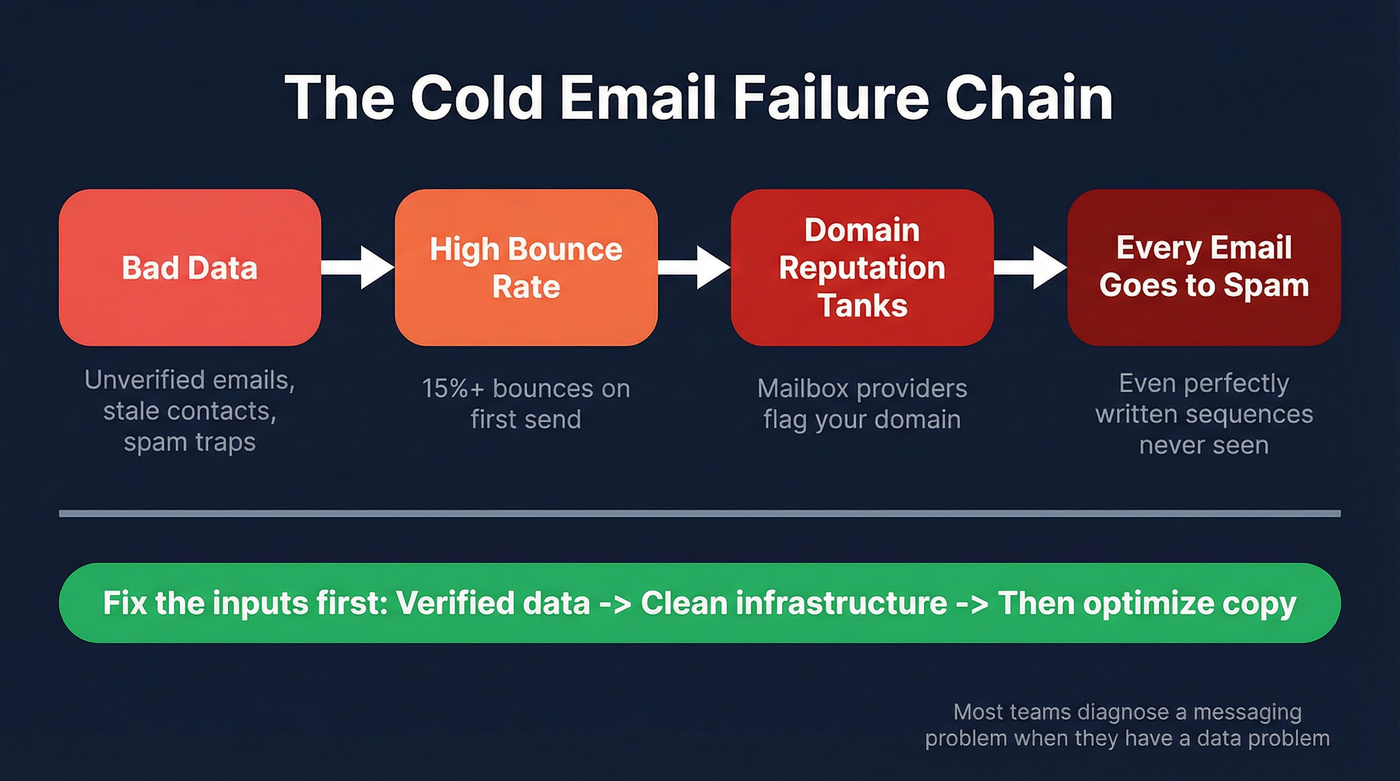
The second failure mode is skipping infrastructure. Missing SPF/DKIM/DMARC, no warm-up, no monitoring. You're sending from a domain that mailbox providers don't trust yet.
The third is generic copy sent to the wrong people. But here's the thing: if you fix the first two, mediocre copy still outperforms brilliant copy sent to bad addresses from a cold domain.
What Actually Matters
Verified data is the prerequisite. Keep bounce rates under 3% or nothing else matters. Infrastructure comes next - warm up domains, authenticate DNS, monitor reputation. And measure meetings booked, not open rates. Open tracking has been unreliable since AI-era inbox changes started filtering pixel loads. The only metric that ties to revenue is meetings created.
The stack is simple: Prospeo for verified contact data, Instantly or Smartlead for sending, and Gmail Postmaster Tools for monitoring. Three tools. That's it.
2026 Cold Email Benchmarks
The 2026 benchmark report from Instantly aggregated platform-wide sending data, and the results are sobering - but encouraging if you're willing to do the work.
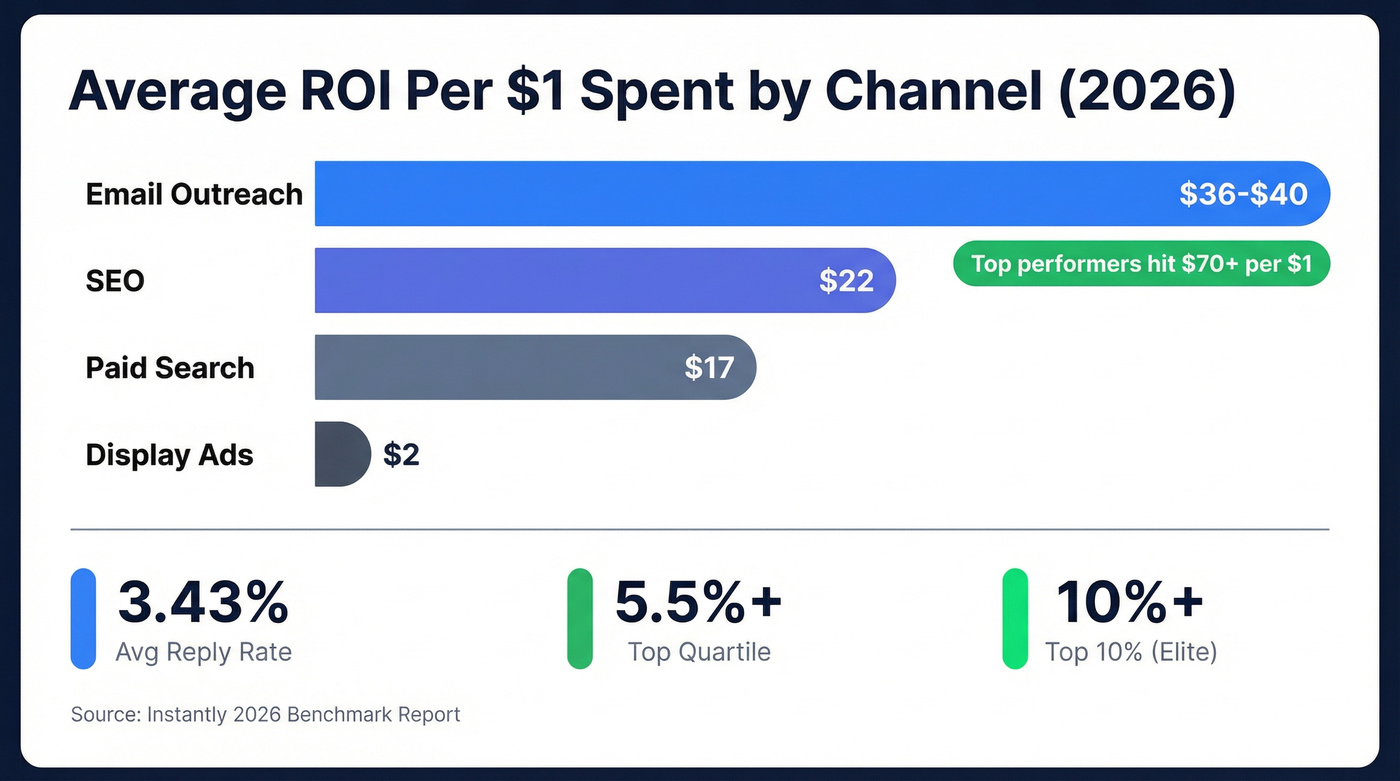
| Metric | Average | Top Quartile | Top 10% |
|---|---|---|---|
| Reply rate | 3.43% | 5.5%+ | 10%+ |
| First email replies | 58% of total | - | - |
| Follow-up replies | 42% of total | - | - |
| Peak reply day | Wednesday | - | - |
| Optimal email length | Under 80 words | - | - |
The gap between average and elite is enormous. A 3x difference in reply rate comes down to data quality, targeting precision, and sequence design. Not subject line hacks.
For the business case: email outreach returns $36-$40 per $1 spent on average, with top performers hitting $70+ per $1.
| Channel | Avg ROI per $1 |
|---|---|
| Email outreach | $36-$40 |
| SEO | ~$22 |
| Paid search | ~$17 |
| Display ads | ~$2 |
Cold email is still the highest-ROI outbound channel - when it works.
Most teams don't have a cold email problem. They have a data hygiene problem masquerading as a cold email problem. Fix the inputs and the outputs fix themselves.

You just read the numbers: bounce rates above 3% destroy domain reputation before your sequences ever get a chance. Prospeo's 5-step verification, catch-all handling, and spam-trap removal keep you under that threshold from day one. 300M+ profiles, 30+ filters including buyer intent and tech stack, and a 7-day data refresh cycle so you're never emailing stale contacts.
Fix the inputs. The outputs fix themselves.
Your Outreach Strategy Playbook
Here's the six-step framework that works across teams running 100 to 10,000 emails per day. Each step builds on the previous one - skip a step and the whole thing wobbles.
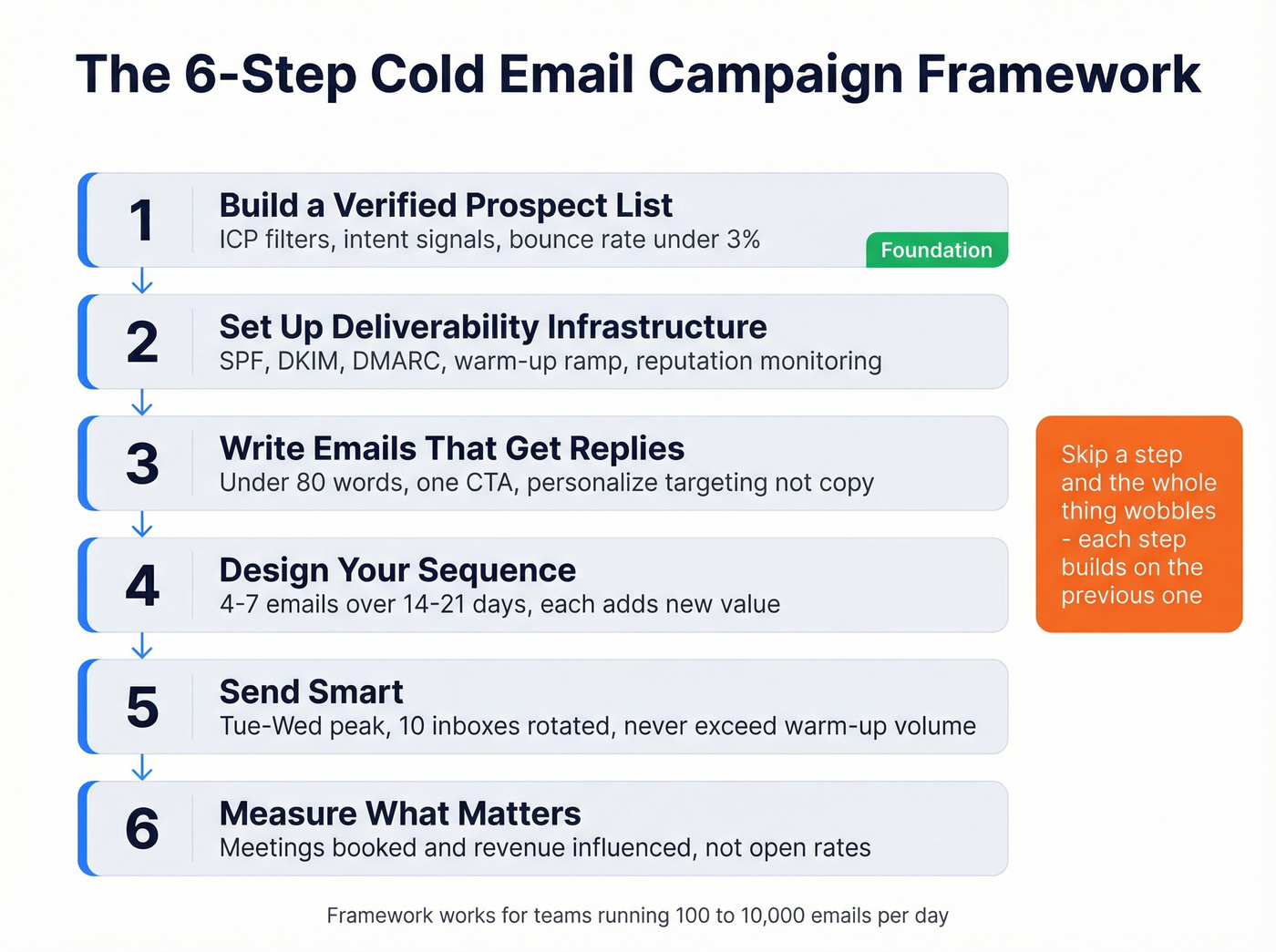
1. Build a Verified Prospect List
Start with your ICP definition. Not a vague "VP of Sales at mid-market SaaS" - a specific set of firmographic and behavioral filters: company size, tech stack, funding stage, hiring signals, buyer intent topics. The tighter your targeting, the higher your reply rate. This is where research separates top performers from everyone else, and it's where the 3x gap between average and elite actually lives, not in the cleverness of your copy.
You want bounce rates under 3% from day one, which means verification happens at the sourcing stage, not after. Prospeo's 5-step verification process catches spam traps, catch-all domains, and honeypots before they ever hit your sending queue. The 30+ search filters let you build lists pre-qualified by intent signals, tech stack, and growth indicators - so you're finding the right people, not just real email addresses.

Meritt went from a 35% bounce rate to under 4% after switching their data source - and their pipeline tripled from $100K to $300K per week. Stack Optimize built from $0 to $1M ARR with client deliverability above 94%, bounce rates under 3%, and zero domain flags across all clients.
Skip this if you're scraping contacts from random sources and planning to "verify later." By the time you discover 15% of your list is invalid, the damage to your sending domain is already done. Verification isn't a cleanup step. It's a sourcing requirement. (If you need a shortlist, start with these email validators.)
2. Set Up Deliverability Infrastructure
Think of domain reputation like a credit score: weeks to build, one bad send to destroy.
DNS Authentication:
- Publish one SPF record (multiple records break validation)
- DKIM with 2048-bit keys
- DMARC starting at p=none with rua reporting - step to quarantine, then reject once alignment is clean
- Make sure your visible "From" domain aligns with DKIM d= and SPF domain
Warm-Up Ramp (per mailbox):
| Week | Daily Volume | Condition |
|---|---|---|
| Week 1 | 30-50 | All metrics green |
| Week 2 | 50-80 | Bounce <3% |
| Week 3 | 80-120 | Complaints <0.1% |
| Week 4 | 120-150 | Sustained health |
If bounce rate exceeds 3% or spam complaints cross 0.1%, pause for 48-72 hours. No exceptions. Include one-click unsubscribe headers - both List-Unsubscribe and List-Unsubscribe-Post - because this is a bulk-sender requirement and a trust signal to mailbox providers.
Some guides recommend against automated warm-up tools entirely. In our experience, they work fine as long as you monitor metrics and don't treat warm-up as set-and-forget. (If you're evaluating options, see automated email warmup.)
Monitor with Gmail Postmaster Tools (free) and Microsoft SNDS if you're on dedicated IPs. These are your early warning systems. If you want the full setup, follow an email deliverability checklist.
3. Write Emails That Get Replies
Personalize your targeting, not your copy. A well-targeted email with a relevant value proposition to the right person beats a poorly-targeted email with a custom first line every time. We've seen teams spend hours researching individual prospects for custom openers, only to send those emails to people who'd never buy.
Keep first-touch emails under 80 words. Follow-ups can stretch to 120. Subject lines should run 10 words or less - personalized, curiosity-driven, no clickbait.
Your "From" name matters more than most people realize: a real first name consistently outperforms "Sales Team at [Company]." One CTA per email, and make it low-friction. "Worth a 15-minute call?" beats "Schedule a demo on our platform." Write conversationally - if you wouldn't say it across a table, don't put it in an email. For examples you can adapt, use these outreach email templates.
Use AI as a research engine, not a writing engine. Build a trigger library of funding rounds, leadership changes, product launches, and earnings calls, then create modular copy blocks that swap openers, proof points, and CTAs based on the trigger. Cluster accounts by intent signals and match messaging to buying stage. (More on this in AI for B2B outreach.)
4. Design Your Sequence
The benchmark data is clear: 58% of replies come from the first email, but 42% come from follow-ups. You need both. The sweet spot is 4-7 emails over 14-21 days.
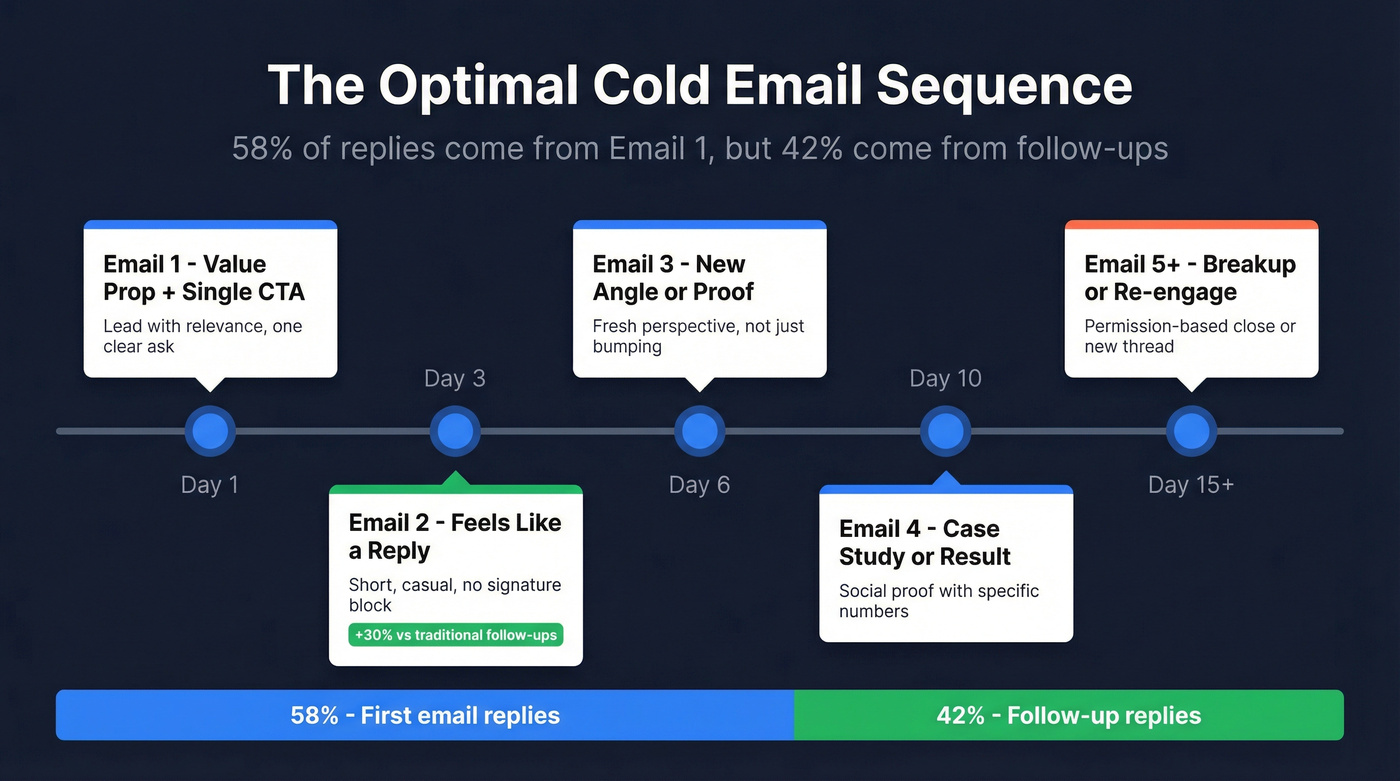
| Touch | Day | Purpose |
|---|---|---|
| Email 1 | Day 1 | Value prop + single CTA |
| Email 2 | Day 3 | "Feels like a reply" |
| Email 3 | Day 6 | New angle or proof |
| Email 4 | Day 10 | Case study or result |
| Email 5+ | Day 15+ | Breakup or re-engage |
One tactic that consistently outperforms: make Step 2 feel like a reply, not a formal follow-up. Short, casual, no signature block. Something like "Hey - did this land?" This approach outperforms traditional follow-ups by roughly 30%.
Each follow-up must add a new perspective or piece of value. If you're just bumping the thread with "circling back," you're training prospects to ignore you. A/B test your messaging weekly - small copy changes compound over time. (If you want a deeper playbook, see cold email tactics.)
For teams ready to go beyond email-only, adding a second channel like phone or social touches can push reply rates from ~3% to 11%+. Multichannel isn't required to start, but it's the clearest path to top-decile performance.
5. Send Smart
Timing and volume discipline matter more than most teams realize.
Peak days: Tuesday and Wednesday show the highest reply rates. Best windows: 9:30-11:00 AM and 1:30-3:00 PM in the prospect's timezone. Rotate across 10 inboxes at 10 emails/day each for 100 emails/day capacity without exceeding safe early volumes. (For a deeper breakdown, use this best time to send prospecting emails guide.)
Never exceed your warm-up volume. If an inbox is warmed to 50/day, don't send 80 because you have a deadline. Throttle sends across the day rather than blasting 50 emails at 9:00 AM sharp.
Scaled teams run 1,000+ emails per day by splitting volume across multiple lookalike domains, each with its own warm-up and reputation. When you're growing past a few hundred sends daily, this is the architecture to plan for. (See how to scale outbound campaigns.)
6. Measure What Matters
Track these: Meetings created. Revenue influenced. Conversations started, defined as a reply that isn't "unsubscribe me." Cost per meeting - expect $50-$300 depending on your list cost, tools, and SDR time. Reply rate as a leading indicator.
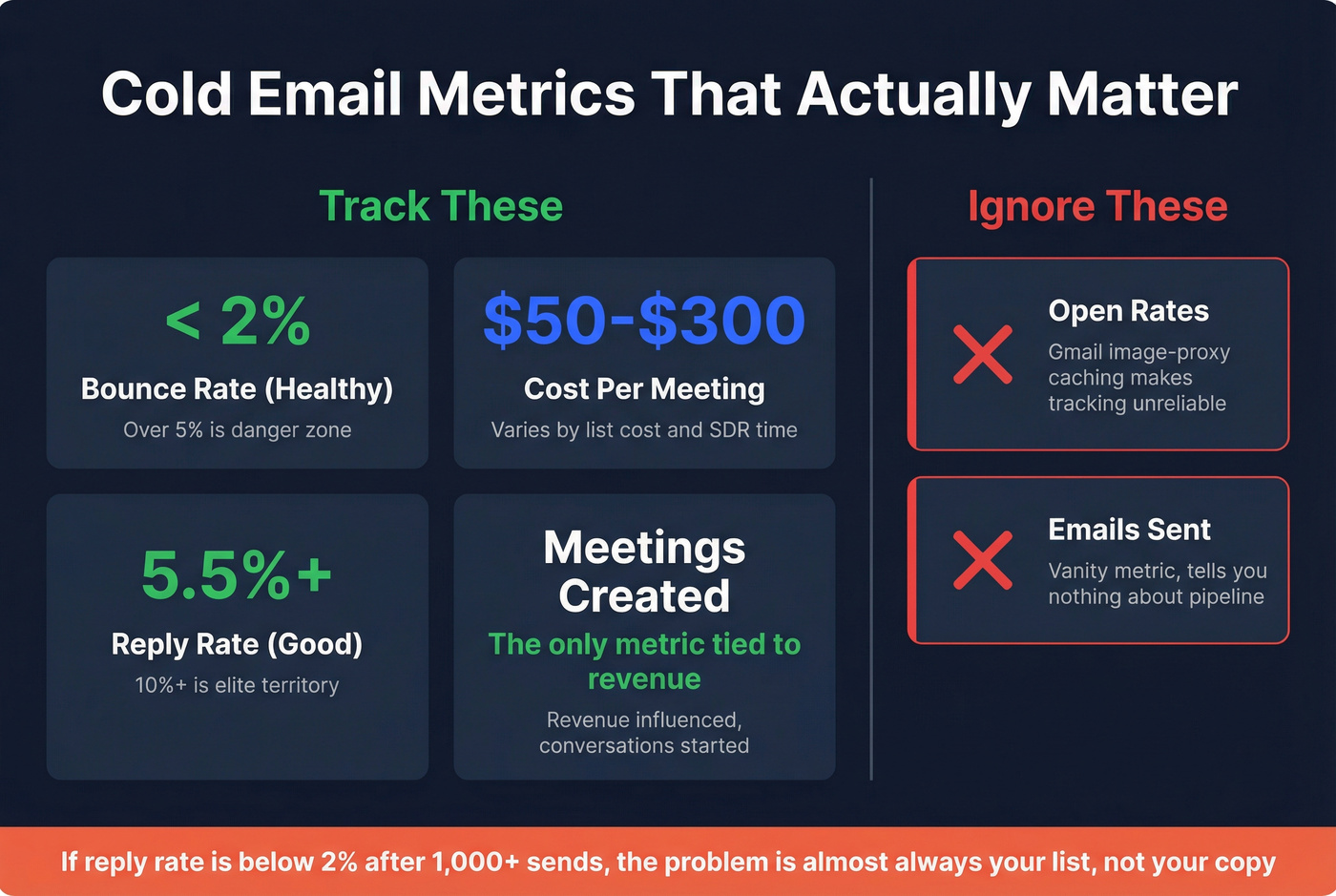
Ignore these: Open rates. Gmail's image-proxy caching makes open tracking unreliable. Vanity metrics like "emails sent" tell you nothing about pipeline.
Healthy benchmarks:
- Bounce rate: under 2% is healthy, over 5% is danger territory
- Reply rate: 3.43% is average, 5.5%+ is good, 10%+ is elite
- The gap between 3.43% and 10%+ isn't luck - it's data quality and targeting precision
Let's be honest: if your reply rate is below 2% after 1,000+ sends, the problem is almost always your list, not your copy. Fix the data first.
Meritt tripled their pipeline to $300K/week. Stack Optimize hit $1M ARR with zero domain flags. The difference wasn't better copy - it was verified data at the source. Prospeo gives you 98% email accuracy, intent signals across 15,000 topics, and lists pre-qualified by growth indicators - all at $0.01 per email.
Stop rewriting subject lines. Start fixing your list.
Legal Compliance Checklist
Compliance isn't just a legal box to check - it's a competitive advantage. Teams that build compliant processes from day one never have to pause campaigns for legal review.
CAN-SPAM (US): Honest subject lines, physical mailing address in every email, opt-outs processed within 10 business days. Penalty: up to $50,120 per email.
GDPR (EU/UK): Explicit consent or a legitimate interest assessment for B2B outreach. Transparency about data source and use. Honor data subject rights. Penalty: up to EUR 20M or 4% of global revenue.
CCPA (California): Right to access, delete, and correct personal data. Opt-out of sale/sharing. Privacy policy required. Penalty: $7,500 per violation.
Every email you send that follows these rules is one your competitors might not. Clean operations build trust before prospects ever reply.
Cold Email Tools Worth Using
You need three things: a data source, a sender, and a monitoring dashboard. Not ten tools. Not a sprawling stack that takes three months to integrate. (If you're comparing platforms, start with cold email marketing tools.)
| Tool | Category | Best For | G2 Rating | Starting Price |
|---|---|---|---|---|
| Prospeo | Data & Verification | Email accuracy + intent filtering | - | Free / ~$0.01/email |
| Instantly | Sending | Solo senders + small teams | 4.9/5 | $30/mo |
| Smartlead | Sending | Agency-scale campaigns | 4.6/5 | $39/mo |
| Saleshandy | Sending | Budget-conscious teams | 4.5/5 | $25/mo |
| Lemlist | Sending + Multichannel | Email + multichannel sequences | 4.4/5 | $55/mo |
| Woodpecker | Sending | Mid-market B2B | 4.5/5 | $49/mo |
| Reply.io | Sending + Multichannel | Full-cycle automation | 4.6/5 | $60/mo |
| Gmail Postmaster | Monitoring | Domain reputation tracking | - | Free |
| Microsoft SNDS | Monitoring | Dedicated IP monitoring | - | Free |
Pick one from each category and master it. We've seen teams waste months evaluating eight sending platforms when the real bottleneck was their contact data the entire time.
FAQ
What is a cold email campaign strategy?
It's your end-to-end plan for reaching prospects who haven't interacted with your brand - covering data sourcing, deliverability infrastructure, messaging, sequence design, and measurement. The best strategies prioritize verified data and domain health over copywriting tricks, because a 15% bounce rate kills campaigns before copy ever matters.
How many cold emails should I send per day?
Start with 30-50 per inbox per day in week one, ramping to 120-150 by week four if bounce stays under 3%. Use multiple inboxes to scale total volume - 10 inboxes at 10 emails each gives you 100 sends daily without stressing any single mailbox early on.
What's a good reply rate in 2026?
The average cold email reply rate is 3.43%, top quartile hits 5.5%+, and the top 10% exceed 10%. The gap comes almost entirely from data quality and targeting precision - not subject line tricks.
Is cold email legal?
Yes, when you comply with CAN-SPAM, GDPR, and CCPA. Include opt-out links, use honest subject lines, and add a physical address. Penalties are steep - up to $50,120 per email under CAN-SPAM and EUR 20M under GDPR.
How do I stop cold emails going to spam?
Authenticate your domain with SPF, DKIM, and DMARC. Warm up new inboxes over 3-4 weeks following a gradual ramp. Keep bounce rates under 3% and spam complaints under 0.1%. Verify your entire list before sending - one bad batch can tank months of reputation building.