

How to Scale Outbound Campaigns Without Destroying Your Domain Reputation
A RevOps lead we work with ran the classic play last quarter: CEO wanted 3x pipeline, so the SDR manager tripled email volume overnight. Within two weeks, deliverability fell off a cliff, reply rates cratered, and it took weeks of warmup and cleanup to recover. The pipeline didn't triple - it went to zero.
Here's the thing most scaling guides won't tell you: when you scale outbound campaigns, it's a data and infrastructure problem first, an automation problem second. Get the foundation wrong and more volume just means more damage, faster.
Three Prerequisites Before Sending a Single Email
Fix these before you touch send volume:
- Verify your prospect data. Bounce rates above 5% will torch your domains. This isn't optional - it's the prerequisite for everything else. (If you need a shortlist, start with these email ID validators.)
- Set up sending infrastructure. Authentication, warmup, domain rotation. Skip this and you're building on sand. Use a proper email sending infrastructure checklist.
- Build a multichannel cadence. Email-only outbound rarely cuts it at scale. Phone, social, and email working together is how scaled outbound actually converts in 2026.
What Breaks When You Scale Outreach
Four failure modes kill campaigns before they produce a single meeting.
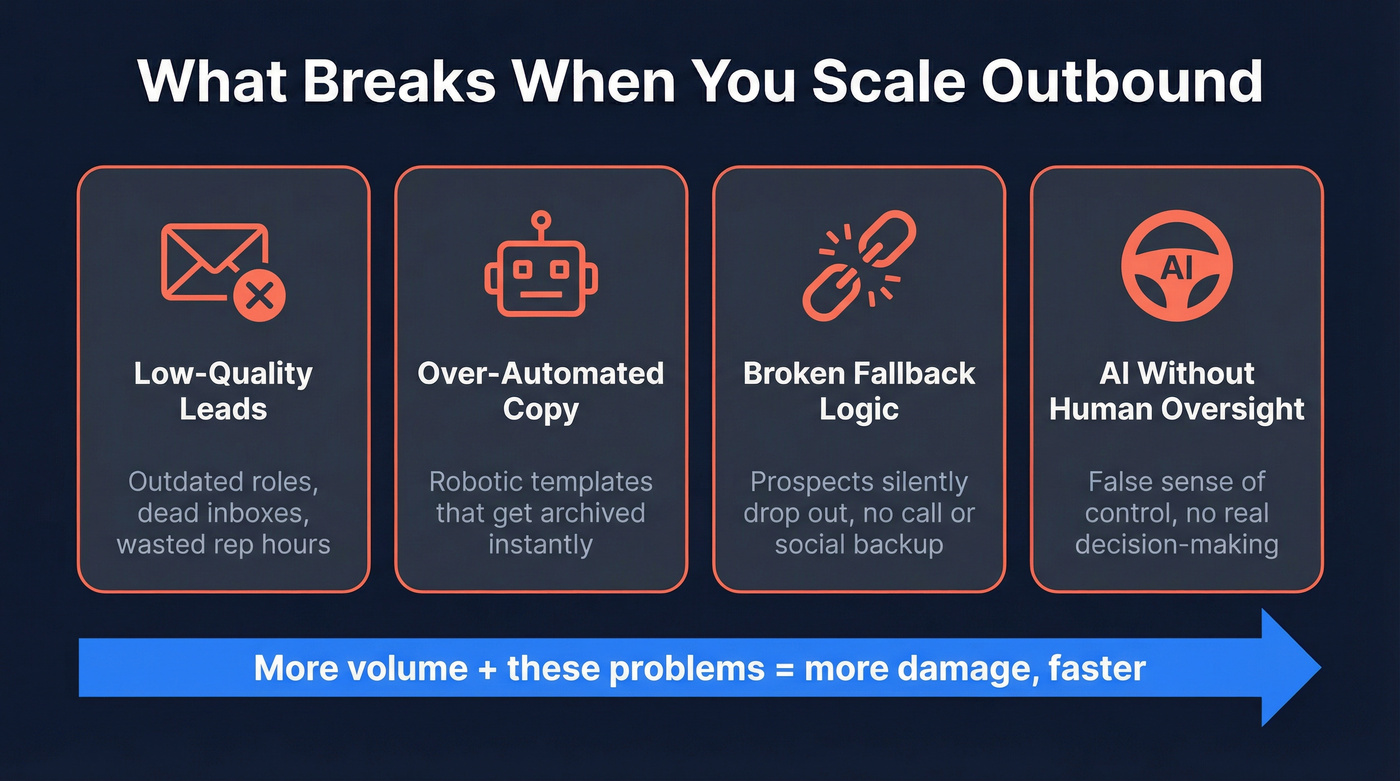
Low-quality leads flooding your CRM. You import a big list from a cheap data provider, and a chunk of it is outdated roles, wrong companies, or dead inboxes. Your reps waste hours chasing ghosts, and pipeline reporting becomes meaningless. The fix: verify and QA every list before it touches your sequencer. (This gets easier when you understand B2B contact data decay.)
Over-automated copy. "Hi {{first_name}}, I noticed {{company}} is growing..." - every prospect gets 15 of these a day. Ask in any SDR community and you'll hear the same thing: robotic messaging is the fastest way to get archived. The fix: use message frameworks, not mail-merge templates. If your openers are stale, swap them for better alternatives for 2026.
Broken fallback logic. A prospect doesn't open email #2, so they silently drop out of your flow. No call attempt, no social touch, no re-engagement. Leads just vanish. The fix: build explicit fallback rules for every step in your sequence.
Letting AI drive decisions. 81% of sales teams are experimenting with AI, but teams that hand AI the steering wheel get a false sense of control. AI is great for research, first-draft copy, and reply classification. Humans own the decisions. (If you're building this into your process, use AI in sales cadences as the reference point.)
We've seen teams pay serious money for data that still produces double-digit bounce rates. That's not a data problem - it's a revenue problem wearing a data mask.
Fix Your Data First
Bad data creates a death spiral most teams don't recognize until it's too late: unverified emails bounce, ISPs flag your sending domain, deliverability drops, even your good emails land in spam, reply rates collapse, and reps lose confidence in the channel entirely. It compounds fast.
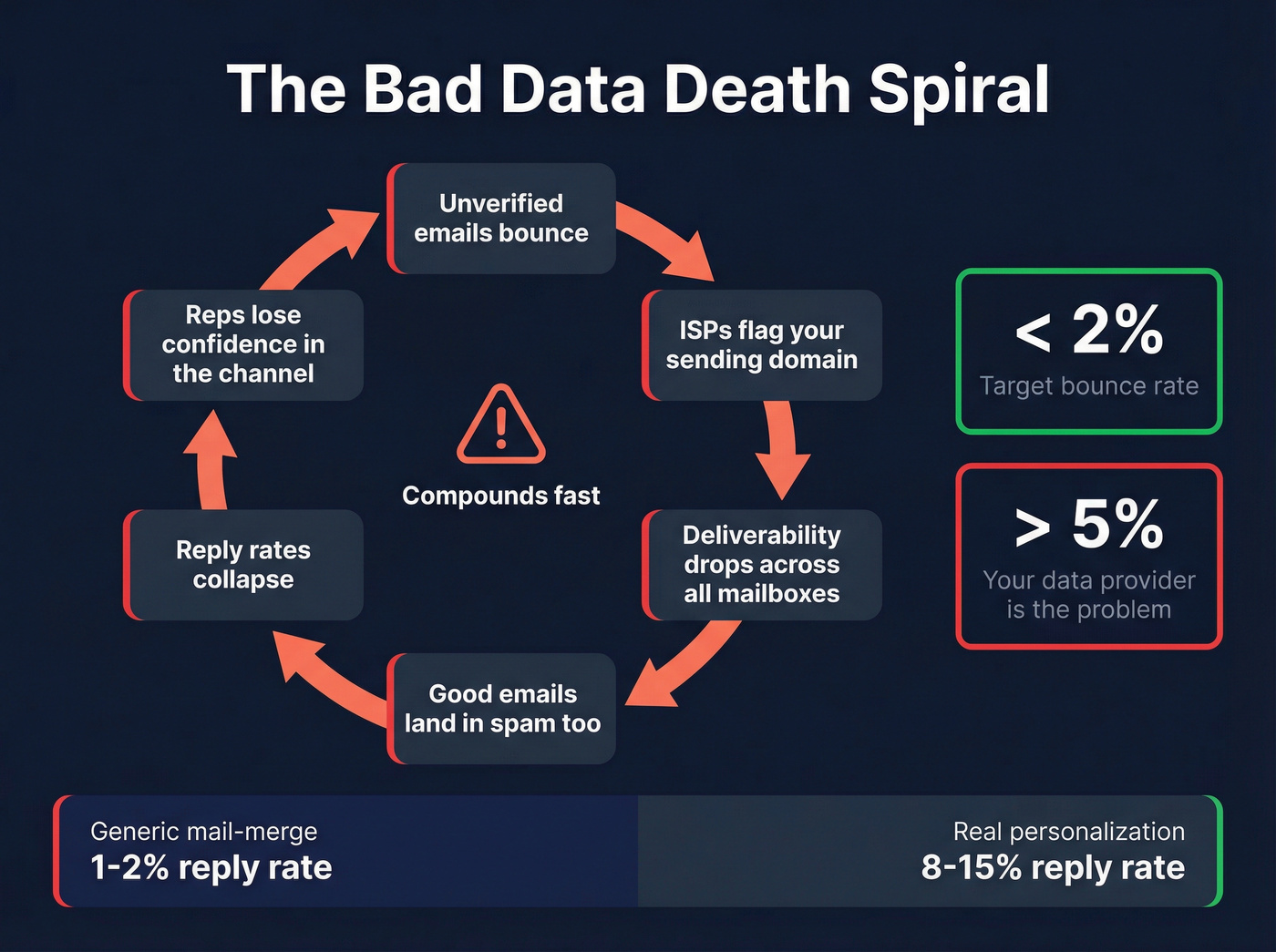
The threshold is clear: keep your bounce rate under 2%. Above 5%, your data provider is the problem, not your campaign. And the data quality issue compounds with personalization - generic mail-merge outreach pulls 1-2% reply rates, while real personalization drives 8-15%. But personalization built on wrong data is worse than no personalization at all. (If you want to formalize this, build a data quality scorecard.)
Look at what happened with Meritt, one of our customers: they were running a 35% bounce rate before switching their data layer. After cleaning up, bounces dropped under 4% and pipeline tripled from $100K to $300K per week. Another customer, Stack Optimize, built an entire agency to $1M ARR on the back of clean data - 94%+ deliverability, bounce under 3%, zero domain flags across all clients. Clean data isn't a nice-to-have. It's the non-negotiable foundation for anyone looking to grow outbound volume without wrecking their sender reputation.

Prospeo's 5-step verification process - including catch-all handling, spam-trap removal, and honeypot filtering - delivers 98% email accuracy across 143M+ verified addresses. Data refreshes every 7 days, compared to the 6-week industry average, so you're not sending to someone who changed jobs last month. Native integrations with Instantly, Smartlead, Lemlist, and Clay mean verified contacts flow directly into your sequencer without a manual export step. (For the mechanics, see email verification for outreach.)
Build Your Sending Infrastructure
Authentication isn't optional. SPF, DKIM, and DMARC must be configured on every sending domain before you send a single cold email. Add RFC 8058 one-click unsubscribe headers - Google and Yahoo enforce this for bulk senders, and Microsoft has similar requirements for Outlook.com. (If you need the full setup walkthrough, use this SPF DKIM DMARC setup for cold email.)
Warmup Timeline Per Mailbox
- Week 1: 5-10 emails/day, mixed with warmup tool engagement
- Week 2: 10-20 emails/day, monitoring inbox placement
- Weeks 3-4: 20-40/day, keep volume predictable
- Weeks 5-6: Scale to 40-50/day if seed tests show 80%+ inbox placement
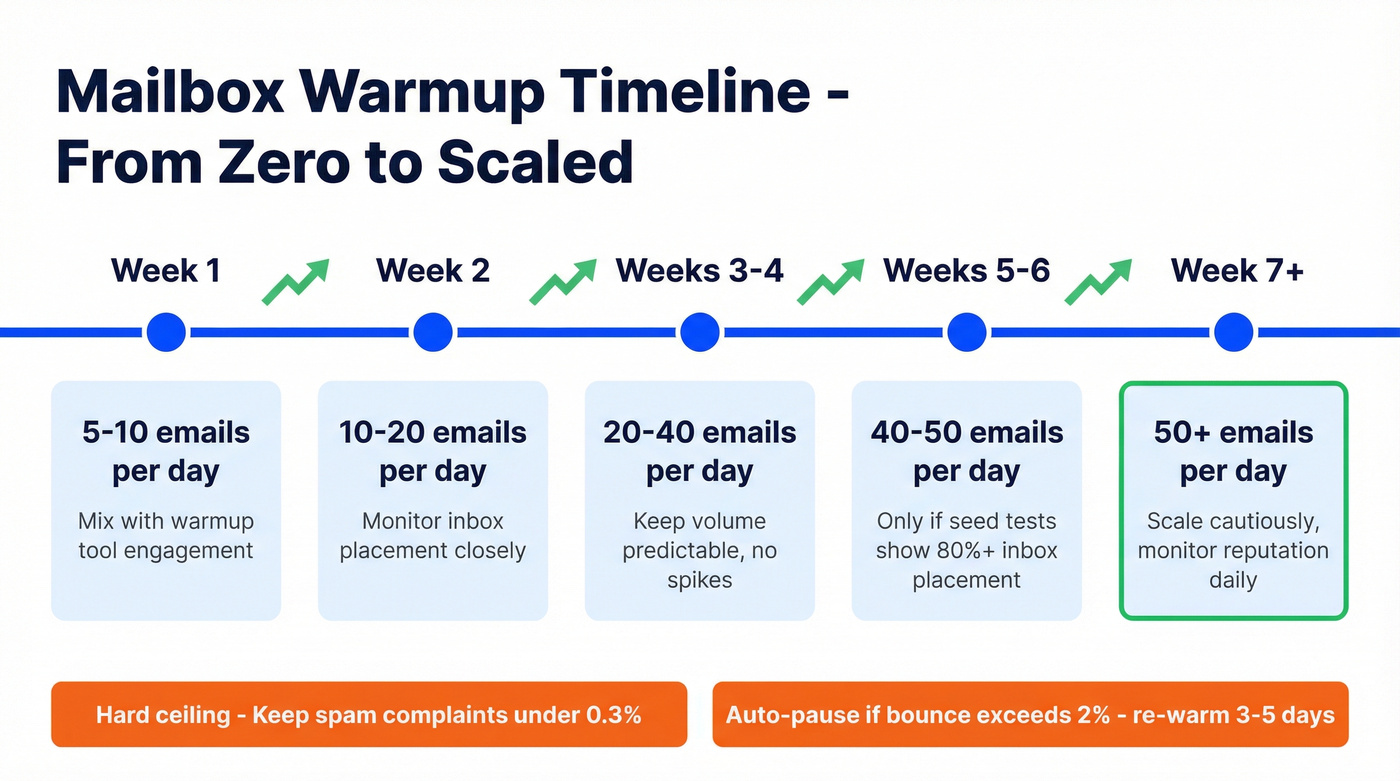
Keep spam complaints under 0.3% - that's the hard ceiling. Set auto-pause guardrails: if bounce exceeds 2% or spam rate approaches 0.3%, pause the mailbox immediately, fix the issue, and re-warm for 3-5 days. (For more, use an email deliverability checklist.)
Domain Rotation Math
If you need to send 500 emails/day and each mailbox caps at 50, you need 10 mailboxes spread across multiple rotated outbound domains. Don't run all volume through your primary domain - one flag and your entire company email reputation is compromised. Dedicated outbound domains are cheap insurance, running about $10-15/year each.

Meritt tripled pipeline from $100K to $300K/week after fixing their data layer. Stack Optimize built a $1M agency with zero domain flags. Both run on Prospeo's 98% accurate emails, refreshed every 7 days - not the 6-week industry average that leaves you emailing people who changed jobs last month.
Stop scaling on stale data. Start scaling on verified contacts.
A 14-Day Multichannel Cadence
Prospects typically need 8-12 touches before engaging. Here's a sequence that covers email, phone, and social without feeling like harassment.
| Day | Channel | Action |
|---|---|---|
| 1 | Initial outreach, under 100 words, one clear ask | |
| 2 | Social | Connection request (no pitch) |
| 4 | Follow-up with new value angle | |
| 5 | Phone | Call attempt; voicemail references emails |
| 7 | Social | Engage with their content |
| 9 | New angle, different hook | |
| 11 | Social | DM if connected |
| 14 | Breakup email |
A few channel-specific rules that matter: keep cold emails under 100 words with one clear ask. Don't pitch in connection requests - that's the fastest way to get ignored. For calls, the 8-9am and 4-5pm windows in the prospect's local time lift connect rates 40-70%. And the breakup email on Day 14? It often generates the highest reply rate of the entire sequence. Well-orchestrated multichannel sequences can hit 27%+ reply rates, which is a different universe from email-only blasts. (If you want more structure, start from a proven sales cadence example.)
Personalize Without Burning Out
Here's the math that kills most scaling efforts: real personalization takes 10-15 minutes per prospect. At 100 prospects per week, that's 16-25 hours of research and writing. For a small team, that's not sustainable.
The solution isn't to skip personalization - it's to build data-rich prospect profiles so hooks take 60-90 seconds instead of 10 minutes. Three elements make personalization effective: signal you did homework by referencing a specific trigger, demonstrate their likely situation to show you understand their world, and offer relevant value instead of a feature dump. (Use this personalization in outbound sales framework.)
This is where AI earns its keep. Teams using AI for signal identification and research automation are 1.3x more likely to see revenue growth, but the lift comes from accelerating the research step - not from letting AI write and send autonomously. Use AI to surface funding rounds, new hires, product launches, and job description language. Then write the message yourself, or at least rewrite AI's first draft until it sounds like a human who did their homework.
Build message frameworks, not templates. A framework says "open with a trigger event, bridge to their likely pain, offer one relevant insight." A template says "Hi {{first_name}}, congrats on {{trigger}}..." - and every prospect can smell it. Signal-personalized outreach pulls 15-25% reply rates versus 3-5% industry average. That's the difference between a pipeline machine and a spam cannon.
Benchmarks for Scaled Outbound in 2026
You can't manage what you don't measure. Here's what good looks like.
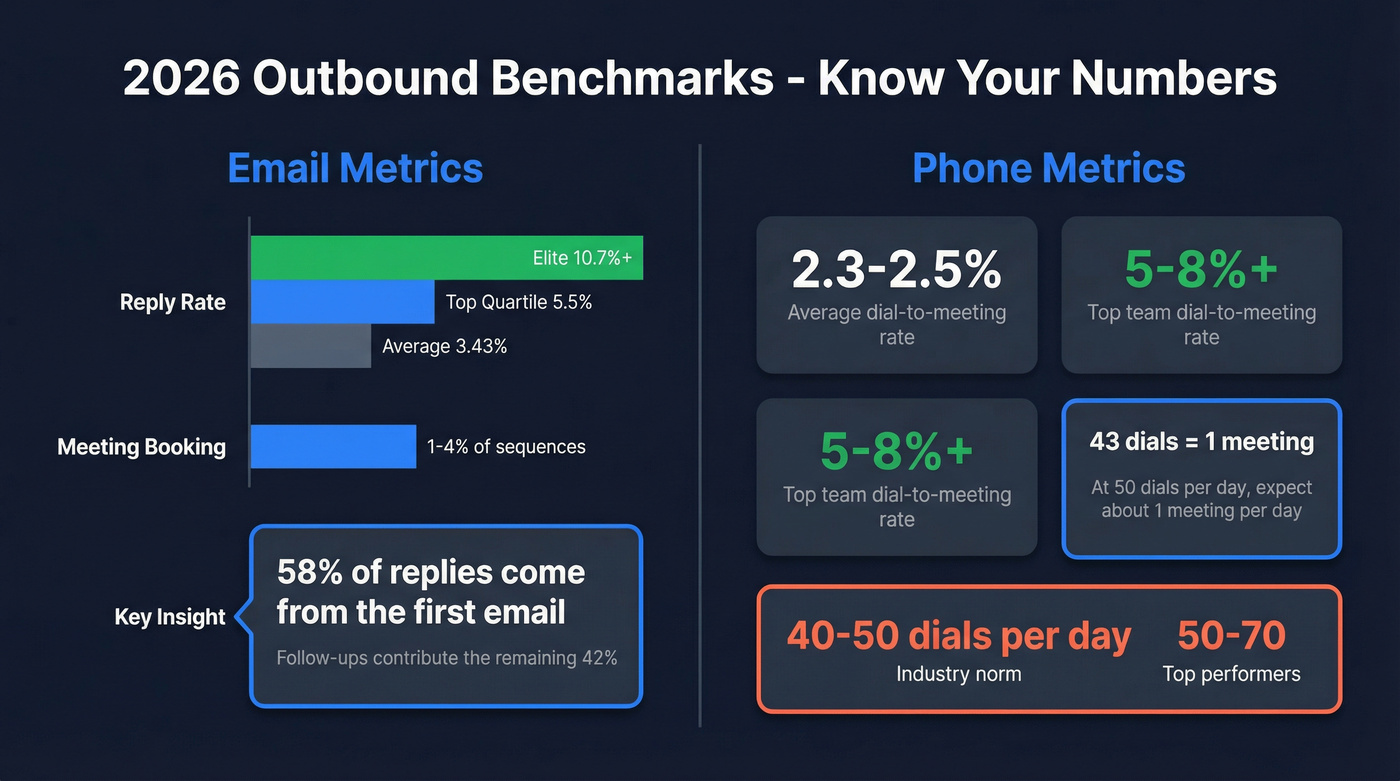
| Metric | Average | Top Quartile | Elite |
|---|---|---|---|
| Reply rate | 3.43% | 5.5% | 10.7%+ |
| Meeting booking | 1-4% of sequences | - | - |
| Reply to meeting | 15-30% | - | - |
| Meeting to opp | 25-40% | - | - |
| Meeting to closed | 3-8% | - | - |
58% of replies come from the first email. Follow-ups contribute the remaining 42%, but that first touch carries the most weight. Get it right.
Phone
| Metric | Average | Top Teams |
|---|---|---|
| Dial-to-meeting | 2.3-2.5% | 5-8%+ |
| Connect rate | 3-10% | - |
| Dials/day norm | 40-50 | 50-70 |
Use these numbers for planning: at 2.3% dial-to-meeting, you need roughly 43 dials to book one meeting. A rep doing 50 dials/day should book about one meeting per day - if the data's clean and the list is well-targeted.
What It Actually Costs
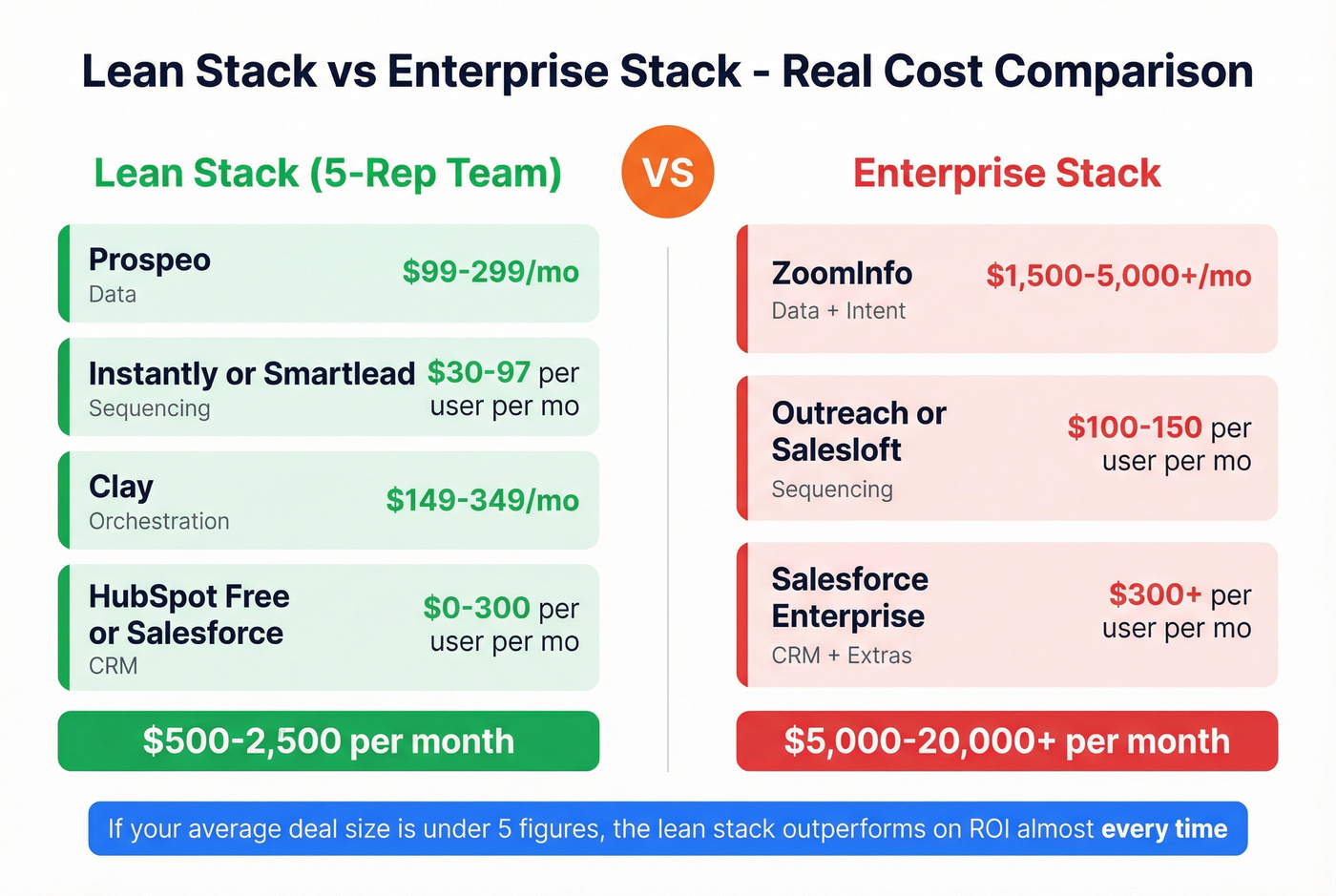
You don't need 12 tools. You need a data provider, a sequencer, a CRM, and maybe an orchestration layer. Here's a realistic stack budget for a 5-rep team.
| Layer | Tool | Monthly Cost |
|---|---|---|
| Data | Prospeo | ~$99-299/mo |
| Sequencing | Instantly or Smartlead | $30-97/user/mo |
| Orchestration | Clay | ~$149-349/mo |
| CRM | HubSpot Free or Salesforce | $0-300/user/mo |
| Total | ~$500-2,500/mo |
Compare that to enterprise stacks running $5,000-20,000+/month with ZoomInfo, Outreach, and Salesforce combined. For teams selling into mid-market or running agency outbound, the lean stack outperforms on ROI almost every time. (If you’re evaluating options, start with cold email marketing tools.)
Let's be honest: if your average deal size is under five figures, you almost certainly don't need an enterprise data platform. The teams we see wasting the most money aren't under-tooled - they're over-tooled. Enterprise platforms bundle intent data, conversation intelligence, and workflow automation into annual contracts. If your team only needs verified contacts and a sequencer, don't pay for the rest. A common refrain on r/sales and RevOps communities is that teams spend more time configuring their tools than actually selling. Start lean, add complexity only when you've maxed out what simple can do.
Your multichannel cadence is only as good as the data behind it. Prospeo gives you 143M+ verified emails and 125M+ verified mobiles with native integrations into Instantly, Smartlead, Lemlist, and Clay - so verified contacts flow straight into your sequences without manual exports or broken workflows.
Feed your sequencer clean data at $0.01 per email. No contracts.
Compliance Guardrails at Scale
Scaling outbound without guardrails is how companies end up on blocklists - or worse. Skip this section if you're only prospecting domestically in the US, but come back before you go international.
CAN-SPAM essentials: include a physical mailing address in every email, use truthful headers and subject lines, honor opt-out requests within 10 business days, and include a visible unsubscribe mechanism. The FTC's CAN-SPAM guide spells out the full requirements.
CASL for Canadian prospects: Canada's rules are stricter. In practice, teams prospecting into Canada should operate as if express consent is required unless a clear exemption applies, like implied consent from an existing business relationship. Keep clean records of consent and suppression.
GDPR for EU/UK prospects: legitimate interest is the typical legal basis for B2B cold outreach, but you need to document your reasoning in a Legitimate Interest Assessment, offer easy opt-out, and maintain suppression lists. Legitimate interest doesn't cover irrelevant mass blasts - the outreach must be targeted and relevant to the recipient's role. The ICO's guidance on legitimate interests is worth bookmarking.
Technical requirements: add RFC 8058 one-click unsubscribe headers. Maintain a global suppression list and sync it across all sending tools - every opt-out from any channel should suppress across every channel.
FAQ
How many emails can I send per day per mailbox?
Start at 5-10 emails per day during warmup and scale to 40-50 over 4-6 weeks. To increase total daily volume safely, use multiple mailboxes spread across rotated domains rather than pushing a single mailbox past its healthy threshold. Never exceed your email provider's sending limits.
What bounce rate should I worry about?
Anything above 2% demands immediate attention - pause sending and audit your list. Above 5% means your data provider is the problem, not your campaign strategy. Run contacts through multi-step verification that catches invalid addresses, spam traps, and catch-all domains before they damage sender reputation.
What's the cheapest way to build a reliable outbound stack?
Prospeo for data (~$99/mo), Instantly or Smartlead for sequencing ($30-97/mo), and HubSpot's free CRM - total under $250/month for a solo SDR. Add Clay for enrichment workflows once volume justifies it, but most teams can start without it and layer complexity as they grow.
Should I use a separate domain for cold email?
Yes, always. Dedicated outbound domains cost $10-15/year each and protect your primary domain's reputation. If a cold email domain gets flagged, your team's internal and client communication stays unaffected. It's the cheapest insurance in your entire stack.
How long before scaled outbound produces pipeline?
Expect 4-6 weeks from warmup start to meaningful pipeline. Weeks 1-2 are warmup only; weeks 3-4 you send at moderate volume while monitoring deliverability; by weeks 5-6 you're at full volume with enough data to optimize. Teams that skip warmup typically spend 6-8 weeks recovering from domain damage - so the "shortcut" costs you more time, not less.