

How to Write a Coffee Meeting Invite Email That Gets a Reply
A study of 16.5 million cold emails found the average reply rate sits at 5.8%. Coffee chat invites aren't exempt. But here's the uncomfortable truth most template articles won't tell you: the template matters less than the targeting. The right person with a relevant reason will reply to a mediocre email. The wrong person won't reply to a masterpiece.
We've sent hundreds of these. The ones that work always have two things in common - a specific ask and a verified email address. With over 376 billion emails sent daily as of 2026, your coffee meeting invite email gets a few seconds to earn a reply. Let's make them count.
Quick Checklist Before You Hit Send
- Verify the email address before you send. Bounces hurt deliverability and waste your send.
- Subject line: 8-10 words, under 50 characters. Specific beats clever.
- Body: under 200 words, 6-8 sentences. Context, compliment, specific ask, logistics, close. (If you want more formats, see these outreach email templates.)
- Send on Thursday between 8-11 PM. Mornings (7-11 AM) are a strong second. (More timing data: best time to send prospecting emails.)
- Turn off open-tracking pixels. They suppress response rates by roughly 3%. (Related: does open tracking hurt cold email.)
- One follow-up at 3-5 days. A graceful close at 10 days. That's it. (More guidance: when should you follow up on an email.)
Find Their Email First
A common reason networking emails fail isn't bad copy - it's that they never reach the inbox. You found the person. You know what to ask. But there's no public email address anywhere.
This is where targeting beats templates. Emailing 1-2 contacts per company yields 7.8% reply rates - double the rate of spray-and-pray approaches targeting 10+ people. The same principle applies to networking: one well-researched email to the right person beats ten generic blasts. (If you're building a repeatable process, use this prospecting workflow.)
Paste their profile URL into Prospeo's email finder and you'll get a verified address instantly. It runs 98% email accuracy with a 5-step verification process, so you're not burning your sender reputation on a bounced message. The free tier covers 75 lookups per month - more than enough for networking. (More options: free email finder.)
Subject Lines That Get Opened
Aim for 36-50 characters to avoid mobile truncation - roughly 8-10 words. Three frameworks work consistently. (If you need guardrails, see words to avoid in email subject lines.)
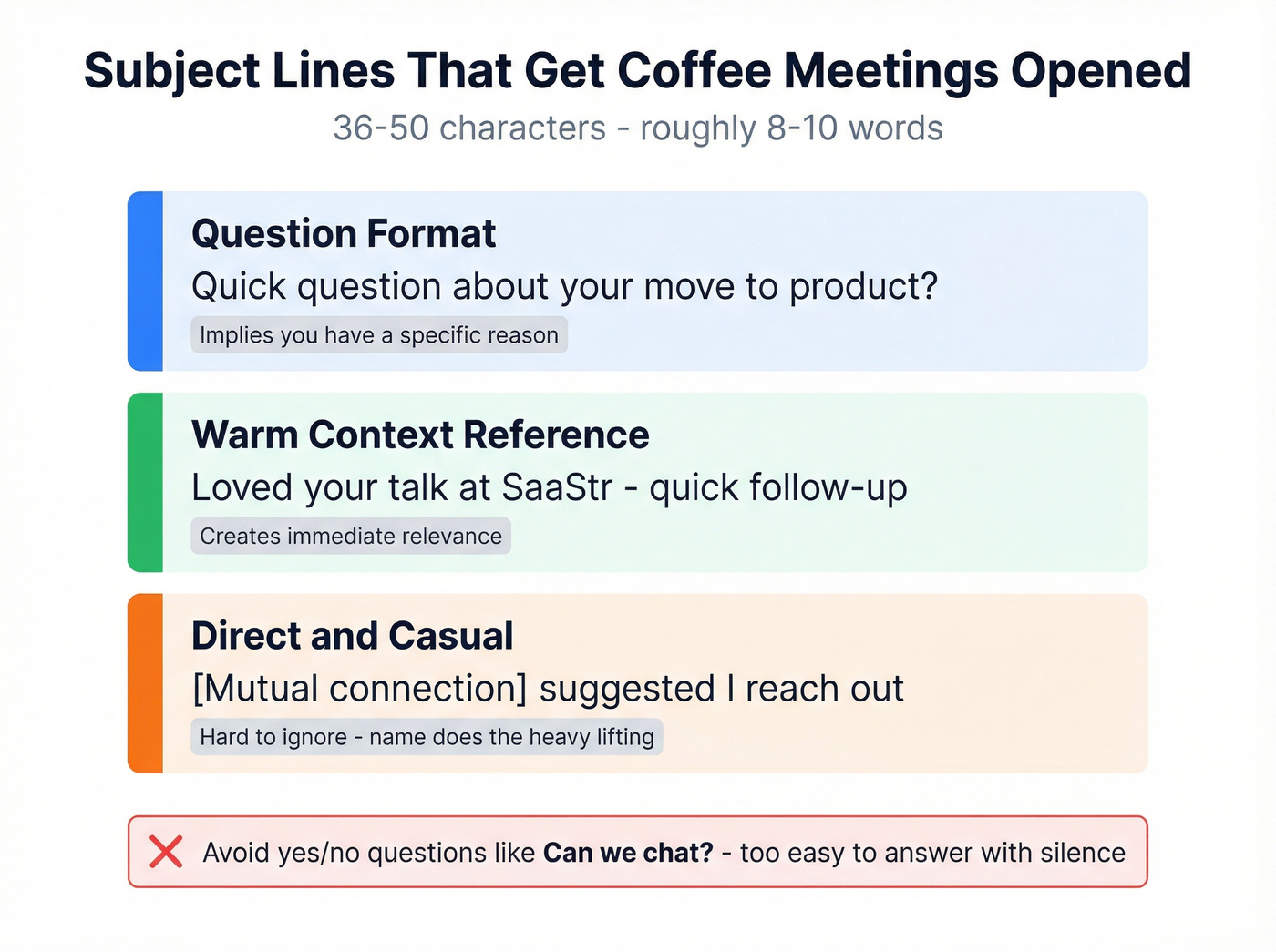
Question formats imply you have a specific reason for reaching out. Something like "Quick question about your move to product?" or "Fellow [School] alum - 15 min for coffee?" gives the recipient a reason to open. Warm context references work just as well: "Loved your talk at [Event] - quick follow-up" creates immediate relevance. And sometimes direct and casual wins. "[Mutual connection] suggested I reach out" is hard to ignore.
Avoid yes/no questions. "Can we chat?" is easy to answer with silence. "Quick question about your career switch to fintech" gives them a reason to click.
5 Mistakes That Kill Your Email
"Can I pick your brain for 30 minutes?" Write instead: "I have two specific questions about breaking into climate tech - would you have 15 minutes this week?"
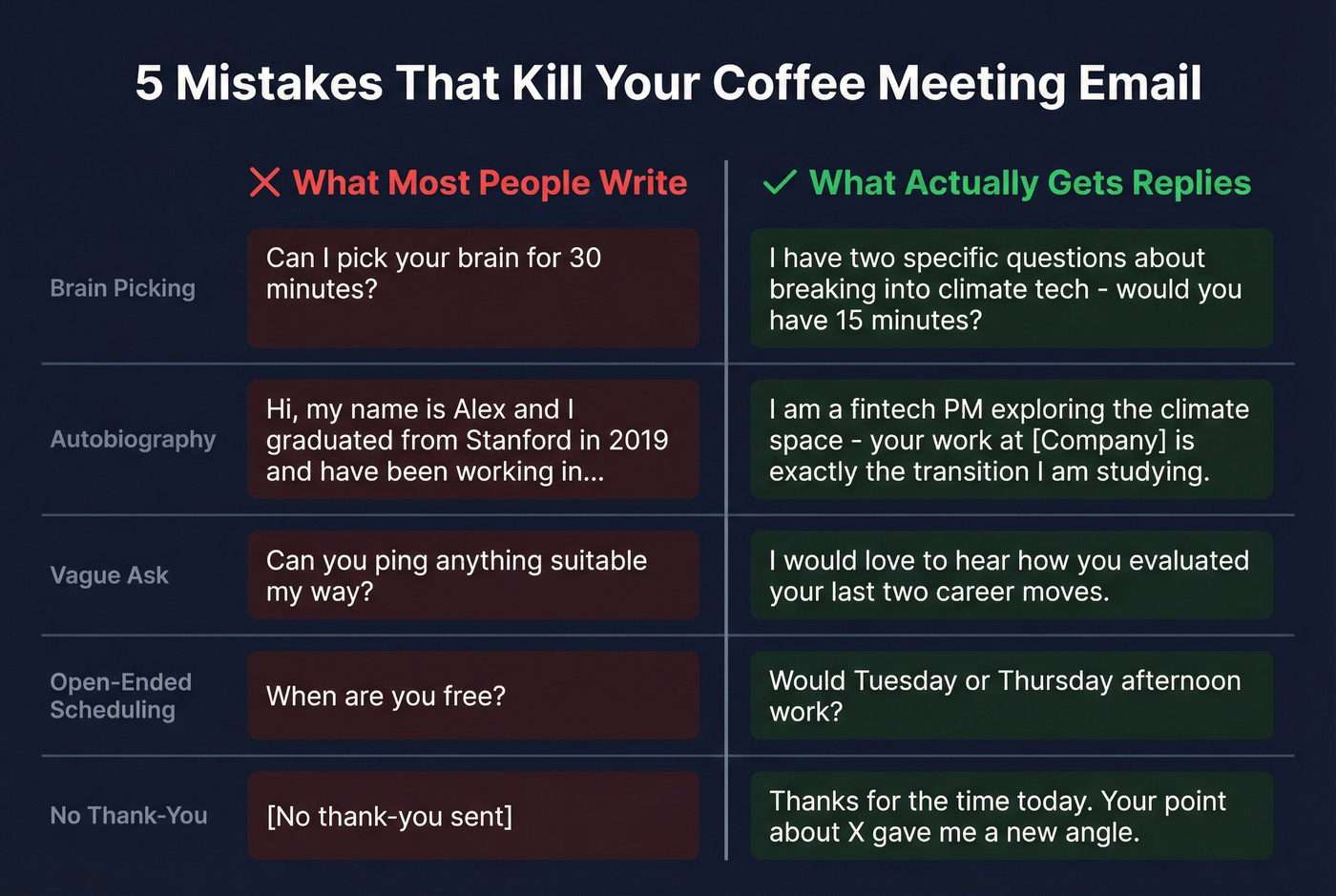
Here's the thing: "pick your brain" is the worst phrase in networking. It's vague, signals zero preparation, and tells the recipient you want to extract value without offering any. Coached.com calls it a "monstrosity" - and career networking communities overwhelmingly agree. It's the fastest way to get ignored.
The autobiography opener. Nobody wants your life story. "I'm a fintech PM exploring the climate space - your work at [Company] is exactly the transition I'm studying" does in one sentence what most people take a paragraph to say. (If you want stronger openers, see how to start an email.)
The vague ask. "Can you ping anything suitable my way?" gets nothing. "I'd love to hear how you evaluated your last two career moves" gives them something concrete to respond to.
"When are you free?" Give them a multiple-choice question, not an essay prompt. "Would Tuesday or Thursday afternoon work?" lifts reply rates on its own.
Skipping the thank-you. 90% of people don't say thanks. That's your competitive advantage.

The best coffee meeting invite won't matter if it bounces. Prospeo's email finder returns 98% accurate addresses through a 5-step verification process - so your networking email actually reaches the inbox. 75 free lookups per month, no card required.
Find their real email in seconds. Send your invite with confidence.
How to Structure the Perfect Ask
Every great coffee chat email follows five parts. Keep the whole thing under 200 words and 6-8 sentences - that length hits the highest reply rates. (For more meeting language, see how to ask someone for a meeting via email.)
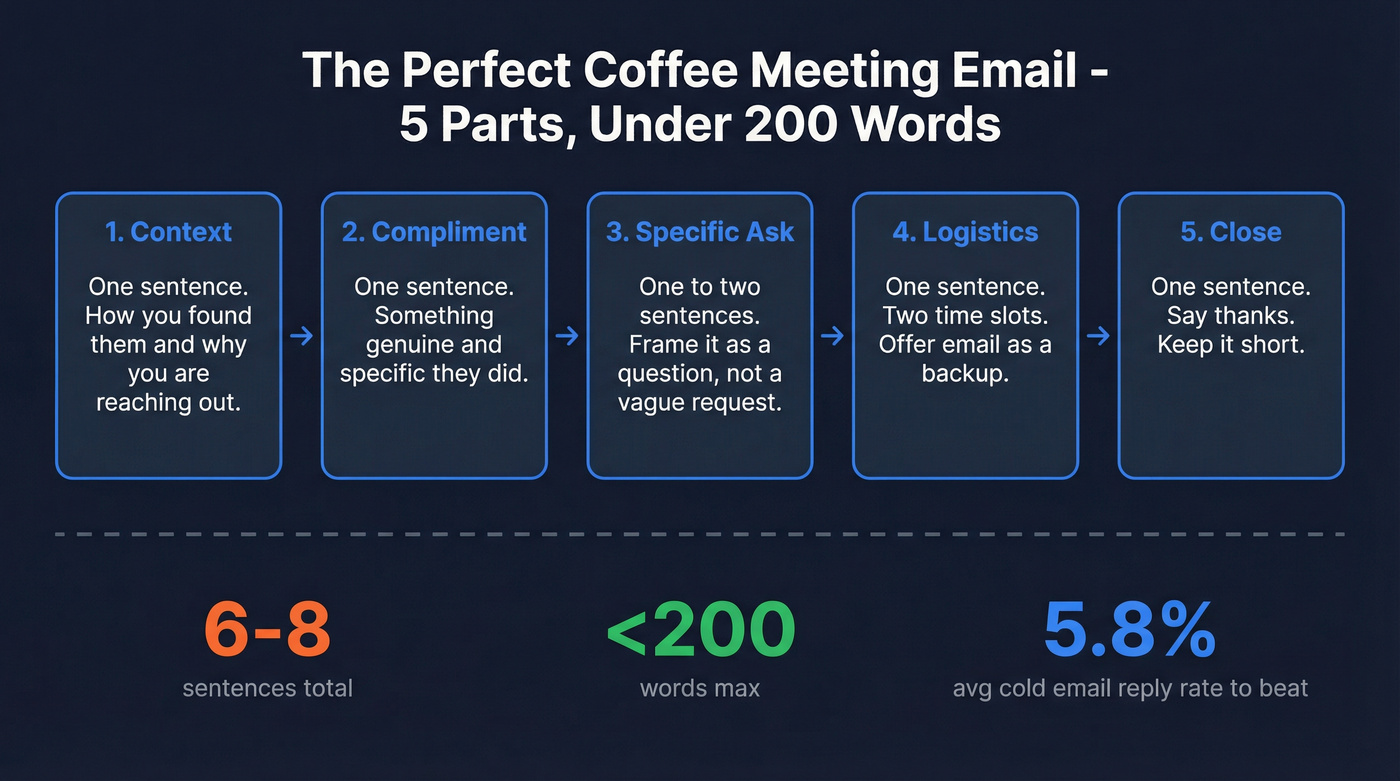
Context - one sentence. How you found them and why you're reaching out. Open with warm context: a shared connection, school, event, or something specific they published.
Compliment - one sentence. Something genuine and specific. Not "I admire your career." Try: "Your breakdown of Series A fundraising metrics was the most practical thing I read last quarter."
Specific ask - one to two sentences. Frame it as a question. Not "I'd love to chat about your experience" - that's a disguised time-vampire request, which translates to "I want your time but haven't earned it." Instead: "I'm curious how you evaluated the jump from consulting to an operator role."
Logistics - one sentence. Offer two specific time slots. Default to Zoom or phone. For very busy people, offer to email your questions instead - it removes the calendar friction entirely.
Close - one sentence. Thank them. Keep it short.
Templates That Actually Get Replies
Cold Outreach to Someone You Admire
Subject: Your [Topic] piece changed how I think about X
Hi [Name],
I came across your [article/talk/post] on [specific topic] and it shifted how I'm approaching [related challenge]. I'm a [your role] at [company].
I'd love to ask two quick questions about [specific aspect]. Would you have 15 minutes - Tuesday or Thursday afternoon?
Either way, thanks for putting that work out there. [Your name]
Alumni Connection
Subject: Fellow [School] alum - quick question
Hi [Name],
I'm a [School] alum ('XX) working in [field]. I saw you made the transition from [previous role] to [current role] - that's exactly the path I'm exploring.
Would you be open to a 15-minute call about how you evaluated that move? Happy to work around your schedule, or I can send my questions over email.
Thanks, [Your name]
In our experience, the alumni angle outperforms cold outreach by a wide margin. If you have this card, play it.
Post-Conference Coffee Invite
Subject: Great meeting you at [Event] - quick follow-up
Hi [Name],
We chatted after the [panel/session] at [Event] about [topic]. Your point about [specific thing] stuck with me. Would a 15-minute call next week work to continue that conversation?
[Your name]
This is the highest-converting format we've seen. If you can only send one type of coffee invite, make it the post-event follow-up. Warm context beats cold outreach every time. A nice touch: send a small coffee gift card with the invite. It's unexpected, memorable, and costs less than most marketing spend. You can adapt this same template for virtual events - just swap the in-person reference for a link to the session recording or chat thread.
Virtual Coffee Chat Email
Subject: Coffee chat - curious about [their project]
Hey [Name],
I'm [Your name] on the [your team] team. I've been following [project] your team shipped last quarter. Would you have 15 minutes for a virtual coffee? Curious how you approached [specific challenge].
Thanks, [Your name]
This virtual coffee email template works equally well for internal colleagues in another department or remote-first teams where grabbing a coffee in person isn't an option.
Senior Executive or Investor
Subject: [Mutual connection] suggested I reach out
Hi [Name],
[Mutual connection] mentioned you'd be a great person to talk to about [specific topic]. I'm working through [specific challenge] right now. Would you have 15 minutes, or would it be easier if I sent two questions over email?
Really appreciate it, [Your name]
Skip the casual tone for anyone more than one level above you. Lead with the mutual connection's name - it's doing the heavy lifting.
Casual Peer Networking
Hey [Name],
We're both in the [industry] space and I've been meaning to reach out. Loved your take on [specific thing]. Want to grab coffee or hop on a quick call this week? No agenda - just swapping notes on [shared interest].
[Your name]
What to Do If They Don't Reply
Don't panic. Don't send three follow-ups in a week.
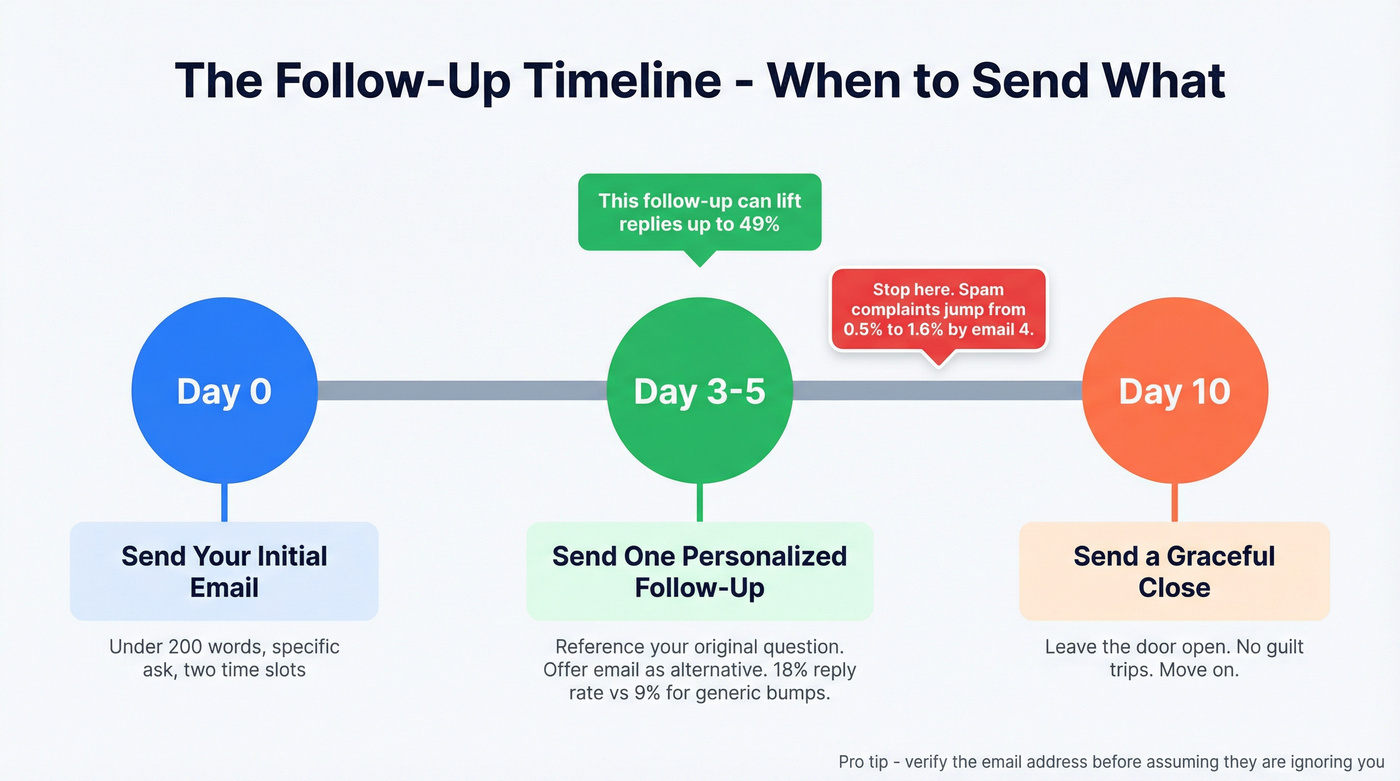
One initial email plus one follow-up is the sweet spot. That first follow-up can lift replies up to 49%. Beyond that, spam complaint rates jump from 0.5% on the first email to 1.6% by the fourth - a steep price for diminishing returns.
Send your follow-up 3-5 days after the original. Personalized follow-ups pull roughly 18% reply rates versus 9% for generic bumps. (More templates: subject lines for follow-up emails.)
Follow-up template:
Hi [Name],
Just floating this back up - I'm still curious about [specific question from original email]. Would a 10-minute call work, or easier to send my questions over email?
No worries either way. [Your name]
If nothing after 10 days, send a graceful close:
Hi [Name],
Totally understand if the timing doesn't work. If [topic] comes up again and you'd like to connect, I'm easy to find.
Appreciate your time, [Your name]
Before you assume they're ignoring you, check whether the email was valid. A quick verification through Prospeo takes a few clicks and saves you from following up on a bounced address. (More on validation: check email account validity.)
You wrote the perfect ask, nailed the subject line, and kept it under 200 words. Don't let a bad email address waste all that effort. Paste any profile URL into Prospeo and get a verified address instantly - 98% accuracy, zero bounced reputation damage.
Stop guessing at email addresses. Verify before you send.
The Thank-You That Builds Relationships
80% of hiring managers say thank-you notes affect their decisions. Send yours within 24 hours. Reference something specific from the conversation, offer to help them with something - even if it's small - and adopt a listening-first posture: reflect back what you heard before jumping to what you need. This is how one coffee chat turns into a real relationship.
Hi [Name],
Really appreciated the time today. Your point about [specific thing] gave me a new way to think about [your challenge]. I'm going to [specific action based on their advice].
If I can ever return the favor - happy to help with [something relevant to them]. Thanks again. [Your name]
FAQ
How long should a coffee chat email be?
Under 200 words and 6-8 sentences. A study of 16.5 million emails found that 6-8 sentences produces the highest reply rates at 6.9%, and sub-200-word emails outperform longer formats. Cut every sentence that doesn't earn its place.
What's the best day and time to send?
Thursday produces the highest reply rates at 6.87%, with the 8-11 PM window peaking at 6.52%. Mornings between 7-11 AM are a strong second choice. Avoid Monday - it consistently underperforms at 5.29%.
What if I don't have their email address?
Use an email finder tool. Paste their professional profile URL into a verification service and get a confirmed address in seconds. Other options include checking company websites or asking mutual connections directly.
Can I use these templates for conference follow-ups?
Post-event coffee invites are the highest-performing format because you already have warm context. Reference the specific session, panel, or hallway conversation, then adapt any template above. The key is sending within 24-48 hours while the event is still fresh.
Do coffee meeting invite email templates even matter?
Most coffee chat emails fail before they're even written - the person was wrong, the email bounced, or the ask was too vague. Templates provide structure, but targeting the right person with a verified address and a specific question matters ten times more. Nail those three things and even an imperfect email gets replies.