How to Ask Someone for a Meeting via Email - What 28M Emails Reveal
The average sales rep sends 344 cold emails to book a single meeting. Top performers book 8.1x more from the same inbox. That gap isn't talent. It's structure - every word in your request either earns a reply or gets archived, and the average cold email reply rate sits at just 3.43%. The reps hitting 10%+ follow the principles below.
The Short Version
Three rules: keep your request under 100 words, suggest two specific times instead of dropping a calendar link, and don't sell. The rest of this article breaks down exactly how - with templates, subject line data, and a follow-up cadence you can copy today.
The 5-Part Email Framework
Professionals spend 28% of their workweek managing email. Your message competes with hundreds of others. A meeting request email works best when it follows five parts in order - skip one and reply rates drop.
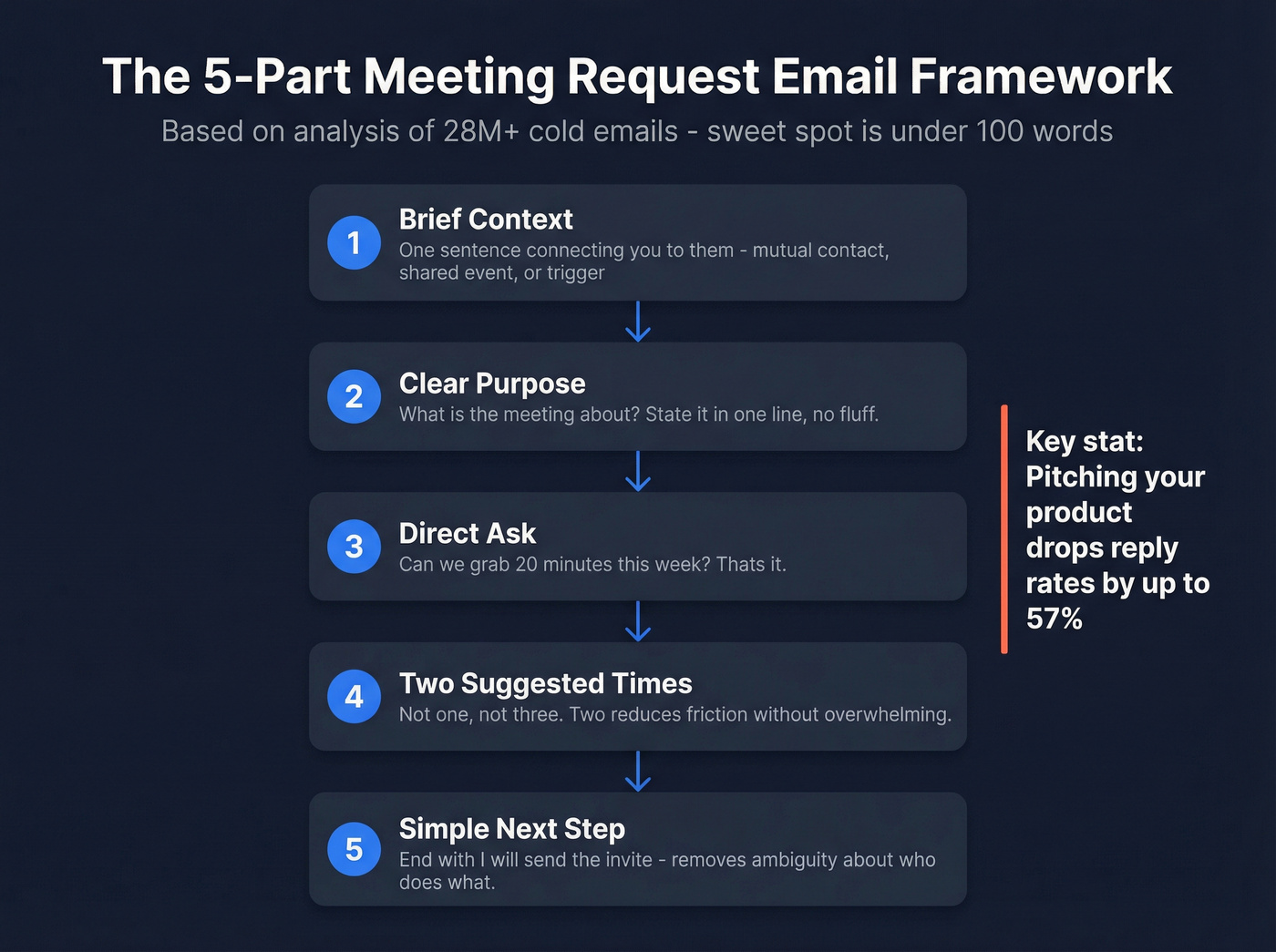
Brief context. One sentence connecting you to the recipient. A mutual contact, a shared event, a relevant trigger. This isn't your bio - it's why you're not a stranger.
Clear purpose. What's the meeting about? State it in one line. "I'd like to discuss how your team handles outbound QA" beats "I'd love to pick your brain."
Direct ask. "Can we grab 20 minutes this week?" That's it.
Two suggested times. Not one, not three. Two reduces friction without overwhelming.
Simple next step. End with "I'll send the invite" - it removes ambiguity about who does what.
An analysis of 28M+ cold emails found the sweet spot is 100 words or fewer, in 3-4 sentences. Boomerang's research narrows it further: response rates peak between 50-125 words. And here's the stat that should change how you write every meeting request - pitching your product drops reply rates by up to 57%.
Subject Lines That Get Opened
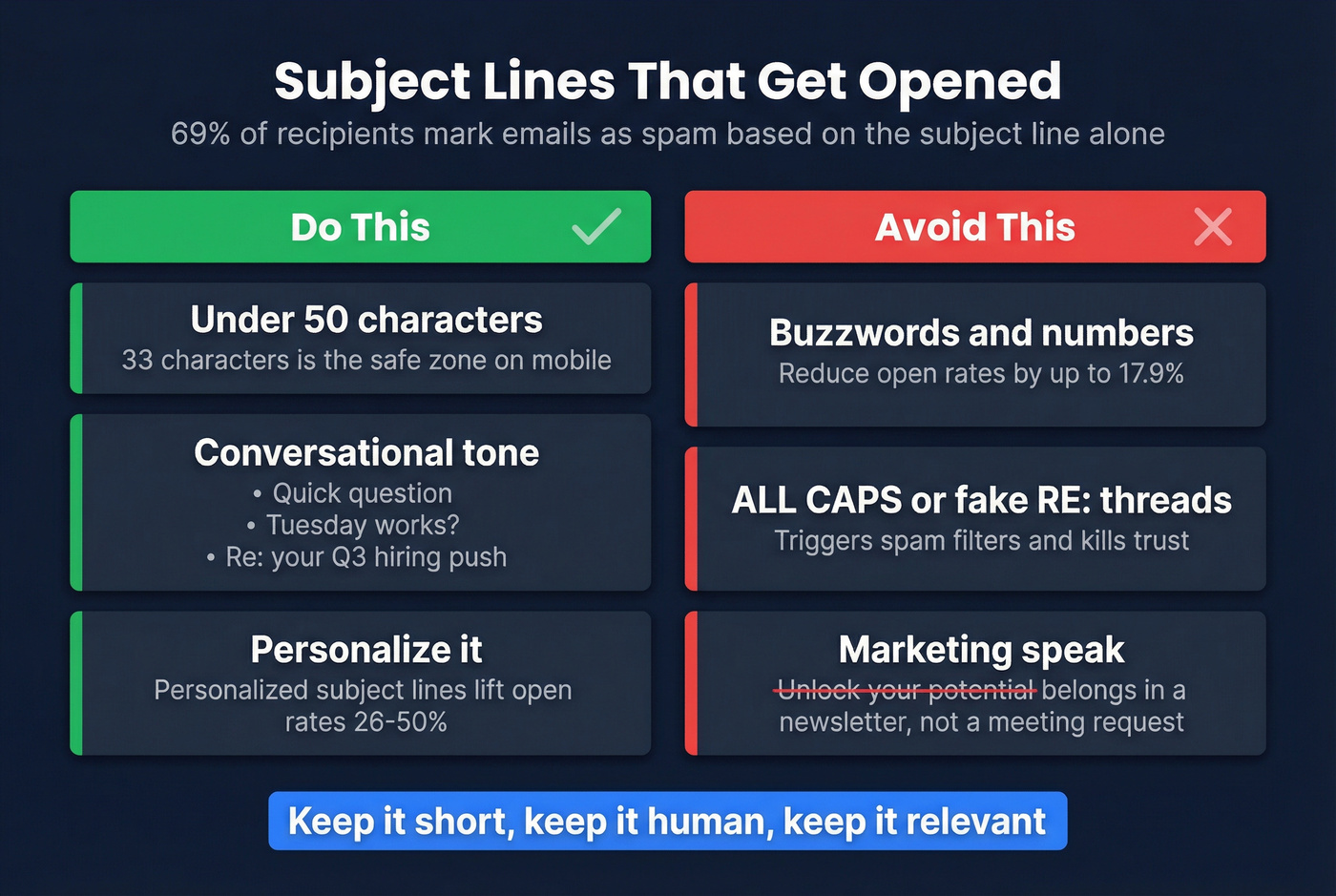
69% of recipients mark emails as spam based on the subject line alone. Your body copy never gets a chance if the subject fails.
What works:
- Keep it under 50 characters. On mobile, 33 characters is the safe zone for full visibility.
- Make it conversational: "Quick question," "Tuesday works?" or "Re: your Q3 hiring push."
- Personalize it. Personalized subject lines lift open rates by 26-50%.
What doesn't:
- Buzzwords and numbers reduce open rates by up to 17.9%.
- ALL CAPS, excessive punctuation, or fake "RE:" threads trigger spam filters and erode trust instantly.
- Anything that sounds like marketing. "Unlock your potential" belongs in a newsletter, not a meeting request.
Meeting Request Email Templates
Cold Outreach
Subject: Quick question about [specific topic]
Hi [Name],
Noticed [company] just [trigger - new hire, funding round, product launch]. We help teams like yours [one-sentence value prop].
Worth a 15-minute chat? I'm open Tuesday at 10am or Thursday at 2pm ET.
- [Your name]
"Worth a chat?" as a CTA consistently outperforms hard-scheduled asks in our testing. Keep the value prop to one line - anything more reads like a pitch deck, and that 57% penalty kicks in fast.
Internal / Colleague
Subject: 20 min - [project name] sync
Hey [Name],
Want to align on [specific topic] before the sprint review. Should take 20 minutes.
Does Wednesday at 11am or Friday at 9am work? I'll send the invite.
Short, respectful of their time, and you own the next step. Internal emails get the same brevity treatment - your colleagues are drowning in messages too.
Executive / Senior Stakeholder
Subject: [Company] + [their company] - quick intro
Hi [Name],
[One sentence of value tied to their priority - e.g., "Your team's expansion into APAC aligns with something we've helped three similar orgs navigate."]
Agenda:
- Your current approach to [specific challenge]
- One idea that cut [metric] by [X%] for [similar company]
Would Tuesday at 3pm or Thursday at 10am work for 20 minutes?
Communicate value in the first two lines. Agenda bullets signal you won't waste their time. Two time slots only. Executives scan faster than anyone - if your email requires scrolling, it's already dead.
Follow-Up After No Response
Subject: Different angle on [topic]
Hi [Name],
Sent a note last week about [topic]. Rather than rehash it - [new angle: a relevant stat, case study, or question].
Still happy to grab 15 minutes if the timing's better now. Tuesday or Wednesday afternoon?
Never write "just checking in." Bring something new.

You just spent time crafting the perfect meeting request. Now make sure it actually lands. Prospeo's 98% verified emails mean bounce rates under 2% - protecting your domain reputation and putting your ask in front of real people.
A perfect email to a dead inbox books zero meetings.
Suggested Times vs. Calendar Link
Look, calendar links feel efficient, but they kill conversion in cold outreach. Chili Piper ran a test - 50 emails with a calendar link vs. 50 with suggested times. The calendar-link version converted at 1.9%. Suggested times booked 13x more demos.
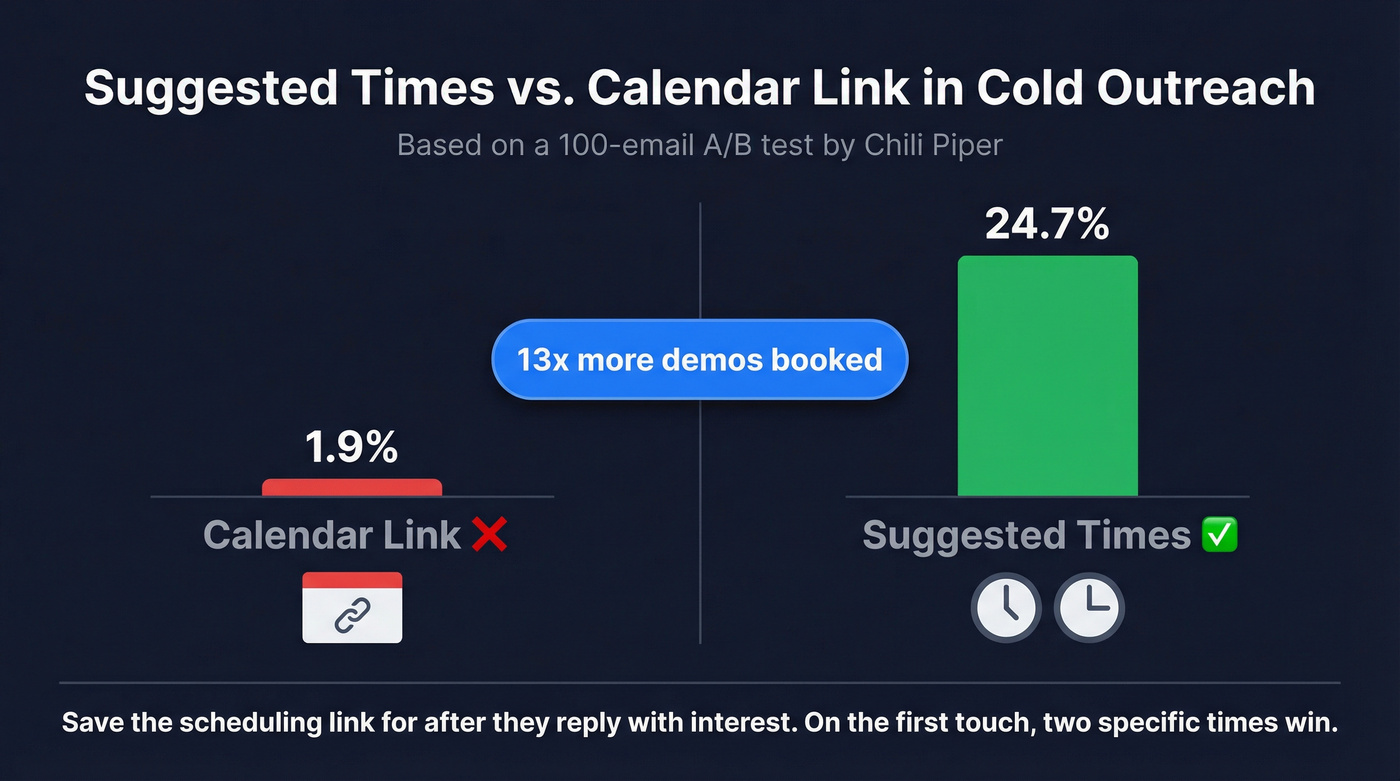
Save the scheduling link for after they reply with interest. On the first touch, two specific times win every time.
Follow-Up Cadence That Works
About 60% of replies come after the first follow-up, yet most people send one email and stop. Meanwhile, 80% of leads need 5-12 contacts before making a decision, and only 8% of reps follow up more than five times. That's a massive gap between what works and what people actually do.
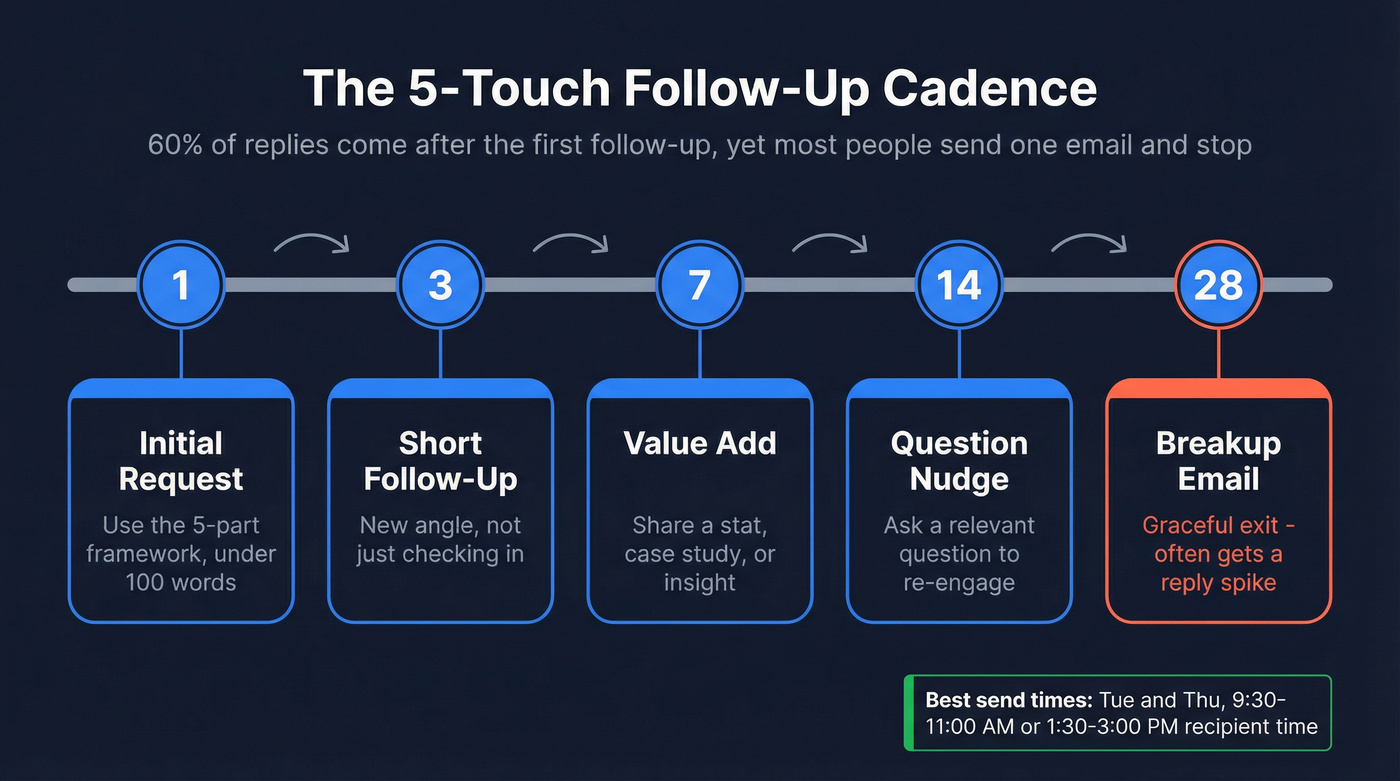
| Day | Action |
|---|---|
| 1 | Initial request |
| 3 | Short follow-up, new angle |
| 7 | Value-add (stat, case study) |
| 14 | Question-based nudge |
| 28 | Breakup email |
In our experience, the breakup email at Day 28 often gets a spike in replies - people respond when they sense the conversation is closing. Vary each touchpoint: social proof in one, a question in another, a graceful exit in the last.
When to send: Tuesdays and Thursdays perform best, ideally between 9:30-11:00 AM or 1:30-3:00 PM in the recipient's timezone. Avoid Mondays and Fridays - inbox overload and checkout mode, respectively. (If you want a deeper breakdown, see best time to send data.)
Before You Hit Send - Deliverability
You can nail the framework, write a perfect subject line, and craft the ideal follow-up sequence - and none of it matters if the email bounces. Bounce rates above 2% start damaging your domain reputation. Above 5%, you're in serious trouble across your entire sending domain.
This is the step most guides skip, and it's the one that frustrates us the most. We've seen teams spend hours personalizing outreach only to torch their sender reputation because 8% of their list was dead addresses. Stale lists create brutal bounce rates fast, and even one bounced email wastes a great piece of personalization. Step zero, before any template matters: verify the address is real. Prospeo runs a 5-step verification process with 98% email accuracy and refreshes data every 7 days - upload your list and clean it before you send a single message. (If you’re comparing tools, start with an email validator shortlist.)
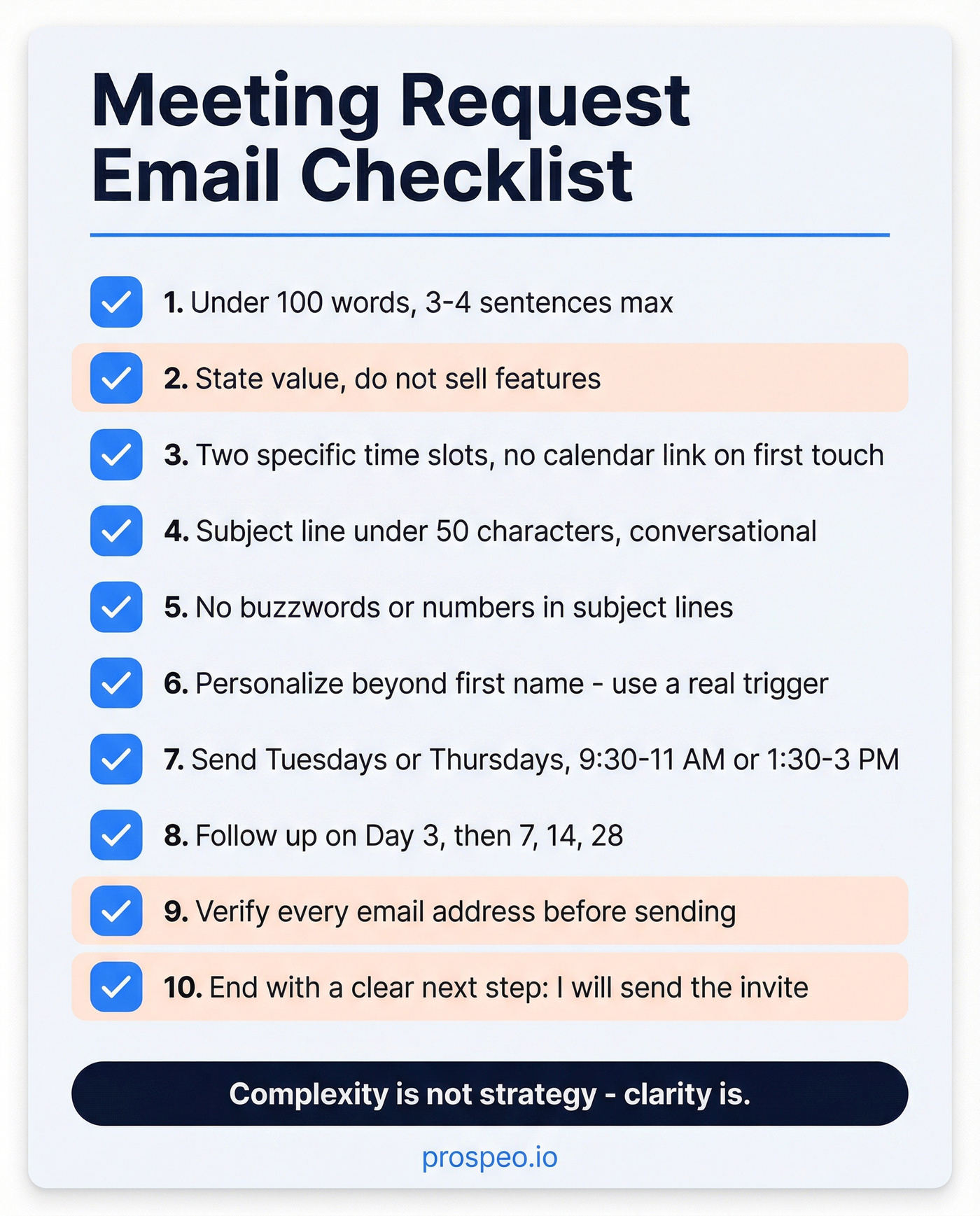
Quick-Reference Checklist
- Under 100 words, 3-4 sentences max
- State value, don't sell features (avoid the pitch slap)
- Two specific time slots, no calendar link on first touch
- Subject line under 50 characters, conversational tone (watch words to avoid)
- No buzzwords or numbers in subject lines
- Personalize beyond first name - use a real trigger (more on personalization)
- Send on Tuesdays or Thursdays, 9:30-11:00 AM or 1:30-3:00 PM recipient time
- Follow up on Day 3, then 7, 14, 28 (use a proven sales cadence example)
- Verify every email address before sending (full email deliverability checklist)
- End with a clear next step: "I'll send the invite"
Let's be honest: if your deals close under five figures, you don't need a 12-touch, multi-channel sequence. A tight three-email cadence following this framework will outperform a bloated sequence with weak copy every single time. Complexity isn't strategy - clarity is.
That 5-touch follow-up cadence only works if every address is live. Prospeo refreshes 300M+ contacts every 7 days - not the 6-week industry average - so your meeting requests reach active inboxes, not spam traps.
Stop burning your sender reputation on stale data.
FAQ
How long should a meeting request email be?
Under 100 words - ideally 50-125. An analysis of 28M emails shows reply rates drop sharply as length increases. Cut everything that doesn't directly earn the reply.
Should I include a calendar link in a cold email?
No. Suggested times book 13x more meetings than a calendar-link-only approach in cold outreach. Save the scheduling link for after they express interest.
How many follow-ups should I send before giving up?
Send at least five. 80% of leads need 5-12 contacts before deciding, and 60% of replies come after the first follow-up. Before you assume silence means "no," verify the address is valid - a bounced email isn't a rejection, it's a wasted slot.
What's the best day and time to send a meeting request?
Tuesday and Thursday mornings between 9:30-11:00 AM in the recipient's timezone consistently outperform other windows. Afternoons from 1:30-3:00 PM are a strong secondary slot.