

3CX vs Aircall: Which Phone System Is Actually Worth Your Money in 2026?
You just opened the renewal quote. Your 3CX license jumped 25% - again - and the MSP is already on the phone explaining why. Meanwhile, the SDR manager down the hall is complaining that half the numbers in the dialer are dead anyway, so does the phone system even matter?
It's a fair question.
Most teams lose more revenue to bad contact data than to phone system limitations, but nobody wants to hear that when they're staring down a five-figure annual commitment. And most 3CX vs Aircall comparisons give you feature checklists and call it a day. None of them tell you what a 15-person team actually pays per year, all-in, with add-ons and hosting. We'll fix that - with real TCO tables, user sentiment straight from Reddit and G2, and an honest take on which tool fits which team.
30-Second Verdict
Choose 3CX if: You've got IT staff (or an MSP), you want self-hosting control and data sovereignty, and your team has a low concurrent-call ratio. The per-system pricing model rewards you here.
Choose Aircall if: You need to be live in 48 hours with tight Salesforce/HubSpot integrations and don't mind paying a premium for simplicity.
Skip both if: Your primary use case is outbound sales dialing and your real bottleneck is bad contact data, not the phone system itself. Fix your data layer first, then pick a dialer.
How 3CX and Aircall Compare at a Glance
The differences here are more structural than they look at first glance - these two platforms have fundamentally different pricing philosophies, deployment models, and target users.
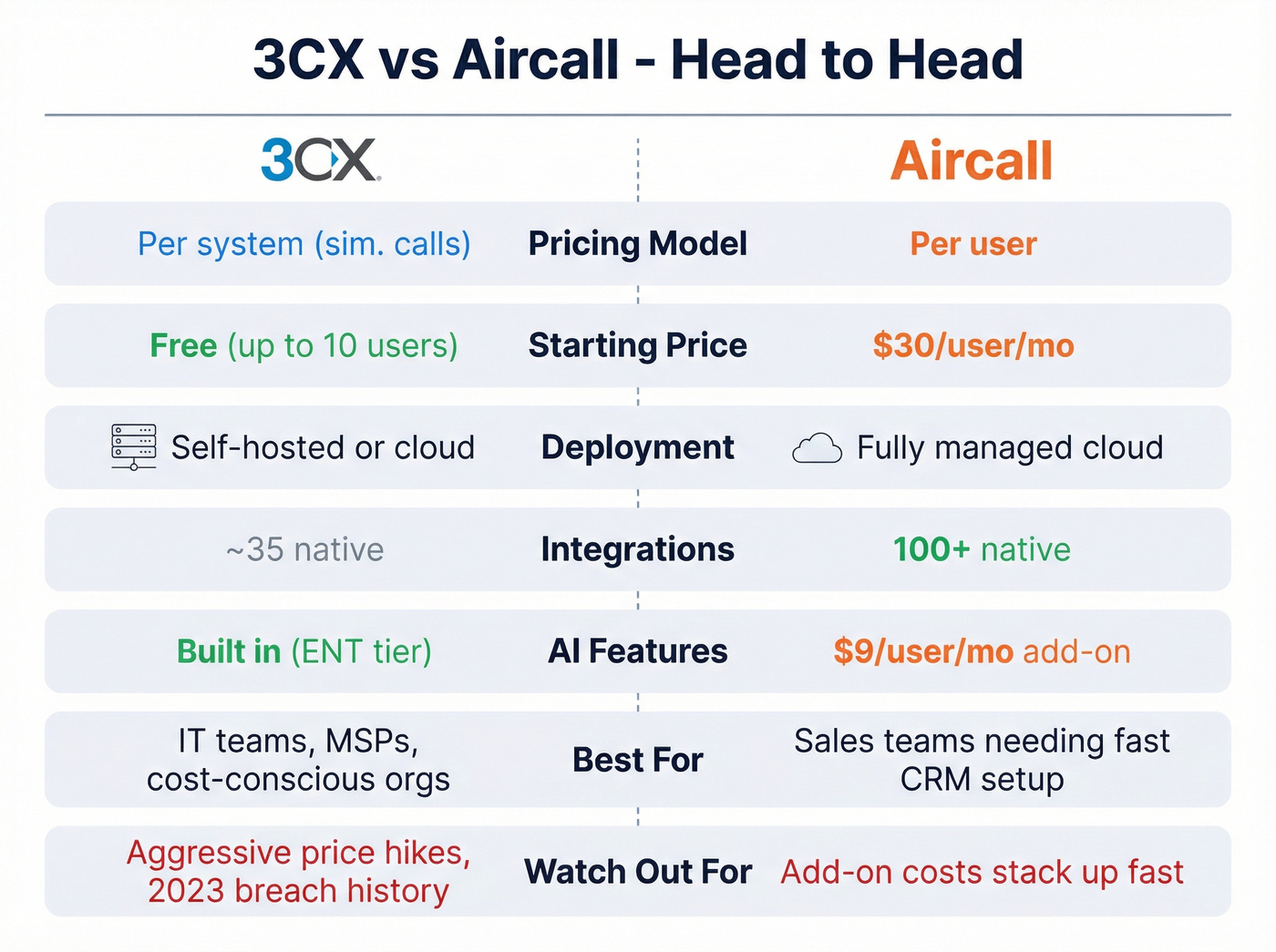
| Dimension | 3CX | Aircall |
|---|---|---|
| Pricing model | Per-system/sim. calls | Per-user |
| Starting price | Free (up to 10 users) | $30/user/mo (annual) |
| G2 rating | 4.4/5 (529 reviews) | 4.3/5 |
| Deployment | Self-hosted or cloud | Fully managed cloud |
| Integrations | ~35 native | 100+ |
| AI features | Built-in (ENT/AI) | $9/user/mo add-on |
| Uptime SLA | Not published | 99.95% |
| Min. seats | None | 3 |
| Companies using | 600,000+ | 22,000+ |
| Founded | 2005 | 2014 |
The table tells one story. The pricing section below tells a very different one.
Pricing - What You Actually Pay
Pricing is where these two platforms diverge most dramatically. 3CX charges per system (based on simultaneous calls), while Aircall charges per user. That distinction sounds minor until you model it for a real team.
Aircall's Real Cost
Aircall lists two public tiers:
- Essentials: $30/user/mo (annual) or $40/user/mo (monthly)
- Professional: $50/user/mo (annual) or $70/user/mo (monthly)
- Custom: 25-user minimum, talk to sales
All plans require a 3-license minimum. Even if you're a two-person team, you're paying for three seats. That's $90/month minimum before you've made a single call - the kind of detail that doesn't show up in feature comparison tables.
But the real cost inflation comes from add-ons. AI features - transcription, call summaries, sentiment analysis - run $9/user/mo extra. Analytics+ is another $15/user/mo. These aren't optional luxuries for most sales teams; they're table stakes. And the billing adds up fast: 10 users on Professional (annual) + AI + Analytics+ = ($50 + $9 + $15) x 10 = $740/mo, or ~$8,880/year. Switch to monthly billing and that jumps to ($70 + $9 + $15) x 10 = $940/mo, or ~$11,280/year.
International calls are billed separately by destination, and Aircall doesn't publish the rates. Budget accordingly.
One G2 reviewer put it bluntly: the billing practices "feel unfair" and "more like a bait-and-switch." That tracks with what we've seen - the sticker price looks competitive until the add-ons stack up.
3CX's Shifting Pricing Model
3CX's pricing philosophy is the opposite: you pay per system based on simultaneous call capacity, not per user. In theory, this is brilliant for teams where only a fraction of employees are on calls at any given time.
- SMB Free: Up to 10 users, core PBX features, $0
- PRO: ~$175/year for small systems (up to 10 users), scaling to ~$2,000+/year for larger deployments
- ENT/AI: ~$350-500/year for small systems, includes AI features
3CX also offers a perpetual license exchange program - if you're switching from another provider, you can get a free year when moving to an annual subscription. Worth asking about.
The catch? 3CX has been raising prices aggressively. Early 2026 brought another round of adjustments with new user caps per tier. Reddit's MSP community isn't happy. One partner described it as "essentially doubling prices over prior years that were already hiked 20%+ annually." Another called the new user limits "per-user licensing in disguise."
3CX is still cheaper than Aircall for most team sizes. But the pricing trajectory is concerning, and the short notice on changes erodes trust.
TCO Comparison - 5, 15, and 50 Users
Here's what actually matters: annual cost for real team sizes, based on 3CX's per-system pricing as of early 2026.
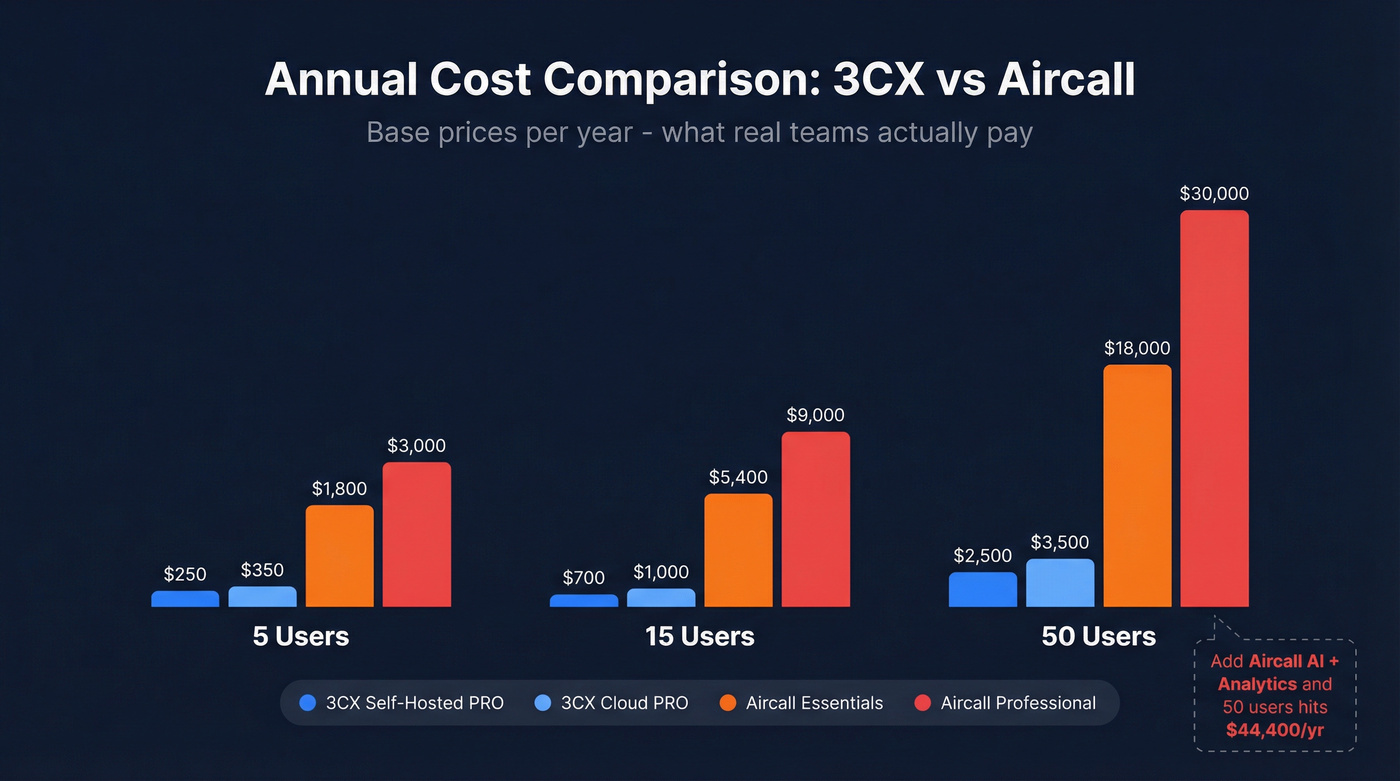
| Team size | 3CX Self-Hosted PRO | 3CX Cloud PRO | Aircall Essentials | Aircall Professional |
|---|---|---|---|---|
| 5 users | ~$250/yr | ~$350/yr | $1,800/yr | $3,000/yr |
| 15 users | ~$700/yr | ~$1,000/yr | $5,400/yr | $9,000/yr |
| 50 users | ~$2,500/yr | ~$3,500/yr | $18,000/yr | $30,000/yr |
These are base prices. Add Aircall's AI ($9/user/mo) and Analytics+ ($15/user/mo) and the gap widens further. A 50-person team on Aircall Professional with both add-ons is looking at ~$44,400/year. The same team on 3CX self-hosted PRO pays roughly $2,500 plus ~$150/year in hosting costs.
That's not a rounding error. That's a headcount.

You're debating $2,500 vs $44,400/year on phone systems - but your SDRs are dialing dead numbers either way. Prospeo's 125M+ verified mobiles hit a 30% pickup rate, vs the industry average of ~12%. That's 2-3x more live conversations from the same dialing hours.
Fix the data layer first. The phone system debate becomes easy after that.
Features Head-to-Head
AI Features - Built-In vs Add-On
3CX includes AI Analytics, AI Transcription, and AI Receptionist in its ENT/AI Edition at no per-user add-on cost. You pay the system license, and AI is part of the package.

Aircall charges $9/user/month for AI features. For a 20-person team, that's $2,160/year just for AI - on top of your base plan.
The AI features themselves are roughly comparable: both offer transcription and call summaries. 3CX's AI Receptionist (automated call answering and routing) is a nice differentiator. But the pricing model is what separates them. 3CX bundles it; Aircall taxes you for it.
Clear winner: 3CX on AI value.
Integrations - Quality Over Quantity
Aircall's 100+ integrations dwarf 3CX's ~35. But it's not just the count - it's the depth. Aircall's CTI enables screen pops with customer context, auto-logging calls to Salesforce and HubSpot, and native connections to Gong, Zendesk, Shopify, Slack, and Zapier.
3CX integrates with the big CRMs - Salesforce, HubSpot, Zoho, Pipedrive - plus Microsoft Teams and Google Workspace. But the integrations are shallower. You won't get the same auto-logging and screen-pop experience without custom work.
If your workflow revolves around a CRM, Aircall's integration depth is a genuine advantage. G2's head-to-head comparison reflects this - users consistently rate Aircall higher on CRM connectivity.
For a deeper look at how CTI and logging actually break in the real world, see our guide to cold calling CRM integration.
Clear winner: Aircall on integrations.
Everything Else
3CX bundles a lot that Aircall doesn't: video conferencing, live chat, and WhatsApp messaging are all included. Aircall is a phone system, period.
Both offer call routing, IVR, and recording. Both have mobile apps - and both get complaints about mobile app quality on G2. Call it a draw there. The question is whether you need the extras. If you're a sales team running outbound sequences, you probably don't need 3CX's video conferencing or live chat. If you're an MSP or IT team managing internal comms alongside customer calls, those bundled features have real value.

Deployment and Setup
This is the sharpest divide between these two platforms.
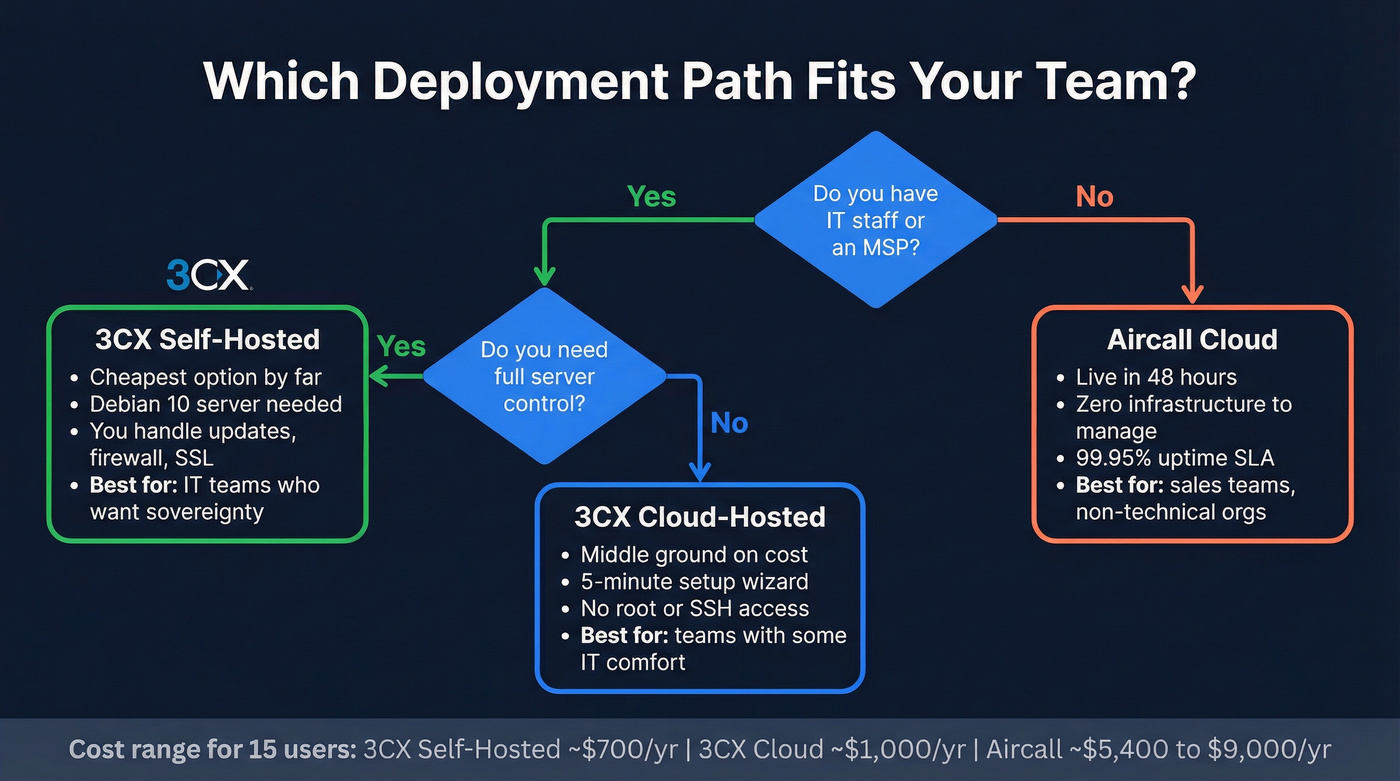
Aircall is fully managed cloud. Sign up, configure your numbers, connect your CRM, and you're live. Aircall guarantees 99.95% uptime and handles all infrastructure. No servers to manage, no firewall rules to configure, no OS updates to schedule. For a non-technical team, this is the entire selling point.
3CX self-hosted is a different animal entirely. You'll need a Debian 10 server - 3CX recommends it over Windows for performance. For up to 25 users, that's 1 vCPU, 1GB RAM, and 30GB SSD, which runs about $6/month on AWS Lightsail. Cheap. But you're responsible for OS updates, firewall configuration (ports 443, 5090, 5060, 9000-10999), SSL certificates, DNS, and static IP management. Call recording multiplies disk and CPU requirements fast.
The upside? 3CX's community forum - 162,000+ members across 110,000+ threads - is a genuine asset for self-hosters troubleshooting configuration issues. That's a deeper knowledge base than most paid support tiers offer.

3CX cloud-hosted splits the difference. There's a 5-minute setup wizard, the first year of hosting is often free for Pro/Enterprise licenses, and 3CX manages the infrastructure. The tradeoff: no root or SSH access. You're limited to the management console.
Here's our honest take: if "managing a Linux server" isn't in your team's skill set, 3CX self-hosting is a non-starter. If it is, you'll save thousands per year. And if you want the middle ground, 3CX's cloud-hosted option works - just know you're giving up the control that makes self-hosting attractive in the first place.
Security - The Elephant in the Room
We need to talk about March 2023.
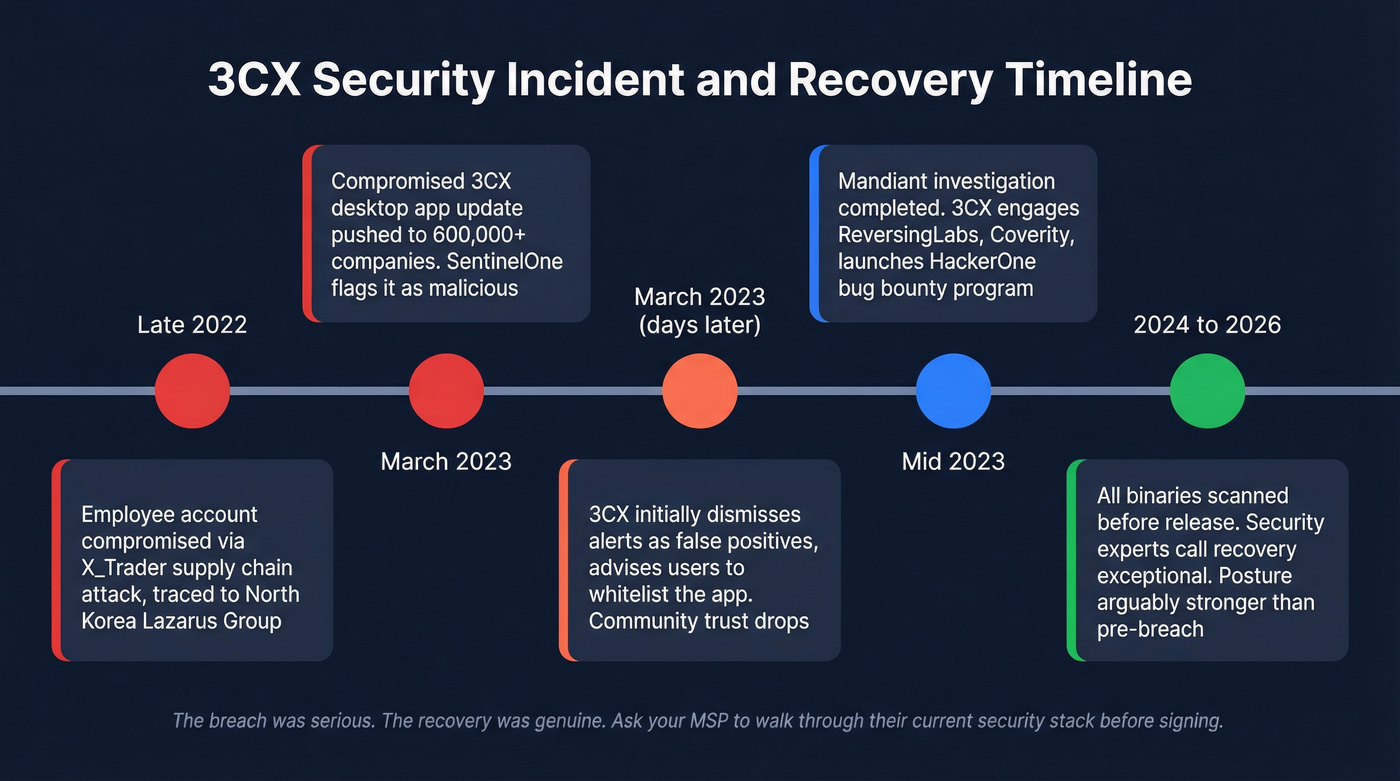
A routine 3CX software update was compromised in a supply chain attack. SentinelOne flagged the 3CXDesktopApp as malicious. 3CX initially dismissed the alerts as false positives and advised users to whitelist the app. Hundreds of thousands of companies were affected.
Mandiant's investigation traced the breach to a compromised employee account, itself targeted through an earlier supply chain compromise involving X_Trader, a financial trading app. The attack was attributed to North Korea's Lazarus Group, specifically targeting cryptocurrency sector customers.
The incident was serious. The initial response - dismissing security vendor alerts - was worse.
But here's what happened next: 3CX invested heavily in post-breach security. They engaged ReversingLabs for binary scanning, Coverity for static analysis, and Mandiant for incident response. They launched a HackerOne bug bounty program. Every 3CX software binary is now scanned before release. Security experts described the recovery as "exceptional."
The incident happened, and buyers should know about it. But 3CX's recovery was genuinely strong - and the security posture today is arguably better than it was before the breach. I wouldn't disqualify 3CX over this, but I would ask your MSP to walk you through their current security stack before signing.
What Real Users Say
3CX: Loved by Users, Resented by MSPs
G2 gives 3CX a 4.4/5 across 529 reviews - 72% five-star. Top praise centers on ease of use (37 mentions), reliability (27), and flexibility (20). Top complaints: complex processes (9), limited features (8), and learning curve (8).
A January 2026 G2 review titled "Flexible and Reliable, but Admin Usability and Reporting Need Work" captures the consensus well - users love the core phone system but find admin tasks unintuitive and reporting limited.
The Reddit sentiment is rougher. MSPs are frustrated with pricing changes and partner policies. One MSP reported a client proactively rejecting 3CX, saying "I've heard so many bad things." The 2023 breach still casts a shadow in certain circles.
Aircall: Great Integrations, Terrible Support
Aircall holds a 4.3/5 on G2. GetApp shows 457 reviews with 30 one-star ratings - a higher complaint ratio than 3CX.
The praise is consistent: "Setup was quick, integrated seamlessly with Salesforce, call quality solid even for remote team." Another user: "CRM integration worked right away, reporting tools are actually useful."
The complaints are equally consistent. The #1 Reddit complaint? "Worst customer service and billing." Other reviewers flag dropped calls, poor audio quality, and latency - especially on mobile and international calls. 38% of Capterra reviews mention slow support.
One Reddit user who tested Aircall against CloudTalk found "call consistency" issues and "limitations unless you're on higher-tier plans." That tracks with the add-on pricing model - you don't get the full experience unless you're paying $50+/user/month plus extras.
Who Should Choose What
Choose 3CX If
- You have IT staff or an MSP who can manage deployment
- You want self-hosting control and data sovereignty
- Your team has a low concurrent-call ratio (e.g., 50 employees but only 10-15 simultaneous calls)
- You're cost-conscious and willing to invest setup time upfront
- You need video conferencing, live chat, or WhatsApp bundled in
3CX is strongest for conference call management and internal collaboration - particularly in IT and marketing sectors where those bundled communication tools pull double duty.
Choose Aircall If
- You need to be live in 48 hours with zero infrastructure decisions
- Your workflow revolves around Salesforce, HubSpot, or Zendesk
- You're a remote or distributed team that values simplicity over control
- You don't mind paying $50-70/user/month for a polished, managed experience
Aircall excels at helpdesk management and sales call workflows, especially in internet and financial services where deep CRM integration drives efficiency across high-volume inbound environments.
Choose Neither If
You're a pure outbound sales team. Both platforms are overkill in different ways. 3CX bundles video, chat, and WhatsApp you won't use. Aircall charges premium prices for features that should be standard at that price point.
Real talk: if your average deal size is under five figures, you probably don't need either of these platforms. The phone system isn't your bottleneck - your data is. I've watched teams spend six months evaluating dialers while their reps burned through lists of disconnected numbers. Fix the inputs before you optimize the pipe.
For high-volume outbound, consider JustCall (~$30-60/user/mo, built for sales dialing with native SMS), CloudTalk (~$25-50/user/mo, strong AI voice agents and responsive support), or a dedicated power dialer. If you're building a wider calling stack, start with our roundup of outbound calling software.
Other Alternatives Worth a Look
Nextiva is the highest-rated option on TrustPilot among users leaving Aircall. It's a full UCaaS platform with built-in CRM capabilities, starting around $20-35/user/mo. Best for teams wanting Aircall-like simplicity with a significantly better support reputation.
RingCentral is the enterprise UCaaS incumbent, starting around $20-30/user/mo. Massive integration ecosystem that rivals Aircall's, plus mature video and messaging. Overkill for a 10-person team, but a safe choice for 100+ seat deployments where IT wants a single vendor and a name the CFO recognizes.
Before You Switch - Fix Your Data First
Here's something neither 3CX nor Aircall will tell you: disconnected numbers waste 45 seconds per dial and kill team momentum faster than any phone system limitation. We've seen teams spend months evaluating dialers when the real problem was upstream - garbage contact data flowing into an expensive dialer that faithfully calls dead numbers all day long.
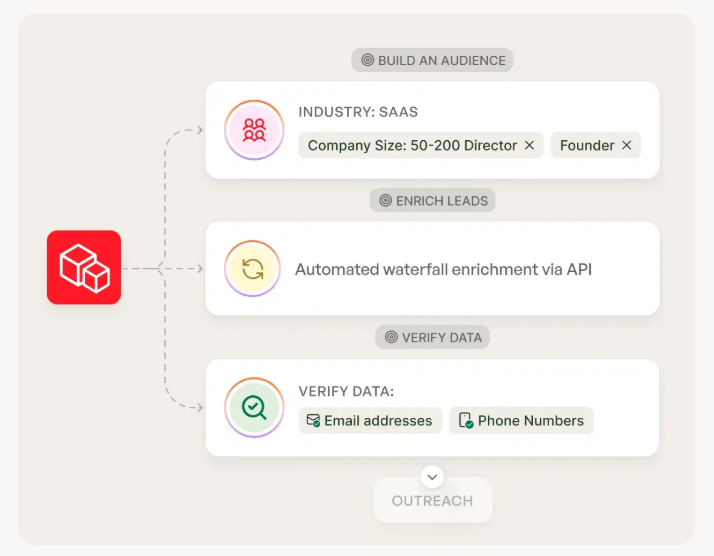
Prospeo covers 125M+ verified mobile numbers with a 30% pickup rate and integrates natively with Salesforce and HubSpot - the same CRMs both 3CX and Aircall connect to - creating a clean data-to-CRM-to-dialer pipeline. The 7-day data refresh cycle means numbers stay current, not stale. There's a free tier (75 emails + 100 Chrome extension credits/month), no contracts, and self-serve onboarding. Before you agonize over which phone system to buy, make sure the numbers you're dialing are actually live.
If you want to quantify the problem first, start with B2B contact data decay and a practical data quality scorecard. Then build a refresh workflow with BDR contact data benchmarks, and use a dedicated guide for lead generation phone numbers (including verification and compliance).
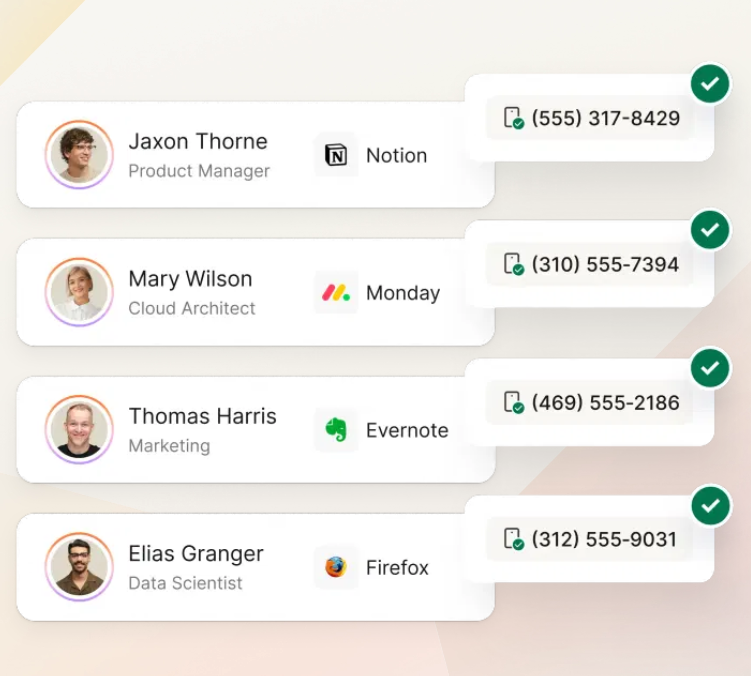
Whether you pick 3CX or Aircall, bad contact data still kills your connect rates. Prospeo delivers 98% email accuracy and verified direct dials at $0.01/lead - refreshed every 7 days, not every 6 weeks like other providers.
Stop paying more for the dialer than for data that actually connects.
3CX vs Aircall FAQ
Is 3CX really free?
Yes - the SMB Free tier supports up to 10 users with core PBX features including call routing, IVR, and mobile apps. PRO starts at ~$175/year for small systems. There aren't per-user fees, but 3CX introduced user caps per tier in early 2026 that limit scalability on lower plans.
Does Aircall charge per user or per seat?
Per user, with a 3-license minimum on all plans. A solo user pays for three seats - $90/month minimum on Essentials. Add-ons like AI ($9/user/mo) and Analytics+ ($15/user/mo) are also per-user charges, which compounds quickly as your team grows.
Is 3CX safe to use after the 2023 security breach?
3CX invested heavily post-breach: ReversingLabs binary scanning, HackerOne bug bounty, and Mandiant incident response. Security experts called the recovery "exceptional." The current security posture is arguably stronger than pre-breach - but ask your MSP about their monitoring setup before committing.
Can I use Aircall or 3CX for outbound sales dialing?
Both support outbound calling, but neither is a dedicated sales dialer. For high-volume outbound, consider JustCall or CloudTalk - and verify your contact data before loading it into any dialer. Disconnected numbers waste 45 seconds per attempt and tank rep morale.
Which platform has better CRM integrations?
Aircall wins decisively with 100+ integrations and deep CTI features - screen pops, auto-logging, native Gong and Zendesk connections. 3CX offers ~35 native integrations with shallower CRM depth. If your daily workflow centers on Salesforce or HubSpot, Aircall's integration layer is a genuine competitive advantage.