How to Build a Remote Sales Team (Full Playbook for 2026)
A RevOps lead we know hired five remote reps last year. Three quit within 90 days. The problem wasn't talent - it was the absence of a system. No onboarding plan, no defined stack, no activity benchmarks. Just "here's your login, go sell."
Building a remote sales team that actually produces requires structure, not hope. 80% of B2B interactions now happen through digital channels, and 71% of B2B buyers will spend $50K+ through a remote or self-serve model. The economics are settled. Execution is where teams fall apart.
Here's our hot take: if your average deal is under $50K, you almost certainly don't need field reps at all. Inside reps cover 4x the prospects at half the cost. Stop debating this and start building.
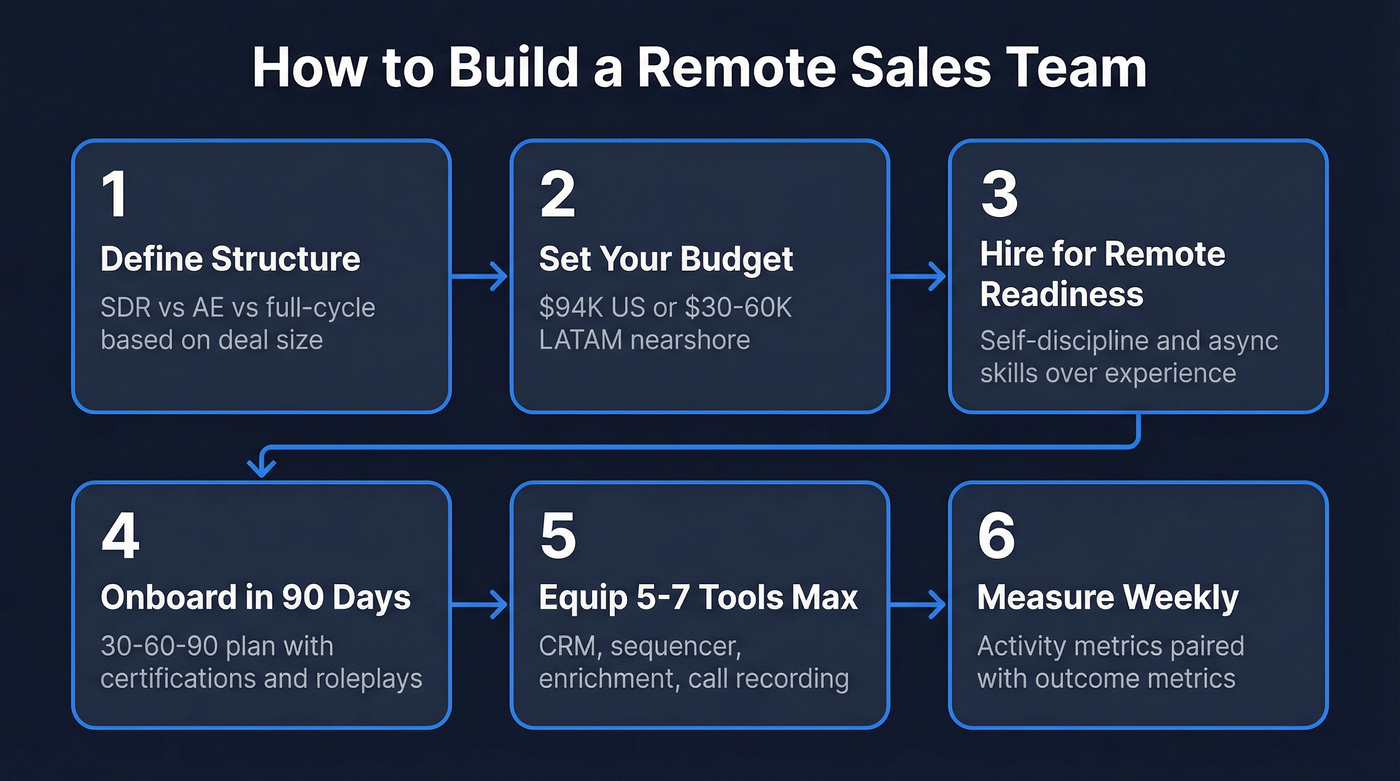
The Build Sequence
- Define structure - SDR vs. AE vs. full-cycle, based on deal complexity
- Set your budget - ~$94K/yr per US rep all-in, or go LATAM nearshore for up to 68% less
- Hire for remote readiness - self-discipline and async communication over years of experience
- Onboard with a 30-60-90 plan - certifications, roleplays, and test pipeline by Day 60
- Equip with 5-7 tools max - CRM, sequencer, enrichment/verification, call recording, enablement
- Measure weekly - activity metrics paired with outcomes, not vanity dashboards
Define Your Team Structure
Start with two SDRs and one AE. Don't hire a sales manager until you have four or more reps - before that, the founder or VP should coach directly. Inside reps now make up roughly 40% of high-growth B2B sales teams, up from about 10% in 2017, and that shift isn't slowing down.
For sub-$20K deals, full-cycle reps who prospect and close are more efficient than splitting the funnel. Once deal complexity or volume justifies specialization, add dedicated SDRs to feed your closers. (If you want a deeper system for distributed outbound, see remote prospecting.)
Budget and Compensation
| Cost Model | Annual/Rep |
|---|---|
| In-house (US, full-time) | ~$94,000 |
| Outsourced (agency) | $36,000-$66,000 |
| LATAM nearshore | $30,000-$60,000 |
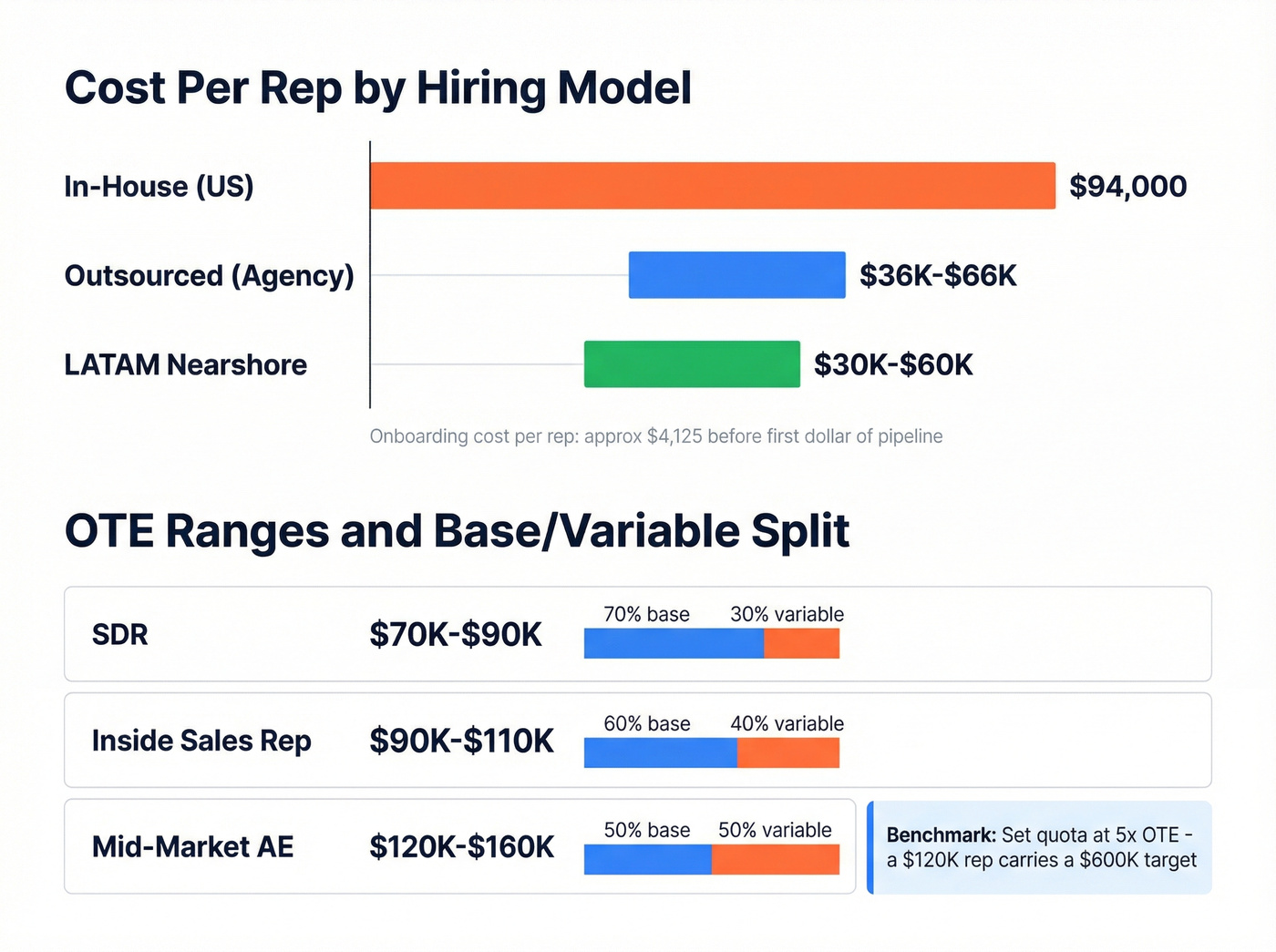
The average onboarding cost per rep runs about $4,125 before they generate a dollar of pipeline. That's real money if you're churning through hires.
| Role | OTE Range | Typical Split |
|---|---|---|
| SDR | $70K-$90K | 70/30 |
| Inside Sales Rep | $90K-$110K | 60/40 |
| Mid-Market AE | $120K-$160K | 50/50 |
Here's the thing: 87% of sales leaders set quota targets without a structured method. Tie quotas to a 5x OTE ratio as a starting benchmark - a rep earning $120K OTE should carry a $600K annual target - then adjust based on territory and ramp stage. Layer in SPIFFs for short bursts to keep energy high without distorting the comp plan.
If you need a tighter operating model for targets and reviews, build it into your sales management dashboard and keep the definitions consistent with your sales reporting dashboard.
Hire for Remote Readiness
Stop screening for "10 years of SaaS sales experience." Screen for self-discipline, written communication skills, and comfort with async work. A rep who writes clear Slack updates and manages their own calendar will outperform a seasoned closer who needs a manager hovering over their shoulder every morning.
We've seen trial periods surface red flags that five rounds of interviews miss. Two weeks of paid work on a real project tells you more than any behavioral question ever will. With average sales turnover running 35% - nearly triple the cross-industry average - getting the hire right saves you months of ramp time and replacement costs. If you want a structured interview loop, use a consistent rubric from how to interview sales candidates.
Skip candidates who can't give you a specific example of managing a complex project without daily check-ins. That single question filters out more bad remote hires than any personality assessment.

GreyScout cut rep ramp time from 8-10 weeks to 4 by giving new hires verified prospect data on day one. Prospeo's 300M+ profiles with 98% email accuracy and 7-day refresh mean your remote SDRs start booking meetings - not Googling contacts.
Stop losing your first 30 days to list building.
Onboard in 90 Days
Only 14% of companies have a documented sales process. That means 86% of new hires are figuring it out on their own. This framework prevents that.
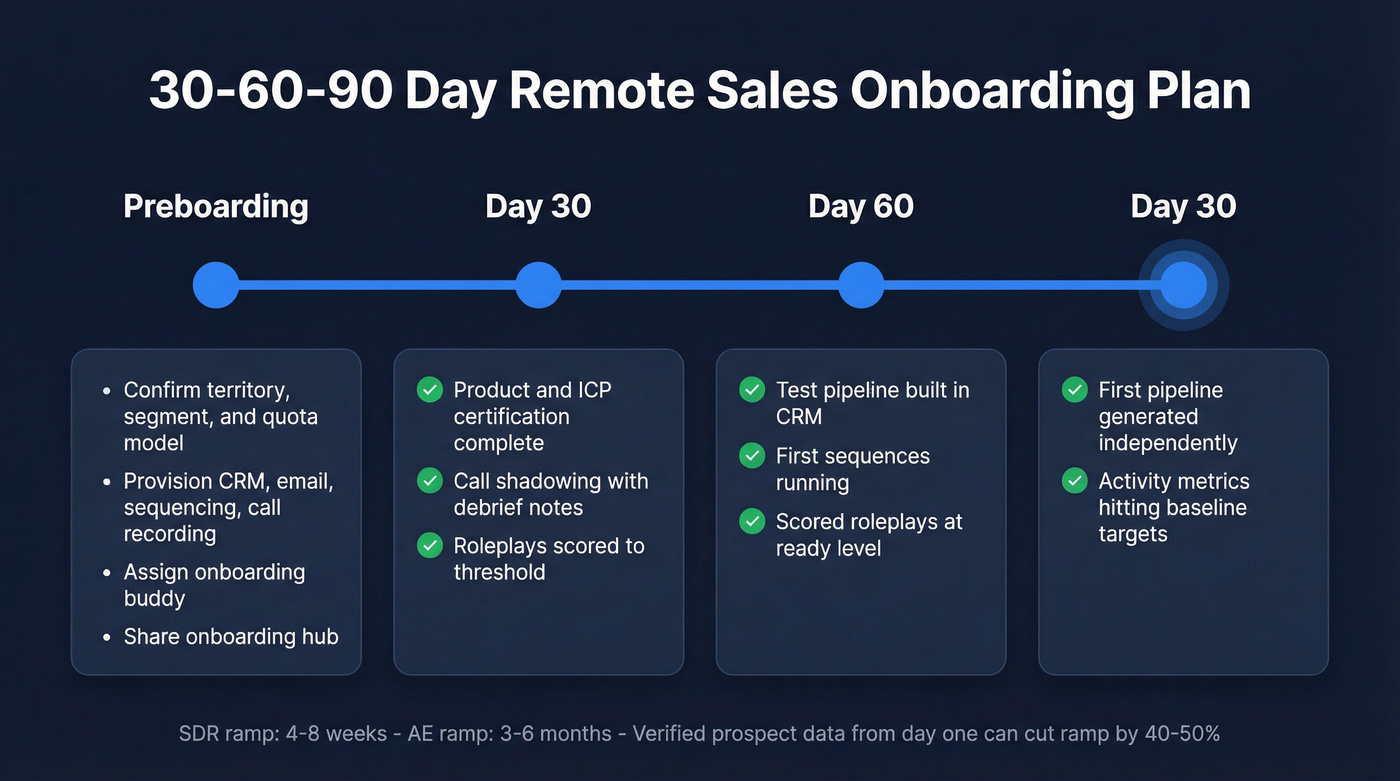
Preboarding: Confirm territory, segment, and quota model. Provision CRM, email, sequencing, and call recording access. Assign an onboarding buddy and share the onboarding hub. (For a full checklist, align this with your remote sales onboarding docs.)
Day 30 - Product and ICP certification complete. Call shadowing with debrief notes. Roleplays scored to threshold.
Day 60 - Test pipeline built in CRM. First sequences running. Scored roleplays at "ready" level.
Day 90 - First pipeline generated independently. Activity metrics hitting baseline targets.
Expect SDRs to ramp in 4-8 weeks and AEs in 3-6 months. GreyScout cut ramp time from 8-10 weeks to 4 weeks by giving new hires verified prospect data from day one instead of making them build lists manually. When reps spend their first week Googling email addresses instead of learning the product, you've already lost momentum that's hard to recover.
Build a Lean Tech Stack
Tech-burdened sellers are 43% less likely to hit their targets. Five to seven tools is the ceiling. In our experience, teams that start with more than seven spend more time configuring than selling. If you’re standardizing your tooling, start with a B2B sales stack blueprint and keep it aligned to a simple sales tools checklist.
| Category | Tool Example | Approx. Price |
|---|---|---|
| CRM | HubSpot | Free tier available; paid plans vary |
| Sequencing | Instantly / Smartlead | ~$30-97/mo |
| Enrichment/Verification | Prospeo | Free tier, 75 emails/mo; ~$0.01/email at scale |
| Call Recording | Gong / Chorus | ~$100+/user/month |
| Enablement | Notion / Loom | Free tiers available |
Before your SDRs send a single email, they need verified contacts. Prospeo delivers 98% email accuracy across 300M+ professional profiles on a 7-day refresh cycle, which means your reps start prospecting with real data on day one instead of spending their first week building lists from scratch. The free tier lets you validate the tool before committing a dollar. (If you’re comparing options, see email ID validators and email verification for outreach.)

Audit your stack twice a year. Kill anything that doesn't directly feed pipeline or close deals.
KPIs That Predict Revenue
84% of reps missed quota last year. Most of them were busy. Activity without conversion tracking is just noise.
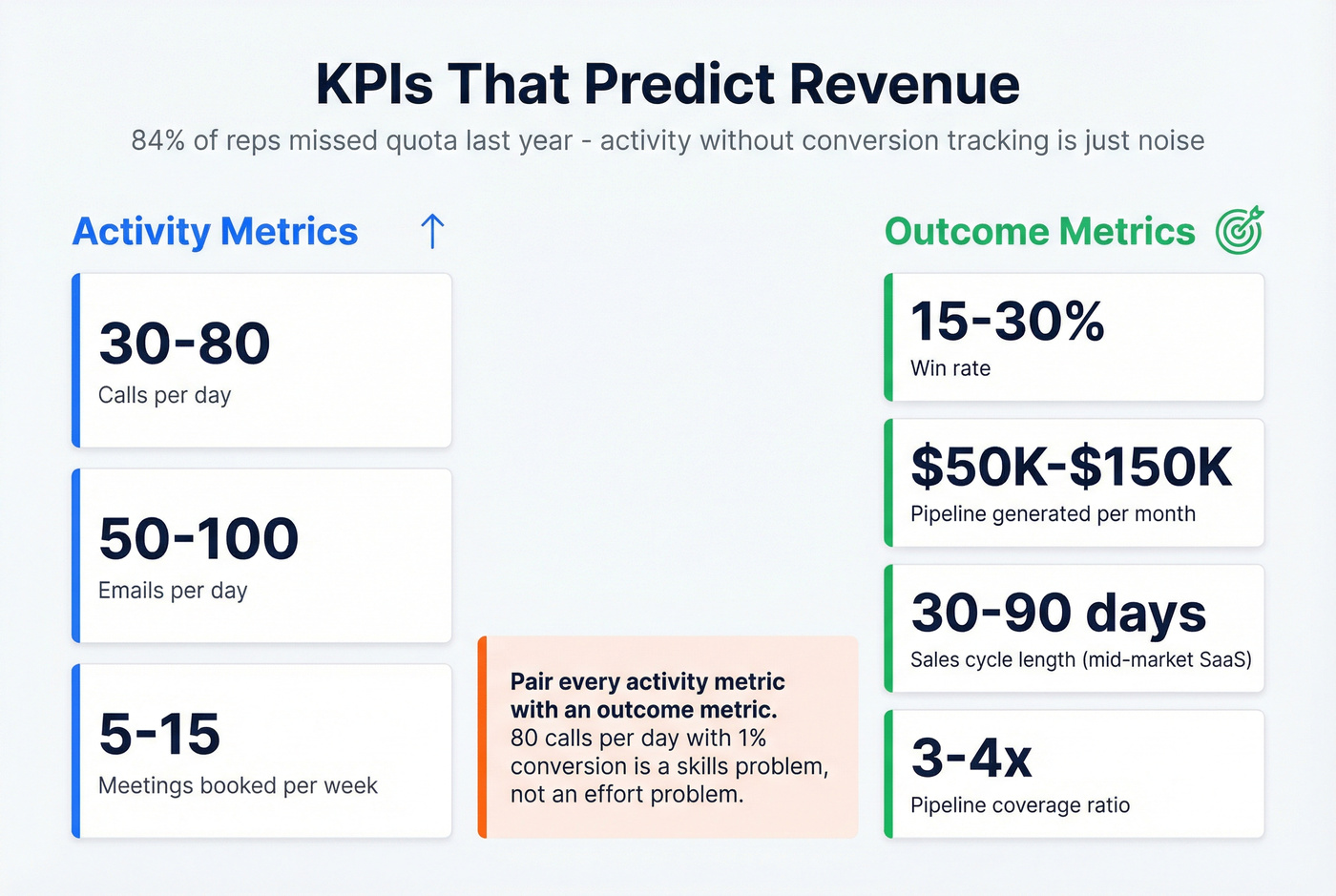
| Metric Type | What to Track | Target Range |
|---|---|---|
| Activity | Calls/day | 30-80 |
| Activity | Emails/day | 50-100 |
| Activity | Meetings booked/week | 5-15 |
| Outcome | Pipeline generated/mo | $50K-$150K (ACV-dependent) |
| Outcome | Win rate | 15-30% |
| Outcome | Sales cycle length | 30-90 days (mid-market SaaS) |
| Outcome | Pipeline coverage | 3-4x target |
Pair every activity metric with an outcome metric. A rep making 80 calls a day with a 1% meeting conversion rate has a skills problem, not an effort problem. Weekly reviews should surface these patterns before they become quarterly misses - and if you're only looking at dashboards monthly, you're already too late. For benchmark ranges and what “good” looks like by role, use SDR conversion rate targets.
Team Building That Works Remotely
Let's be honest about the three patterns that consistently destroy distributed sales orgs. First, no documented process - reps improvise and results vary wildly. Second, pipeline interrogation disguised as coaching, where "why isn't this deal closed?" passes for development. Third, bad contact data treated as a minor inconvenience instead of the infrastructure failure it actually is.
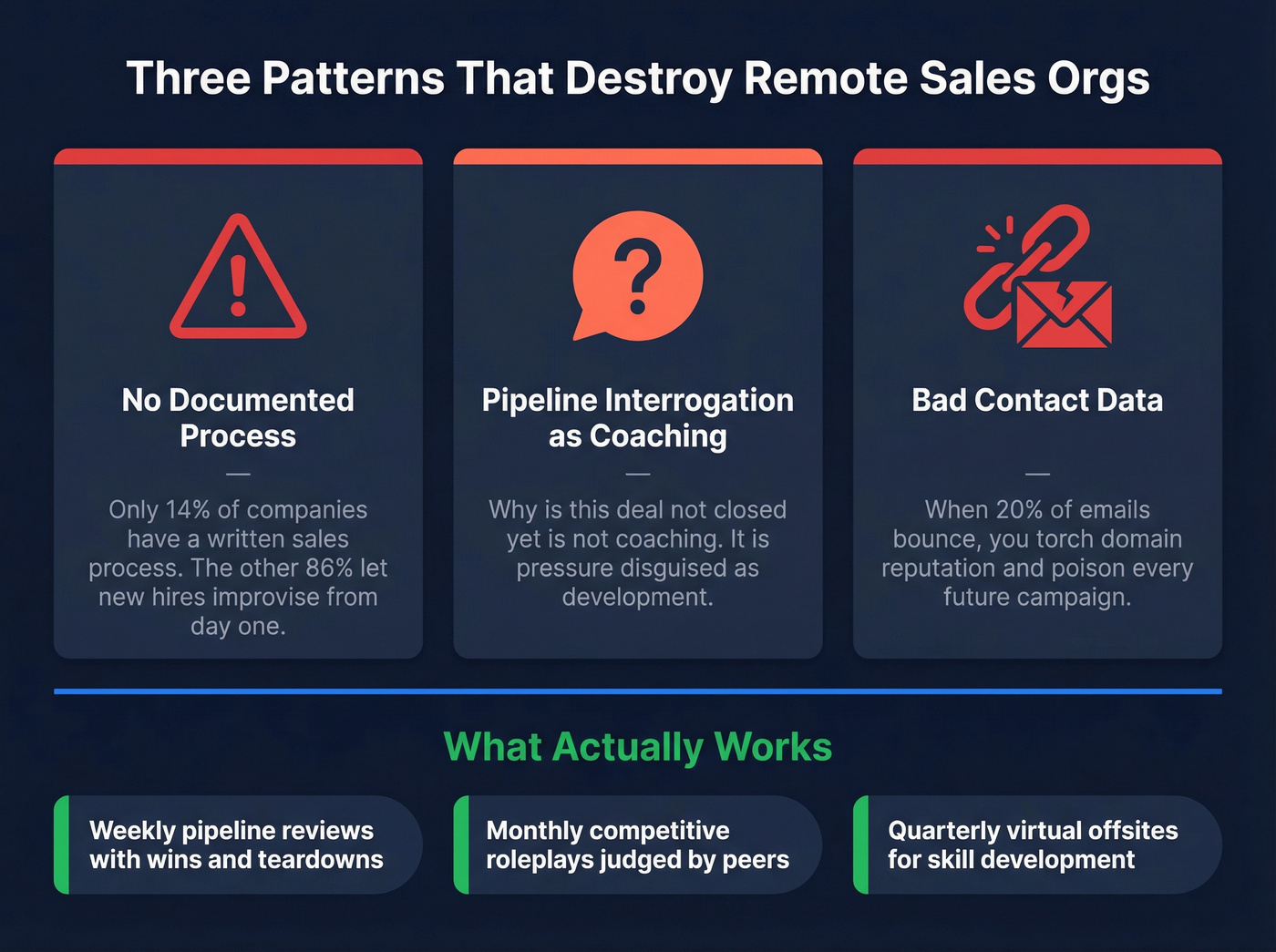
Beyond avoiding those mistakes, invest in rituals that create real cohesion. Weekly pipeline reviews where reps share wins and teardowns. Monthly competitive roleplays judged by peers. Quarterly virtual offsites focused on skill development. These keep distributed teams aligned without forcing awkward icebreakers nobody wants. Remote team building isn't about trivia nights - it's about shared context that makes async collaboration possible. If you want a repeatable coaching cadence, borrow from sales coaching best practices.
If your reps are spending more than 15 minutes per day finding contact data, your stack is broken. Fix that before you fix anything else. When 20% of your emails bounce, you're not just wasting rep time - you're torching your domain reputation and poisoning every future campaign. The consensus on r/sales is pretty clear on this: bad data is the silent killer of outbound programs, and most teams don't realize it until deliverability craters.
Your lean tech stack needs enrichment that won't break the budget. Prospeo starts free with 75 verified emails per month and scales at ~$0.01/email - 90% cheaper than ZoomInfo. Native integrations with HubSpot, Smartlead, and Instantly mean zero extra configuration for your remote team.
Equip every remote rep with enterprise-grade data at startup pricing.
FAQ
How many reps should I start with?
Two SDRs and one AE. Don't hire a manager until you have four or more reps - the founder or VP should coach directly until then. For sub-$30K deal cycles, full-cycle reps are more capital-efficient than splitting the funnel early.
Should I outsource or build in-house?
Build in-house first. Outsourcing runs $3,000-$5,500/mo per rep and sounds cheap, but you lose control of messaging quality and iteration speed. Outsource overflow once your internal playbook is proven and repeatable.
How long does it take to ramp a remote rep?
SDRs typically ramp in 4-8 weeks; AEs take 3-6 months depending on deal complexity. Companies that give new hires verified prospect data from day one - instead of making them build lists manually - consistently cut ramp time by 40-50%.
What's the biggest mistake when building a distributed sales org?
Skipping the documented sales process. Only 14% of companies have one, which means most new hires are improvising from day one. A written playbook covering ICP, objection handling, and qualification criteria is the single highest-ROI investment before you hire your first rep.