How to Interview Sales Candidates: The System That Actually Predicts Performance
Your last sales hire crushed the interview. Confident handshake, polished answers, a story for every behavioral question. Six months later, they're at 40% of quota and you're back on the phone with recruiters. A bad sales hire costs $150K-$750K - that's 1-5x their annual salary when you factor in ramp time, lost pipeline, and the opportunity cost of an empty territory. The U.S. Department of Labor puts the floor at 30% of first-year earnings, and that's before you count the deals that never happened.
Here's the core problem: salespeople are professional persuaders. They're trained to make you feel good about saying yes. Learning how to interview sales candidates means accepting that traditional interviews are uniquely unreliable for sales roles - the skill you're evaluating is the same skill that makes candidates look great in a conversation that has nothing to do with actual selling. I've watched hiring managers fall for this false confidence trap over and over, and the pattern never changes: great interview, terrible quota attainment.
What You Need (Quick Version)
Three things separate teams that hire well from teams that churn through reps every 18 months:
- Structured 4-stage process. Not a free-flowing chat. Structured interviews predict performance at 0.55-0.70 validity - roughly double the predictive power of unstructured ones.
- Weighted competency scorecard. Eight competencies max, scored independently before any debrief. No anchoring bias, no "I liked them" overriding the data.
- One 15-minute role-play. A short role-play often predicts performance better than an hour of behavioral questions.
The 4-Stage Sales Interview Process
Every stage has a job. Skip one and you're guessing.
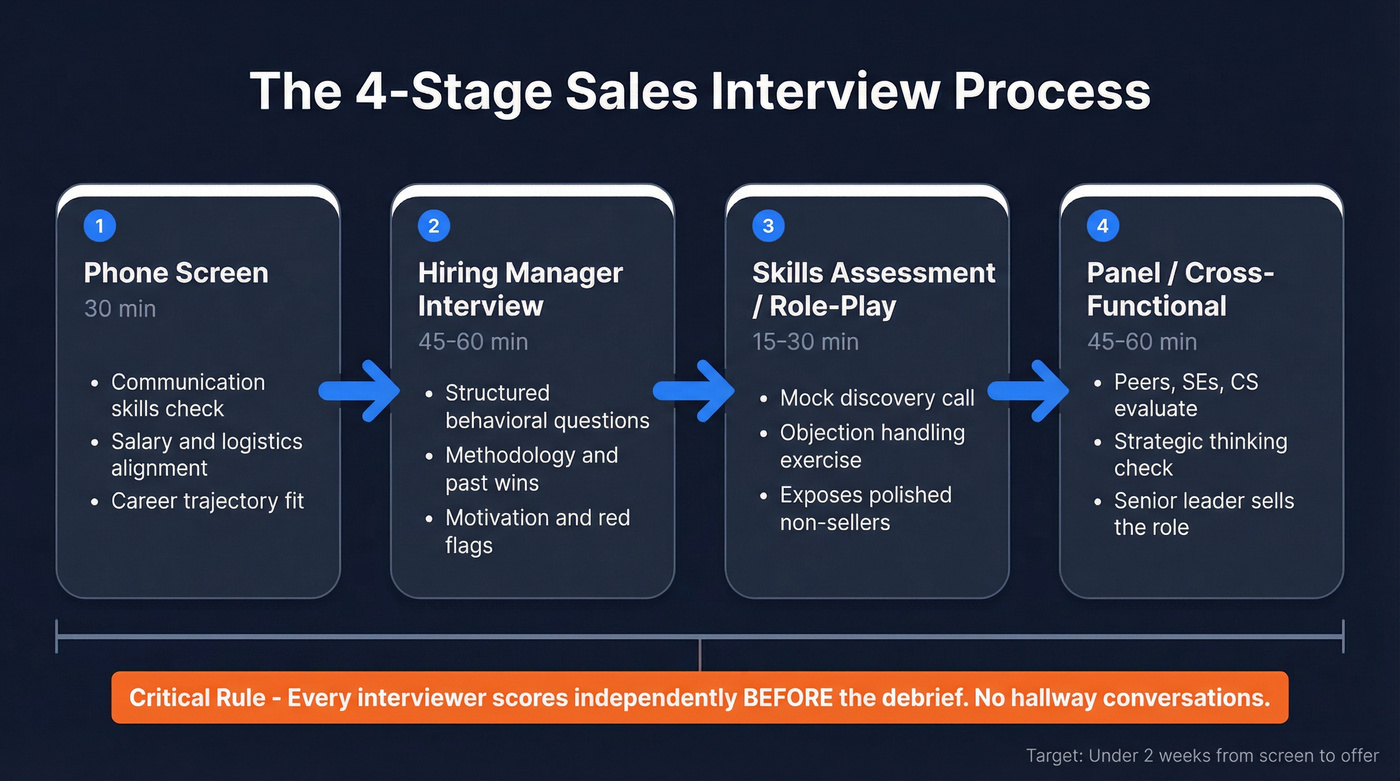
Stage 1: Phone screen (30 minutes). Basic fit check - communication skills, logistics, salary expectations, career trajectory. You're filtering out obvious mismatches, not evaluating selling ability. If they can't articulate why they want this specific role in 30 minutes, they won't articulate your value prop to prospects either.
Stage 2: Hiring manager interview (45-60 minutes). This is where structured behavioral and situational questions do the heavy lifting, and where that 0.55-0.70 validity advantage actually comes from. Consistent questions across every candidate. No improvising. You're evaluating methodology, past achievements, motivation, and red flags.
Stage 3: Skills assessment / role-play. The moment of truth. A mock discovery call, an objection-handling exercise, or a live pitch. This is where polished interviewers who can't actually sell get exposed.
Stage 4: Panel or cross-functional interview. Peers, SEs, CS leaders, or marketing - each evaluating a distinct dimension. Optional senior leader close to assess strategic thinking and sell the candidate on the role.
The critical rule: every interviewer completes their scorecard independently before the debrief. The moment a hiring manager says "I loved them" in a hallway conversation, you've contaminated every subsequent evaluation. Send rejection emails within 2-3 days - top candidates judge your company by how you treat them when they don't get the job.
Questions That Predict Performance
Drop "Why do you want to work in sales?" and "Tell me about yourself." Those questions test polish, not performance. Meta-analyses from the Journal of Applied Psychology show situational questions predict performance at 0.41-0.47 corrected validity, so 30-40% of your questions should be hypothetical job dilemmas, not backward-looking stories.
Behavioral Questions
- "Walk me through your last lost deal. What happened, and what would you change?" A strong answer includes specific deal details, honest self-assessment, and a lesson applied to a later win.
- "Tell me about a quarter where you were behind at the halfway mark. What did you do?" You want concrete pipeline-building actions, not vague "I worked harder."
- "Describe a time you had to sell against an entrenched competitor." Listen for a differentiation strategy, not feature-dumping.
Situational Questions
- "You're three weeks into a deal and the champion goes silent. Walk me through your next five moves." A strong answer involves multi-threading into other contacts, not just "follow up again."
- "A prospect says your price is 40% higher than the competitor. What do you say - right now?" The best candidates reframe value and ask discovery questions. They don't immediately discount.
Pipeline Math
- For SDRs: "If your target is 15 qualified meetings per month and your connect rate is 8%, how many dials do you need daily?" Strong candidates do the math quickly, then pivot to talking about improving the rate.
- For AEs: "You have a $1.2M annual quota. Walk me through your territory plan for the first 90 days." You want account segmentation by tier, quick wins identified, and a coverage model sketched out.

Your new hire's first 90 days depend on pipeline quality. Prospeo gives reps 300M+ profiles with 98% email accuracy and 125M+ verified mobiles - so that territory plan they pitched in the interview actually converts.
Set your next hire up to crush quota from day one.
Build Your Interview Scorecard
Limit your scorecard to eight competencies. Each takes roughly 10 minutes to assess properly, which means you're looking at around 80 minutes of competency coverage across the full process - long enough to be thorough, short enough that interviewers stay sharp.
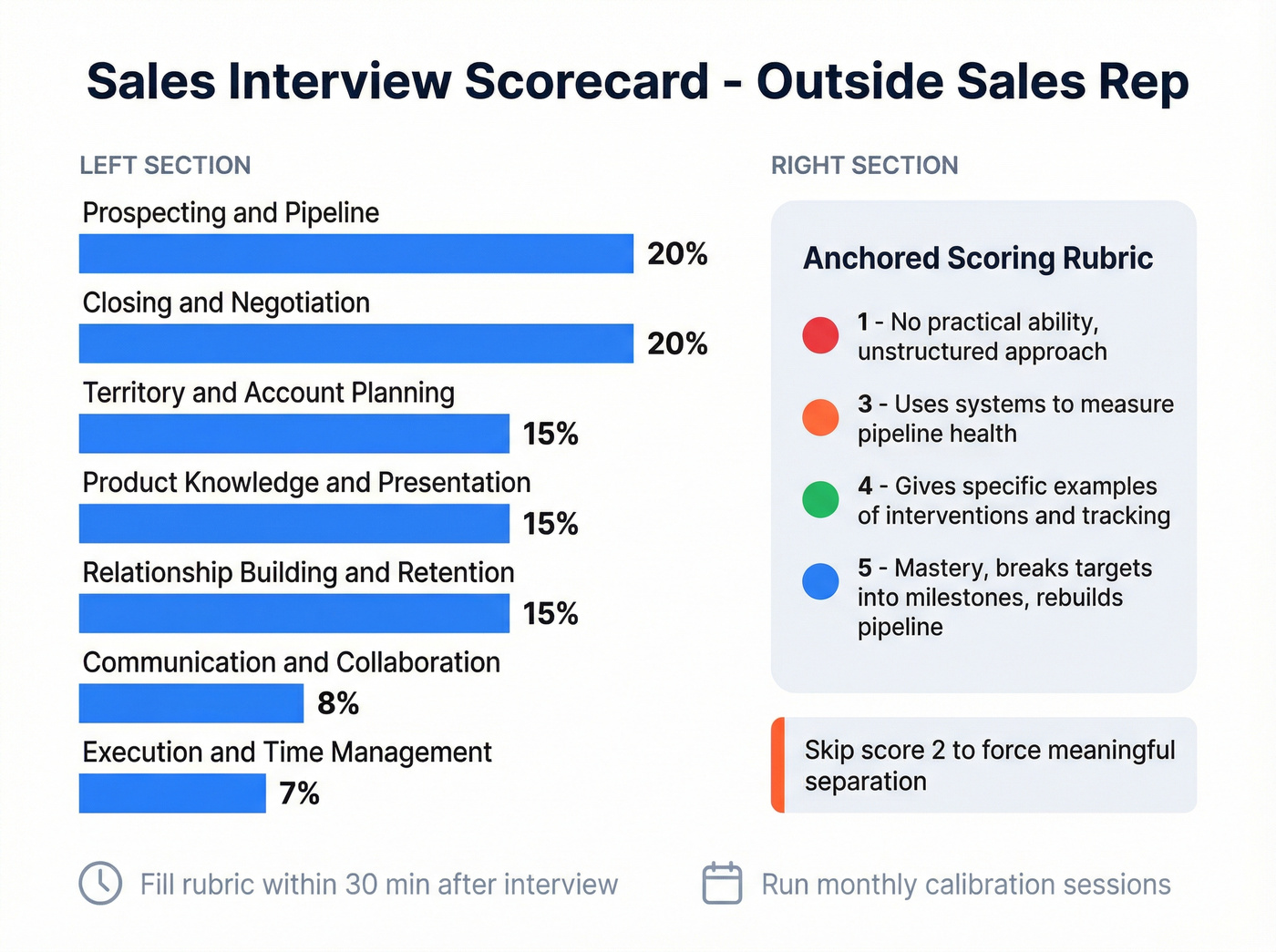
Use a simple weighting system: 1 (standard), 1.5 (important), or 2 (critical). Here's a starting point for an outside sales rep:
| Competency | Weight | What a "4" Looks Like |
|---|---|---|
| Prospecting & Pipeline | 20% | Gives specific examples of pipeline interventions; effective forecasting |
| Closing & Negotiation | 20% | Navigates pricing objections with logic; creates urgency without pressure |
| Territory & Account Planning | 15% | Segments accounts by potential; builds a coverage model |
| Product Knowledge & Presentation | 15% | Adapts demo to buyer's pain; handles curveball questions |
| Relationship Building & Retention | 15% | Multi-threads within accounts; earns referrals |
| Communication & Collaboration | 8% | Clear written/verbal skills; works cross-functionally |
| Execution & Time Management | 7% | Manages 50+ accounts without dropping balls |
Score on an anchored 1/3/4/5 rubric - skip "2" to force meaningful separation. We've found this single change eliminates the mushy middle where every candidate lands on a 3. For "Building and Managing a Pipeline," a 1 means no practical ability and an unstructured approach, while a 3 means they use systems to measure pipeline health. A 4 means they give examples of specific interventions and demonstrate effective tracking and forecasting. A 5 is mastery - they break targets into milestones and describe multiple methods to rebuild pipeline when it dries up.
Two process rules that make scorecards actually work: fill the rubric within 30 minutes after the interview because memory decays fast, and run monthly calibration sessions where your interview panel scores the same sample answers to stay aligned.
Role-Plays That Reveal the Real Candidate
Let's be honest: a 15-minute mock discovery call tells you more about a candidate than an hour of "tell me about a time" questions. Behavioral questions test storytelling. Role-plays test selling. Ask any experienced sales leader and they'll say the same thing - the role-play is where the truth comes out.
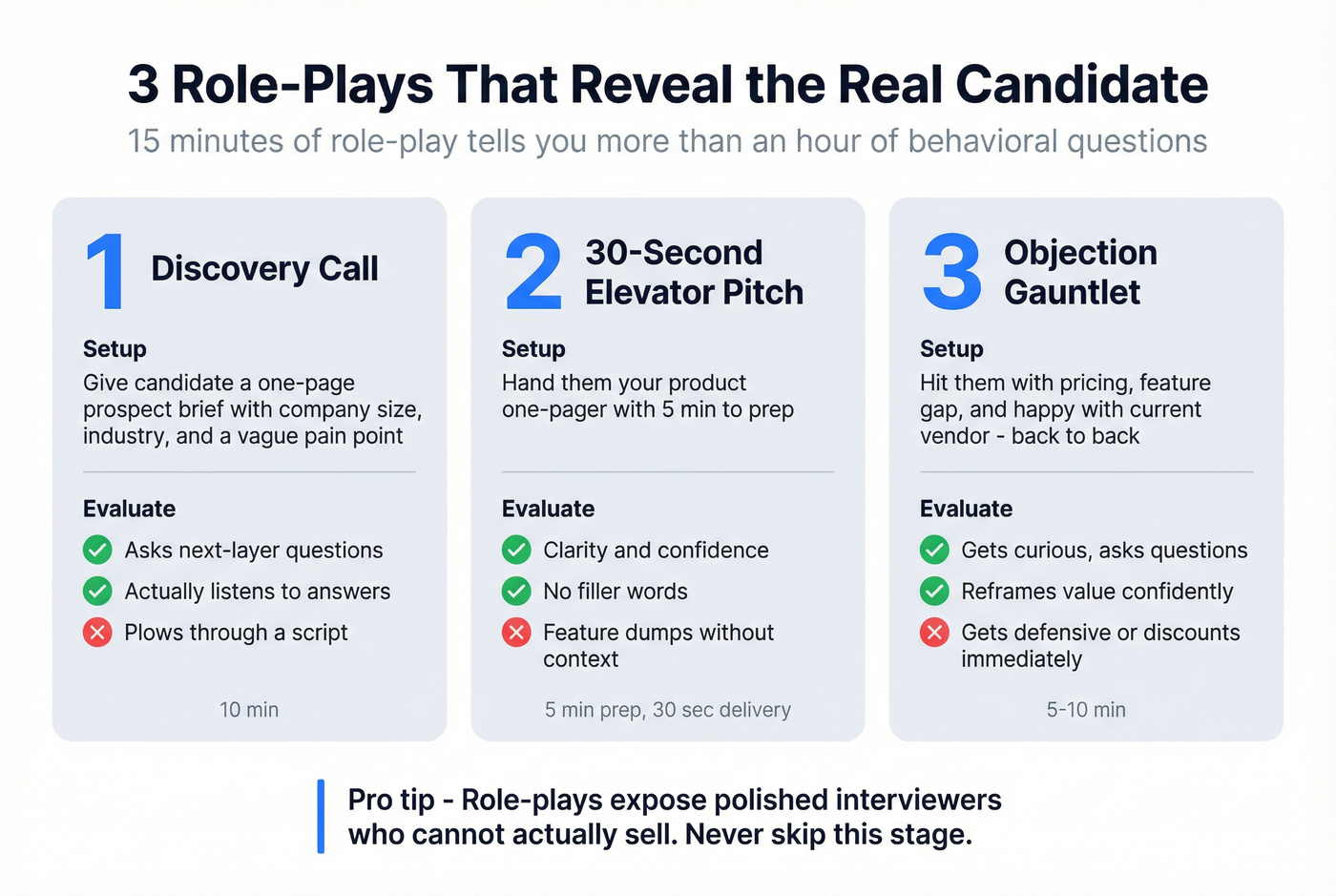
Discovery call role-play. Give the candidate a one-page prospect brief with company size, industry, and a vague pain point. They get 10 minutes to run discovery with you as the prospect. Evaluate whether they ask "next layer" questions and actually listen to your answers instead of plowing through a script.
30-second elevator pitch. Hand them your product's one-pager with five minutes to prep. Evaluate clarity, confidence, and the absence of filler words.
Objection handling. Hit them with a pricing objection, then a feature gap, then "we're happy with our current vendor." The best candidates get curious when they hear an objection. They don't get defensive.
SDR vs. AE: Tailor the Evaluation
SDR interviews and AE interviews should share maybe 30% of the same questions. The roles are fundamentally different.
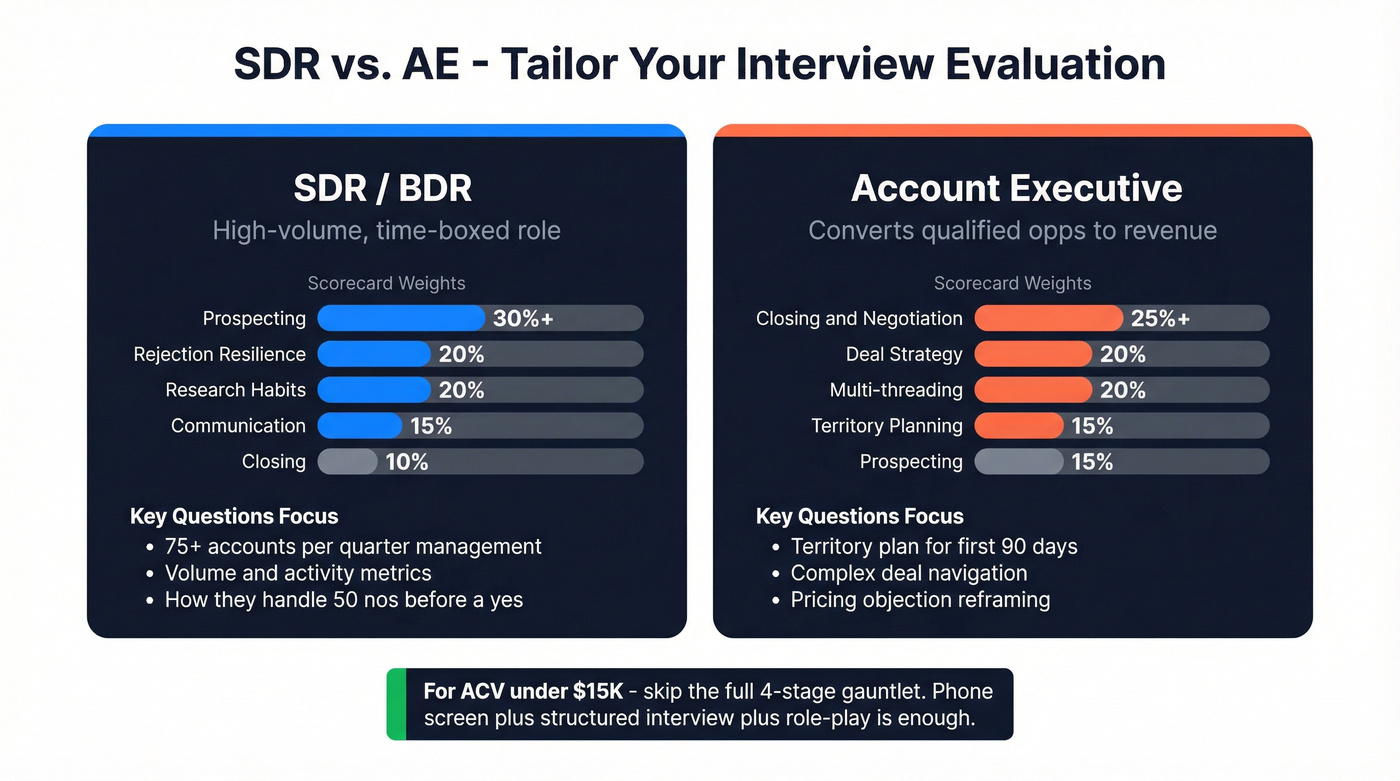
SDRs typically handle inbound lead qualification, while BDRs focus on outbound prospecting - and plenty of orgs blend the two. Either way, the job is high-volume and time-boxed. Bridge Group research shows 58% of SDRs juggle 75+ accounts per quarter. Weight Prospecting at 30%+ on your SDR scorecard and drop Closing to 10%. Focus your SDR questions on volume management, rejection resilience, and research habits - these traits matter far more than closing ability at this stage.
AEs convert qualified opportunities into revenue. Weight Closing & Negotiation at 25%+ and add deal strategy and multithreading as evaluation criteria.
For teams with average contract values under $15K, you probably don't need a five-round interview gauntlet. A phone screen, one structured interview, and a role-play will tell you everything you need to know. Save the full four-stage process for roles where a bad hire costs you a territory for a year.
Set Your New Hire Up to Succeed
You just spent weeks running a rigorous process. Don't waste it by handing your new rep a laptop and a stale contact list.
Ramp time runs 3-6 months for SMB and mid-market roles, 6-12 months for enterprise. The single fastest way to compress that timeline is giving new reps verified contact data from day one so they're prospecting real accounts instead of cleaning spreadsheets. One team we've seen, GreyScout, cut rep ramp time from 8-10 weeks down to 4 by giving new hires clean, verified lists built with Prospeo on their first day - 300M+ professional profiles with 98% email accuracy and a 7-day refresh cycle, so the data doesn't go stale before the rep finishes onboarding.
If you want that ramp to stick, pair clean data with remote sales onboarding and tight CRM hygiene so reps aren’t fighting bad inputs.
That pipeline math question you just asked? The answer gets a lot easier when your reps start with verified data. Prospeo's 30% mobile pickup rate means fewer wasted dials and more conversations - at $0.01 per email.
Stop hiring great reps and handing them bad data.
FAQ
How many interviews should a sales candidate go through?
Four stages is the sweet spot for most roles: phone screen, hiring manager interview, role-play, and panel. Fewer than four and you'll miss critical signals. More than five causes top candidates to drop off - keep the total process under two weeks from first screen to offer.
What's the biggest mistake when interviewing sales candidates?
Relying on gut feel instead of a weighted scorecard. Unstructured interviews predict performance at roughly half the rate of structured ones, around 0.20-0.30 validity vs. 0.55-0.70. Define your competencies before you start interviewing and score every candidate on the same rubric.
How do you screen sales candidates before the live interview?
Verify quota attainment claims - ask for W-2s or pay stubs showing commission income, because real quota crushers don't hesitate. Request specific deal names you can reference-check with the buyer or their former manager. Vague answers on pipeline math like coverage ratios, win rates, and deal cycles are a red flag. Combining resume verification with a structured phone screen is the most reliable way to avoid wasting interview slots on polished storytellers.
What tools help new sales hires ramp faster after hiring?
Verified B2B data platforms cut ramp time significantly. Pair clean contact data with a structured onboarding playbook and CRM enrichment, and new reps can start real outbound on day one instead of spending their first month building lists from scratch.