Director of Sales Operations: The Definitive 2026 Guide
You just got promoted. Day one as director of sales operations, and the firehose is already running - the CEO wants a new territory model by Friday, the CRO needs a forecast she can defend to the board, and three reps are complaining about bounced emails tanking their sequences. Meanwhile, the marketing ops team just dumped 4,000 "leads" into Salesforce with no routing rules, and your phone won't stop buzzing with Slack messages that all start with "quick question."
Welcome to the role that sits at the intersection of strategy, technology, and organizational sanity.
This role makes the revenue engine actually work. Not by selling, but by building the systems, processes, and data infrastructure that let sellers sell. Reps spend just 28% of their time actually selling - the rest disappears into admin, CRM updates, and chasing bad data. Your job is to claw back as much of that lost time as possible. The stakes are real: companies with dedicated sales ops teams achieve 15-20% higher revenue growth than those without.
Think of it as the backbone of the sales org. You own the tech stack, the forecasting methodology, the territory design, and the data quality that underpins all of it. When things work, nobody notices. When they don't, everyone notices immediately.
Role, Pay, and Path at a Glance
| Dimension | Summary |
|---|---|
| The Role | Leader owning sales process, tech stack, data, and forecasting so reps focus on selling |
| Total Comp | $157K-$253K (25th-75th); $197K median. Top-paying companies push roughly $250K-$430K+ |
| Path | 3-5 years from Sales Ops Manager, anchored by owning a major initiative and proving revenue impact |
Core Responsibilities
The best framework for understanding the role breaks into four pillars. Every director of sales operations balances all four, though the weight shifts depending on company stage and team size.
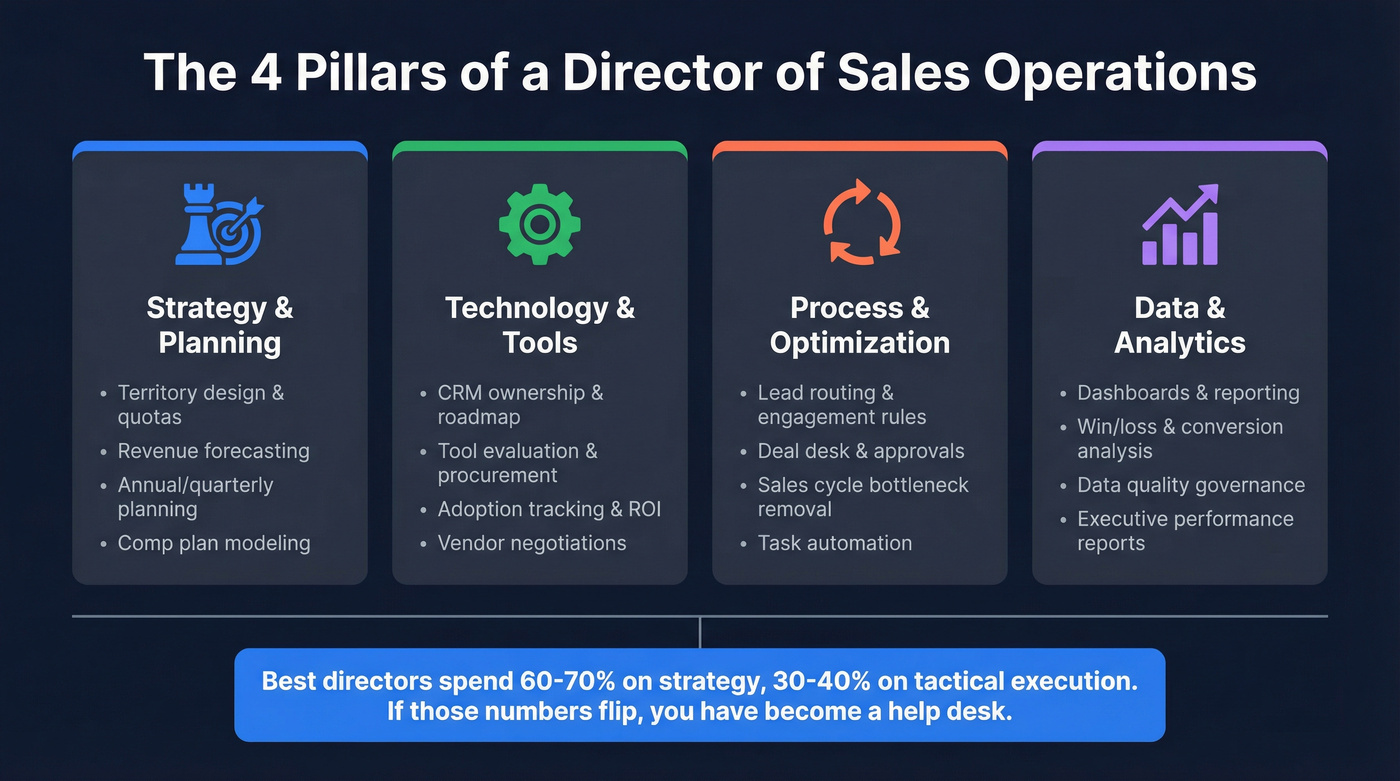
Strategy & Planning
- Territory design and quota allocation
- Revenue forecasting and pipeline analysis (see sales forecast methods and tradeoffs)
- Annual/quarterly planning with sales leadership
- Comp plan design and modeling
Technology & Tools
- CRM ownership and roadmap - Salesforce, HubSpot, or whatever your org runs
- Tool evaluation, procurement, and integration management
- Adoption tracking and ROI measurement
- Vendor negotiations and contract renewals
Process & Optimization
- Lead routing and rules of engagement (tighten SLAs with lead qualification)
- Deal desk and approval workflows
- Sales cycle analysis and bottleneck removal (common blockers: sales pipeline challenges)
- Automation of repetitive tasks (where AI CRM data entry automation helps most)
Data & Analytics
- Dashboard and reporting infrastructure (build a durable sales reporting dashboard)
- Win/loss analysis and pipeline conversion metrics
- Data quality governance and enrichment (start with CRM hygiene)
- Performance reporting to the executive team
The staffing benchmark is roughly 1 sales ops professional per 30 reps. As director, you're overseeing that ratio and deciding where to invest headcount versus tooling.
The best directors spend 60-70% of their time on high-level work and 30-40% on tactical execution. If those numbers are inverted, you've become a help desk. That's the single biggest trap in this role - getting pulled into ad-hoc requests, CRM policing, and "can you pull this report?" busywork until you've lost all strategic leverage. We've watched it happen to smart people who couldn't say no fast enough.
Director vs Manager: The Real Difference
Most director job descriptions are wish lists, not role definitions. The real distinction comes down to scope and authority.
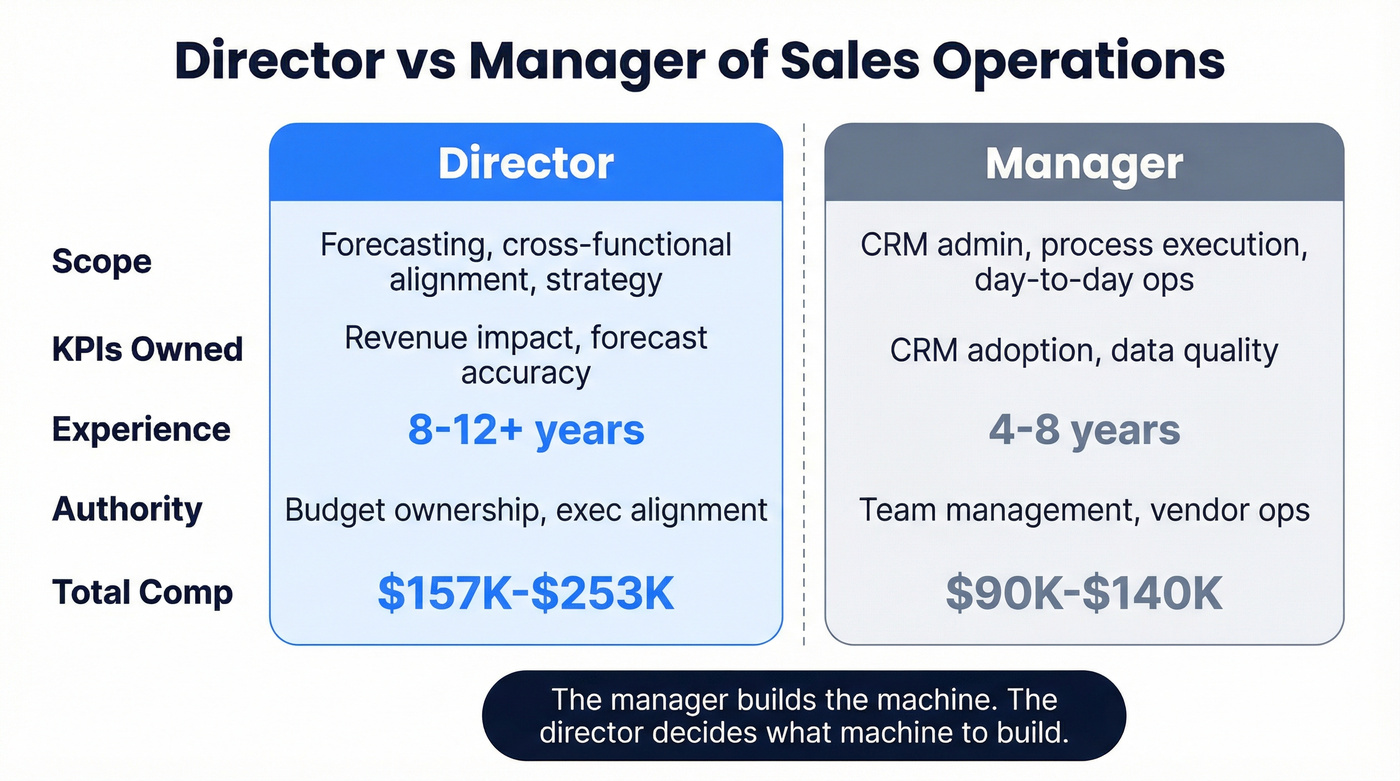
| Dimension | Director | Manager |
|---|---|---|
| Scope | Forecasting, cross-functional alignment | CRM admin, process execution |
| KPIs Owned | Revenue impact, forecast accuracy | CRM adoption, data quality |
| Experience | 8-12+ years | 4-8 years |
| Authority | Budget ownership, exec alignment | Team management, vendor ops |
| Typical Comp | $157K-$253K total | $90K-$140K total |
The manager builds and maintains the machine. The director decides what machine to build.
In practice, the line blurs constantly - especially at smaller companies where the director is also the manager, the analyst, and the CRM admin. But the career jump from manager to director is fundamentally about moving from "how do we execute this?" to "what should we execute, and why?"
Salary & Compensation in 2026
Two major aggregators give slightly different views, and both are useful.
PayScale puts the average base salary at $132K, with a range from $94K at the 10th percentile to $181K at the 90th. Bonus adds $10K-$40K, and commission ranges from $4K-$55K depending on how close the role sits to revenue.
Glassdoor paints a broader picture with a median total pay of $197K. Base runs $113K-$171K, with additional pay from bonus, commission, and equity adding $44K-$82K on top.
Most director-level comp plans use a 70/30 or 80/20 pay mix - 70-80% base salary with 20-30% variable tied to team or company targets. Unlike quota-carrying reps, the variable component usually ties to forecast accuracy, pipeline health, or revenue attainment rather than individual deals. In mid-market SaaS, quota-to-OTE ratios typically run 1-3x; in non-tech industries, that ratio can stretch to 10-20x.
At pre-IPO companies, equity can add $50K-$200K+ in annual value depending on stage and valuation trajectory. Don't ignore this when comparing offers - a lower base with strong equity at a Series B can outperform a higher base at a public company by a wide margin.
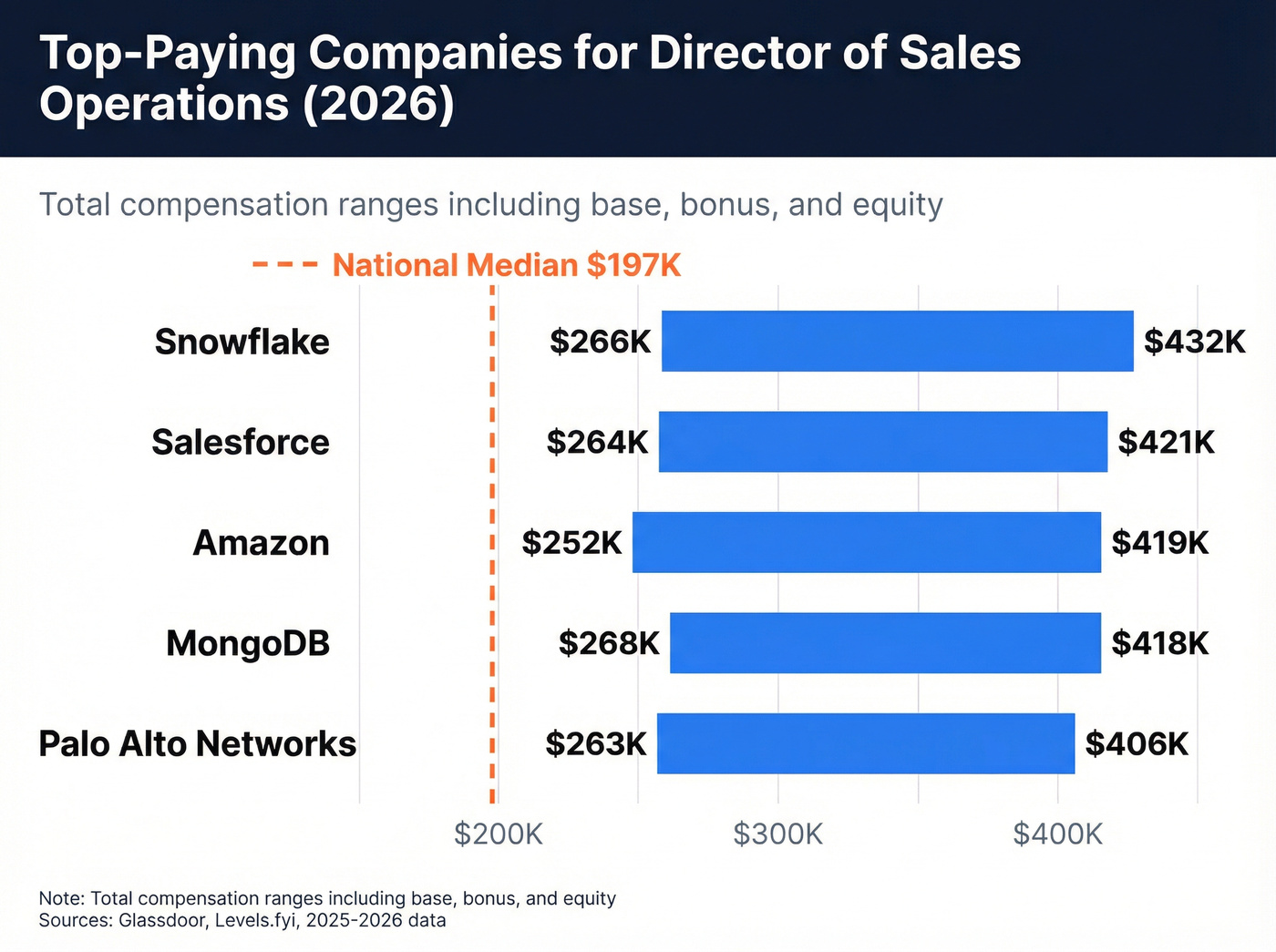
Top-Paying Companies
| Company | Total Comp Range |
|---|---|
| Snowflake | $266K-$432K |
| Salesforce | $264K-$421K |
| Amazon | $252K-$419K |
| MongoDB | $268K-$418K |
| Palo Alto Networks | $263K-$406K |
Industry & Geography Premiums
The highest-paying industry is information technology at $261,609 median total, followed by telecommunications at $203,578. SF and NYC carry a 15-25% premium above the national median. Startups typically offer lower base with meaningful equity upside; enterprise companies offer higher base with smaller variable components.
Here's the thing about OTE figures in job postings: they assume 100% quota attainment. OTE = base salary + on-target variable. If the company's quota methodology is aggressive, that posted OTE is aspirational. Always ask what percentage of the team hit 100% last year.

Reps spend 72% of their time not selling - and bad data is a huge reason why. Prospeo's 98% email accuracy and 7-day refresh cycle mean fewer bounces, cleaner sequences, and less CRM policing for your ops team. At $0.01/email, it costs less than the 15 minutes a rep wastes chasing a dead address.
Stop being the team's help desk for bad contact data.
The Tech Stack You'll Own
The average sales team runs 13 tools. That's too many. The best directors consolidate, not add.
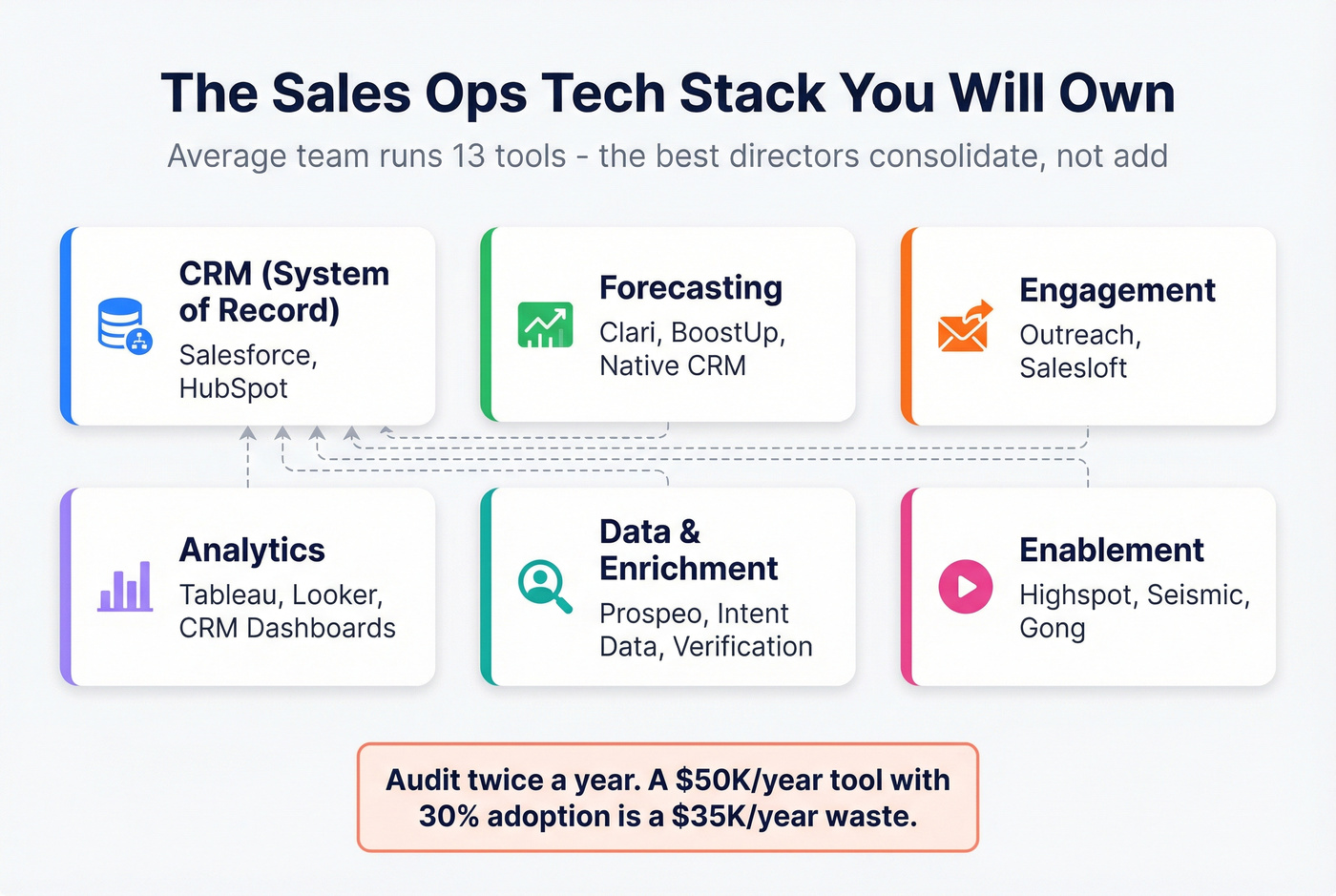
Your stack typically spans six categories:
- CRM: Salesforce, HubSpot - the system of record
- Forecasting: Clari, BoostUp, or native CRM forecasting
- Engagement: Outreach, Salesloft, or similar sequencing platforms (optimize sales cadences)
- Analytics: Tableau, Looker, or CRM-native dashboards
- Data & Enrichment: Contact databases, email verification, intent data (see B2B contact data decay)
- Enablement: Highspot, Seismic, Gong
Audit the stack twice a year. Not just for cost - for adoption. A $50K/year tool that 30% of reps actually use is a $35K/year waste. In our experience, the directors who run the tightest stacks aren't the ones who buy the fewest tools. They're the ones who kill underperforming tools fastest.
Data quality deserves special attention because it cascades everywhere. Bad contact data doesn't just mean bounced emails - it means polluted forecasts, wasted rep time, and burned domain reputation. Remember those reps from the intro complaining about bounced emails? That's a data quality problem, not a training problem. Tools like Prospeo handle this at the enrichment layer with 98% email accuracy on a 7-day refresh cycle and native Salesforce and HubSpot integrations, so you can stop the bleeding on a messy database without paying enterprise-platform prices.

Sales Ops vs RevOps
RevOps is eating Sales Ops. The directors who survive expand their scope before someone else does it for them.
Gartner projects that by 2026, 75% of the highest-growth companies will adopt a RevOps model - unifying sales, marketing, and customer success operations under one umbrella. Sales ops teams now dedicate 68% of their time to non-sales functions, up from 39% in 2019. That's not scope creep. That's the role evolving. PeerSignal benchmarks show RevOps teams staffing at roughly 12:1 reps-to-ops, a much tighter ratio than the traditional 30:1 in sales ops alone.
GenAI accelerates the shift. McKinsey estimates 10-15% efficiency gains from automation and analytics in B2B sales, with genAI unlocking $0.8T-$1.2T in additional productivity across sales and marketing. But only 21% of commercial leaders have fully enabled enterprise-wide genAI adoption. The gap between early movers and everyone else is widening fast.
The directors who thrive are the ones automating the tactical 30-40% - CRM logging, lead routing, scheduling, follow-up sequences, lead enrichment - so they can focus on the work that actually moves revenue.
Career Path to Director
The typical progression runs: Analyst -> Manager -> Director -> VP of Sales Ops/RevOps -> CRO. The Manager-to-Director jump takes 3-5 years for most people, but timeline matters less than what you've owned.
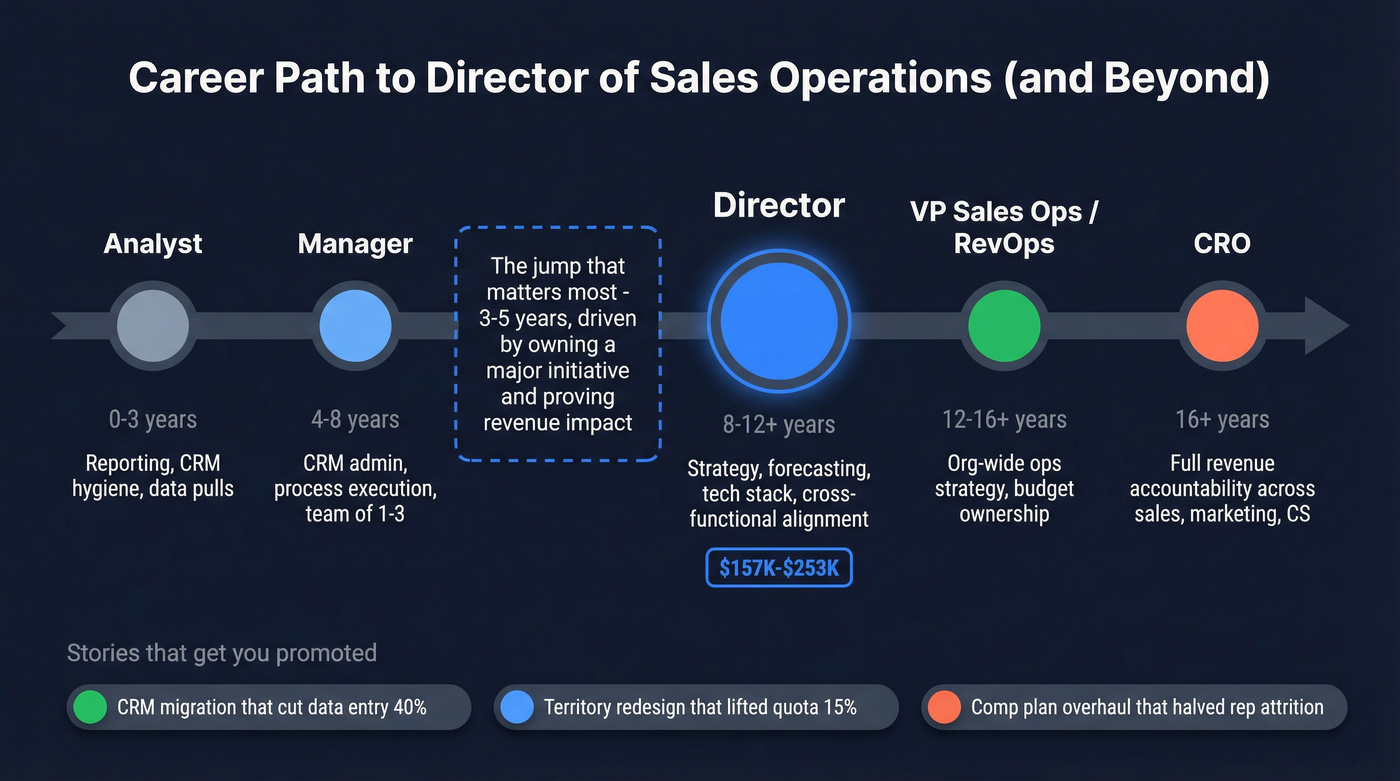
The fastest path isn't collecting certifications - it's owning a major initiative and proving revenue impact. A CRM migration that reduced data entry time by 40%. A territory redesign that lifted quota attainment by 15%. A comp plan overhaul that cut rep attrition in half. These are the stories that get you promoted and hired.
Let's be honest: if your average deal size is under $10K, your company probably doesn't need a full-time director of sales operations yet. They need a strong manager with a clear mandate. The director role earns its salary when the org is complex enough that cross-functional alignment, forecasting rigor, and tech stack governance become existential problems - not nice-to-haves. Skip this role in your career planning if you're at a 10-person startup; aim for it once you're operating at 50+ reps across multiple segments.
The foundational skills matter: deep Salesforce or HubSpot proficiency, forecasting methodology, cross-functional leadership, and data analysis. Certifications like CSOP, Prosci for change management, or an MBA help at larger companies where HR filters for them. But we've seen plenty of directors who got there without any of those, purely on the strength of their operational track record. The consensus on r/salesoperations echoes this - track record beats credentials every time.
Interview Prep & 30/60/90 Plan
The VP of Sales asks: "What would your first 90 days look like?" Here's how to answer - and five other questions you should prepare for.
Director-Level Interview Questions:
- What would your 90-day plan look like as our first Director of Sales Operations?
- How would you build a forecasting model for a company transitioning from founder-led sales?
- Walk me through a CRM migration you've led with limited resources.
- How do you design territories and set quotas that reps actually believe in?
- How would you improve CRM data quality without becoming the "process police"?
The 30/60/90 Framework:
Days 1-30 - Audit and listen. Map the tech stack, review pipeline data, sit in on sales calls, interview reps and managers. Change nothing yet. I can't stress this enough: the directors who blow up in the first quarter are almost always the ones who started "fixing" things before they understood the org's actual pain points. Resist the urge.
Days 31-60 - Quick wins. Fix the worst data quality issues, eliminate redundant tools, standardize reporting. Ship something visible that makes reps' lives easier - even if it's small, it buys you credibility for the bigger asks coming next.
Days 61-90 - Strategic roadmap. Present a 6-month plan to the CRO with clear priorities, resource asks, and expected revenue impact. Tie every initiative to a number. "Improve data quality" isn't a plan. "Reduce bounce rate from 12% to under 3%, saving 6 hours per rep per week" is.
You own the tech stack - and every director knows 13 tools is too many. Prospeo consolidates email finding, mobile numbers, CRM enrichment, and intent data into one platform with native Salesforce and HubSpot integrations. 92% API match rate, 50+ data points per contact, zero annual contracts.
Consolidate your data stack and give your reps numbers that actually pick up.
FAQ
What does a director of sales operations do?
They lead four pillars - forecasting and territory design, CRM and tech stack ownership, process optimization, and data analytics - splitting roughly 60-70% strategic work and 30-40% tactical execution. The role exists to maximize the time reps spend selling.
How much does this role pay in 2026?
Median total comp is $197K/year according to Glassdoor. The 25th-75th percentile range runs $157K-$253K, while top-paying tech companies like Snowflake and MongoDB push above $400K with equity included.
What's the difference between Sales Ops and RevOps?
Sales Ops focuses on sales-specific processes and tools. RevOps unifies sales, marketing, and CS operations under one function. By 2026, 75% of high-growth companies are expected to run a RevOps model - making cross-functional fluency essential for any sales ops director.
How long does it take to become a director?
Most make the jump from Manager in 3-5 years. The accelerant isn't certifications - it's owning a high-impact initiative like a CRM migration or territory redesign and demonstrating measurable revenue results.
What tools should a new director evaluate first?
Start with the three that touch everything: your CRM, your forecasting tool, and your contact data layer. Bad data pollutes every downstream system, so getting enrichment and verification right early pays dividends across the entire stack.