

SDR Conversion Rate Benchmarks: Every Metric You Need in 2026
Your VP just asked why 15 meetings last month turned into 6 opportunities. You're staring at a spreadsheet trying to figure out if that's normal or a five-alarm fire. The answer depends entirely on which SDR conversion rate you're measuring - and most teams are tracking the wrong ones.
We've consolidated data from 16.5M cold emails and 204K+ cold calls into one reference so you can stop hunting for benchmarks and start diagnosing what's actually broken. These numbers draw from two of the largest publicly shared datasets collected through 2025 - the most current large-scale data available as of 2026.
(Looking for IMF Special Drawing Rights? Wrong SDR.)
The Quick Version
Five core SDR conversion benchmarks:
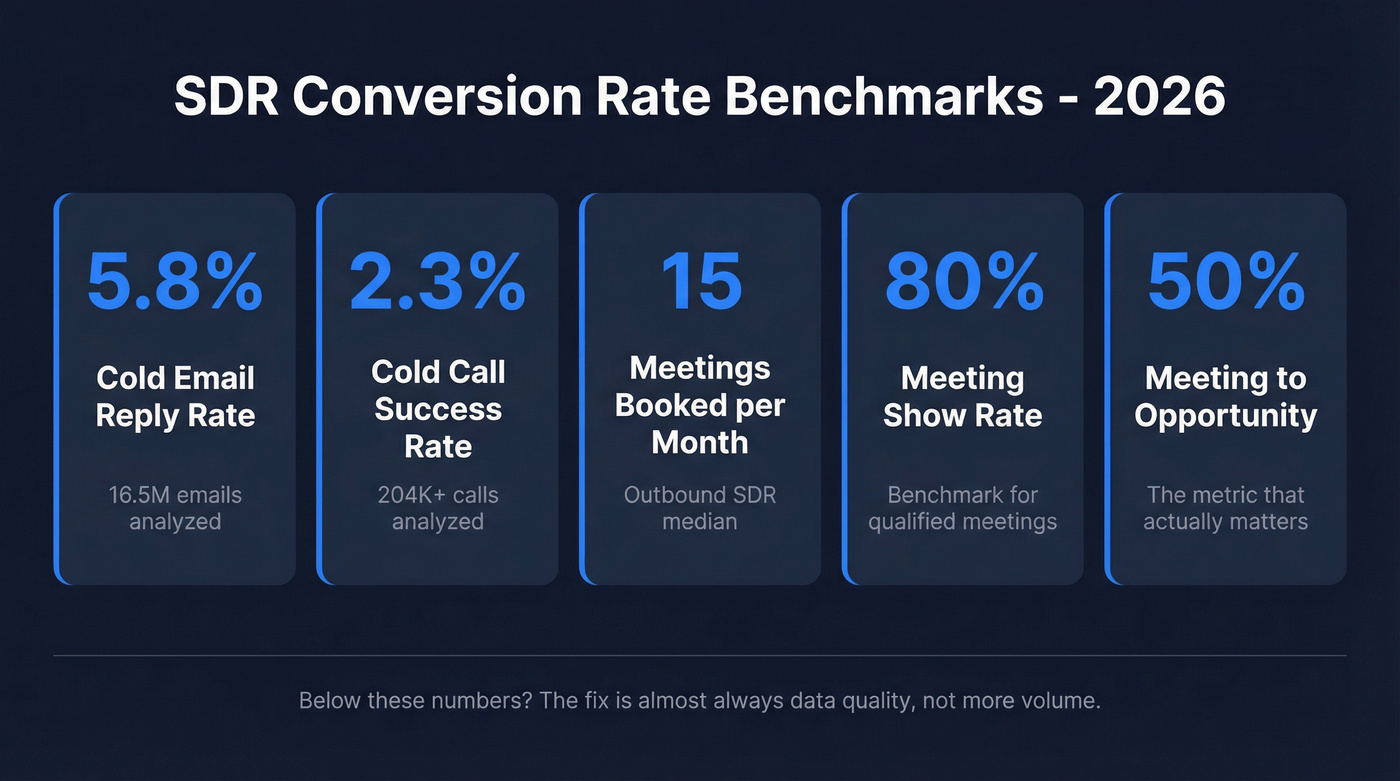
- Cold email reply rate: 5.8% average
- Cold call success rate: 2.3% average
- Meetings booked/month: 15 (outbound SDR)
- Meeting show rate: ~80%
- Meeting to opportunity: ~50%
If your numbers fall below these, the fix is almost always data quality, not more volume.
What the Metric Actually Means
"SDR conversion rate" isn't one number. It's five different metrics measuring different stages of the funnel, and conflating them is how teams end up celebrating a 6% reply rate while pipeline quietly flatlines. BDR conversion rates follow the same funnel logic - the terminology differs by org, but the math is identical.
Here's what to track:
- Reply Rate = Replies / Emails Sent. Measures message resonance and deliverability.
- Connect Rate = Live Conversations / Dials. Measures phone data quality and timing.
- Meeting Booked Rate = Meetings Scheduled / Total Outreach Attempts. The first metric that actually matters for pipeline.
- Show Rate = Meetings Held / Meetings Booked. Measures qualification quality and follow-up discipline.
- Meeting to Opportunity Rate = Opportunities Created / Meetings Held. The conversion that determines whether your SDRs are feeding pipeline or wasting AE time.
Pipeline coverage ratio - pipeline divided by quota - should run 3-5x your target to account for natural attrition at each stage.
Here's the thing: reply rate is a vanity metric. Meeting-held-to-opportunity is the only conversion that matters for forecasting. A team with a 4% reply rate and tight qualification will outperform a team with 8% replies and loose meeting criteria every single quarter.
2026 Master Benchmark Table
| Metric | Average | Good | Top Performer | Source |
|---|---|---|---|---|
| Cold email reply | 5.8% | 7-8% | 10%+ | Belkins |
| Cold call success | 2.3% | 4-5% | 6.7%+ | Cognism |
| Meetings booked/mo | 15 | 18-20 | 25+ | Operatix |
| Show rate | 80% | 85% | 90%+ | Operatix |
| Meeting (SAL) to next step | 50% | 55-60% | 60%+ | Crunchbase |
| Win rate (SDR opps) | 22% | 30% | 40%+ | TOPO |
| Quota attainment | 56-60% | 70% | 80%+ | Tenbound |
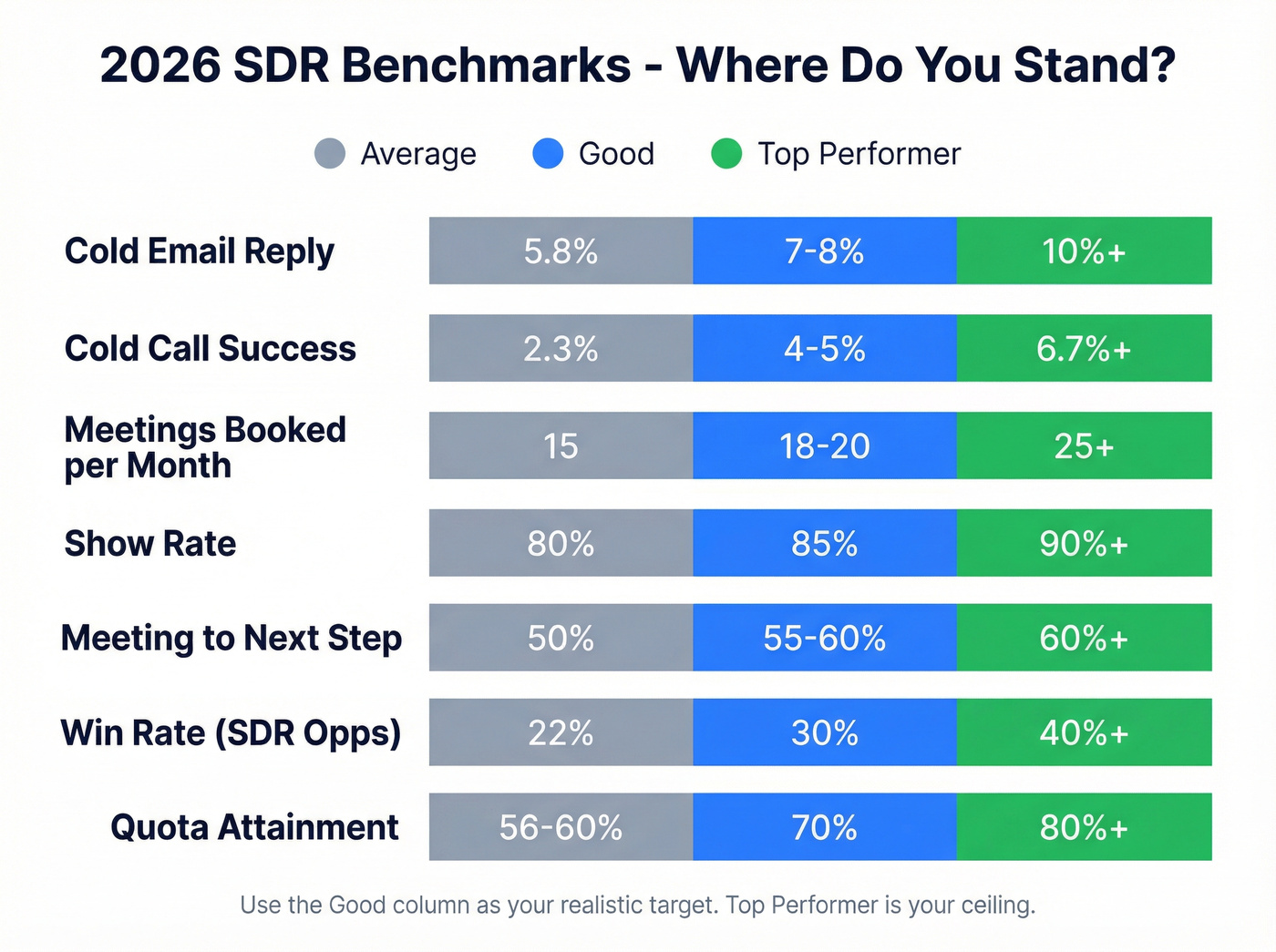
The "average" column is misleading on its own. Industry, deal size, ICP definition, and data quality shift these numbers dramatically - a team selling six-figure enterprise deals into financial services will have completely different benchmarks than an SMB SaaS team running high-velocity outbound. Use the "Good" column as your realistic target and "Top Performer" as your ceiling.
For context, website visitor-to-lead conversion rates vary wildly by industry. B2B SaaS averages just 1.1% while legal services hits 7.4%, per FirstPageSage. SDR outreach conversion operates on a completely different scale, so don't confuse marketing funnel benchmarks with outbound performance.
The Gradient Works benchmark compilation is the best single resource for cross-referencing these numbers against your specific motion.
Cold Email Conversion Rates
The headline number: a 5.8% average reply rate across 16.5M cold emails, down from 6.8% in 2023. That decline isn't slowing down. Inboxes are more crowded, spam filters are smarter, and prospects have less patience for generic outreach.
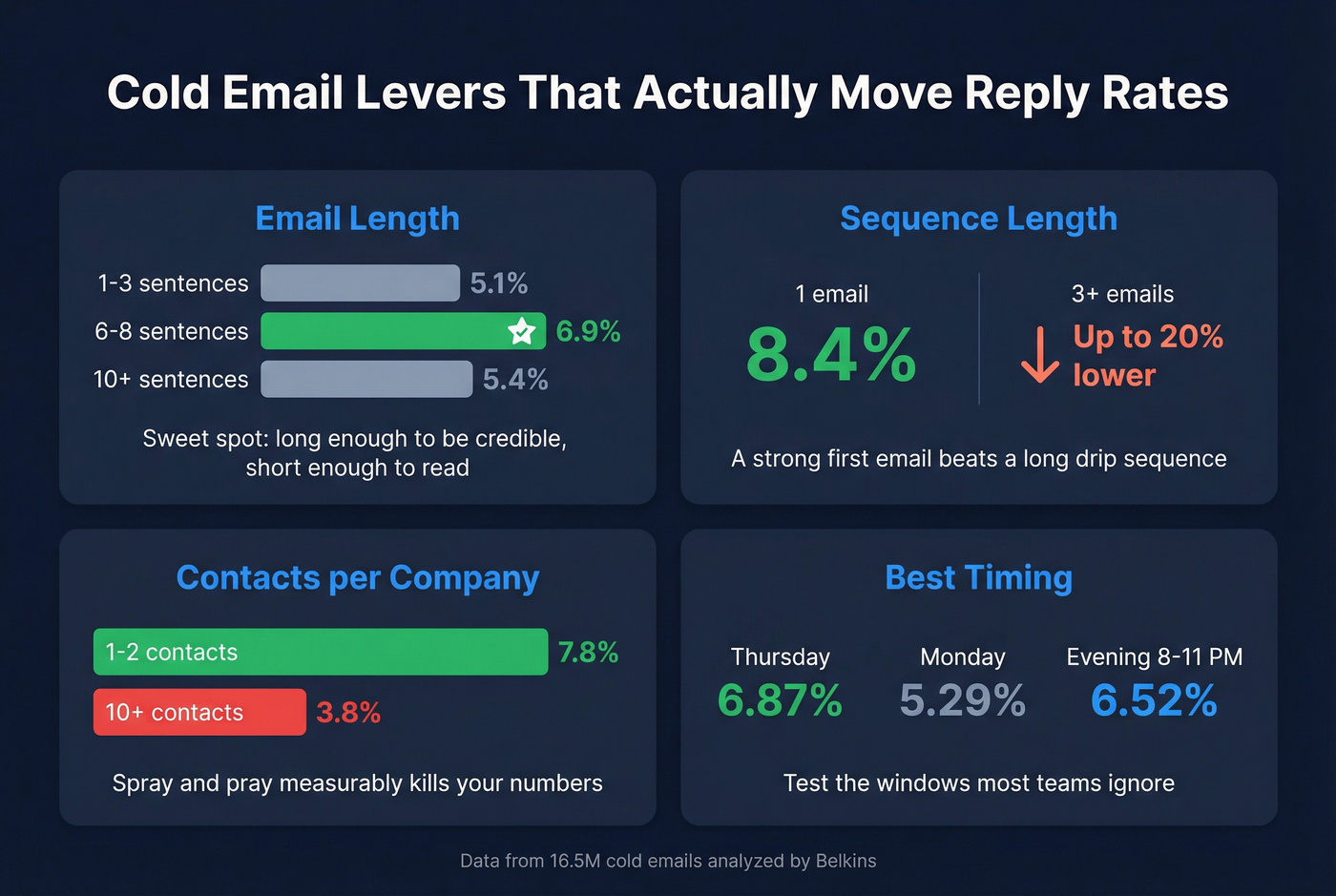
But the averages hide some counterintuitive findings. Email length matters more than most teams realize - 6-8 sentences hit a 6.9% reply rate, the sweet spot between "too short to be credible" and "too long to read." And here's the one that surprises everyone: 1-email sequences had the highest reply rate at 8.4%. Adding a third email actually reduced reply rates by up to 20%. The conventional wisdom about "always follow up 5+ times" doesn't hold when your first email is strong enough.
List strategy is the biggest lever most teams ignore. Contacting 1-2 people per company pushed reply rates to 7.8%. Blasting 10+ contacts at the same company dropped it to 3.8%. Spray-and-pray doesn't just feel lazy - it measurably kills your numbers.
Timing helps at the margins. Thursday emails hit 6.87% reply rates versus Monday's 5.29%, and evening sends between 8-11 PM peaked at 6.52% - a window most teams aren't testing. One operational detail worth noting: turning off open-tracking pixels produced 3% higher response rates in internal testing, because email providers are increasingly flagging tracking pixels as spam signals.
The end-to-end numbers are brutal. Only 0.2-2% of cold emails convert into actual sales. Typical outbound cost-per-lead benchmarks put cold email around $30-50, making it the cheapest outbound channel by far - but only if your deliverability is intact.

A 5.8% reply rate means nothing if 35% of your emails bounce. Bad data destroys deliverability, tanks sender reputation, and quietly kills every SDR metric downstream. Prospeo's 98% email accuracy and 7-day refresh cycle keep your lists clean so replies actually convert to pipeline - not spam folders.
Stop blaming your copy when the real problem is your contact data.
Cold Call Conversion Rates
Cold calling's average success rate sits at 2.3% based on analysis of 204,000+ calls. That's dial-to-booked-meeting. The conversation success rate - once you actually get someone on the phone - is a much healthier 65.6%. This qualified conversation rate is the number managers should coach against, since it isolates rep skill from data quality.
The gap between those two numbers tells the whole story. The problem isn't what reps say on calls. It's reaching the right person.
| Region | Success Rate |
|---|---|
| UK | 8% |
| Europe | 6% |
| US | 6% |
Connecting takes about 3 attempts on average, with 93% of conversations happening by the third call. The 16.6% connect rate from a separate study of 55,000 dials aligns with what we see in practice. Best timing: Tuesdays, with 10-11am and 2-3pm as the peak windows. Average call duration runs just 93 seconds - barely enough time to qualify.
Typical outbound cost-per-lead benchmarks put cold calling around $300-500. That math only works if your connect rates are solid.
Now picture this: your SDR makes 80 dials, gets 4 connects, but 2 of those are wrong contacts - people who left the company months ago. That's half their productive conversations wasted on stale data. Wrong numbers and outdated contacts are a morale killer on outbound teams. Verified mobile data is the difference between reps reaching humans and reps leaving voicemails for people who moved on six months ago.
Inbound vs. Outbound Conversion
Invest in inbound SDRs when you're generating 300+ inbound leads per month and need someone to qualify and route them fast. High-intent inbound leads like demo requests and pricing page visits convert at 75-80% lead-to-meeting. One inbound SDR can handle roughly 15 leads per day.
Invest in outbound SDRs when your inbound volume can't fill pipeline alone - which describes most companies. Low-intent inbound like ebook downloads and webinar attendees converts at just 5-10% lead-to-meeting. SDRs generate 46-73% of pipeline at most B2B companies, per TOPO research. Social outreach converts at 0.5-2%, making it a support channel rather than a primary pipeline driver.
This isn't a "which is better" question. It's a resource allocation decision. Most scaling teams need both motions running simultaneously, with outbound carrying the heavier pipeline load.
Full Funnel: Touch to Closed-Won
This is where most discussions about SDR conversion rates fall apart - people look at one stage in isolation instead of tracing the full waterfall.
| Stage | Conversion Rate |
|---|---|
| Lead to MQL | 35-45% |
| MQL to SQL | 15% |
| SQL to Opportunity | 25-30% |
| Opp to Closed-Won | 6-9% |
| Overall lead to customer | 1.5-2.5% |
The MQL-to-SQL handoff is where pipeline goes to die. That 15% conversion is the largest single drop-off in the funnel, and it's usually a qualification problem - either SDRs are booking meetings with the wrong people, or the MQL definition is too loose.
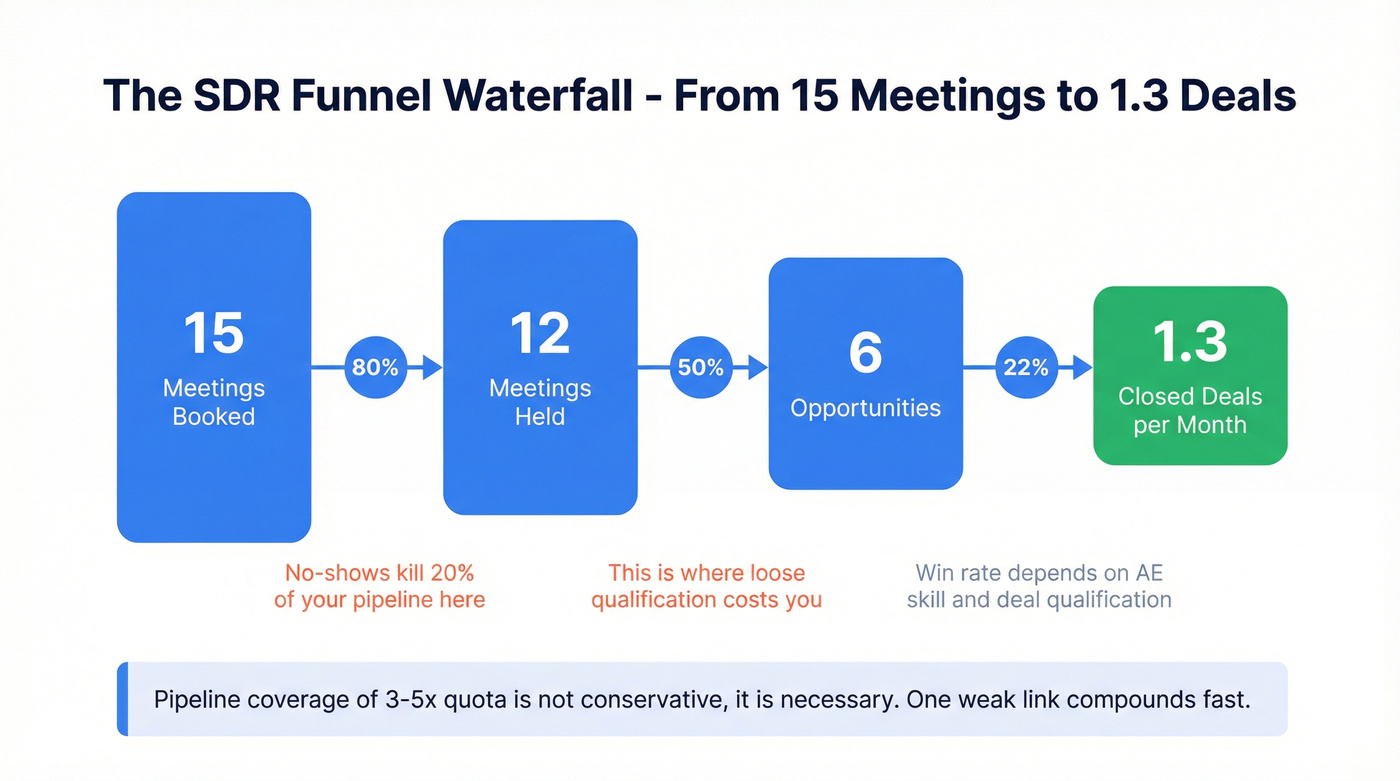
Let's run the math with Operatix's numbers. Start with 15 meetings booked. An 80% show rate gives you 12 held meetings. Half convert to a next step - demo, POC, or proposal - leaving 6 opportunities. At a 22% win rate on SDR-sourced opps, that's roughly 1.3 closed deals per month per SDR.
The Bridge Group's widely-cited median is $3M in SDR-generated pipeline annually. That's solid - but it requires every stage of the funnel to perform at benchmark. One weak link compounds fast.
The macro environment isn't helping either. The average B2B deal now involves 13 decision-makers, and 80% of buyer interactions happen digitally. More stakeholders, more touchpoints, longer cycles. The percentage of deals that go dark and never re-engage is climbing as committees grow, making proactive multi-threading more critical than ever. That's why pipeline coverage of 3-5x quota isn't conservative - it's necessary.
Why These Numbers Keep Dropping
Three forces are compressing conversion rates across the SDR function, and only one of them is about the market.
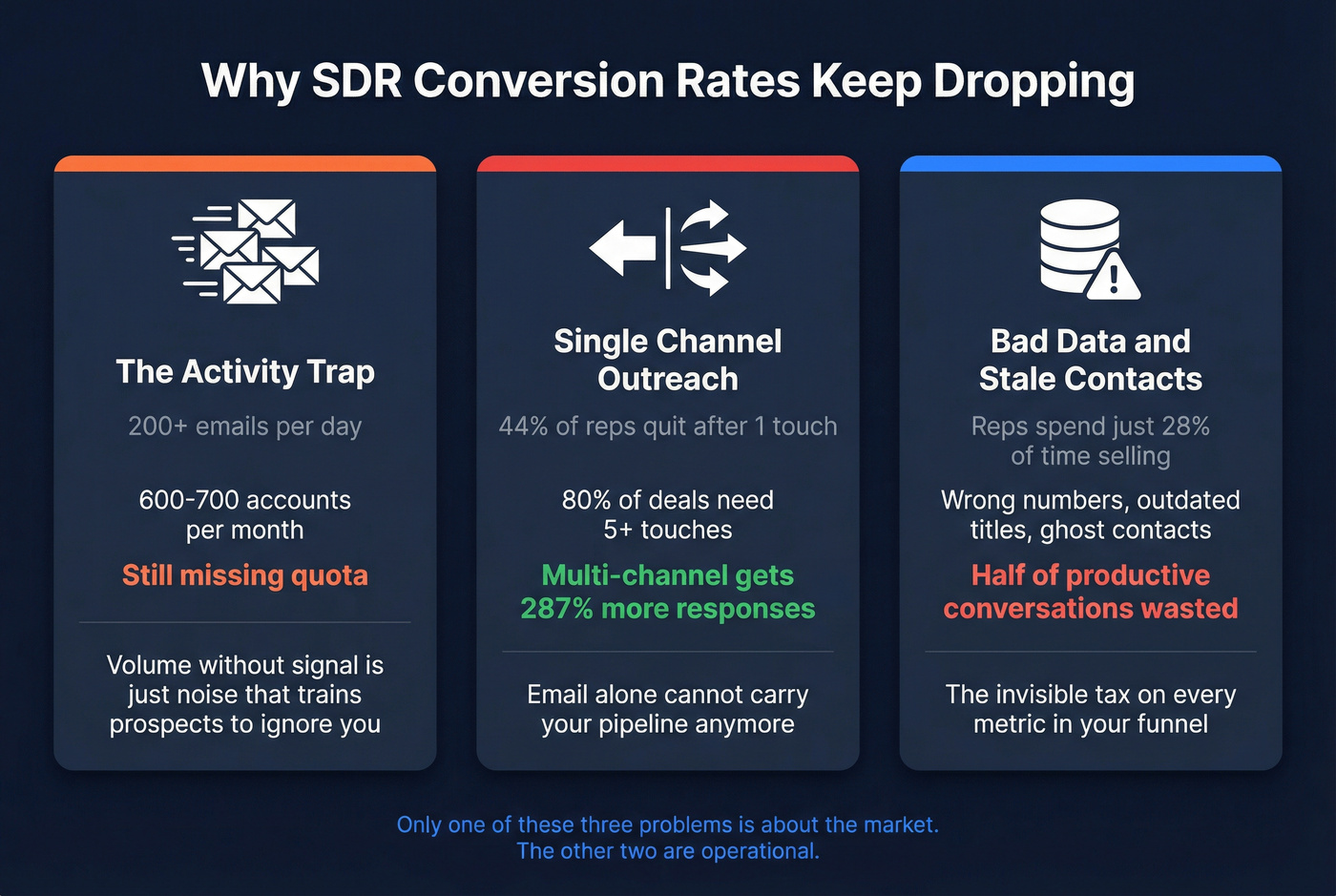
The activity trap. Chili Piper documented this with their own team: reps sending 200+ emails per day and working 600-700 accounts per month were still missing quota. Activity-based SDR management is dead. Volume without signal is just noise that trains prospects to ignore you.
Single-channel outreach. Using email, phone, and social together increases response rates by 287% versus single-channel outreach. Yet 44% of reps give up after one touch, while 80% of deals require five or more. The math is brutal for teams that rely on email alone.
Bad data and stale contacts. Reps spend just 28% of their time actually selling. The rest goes to admin, CRM hygiene, and chasing dead leads. Average lead response time is 42 hours, and only 7% of companies respond to inbound leads within 5 minutes. Meanwhile, 89% of revenue orgs say they're using AI - but the fundamentals are still broken. AI can't fix a sequence built on bounced emails and disconnected phone numbers.
We've seen teams invest six figures in sequencing tools and intent platforms while running on a contact database that hasn't been refreshed in two months. The sequencing tool isn't the bottleneck. The data is.
Hot take: If your average deal is under $25k, you probably don't need a $40k/year intent data platform. You need accurate emails, verified phone numbers, and a rep who can hold a 93-second conversation without fumbling the value prop. Fix the basics before you layer on the fancy stuff.
How to Improve SDR Conversion
Three levers move the needle, ranked by impact: data accuracy first, multichannel sequencing second, tighter ICP targeting third.
Fix Your Data First
If 25% of your emails bounce, your domain reputation tanks and future deliverability drops - a compounding problem that gets worse every week you ignore it. This is the single highest-ROI fix for most SDR teams.
Prospeo verifies emails in real-time with 98% accuracy and refreshes contact data every 7 days, compared to the 6-week industry average. The results speak for themselves: Meritt saw their bounce rate drop from 35% to under 4% and connect rates triple to 20-25% after switching their data source. GreyScout cut bounce from 38% to under 4% and grew pipeline 140%. These aren't marginal improvements - they're the difference between a functioning outbound motion and one that's slowly destroying your sending domain.
Go Multichannel
That 287% response rate lift for multichannel versus single-channel isn't a rounding error. Chili Piper pivoted from an email-heavy approach to a hybrid model emphasizing calls and hit 118% of their closed-won goal. The playbook is straightforward: email opens the door, calls create urgency, social touches build familiarity. Running all three in a coordinated sequence is table stakes in 2026.
Tighten Your Targeting
The data is clear: 1-2 contacts per company yields a 7.8% reply rate versus 3.8% for 10+ contacts. More isn't better - it's lazier. TOPO recommends 75-125 accounts per rep, which forces prioritization. Chili Piper's "pipeline equality" concept - giving reps more equitable access to high-tier accounts - reduced ramp time and improved efficiency across their team.
One bonus finding worth acting on: 1-email sequences outperformed multi-step sequences at 8.4% reply rate. If your first email is strong and your targeting is tight, you don't need a 12-step drip. Send fewer, better emails to fewer, better-qualified prospects.
Skip the intent data stack if your bounce rate is above 5%. Seriously. No amount of buyer signals helps when half your emails never land.
Your reps are dialing 80 times to get 4 connects - and half of those are wrong numbers. Prospeo's 125M+ verified mobile numbers deliver a 30% pickup rate, 3x the industry average. That's the difference between 2 productive conversations per day and 8.
Triple your cold call connect rate with mobiles that actually ring.
FAQ
What is a good SDR conversion rate?
A good cold email reply rate is 6-8%, above the 5.8% average. For cold calls, anything above 4% beats the 2.3% benchmark. Show rates should hit 80%+, and meeting-to-opportunity conversion should land at 50% or higher. BDR conversion rates follow the same benchmarks when the role mirrors outbound SDR responsibilities.
How many meetings should an SDR book per month?
The benchmark is 15 meetings per month for outbound SDRs, with a ~20% no-show rate leaving 12 held meetings. Top performers consistently hit 20+ booked with strong data and multichannel sequences. Track meeting-to-opportunity closely - it's the metric that connects activity to pipeline.
What's the average cold email reply rate in 2026?
5.8% across 16.5M cold emails analyzed, down from 6.8% in 2023. Shorter emails of 6-8 sentences and tighter targeting of 1-2 contacts per company push reply rates above 7%. Turning off open-tracking pixels can add another 3% lift.
How do you fix low SDR conversion rates?
Start with data quality - if bounce rates exceed 5%, your domain reputation is degrading and every other optimization is wasted. Then layer multichannel sequencing (287% lift vs. email-only) and tighten ICP targeting to 75-125 accounts per rep. In our experience, teams that fix data first see the fastest improvement by far.
Does data quality affect SDR conversion rates?
Directly and measurably. Bounced emails damage domain reputation, lowering future deliverability in a compounding cycle. Wrong phone numbers waste dial time and kill rep morale. Teams that fix data quality first - like Meritt tripling connect rates after cleaning their database - see the largest performance gains.