

AI Lead Generation for Agencies: The Operational Playbook for 2026
You're running campaigns for six clients. One of them - a SaaS company that took three months to close - just forwarded you a Postmaster Tools screenshot. Their primary domain's reputation dropped to "Bad." The culprit: a 5,000-email campaign where 1,200 bounced. That's a 24% bounce rate, and now their domain is functionally blacklisted for cold outreach. They're blaming you. They should be.
This is why AI lead generation for agencies is a fundamentally different game than running outbound for a single in-house team. You're not just managing your own domain. You're a custodian of every client's sender reputation, and one bad list can unravel months of relationship-building overnight.
What You Actually Need
You don't need 16 tools. You need three or four, wired together correctly:
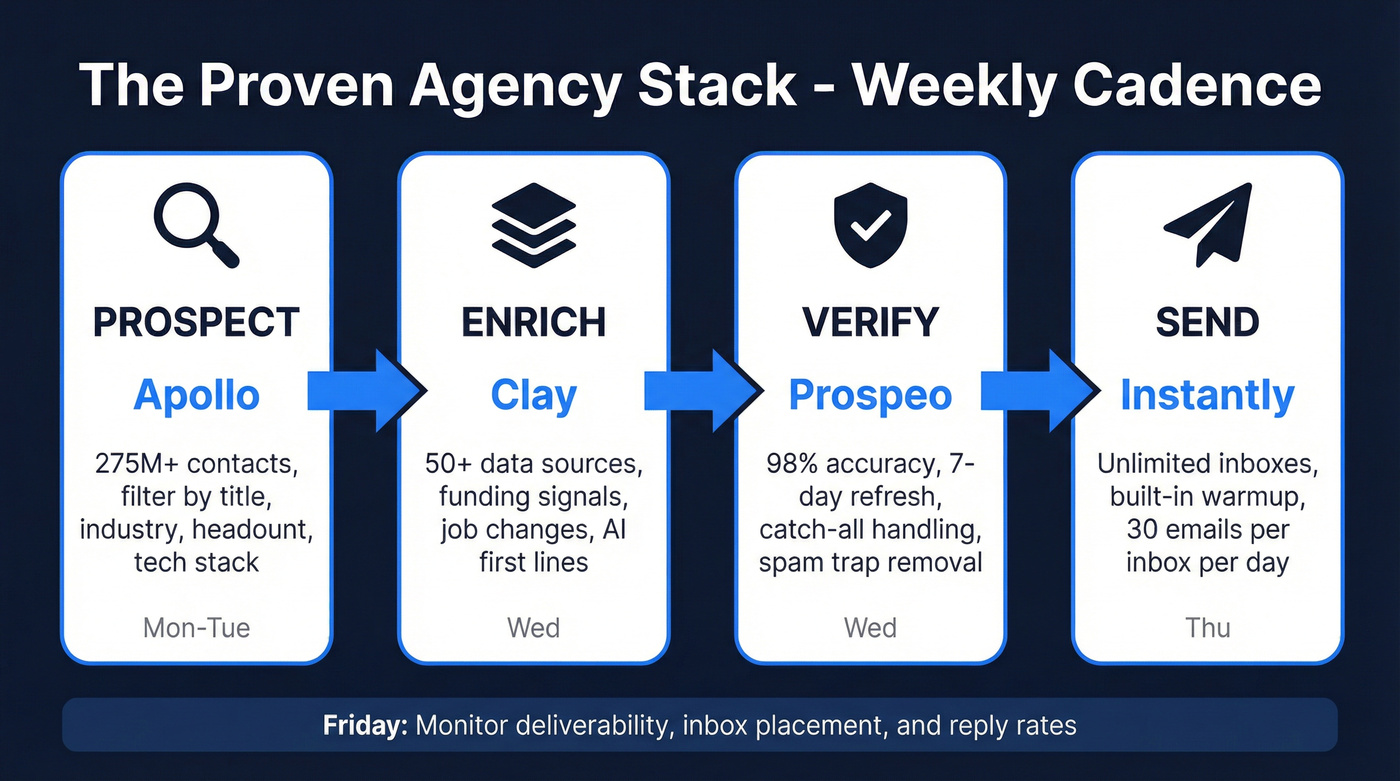
- Apollo - prospect and build initial lists (275M+ contacts)
- Clay - enrich with 50+ data sources for personalization
- Prospeo - prospect, verify, and find direct dials from a single platform (300M+ profiles, 143M+ verified emails, 125M+ verified mobile numbers, 98% email accuracy, 7-day refresh)
- Instantly - send with unlimited email accounts and built-in warmup
All-in monthly cost for a 10-client agency: $300-$900/mo for tools, plus $100-200/mo for domains and warmup infrastructure. The $300 floor is realistic if you lean on free tiers aggressively. Stack Optimize scaled to $1M ARR with this exact stack - 94%+ deliverability, zero domain flags across all clients.
The single biggest margin-killer isn't tool cost. It's skipping verification and torching client domains with bounced emails.
Why AI Works Differently for Agencies
The speed-to-lead data is brutal. Contacting a lead within one hour makes you roughly 7x more likely to qualify them versus waiting an additional hour. Wait 24 hours and qualification likelihood drops by 98%+. You can't hit that window manually when you're juggling 10+ client accounts with different ICPs, verticals, and messaging.
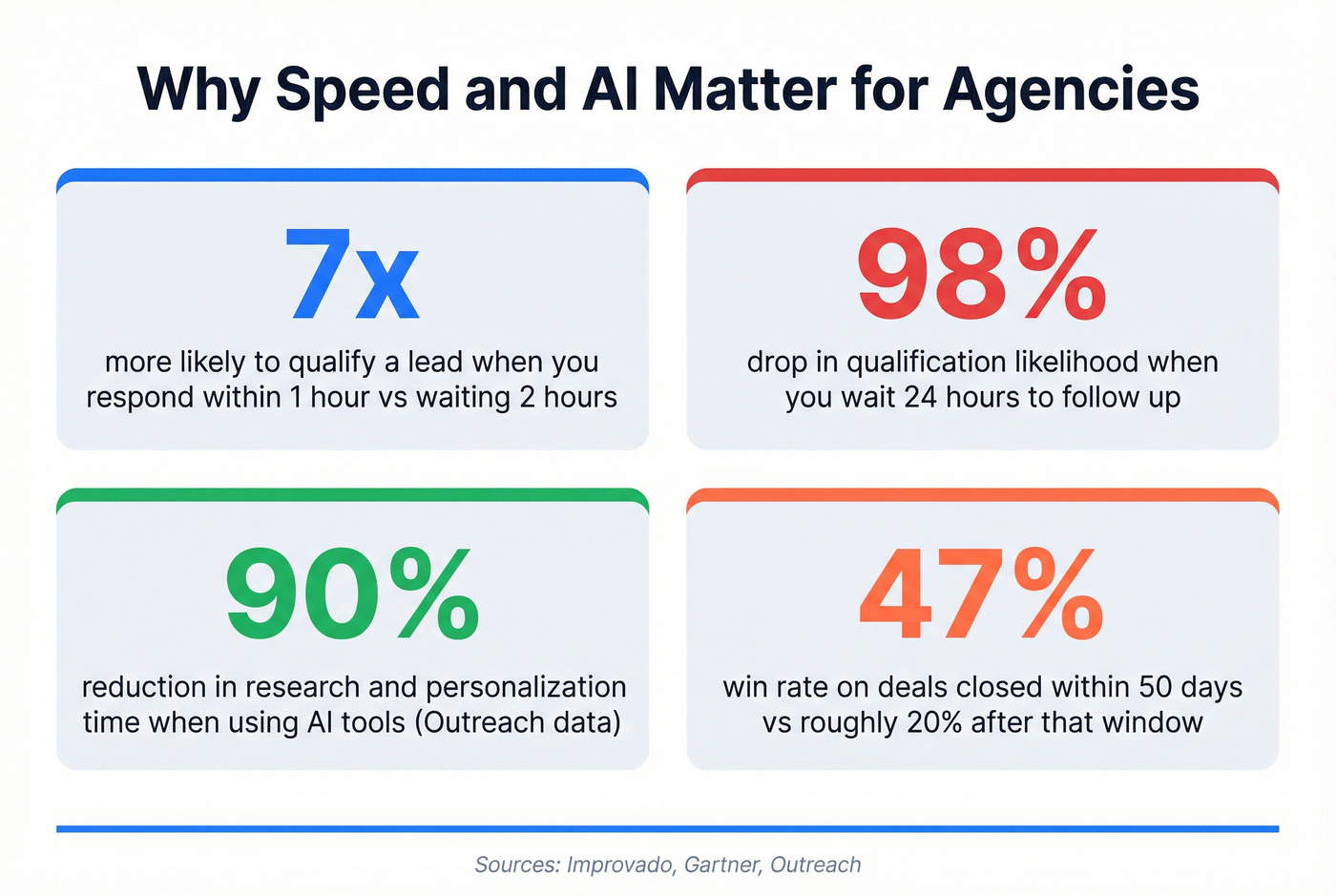
AI lead scoring alone cuts qualification time by up to 30%, per Gartner. Multiply that across 10 client accounts and the time savings become existential - it's the difference between a profitable agency and one that's drowning in manual work. Outreach reports that sellers using AI tools cut research and personalization time by 90%. For agencies running AI-powered prospecting, this isn't optional. It's the only way the economics work.
That's why 45% of sales teams now run a hybrid AI-SDR model - AI handles the prospecting, enrichment, and initial sequencing while humans step in for replies and meetings. Tools like Outreach and Instantly are pushing autonomous AI agents for prospecting and replies. For agencies, the risk is letting an AI agent send on a client's domain without human review. Use agents for research and drafting, not unsupervised sending.
Here's the number that should shape your entire operating cadence: opportunities closed within 50 days carry a 47% win rate versus roughly 20% after that threshold. Your clients are paying you to compress that timeline. AI tooling is how you do it across multiple accounts without hiring a team of 15.
The Proven Agency Stack
The weekly cadence we've seen work best: prospect Monday-Tuesday, enrich and verify Wednesday, launch Thursday, monitor Friday. A 7-touch sequence over ~35 days (intro, social proof, value add, question, different angle, urgency, breakup) gives each lead enough touches without burning the list. (If you need templates, start with these best sales sequences.)
Step 1 - Prospect with Apollo
Use this if you need a massive B2B database with built-in sequencing and a free tier to get started. Apollo's 275M+ contacts and filtering make it the fastest way to build initial target lists by title, industry, headcount, and tech stack.
Skip this if you plan to send directly from Apollo's "verified" emails without a separate verification step. Practitioners on r/coldemail consistently cite 20-30% bounce rates when sending Apollo "verified" emails without an additional verification layer. Apollo starts around ~$49-$119/user/mo on paid plans, with a free tier for smaller lists.
Step 2 - Enrich with Clay
Clay pulls deep personalization signals - recent funding, job changes, tech stack, hiring patterns - from 50+ data sources and stitches them together automatically. Multi-source enrichment can raise contact accuracy from roughly 60% to 85%+, and the AI research agent (Claygent) writes personalized first lines at scale.
The catch: budget 2-4 weeks for the learning curve. Clay thinks like a spreadsheet on steroids, and inefficient workflows burn through credits fast. We've tested dozens of enrichment combinations, and Clay into a verification layer consistently produces the cleanest lists. Starter plans run $134/mo for 24K credits/year; most agencies land on Explorer ($314/mo) or Pro ($720/mo) depending on volume. (If you're comparing options, see data enrichment for cold email.)
Step 3 - Verify
This is the step that separates agencies that keep clients from agencies that lose them. Your verification tool sits between your enrichment layer and your sending tool, catching bad data before it does damage.
Prospeo's numbers: 98% email accuracy, a 7-day data refresh cycle versus the 6-week industry average, and a 5-step verification process that includes catch-all handling, spam-trap removal, and honeypot filtering. At roughly $0.01 per email, verification is the cheapest insurance in your entire stack. Native integrations with Instantly, Smartlead, Lemlist, Clay, Salesforce, HubSpot, Zapier, and Make mean you don't have to duct-tape anything together. (For a deeper breakdown, use this email deliverability checklist and this guide to AI email verification.)
Step 4 - Send with Instantly
Instantly's agency economics are the reason it dominates multi-client outbound. Unlimited email accounts with built-in warmup on every plan. Growth Outreach at $37/mo covers sending, and you can run dozens of warmed inboxes without per-seat charges.
The gap: Instantly's lead search requires separate credit packs (SuperSearch credits run $9-$197 depending on volume), and the built-in data isn't as accurate as dedicated prospecting tools. Cap sends at 30 emails per inbox per day and monitor inbox placement weekly. Sending is the easy part - it's the data feeding the sends that determines whether you keep or lose clients. (If you're scaling volume, follow cold email volume best practices.)
Tool Pricing Comparison
| Tool | Starting Price | Best For | Agency Limitation |
|---|---|---|---|
| Apollo | ~$49/user/mo | Building target lists | High bounce without verify |
| Clay | $134/mo (Starter) | Enrichment, personalization | 2-4 week learning curve |
| Instantly | $37/mo (Growth) | Sending, deliverability | Credits needed for lead search |
| Seamless.AI | ~$125/user/mo (est.) | Real-time contact search | Opaque pricing |
| ZoomInfo | $15-40k/year | Enterprise intent data | Enterprise pricing |
| Outreach | ~$100-150/user/mo | Full-cycle engagement | Annual contracts, enterprise focus |
Let's be honest about ZoomInfo. Its 500M+ contacts and 1B monthly buying signals sound impressive, but a 10-seat contract with intent data can run $40k+/year. That's more than most agency clients pay in annual retainers. Unless you're running ABM for enterprise accounts, ZoomInfo is solving a different problem than yours. (If you're building an ABM motion, start with an ABM account plan template.)
Seamless.AI and Outreach land in similar territory - solid tools built for in-house sales orgs with dedicated RevOps teams, not lean agencies managing multi-client campaigns on thin margins.

Stack Optimize built a $1M agency on Prospeo's data - 94%+ deliverability, bounce rates under 3%, zero domain flags across all clients. At $0.01/email with 98% accuracy and a 7-day refresh cycle, verification is the cheapest insurance in your entire stack.
Stop gambling with client domains. Verify every lead before it sends.
The Data Accuracy Problem
Here's the thing: half these tools call their emails "verified" when practitioners regularly report 20-30% bounce rates. Apollo's database is massive and useful for building target lists, but sending directly from it is playing Russian roulette with your client's domain.

The chain reaction is predictable. Bad emails lead to high bounce rates, which tank domain reputation, which pushes emails to spam, which craters reply rates, which churns clients. In our experience, the agencies that scale past 10 clients all share one trait - they never skip verification. (If you're troubleshooting, start with hard bounce and then how to prevent email blacklisting.)
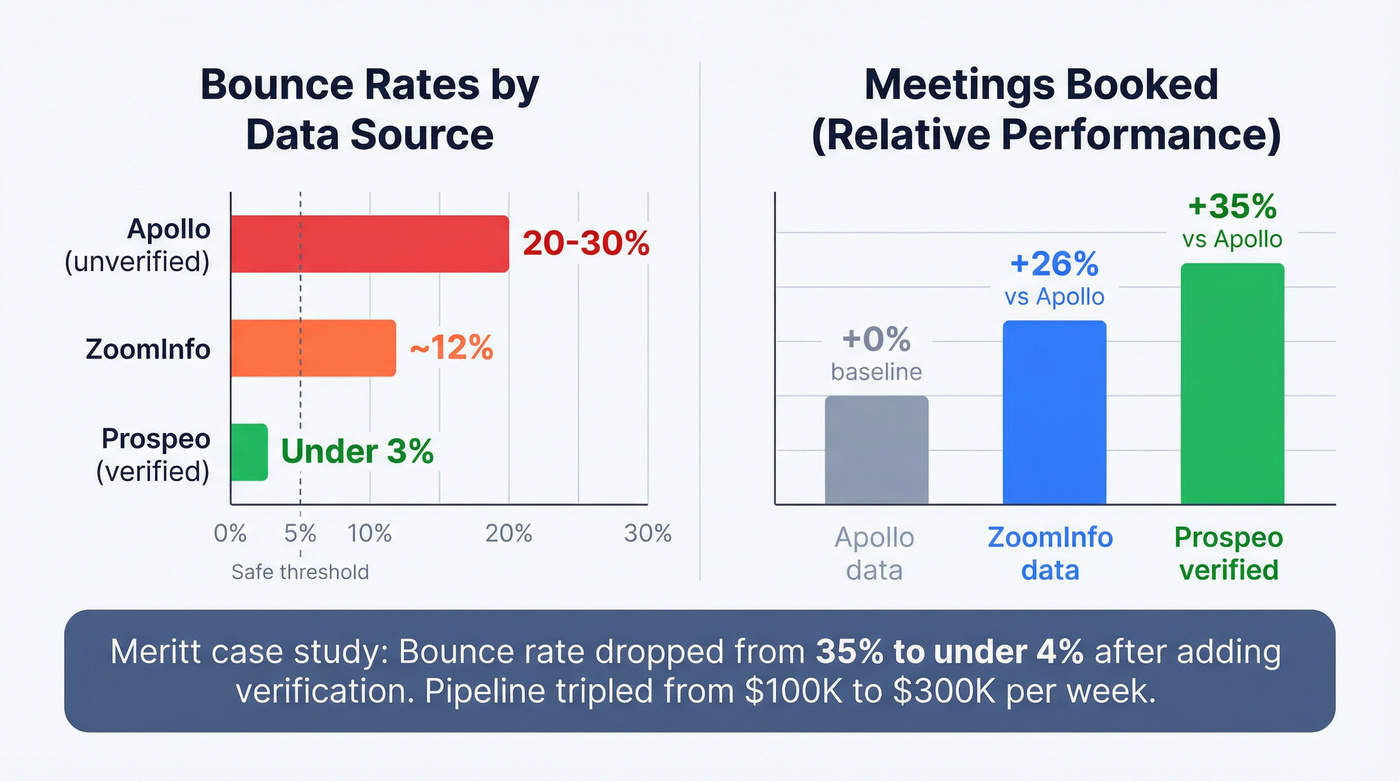
The accuracy gap translates directly to revenue. Teams using a 98%-accuracy verification layer book 26% more meetings than teams relying on ZoomInfo data and 35% more than teams relying on Apollo data. Meritt switched to a dedicated verification tool and their bounce rate dropped from 35% to under 4% - pipeline tripled from $100K to $300K per week. At $0.01 per email, verification costs are rounding errors compared to the cost of losing a client.
Running AI lead gen across 10+ clients means you need one platform for prospecting, verification, and direct dials - not four duct-taped tools. Prospeo gives you 300M+ profiles, 125M+ verified mobiles, and native integrations with Instantly, Clay, and HubSpot.
Replace your patchwork stack with one platform that agencies actually trust.
Unit Economics
Let's model a 10-client agency:
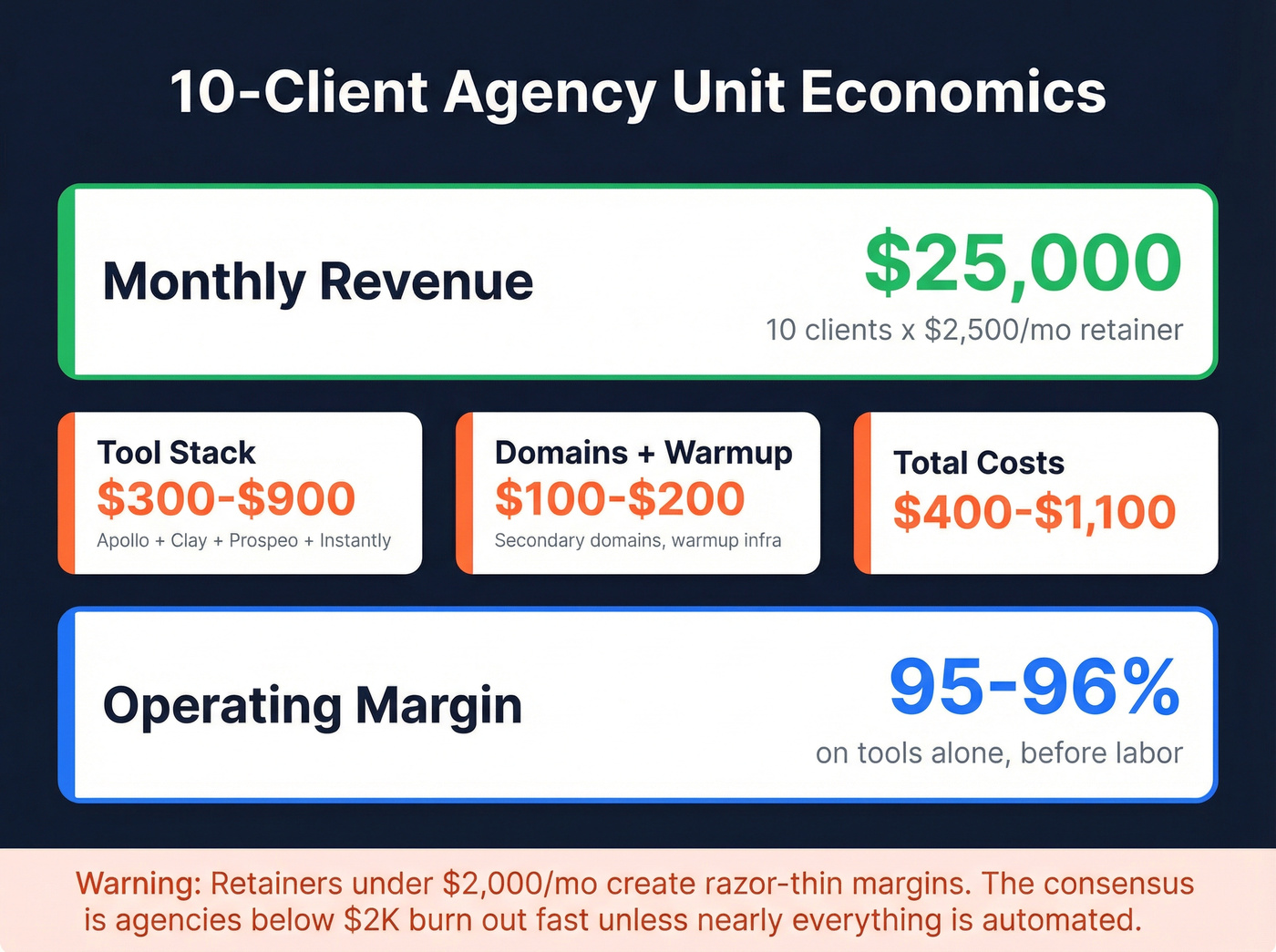
| Cost Category | Monthly Range |
|---|---|
| Tool stack (Apollo + Clay + verification + Instantly) | $300-$900 |
| Domains + warmup infrastructure | $100-$200 |
| Total operating cost | $400-$1,100 |
At $2,500/mo retainers across 10 clients, you're pulling $25,000/mo in revenue against roughly $1,000 in tool costs. That's healthy - AI-powered lead generation delivers margins that manual prospecting can't touch.
Real talk: if your retainers are under $2,000/mo, you need either fewer, higher-value clients or a stack that's ruthlessly optimized for cost. Ten clients at $1,500 is $15,000/mo. Subtract $1,000 in tools, $2,000-3,000 in labor (even with AI doing the heavy lifting), and you're looking at razor-thin margins before taxes and overhead. The consensus on r/coldemail is that agencies below $2K retainers burn out fast unless they've automated nearly everything. If your average deal size sits below five figures, a lean stack with aggressive use of free tiers will outperform an enterprise suite you're only using 20% of. (If you're pricing services, see cold email agency pricing.)
Build In-House or Hire an Agency?
One question clients increasingly ask: should they handle lead generation internally or outsource? The honest answer depends on volume and complexity.
If a company sends fewer than 2,000 emails per month to a single ICP, an in-house SDR with basic tooling can manage. But the moment they need multi-segment targeting, ongoing deliverability management, and weekly iteration on messaging across channels, the operational overhead favors an agency that already has the infrastructure dialed in. The debate often misses the real variable: it's not whether AI or humans are better, it's whether the company has the operational discipline to maintain data quality, domain health, and compliance across every campaign. Most don't - which is exactly why they hire you. (If you're deciding between models, compare AI SDR vs Agency.)
Compliance
As an agency, you carry liability for every client campaign you run. The penalties aren't theoretical:
| Regulation | Penalty | Scale Example |
|---|---|---|
| TCPA | $500-$1,500/violation | 1,000 contacts = $500K-$1.5M |
| CAN-SPAM | Up to $53,088/email | Single campaign exposure |
| GDPR | 4% of revenue or EUR 20M | Whichever is greater |
| CCPA | $2,663-$7,988/violation | Per-contact basis |
The TCPA alone can turn a 1,000-contact campaign into seven-figure exposure if you don't have proper consent documentation. Keep consent records for a minimum of four years. Honor opt-outs within 10 business days. Include unsubscribe links in every email. Use GDPR-compliant data providers, and make sure your enrichment sources have proper data processing agreements in place.
Look, compliance isn't the exciting part of agency lead gen. But one client complaint to a regulator can end your business faster than any bad campaign.
FAQ
What's the best AI lead gen tool for agencies?
No single tool covers the full workflow. Agencies need a stack: a prospecting database for building lists, Clay for enrichment, a verification layer like Prospeo for data quality (98% accuracy, $0.01/email), and Instantly for sending. The verification step separates agencies that retain clients from those that burn domains and churn.
How much does an AI lead gen stack cost?
A competitive agency stack runs $400-$1,100/month for tools, domains, and warmup - enough to serve 10+ clients. Free tiers from Prospeo (75 credits/mo) and Apollo, plus Instantly's $37/mo entry point, keep the floor low while you scale.
How do I avoid burning client domains?
Verify every email before it hits a sending tool. Use dedicated domains per client, warm them for 2+ weeks minimum, cap sends at 30 per inbox per day, and monitor bounce rates weekly. Anything above 3% is a red flag that needs immediate attention.
Is AI lead generation GDPR compliant?
It can be - if you use GDPR-compliant data providers, honor opt-outs promptly, include unsubscribe links, and maintain consent records for at least four years. Non-compliance risks fines up to 4% of global revenue or EUR 20M.
How many leads can AI tools produce monthly?
A well-run stack produces 1,000+ qualified leads per month per client, with positive reply rates of 1-5% and meeting rates of 0.5-2%. Results depend heavily on ICP targeting quality and data accuracy - which is why verification isn't optional.
The agencies that scale past $50K/mo in revenue all share one trait: they treat data quality as infrastructure, not an afterthought. Build your AI lead generation stack right once, and every client campaign gets easier.