

The Best Outbound Lead Scraping Tools for 2026, Compared
Your SDR exported 5,000 contacts last Tuesday, loaded them into Instantly, and 800 bounced on the first send. That's a 16% bounce rate - enough to torch your domain reputation before lunch. Salespeople already spend just one-third of their day actually engaging with prospects; the rest disappears into admin, data cleanup, and fixing exactly this kind of mess. The outbound lead scraping tool you choose determines whether outbound works or becomes an expensive way to burn sender domains.
This list focuses on B2B outbound sales tools - not local directory scrapers or web crawlers. We've tested and tracked 12 options, ranked by what actually matters: data accuracy, freshness, and real-world cost.
Our Picks (TL;DR)
| Scenario | Pick |
|---|---|
| Best data accuracy & freshness | Prospeo - 98% email accuracy, 7-day refresh, free tier |
| Best free tier to start | Apollo.io - generous credits, built-in sequencing |
| Best for enterprise with budget | ZoomInfo - deep database, intent data, $15K+/yr minimum |
| Best for technical/RevOps teams | Clay - waterfall enrichment, flexible workflows (budget 2-3x sticker) |
| Best for European prospecting | Kaspr - GDPR-native, strong EMEA phone coverage |
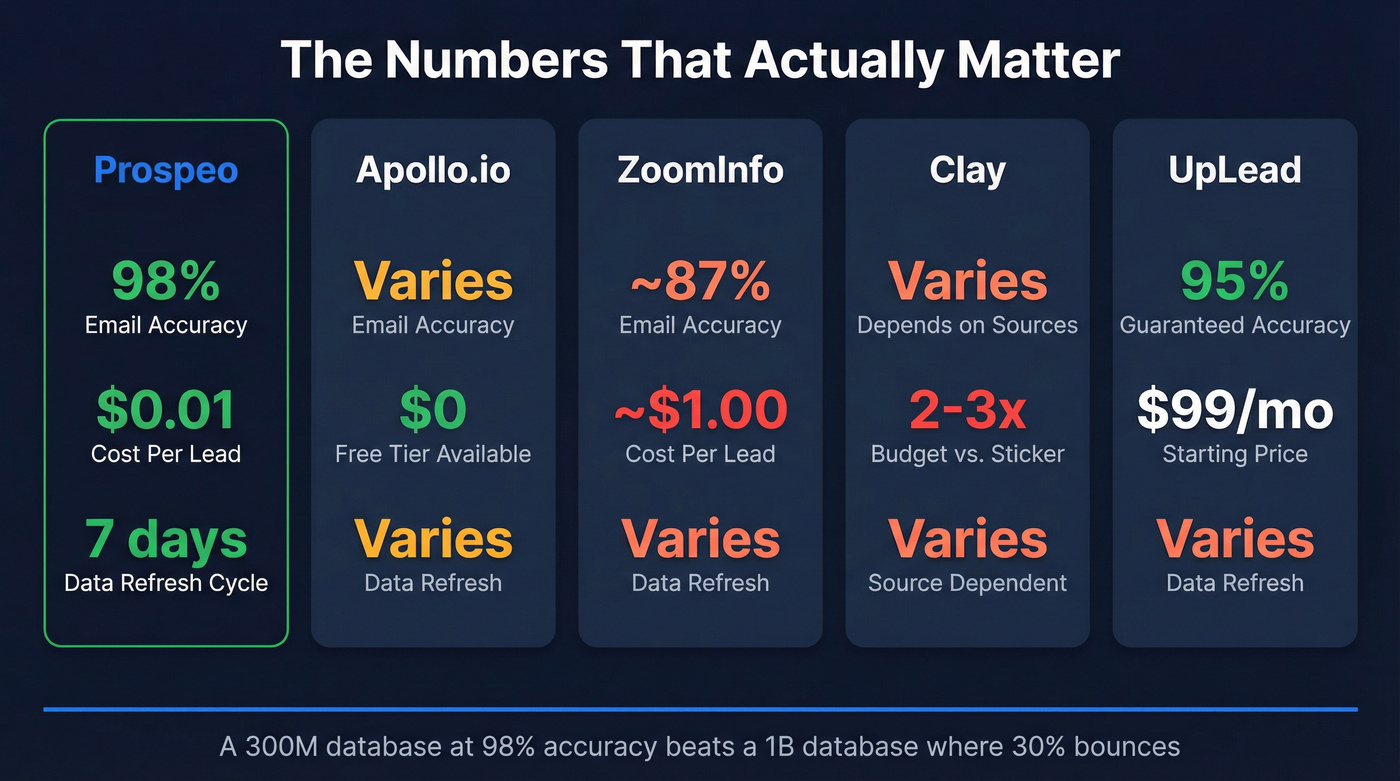
Prospeo takes the top spot because 98% email accuracy and a 7-day data refresh cycle are the difference between a sequence that books meetings and one that gets your domain blacklisted. Apollo is the obvious starting point for teams with zero budget. ZoomInfo is genuinely powerful if you can stomach the contract. Clay is brilliant for RevOps engineers who think in workflows. And Kaspr is the pick if your ICP lives in Europe.
How We Evaluated
Database size is a vanity metric. A 300M database with 98% accuracy beats a 1B database where 30% bounces. Here's what we actually weighted:
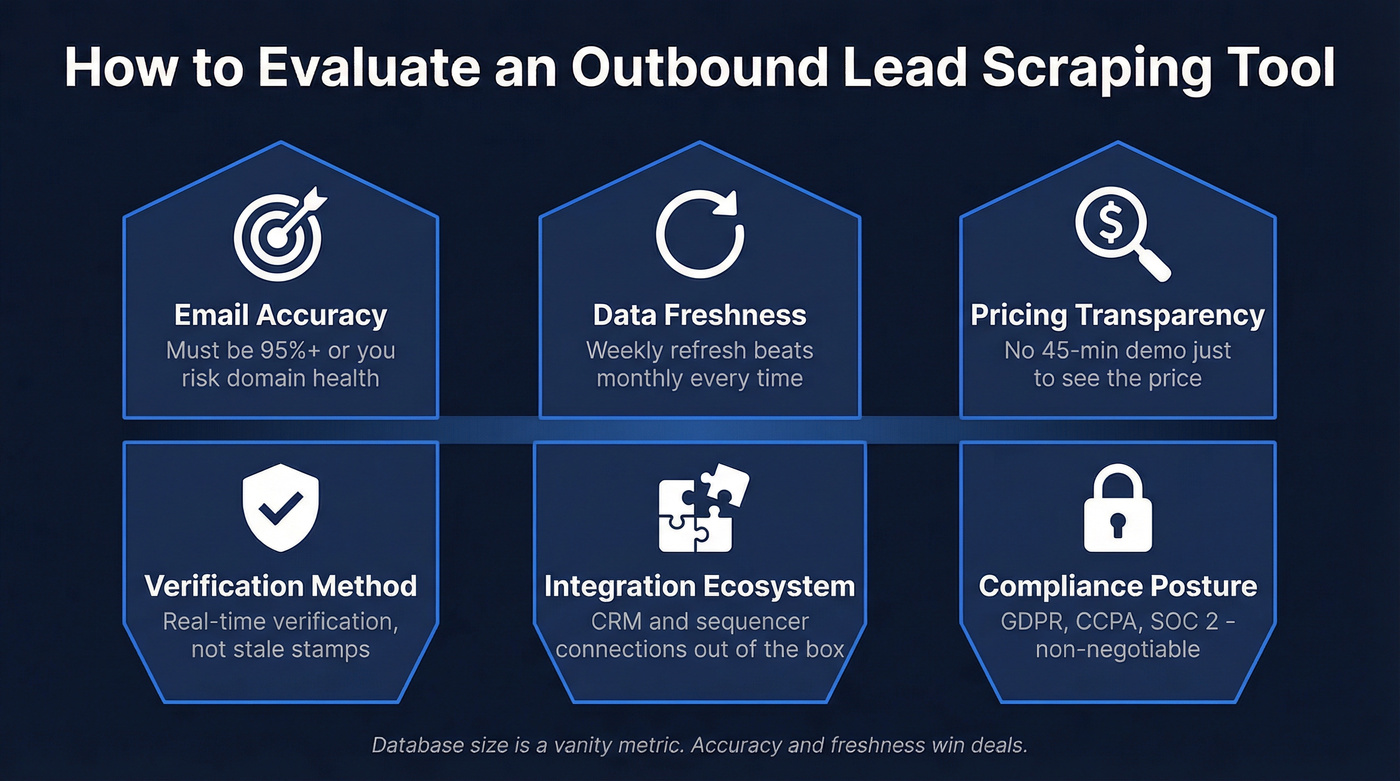
- Email accuracy - what percentage of emails are deliverable on first send? Anything below 95% creates domain risk. (If you need a verifier, start with this list of email ID validators.)
- Data freshness - how often does the provider re-verify records? A long refresh cycle means part of your list is dead before you hit send.
- Pricing transparency - can you figure out what you'll pay without a 45-minute demo? You shouldn't need a sales call to evaluate a data tool.
- Verification methodology - real-time verification, or just a "verified" stamp on stale records?
- Integration ecosystem - does it connect to your sequencer and CRM without duct tape?
- Compliance posture - GDPR, CCPA, SOC 2. If the vendor can't explain their compliance story, that's a red flag.
Comparison Table
| Tool | Email Accuracy | Data Refresh | Starting Price | Best For |
|---|---|---|---|---|
| Apollo.io | Varies | Varies | Free / $49/mo | Budget-conscious SDRs |
| ZoomInfo | ~87% | Varies | ~$15K/yr | Enterprise orgs |
| Clay | Varies by source | Varies | Free / $134/mo (annual) | RevOps workflows |
| Cognism | Varies | Varies | ~$1,500/mo | EMEA enterprise |
| Lusha | Varies | Varies | Free / $49/mo | Quick lookups |
| Kaspr | Varies | Varies | Free / EUR45/mo | EU prospecting |
| Seamless.AI | Varies | Real-time lookup | Free / ~$147/mo | High-volume search |
| UpLead | 95% (guaranteed) | Varies | $99/mo | Mid-market simplicity |
| RocketReach | Varies | Varies | ~$39/mo | One-off lookups |
| Snov.io | Varies | Varies | Free / $30/mo | Solopreneurs |
| LeadIQ | Varies | Monthly | Free / ~$39/user/mo | SDR CRM workflows |
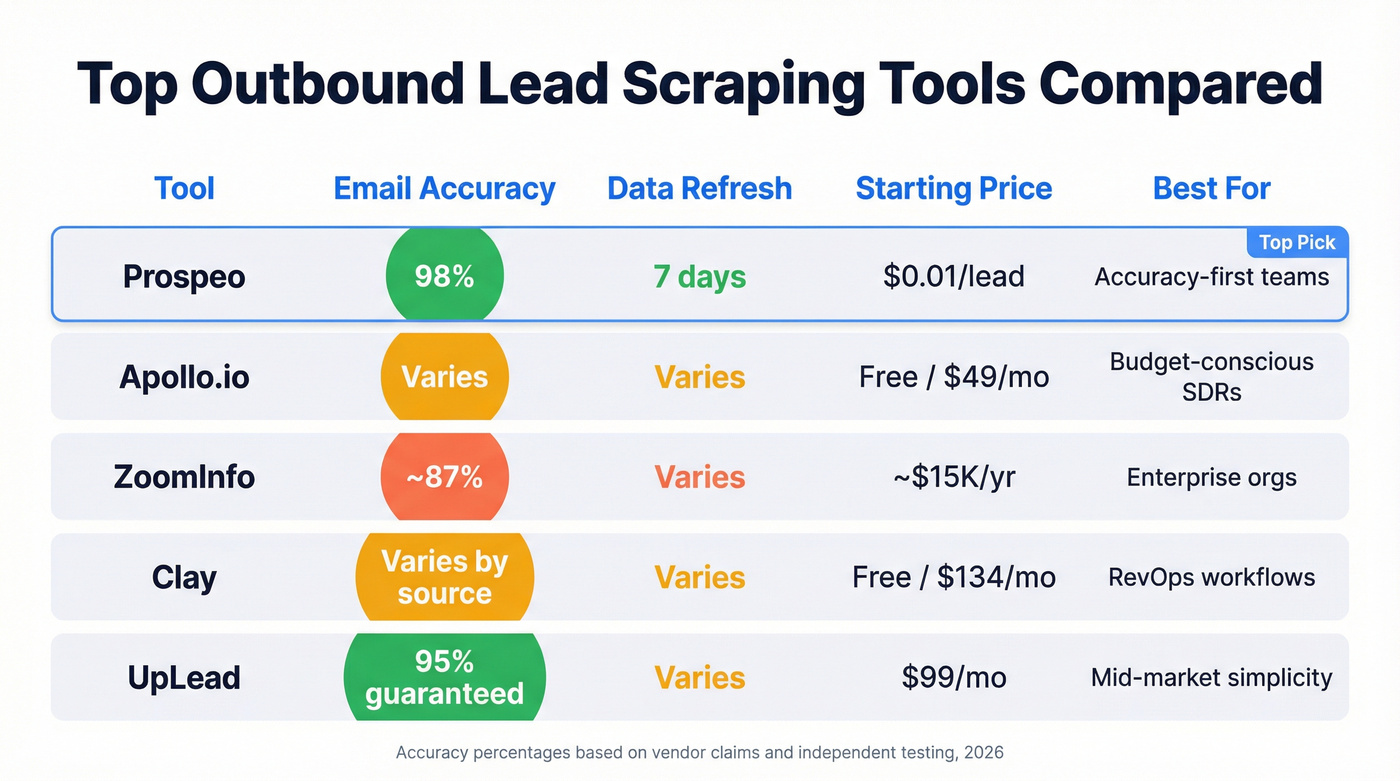
Notice the refresh column. Most tools sit around monthly refreshes or longer. That matters more than you think - we'll get to why.

That 16% bounce rate in the intro? It happens when your lead scraping tool refreshes data every 6 weeks. Prospeo re-verifies every 7 days and delivers 98% email accuracy - so your sequences hit real inboxes, not spam traps. At $0.01 per lead, you get cleaner data than tools charging 90x more.
Scrape leads that actually convert. Start free with 75 verified emails.
The Best Lead Scraping Tools for Outbound
Prospeo
Use this if: You've been burned by bounced emails and need data you can trust on the first send. You want self-serve pricing without annual contracts. You're an agency managing multiple client domains and can't afford deliverability issues.
Skip this if: You need a full-stack GTM platform with built-in dialing, chat, and ABM orchestration. Pair Prospeo with your sequencer of choice instead.
Prospeo's database covers 300M+ contacts pulled from 800M+ collected records, run through a 5-step verification process with catch-all handling, spam-trap removal, and honeypot filtering. The result is 98% email accuracy and 125M+ verified mobile numbers with a 30% pickup rate across all regions. The API returns a 92% match rate, and intent data powered by 15,000 Bombora topics lets you filter for in-market buyers. CRM and CSV enrichment returns 50+ data points per contact with an 83% match rate.

The 7-day data refresh cycle is the real differentiator. While most competitors refresh every 4-6 weeks, Prospeo re-verifies weekly - which means you're not emailing someone who left their company two months ago. The proprietary email-finding infrastructure doesn't rely on third-party providers, so you're not getting the same recycled data as everyone else. At roughly $0.01 per lead versus ZoomInfo's ~$1 per lead, it's about 90% cheaper with higher accuracy.
Real results back this up. Snyk's 50-person AE team cut bounce rates from 35-40% to under 5% and saw AE-sourced pipeline jump 180%. Stack Optimize built from $0 to $1M ARR with 94%+ deliverability, sub-3% bounce rates, and zero domain flags across all clients.
Free tier gives you 75 verified emails and 100 Chrome extension credits monthly. No contracts, cancel anytime. Integrations cover Salesforce, HubSpot, Smartlead, Instantly, Lemlist, Clay, and Zapier.
Apollo.io
Apollo is where most outbound teams start, and that's fine. The free tier is one of the most generous in the category, and having prospecting plus email sequencing in one platform removes real friction for early-stage teams. The database sits in the 210M-275M+ contact range depending on the product page, and paid plans are accessible: Basic at $49/mo per user (billed annually, 900 mobile credits/yr), Professional at $79/mo per user (1,200 mobile credits/yr), Organization at $119/mo per user (minimum three users, 2,400 mobile credits/yr).
Pros:
- Built-in email sequencing eliminates the need for a separate tool (see our roundup of cold email marketing tools)
- Enough free credits to learn outbound before spending a dollar
- Solid filtering for company size, industry, and job title
Cons:
- Email accuracy drops at scale - bounce rates often climb on larger exports unless you add a verification layer
- The credit system gets restrictive fast once you're past the free tier
- Records can sit for weeks without re-verification
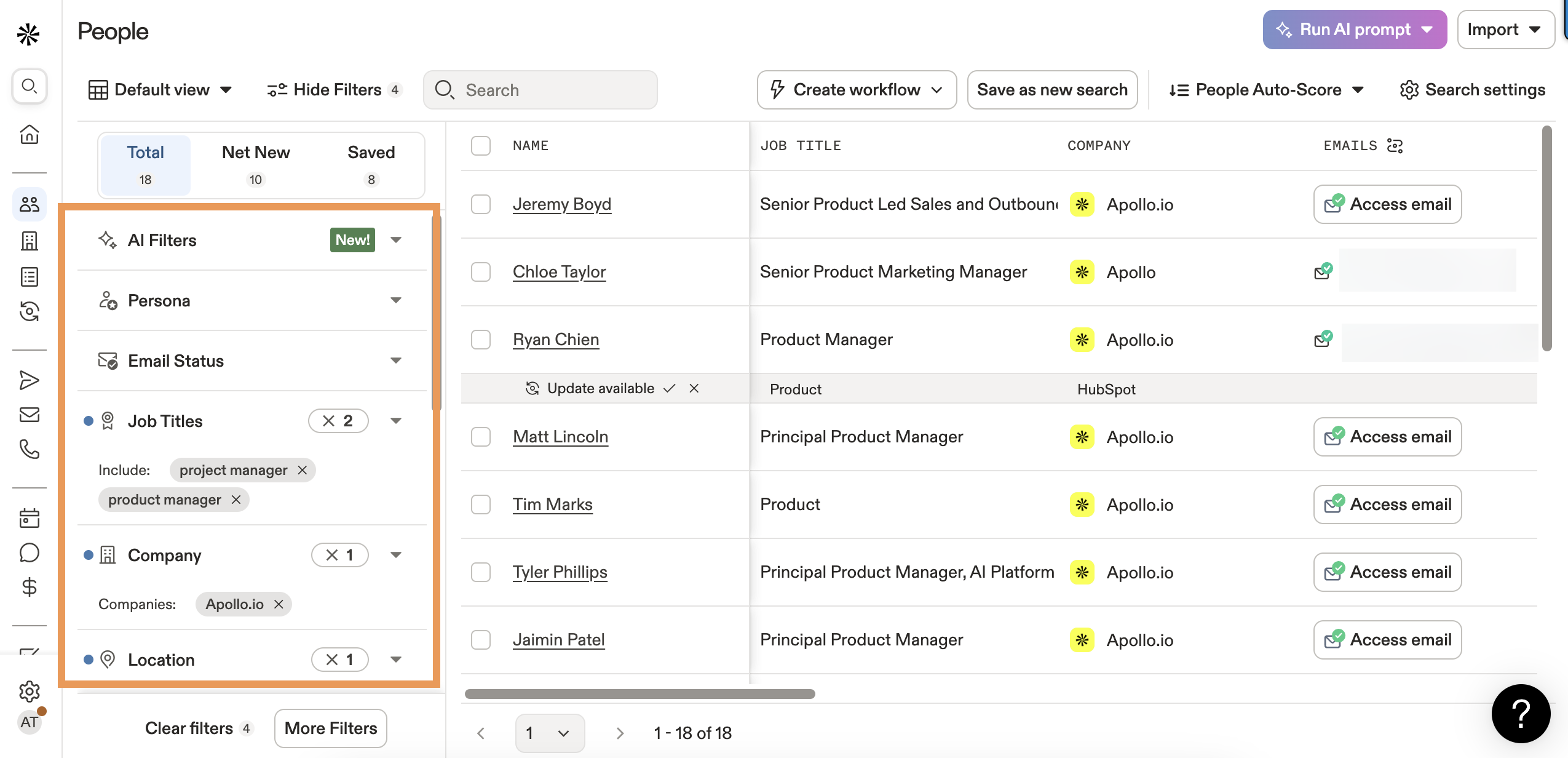
Apollo is also where most teams hit a ceiling. Once you're sending 1,000+ emails a week and accuracy starts mattering for domain health, you'll need a verification layer on top - or a different primary database entirely.
ZoomInfo
Use this if: You're a 50+ person sales org with a $30K+ annual data budget, dedicated RevOps, and you need intent data, website visitor tracking, and workflow automation all in one platform.
Skip this if: You have fewer than 10 reps, no RevOps team, or a budget under $15K/year. You'll pay for modules you never activate.
ZoomInfo's database is one of the deepest in the market - 500M+ contacts across 100M+ companies, with GDPR, CCPA, and SOC 2 Type II compliance. Data quality for US-based contacts is strong, and the intent signals are useful if you have the ops team to act on them.
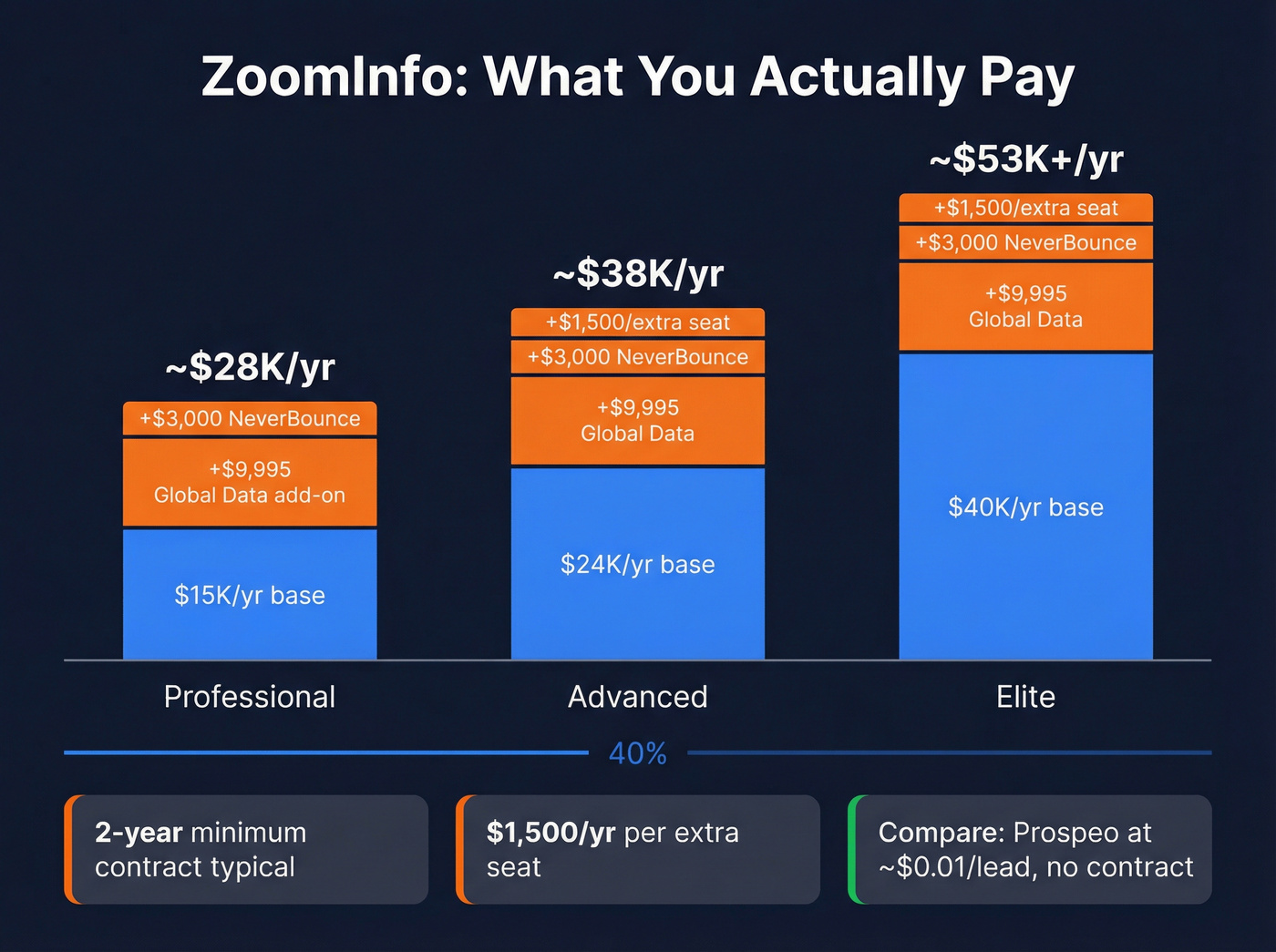
The pricing is where it gets real. Professional starts around $15K/year, Advanced runs ~$24K/year, and Elite pushes past $40K. Add-ons like Global Data ($9,995) and NeverBounce ($3,000) stack on top. Contracts typically require a two-year minimum. Every extra seat costs at least $1,500/year.
The #1 complaint in sales communities? Price - specifically, paying for intent, chat, and workflow features that only 2 of your 8 reps actually use. We've watched that scenario play out multiple times: finance flags your $24K renewal and only 4 reps log in.
Here's the thing: ZoomInfo is still the best all-in-one GTM platform. But most teams don't need all-in-one. If your deal sizes sit below $15K, you almost certainly don't need ZoomInfo-level infrastructure - and you're paying for complexity that slows your team down instead of speeding it up.
Clay
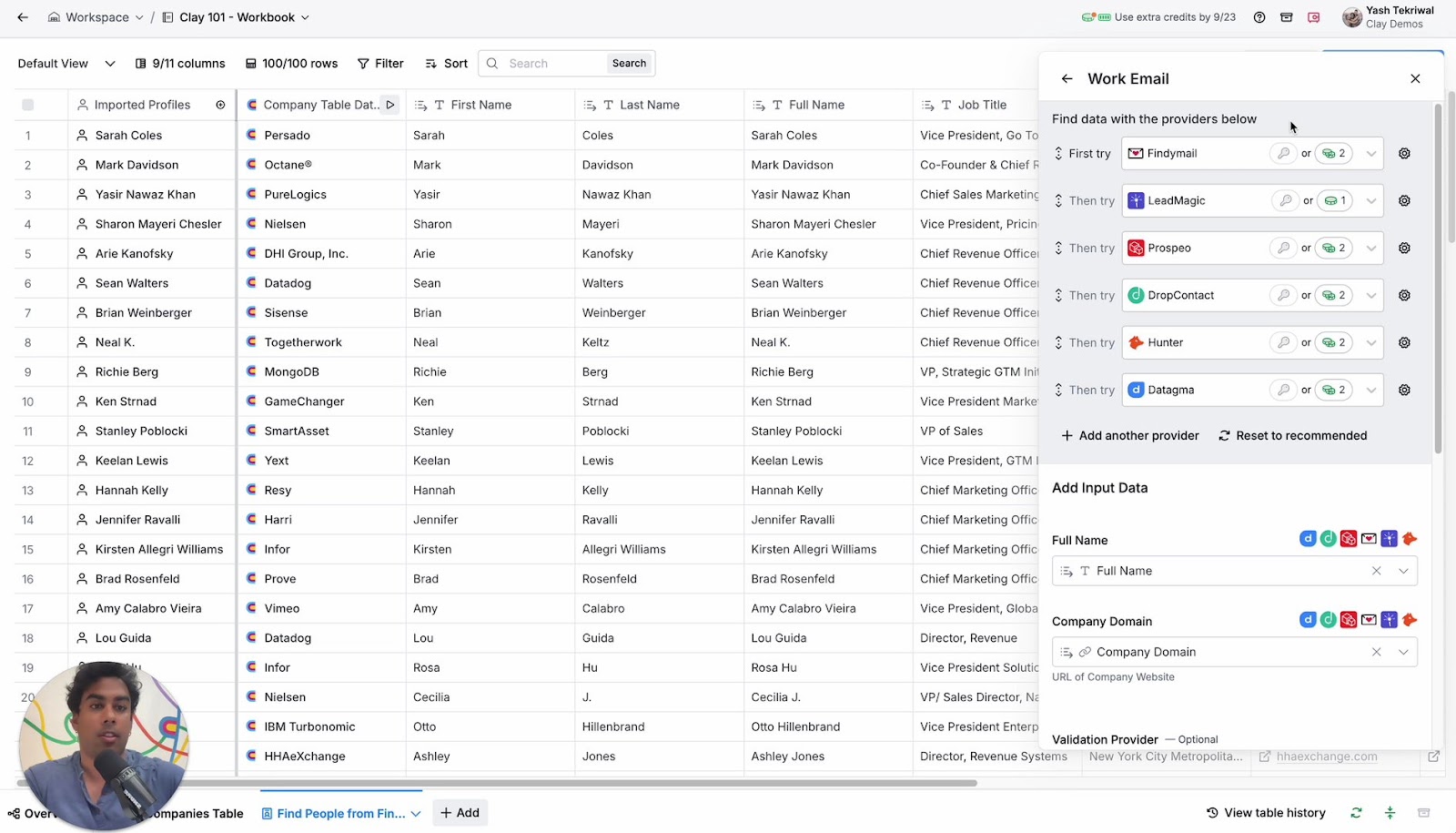
Clay isn't a database. It's a workflow engine that pulls data from multiple providers, scores it, and routes it automatically. That distinction matters because it changes how you should think about cost. (If you want a deeper breakdown, see our guide to Clay pricing.)
Use this if: You're a RevOps engineer or technical operator who wants to build waterfall enrichment workflows. Clay's flexibility is unmatched.
Skip this if: You want a simple "search and export" database. And if you're not comfortable budgeting 2-3x the sticker price, you'll be frustrated within a month.
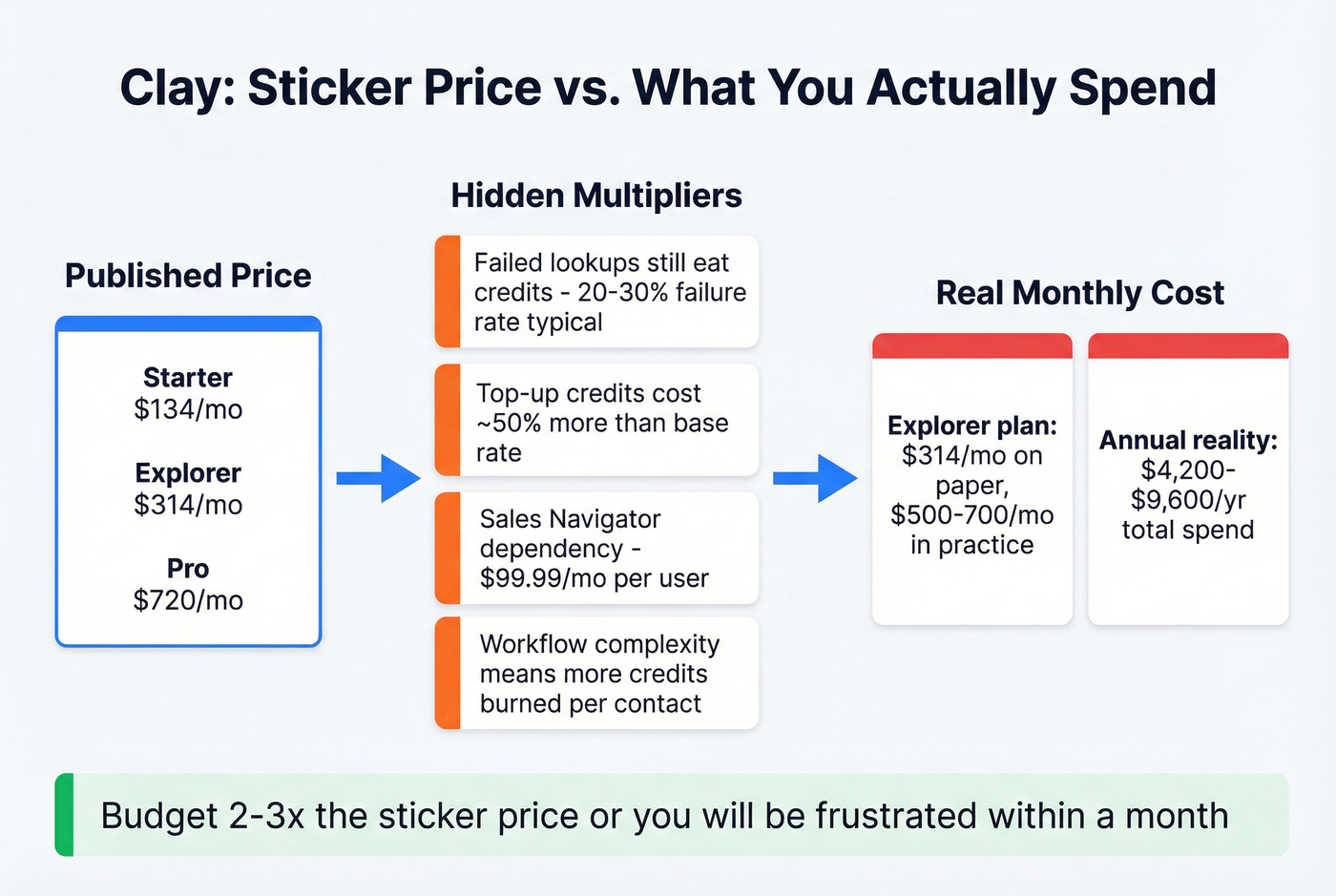
Clay's published pricing looks reasonable: Free (1,200 credits/year), Starter at $134/mo, Explorer at $314/mo, Pro at $720/mo - all billed annually with credits granted upfront. The real-world spend tells a different story.
Failed lookups still consume credits, and typical failure rates run 20-30%. Top-up credits carry a ~50% markup over your plan's base rate. Many enrichment workflows use Sales Navigator ($99.99/mo per user) as a dependency. Most teams end up spending $4,200-$9,600/year once you factor in top-ups, failed lookups, and add-on subscriptions. That Explorer plan at $314/mo? Budget $500-700/mo in practice.
Clay is brilliant. It's also the tool most likely to blow past your budget without warning.
Cognism
Cognism is the European enterprise play, and it owns that lane. The database covers 400M+ contacts with a particular strength in EMEA markets where ZoomInfo's coverage thins out. Their "Diamond Data" program phone-verifies mobile numbers through a human research team - not just algorithmic matching - which produces noticeably higher connect rates for European decision-makers.
The GDPR-first approach isn't marketing spin. Cognism was built in Europe, for European selling, with compliance baked into the data collection methodology rather than bolted on afterward. If your ICP is EMEA C-suite and you have the budget, Cognism's phone data is hard to beat.
The frustrating part: pricing is completely opaque. Custom annual contracts typically land at $1,500-$3,500/mo for SMB teams, scaling to $30K-$80K+/year for enterprise. You shouldn't need a 45-minute demo to find out if a tool fits your budget. (If you're evaluating, start with this breakdown of Cognism pricing.)
Where Cognism wins over ZoomInfo: EMEA mobile coverage and GDPR compliance. Where ZoomInfo still wins: US database depth, intent data breadth, and workflow automation.
Lusha
Lusha covers 300M+ contacts and works best as a Chrome extension for individual SDRs who need quick lookups rather than bulk exports. Free tier gets you started with 50 email credits/month, Pro runs $49/mo (160 email credits), Premium $79/mo (320 email credits), and Scale is custom-priced per user. The interface is clean and the learning curve is minimal. Credit limits get tight fast for team-wide prospecting, though, and the data accuracy on bulk pulls doesn't match dedicated database platforms. Think of Lusha as a sidearm, not a primary weapon.
Kaspr
Kaspr is purpose-built for European prospecting. The free plan includes 15 B2B email credits and 5 phone credits per month - enough to test the waters. Starter runs EUR45/mo with unlimited B2B email credits and 100 phone credits monthly. The Chrome extension is the primary interface, designed for one-at-a-time prospecting rather than bulk list building.
For teams targeting European decision-makers where GDPR compliance isn't optional, Kaspr is the most straightforward option at this price point. It won't replace a full database for US-focused teams, but that's not what it's trying to do. (For plan details, see our Kaspr pricing breakdown.)
Seamless.AI
Unlike every other tool on this list, Seamless.AI doesn't maintain a static database - it's a real-time search engine claiming 1B+ records. The free tier lets you test, with paid plans starting around $147/mo and enterprise pricing going custom.
The downsides are well-documented on r/sales and other communities: accuracy at scale is inconsistent, and the upselling is aggressive - expect persistent upgrade prompts. Worth testing if you value volume over precision, but verify before sending.
UpLead
UpLead positions itself as the mid-market simplicity play with a 95% data accuracy guarantee. Essentials starts at $99/mo for 170 credits, Plus at $199/mo for 400 credits, and Professional is custom. Real-time email verification happens before export, which means you're not paying for contacts that bounce. The database is smaller than ZoomInfo or Apollo, but the verification-first approach means what you get tends to be usable. Good fit for teams that want clean data without the complexity of Clay or the cost of ZoomInfo.
RocketReach
RocketReach covers 700M+ contacts with plans from ~$39/mo (Essentials) to ~$249/mo (Ultimate). Solid for one-off lookups and research, but the bulk prospecting experience and integration ecosystem don't match dedicated outbound platforms.
Snov.io
Snov.io combines email finding with built-in drip campaigns - trial is free with 50 credits, Starter runs $30/mo, and Pro scales from $75-$554/mo. Best for solopreneurs who want prospecting and outreach in one tool without paying for separate platforms.
LeadIQ
LeadIQ covers 750M+ profiles with a free tier, Essential at ~$39/user/mo, and Pro at ~$79/user/mo. Designed specifically for SDR workflows with one-click CRM push. Pairs well with Salesforce-heavy teams who want prospecting data flowing directly into their existing stack. (If you're comparing options, see LeadIQ alternatives.)
The Hidden Cost Nobody Talks About
Stale data is the silent budget killer.
Most tools refresh their databases on 4-6 week cycles. If you're working from a list that's weeks old, a meaningful chunk of it is outdated before you ever hit send. At 5,000 contacts, even a small stale-data percentage turns into a lot of bounces - enough to trigger spam filters and damage your sender reputation for weeks. Weekly re-verification closes that gap between "verified" and "actually deliverable." (More on benchmarks in our guide to B2B contact data decay.)

Credit waste inflates your real cost by 30-50%. Clay's credit mechanics are the most visible example - failed lookups consume credits at a 20-30% rate, top-ups carry a ~50% markup, and dependency tools like Sales Navigator add another $100/mo per user. But this pattern isn't unique to Clay. ZoomInfo's add-on creep (Global Data at $9,995, NeverBounce at $3,000) turns a $15K contract into a $25K+ line item. The real question isn't "what does the plan cost?" It's "what will I actually spend in 12 months?"
How to Choose the Right Tool
You don't need 10 tools. You need one good database and one verification layer. (If you want the bigger picture, start with our B2B sales stack blueprint.)
5-person SDR team, ~$500/mo budget: Start with Apollo's free tier for prospecting volume, then run your exports through a verification layer before loading into your sequencer. This combo costs under $100/mo and keeps your bounce rate below 5%.
20-person sales org, $2K+/mo budget: Prospeo as your primary database if your ICP is global or US-focused. Cognism if your ICP is heavily EMEA. Both give you verified data at this price point without the ZoomInfo contract commitment.
Agency managing 10+ clients: Per-credit pricing with no contracts is built for this model. You're paying for what you use, protecting each client's domain independently, and not locked into annual minimums that don't flex with client churn.
Enterprise with RevOps team and $30K+ budget: ZoomInfo if you need the full GTM platform with intent, chat, and workflow automation. Clay if your RevOps team wants to build custom waterfall enrichment. Either way, verify the data before sending - even enterprise tools bounce.
Let's be honest: most teams overcomplicate this. Pick one outbound lead scraping tool that matches your region and budget, verify everything before it hits your sequencer, and focus your energy on messaging instead of tool shopping.
Is Lead Scraping Legal?
Lead scraping legality depends on four factors: what data you're collecting, what jurisdiction governs it, whether you're respecting platform terms of service, and what you intend to do with the data.
GDPR treats even publicly available personal data as protected. The California Law Review puts it directly: "Public availability doesn't eliminate privacy interests." Scraping someone's work email from a company website doesn't automatically give you the right to cold email them in the EU without a legitimate interest basis.
Practical guidance for staying compliant:
- Use GDPR/CCPA-compliant tools that handle consent and opt-out infrastructure for you. Look for SOC 2, GDPR, and CCPA certifications, plus globally enforced opt-outs and available DPAs.
- Honor opt-outs immediately. This isn't optional - it's the law in most jurisdictions.
- Document your legitimate interest basis for B2B outreach. "We're contacting this VP of Engineering because they match our ICP and their company uses a competing technology" is a defensible basis.
- Don't scrape behind authentication walls or violate platform terms of service. The US CFAA creates real legal risk here, and outcomes are case-driven.
The safest path: use tools that bake compliance into their data collection methodology rather than trying to DIY scraping and hoping for the best.
Every tool on this list claims a massive database. Only one runs 5-step verification with catch-all handling, spam-trap removal, and honeypot filtering on a 7-day cycle. Prospeo's 300M+ profiles aren't recycled from third-party providers - they're verified through proprietary infrastructure. That's why Snyk cut bounce rates from 35% to under 5% across 50 AEs.
Replace your lead scraping tool with one that protects your domain.
FAQ
What's the difference between lead scraping and data enrichment?
Lead scraping finds new contacts from scratch using filters like job title, industry, and company size. Enrichment adds missing data points - emails, phone numbers, technographics - to contacts you already have. Most modern B2B data platforms handle both, but pricing models differ significantly between the two functions.
How many leads can I scrape for free?
Apollo offers one of the most generous free tiers for raw volume. Prospeo gives 75 verified emails and 100 Chrome extension credits monthly - with full verification included. Kaspr offers 15 email and 5 phone credits. Compare what you get per credit, not just the number.
Will scraping tools damage my email deliverability?
Only if the data is bad. Unverified or stale emails bounce, which tanks your sender reputation. The threshold is around 5% - go above that consistently and you'll land in spam. Always run contacts through real-time verification before sending, regardless of what your data provider claims.
What's a good email bounce rate for outbound?
Under 3% is excellent and signals clean, fresh data. Under 5% is acceptable for most ESPs. Above 5% means your data source needs upgrading - you're actively damaging your sender reputation and reducing inbox placement across all future sends.
Do I need a separate email verification tool?
If your scraping platform doesn't include real-time verification, yes. Some tools stamp "verified" on records without checking catch-all domains, removing spam traps, or filtering honeypots. Prospeo's 5-step verification handles this natively, but for tools like Apollo or Seamless.AI, adding a dedicated verification layer before sending is essential.