

How to Choose the Right Targets for Cold Outreach
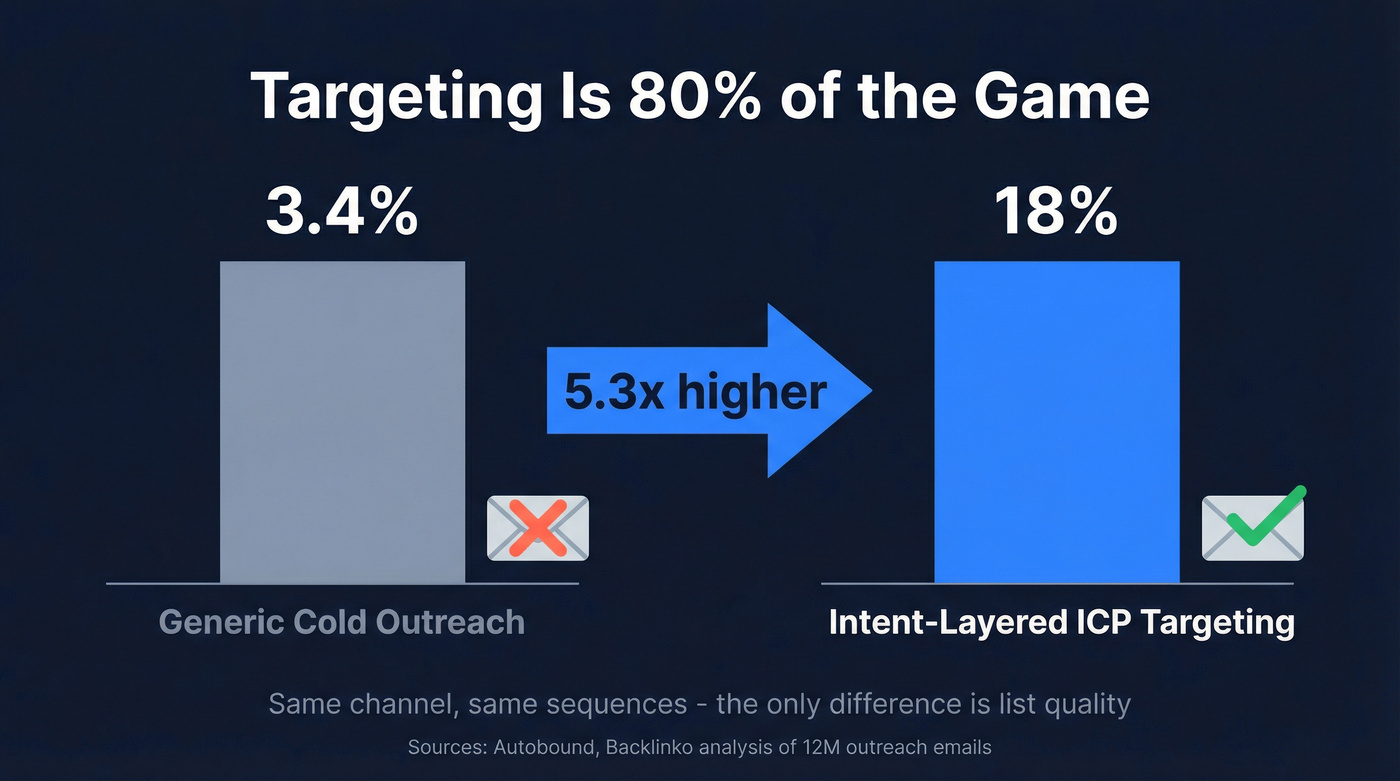
You send 5,000 emails. You get 170 replies. That's a 3.4% response rate - the industry average for generic cold outreach. Backlinko's analysis of 12 million outreach emails found an 8.5% average reply rate, but that average hides a massive spread. Teams that layer intent signals onto a tight ICP hit 18% response rates on the same channel.
The difference isn't copywriting or subject lines. It's targeting.
Choosing targets for cold outreach is 80% of the game, and most teams invert that ratio - spending weeks on sequences and minutes on list quality. List quality beats copywriting every time.
The Three Things That Actually Matter
Three things separate high-performing outbound lists from spray-and-pray:
- Build a 3-layer ICP (firmographics + demographics + technographics) from your CRM's closed-won data, not assumptions.
- Layer 1-2 intent signals - funding rounds, hiring surges, tech adoption - onto your ICP list. This moves reply rates from ~3.4% to ~18%.
- Verify every contact before it enters a sequence. One bad-data batch can torch your domain reputation for months.
7-Step Framework for Outreach Targeting
Step 1 - Build Your ICP from CRM Data
Start with your CRM, not your gut. Pull your last 50 closed-won deals and look for patterns across three layers:
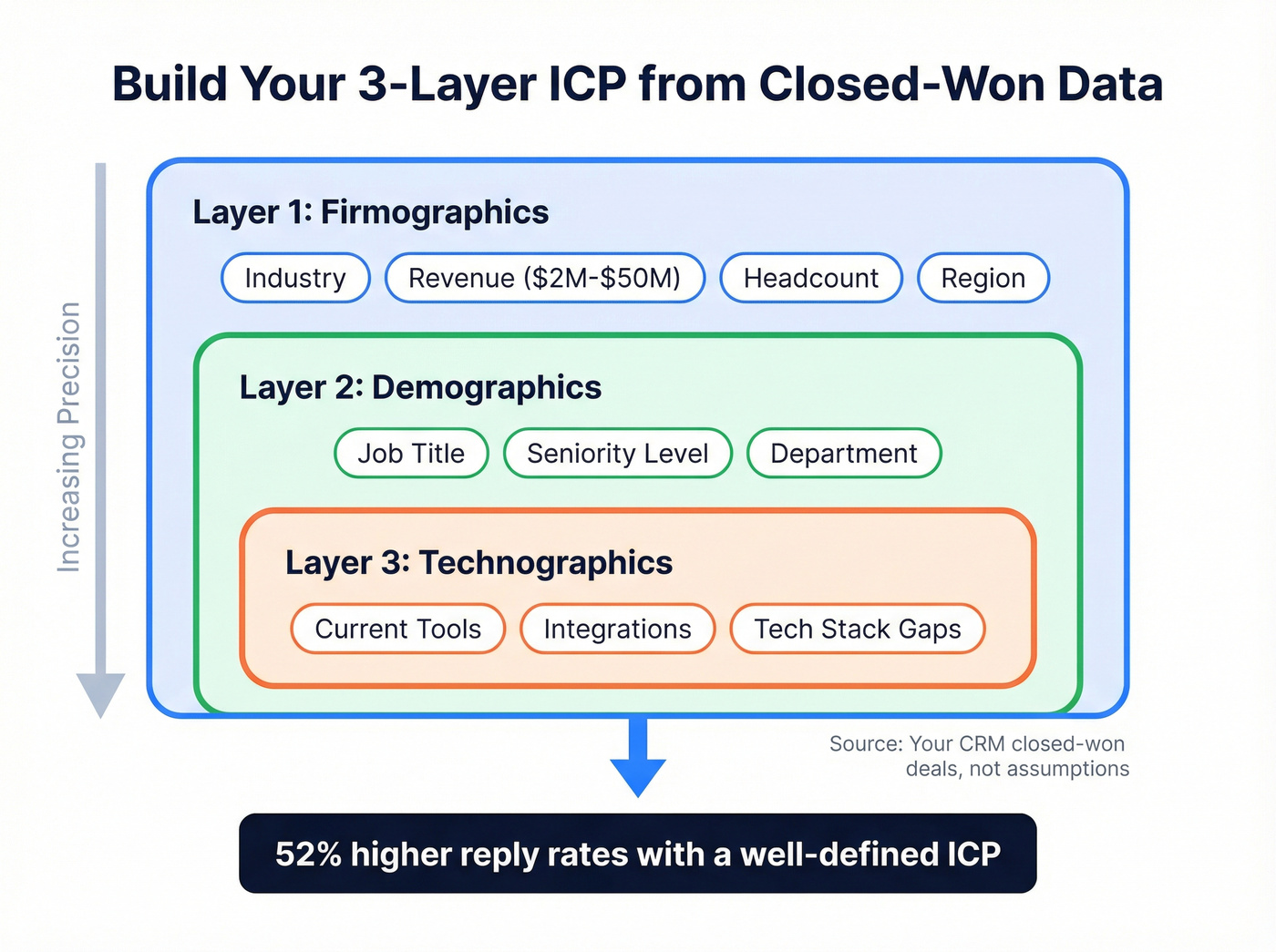
| Layer | What to capture | Example values |
|---|---|---|
| Firmographic | Industry, revenue, headcount, region | SaaS, $2M-$50M, North America |
| Demographic | Title, seniority, department | VP Sales, Director Ops |
| Technographic | Tools they use, integrations | Shopify, Google Analytics, HubSpot |
Personalized emails built on a well-defined ICP yield 52% higher reply rates than generic messaging. That lift comes from relevance, not cleverness. Segment your closed-won accounts by revenue contribution, win rate, and retention - the patterns will tell you who to target next. Use CRM data for your outbound analysis rather than anecdotal feedback from reps. The numbers don't lie, and they'll often surprise you: the segment your team thinks is "the best fit" frequently isn't the one generating the most revenue.
Step 2 - Find Cluster Sources
Don't build lists one contact at a time. SparkToro calls these "cluster sources" - entities that aggregate many relevant targets in one place:
- Industry roundups - "Top 50 SaaS companies" lists, awards, "40 under 40"
- Curation sites - ProductHunt, AngelList, G2 category pages
- Communities - Slack groups, niche subreddits, paid mastermind groups
- Job boards - companies hiring for roles your product supports
- Competitor review sites - G2 and Capterra let you target competitor customers who are publicly evaluating alternatives
For each prospect, ask two questions: does their profile give you an "Ooh!" moment (initial resonance) and an "Aha!" moment (clear value you can deliver)? If neither clicks, move on. Spending time on lukewarm prospects is how teams end up with 3.4% reply rates and wonder what went wrong.
Step 3 - Layer Intent Signals
Static ICP lists are a starting point. Intent signals turn them into a prioritized queue. The first seller to reach a prospect after a trigger event is 5x more likely to win the deal.
| Signal type | Example | Where to find it |
|---|---|---|
| Funding round | Series B closed last week | Crunchbase, PitchBook |
| Hiring surge | 15 SDR roles posted | Job boards, company careers page |
| Job change | New VP Sales started 30 days ago | Professional profiles, alerts |
| Tech adoption | Just installed Salesforce | BuiltWith, Wappalyzer |
| Content consumption | Researching "outbound tools" | Bombora, G2 intent |
Step 4 - Score and Prioritize
Not every ICP-fit prospect deserves the same effort. Use a simple scoring rubric:
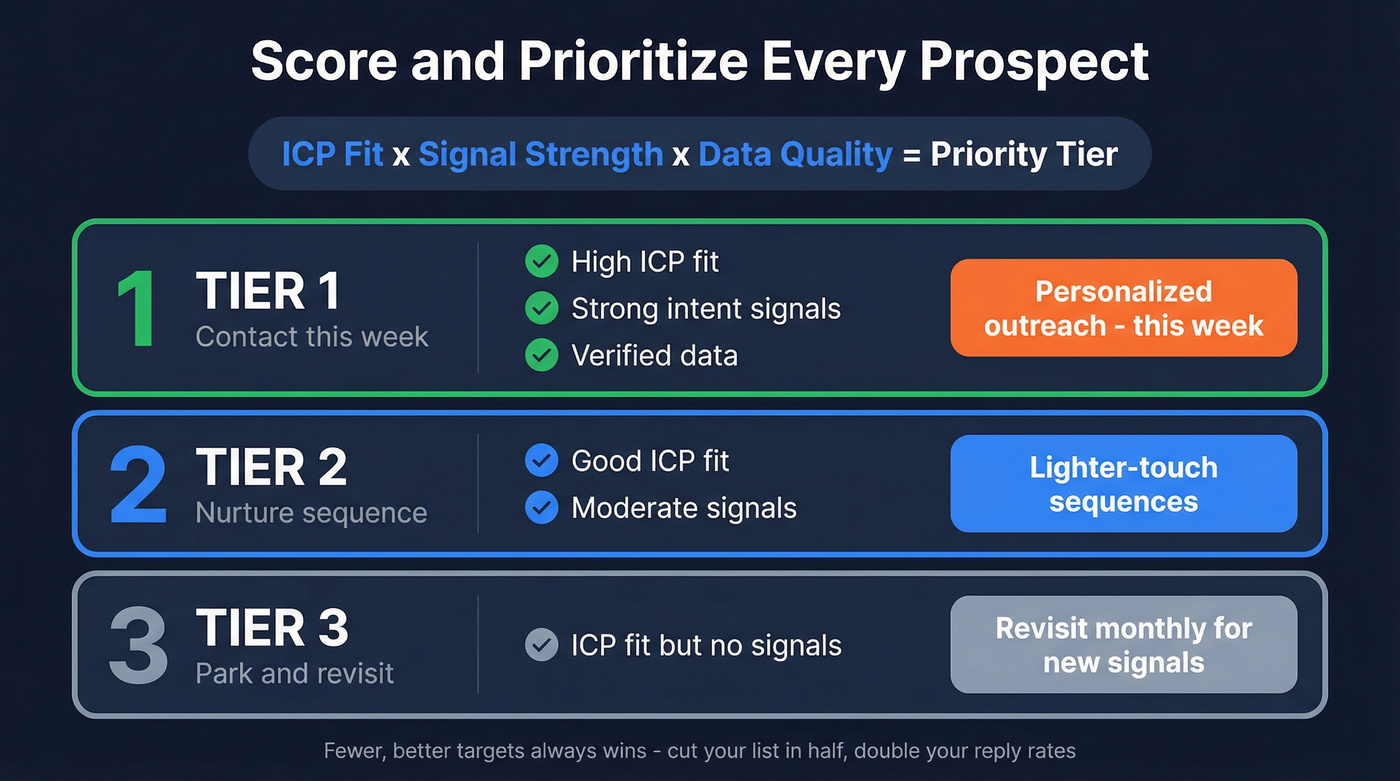
ICP fit x signal strength x data quality = priority tier.
- Tier 1 (high fit + strong signals + verified data) - contact this week with personalized outreach.
- Tier 2 (good fit + moderate signals) - nurture with lighter-touch sequences.
- Tier 3 (fit but no signals) - park and revisit monthly.
Step 5 - Verify Before You Send
Here's the thing: verification isn't a deliverability step. It's a targeting step.
If a big chunk of your list bounces, you haven't just wasted sends - you've told inbox providers your domain can't be trusted. That damage takes weeks to repair. Real-time email verification catches bounces, spam traps, and catch-all domains before they tank your sender reputation. A 7-day data refresh cycle matters here - tools running on a 6-week refresh mean you're emailing people who left the company weeks ago. One team we work with, Meritt, switched to a weekly-refresh verification workflow and dropped their bounce rate from 35% to under 4%, tripling their connect rate in the process. If you want a deeper dive on list decay, see data refresh cycle.
Step 6 - Build Your Negative ICP
Your list of 2,000 contacts isn't really 2,000 contacts. After you strip out the wrong fits, it's probably 900. Build explicit exclusion criteria:
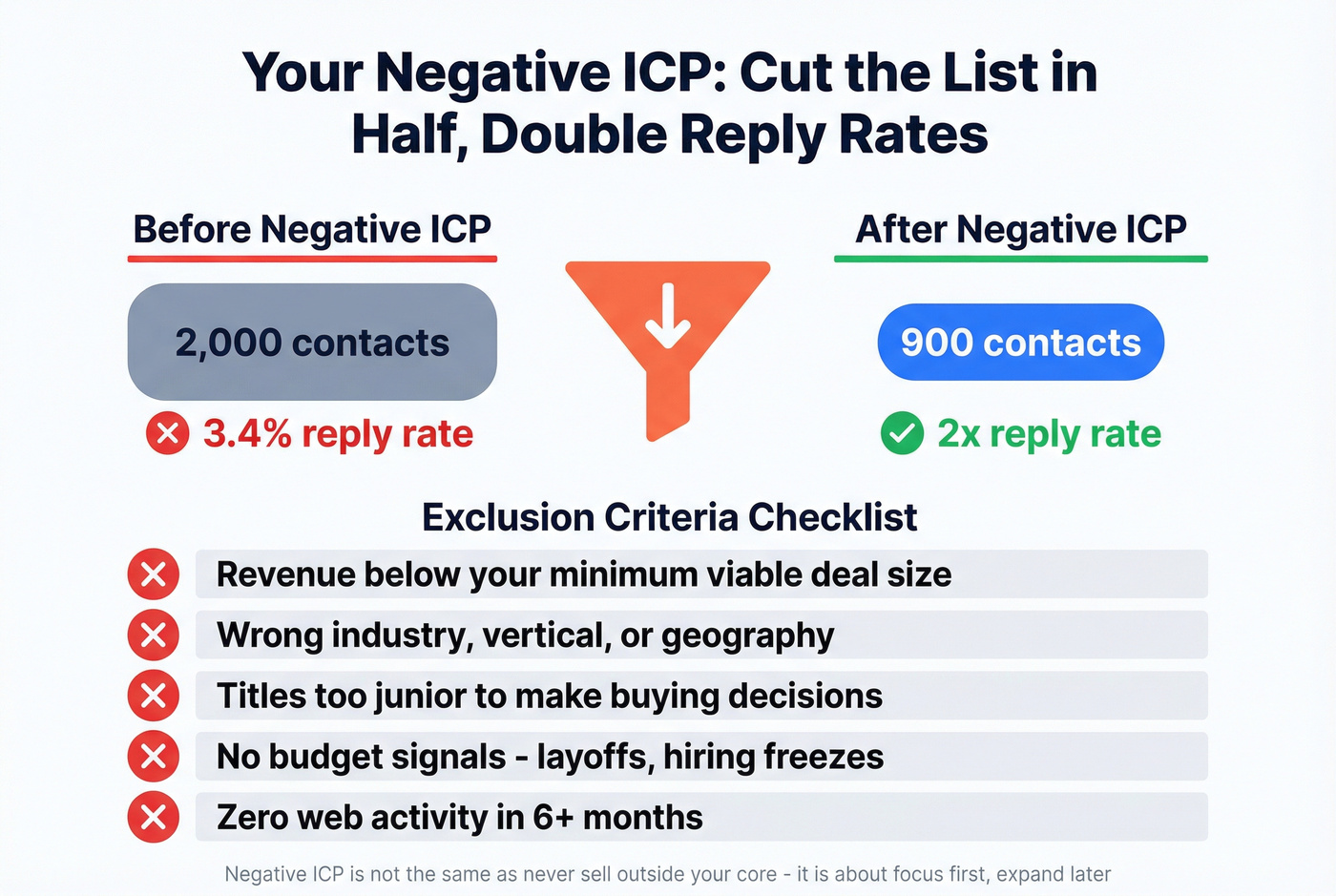
- Revenue below your minimum viable deal size
- Wrong industry, vertical, or geography
- Titles too junior to buy
- No budget signals like layoffs, hiring freezes, or zero web activity in 6+ months
We've seen teams cut their lists in half with a negative ICP and double their reply rates. Fewer, better targets always wins. That said, don't confuse "negative ICP" with "never sell outside your core." Selling beyond your ideal customer profile can work - but only as a deliberate expansion play after you've saturated your primary segments, not as a substitute for focus.
Step 7 - Test, Measure, Iterate
Your first ICP hypothesis is wrong. That's fine. Use a simple lead scoring system and keep iterating based on outcomes, not opinions.

Your targeting framework is only as good as the data behind it. Prospeo gives you 30+ search filters - buyer intent, technographics, job changes, headcount growth, funding - so you can build Tier 1 lists that match your ICP exactly. Every email is 98% accurate on a 7-day refresh cycle.
Turn your ICP into a verified, intent-layered hit list in minutes.
Targeting Specific Personas and Markets
Once your core framework is running, you'll want to expand into adjacent segments. Let's break down a few common scenarios.
B2B sales to executives - C-suite prospects respond to business outcomes, not feature lists. Lead with ROI data and keep emails under 80 words. A cold email to a CFO should quantify cost savings in the first sentence, full stop. If you're refining exec messaging, use these sales email structure patterns.
Selling to individual contributors - ICs often influence tool adoption from the bottom up. Target them with product-led messaging and free trials rather than ROI decks. Skip this approach if your product requires top-down buy-in with a six-figure contract - ICs won't have the authority to champion it.
Niche B2B markets - smaller TAMs demand higher precision. Use technographic filters and community-based cluster sources to build lists that would be impossible with firmographics alone. The consensus on r/sales is that niche outbound with 200 hyper-targeted contacts beats blasting 5,000 generic ones, and in our experience that's exactly right. For more on precision targeting, see account-based prospecting.
Selling into DACH - the Germany-Austria-Switzerland region has stricter data privacy norms and longer sales cycles. Localize your messaging, respect GDPR opt-in requirements, and expect 20-30% longer deal timelines.
Targeting past customers - churned accounts already know your product. Re-engage them when you spot intent signals like new leadership hires or renewed hiring in the department that originally bought. This pairs well with a B2B lead re-engagement motion.
Tools for Building Cold Outreach Lists
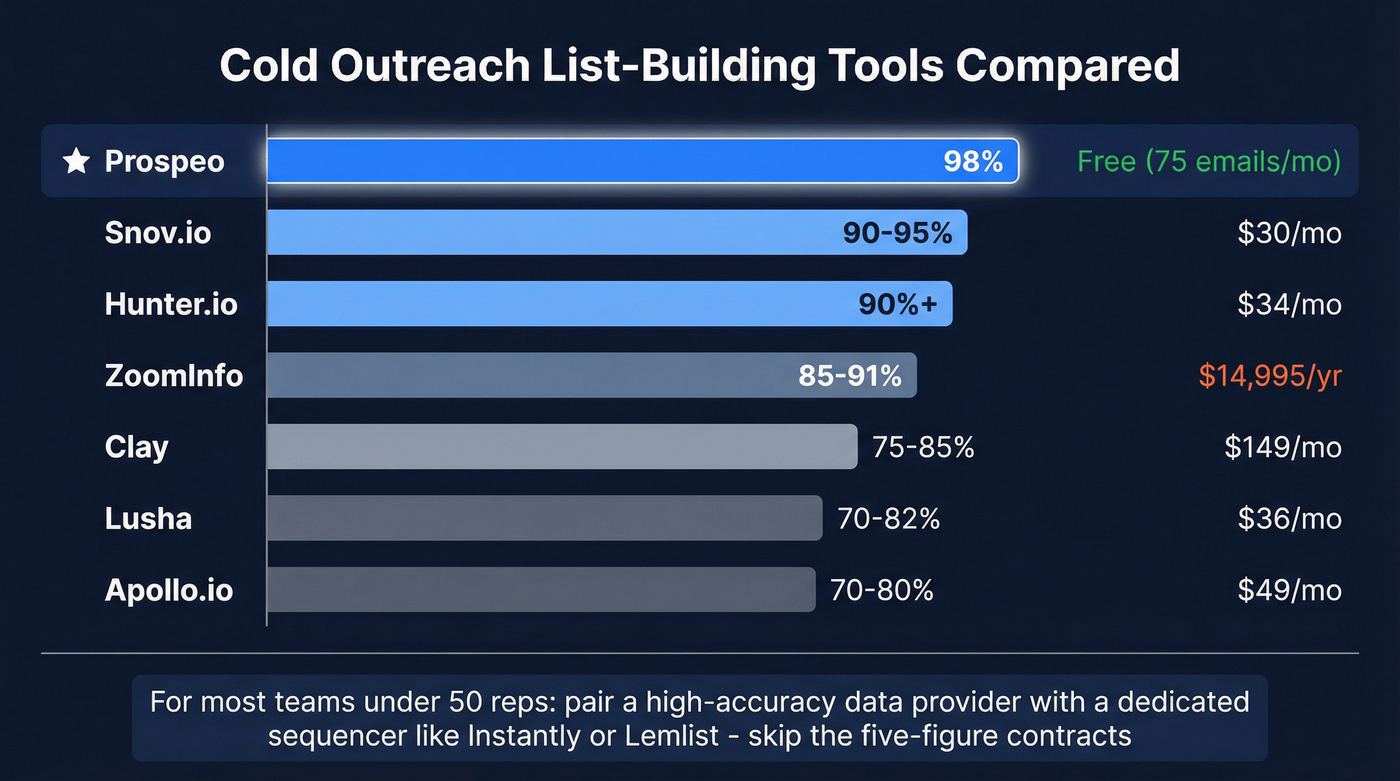
Most outbound teams run a 2-4 tool stack: data provider, enrichment layer, verification, and sequencer. Here's how the major list-building tools compare for targeting:
| Tool | Starting price | Email accuracy | Best for |
|---|---|---|---|
| Prospeo | Free (75 emails/mo) | 98% | Verified emails + intent data |
| Apollo.io | $49/mo | 70-80% | Free-tier prospecting |
| ZoomInfo | ~$14,995/yr | 85-91% | Enterprise teams with budget |
| Clay | $149/mo | 75-85% | Multi-source enrichment |
| Hunter.io | $34/mo | 90%+ (limited find rate) | Domain-level email search |
| Lusha | $36/mo | 70-82% | Quick contact lookups |
| Snov.io | $30/mo | 90-95% verified | Budget-friendly email finding |
Look, ZoomInfo is still the most comprehensive all-in-one platform. But most teams don't need all-in-one - they need accurate data and a sequencer. For most teams under 50 reps, pairing a B2B database with 30+ search filters with a dedicated sequencer like Instantly or Lemlist covers everything without a five-figure annual contract. If you're evaluating vendors, start with this list of sales prospecting platforms.
Bad data doesn't just waste sends - it torches your domain. Prospeo's 5-step verification with catch-all handling and spam-trap removal keeps bounce rates under 4%. Meritt used this exact workflow to triple their connect rate and grow pipeline from $100K to $300K per week.
Verify every contact before it enters your sequence - at $0.01 per email.
FAQ
How many targets should I have per campaign?
Start with 50-100 Tier 1 prospects per rep per week. A tight, signal-filtered list of 100 will outperform a generic list of 1,000 every time - higher reply rates, fewer bounces, and better pipeline per send.
What's the biggest targeting mistake in cold outreach?
Skipping verification. High bounce rates don't just waste sends - they damage your sender reputation and can land your entire domain in spam within weeks. Meritt cut bounces from 35% to under 4% by verifying every contact before sequencing.
Can I use intent data without an expensive platform?
Yes. Track manual signals - funding announcements on Crunchbase, hiring surges on job boards - for free. Intent data powered by Bombora across 15,000 topics is available starting with a free tier, so you don't need a $25K+ contract to prioritize in-market buyers.
Should I target competitor customers?
Absolutely - if you can identify them. Review sites like G2, case study pages, and technographic tools like BuiltWith reveal which companies use competing products. Pair that data with a switching trigger like contract renewal season, a price hike, or a wave of negative reviews for a high-intent list that already understands the problem you solve.