"I Hope This Email Finds You Well" Is Costing You Replies - Here's What to Write Instead
You've typed it. You've stared at it. You've deleted it, retyped it, and hit send anyway. Linguist Naomi Baron calls "I hope this email finds you well" the "cockroach of email openers - indestructible, omnipresent, and curiously devoid of personality." She's right. And that cockroach is eating your reply rates.
The phrase isn't a grammar problem. It's a strategy problem. It wastes your most valuable email real estate - the preview line - on words that say absolutely nothing. Let's fix that.
Quick Version
- Professional emails: Swap to "I hope you're well" or skip the opener entirely and lead with purpose.
- Cold outreach: Open with a specific observation about the recipient. Generic openers kill reply rates.
- International or formal contexts: Keep a polite opener, but personalize it to something real.
- When in doubt: Reference a recent event, shared context, or the recipient's work in your first line.
Where the Phrase Came From
Back when letters traveled by ship, "I hope this finds you well" wasn't filler - it was literal. A message could take weeks or months to arrive, and the recipient might genuinely not be alive when it got there. Expressing hope for their wellbeing was a sincere act.
That context evaporated the moment email made delivery instantaneous. But the phrase survived, fossilized into what linguists call a "frozen phrase" - one that's lost its original pragmatic force. It sticks around because muscle memory and autocomplete keep it alive, not because it does anything useful. Linguist Susan Herring has pointed out that autocomplete suggests the phrase the moment you type "I hope," which only accelerates the fossilization.
Today, it's the email equivalent of a vestigial organ.
Why People Hate This Opener
Three distinct problems converge on this one phrase - plus a cultural backlash most email etiquette guides ignore.
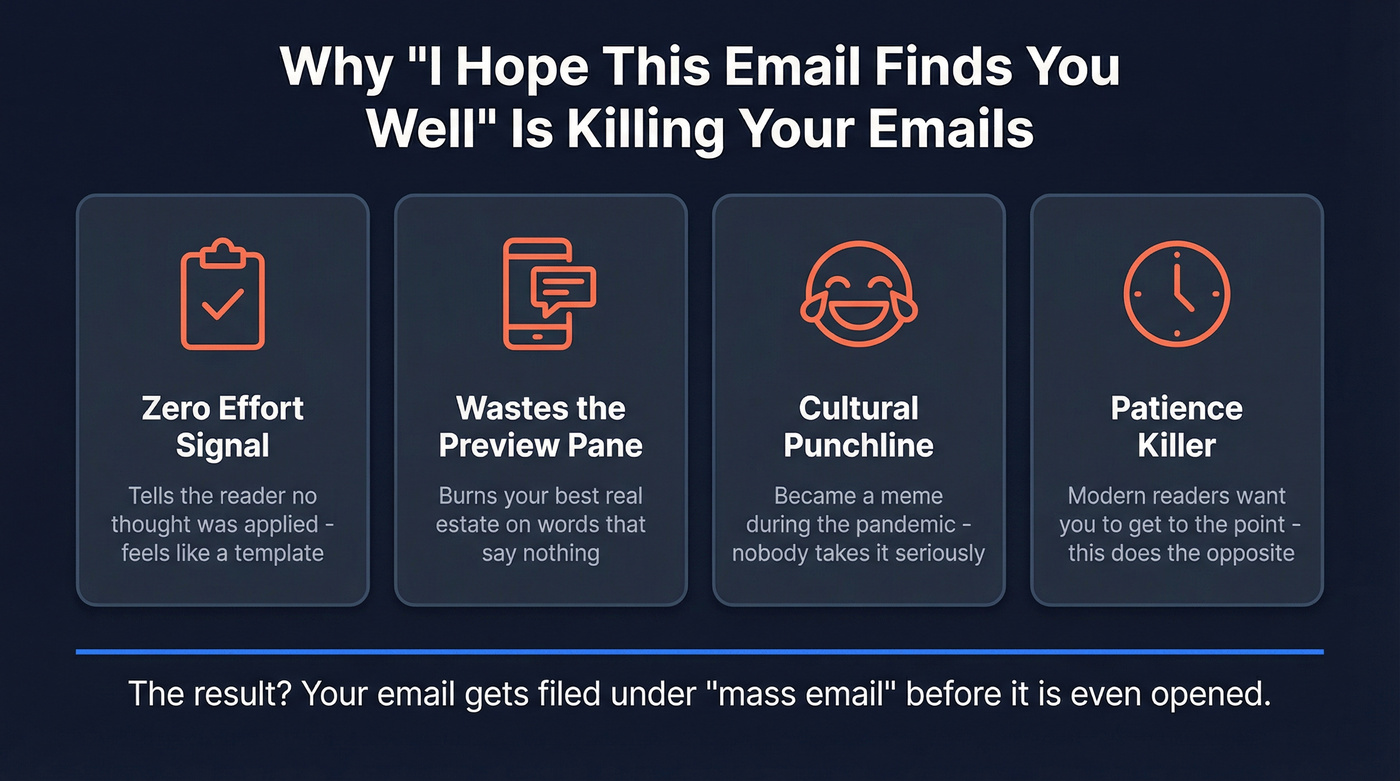
It signals zero effort. Etiquette expert Nick Leighton puts it bluntly: the opener tells the recipient that "no particular thought was applied." It's boilerplate. Performatively courteous. The email equivalent of a limp handshake. When someone reads it, they don't feel warmth - they feel a template.
It wastes the preview pane. Every email client shows a snippet of the first line in notifications and inbox previews. That's prime real estate. If your first line is a generic well-wishing phrase, the recipient's brain files it under "mass email" before they even open it. You've burned your one shot at a first impression on words that could've been auto-generated - because they often are.
It became a cultural punchline. The phrase got so ubiquitous during the pandemic that "How the email found me:" became its own meme format - people posting images of their actual emotional state next to the polished opener. The joke landed because everyone recognized the absurdity.
It clashes with how people actually communicate now. Communication professor Michael Plugh puts it sharply: modern message volume has made everyone impatient. "Everyone's a New Yorker in the digital age" - people want you to get to the point. The general sentiment across Reddit threads and online discussions about this phrase boils down to "just say hi and get on with it." That's not rudeness. It's respect for someone's time.
The AI Suspicion Problem
Here's a wrinkle that most email etiquette guides miss entirely. Formulaic openers now carry an AI suspicion tax.
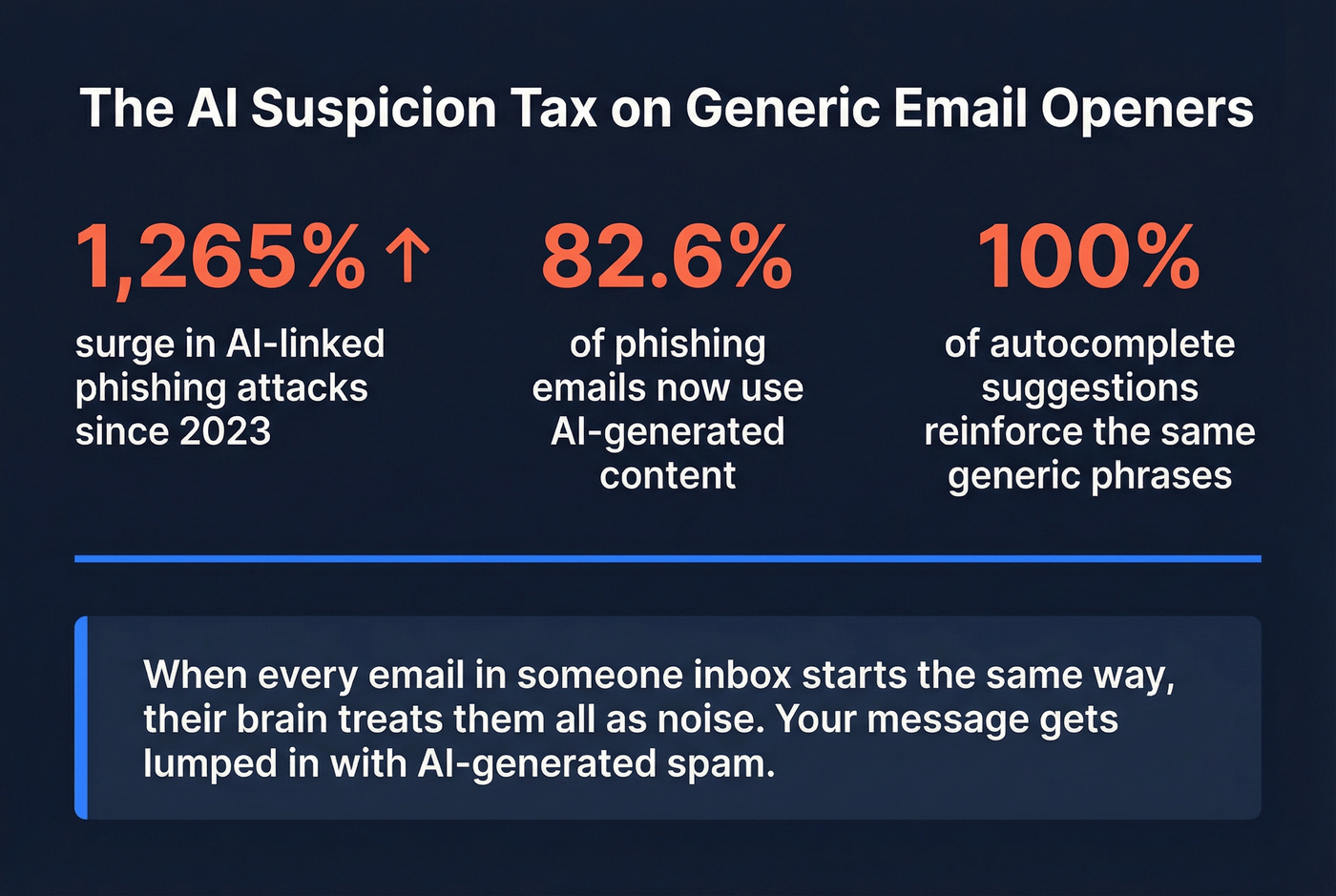
There's been a 1,265% surge in AI-linked phishing attacks since 2023, and roughly 82.6% of phishing emails now use some form of AI-generated content. Security tools from companies like Check Point use NLP to flag "unusual language or tone that reveals inauthenticity" - and formulaic, template-sounding language is exactly what those systems look for.
Herring connects the dots for everyday recipients too: autocomplete suggests the phrase the moment you type "I hope," which increases its frequency. And that frequency breeds suspicion. As she puts it, "we're concerned that these formulaic things may now be bots, and people don't like that."
When every email in someone's inbox starts the same way, their brain treats them all as noise. Your carefully written message gets lumped in with the AI-generated spam.

A perfect opening line is worthless if it lands in the wrong inbox - or bounces entirely. Prospeo's 98% verified emails mean your carefully crafted first line actually reaches a real person. At $0.01 per email, bad data stops being the reason your outreach fails.
Stop perfecting openers for emails that never arrive.
When a Polite Opener Still Makes Sense
Look, the "just get to the point" advice is culturally incomplete, and following it blindly will cost you deals in half the world's markets.
| Context | Recommended Approach |
|---|---|
| Cross-cultural (German, Japanese) | Family names, formal titles, polite opener |
| First international contact | Brief personalized greeting before purpose |
| Legal/formal correspondence | Formal opener; personalize if possible |
| Sensitive situations (illness, loss) | A genuine "I hope you're doing well" is appropriate |
| Established internal relationships | Skip the opener entirely |
| Cold outreach (any region) | Replace with specific, relevant observation |
German and Japanese business emails almost always use family names, even with colleagues and long-term customers. If you're emailing a VP in Tokyo for the first time, "just get to the point" isn't efficient - it's rude. The key is making your polite opener specific rather than generic.
Better Alternatives by Scenario
Most guides give you a replacement line. That's not enough - a single swapped phrase still reads like a template. Here's what the full opening paragraph looks like across different scenarios.
Professional and Client Emails
Replace the generic hope with something that proves you're paying attention. Reference a recent meeting, a shared project, or skip the opener and lead with purpose.
Instead of: "I hope this email finds you well. I wanted to follow up on our discussion."
Try: "Great conversation at the Q2 review on Thursday - your point about the APAC rollout timeline stuck with me. I've put together a revised schedule that addresses the concerns you raised."
The difference is night and day. One sounds like a robot clearing its throat. The other sounds like someone who was actually in the room.
Internal and Team Emails
Your colleagues don't need pleasantries. They need information. Here's the test: if you'd skip the small talk in a Slack message, skip it in the email.
| Don't write | Write this |
|---|---|
| "Hi team, I hope this email finds you well." | "Quick update on the migration - we're on track for Friday's cutover." |
| "Hope everyone's having a great week! Just wanted to share..." | "Two things need your input before EOD Wednesday." |
No one on your team has ever thought, "I wish this Slack message started with a greeting."
Cold Outreach
This is where generic openers do the most damage. Every guide says "personalize," but let's be specific about what that actually looks like.
Generic version: "I hope this email finds you well. I'm reaching out because I think your company could benefit from..."
What actually works: "Saw that Acme just closed a Series B - congrats. Most teams at your stage hit a wall scaling outbound without burning their domain reputation. We helped a similar company cut bounce rates from 35% to under 4%."
The opener earns the read. The specificity proves you're not blasting 10,000 people. We've tested both approaches across hundreds of campaigns, and the personalized version consistently pulls 2-3x the replies. It's not even close.
Follow-Up Emails
Reference the last interaction directly. Don't restart the relationship from zero - that's what makes follow-ups feel like spam rather than continuations.
"Circling back on the pricing breakdown I sent Tuesday. I've added a comparison to your current vendor that might make the decision easier - see the attached one-pager."
No filler greeting. No "just following up on my previous email." The revised version respects the recipient's time, proves you remember the conversation, and gives them a reason to open the attachment.
Formal and International
Dear Dr. Tanaka, I hope the Osaka conference went well - I saw your panel was standing room only. I wanted to follow up on the integration timeline we discussed.
The formality is preserved, but the generic filler is gone. You've shown you know who they are and what they've been doing. That's the difference between professional email etiquette and autopilot.
Cold Email Openers That Get Replies
Let's go deeper on cold outreach, because this is where the stakes are highest. About 95% of cold emails fail to generate replies. Average reply rates sit around 5.1%. And roughly 17% of cold emails never even reach the inbox.
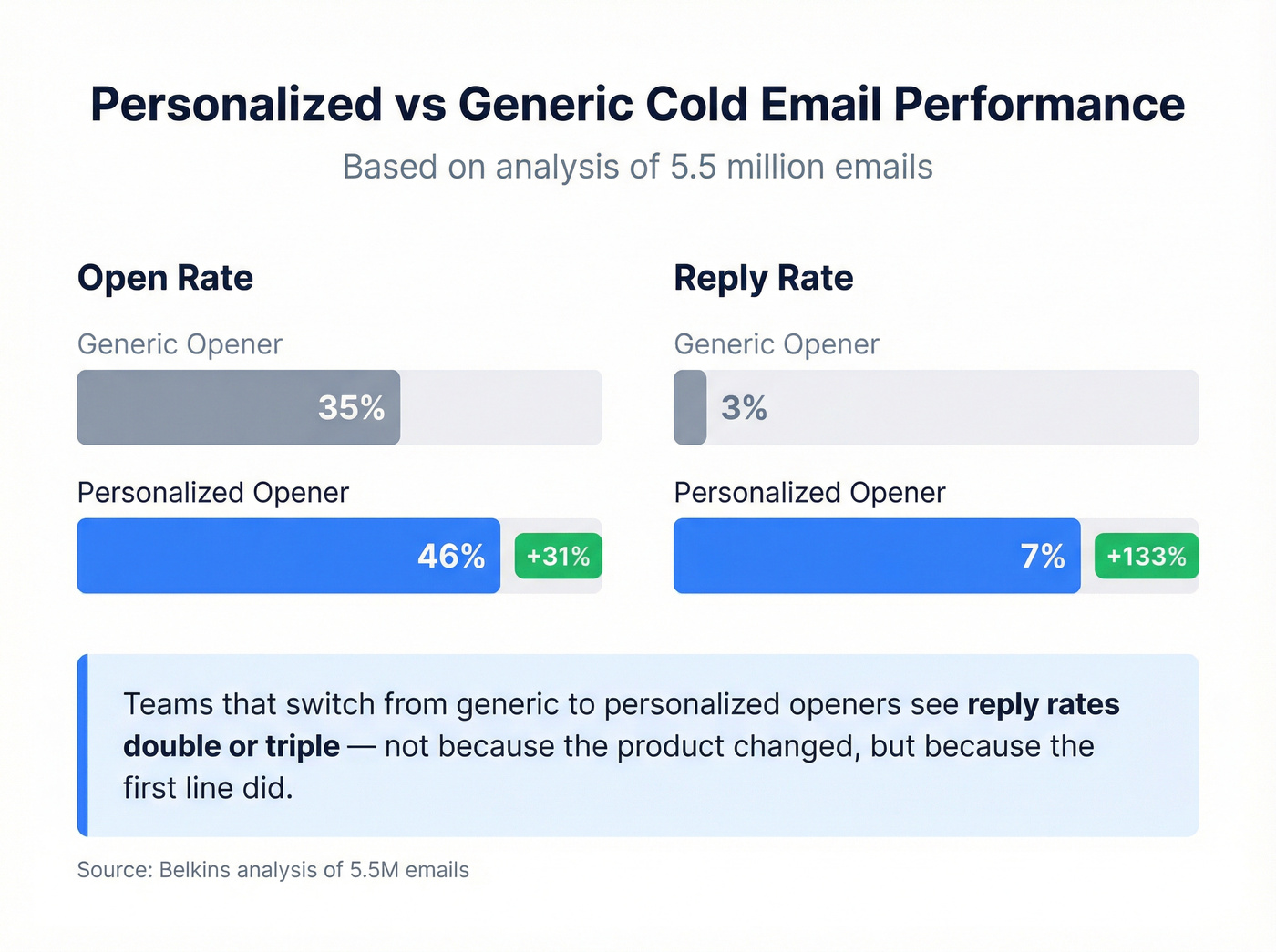
You have only a few seconds after someone opens your email to earn a reply. A Belkins analysis of 5.5 million emails found that personalized messaging hit a 46% open rate versus 35% without personalization. Reply rates jumped from 3% to 7% - a 133% increase.
That data covers subject lines, but the principle extends to openers: generic language signals "mass template" and triggers the delete reflex. The mindset shift that actually moves the needle? Stop writing from "I want something from you" and start writing from "I have something for you." In our experience, teams that make this switch see reply rates double or triple - not because the product changed, but because the first line did.
Five opener frameworks that work:
- Funding congrats + challenge: "Congrats on the Series B. Most teams at your stage struggle with [specific problem] - here's how we solved it for [similar company]."
- Competitor intelligence: "Noticed you're using [competitor tool]. Teams that switch typically see [specific improvement] - happy to share the data."
- Industry insight hook: "The new [regulation/trend] is going to hit [their vertical] hard in Q3. We've been helping teams like yours get ahead of it."
- Problem callout: "Your job postings mention [specific skill gap]. That usually means [inference about their challenge]."
- Question hook: "Quick question - how's your team handling [specific operational challenge] since the [recent change]?"
Here's the thing every guide glosses over: personalizing 50 emails a day is a fundamentally different problem than personalizing one. You can't hand-research every prospect for 15 minutes. That's where your data stack matters - but a personalized opener is worthless if the email bounces. Prospeo verifies emails in real time with 98% accuracy on a 7-day refresh cycle, so your carefully crafted first line actually reaches a real inbox instead of a dead address that tanks your email deliverability.
The "Skip the Opener" Playbook
Sometimes the best opener is no opener at all.
Skip it when: You're emailing someone you've already spoken with, sending an internal update, following up on an existing thread, or the request is time-sensitive and the recipient will appreciate brevity.
Don't skip it when: You're contacting a senior executive for the first time, writing across cultures where formality signals respect, or the topic is sensitive - a condolence, a difficult conversation, a delicate negotiation.
Here's what the skip looks like in practice:
Before: "Hi Sarah, I hope this email finds you well! I wanted to circle back on the proposal we discussed last week and see if you had any questions."
After: "Hi Sarah - the revised proposal is attached with the two changes you flagged on our call. Let me know if the timeline on page 3 works for your team."
The second version respects Sarah's time, proves you listened, and gets to the point. We've seen more replies come from emails that skip the pleasantry than from those that agonize over the perfect warm-up line. No one misses the filler.
You just learned how to write openers that don't trigger AI suspicion filters. Now make sure the rest of your outreach stack matches. Prospeo refreshes 300M+ contacts every 7 days - so you're never emailing someone who left the company six weeks ago.
Pair better copy with data that's actually current.
FAQ
Is "I hope this email finds you well" grammatically correct?
Yes, it's perfectly grammatical. The problem isn't grammar - it's that the phrase signals zero effort and wastes your most valuable email real estate: the preview line recipients see before deciding whether to open. Grammatically correct and strategically effective are two very different things.
Can I say "I hope you're doing well" instead?
It's slightly warmer but still generic. An "I hope you're doing well" works for casual check-ins with people you know. For outreach or professional contexts, reference something specific to the recipient - a recent project, shared connection, or their published work. If you can't personalize, skip the pleasantry and lead with purpose.
What's the best cold email opener for sales?
Lead with a specific observation about the recipient's company, role, or recent news. Data from 5.5 million emails shows personalized messaging gets 133% more replies than generic approaches. Top frameworks: funding congrats tied to a challenge, competitor intelligence, and industry-specific problem callouts. Pair strong openers with verified contact data so your email actually reaches a real inbox.
Does my email opener actually affect reply rates?
Yes - measurably. Personalized openers lift reply rates from roughly 3% to 7%, a 133% increase. Generic greetings signal "mass template" and trigger the delete reflex. The catch: none of this matters if the email bounces. Bad contact data is the silent killer of even the best-written outreach.