Sales Email Closing Lines That Get Replies (and Meetings) in 2026
Your cold email can be good - solid subject line, real personalization, clear value - and still die on the last sentence.
Not with a "no." With silence.
Sales email closing lines decide whether replying feels like a 10-second favor or a 10-minute chore. And if you're wondering how to end a sales email, this is the part that quietly makes or breaks your sequence.
What you need (quick version)
Belkins' benchmark covering Jan-Dec 2026 shows replies peak when cold emails are 6-8 sentences and under 200 words - short enough to skim, long enough to land the point.
Here's the reality check: the average cold email reply rate is 5.8%. If you're at 2-4%, you're not cursed. You're just competing in a crowded inbox.
Use one CTA rule and you'll beat most sequences:
- Cold outbound: use an interest CTA. Gong found interest CTAs make you 2x more likely to book meetings than asking for a specific day/time.
- Later-stage: switch to a specific day/time CTA. It's 12% more effective once there's momentum.
Stop using closers that feel polite but kill meetings:
- "Thoughts?" correlates with -20% meetings booked.
- "I never heard back" correlates with -14% meetings booked.
And don't A/B test closers on a decaying list. Prospeo, "The B2B data platform built for accuracy", delivers 98% email accuracy with a 7-day refresh, so your "winner" isn't just "the version that bounced less."

Why your closing lines are underperforming (benchmarks + reality check)
Belkins' benchmark (16.5M cold emails across 93 business domains/industries) puts the average reply rate at 5.8%. That's the baseline. Not "email is dead" - just "buyers are busy and skeptical."
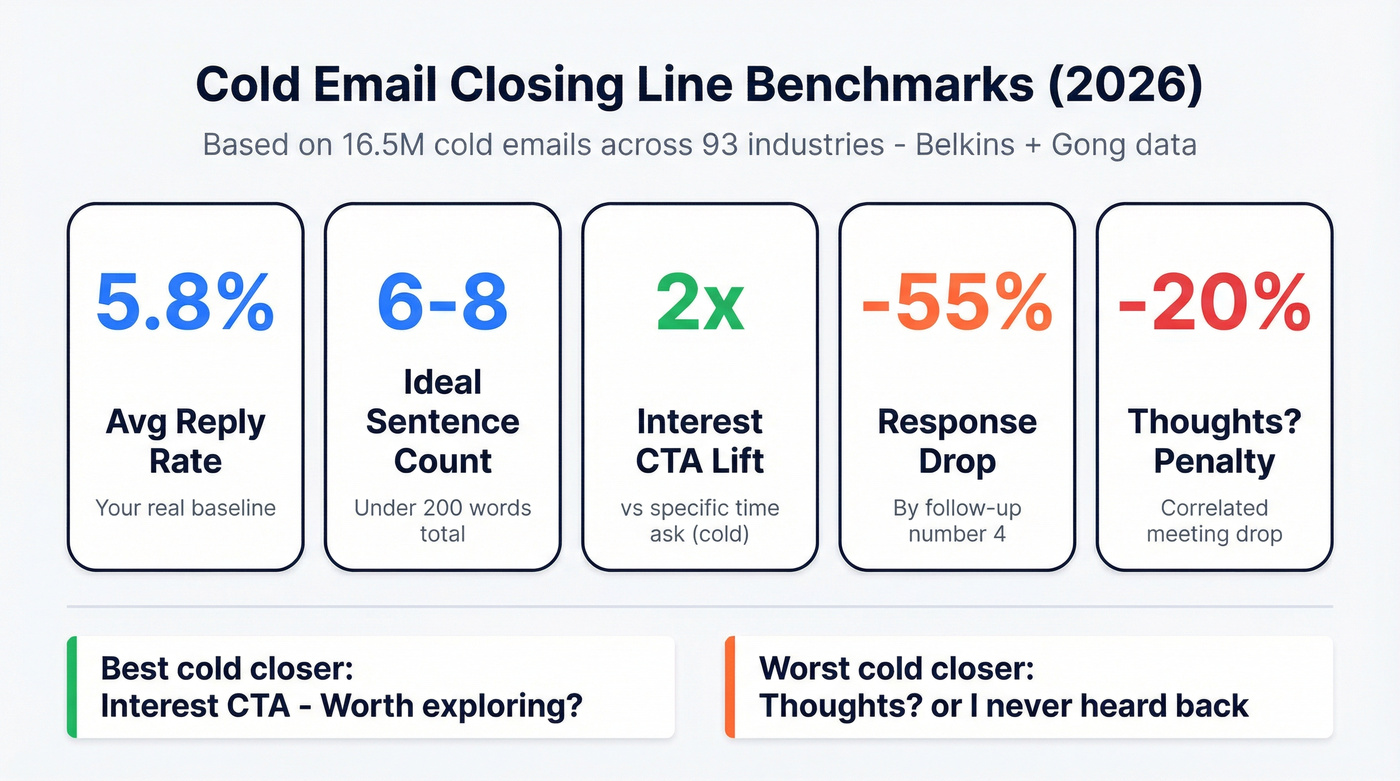
The same benchmark shows the best-performing cold emails tend to be 6-8 sentences and under 200 words. In that format, your closing line carries extra weight because it's the last thing they read before deciding whether replying is worth it, so if you're trying to figure out how to close a sales email, start there.
Follow-ups aren't a cheat code anymore. By follow-up #4 (your 5th email), response rates drop 55% versus earlier touches, which means a weak closer doesn't just underperform once - it drags down the whole sequence while you keep "checking in" and hoping volume fixes it.
I've watched teams obsess over subject lines for weeks, then end every email with a mushy "Thoughts?" and act surprised when meetings don't happen. That's the easiest fix in outbound.
The closing-line decision engine (stage + intent signal + friction)
Gong's CTA rule is the cleanest one to memorize: in cold outreach, an interest CTA makes you 2x more likely to book a meeting than proposing a specific day/time. Later in the deal cycle, it flips - asking for a specific day/time is 12% more effective than an interest CTA.
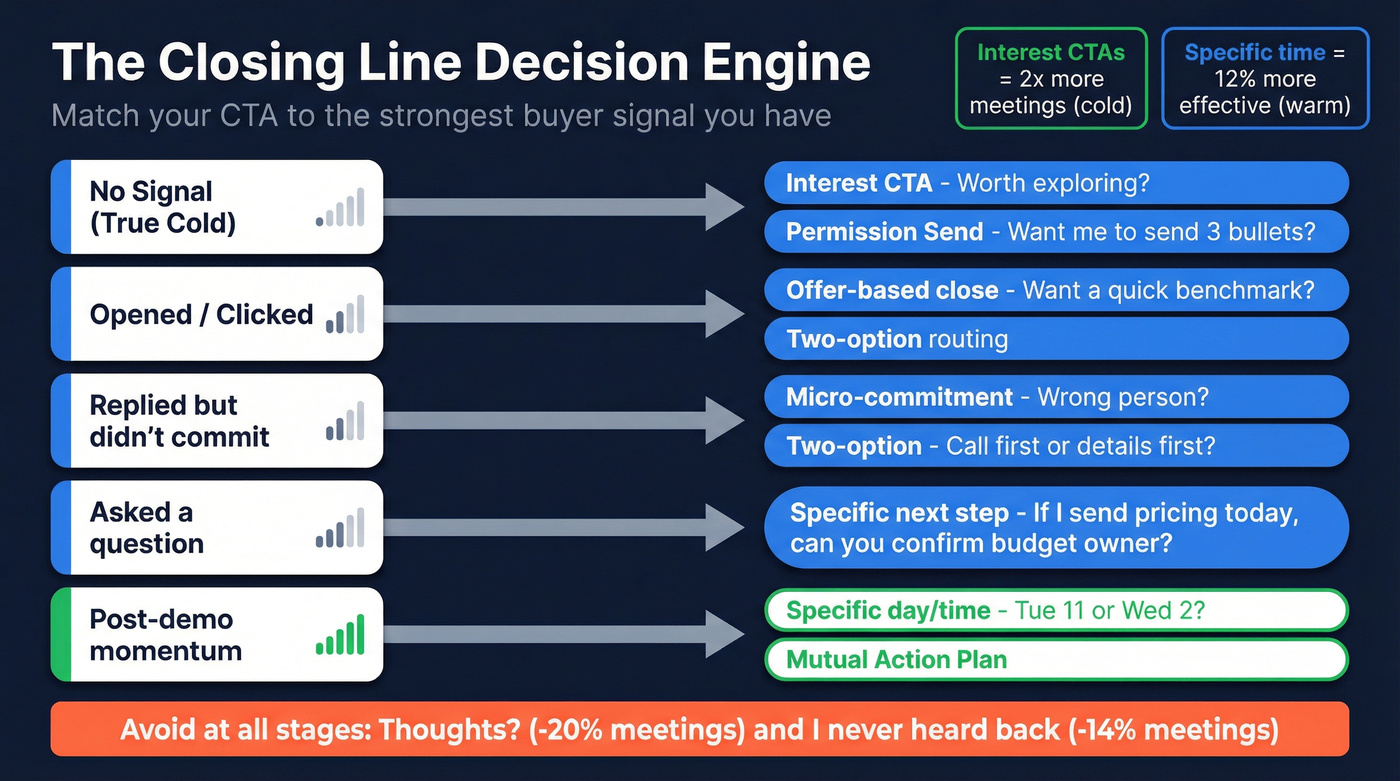
Most reps underperform because they use the same closer everywhere. They treat a stranger, a warm lead, and a post-demo champion like the same person.
Buyers feel that instantly.
The "Signal → CTA" map (use this like a cheat sheet)
Use the strongest signal you have - not the stage you wish you were in.
- No signal (true cold): Interest CTA or permission-based send Best closer types: interest question, "want me to send X?"
- Opened only (no click/reply): Permission-based send or two-option routing Best closer types: "Want the 3-bullet version or the 1-pager?"
- Clicked a link: Offer-based close (audit/benchmark/resource) Best closer types: "Want me to run a quick benchmark and send results?"
- Replied but didn't commit ("send info"): Two-option close or micro-commitment Best closer types: "Details first, or 15-min to sanity-check?"
- Asked a question (price, integration, timing): Specific next step + mutual action Best closer types: "If I send pricing options today, can you confirm budget owner?"
- Forwarded / looped in a colleague: Stakeholder routing Best closer types: "Who's the final owner - RevOps, IT, or Finance?"
- Security/legal mentioned: Risk-reversal pack + timeline check Best closer types: "Want our SOC 2 pack, and who owns the review?"
- Post-demo momentum: Specific day/time + mutual action plan Best closer types: "MAP review Tue 11 or Wed 2?"
Seven closer frameworks (memorable, repeatable)
These are the only moves you need. Swap them by stage.
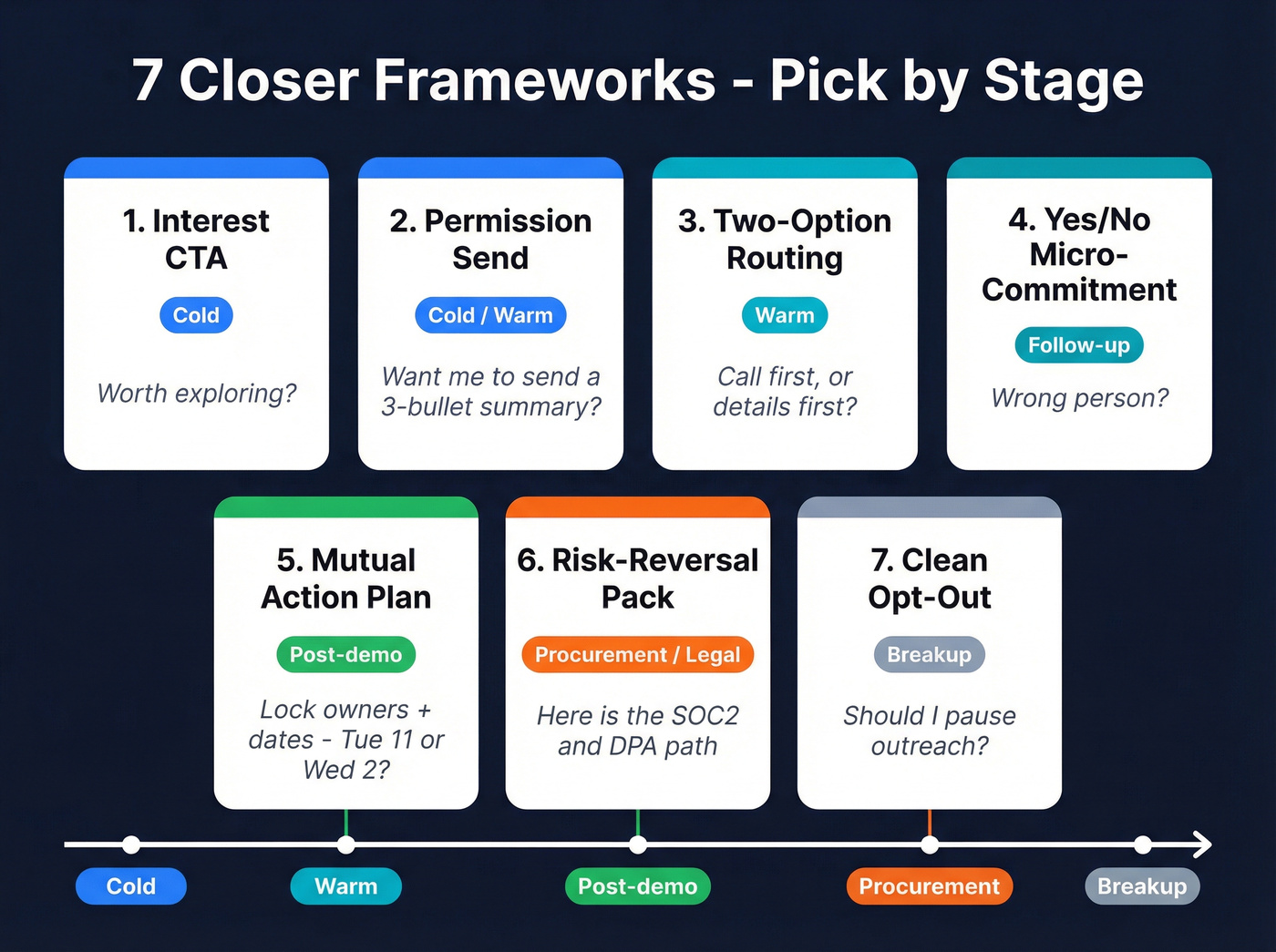
- Interest CTA (cold): "Worth exploring?"
- Permission send (cold/warm): "Want me to send a 3-bullet summary?"
- Two-option routing (warm): "Call first, or details first?"
- Yes/No micro-commitment (follow-up): "Wrong person?"
- Mutual Action Plan (MAP) (post-demo): "Let's lock owners + dates."
- Risk-reversal pack (procurement/security): "Here's the SOC2/DPA path."
- Clean opt-out (breakup): "Should I pause outreach?"
Stage defaults (when you don't have a strong signal)
- Cold outbound (no intent yet): interest CTA + permission-based
- Warm follow-up (some engagement): micro-commitment + two-option
- Post-demo / evaluation: specific next step + mutual action
- Procurement/Sec/Legal: routing + risk-reversal
- Breakup / last touch: low-pressure close + clean opt-out
| Stage | Goal | Best CTA (Gong) | 2 example closing lines | Avoid (penalty) |
|---|---|---|---|---|
| Cold outbound | Start convo | Interest (2x) | Interest: "Worth exploring?" / Permission: "Want the 3-bullet version?" | "Thoughts?" (-20%) |
| Warm follow-up | Get direction | Micro / Two-option | Micro: "Wrong person?" / Two-option: "Call first or details first?" | "I never heard back" (-14%) |
| Post-demo | Advance step | Specific time | "Tue 11 or Wed 2?" / "MAP review Thu?" | ROI talk (-15%) |
| Procurement/Sec/Legal | Unblock | Routing + risk | "Who owns security?" / "Want our SOC2 pack?" | "Any update?" |
| Breakup | Clean exit | Low-pressure | "Should I pause?" / "Close the loop?" | Guilt language (-14%) |

The perfect closing line is worthless if it lands in a dead inbox. With a 5.8% average reply rate, every bounced email is a wasted closer. Prospeo delivers 98% email accuracy with a 7-day refresh cycle - so your A/B-tested closing lines reach real buyers, not abandoned addresses.
Stop perfecting closers that bounce. Start sending to verified emails.
Sales email closing lines swipe file (70+ examples, categorized)
30MPC reports an analysis of 85M+ cold emails and found compelling offers can lift replies by 28%. That matches what we've seen running outbound with teams: the best closers aren't clever, they're concrete.
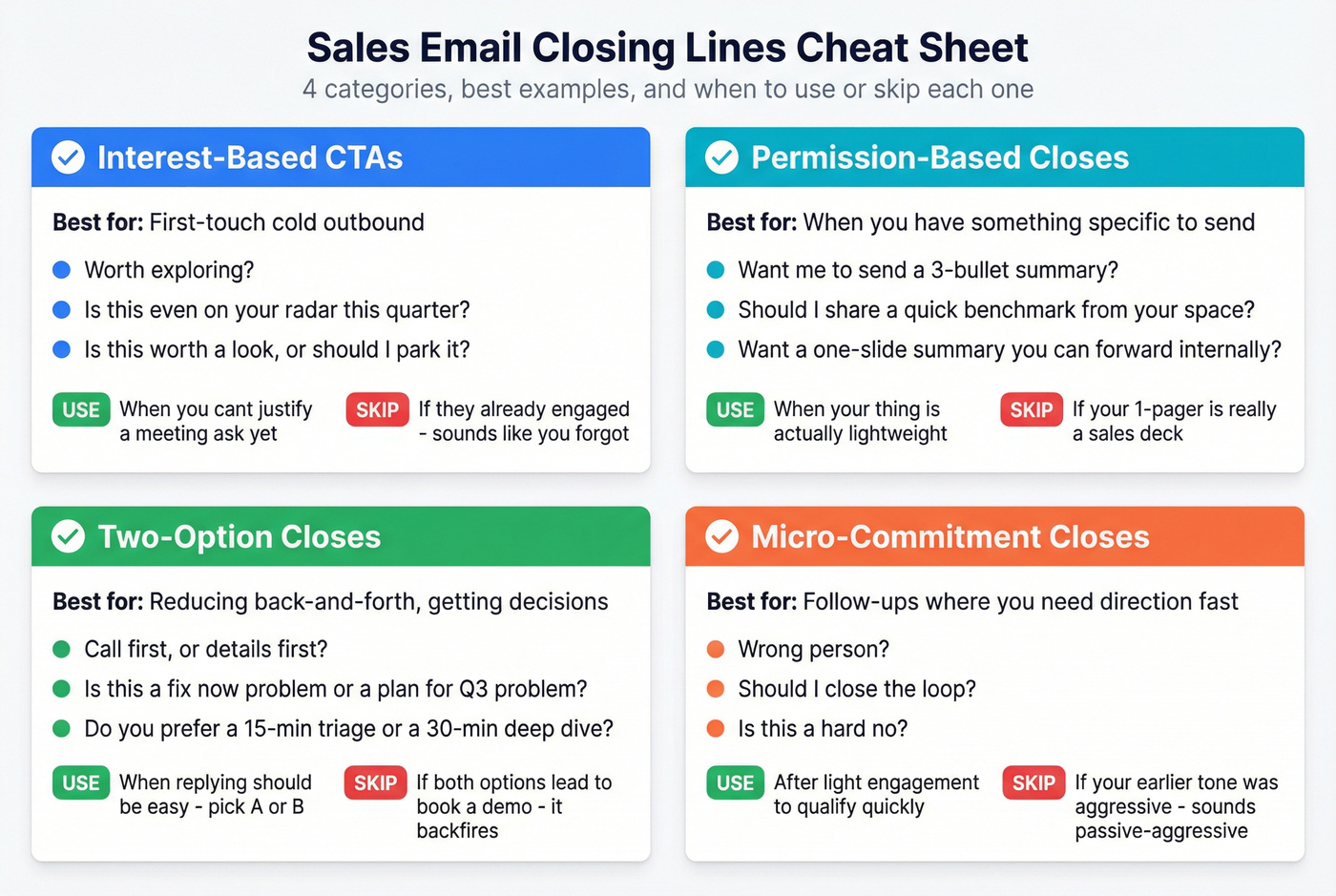
Below are closing lines you can copy/paste, with blunt use/skip notes.
Interest-based CTAs (cold #1 pick)
When to use
- First-touch cold outbound with no engagement
- You're introducing a new idea, not pushing a demo
Closing lines
- "Worth exploring?"
- "Open to a quick idea here?"
- "Is this even on your radar this quarter?"
- "Curious if this is a priority or a 'later' project."
- "Would it be crazy to look at this now?"
- "Is improving this something you're actively working on?"
- "Is this relevant for you, or should I move on?"
- "Does this map to anything you're measured on?"
- "Is it fair to say this is a pain point today?"
- "Would you be open to hearing how teams like you handle this?"
- "Should we explore whether there's a fit?"
- "Is this worth a 2-minute back-and-forth?"
- "Would you be against a quick conversation if it's relevant?"
- "Is this a 'yes, interesting' or a 'not us'?"
- "Is this worth a look, or should I park it?"
- "If I'm off-base, tell me and I'll disappear."
Use/skip notes
- Use these when you can't justify a meeting ask yet.
- Skip if they already engaged. Interest CTAs can sound like you forgot the thread.
Permission-based closes (low resistance)
When to use
- You have something specific to send (3 bullets, a 1-pager, a short loom)
- You want a reply without asking for time
Closing lines
- "Want me to send a 3-bullet summary and you can tell me if it's relevant?"
- "Should I send a quick example so you can sanity-check it?"
- "If I send a 1-page overview, will you take a look?"
- "Want the short version (3 bullets) or the detailed version (1 pager)?"
- "Should I share a quick benchmark we're seeing in your space?"
- "Want me to send a sample workflow so you can see what I mean?"
- "If I put together a rough estimate, would that be useful?"
- "Should I send a checklist your team can use internally?"
- "Want me to send the exact steps (no meeting needed)?"
- "If I send a 60-second video walkthrough, would you watch it?"
- "Want me to tailor a 3-bullet plan for your current setup?"
- "Should I send a couple examples and you pick what's relevant?"
- "If I send this over, do you prefer email or a shared doc?"
- "Want a one-slide summary you can forward internally?"
- "Want me to send the 'what this replaces' list in plain English?"
Use/skip notes
- Permission closes work when your "thing" is actually lightweight.
- Skip if your "1-pager" is really a sales deck. Prospects can smell that.
Two-option closes (reduces back-and-forth)
When to use
- You need a decision, owner, or next step
- You want to avoid "sure, what times?" ping-pong
Closing lines
- "Is this owned by RevOps or Sales leadership on your side?"
- "Better to loop in Finance or Procurement for next steps?"
- "Does IT/Security need to weigh in, or can your team decide?"
- "Should we talk this week, or is next week more realistic?"
- "Is the right next step a quick call, or should I send details first?"
- "Do you want a pilot proposal, or a pricing range first?"
- "Is your priority speed (launch fast) or control (custom setup)?"
- "Are you optimizing for cost reduction or conversion lift?"
- "Should I coordinate with you, or with your ops lead?"
- "Is this a 'fix now' problem or a 'plan for Q3' problem?"
- "Do you prefer a 15-min triage or a 30-min deep dive?"
- "Is the goal to replace a tool, or improve the workflow you've got?"
- "Would you rather see a case study or a teardown of your current flow?"
- "Is this a 'send info' situation or a 'talk it through' situation?"
- "Should we aim for a pilot, or a straight rollout?"
Use/skip notes
- Two-option closes work because replying is easy: pick A or B.
- Skip if your options are fake. If both options lead to "book a demo," it backfires.
Micro-commitment closes (yes/no, 10 seconds)
When to use
- Follow-ups where you need direction
- You're trying to qualify quickly without sounding needy
Closing lines
- "Wrong person?"
- "Should I be talking to someone else?"
- "Is this a 'not a priority' right now?"
- "Do you want me to stop reaching out?"
- "Should I close the loop?"
- "Is there any scenario where this is worth a look?"
- "Is this already solved on your side?"
- "Are you the right owner for this?"
- "Quick yes/no: should I send more detail?"
- "Quick check: are you open to revisiting this later?"
- "Did I catch you at a bad time?"
- "Is this a hard no?"
- "If I don't hear back, I'll assume it's not relevant - fair?"
- "Is there a better month to circle back?"
- "Should I stop here, or keep going?"
- "Am I aiming at the wrong problem?"
Use/skip notes
- Micro-commitments are your best friend after light engagement.
- Skip "Do you want me to stop emailing?" if your earlier tone was aggressive. It can sound passive-aggressive.
Offer-based closes (audit/benchmark/resource)
When to use
- You can offer something valuable without a meeting
- You sell something complex and need a "bridge" CTA
Closing lines
- "Want me to run a quick benchmark and send the results?"
- "If I mapped your current process into a 1-page teardown, would that help?"
- "Want a short audit of your outbound flow (2-3 findings, no pitch)?"
- "Should I send a template your team can copy?"
- "Want a peer comparison: what similar teams track and where they're landing?"
- "If I pull a sample list of target accounts and gaps, would you review it?"
- "Want me to share a 'what good looks like' scorecard?"
- "Should I send a checklist for stakeholder buy-in?"
- "If I put together a draft business case, would you poke holes in it?"
- "Want a quick 'before/after' example from a similar team?"
- "Should I send a 10-minute playbook your reps can use tomorrow?"
- "If I build a small proof-of-concept, would you give feedback?"
- "Want me to outline 3 options (light/standard/enterprise) so you can choose?"
- "If I send a short risk assessment, would that be useful for Security?"
- "Want a one-page ROI model you can edit (no call needed)?"
- "Want a 'questions to ask vendors' checklist so you can compare options?"
Use/skip notes
- This category is where that "compelling offer" lift shows up in real life.
- Skip offers that require a ton of their time ("fill out this 12-question survey").
Post-demo closes (mutual action plan + next step)
When to use
- After a demo, discovery call, or evaluation meeting
- You need momentum and shared accountability
Closing lines
- "If we're aligned, can we lock the next step: MAP review on Tue or Wed?"
- "Want me to send a mutual action plan today, and we confirm owners tomorrow?"
- "Should we schedule a 20-min stakeholder recap with your team?"
- "What's the one question we need to answer to move forward?"
- "Can you introduce me to the decision-maker, or should we wait until you've aligned internally?"
- "If I send pricing + packaging options, can you confirm budget owner?"
- "Are we aiming for a pilot start this month or next?"
- "Should we book a technical review, or is the business case the blocker?"
- "If I send the security packet, can you connect me with your Security lead?"
- "Can we agree on success criteria for a pilot before we start?"
- "Do you want a reference call, or is that overkill?"
- "What would make this a 'yes' by end of week?"
- "If we can solve X, are you comfortable moving to procurement?"
- "Is there anyone else who needs to see this before you decide?"
Use/skip notes
- Post-demo closers should feel like project management, not selling.
- Skip "Let me know next steps." It's a momentum killer.
Procurement/security closes (stakeholder + requirements routing)
When to use
- You're stuck in security review, legal, or procurement
- You need clarity on process and owners
Closing lines
- "Who owns the security review on your side?"
- "Do you have a standard vendor questionnaire you want us to complete?"
- "Want our SOC 2 / security pack to speed this up?"
- "Is legal review required, or can we proceed with standard terms?"
- "What's the procurement timeline you're working with?"
- "Should we loop in your IT lead for a quick requirements check?"
- "Is there a preferred vendor onboarding process we should follow?"
- "Do you need a DPA, or is your standard template fine?"
- "What's the one risk you need mitigated to get this approved?"
- "If I outline implementation steps + owners, can you confirm feasibility?"
- "Is there a budget threshold that triggers extra approvals?"
- "Should we align on data handling requirements before we move forward?"
- "Who signs off: VP, CFO, or procurement manager?"
- "If we can meet your requirements by Friday, can we target signature next week?"
Use/skip notes
- Calm, operational language wins here.
- Skip hype. Procurement doesn't care.
Breakup closes (polite exit + reopen door)
When to use
- Last touch in a sequence
- You want a reply without guilt-tripping
Closing lines
- "Should I close the loop on this?"
- "Want me to pause outreach for now?"
- "Is it okay if I stop reaching out?"
- "Sounds like timing's off - should I check back in a few months?"
- "If this isn't a priority, no worries - where should I file this?"
- "Is there someone else I should speak with, or should I drop it?"
- "I'll assume this isn't relevant and step back - fair?"
- "If you want, I can send one last resource and then disappear."
- "Should I take you off my list?"
- "If this becomes important later, what's the best way to re-engage?"
- "Do you want me to circle back after your next planning cycle?"
- "Is there a better time of year for this conversation?"
- "If I don't hear back, I'll close this out on Friday."
- "Last note from me - want me to stop, or point me to the right owner?"
Use/skip notes
- Breakup works when it's actually an exit.
- Skip "bumping this to the top of your inbox." It sounds annoyed.
Two full email examples (closer in context)
Competitors love dumping one-liners. Useful, but incomplete.
Here are two short templates that show how the closing line works when the rest of the email's doing its job.
Example 1: Cold email (interest CTA + permission close)
Subject: Quick idea for {{Company}}'s {{process}}
Hi {{FirstName}} - I noticed {{trigger}} and it usually creates {{pain}} for {{role}} teams. We help {{peer group}} reduce {{pain metric}} by {{mechanism}} without ripping out {{current tool/process}}.
If it's helpful, I can send a 3-bullet breakdown of what typically changes first (and what to ignore).
Closing line: Want the 3-bullet version, or should I leave you alone?
Thanks, {{Name}}
Example 2: Follow-up (micro-commitment + two-option)
Subject: Re: {{original subject}}
Hi {{FirstName}} - quick follow-up. If this isn't on your plate, tell me who owns it and I'll reroute.
If it is on your plate, I can either: A) send a short example from a similar team, or B) do a 15-min call to sanity-check whether it's even worth pursuing.
Closing line: Which is better - A (example) or B (15-min sanity-check)?
Thanks, {{Name}}
What I see top reps do (that average reps don't)
Top reps treat the closing line like a product decision, not a politeness ritual.
- They sell the reply, not the meeting. Cold emails end with an interest or permission CTA, because the first win's a response.
- They make replying brain-dead simple. Two-option closes beat open-ended questions because the prospect can answer in one tap.
- They keep the ask proportional to trust. Strangers get "worth exploring?" Champions get "Tue 11 or Wed 2?"
- They drive the process after the demo. Post-demo closers look like project management: owners, dates, and the next artifact (MAP, security pack, pilot plan).
- They stop bumping. If a follow-up doesn't add value (new info, new offer, new angle), they don't send it.
Hot take: if your average deal's a few thousand bucks and you're asking for 30 minutes in email #1, you're making your life harder for no reason. Earn the reply first.
Sign-offs that correlate with replies (and when gratitude backfires)
Boomerang analyzed closings in 350,000+ email threads and found a baseline response rate of 47.5%. Gratitude-heavy sign-offs correlated with higher response rates: "thanks in advance" hit 65.7%, "thanks" 63.0%, and "best" lagged at 51.2%; they also found "thankful" closings averaged 62% response vs 46% without a thankful close.
That's not a sales-only dataset, but it's still a useful pattern: gratitude frames the reply as a small favor.
The catch: "thanks in advance" can read as presumptuous with senior buyers or in some cultures. I use "Thanks" as the default, and I save "Thanks in advance" for emails where the ask's genuinely tiny and clearly helpful.
If you're wondering how to sign off a sales email, treat the sign-off as tone control: your sales email sign offs should match the relationship (cold vs warm vs post-demo) and the size of the ask.
| Sign-off | Reply rate (Boomerang) | When it works | When it backfires |
|---|---|---|---|
| Thanks in advance | 65.7% | Small ask, warm tone | Can feel presumptuous |
| Thanks | 63.0% | Most cold/warm emails | Rarely offensive |
| Thank you | 57.9% | More formal buyers | Can feel stiff |
| Cheers | 54.4% | UK/AU, casual tone | Too casual in some orgs |
| Kind regards | 53.9% | Formal, EMEA-friendly | Can feel generic |
| Best | 51.2% | Neutral default | Lowest of popular closings |
One more contrarian nugget from Gong: if you need a neutral opener, "Hope all is well" correlates with +24% meetings booked. It's not magic. It just keeps the tone normal.
Closers to stop using (with quantified penalties)
Some closers feel productive because they get replies. But they don't get meetings.
Gong's data's blunt about this.
Replace this with that (and why)
Replace: "Thoughts?" With: "Worth exploring?" or "Open to a quick idea?" Why: "Thoughts?" correlates with -20% meetings booked. It invites commentary, not action.
Replace: "I never heard back" / "Just bumping this" With: "Should I close the loop?" or "Wrong person?" Why: guilt phrasing correlates with -14% meetings booked. You'll get more "sorry, busy" replies and fewer real next steps.
Replace: ROI-heavy closes ("We can increase revenue by 30% - free 15 minutes?") With: offer-based or interest-based closes ("Want a quick benchmark?") Why: ROI language decreases success rates by -15% in Gong's analysis. It triggers skepticism and "prove it" mode.
Replace: "Do you have 15 minutes this week?" (cold) With: "Open to hearing the idea?" Why: cold prospects don't want scheduling work. Interest CTAs are the bridge.
Look, these bad closers are lazy. They dump the hard work (a clear next step) onto the prospect.
Prospects don't do homework for strangers.
Compliance-ready closing blocks (CTA + sign-off + PS + footer)
You can write the perfect closer and still get burned if your footer feels sketchy or your opt-out's missing. You want two outcomes: stay compliant, and keep it human.
CAN-SPAM basics that affect your closing/footer: you need a visible opt-out, you must honor opt-outs within 10 business days, and you need a valid physical address in the email.
EU/UK practical add-on: be ready to state why you're emailing (legitimate interest) and where you got the business contact details ("work email from public web sources," "company website," etc.). Keep it one sentence. Don't turn your email into a legal memo.
Copy/paste PS opt-out (human, 1:1)
Pick one and keep it consistent across your sequences:
Variant A (simple)
- P.S. If you'd rather I don't reach out again, just reply "opt out" and I'll stop.
Variant B (polite + control)
- P.S. Not a fit? Reply "no" and I'll close the loop. If timing's the issue, tell me when to circle back.
Variant C (GDPR-style tone without legalese)
- P.S. I'm reaching out because your role matches who we help. If you want me to remove your details, reply "remove" and I'll do it.
Where to place address + identity so it doesn't kill replies
Put compliance bits where they're least disruptive:
- Sign-off line: Name, title, company
- One-line identity: "Sent from [Company], [website]" (optional)
- Physical address: last line in small plain text (no banners, no images)
Example footer structure:
Best, Name Title, Company City, State Street Address, City, State ZIP
"Right person?" routing PS that stays compliant
- P.S. If you're not the right person, who owns this? If you'd rather I stop, reply "opt out" and I will.
Two easy replies. No guilt.
How to A/B test closing lines (measure meetings booked, not vibes)
If you don't test closers correctly, you'll "learn" the wrong lesson fast. Belkins found that turning off open tracking improved response by 3%, so your measurement setup can change outcomes.
Sequence risk's real too: Belkins shows spam complaints rising from 0.5% on the first email to 1.6% by the 4th email. That's how domains get cooked.
Step-by-step testing matrix
- Pick one stage. Don't mix cold + post-demo in the same test.
- Hold everything constant except the closing line: same subject, body, offer, sender, and send window.
- Define success: meetings booked, not replies.
- Run A vs B for 300-500 sends per variant to get signal without waiting forever.
- Segment by persona if you can (VP vs Manager behaves differently).
- Stop if risk spikes: if unsubscribes/complaints jump, don't power through.
Mini checklist (so your data isn't lying)
- Turn off open tracking if you're optimizing for replies. It can hurt.
- Keep follow-ups reasonable. More touches can mean more complaints.
- Don't change your list mid-test.
Here's a scenario I've seen too many times: a team "finds a winner" closer in week one, then rolls it out to the full list in week three after the list has aged, bounced harder, and hit more spam traps, so the closer gets blamed for what was really a data and deliverability problem.
Interest CTAs double your meeting rate - but only if you're emailing the right person. Prospeo's 300M+ profiles with 30+ filters let you target by intent, job change, and tech stack so your "Worth exploring?" lands with someone who actually cares.
Find the buyers who'll reply. 100 free credits, no sales call required.
Start here (3 closers I'd use today)
If you only change three things, change these:
- Cold email: "Worth exploring?"
- Warm follow-up: "Which is better - details first, or a 15-min sanity-check?"
- Breakup: "Should I close the loop?"
Write the rest of the email however you want. Those three lines fix a shocking amount of "opened but ignored."
FAQ
What's the difference between a closing line, a CTA, and a sign-off?
A closing line is the final sentence that prompts action, the CTA is the specific action you're asking for (interest, permission, time, routing), and the sign-off is the goodbye ("Thanks," "Best," your name). In practice, your closing line often contains the CTA, and your sign-off sets tone, so learning how to end a sales email is really learning how to pair the CTA with the right sign-off.
What's the best closing line for a cold sales email in 2026?
An interest-based CTA is the best default for cold outbound because it removes scheduling friction and still moves the deal forward. Use "Worth exploring?" or "Open to a quick idea?" Gong found interest CTAs make you 2x more likely to book meetings than proposing a specific day/time. Save calendar asks for warm threads.
Should you ask for a meeting in the first cold email?
You can ask for time in email #1, but it underperforms unless there's clear intent (referral, inbound, or a strong trigger) because it creates extra work for a stranger. A better default's an interest or permission CTA first, then a specific day/time ask once they've replied or clicked.
Are "thanks in advance" and "thoughts?" good closers?
"Thanks in advance" can lift replies (Boomerang saw 65.7% response in their dataset), but it can feel presumptuous with senior buyers, so use it only for genuinely tiny asks. "Thoughts?" is a consistent loser for meetings: Gong found it correlates with -20% meetings booked, even when it gets low-value replies.
Before A/B testing closing lines, what should you fix first (deliverability/data)?
Fix list quality and deliverability first because bounces and spam complaints will swamp any copy lift and make tests meaningless. Verify emails, keep segments stable, and don't change tracking mid-test. Prospeo's a strong baseline for this: 98% email accuracy, a 7-day refresh cycle, and enrichment that returns contact data for 83% of leads.
Summary: steal these sales email closing lines and ship
If your emails are getting opened but not answered, don't rewrite everything. Swap the last sentence.
Use interest CTAs for cold outreach, two-option closes for warm threads, and clean opt-outs for breakup touches. Then test properly on a verified list so your sales email closing lines win because they're better, not because your data aged out.