Sales Coaching Best Practices: The Playbook Your Managers Actually Need
It's Monday morning. Your sales manager opens their calendar, sees five "coaching" sessions back-to-back, and asks the same question in every one: "So, how's your pipeline looking?" That's not coaching - that's a status update with a calendar invite.
75% of reps say they're more likely to hit targets with a coach or mentor, yet managers spend less than 20% of their time actually coaching. And 80% of reps who receive quality coaching report high job satisfaction, while half of those who don't are actively job hunting. The gap between knowing sales coaching best practices and executing them is where quota goes to die.
Three things separate effective coaching from glorified pipeline reviews:
- Structure - use the 30-minute session agenda below, not freeform conversation
- Cadence - biweekly minimum, weekly if you can swing it
- Clean data - so your metrics reflect rep skill, not database decay
8 Practices That Actually Move the Needle
1. Coach the middle 60%, not just the top and bottom. Most managers spend coaching time on struggling reps and star performers. The middle 60% - your B and B+ players - deliver the highest coaching ROI. Moving a B player to B+ creates more total revenue impact than saving one underperformer, and it's a fraction of the effort.
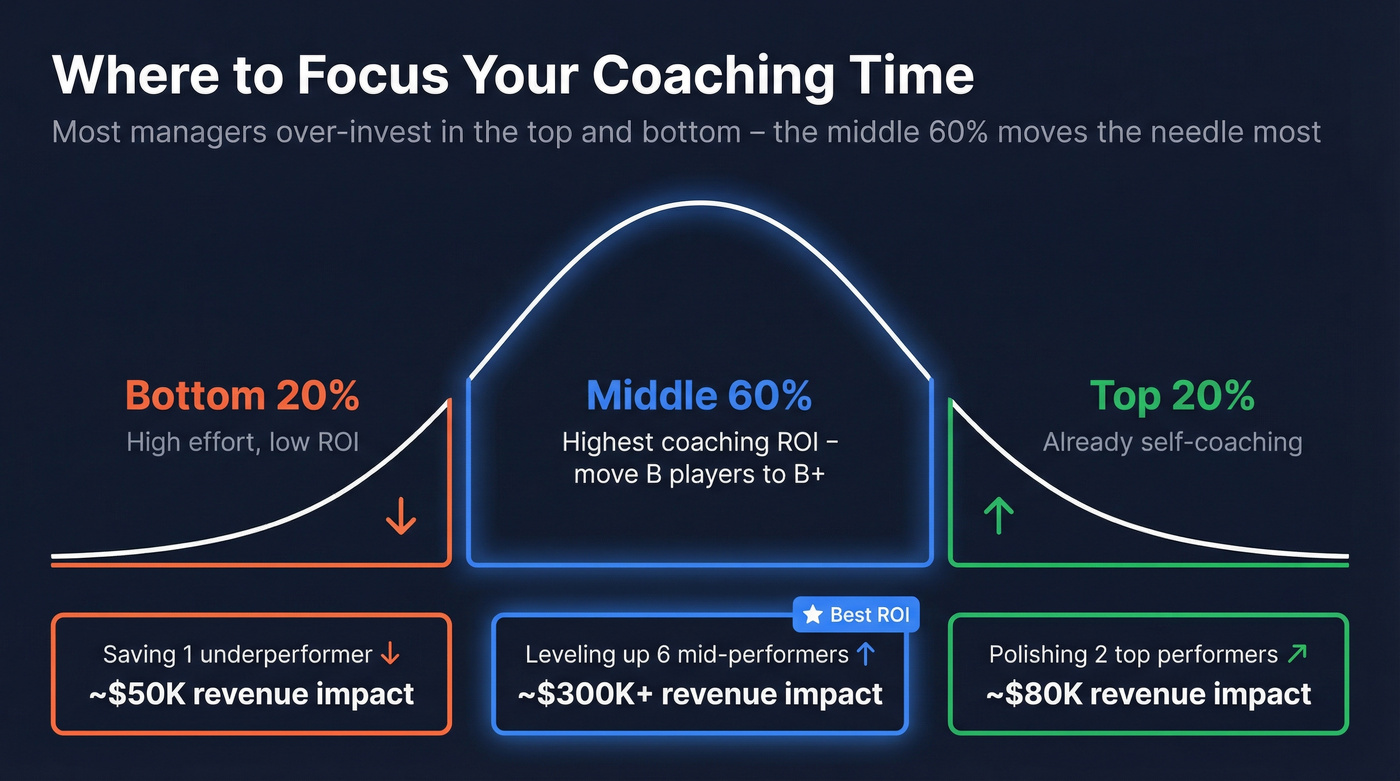
2. Hold sessions biweekly at minimum. Once-a-month coaching is reactive. By the time you address a problem, the rep has reinforced the wrong behavior for weeks. A consistent cadence of at least biweekly - ideally weekly - keeps coaching tied to real behavior while there's still time to course-correct.
3. Use a scorecard, not vibes. "I think you need to improve your discovery" isn't actionable. A 1-5 scorecard across specific competencies gives reps a clear picture and gives you a trend line over time. The GROW coaching framework - goal, reality, options, way forward - pairs well with a scorecard to keep sessions structured and measurable.
4. Separate deal coaching from skill coaching. Deal coaching asks "how do we win this opportunity?" Skill coaching asks "how do we make you better at discovery?" Pairing both lifts win rates by 27%+, but only when you're intentional about which one you're doing in each session. Mixing them together muddies the conversation and leaves reps unsure what they're supposed to improve.
5. Build self-coaching between sessions. Give reps self-assessment tools, call recording review prompts, and specific homework. The best reps already do this naturally - your job is to systematize it for everyone else.
6. Segment by role. SDRs need work on active listening, written communication, and call discipline. AEs need coaching on discovery depth, negotiation, and multi-threading. One-size-fits-all feedback wastes everyone's time.
Here's the thing: if your average deal size is under $15k and your team is under 10 reps, skip the expensive coaching platform entirely. A Google Doc scorecard and a biweekly calendar hold will outperform any $200/seat tool that nobody logs into after month two.
7. Lead with questions, not advice. 82% of manager comments skew negative even when managers try to balance feedback. Start with "What do you think went well?" before offering your perspective. Reps who self-diagnose retain the lesson longer, and coaching should build psychological safety, not dread.
8. Keep the playbook alive. A playbook that doesn't adapt monthly is outdated quarterly. Build feedback loops where reps flag what's working, what's stale, and what buyers are actually saying. Perfection kills adoption - optimize for speed and relevance. Coaching isn't a manager activity; it's a team culture.
The 30-Minute Session Agenda
This replaces the "how's your pipeline?" conversation. It's structured, skill-focused, and ends with commitments - not vague encouragement.
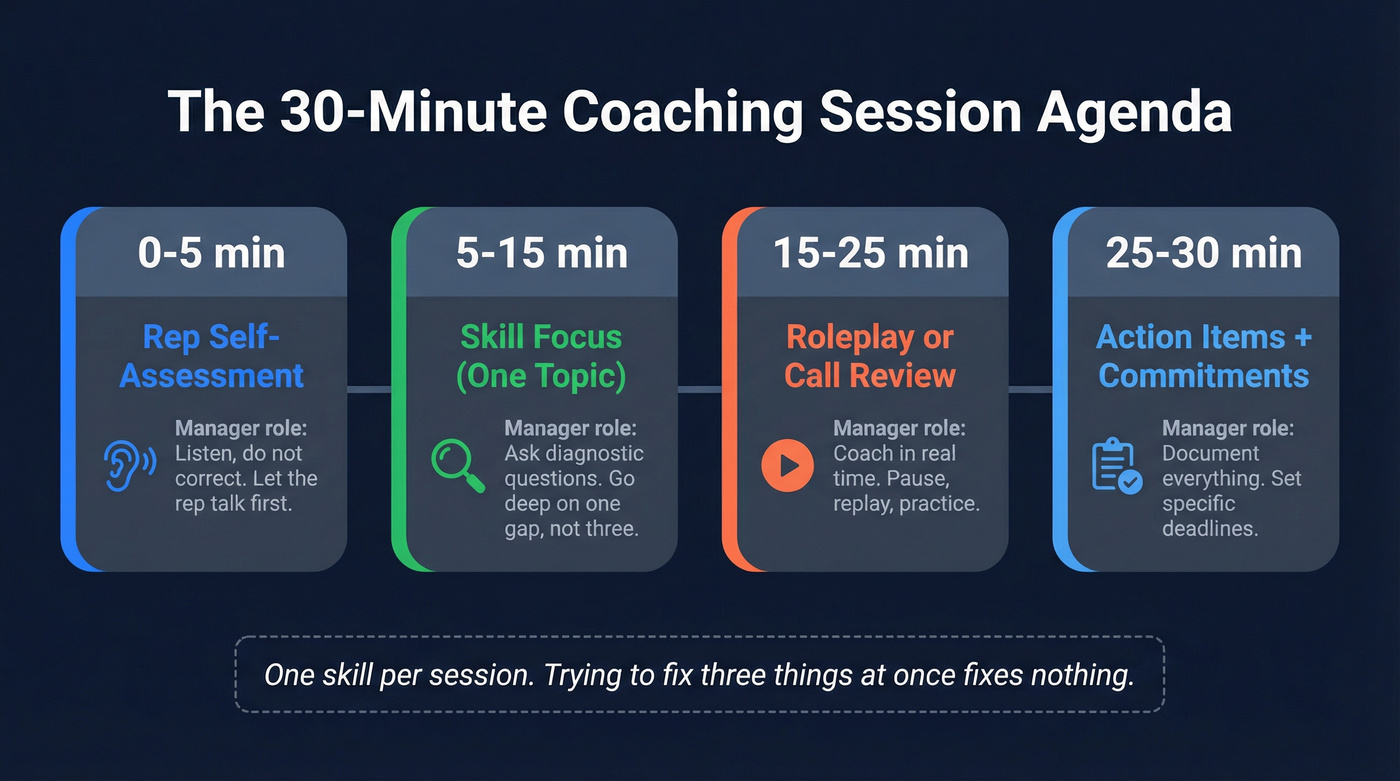
| Time Block | Activity | Manager's Role |
|---|---|---|
| 0-5 min | Rep self-assessment | Listen, don't correct |
| 5-15 min | Skill focus (one topic) | Ask diagnostic questions |
| 15-25 min | Roleplay or call review | Coach in real time |
| 25-30 min | Action items + commitments | Document, set deadlines |
One skill per session. Trying to fix three things at once fixes nothing. Pick the biggest gap and go deep.
We've seen managers try to cram discovery, objection handling, and closing technique into a single 30-minute block. The rep walks out overwhelmed, improves at none of them, and dreads the next session. Constraint is your friend here.
Coaching Scorecard Template
Score each competency 1-5 every session. Track the trend, not the snapshot.
| Competency | 1 (Needs Work) | 3 (Solid) | 5 (Exceptional) |
|---|---|---|---|
| Discovery quality | Surface-level questions | Uncovers pain + timeline | Maps full buying process |
| Objection handling | Freezes or deflects | Handles common objections | Reframes into value |
| Follow-up discipline | Inconsistent timing | Follows cadence | Personalizes every touch |
| Multi-threading | Single-threaded | 2-3 contacts per deal | Champions + economic buyer |
| Product knowledge | Reads from slides | Handles live questions | Tailors to use case |
Swap in active listening and written communication for SDRs; add negotiation and presentation skills for AEs.

Your coaching scorecard is only as good as the data behind it. When reps dial disconnected numbers and bounce emails, you can't tell if it's a skill gap or a data gap. Prospeo's 98% email accuracy and 7-day refresh cycle give you clean metrics to coach against.
Coach skills, not data problems. Start with verified contacts.
Role-Specific Coaching KPIs
| Metric | SDR Benchmark | AE Benchmark |
|---|---|---|
| Open rate | ~27.7% | N/A |
| Reply rate | ~5.1% | N/A |
| Connect rate | 3-10% | N/A |
| Dial-to-meeting | ~2.3% | N/A |
| Win rate | N/A | 20-30% typical B2B |
| Avg deal size | N/A | Track quarterly trend |
| Sales cycle length | N/A | Track quarterly trend |
| Multi-threading | N/A | 10-11 stakeholders avg |
If SDR connect rates are below 3%, check the data before coaching the rep. Stale contacts poison your metrics - Prospeo's 98% email accuracy and 7-day refresh cycle eliminate that variable, so you can isolate whether it's a skill problem or a data problem. GreyScout cut rep ramp time from 8-10 weeks to 4 weeks after switching to verified contact data, because new reps weren't wasting their first month dialing disconnected numbers.

5 Coaching Mistakes That Kill Trust
1. Leading with criticism. That 82% negativity bias is real. If every session starts with what went wrong, reps stop being honest about their struggles. Open with wins first - even small ones.
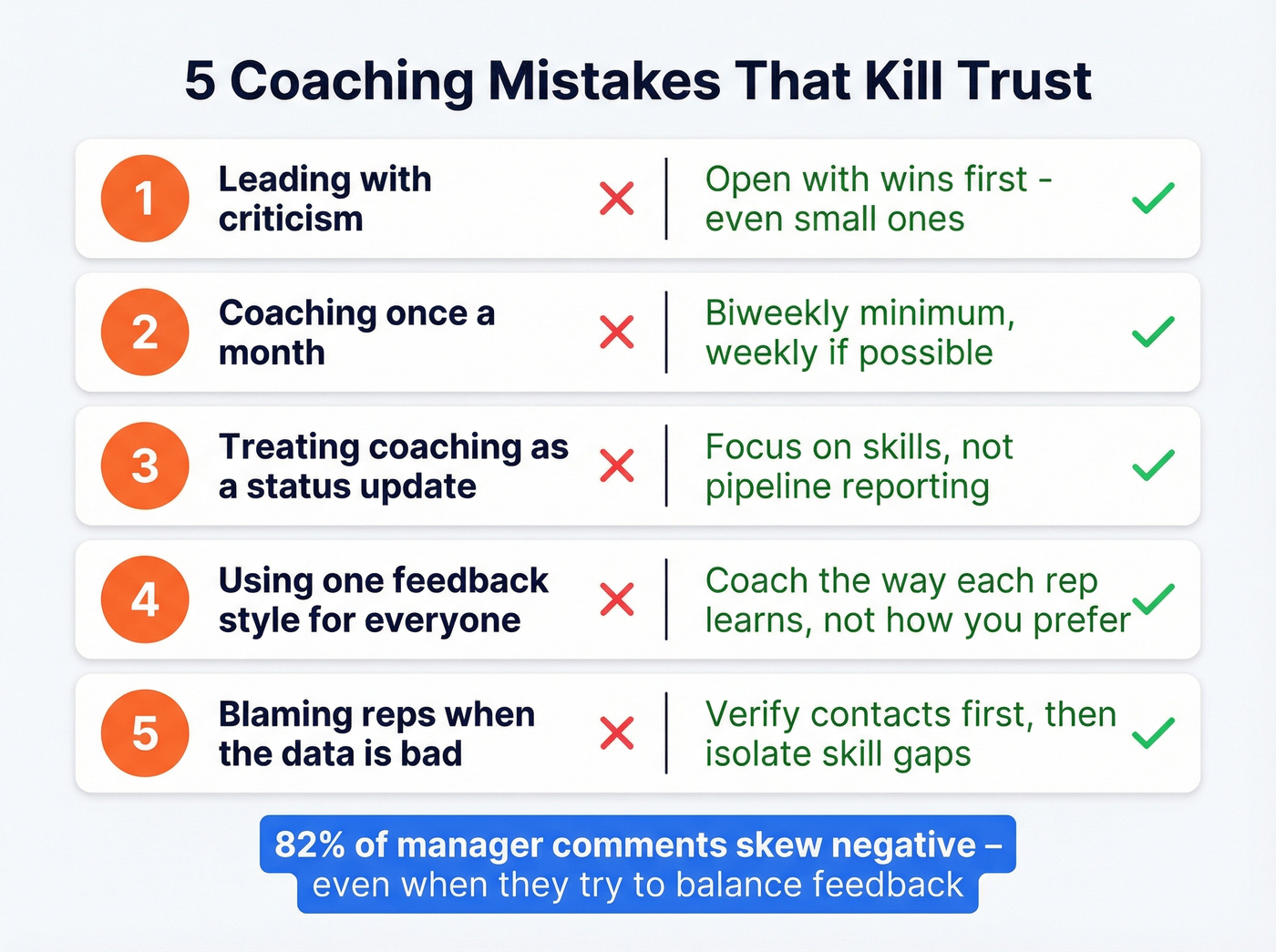
2. Coaching once a month. Monthly cadence means you're always reacting to problems already baked in. By the time you course-correct, the quarter is half over.
3. Treating coaching as a status update. "Walk me through your pipeline" isn't coaching. It's reporting. If your 1:1s could be replaced by a Salesforce dashboard, they should be.
4. Using one feedback style for everyone. Some reps need direct, blunt feedback. Others shut down without a praise-critique-praise sandwich. Know your people. The consensus on r/sales is that most managers default to whatever style they personally prefer receiving, which is exactly backwards - coach the way each rep learns, not the way you do.
5. Blaming reps when the data is bad. Your SDR's connect rate is 2%. Before you put them on a PIP, pull their call list. If 40% of numbers are disconnected, the problem isn't their pitch - it's their data. Verify contacts on a regular refresh cycle so you can actually isolate skill issues from data quality issues.
How AI Tools Support Coaching
Let's be honest: you don't need a coaching platform. You need a coaching habit. Build the habit first, buy the tool later.
That said, AI coaching tools can help new hires ramp 30-40% faster when paired with consistent manager involvement. In our experience, the teams that get the most from these tools already have a functioning coaching rhythm - the software amplifies what's working, it doesn't create it from scratch.
| Tool | What It Does | Best For | Price Range |
|---|---|---|---|
| Gong | Call intelligence + coaching | Enterprise teams with $100K+ enablement budgets | ~$120-$250/user/mo + platform fees |
| Chorus | Conversation intelligence | ZoomInfo users consolidating tools | ~$100-$150/user/mo |
| Highspot | Sales enablement + coaching | Orgs needing content + coaching in one place | ~$50-$80/user/mo |
| Sybill AI | AI notetaker + insights | Solo reps or small teams | $19-$79/user/mo |
| Hyperbound | AI roleplay practice | Teams that need scalable practice reps | From ~$40/user/mo |
| Spekit | In-context learning | Onboarding-heavy orgs with high turnover | From ~$25/user/mo |
Skip Gong and Chorus if you're a team of five with a $30k tech budget. You'll spend more time configuring the platform than coaching. Start with Sybill or Hyperbound, or just record calls in Zoom and review them together.
GreyScout cut rep ramp time in half - from 8-10 weeks to 4 - because new hires stopped wasting their first month on dead leads. With 300M+ verified profiles and 125M+ direct dials, your SDRs hit real buyers from day one.
Ramp reps faster when every dial reaches a real person.
Measuring Coaching Effectiveness
Track both leading and lagging indicators. Leading: scorecard scores trending upward, session completion rate above 80%, rep self-assessment accuracy improving, call quality scores rising. Lagging: quota attainment lift, win rate change, rep retention, new hire ramp time.
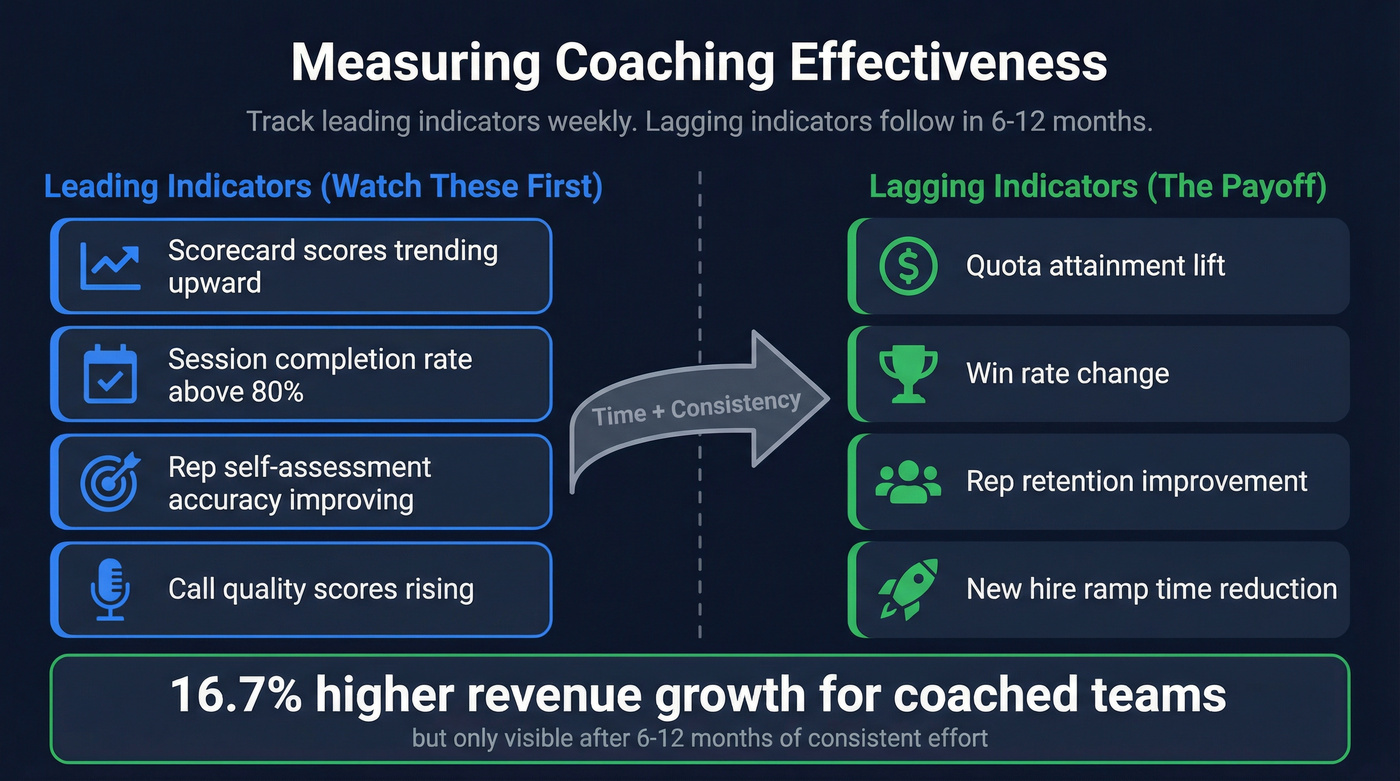
Research shows coached teams see 16.7% higher revenue growth - but that only becomes obvious in lagging metrics after 6-12 months of consistent effort.
The biggest mistake we see is teams measuring coaching by lagging indicators alone, then abandoning the program after one quarter because quota didn't jump. Watch the leading indicators. If scorecard scores are climbing and sessions are happening, the revenue lift is coming. Sales leaders improve outcomes not by adding more meetings, but by building coaching capabilities into the team's daily rhythm - scorecards, self-assessments, and peer feedback that compound over time.
FAQ
How often should managers coach reps?
Biweekly 30-minute skill sessions plus weekly 15-minute pipeline check-ins plus monthly career deep-dives. Layer in AI-generated nudges post-call for reinforcement between sessions. Monthly-only coaching is always reactive - by the time you address a gap, the rep has reinforced the wrong behavior for weeks.
What's the difference between coaching and training?
Training teaches new skills in a group setting; coaching applies them to real deals one-on-one. 70% of training content is forgotten within a week without reinforcement - coaching is the loop that makes your $50k SKO more than a team bonding event.
How do you know if bad data is hurting coaching outcomes?
Check your team's bounce rate and connect rate against benchmarks. SDR connect rate should be 3-10%. If metrics fall below that despite strong call quality scores, stale contact data is the culprit, not the rep. A data provider with a weekly refresh cycle lets you isolate skill issues from data issues with confidence.
What's the best advice for first-time coaches?
Start with one rep and one skill per session. New managers often try to improve every competency at once, which overwhelms both the coach and the rep. Master the 30-minute agenda above with a single direct report before scaling to the full team. I'd also recommend recording your own coaching sessions - you'll catch your own patterns faster than any feedback survey will.