How to Review Sales Calls: Scorecard, Benchmarks & Tools
75% of sales leaders don't listen to their reps' calls. Among those who do, managers review less than 1% of total conversations. That's not a coaching gap - it's a coaching void.
The fix isn't complicated, but it does require a structured sales call review process that turns recorded conversations into real development. Use the 25-point weighted scorecard below to standardize every review. Review 3-5 calls per rep per week, prioritizing lost deals and first calls from new hires. Start with strengths, coach one or two areas max, and meet weekly.
Why Reviewing Sales Calls Matters
90% of sales calls are virtual now. Every one of them is recordable. That means every team is sitting on a library of game tape they're ignoring. Consistent coaching generates a 20% improvement in sales objective attainment - not from new tools or new hires, but from reviewing what's already happening and making it better.
The best reps self-coach by rewatching their own calls. The best managers build a rhythm around it. A simple self-review habit: record everything, pick your worst call of the week, and ask yourself what you'd coach a new hire to do differently. When you review recorded conversations consistently, patterns emerge that no dashboard can surface - the filler phrases that signal uncertainty, the moments where a rep talks past the close, the discovery questions that consistently open up budget conversations. Everyone else wings it and wonders why ramp takes forever.
The 25-Point Scorecard
A scorecard eliminates the "I don't know what to listen for" problem. Here's a weighted rubric that works across discovery, demo, and closing calls. Adjust the weights to match your sales process.
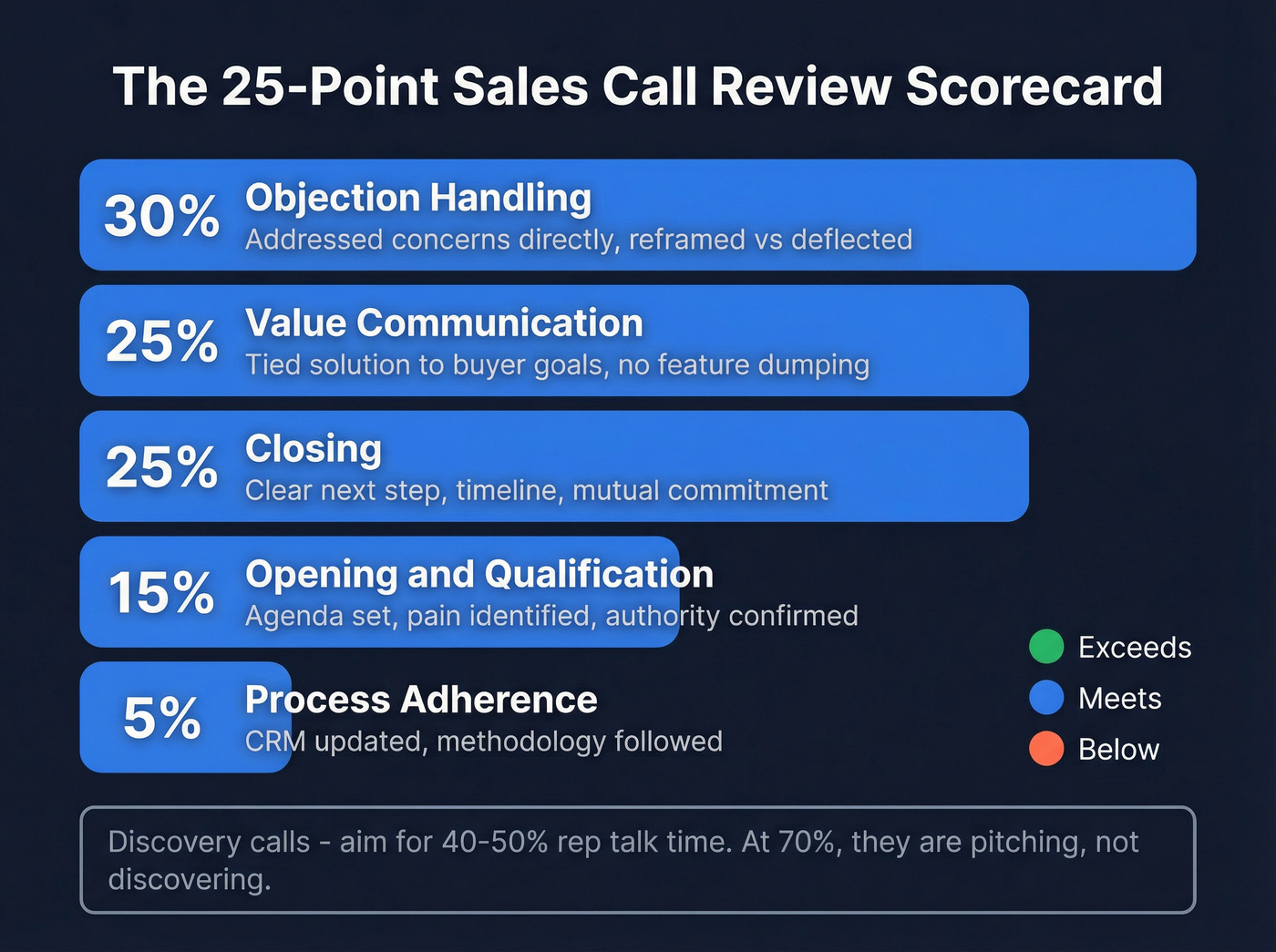
| Category | Weight | What You're Scoring |
|---|---|---|
| Opening & Qualification | 15% | Agenda set, pain identified, authority confirmed |
| Value Communication | 25% | Tied solution to buyer's goals, not feature-dumped |
| Objection Handling | 30% | Addressed concerns directly, reframed vs. deflected |
| Closing | 25% | Clear next step, timeline, mutual commitment |
| Process Adherence | 5% | CRM updated, methodology followed (MEDDIC, SPICED, etc.) |
For each category, score reps on three levels: exceeds expectations, meets expectations, or below expectations. Talk-to-listen ratio is a scored dimension - on discovery calls, aim for around 40-50% rep talk time. If they're running at 70%, they're pitching, not discovering.
If a full 25-point rubric feels heavy, start with a simpler 7-question yes/no checklist covering prep, rapport, questioning, pain, value, structure, and next steps. Upgrade to the weighted version once the habit sticks. We've seen teams pilot the full scorecard for 4-6 weeks with one pod before rolling it org-wide - that approach builds buy-in faster than a top-down mandate.
How to Run a Review Session
Each review should take 10-20 minutes per call. Here's the workflow:
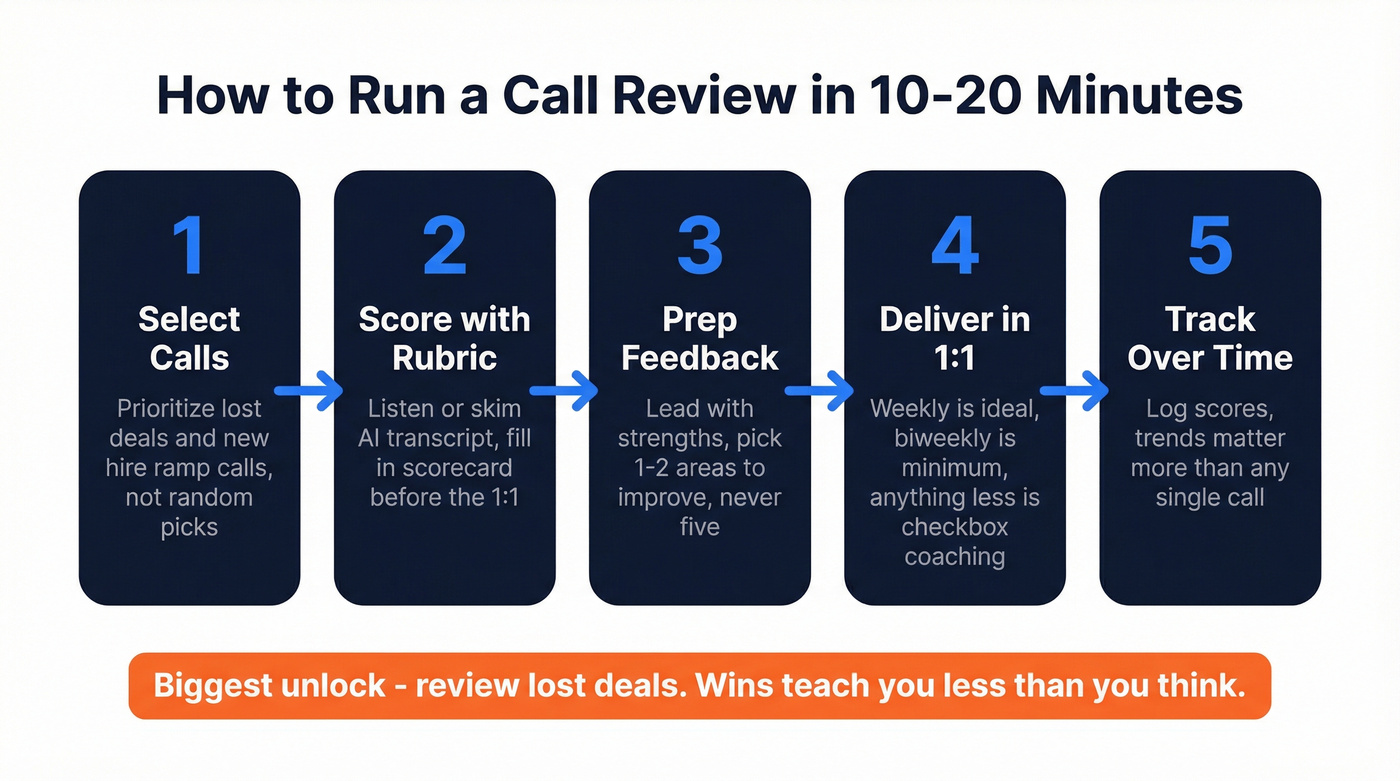
- Select calls. Prioritize lost deals and new hire ramp calls. Don't pick at random - random selection usually creates inconsistent coaching.
- Score with the rubric. Listen or skim the AI transcript and fill in the scorecard before the 1:1.
- Prep feedback. Lead with what the rep did well. Then pick one or two areas to improve - not five. Also check whether the rep shared the right information with the prospect versus held back appropriately. Oversharing kills deals as fast as under-qualifying.
- Deliver in a 1:1. Weekly is ideal. Biweekly is the minimum. Anything less and you're not coaching, you're checking a box.
- Track improvement. Log scores over time. Trends matter more than any single call.
The biggest unlock we've found is reviewing lost deals - wins teach you less than you think. Building a feedback loop where scores feed directly into the next week's coaching priorities is what separates ad-hoc listening from real development.
If you want a deeper framework for rep development beyond call listening, borrow a few ideas from sales coaching best practices and apply them to your weekly review cadence.

Your scorecard is useless if reps can't reach prospects. 80% of cold calls go to voicemail - mostly because the numbers are wrong. Prospeo's 125M+ verified mobile numbers deliver a 30% pickup rate, turning dead dials into reviewable conversations.
Stop reviewing voicemails. Start reviewing real sales conversations.
Post-Call Coaching Mistakes
Telling instead of asking. "You should've asked about budget" creates defensiveness. Try this instead: "Walk me through your thinking when they said the budget was tight. What options did you consider?" That question forces the rep to reconstruct their decision-making, which is where real learning happens.
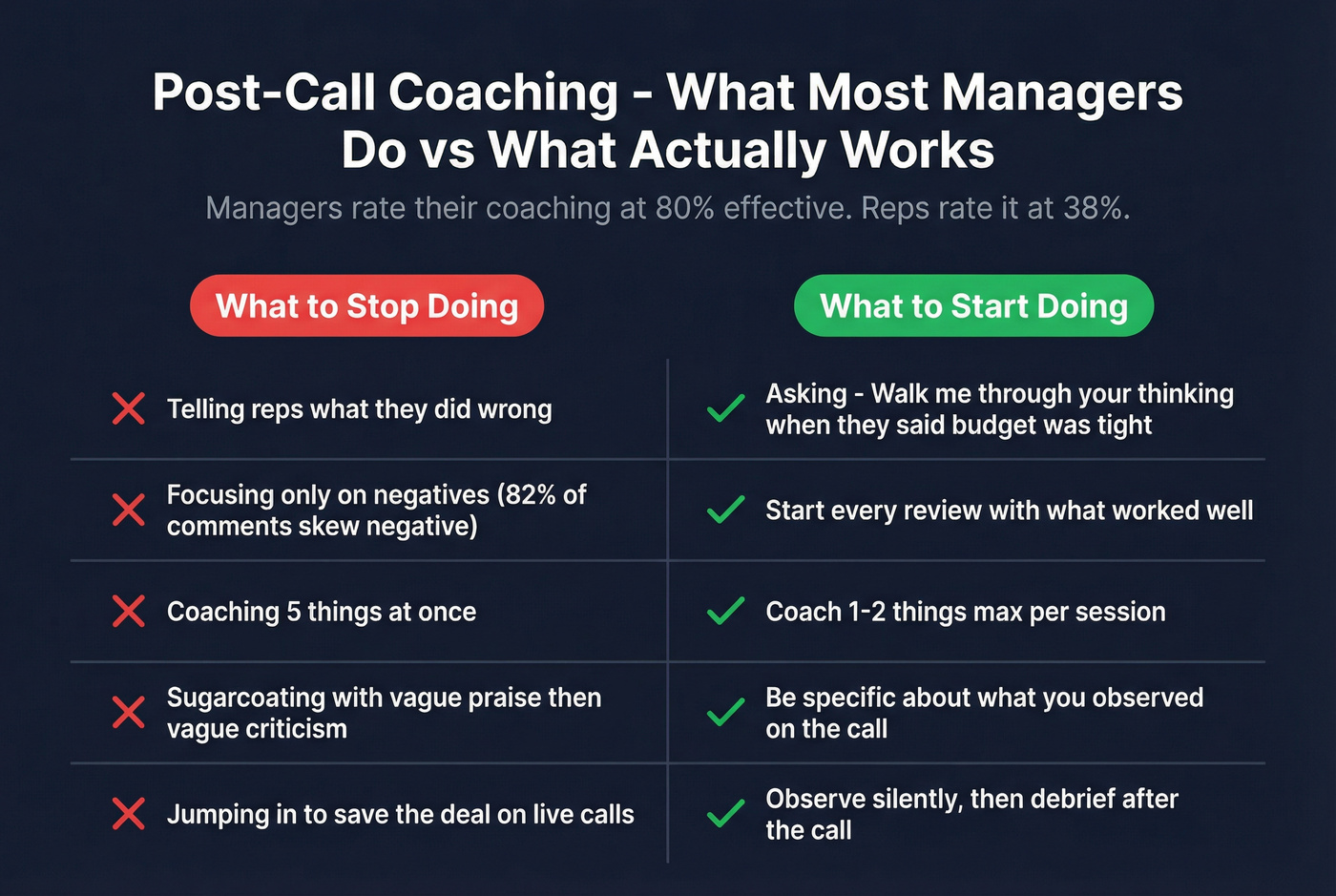
Focusing only on negatives. 82% of manager comments skew negative when asked to comment on both strengths and weaknesses. Start with what worked.
Too many priorities. Coach one or two things per session. Three is nitpicking. Five is noise.
Sugarcoating. Vague praise followed by vague criticism helps nobody. Be specific about what you observed.
Taking over on calls. If you're jumping in to "save" the deal, you're selling, not coaching. Observe, then debrief after.
Here's the thing: managers rate their own coaching at about 80% effectiveness. Reps rate those same managers at 38%. That perception gap is the real problem, and the only way to close it is to ask reps what's actually landing. The consensus on r/sales echoes this constantly - reps want specific, actionable feedback, not a vibe check. Effective post-call coaching requires the manager to listen more than they talk, mirroring the same skill they're trying to develop in their reps.
Benchmarks - What Good Looks Like
Before you review calls, make sure your reps are actually reaching people. These are the latest cold calling benchmarks to measure against:
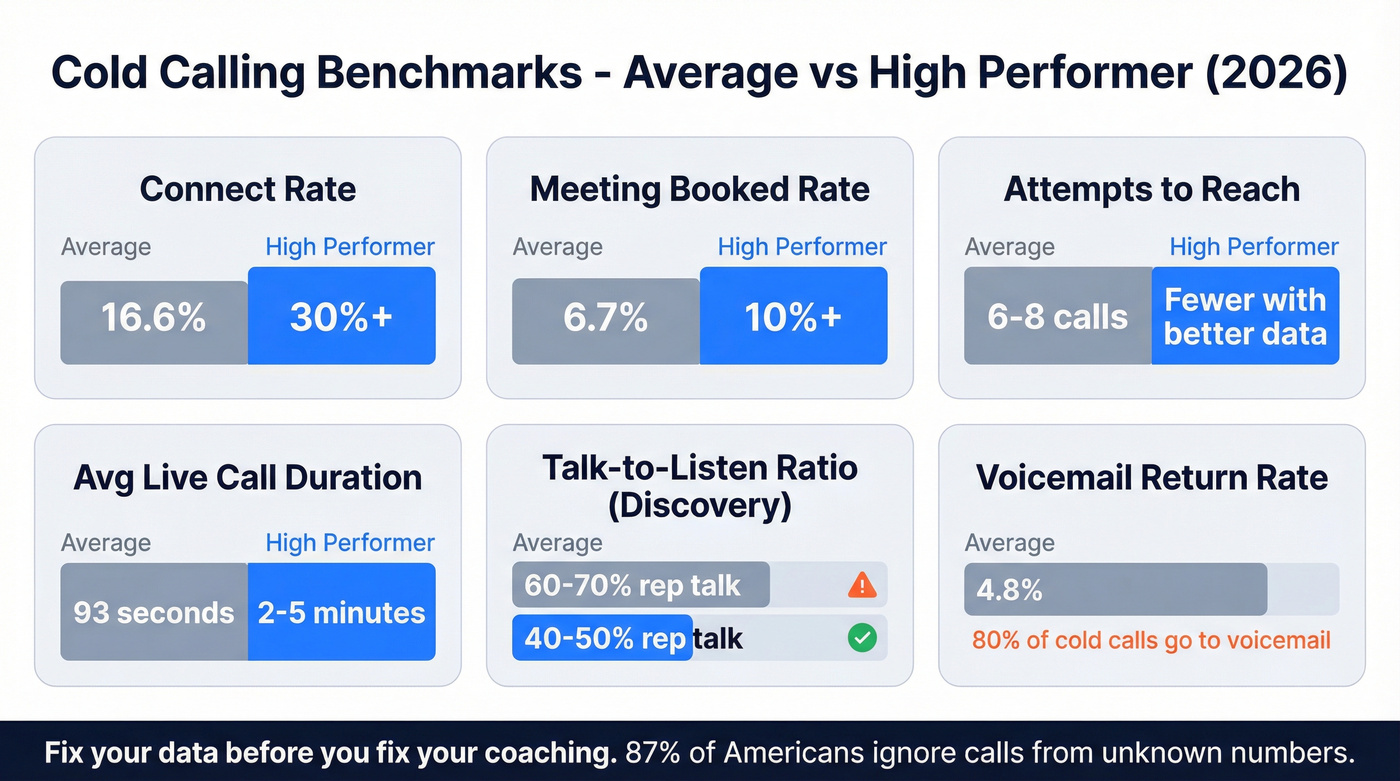
| Metric | Average | High Performer |
|---|---|---|
| Connect rate | 16.6% | 30%+ |
| Success rate (meeting booked) | 6.7% | 10%+ |
| Attempts to reach | 6-8 calls | Fewer with higher connect rates |
| Avg live call duration | 93 seconds | 2-5 minutes |
| Talk-to-listen ratio (discovery) | 60-70% rep talk | Around 40-50% rep talk |
| Voicemail return rate | 4.8% | - |
The ugly reality: 80% of cold calls go to voicemail, and 87% of Americans ignore calls from unknown numbers. If your reps are dialing unverified numbers pulled from a stale database, your connect rate is garbage before the review even starts.
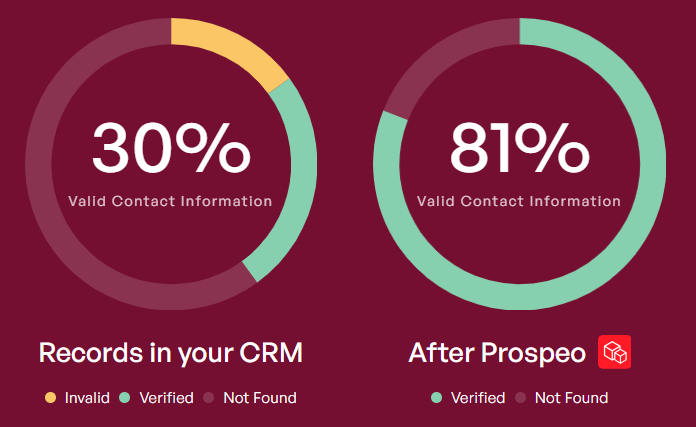
Skip the conversation intelligence budget if your deal size is under $25k and your connect rate sits below 15%. Fix your data quality first.
Tools for Call Review
Let's be honest: a Google Sheet scorecard and a weekly 1:1 can beat an expensive conversation intelligence rollout that nobody adopts. That said, manual review covers maybe 10-15% of calls. AI covers 100%. For teams with 8+ reps and a defined methodology, the ROI on conversation intelligence is real. Most AI coaching tools take 1-2 weeks to configure with your call source and sales methodology.
If you're evaluating platforms, this breakdown of sales call review software can help you shortlist by team size and budget.
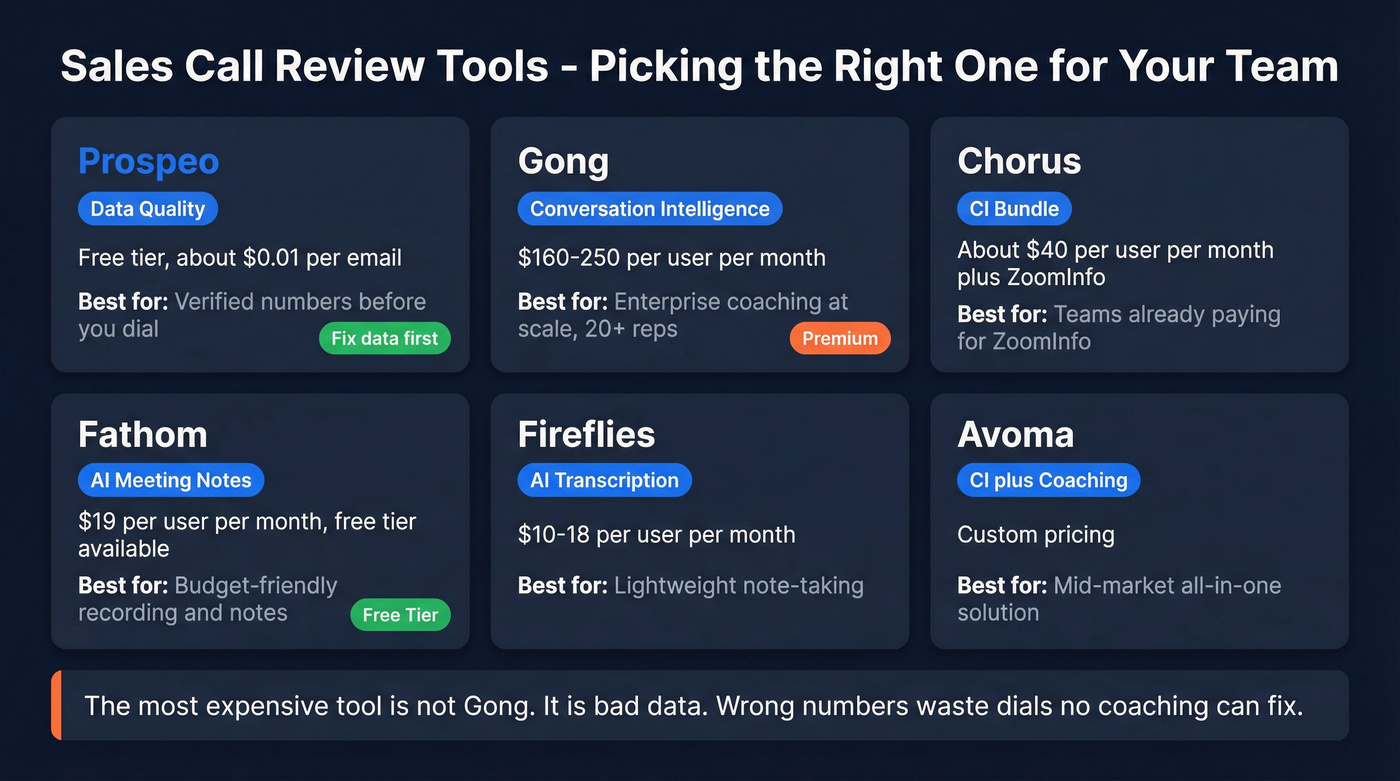
If you're on Zoom or Google Meet, built-in recording is free - pair it with a scorecard and you're already ahead of 75% of managers. This table focuses on dedicated review and coaching tools; AI dialers like Orum and Aircall are a separate category.
| Tool | Category | Starting Price | Best For |
|---|---|---|---|
| Prospeo | Data quality | Free tier; ~$0.01/email | Verified numbers pre-dial |
| Gong | Conversation intelligence | ~$160-250/user/mo | Enterprise coaching at scale |
| Chorus | CI (ZoomInfo bundle) | ~$40/user/mo + ZoomInfo | Teams already on ZoomInfo |
| Fathom | AI meeting notes | $19/user/mo (free tier) | Budget-friendly recording |
| Fireflies | AI transcription | $10-18/user/mo | Lightweight note-taking |
| Avoma | CI + coaching | Custom pricing | Mid-market all-in-one |
Gong is the 800-pound gorilla here, and for good reason - its deal intelligence and coaching scorecards are best-in-class for orgs with 20+ reps. But at $160-250/user/month, it's a serious line item. Fathom and Fireflies are solid for smaller teams that just need transcription and basic insights without the enterprise price tag. Chorus makes sense if you're already paying for ZoomInfo, since it bundles in; otherwise, it's hard to justify on its own.
The most expensive tool in this stack isn't Gong, though. It's bad data. When reps waste dials on wrong numbers, no amount of call coaching fixes the pipeline math. If you're troubleshooting why connects are low, start with B2B contact data decay and work backward.
You read it above: fix your data before you fix your coaching. Prospeo refreshes every record on a 7-day cycle - not the 6-week industry average - so your reps dial numbers that actually connect. At $0.01 per email and 10 credits per mobile, it costs less than one lost deal.
Double your connect rate and give your managers calls worth reviewing.
FAQ
How often should managers review calls?
Weekly is ideal, biweekly is the minimum. Consistent coaching generates a 20% improvement in sales objective attainment. Review 3-5 calls per rep per cycle, prioritizing lost deals and new hire ramp calls over random sampling.
What's the best free tool for reviewing calls?
Fathom offers a generous free tier for AI meeting notes and call recording. Prospeo's free plan handles the data-quality side so reps actually connect - 75 emails and 100 Chrome extension credits per month. Pair either with a Google Sheet scorecard. The framework matters more than the software.
How should SDR reviews differ from AE reviews?
SDR reviews should focus on opening technique, objection handling in the first 30 seconds, and meeting-set conversion. AEs need deeper scoring on discovery quality, value communication, and close mechanics. Many teams run group sessions weekly, pulling one strong and one weak SDR call to discuss as a pod - peer learning accelerates ramp faster than 1:1 coaching alone.
How do you improve connect rates before reviewing calls?
Bad contact data skews every call metric. Verified direct dials can double your connect rate overnight. Fix the numbers first, then coach the conversations. Our team has seen reps go from sub-15% connect rates to 25%+ just by switching to a verified mobile database with a weekly refresh cycle.