How to Build Sales Leadership Trust That Actually Moves Revenue
Your VP wants you to "build culture" but also wants 47 activity metrics in Salesforce by Friday. Meanwhile, half your team is mentally checked out, and the other half is updating their resumes.
Sales leadership trust is the thing nobody teaches you - and it's the thing that determines whether your team performs or quietly quits. A study of 6,972 US sales leaders found that 52% rated their team's engagement as "very low," and 82% of those leaders never received formal training on how to lead. Browse any r/sales thread about new managers and you'll see the same complaints: changed comp plans, canceled 1:1s, and pipeline reviews disguised as coaching. Let's build the playbook from scratch.
The Five Trust Levers That Actually Matter
If you're short on time, here's the ranked list:
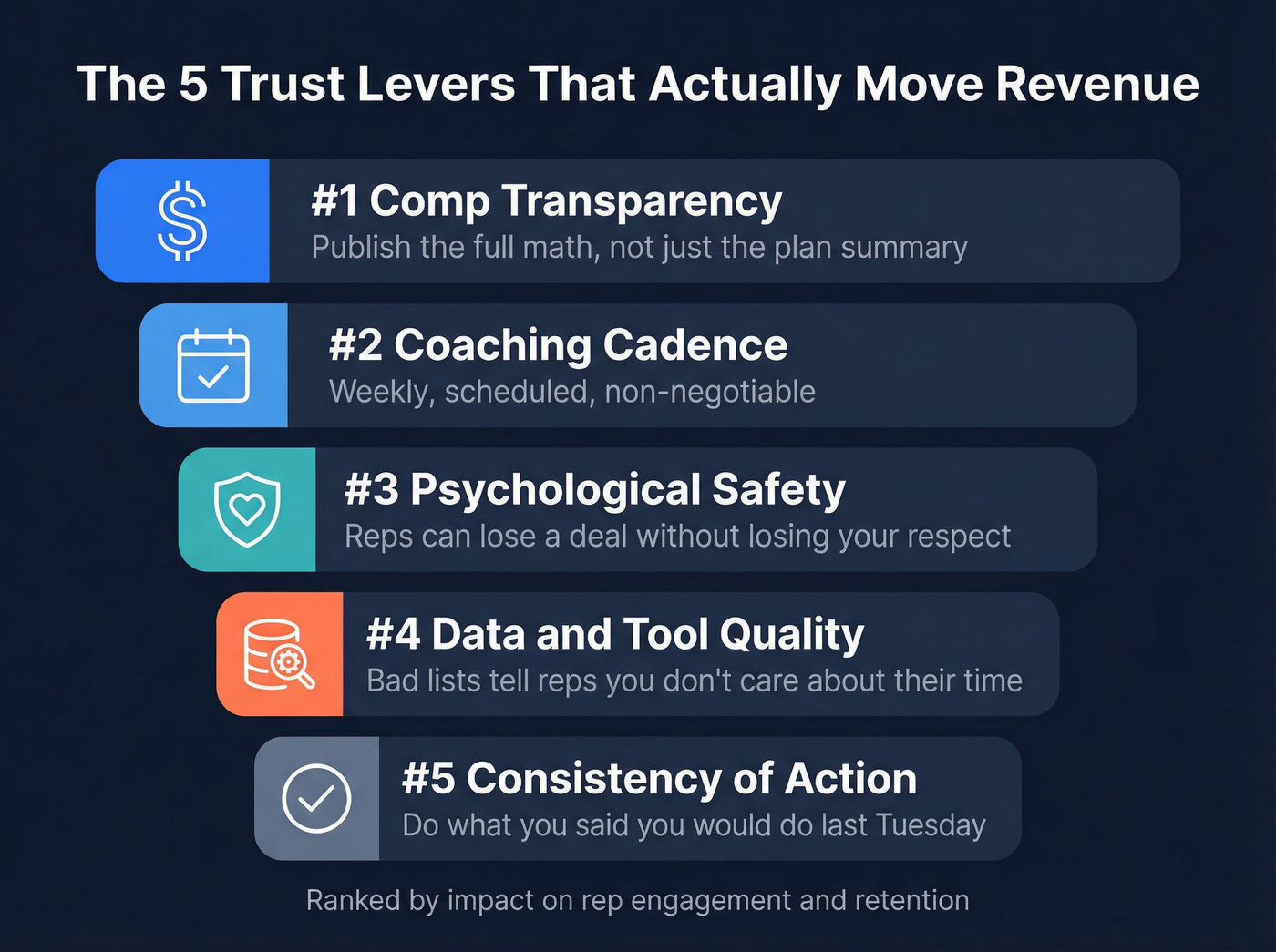
- Comp transparency - publish the full math, not just the plan summary
- Coaching cadence - weekly, scheduled, non-negotiable (see sales coaching)
- Psychological safety - reps can lose a deal without losing your respect
- Data and tool quality - bad lists tell reps you don't care about their time (fix it with data quality)
- Consistency of action - do what you said you'd do last Tuesday
Building credibility with your sales team isn't about grand gestures. It's about nailing these five levers repeatedly until they become muscle memory.
The Trust Cascade - Why It Drives Revenue
Mark Hunter puts it bluntly: "The way a leader treats their team is the same way their team treats their customers." That's not a motivational poster - it's a revenue mechanism. When reps feel supported internally, they show up differently on calls. They listen better. They push back on bad-fit deals instead of sandbagging pipeline.
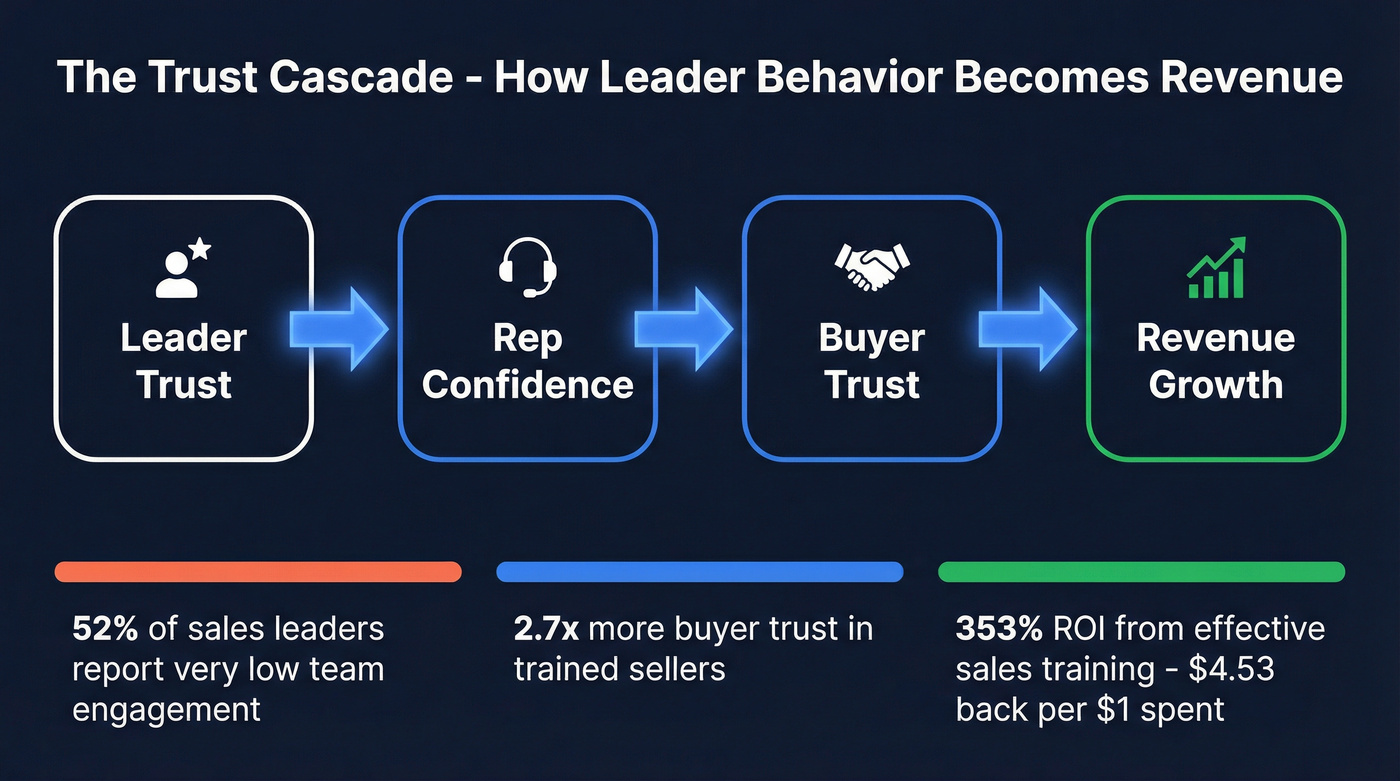
RAIN Group found that buyers show 2.7x more trust in trained sellers - and only 18% of buyers believe salespeople are well-prepared. Effective sales training delivers a 353% ROI, returning $4.53 for every dollar spent. High-trust teams typically see 10-25% higher productivity and materially lower attrition. The cascade runs one direction: leader to rep, rep to customer, customer to revenue.
The Four-Pillar Framework
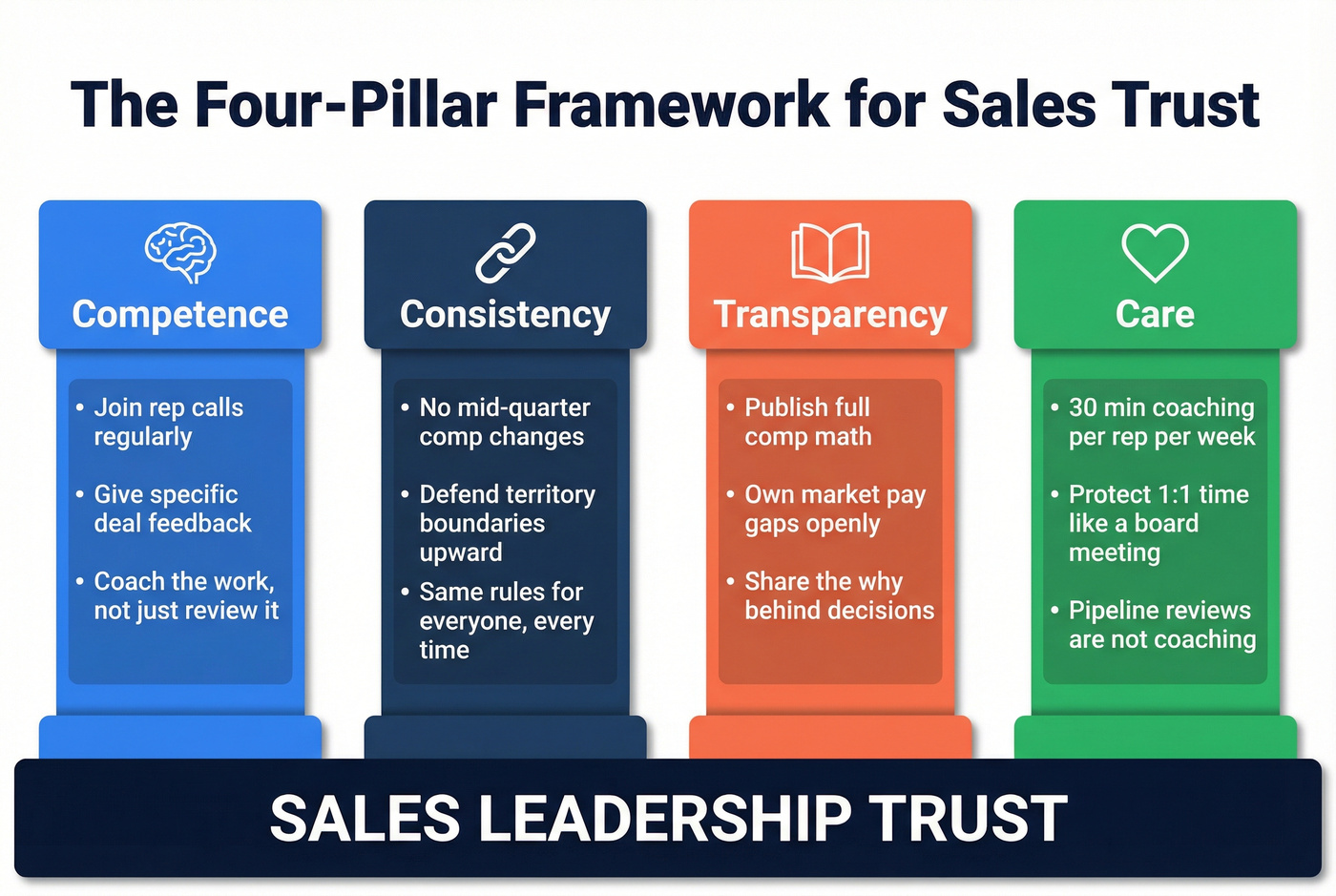
Most sales leadership advice tells you to "be authentic." That's not wrong - it's just useless. Lencioni's pyramid puts trust at the base for a reason: without it, nothing above holds. Trust isn't built through vibes. It's built through systems.
Competence - Know the Work
Your reps can tell within two weeks whether you understand their job. Join calls. Run debriefs. Give specific feedback - "your discovery was too surface-level on the budget question" beats "nice job" every time. If you can't coach a deal, you can't lead the team selling it. Competence is the fastest path to respect because it proves you've earned the right to lead, not just the title. (If you want a deeper playbook on earning it fast, see how to build credibility in sales.)
Consistency - Keep Your Word
Here's the fastest way to destroy trust: change the comp plan mid-quarter. Full stop.
Every time leadership moves territories or tweaks accelerators without warning, you're telling reps the rules don't matter. Draw a bright line - no mid-quarter comp changes - and defend it upward. We've watched teams unravel over a single surprise territory reshuffle that leadership thought was "minor." It never is.
Transparency - Show the Math
Reps talk. They compare OTEs, they compare territories, they compare how accelerators kick in. If you're not publishing the full math, they're filling gaps with assumptions - and those assumptions are always worse than reality. SDR OTE runs about $85K on average, AE OTE around $154K. If your plan doesn't match market, own that conversation before your reps have it without you. Brutal honesty isn't comfortable, but it's cheaper than replacing a rep who left because they felt misled.
Care - Invest in Their Growth
Only 26% of reps receive weekly coaching, and 49% of sales leaders say training and coaching are the most useful levers for improving engagement. Pipeline reviews aren't coaching - I've watched managers confuse the two for years, and it's where trust goes to die. Block 30 minutes per rep per week and protect that time like a board meeting. (If you need a way to operationalize it, use sales training KPIs to track impact.)

You just read that bad data is a burnout accelerator - and burnout blocks 70% of reps from high engagement. Prospeo's 98% email accuracy and 7-day refresh cycle mean your reps stop wasting hours on dead contacts and start trusting that leadership invested in tools that actually work.
Stop eroding trust one bounced email at a time.
Psychological Safety on the Sales Floor
Amy Edmondson's research at Harvard identifies four elements of psychological safety: willingness to help, inclusion, attitude toward risk and failure, and open conversation. On a sales floor, that translates to senior reps mentoring new hires without being asked, the quiet SDR's idea getting the same airtime as the top closer's, and a rep telling you the messaging isn't working without you taking it personally. Most importantly, your reps can lose a deal without losing your respect - and they know it because you've said it explicitly.
Run Edmondson's psychological safety scale as a quarterly diagnostic. The first time you run it, the results will sting. That's the point. You can't fix what you won't measure, and 76% of organizations already use employee surveys to track engagement - so you won't be inventing a new process.
Your Tools Are a Trust Signal
Picture this: you hand your team 2,000 contacts for a new campaign. They load it into their sequencer, hit send, and 680 emails bounce. Your reps didn't just waste a day - they burned sender reputation and quietly concluded that leadership doesn't care enough to invest in tools that work.
Burnout prevents 70% of sales staff from achieving high engagement, and bad data is a burnout accelerator. Nothing erodes confidence in management faster than garbage contact lists. Respecting your reps' time starts with the data you hand them.
This is where data quality becomes a leadership decision, not just an ops one. Tools like Prospeo verify emails at 98% accuracy on a 7-day refresh cycle, so reps aren't burning hours on dead contacts. Layer in intent data and they're reaching buyers who are actively researching your category - not spraying into the void. Run your current list through verification. If more than 5% bounce, your data provider is costing you trust. (If you want the mechanics, start with email verification for outreach.)
The 30/60/90 Trust-Building Plan
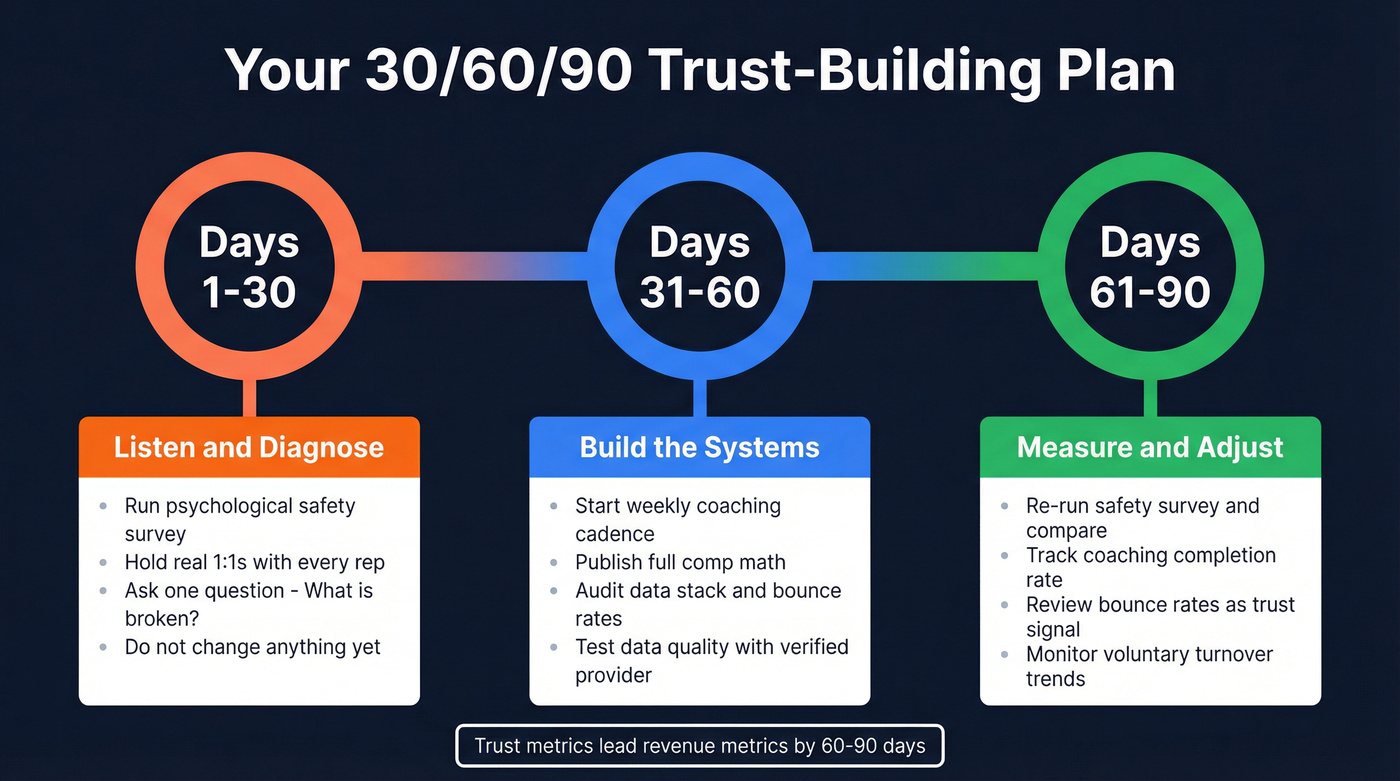
Days 1-30: Listen and Diagnose
Don't change anything yet. Run Edmondson's safety survey for a baseline. Hold 1:1s with every rep - not pipeline reviews, real conversations. Ask one question: "What's broken?" Then shut up and write down what they say. If you're wondering how to gain credibility with your team, this is where it starts: proving you'll listen before you act. (If you need a structure for those conversations, borrow from BDR performance management.)
Days 31-60: Build the Systems
Act on what you heard. Establish a weekly coaching cadence - 30 minutes per rep, skill-focused. Publish your comp plan with the full math: base, OTE, accelerators, territory logic. Audit your data stack and test your bounce rates against a provider with verified data. Prospeo's free tier gives you 75 verified emails per month to benchmark against your current provider's quality, no contract required.
Days 61-90: Measure and Adjust
Re-run the safety survey and compare to your Day 1 baseline. Track coaching completion rate - if you're canceling more than 20% of scheduled 1:1s, that's your first red flag. Review bounce rates as a leading indicator of tool quality. Look at voluntary turnover trends. These trust metrics lead revenue metrics by 60-90 days. (To connect the dots to pipeline, use a sales management dashboard.)
Coaching, transparency, and consistency build trust - but handing reps garbage data destroys it overnight. Prospeo gives your team 300M+ verified profiles with intent data across 15,000 topics, so every list you assign signals that you respect their time and set them up to win.
Great sales leaders don't send their team into battle with broken weapons.
When Trust Is Already Broken
Look - it's your third week managing a team you didn't hire. The last manager promised territories wouldn't change, then reshuffled everything in Q3. Two top reps left. The ones who stayed don't believe a word from leadership.
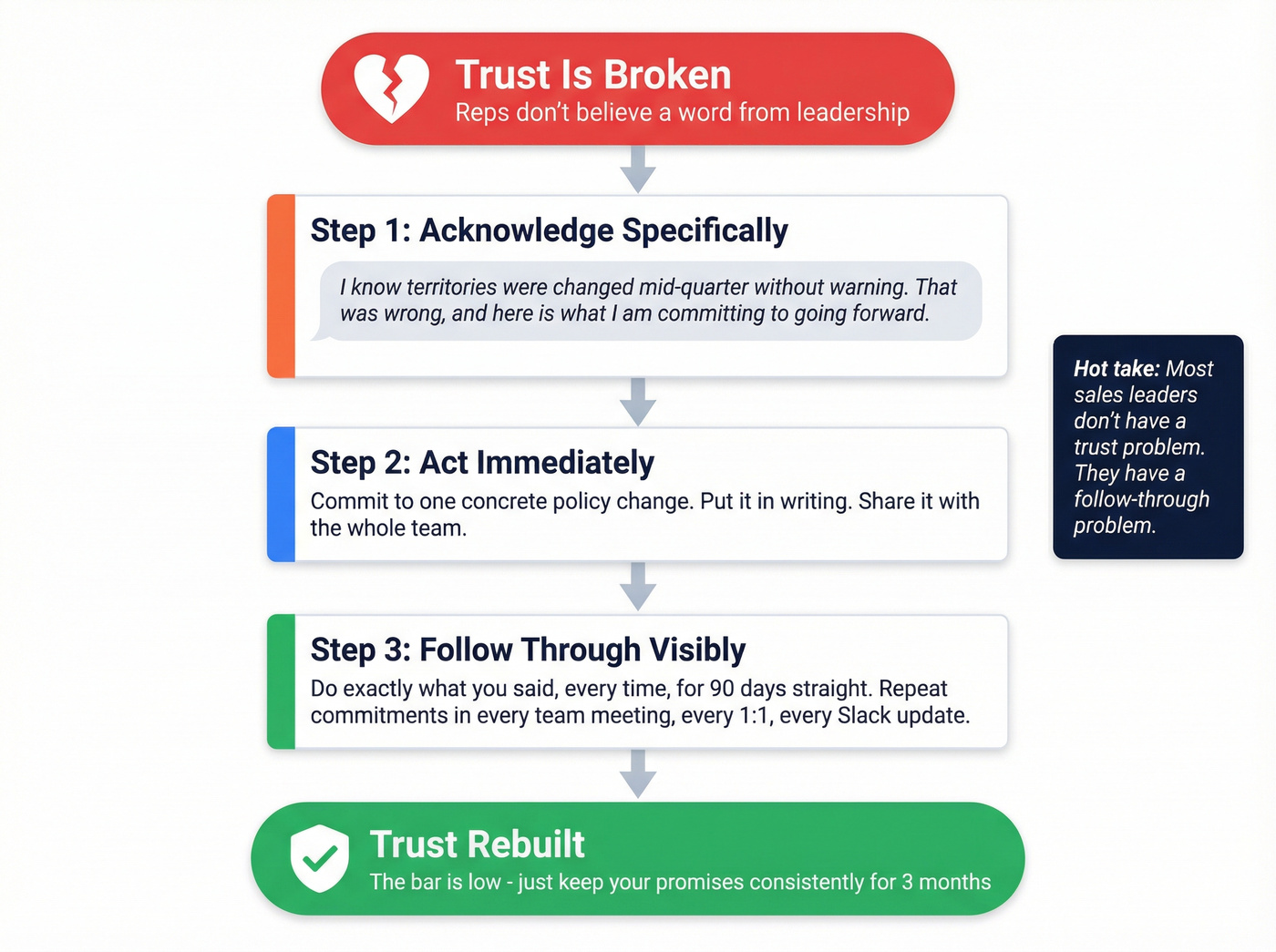
Here's the repair model. First, acknowledge specifically. Say this in your next team meeting: "I know territories were changed mid-quarter without warning. That was wrong, and here's what I'm committing to going forward." Then act immediately - commit to one concrete policy change and put it in writing. Finally, follow through visibly. Do exactly what you said, every time, for 90 days straight. Trust repair isn't a conversation. It's a pattern of behavior sustained long enough that people stop waiting for the other shoe to drop. Relentless communication - repeating your commitments in every team meeting, every 1:1, every Slack update - is what turns promises into belief.
Hot take: Most sales leaders don't have a trust problem. They have a follow-through problem. The bar is shockingly low. If you simply do what you said you'd do, consistently, for three months, you'll be in the top tier of managers your reps have ever worked for. That's not inspiring. It's just math. Sales leadership trust isn't some abstract concept - it's the compound interest of keeping small promises.
FAQ
How do you build trust as a new sales manager?
Start with 1:1 listening sessions - not pipeline reviews - during your first 30 days. Run a psychological safety survey for a baseline, then make one visible improvement within the month: coaching cadence, comp transparency, or data quality. Earning your team's confidence is a 90-day project, not a first-week speech.
How do you measure trust on a sales team?
Use Edmondson's psychological safety scale quarterly, tracking scores over time. Supplement with voluntary turnover rate, coaching attendance, 1:1 cancellation rates, and email bounce rates as a proxy for tool investment. If bounce rates exceed 5%, your data provider is undermining rep confidence.
Why does comp transparency matter for trust?
Reps who don't understand their comp plan assume the worst - hidden accelerators, unfair territory splits, moving targets. Publishing the full math removes ambiguity. Teams with transparent compensation report higher engagement and lower voluntary attrition within six months.