

The Complete BDR Performance Management System for 2026
Your top BDR quit last month. Two replacements are ramping, and neither is hitting 40% of quota. The pipeline forecast you gave the VP on Monday is already wrong by Thursday.
Here's the thing: most BDR performance management guides online are actually program launch guides - how to hire, what tools to buy, how to write a job description. That's not your problem. Your problem is managing performance when the team is already in motion and the numbers aren't moving fast enough.
What You Need (Quick Version)
If you only take five things from this article, make it these:
- Track 5 metrics, not 15. Every additional KPI dilutes focus. Your scorecard should stay tight: pipeline coverage, contact-to-meeting rate, meetings held, pipeline created, and an ICP fit score. Everything else is a diagnostic.
- Run a weekly operating rhythm you never cancel. The gap between supported and unsupported BDRs is 15 points of quota attainment. Coaching isn't optional.
- Coach differently by rep stage. A new hire and a plateaued rep need completely different interventions. One-size-fits-all coaching is the #1 management failure.
- Audit your data before you audit your people. Contact data is the most requested resource among BDRs. If your numbers are bad, your metrics are lying to you.
- PIP with a plan, not a threat. A PIP without a documented coaching plan is just a countdown to termination.
2026 BDR Performance Benchmarks
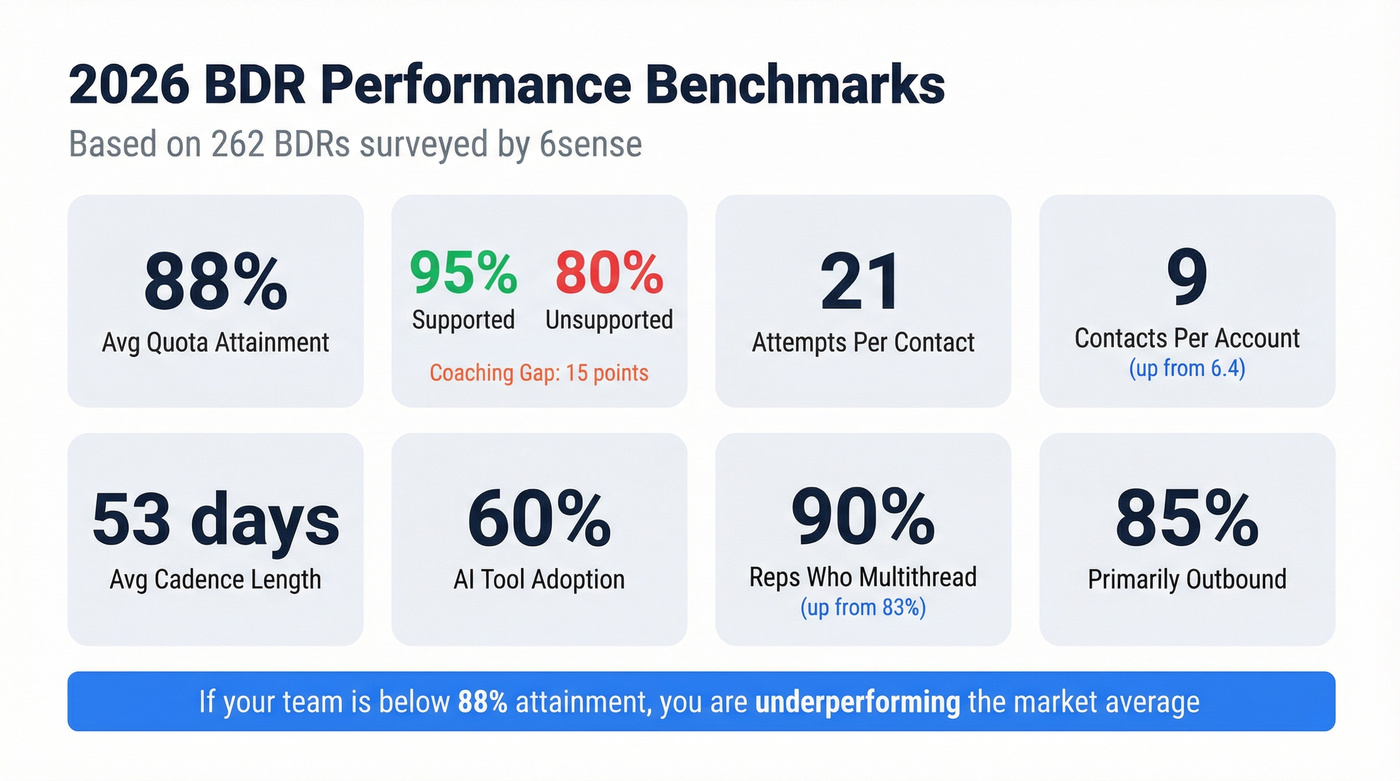
Before you can manage performance, you need to know what "good" looks like. The 6sense BDR Benchmark surveyed 262 BDRs and gives us the clearest picture available.
| Metric | Benchmark |
|---|---|
| Avg. quota attainment | ~88% |
| Supported vs unsupported | 95% vs 80% |
| Attempts per contact | ~21 |
| Contacts per account | ~9 |
| Avg. cadence length | 53 days |
| AI tool adoption | ~60% |
| Primarily outbound | 85% |
If your team is below 88% attainment, you're underperforming the market average. If you're not providing structured coaching and enablement support, you're leaving 15 points of attainment on the table - that's the gap between 95% and 80%.
And if your reps are still running 12-touch cadences over 3 weeks, they're giving up too early. The benchmark is 21 attempts over 53 days. Ninety percent of BDRs now multithread (up from 83%), and those who do are reaching ~9 contacts per account, up from 6.4 last year. Meanwhile, 80% of BDRs report to Sales (up from 60% in 2022), and the most-used AI tools are call transcription and email writing - both augmenting the rep, not replacing them.
KPI Framework That Actually Works
Stop adding more KPIs. You need five, not fifteen. Every metric beyond these five is a diagnostic you pull when something breaks - not a standing item on your scorecard.
The Five Metrics That Matter
Pipeline coverage ratio tells you whether you have enough pipeline to hit the number. Total pipeline value divided by revenue quota. If your quota is $500K and your pipeline is $2M, you're at 4x coverage. Anything below ~3x is a red flag.
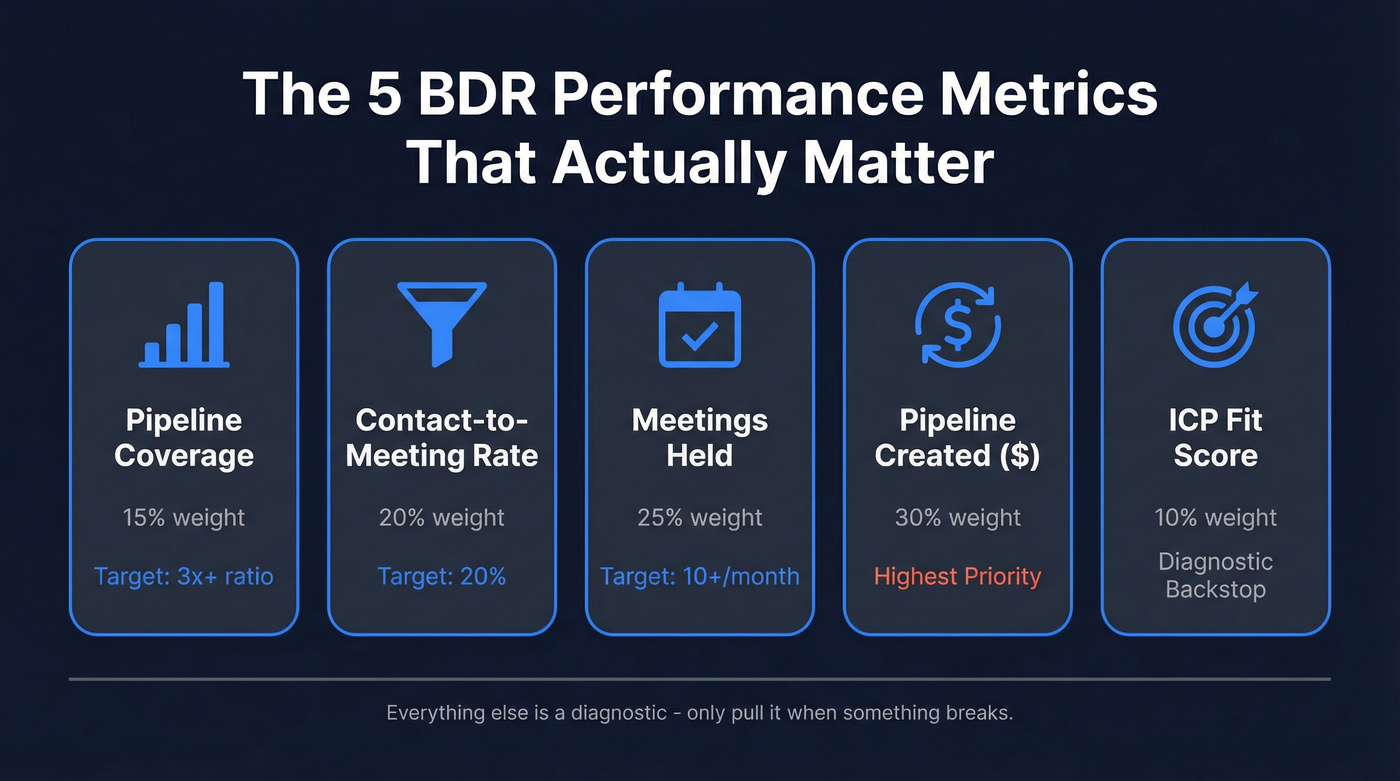
Contact-to-meeting rate measures conversion efficiency. Meetings booked divided by prospects you actually had a conversation with, times 100. A 20% contact-to-meeting rate is a solid target for SaaS BDRs. Below 10% often points to messaging or ICP targeting issues, not effort.
Meetings held - not booked. Booked meetings that no-show are vanity metrics. Track the ones that actually happened. This is the number your AEs care about, and it's the number your comp plan should reward.
Pipeline created ($) connects activity to revenue. A BDR who books 15 meetings a month that generate $50K in pipeline is more valuable than one who books 20 meetings worth $20K. Dollar value forces quality conversations.
ICP fit score is your diagnostic backstop. Assign points to ICP criteria - desired industry gets a 10, adjacent industries get 5, everything else gets 1-2. When meeting quality drops but volume stays steady, ICP score tells you whether reps are drifting off-target.
Quota-to-Activity Math
Work backward from the number. If a BDR needs 10 meetings per month and historical data shows it takes roughly 60 calls to generate one meeting, the target is 600 calls per month - about 150 per week, 30 per day. Layer in lead response time: responding to an inbound lead in under 5 minutes dramatically increases conversion. If your team's average response time is 45 minutes, you're losing meetings before the conversation starts.
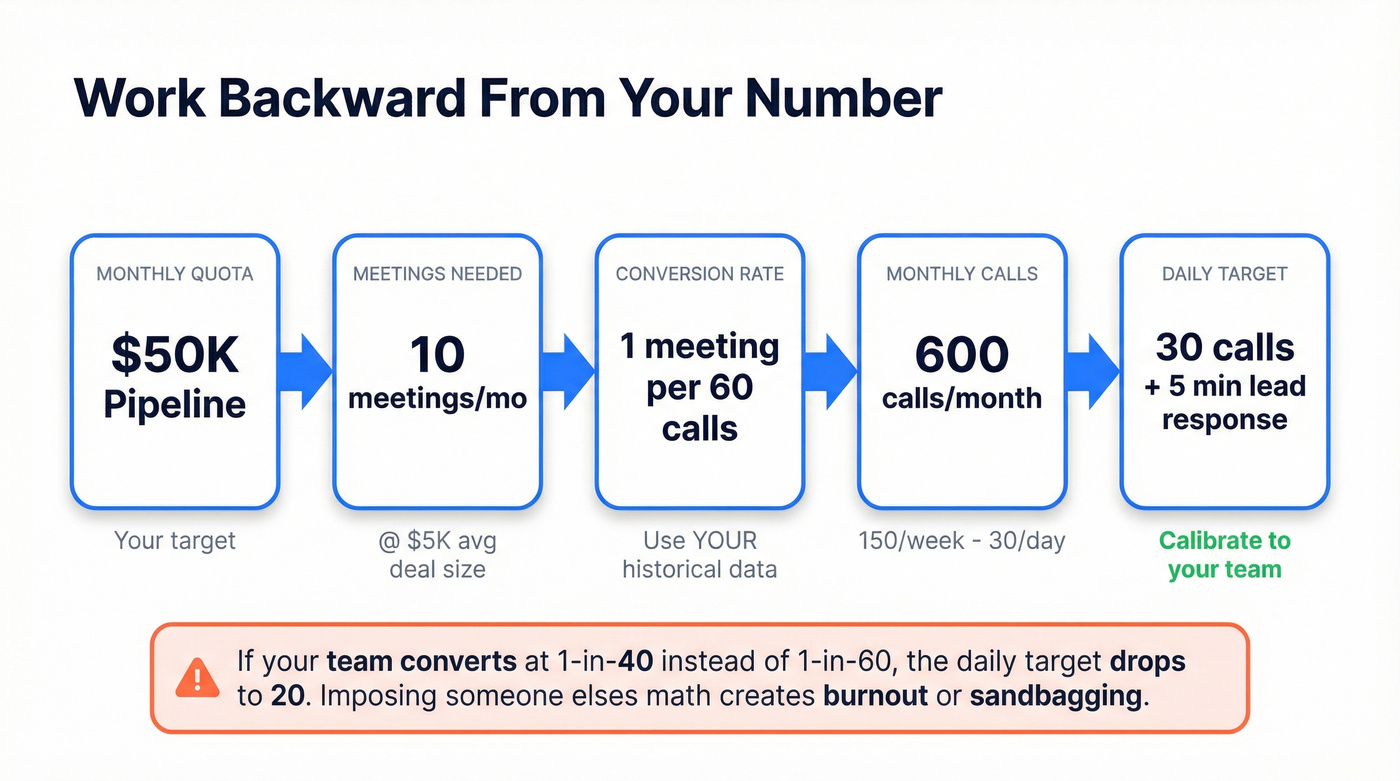
The key is calibrating these numbers from your historical data, not industry averages. If your team converts at 1-in-40 instead of 1-in-60, the daily call target drops to 20. Imposing someone else's math on your team creates either sandbagging or burnout.
Building Your BDR Scorecard
Scorecard vs Dashboard
These aren't the same thing, and confusing them is a common mistake.
| Scorecard | Dashboard | |
|---|---|---|
| Purpose | Rep-level performance | Team/org overview |
| Audience | Manager + individual rep | Leadership + RevOps |
| Cadence | Weekly (in every 1:1) | Daily/real-time |
| Example metrics | Contact-to-meeting rate, ICP score | Pipeline, revenue, CPM |
A dashboard tells you the business is healthy. A scorecard tells you which rep needs help and where. Pull up the scorecard in every 1:1 - it's the conversation starter, not the conversation.
What Goes on the Scorecard
Your five core metrics, weighted by what matters most to your business. A typical weighting: pipeline created (30%), meetings held (25%), contact-to-meeting rate (20%), pipeline coverage (15%), ICP fit score (10%).
Diagnostic metrics like multithreading score, disqualification rate, and ICP score only get pulled when a core metric is off. If meetings held drops but activity volume is steady, check ICP score. If pipeline value drops but meetings are stable, check multithreading - the rep might be single-threading into accounts that need broader engagement.
Weekly Coaching Rhythm
Let's be honest: coaching isn't a "nice to have." It's a 15-point attainment gap. Supported BDRs hit 95% of quota. Unsupported ones hit 80%. That gap compounds across a team of 8-10 reps into hundreds of thousands in pipeline.
| Cadence | Activity | Duration | Purpose |
|---|---|---|---|
| Daily | Standup | 10-15 min | Pipeline blockers, wins, priorities |
| Weekly | 1:1 | 30-45 min | Scorecard review, coaching |
| Weekly | Game film / call review | 60 min block | Team skill-building |
| Monthly | Performance review | 45-60 min | Trend analysis, goal adjustment |
| Quarterly | Calibration | Half-day | Quota resets, comp review, promotions |
The weekly 1:1 is the most important meeting on your calendar. Never cancel it. Never move it. We've seen the difference firsthand: the managers whose teams actually perform are the ones who hold 1:1s religiously and use them for metric-driven coaching, not status updates. Break down your top performer's activities every week - call volume, email cadence, messaging patterns, subject lines, cold call openers. Build a replicable model, then coach the rest of the team toward it.

You said it yourself: audit your data before you audit your people. 98% email accuracy and 125M+ verified mobiles mean your BDRs spend time selling, not chasing bounces. At $0.01/email, bad data is no longer an excuse for missed quota.
Stop blaming reps when the real problem is your contact data.
Coaching by Rep Stage
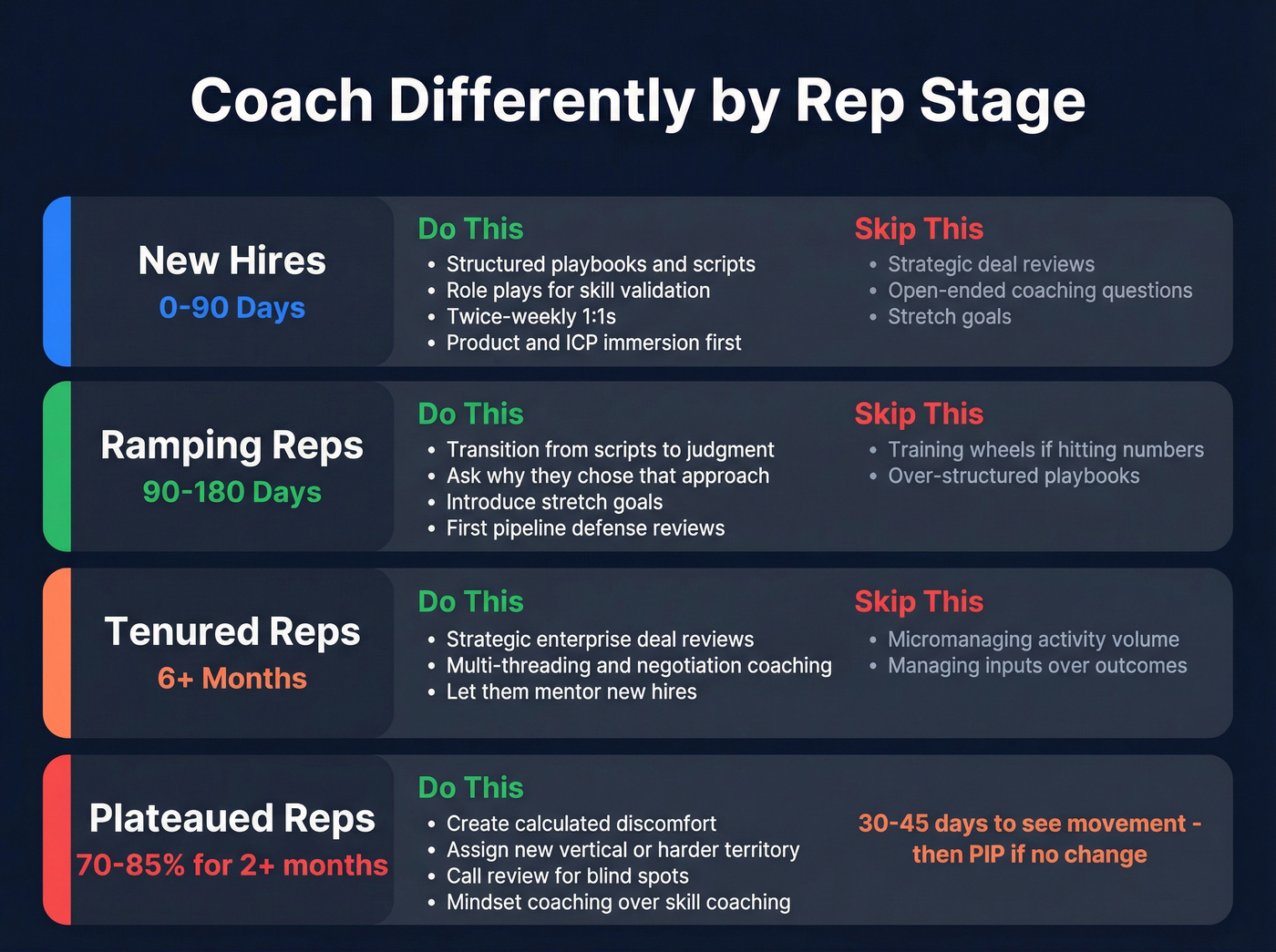
One-size-fits-all coaching is the #1 management failure in BDR orgs. A new hire drowning in cold call anxiety needs a fundamentally different intervention than a tenured rep who's coasting.
New Hires (0-90 Days)
Do this: Structured playbooks, repeatable scripts, basic skill validation through role plays, high-touch 1:1s (twice weekly if possible). Focus on process adherence, not creativity. Weeks 1-2 should be product and ICP immersion. Weeks 3-4 shift to live shadowing and first supervised calls. By week 6, they should be running cadences independently with daily check-ins.
Skip this: Strategic deal reviews, open-ended "how would you approach this?" coaching, stretch goals. They don't have enough reps to improvise yet.
Ramping Reps (90-180 Days)
Do this: Transition from scripts to judgment. Start asking "why did you choose that approach?" instead of "did you follow the script?" Introduce stretch goals. Run their first deal reviews where they present their pipeline and defend their prioritization.
Skip this if the rep is hitting numbers: Treating them like new hires. If someone's still on training wheels at month 5, the problem is either the hire or the onboarding - not the coaching cadence.
Tenured Reps
Tenured reps are your highest-leverage coaching investment. Give them strategic deal reviews focused on enterprise judgment, negotiation coaching, and multi-threading strategy for complex accounts. Let them mentor new hires - it reinforces their own skills and builds team culture.
Don't micromanage activity volume. If a tenured rep is hitting their number, manage to outcomes, not inputs.
Plateaued Reps
This is where most managers fail. They see the plateau, hope it resolves, and six months later they're writing a PIP for someone who never got a real intervention. I've watched it happen at three different companies, and it always plays out the same way.
Warning signs: Consistent quota attainment between 70-85% for 2+ months, declining call energy on recordings, shrinking pipeline despite steady activity, same objection-handling mistakes on repeat.
Intervention: Create calculated discomfort. Assign a new vertical, a harder territory, or a stretch account list. Identify blind spots through call reviews - plateaued reps often don't know what they don't know. Mindset coaching matters here more than skill coaching.
Expected timeline: 30-45 days to see movement. If the needle hasn't moved after a focused intervention with documented coaching, then you're looking at a PIP conversation - not before.
Comp Plans That Drive Behavior
The standard SaaS BDR comp structure runs 60/40 or 70/30 base-to-variable. For U.S. SaaS roles, entry-level BDRs commonly land around $45K-$65K OTE, while senior BDRs often reach $80K+ and can push higher in high-cost markets.
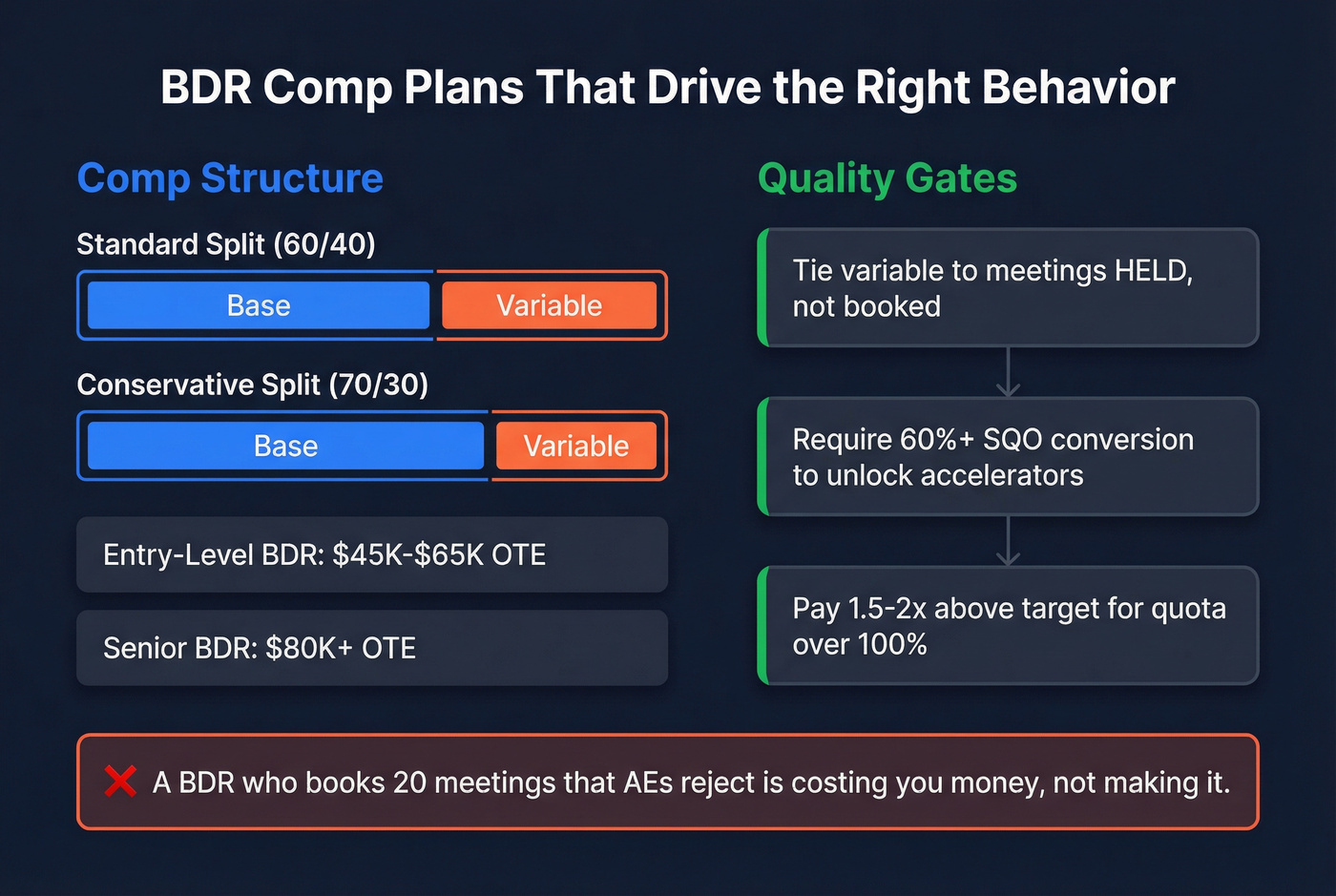
Tie variable comp to meetings held and SQO acceptance, not just meetings booked. A BDR who books 20 meetings that AEs reject is costing you money, not making it. Build quality gates into the comp plan - if fewer than 60% of meetings convert to SQOs, the rep doesn't hit accelerators regardless of volume.
Accelerators above 100% of quota are essential for retention. The best BDR comp plans pay 1.5-2x above target. Without accelerators, your top performers have no reason to stay past month 12.
One sanity check from Highspot's research: if fewer than 70-80% of your team is hitting quota, the quotas are miscalibrated. Recalculate using historical conversion data before blaming execution. Unrealistic quotas destroy morale faster than bad coaching.
Data Quality - The Hidden Killer
A BDR is expected to make around 40-60 calls per day. If 35% of those phone numbers are disconnected, that rep is effectively making 39 calls. They're working just as hard, but the scorecard says they're underperforming.
That's not an effort problem. That's a data problem.
Your BDR team's data quality is a management problem, not a rep problem. The benchmark data found that contact data is the #1 resource BDRs request. They know the numbers are bad. They're telling you.
Before you restructure your coaching program, fix the inputs. Run a quick audit: is your email bounce rate above 5%? Is your phone connect rate below 15%? Has your contact data been refreshed in the last 30 days? If any answer is yes, you've found a likely root cause.

In our experience, this is where Prospeo makes the biggest difference for BDR teams - 98% email accuracy, 125M+ verified mobile numbers with a 30% pickup rate, and a 7-day data refresh cycle compared to the 6-week industry average. When GreyScout switched, their bounce rate dropped from 38% to under 4%, and rep ramp time was cut from 8-10 weeks to 4 weeks. That's the difference between a BDR hitting quota in month 2 versus month 4.
Look - if your deal sizes sit below $25K and your team has fewer than 5 reps, you probably don't need a $150/user/month conversation intelligence tool. You need clean data and a manager who actually listens to calls. Fix the inputs before you layer on analytics.
BDRs now multithread into 9 contacts per account over 53-day cadences. That only works if every email lands. Prospeo refreshes 300M+ profiles every 7 days - not the 6-week industry average - so your reps never burn touches on stale data.
Give your BDRs the 15-point attainment lift that starts with accurate data.
The Performance Improvement Plan
A PIP should be the last step, not the first. Before you put anyone on a plan, ask two questions: have you been coaching this rep consistently for at least 30 days? And have you ruled out data quality as a factor? If the answer to either is no, you're not ready for a PIP - you're ready for a coaching cadence.
When a PIP is warranted, structure it as a 30-day plan with weekly checkpoints:
- Clear activity targets - daily calls, emails, conversations, calibrated to your team's conversion math, not arbitrary numbers
- Quality targets - ICP fit score, meeting acceptance rate
- Outcome targets - meetings held, pipeline created
- Documented coaching plan - what you will do to support the rep, not just what they need to fix
- Exit criteria - define both success (rep returns to standard performance expectations) and separation (rep doesn't meet targets despite documented support)
A PIP without a coaching plan is just a countdown to termination. And if your PIP documentation doesn't include what the manager committed to doing, HR will notice - and so will the rep.
The BDR Performance Stack
Your tech stack should serve four functions. Everything else is optional.
| Layer | Tools | Price Range |
|---|---|---|
| CRM | Salesforce / HubSpot | Salesforce: ~$25-$330+/user/mo (plan-dependent); HubSpot: free tier, paid seats from ~$20+/user/mo |
| Sales Engagement | Outreach, Salesloft | ~$100-$150/user/mo |
| Conversation Intel | Gong | ~$100-$200/user/mo depending on package |
| Data Quality | Prospeo | Free tier (75 emails/mo), ~$0.01/email |
The most common mistake we see: teams spend $150/user/month on Gong and Outreach, then feed those tools unverified contact data from a provider that refreshes every 6 weeks. You're optimizing the engine while pouring sand in the fuel tank. None of the other layers matter if your reps are calling dead numbers and bouncing emails.
FAQ
How many KPIs should a BDR manager track?
Five on the scorecard: pipeline coverage, contact-to-meeting rate, meetings held, pipeline created, and ICP fit score. Everything else is a diagnostic you pull when one of those five is off. Adding more standing KPIs dilutes focus and makes coaching conversations wander.
What's a good BDR quota attainment rate?
The benchmark average is 88%. If fewer than 70% of your team is hitting quota, the quotas are likely miscalibrated - recalculate using historical conversion data before blaming execution. Well-set quotas should see 70-80% of the team achieving target.
How long should a BDR PIP last?
Thirty days with weekly checkpoints. Set clear activity, quality, and outcome targets, and document the coaching plan - what you'll do, not just what the rep needs to fix. If you haven't been coaching consistently before the PIP, start there first.
How does bad contact data affect BDR metrics?
A BDR dialing 60 numbers per day with a 35% disconnection rate is effectively making 39 calls. A 7-day data refresh cycle and 98% email accuracy fix the inputs so your scorecard reflects actual rep effort, not data decay. Audit data quality before you audit your people.
What's a cost-effective data tool for small BDR teams?
Prospeo offers 75 free verified emails per month with no contract - a good fit for teams under 5 reps or those testing data quality improvements before committing budget. At ~$0.01/email on paid plans, it's significantly cheaper than enterprise providers while delivering higher email accuracy.