

B2B Cold Calling: The 2026 Playbook That Works
63% of sellers say cold calling B2B prospects is the worst part of their job. Fair enough. But 82% of buyers have accepted meetings from strategic cold outreach, and 69% are open to taking unsolicited calls in the first place. The problem isn't the channel - it's how most reps execute. Bad numbers, weak openers, feature-dumping to people who didn't ask. The reps who book meetings do three things differently, and none of them involve being more "persistent."
What You Need (Quick Version)
Three things separate reps who book meetings from reps who dread the phone:
- Clean data - verified mobile numbers, not office lines. Mobiles pick up at 4-10x the rate of office lines, and a 30% pickup rate means fewer wasted dials and more live conversations. (If you're fighting list rot, start with B2B contact data decay.)
- A 3-part framework - not 30 tips. Opener, value statement, close. That's the entire call.
- Three memorized objection responses - "not interested," "send me info," and "already have a vendor." Handle those three and you'll cover 80% of resistance.
2026 Cold Calling Benchmarks
Here are the most-cited benchmarks from recent datasets, pulled from Instantly's benchmark analysis and Cognism's 2026 report:
| Metric | Benchmark |
|---|---|
| Connect rate (live conversations per dials) | 16.6% |
| Meeting-booked rate (Instantly benchmark) | 6.7% |
| Average success rate (Cognism baseline) | 2.3% |
| Cognism-reported success rate (their dataset) | 11.3% |
| Attempts to reach a prospect | 8 calls |
| Most conversations happen within... | 1.55 dials |
| Average live call duration (Instantly) | 93 seconds |
| Average cold call length (Cognism) | 82 seconds |
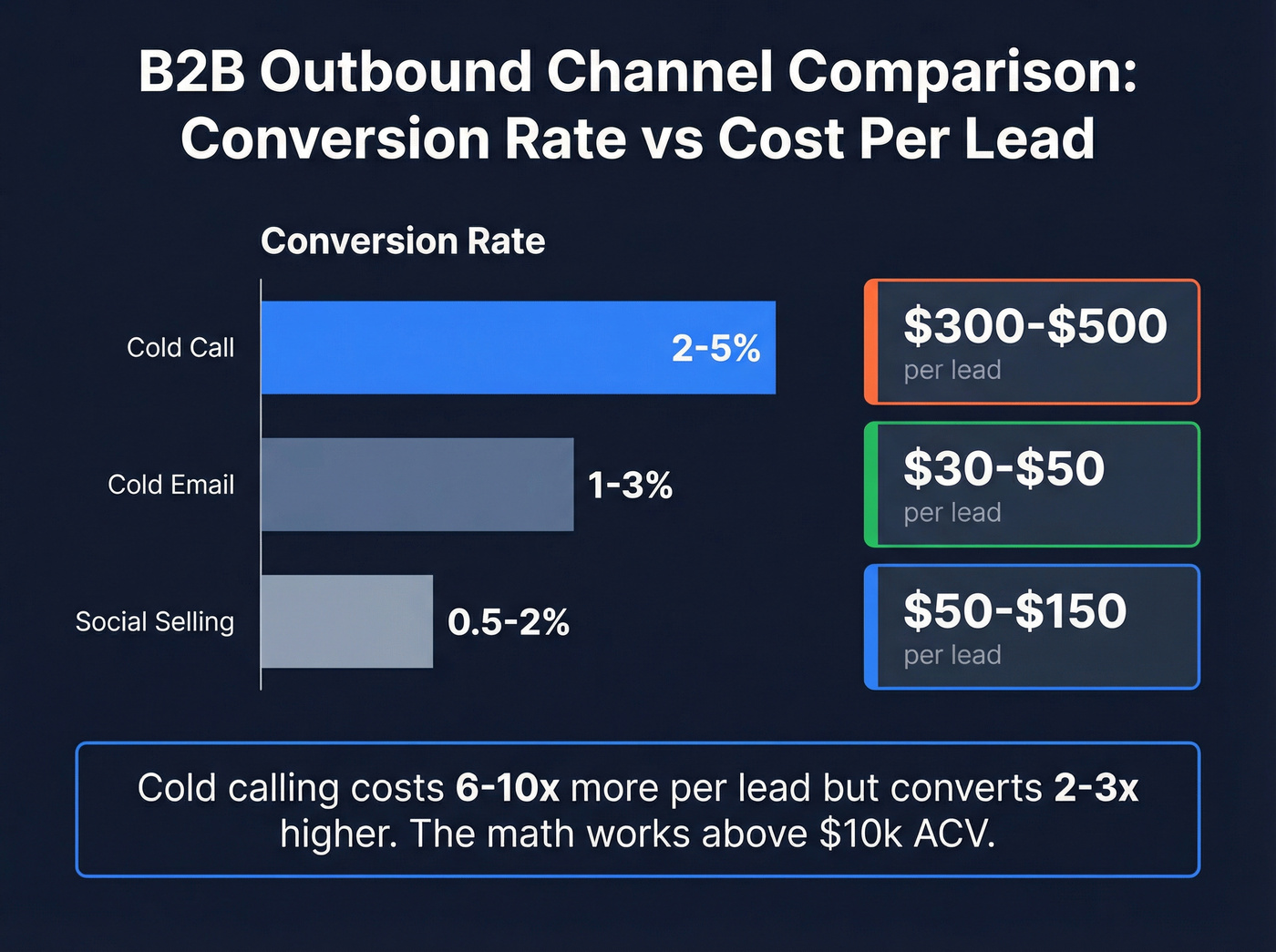
And here's how cold calling stacks up against other outbound channels:
| Channel | Conversion Rate | Cost Per Lead |
|---|---|---|
| Cold call | 2-5% | $300-$500 |
| Cold email | 1-3% | $30-$50 |
| Social selling | 0.5-2% | $50-$150 |
B2B phone outreach costs more per lead but converts at roughly 2-3x the rate of email. The math works when your data is clean and your framework is tight. When it's not, you're burning $300-$500 per lead on wrong numbers and voicemails. (If you're deciding channel mix, see cold emailing vs cold calling.)
One caveat: if your average deal size is under $5k, phone-first outbound probably isn't worth the cost-per-lead math. Email and social will get you there cheaper. But above $10k ACV, calling is usually the highest-converting outbound channel in the mix.
The 3-Part Cold Call Framework
This framework is simple enough to memorize and flexible enough to adapt to any prospect.
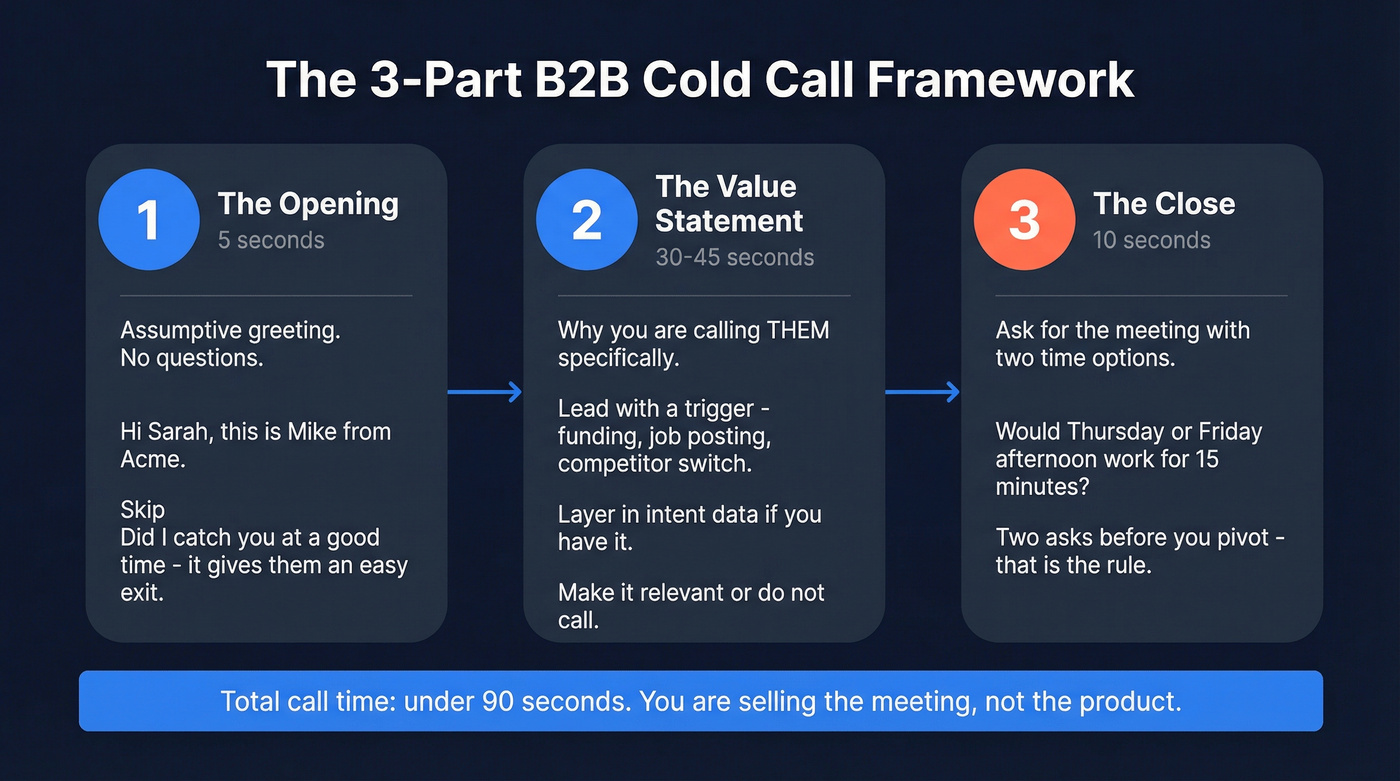
Step 1: The Opening (5 seconds). Use an assumptive greeting - "Hi Sarah, this is Mike from Acme." No "Is this Sarah?" No "Did I catch you at a good time?" Both give the prospect an easy exit before you've said anything of value. (If you want more tested openers, borrow from sales pitch opening lines.)
Step 2: The Value Statement (30-45 seconds). Cover who you are, why you're calling them specifically, and what you want. A trigger - new funding, a job posting, a competitor switch - turns a cold call into a warm one. Layer in intent data if your data provider tracks it; knowing a prospect is actively researching your category before you dial changes the entire dynamic of the conversation. (More on this in intent signals.)
Step 3: The Close (10 seconds). Ask for the meeting with two time options: "Would Thursday or Friday afternoon work for a 15-minute call?" Two asks before you shift - that's the rule. (If you need a deeper script, use this how to secure a meeting on a cold call playbook.)
Fix the Data Layer First
It's 9:15 AM. You've made 12 dials. Nine went to voicemail. Two were wrong numbers. One was a gatekeeper who stonewalled you. Your call block is half over and you haven't had a single conversation.
This isn't a skills problem. It's a data problem.
The dialer doesn't matter if the numbers are wrong. Fix the data layer first. (Start with prospect data accuracy and work backward.)
Scripts That Actually Work
Forget memorizing a 200-word monologue. You need four opener frameworks and the judgment to pick the right one.
The Pattern Interrupt:
"Hey Sarah, how have you been?"
Counterintuitive - you've never spoken to Sarah. But LeadsAtScale's data shows it boosts success rates 6.6x. It breaks the "sales call" pattern and buys you 10 seconds of curiosity.
The Reason Statement:
"Hi Sarah, this is Mike from Acme. The reason for my call is..."
Direct, transparent, respectful of their time. 2.1x higher success rate than generic openers. In our testing, this works especially well with VP-level and above - senior buyers appreciate efficiency over cleverness.
The Permission-Based Opener:
"Mind if I take 30 seconds to tell you why I called? Then you can decide if it's worth continuing."
Low-pressure. Gives the prospect control. Pairs well with prospects who sound guarded or rushed.
The Trigger-Based Opener:
"I noticed you just raised a Series B - congrats. We work with a lot of post-funding teams scaling their outbound. Quick question..."
This is the highest-converting framework when you have the intel. A hiring signal, a funding round, a competitor mention - any of these turns a cold call warm. (To operationalize this, use how to track sales triggers.)

You just read it: 9 out of 12 dials going to voicemail or wrong numbers isn't a skills problem - it's a data problem. Prospeo gives you 125M+ verified mobile numbers with a 30% pickup rate, refreshed every 7 days. At $0.10 per mobile, you pay only when a number is found.
Fix your data layer before your next call block.
Three Objections That Matter
"I'm not interested."
Most reps fold here. Don't. Acknowledge, reframe with a proof point, then ask for a short window:
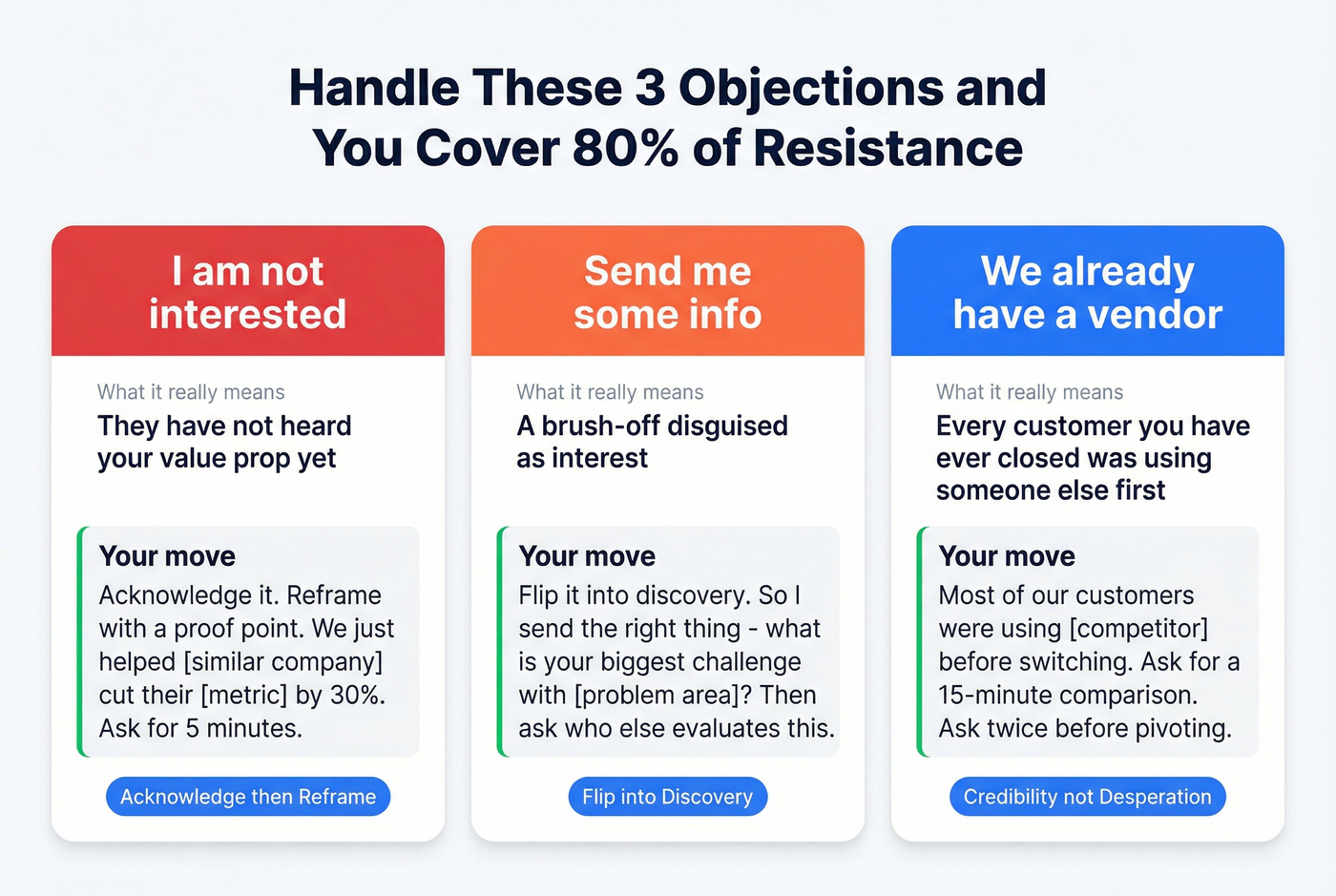
"Totally fair - most people say that before they hear why I'm calling. We just helped [similar company] cut their [metric] by 30%. Can I take 5 minutes to show you how?"
80% of sales require five or more touches after the initial objection. This is touch one, not the end.
"Send me some information."
This is a brush-off disguised as interest. Flip it into a discovery moment: "Happy to. So I send you the right thing - what's your biggest challenge with [problem area] right now?" Then: "Who else would be evaluating this with you?" Two diagnostic questions, and now you control the next step instead of sending a PDF into the void.
"We already have a vendor."
Every customer you've ever closed was using someone else when you first called them. The response:
"That's great - most of our customers were using [competitor] before switching. Would Wednesday or Thursday work for a 15-minute comparison?"
Ask for the meeting twice before pivoting. Double down with credibility, not desperation.
Mistakes That Kill Your Calls
"Is this Bob?" Use an assumptive greeting. Asking triggers defensiveness.
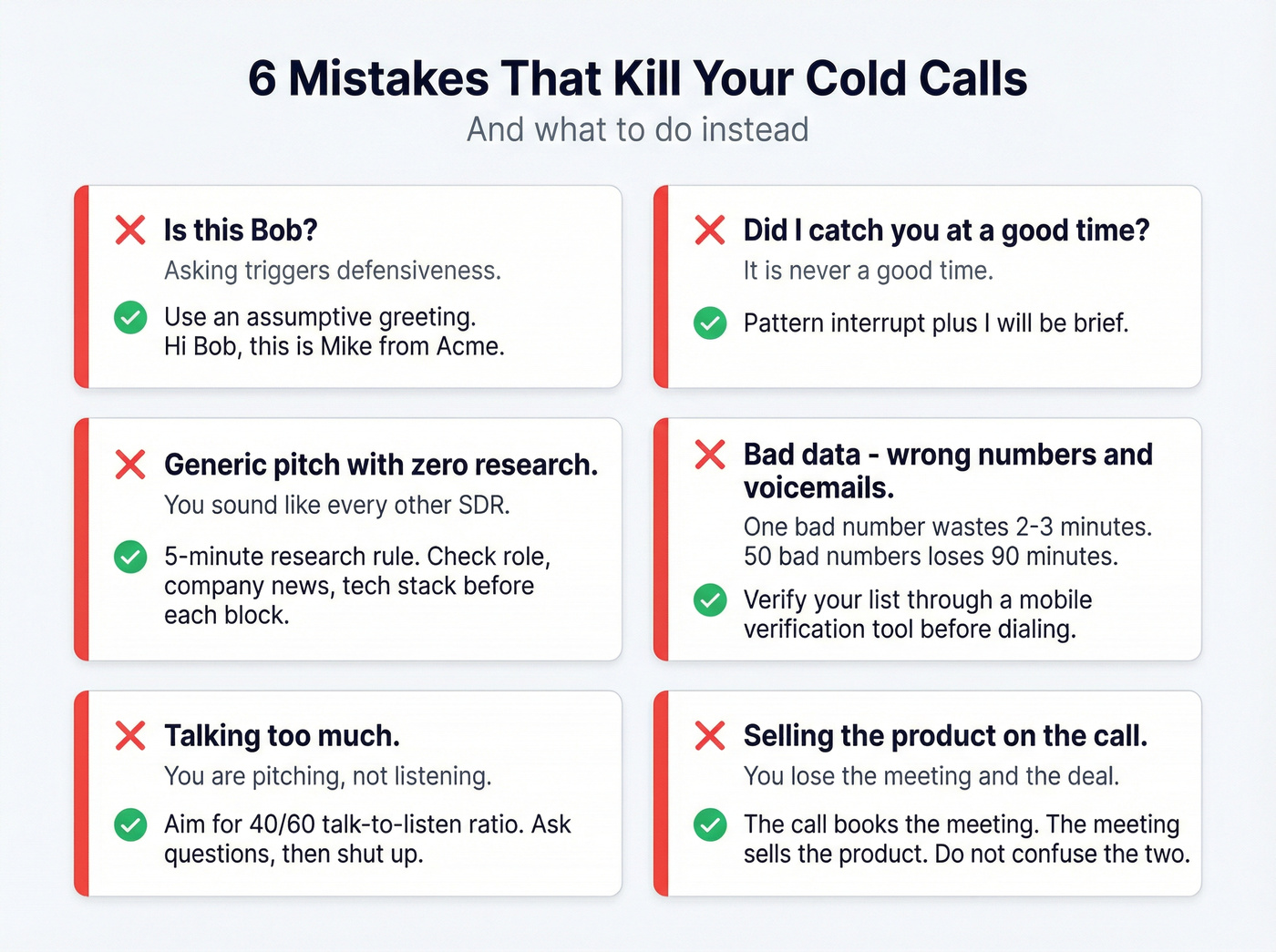
"Did I catch you at a good time?" It's never a good time. Pattern interrupt plus "I'll be brief."
Generic pitch with zero research. The 5-minute research rule separates top performers from dialers. Review the prospect's role, company news, and tech stack before each call block. (Use this pre call research checklist to standardize it.)
Bad data. Run your list through a verification tool before you start dialing. One bad number wastes 2-3 minutes of your call block - multiply that by 50 dials and you've lost an hour and a half to garbage data. (If you're cleaning phone lists, start with a phone validator.)
Talking too much. Aim for a 40/60 talk-to-listen ratio. You're selling the meeting, not the product.
Selling the product on the call. Three minutes, one clear ask, then listen. The call books the meeting. The meeting sells the product. Confuse those two and you'll lose both.
Best Times to Make B2B Calls
Thursday is the most reliable day for meaningful conversations, based on an analysis of 110,000+ outbound dials. Tuesday is best specifically for booking meetings.
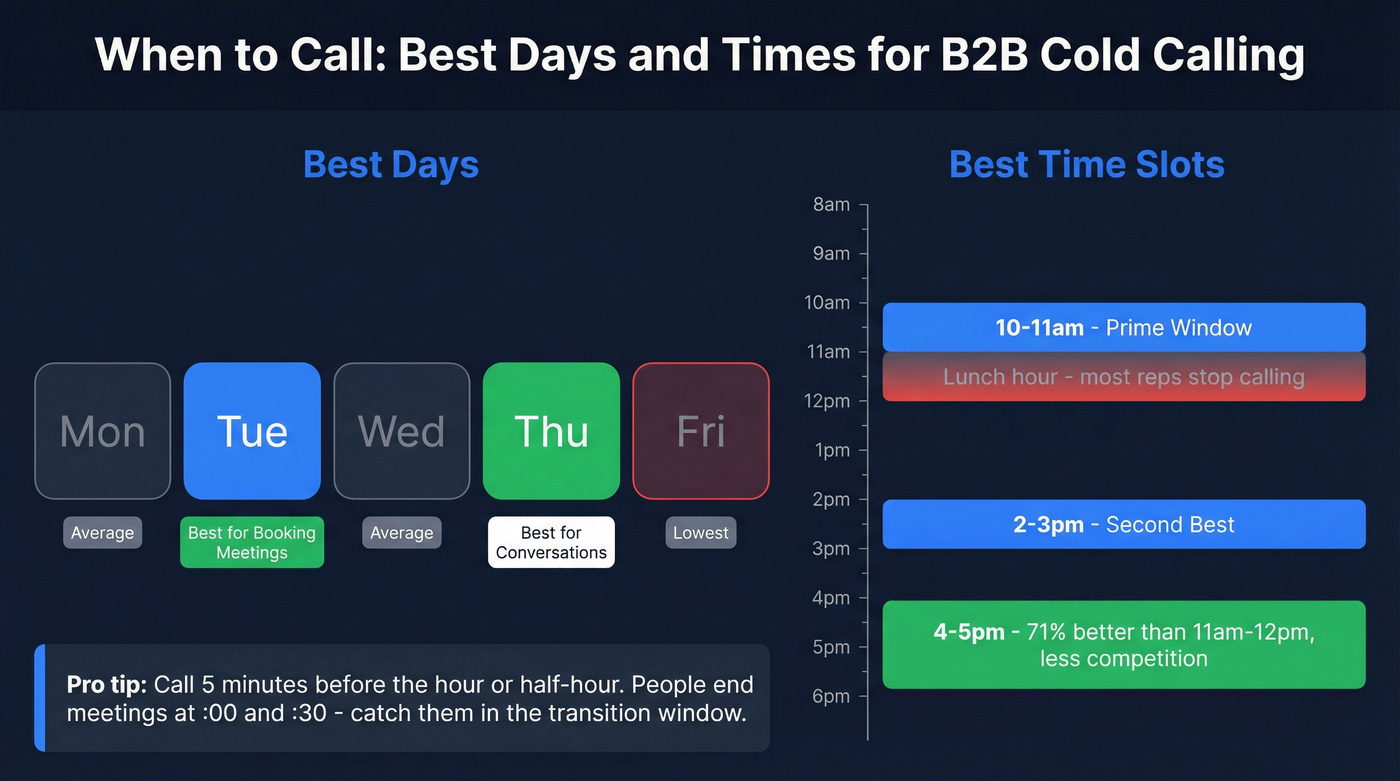
Best times: 10-11am local time, then 2-3pm. Calling 4-5pm yields 71% better results than the 11am-12pm slot - most reps are eating lunch, so you've got less competition.
Here's the thing: call 5 minutes before the hour or half-hour. People end meetings at :00 and :30. Catch them in that transition window and you'll get through more often. For teams running outbound in the UK, shift your windows accordingly - 10-11am GMT and 3-4pm GMT tend to perform best.
Tools for B2B Cold Calling
You need three things: a data provider, a dialer, and a CRM. That's it.
Data Providers
| Tool | Best For | Starting Price |
|---|---|---|
| Apollo | Budget data + built-in dialer | Free; from ~$49/mo |
| Cognism | EMEA mobile numbers | ~$1,000-3,000/mo |
| ZoomInfo | Enterprise full-platform | $15,000-40,000/yr |
At ~$0.01/email versus ZoomInfo's ~$1 per lead, Prospeo gives you 98% email accuracy and 125M+ verified mobiles without the enterprise contract. Pair it with any dialer below and you've got a complete outbound stack for under ~$100/user/month. (If you're comparing vendors, start with sales prospecting platforms.)
Dialers
| Tool | Starting Price | Notes |
|---|---|---|
| Dialpad | $15/user/mo | Budget pick, solid for small teams |
| CloudTalk | $19/user/mo | Best power dialer under $25 |
| Aircall | $30/user/mo | 3-user minimum, strong integrations |
| Close CRM | ~$49/user/mo | Dialer + CRM in one - skip this if you already have a CRM |
| Orum | ~$100-200/user/mo | Parallel dialing for high-volume teams |
We've tested most of these. For teams under 5 reps, CloudTalk at $19/user is the sweet spot. For teams running 200+ dials per rep per day, Orum's parallel dialing pays for itself in the first week.
Trigger-based openers convert highest - but only if you have the intel. Prospeo tracks 15,000 intent topics via Bombora and layers in funding, job changes, and headcount growth signals across 300M+ profiles. Know exactly why you're calling before you dial.
Turn every cold call warm with real-time buyer signals.
Compliance: What Costs $1,500 Per Call
TCPA requires prior express written consent for autodialed or prerecorded calls to mobile numbers - including B2B. AI-generated voice calls follow the same rules per the FCC's 2023 clarification. Penalties run up to $1,500 per call. (If you're considering automation, read AI cold calling first.)
Quick compliance checklist:
- Manual dialing to business numbers is generally permitted
- Autodialed or prerecorded calls to mobiles require written consent
- TSR calling window: 8am-9pm local time
- Stricter states: Florida, Oklahoma, Indiana, North Dakota, Louisiana, Washington
- AI voice agents follow prerecorded-message rules
- Maintain your internal DNC list and scrub against the national registry
Real talk: the $1,500-per-call penalty isn't theoretical. If you're running a parallel dialer at scale, get your compliance reviewed by someone who actually reads telecom law. The consensus on r/sales is that most teams don't think about this until they get a cease-and-desist, and by then the damage is done.
FAQ
How many cold calls should a B2B SDR make per day?
50-80 dials is the standard range. With verified mobiles, 40-50 targeted dials produce more meetings than 100 dials to office lines. Optimize for connect rate (aim for 15%+), not raw activity volume.
What's the best time for B2B cold calls?
10-11am local time, then 2-3pm. Thursday is the strongest day overall. Call 5 minutes before the hour to catch prospects in the transition window between meetings.
Cold calling vs cold email - which converts better?
Cold calls convert at 2-5% versus 1-3% for email but cost 6-10x more per lead. Best results come from calling first, then emailing within the hour - the multi-touch combo outperforms either channel alone.
Is B2B cold calling legal in 2026?
Yes. Manual dialing to business numbers is generally permitted under TCPA. Autodialed or prerecorded calls to mobiles require written consent. Penalties reach $1,500 per violation - scrub your lists and stay inside the 8am-9pm local window.