

AI Cold Calling in 2026: Tools, Costs & What's Legal
A RevOps lead we know ran 5,000 AI-powered cold calls last quarter. Eighteen hundred went to disconnected numbers. At 30 seconds wasted per failed attempt and $0.10-$0.15/min in charges, that's roughly $90-$135 burned before a single prospect picked up. The AI wasn't the problem - the data was. That's the story nobody in the AI cold calling space wants to lead with, but it's the one that matters most.
What Is AI Cold Calling?
AI cold calling uses artificial intelligence to automate, assist, or optimize outbound phone prospecting. It's not robocalling. The difference is critical: robocalling blasts prerecorded messages to thousands of numbers indiscriminately, while AI cold calling uses natural language processing, real-time voice synthesis, and machine learning to have actual conversations - or to make human reps dramatically more effective at having them.
The space breaks into three categories. AI-powered dialers automate the mechanical parts of calling (dialing, voicemail detection, call routing) while keeping a human on the line. Autonomous AI voice agents handle entire conversations - qualifying leads, answering objections, and booking meetings without a human present. Conversation intelligence platforms listen to live calls and feed reps real-time guidance.
These aren't interchangeable. A dialer makes your reps faster. An autonomous agent replaces the rep for initial qualification. A coaching layer makes the rep better. Most teams need one or two of these, not all three.
What You Need (Quick Version)
- For autonomous AI agents that handle full conversations: Bland AI (most transparent pricing) or Retell AI (most flexible component stack).
- For AI-assisted human calling: Dialpad Sell (best real-time coaching) or JustCall (best value for small teams).
- Before you automate anything: Verify your phone list. 25-40% of B2B numbers go stale within 90 days. Prospeo verifies 125M+ mobile numbers with a 30% pickup rate at roughly $0.01 per lead - a fraction of what one wasted AI call minute costs.
Why Voice AI Is Exploding
The voice AI agents market is projected to grow from $2.4B in 2024 to $47.5B by 2034 - a 34.8% CAGR that puts it among the fastest-growing segments in enterprise software. VC funding in voice AI jumped from roughly $315M in 2022 to $2.1B in 2024. That's a 7x increase in two years.
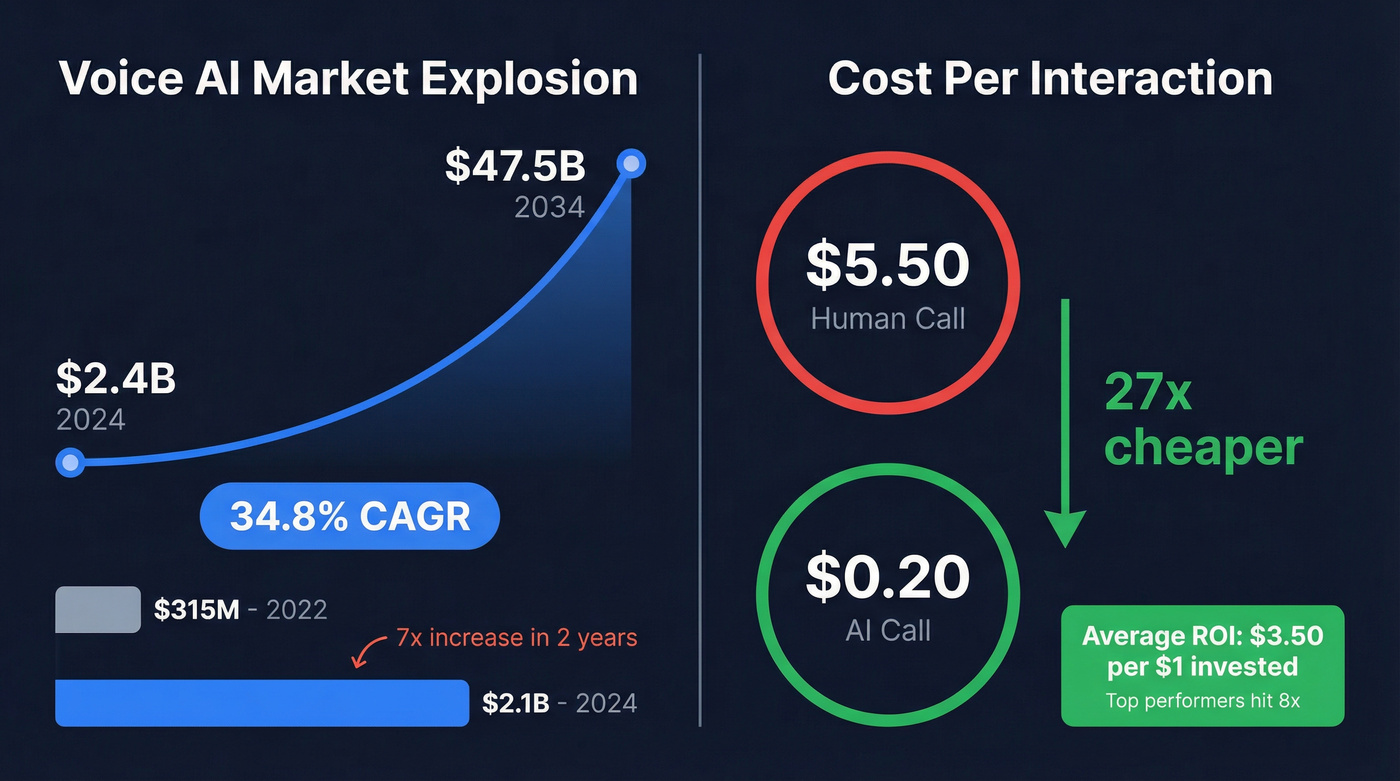
The economics are what's driving adoption. An AI-handled voice interaction costs roughly $0.20, compared to $5.50 for a human-only call. A 27x cost difference. One case study showed an autonomous voice agent operating at under $4/hour with sub-450ms response latency.
Enterprise adoption is accelerating too: 97% of enterprises have adopted some form of voice AI technology, with 67% considering it foundational to their operations. The average ROI sits at $3.50 returned per $1 invested, with top performers hitting 8x.
Cold Calling Benchmarks
Before investing in any calling tool, you need to know what "good" looks like.
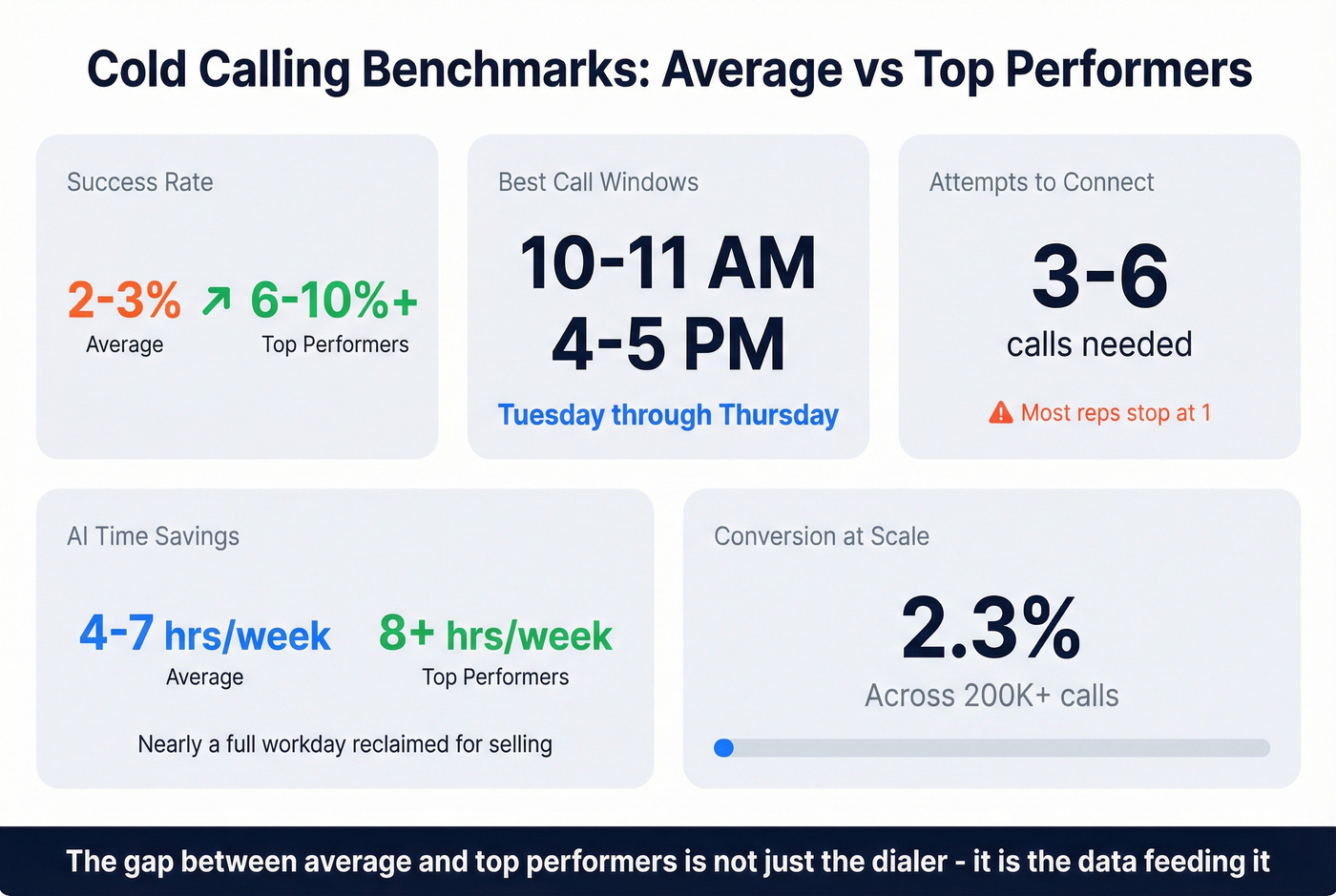
| Metric | Average | Top Performers |
|---|---|---|
| Success rate | 2-3% | 6-10%+ |
| Best call windows | 10-11 AM, 4-5 PM | Tue-Thu |
| Attempts to connect | 3-6 calls | Most reps stop at 1 |
| AI time savings | 4-7 hrs/week | 8+ hrs/week |
| Conversion (200K+ calls) | 2.3% | - |
The market is splitting into two tiers. Top teams push past 6% conversion, while average teams stay stuck around 2-3%. The difference isn't just the dialer - it's the data feeding it, the timing of calls, and the persistence to make 3-6 attempts instead of giving up after one.
The most common regret we hear from early adopters: they automated before cleaning their data. AI tools save reps 4-7 hours weekly on average, mostly by eliminating manual dialing, voicemail detection, and post-call logging. That's nearly a full workday reclaimed for actual selling - but only if those calls reach real people.
Three Types of Tools
| Category | What It Does | Price Range | Best For |
|---|---|---|---|
| AI-powered dialers | Automates dialing, routes calls | $15-149/user/mo | Teams with human reps |
| Autonomous voice agents | Full AI conversations | $0.07-0.15/min | High-volume qualification |
| Coaching/intelligence | Real-time rep guidance | ~$100-150/user/mo | Improving rep performance |
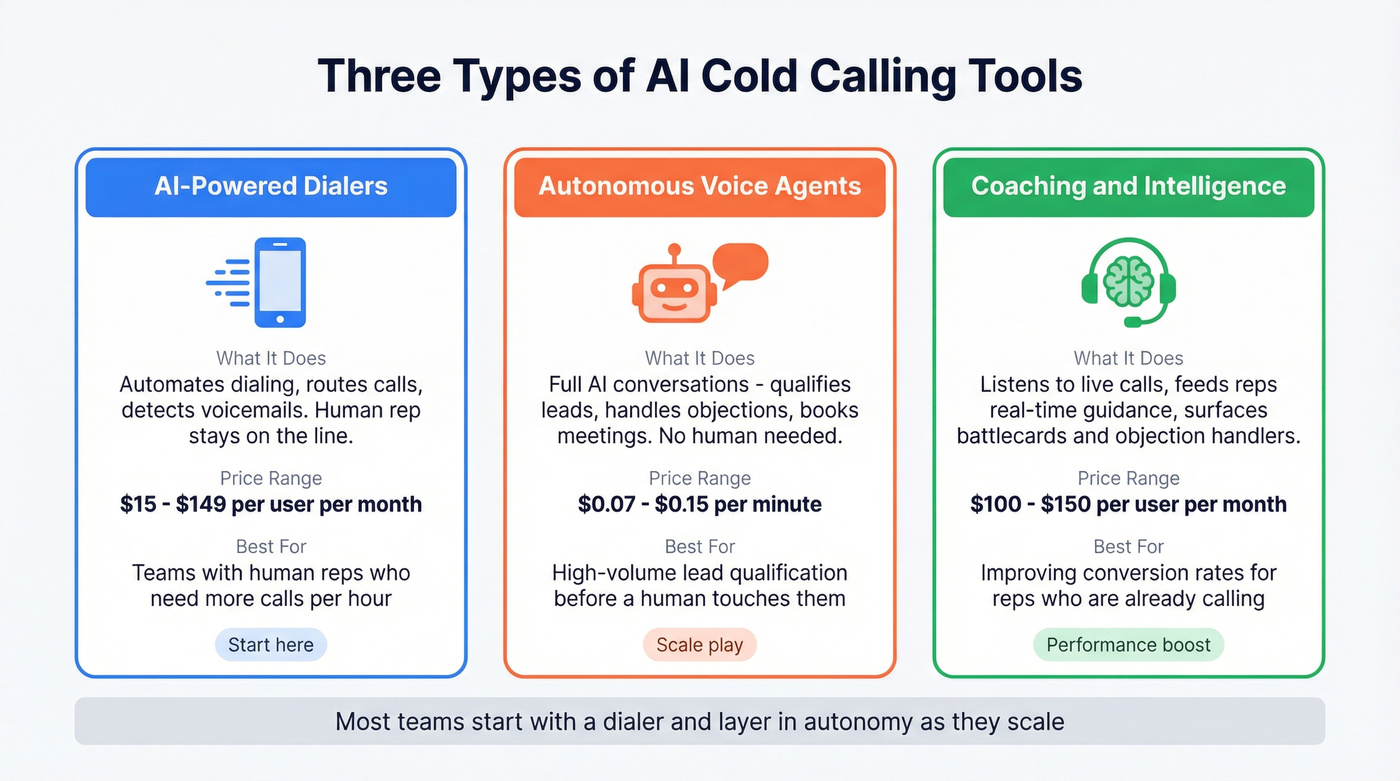
Use a dialer if you have reps who need to make more calls per hour. Use an autonomous agent if you want to screen thousands of leads before a human touches them. Use a coaching platform if your reps are already calling but their conversion rates are stuck.
Most teams start with a dialer and layer in autonomy as they scale.

That RevOps lead burned $135 on disconnected numbers before a single prospect picked up. Prospeo's 125M+ verified mobile numbers deliver a 30% pickup rate - at roughly $0.01 per lead. That's less than one wasted AI call minute.
Clean your list before you automate it.
Best AI Cold Calling Tools
Autonomous Voice Agent Pricing
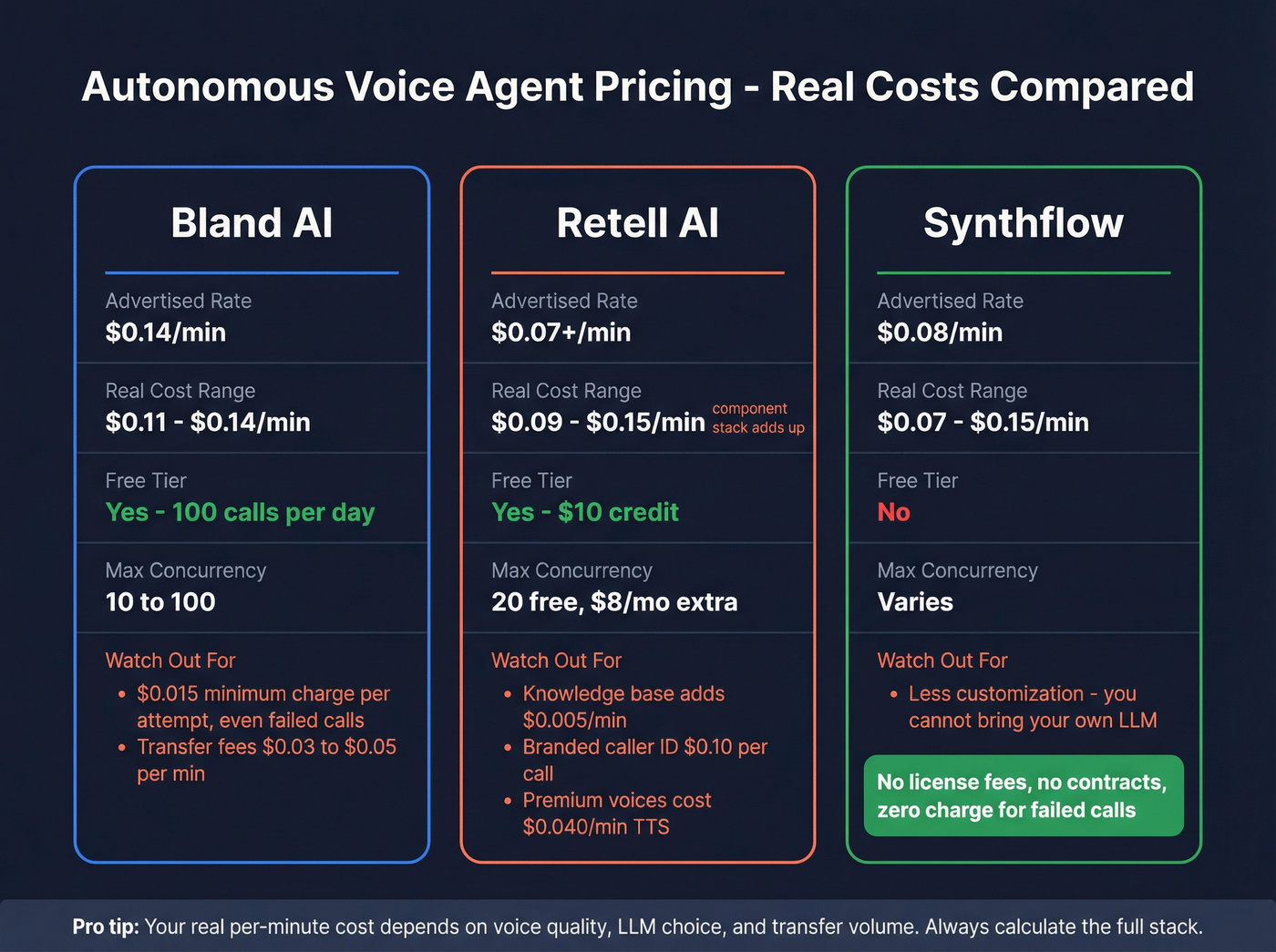
| Tool | Starting Rate | Real Cost Range | Free Tier | Max Concurrency | Hidden Costs |
|---|---|---|---|---|---|
| Bland AI | $0.14/min (Start plan is free) | $0.11-$0.14/min | Yes (100 calls/day) | 10-100 | $0.015/attempt min; transfer fees $0.03-$0.05/min |
| Retell AI | $0.07+/min | $0.09-$0.15/min | Yes ($10 credit) | 20 free, $8/mo extra | Knowledge base +$0.005/min; branded caller ID $0.10/call |
| Synthflow | $0.08/min | $0.07-$0.15/min | No | Varies | None - no license fees, no failed-call charges |
AI Dialer Pricing
| Tool | Price/User/Mo | Key AI Feature | Best For |
|---|---|---|---|
| Dialpad Sell | $60 | Real-time coaching + battlecards | Mid-market B2B teams |
| JustCall | $29-$89 | Call scoring + sentiment analysis | Small teams (<10 reps) |
| PhoneBurner | $149 | Zero-delay power dialing | High-volume speed |
| Squaretalk | $15 | Predictive dialing | Budget-conscious teams |
| CloudTalk | $25 | 160+ country coverage | International teams |
| Close | from $9/seat | Built-in CRM + dialer | Startups wanting one tool |
Bland AI
Use this if you want the most transparent pricing in the autonomous agent space and need high concurrency for outbound campaigns.
Bland AI runs plan-based connected-minute pricing. The Start plan (free) gives you $0.14/min connected time with 10 concurrent calls, 100 calls/day, and 1 voice clone. The Build plan ($299/mo) drops to $0.12/min with 50 concurrent calls, 2,000 calls/day, and 5 voice clones. Scale ($499/mo) hits $0.11/min with 100 concurrent calls, 5,000 calls/day, and 15 voice clones.
Two details most comparisons miss. First, there's a $0.015 minimum charge per outbound attempt - even for failed calls - when using Bland's telephony. Second, transfer time adds $0.05/min on Start, $0.04/min on Build, and $0.03/min on Scale when transferring to a human using Bland-provided numbers. Bring your own Twilio account and you avoid those transfer-time fees entirely, costs that compound fast if your agents frequently warm-transfer to reps.
Skip this if you need premium voice quality. Bland's voice clones are functional but not the most natural-sounding in the market.

Retell AI
Retell is the platform for teams that want to control every layer of their voice AI stack. It's processing 40M+ real-time AI phone calls monthly, which speaks to reliability at scale - but the pricing model rewards teams who do the math upfront.
The advertised $0.07+/min is a floor, not a real price. Your actual cost is a component stack: infrastructure at $0.055/min, plus TTS at $0.015/min (or $0.040/min for ElevenLabs premium voices), plus telephony at $0.015/min, plus your LLM cost. A lightweight model runs $0.006/min; a premium LLM runs $0.08/min. So your actual per-minute cost lands between $0.09 and $0.15 depending on choices.
The free tier is generous - $10 in credits, 20 concurrent calls, and 10 knowledge bases. But monthly subscription costs add up: extra concurrency runs $8/month per slot, phone numbers cost $2/month each, and verified phone numbers are $10/month. Add-ons like Knowledge Base (+$0.005/min), Batch Call (+$0.005/dial), and Branded Caller ID (+$0.10/call) stack further. Caller ID reputation is one of the fastest ways to kill an outbound campaign at scale, and Retell's branded option helps, but at $0.10 per outbound call it's a meaningful line item.
Synthflow
Here's the thing about Synthflow: it's built for the team that doesn't want to calculate component stacks or worry about per-attempt minimums on failed calls. You load a list, press go, and pay only for minutes that actually connect.
Starting at $0.08/min and dropping to $0.07/min at enterprise volume, Synthflow charges no license fees, requires no contracts, and bills zero for failed calls. For teams running 1,000-10,000 minutes monthly, expect $1,000-$3,000. At growth scale (50K-150K minutes), monthly spend runs $5K-$15K. The trade-off is flexibility: you can't bring your own LLM or deeply customize the agent's architecture. Synthflow trades control for simplicity, and for most SMBs, that's the right trade.
Dialpad Sell
Dialpad Sell starts at $60/user/month and is the strongest option for teams that want human reps enhanced by AI, not replaced by it. The real-time coaching feature listens to live calls and surfaces talk tracks, objection handlers, and competitor battlecards while the rep is still on the phone. We've seen this approach outperform autonomous agents for complex B2B sales where the conversation needs nuance a bot can't deliver yet.
For teams focused on outbound sales calls, Dialpad's combination of intelligent routing and live coaching is hard to beat.
JustCall
JustCall's base plan starts at $29/user/month, with AI-powered features available from the Team Plus plan at $49/user/month and Pro Plus at $89/user/month on annual billing. It's the best value play for small teams that need a capable dialer without enterprise complexity. The AI features - call scoring, sentiment analysis, and automated summaries - deliver capabilities you'd expect at $100+/user. For teams under 10 reps, JustCall consistently delivers the most per dollar.
Other Notable Tools
PhoneBurner ($149/user/mo) is the power dialer workhorse - no connection delays, 60-80 calls/hour, built for teams that prioritize speed over AI sophistication.
Squaretalk (from $15/user/mo) is the budget entry point with surprisingly capable predictive dialing and CRM integrations. CloudTalk (from $25/user/mo) targets international teams with 160+ country coverage and solid call quality across regions. Close (from $9/seat/mo) bundles a built-in dialer with its CRM - ideal for startups that want one tool instead of three.
Gong (~$100-150/user/mo) is the conversation intelligence leader. It doesn't dial - it listens, analyzes, and coaches. Pair it with any dialer for the full stack.
Hyperbound (~$100+/user/mo, custom pricing) takes a different angle: AI roleplay for call practice. Reps train against AI prospects before touching real leads, a powerful way to rehearse objection handling before the stakes are real.
What It Actually Costs
| Cost Factor | Human SDR | AI Dialer | Autonomous Agent |
|---|---|---|---|
| Hourly cost | $35-45/hr | $2-8/hr (amortized) | <$4/hr |
| Cost per call | $3-6 | $0.50-1.50 | $0.10-0.30 |
| Annual (10-person) | $700K-900K | $18K-180K | ~$5K-$50K |
| Setup complexity | Hiring + training | Low-medium | Medium-high |
A fully loaded human SDR costs $70K-$90K/year. An AI voice agent operates at under $4/hour with a 1:1 to 1.5:1 sales quality ratio compared to human agents. The math is compelling, but it's not as simple as "replace all your reps."
Autonomous agents excel at high-volume initial qualification - the first 30 seconds of a cold call where you're confirming the right person, gauging interest, and booking a meeting. They struggle with complex objection handling, relationship building, and the kind of improvisation that closes six-figure deals. The sweet spot for most teams is using AI agents to screen and qualify, then warm-transferring interested prospects to human reps.
Let's be honest about the threshold. If your average deal size is under $10K, an autonomous agent can handle 80% of your outbound qualification. Above that, you still need humans - but those humans should never be manually dialing. Industry benchmarks tell a clear story: at starter volume (1K-10K minutes), expect $0.10-$0.15/min; at growth scale (50K-150K minutes), $0.08-$0.10/min; enterprise volume (250K+ minutes) drops to $0.07-$0.09/min. The average ROI across contact center AI deployments is $3.50 per $1 invested, with top performers hitting 8x.
Compliance - What's Legal in 2026
Compliance isn't a footnote when you're running automated outbound calls. It's existential.
On February 8, 2024, the FCC issued a declaratory ruling that AI-generated voices qualify as "artificial or prerecorded voices" under the TCPA. Every rule that applies to robocalls now applies to your AI voice agent. Prior express consent is required before making AI-voiced calls.
The penalties are severe. The FCC can fine up to $23,000 per violation. Private lawsuits can recover up to $1,500 per unwanted call. One bad campaign to 1,000 numbers could cost $23 million in FCC fines alone - and that's not hypothetical. The ruling was prompted partly by AI-cloned political robocalls that triggered immediate enforcement action.
Automated QA and compliance monitoring often drives 50-60% reductions in violations within 90 days. The investment pays for itself after a single avoided incident.
Your compliance checklist:
- Get prior express consent before any AI-voiced outbound call. Document it.
- Scrub against DNC lists - federal and state - before every campaign.
- Disclose AI use to the prospect. Some states require explicit disclosure.
- Record and store consent records. If challenged, you need proof.
- Check state-level rules. Several states have restrictions beyond federal TCPA.
- Monitor caller ID reputation. Carriers flag high-volume callers aggressively, and a "Spam Likely" tag kills campaigns overnight.
B2B cold calling has historically had more latitude than B2C under TCPA, but the FCC's 2024 ruling doesn't carve out a B2B exception for AI-generated voices. Treat every AI-voiced call as requiring consent until case law says otherwise.
The Data Problem Nobody Talks About
Every guide about automated outbound focuses on the tools. Almost none talk about what happens when you feed those tools garbage data.
You load 5,000 numbers into your autonomous agent. You run the campaign at $0.10-$0.15/min. Eighteen hundred calls go to disconnected numbers - 36% of your list. At a conservative 30 seconds of wasted time per failed attempt, you've burned $90-$135 in per-minute charges plus the $0.015/attempt minimums on platforms like Bland. You've accomplished nothing except damaging your caller ID reputation with carriers.
The root cause: 25-40% of B2B phone numbers go stale within 90 days. People change jobs, companies reassign extensions, mobile numbers get recycled. If you're pulling numbers from a database that refreshes monthly - or worse, quarterly - a third of your list is dead before you start. No amount of personalization or script optimization can salvage a campaign built on disconnected numbers.
When teams move to weekly-refreshed, verified contact data, the impact is immediate. Snyk's 50-person AE team saw bounce rates drop from 35-40% to under 5%, while GreyScout cut theirs from 38% to under 4% and grew pipeline 140%.
AI voice agents cost $0.07-$0.15/min. But 25-40% of B2B numbers go stale every 90 days. Prospeo refreshes data every 7 days - not the 6-week industry average - so your autonomous agents reach real humans, not dead lines.
Stop paying per minute to dial numbers that don't exist.
Implementation Best Practices
Verify your list before loading it into any dialer. This is step zero. Every dollar spent on verification saves $5-10 in wasted call minutes and carrier reputation damage. If you're building a broader outbound motion, align this with your CRM hygiene process.
Start with a dialer and human reps before going fully autonomous. Autonomous agents are impressive, but they aren't plug-and-play. Learn what your prospects respond to with human calls first, then encode those patterns into your AI agent's scripts. We've watched teams skip this step and spend months debugging agent scripts that a week of human calling would have informed. For a deeper baseline, use a full B2B cold calling guide alongside your AI rollout.
Design the AI-to-human handoff carefully. Warm transfer quality varies wildly between platforms. Test the handoff experience from the prospect's perspective - a clunky transfer kills the trust the AI just built. This is also where cold calling CRM integration (CTI + logging) prevents follow-up gaps.
Monitor spam labeling relentlessly. Carrier flagging becomes a real operational headache at higher volumes. Rotate numbers, keep call duration reasonable, and use branded caller ID where available. If you're seeing deliverability-style symptoms across channels, treat it like a data quality issue, not just a dialer issue.
Measure cost-per-meeting, not call volume. Making 10,000 calls means nothing if you booked 3 meetings. Track cost per qualified meeting and A/B test scripts against that metric. The consensus on r/sales is that teams obsessing over dial counts instead of meeting rates are optimizing for the wrong thing entirely. If you need a KPI framework, map it to your outbound calling strategy.
Iterate weekly. Tag successful calls, feed the patterns back into your agent's training data, and refine scripts based on what's actually converting. Understanding which talk tracks work, which objections stall deals, and which time slots connect is what separates teams that scale from teams that stall. A lightweight cold call coaching scorecard makes iteration faster.
Most teams need three tools maximum: one for data, one for dialing, and one for coaching. Don't overcomplicate the stack. If you're standardizing tooling, start from a B2B sales stack blueprint.
FAQ
Is AI cold calling legal?
Yes, with proper consent. The FCC's 2024 ruling classified AI-generated voices as "artificial or prerecorded" under the TCPA, so prior express consent is required for every AI-voiced outbound call. Violations carry penalties up to $23,000/call from the FCC or $1,500/call in private lawsuits. Compliance is non-negotiable.
How much does an autonomous voice agent cost per minute?
Expect $0.09-$0.15/min in real-world usage, depending on your LLM, voice provider, and telephony choices. Advertised $0.07 rates are component floors - actual costs run higher once you stack infrastructure, TTS, and model fees. AI-assisted dialers run $15-$149/user/month as flat subscriptions.
Can AI fully replace human SDRs?
Not yet for complex B2B sales. AI agents handle initial qualification effectively, with case studies showing a 1:1 to 1.5:1 sales quality ratio versus humans. For nuanced objection handling and deals above $15K-$20K, human handoff remains critical. The best approach is augmentation: AI screens and qualifies, then a human rep takes over.
What's the biggest mistake teams make?
Bad data. If 30%+ of your phone numbers are disconnected, you're burning budget on every campaign. Verify your list before you automate anything - at roughly $0.01/lead for verification, it's the cheapest insurance in your stack when a single wasted AI minute costs 10-15x more.
What tools do I need to start?
Three tools cover most teams: a data verification platform for verified mobiles and emails, a dialer or autonomous agent depending on your approach, and optionally a coaching platform like Gong for rep development. Start with data quality, then layer in automation.