

The Data Verification Process: A Practitioner's Guide
Your marketing team just ran a 50,000-email campaign and 12,000 bounced. That's not a minor hiccup - poor data quality costs companies $12.9M annually, and 95% of businesses suspect their data is inaccurate. Most of them are right.
The dangers of unverified emails go beyond wasted spend. They tank your sender reputation and can get your domain blacklisted entirely. A reliable data verification process is the difference between campaigns that convert and ones that destroy your infrastructure.
Here's the short version: verification is a continuous loop across three phases - pre-collection, in-process, and post-collection. This guide gives you the framework, checklist, and tools to stop reacting and start verifying proactively.
What Is Data Verification?
Data verification confirms that data is actually correct by checking it against trusted external sources. That's different from validation, which only checks whether data looks right.
Validation catches a phone number with too few digits. Verification checks whether that phone number is still in service. Validation flags an address missing a zip code. Verification confirms the address exists in official postal records.
| Validation | Verification | |
|---|---|---|
| Question | Does it look right? | Is it actually right? |
| Timing | At data entry | After collection/storage |
| Example | Email has @ and domain | Email is deliverable |
You need both, but verification is where most teams fall short.
Why Verification Matters
Analytics teams burn over 30% of their time on data cleanup. In migrations, the stakes get even higher: 83% of data migration projects fail or exceed budgets and timelines, primarily due to poor planning and inadequate validation.
B2B contact data is especially brutal - it decays 22.5-70% annually as people change jobs and companies rebrand. One real example: Meritt went from a 35% email bounce rate to under 4% by running lists through proper verification before sending. That's the difference between a campaign that works and one that tanks your domain reputation.

When you calculate the ROI of lead verification, the math is straightforward: fewer bounces mean higher deliverability, better engagement, and more pipeline from the same list. For regulated industries, verification isn't optional - GDPR and HIPAA require technical safeguards and auditability around how sensitive data is handled and shared.
The 3 Phases of Verification
Verification isn't a step you bolt on at the end. It's a loop that runs before, during, and after data enters your systems.
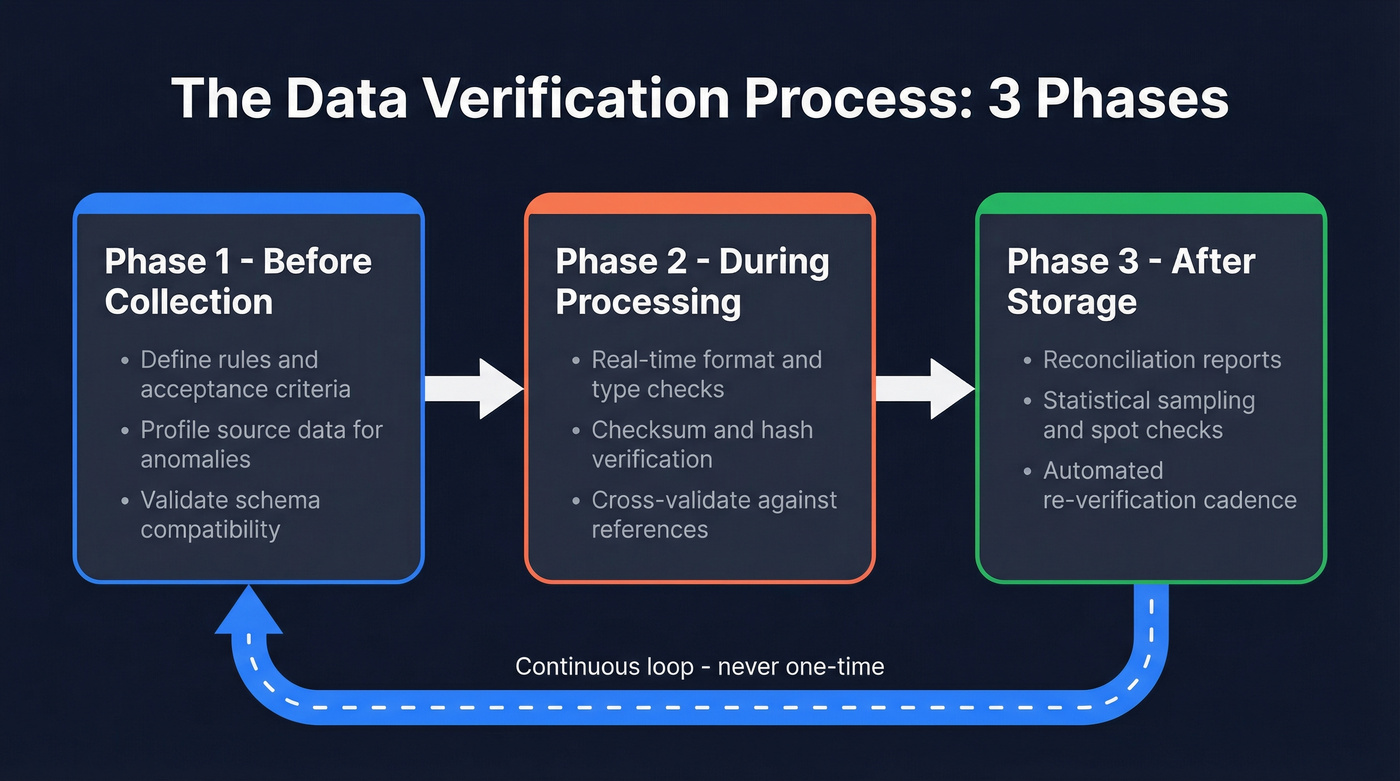
Phase 1 - Before Collection
- Define verification rules and acceptance criteria upfront
- Profile source data for anomalies, duplicates, and missing values
- Establish baselines for expected row counts and field completeness
- Validate schema compatibility for migrations
- Implement double opt-in email verification on web forms to ensure contacts are real before they ever enter your CRM
In our experience, teams that skip source profiling spend 3x longer debugging after the fact. Don't assume source data is clean. It almost never is.
Phase 2 - During Processing
- Run real-time checks at point of entry for format, type, range, and presence
- Match row counts between source and target systems
- Use checksum or hash verification for data integrity
- Cross-validate against reference sources and check referential integrity
This phase is where automation pays for itself fastest - a single malformed field at ingestion can cascade into thousands of bad records downstream if you aren't catching it in real time.
Phase 3 - After Storage
- Generate reconciliation reports comparing source to target
- Run statistical sampling and spot checks on stored data
- Conduct UAT with stakeholders who know what the data should look like
- Set up automated regression testing on a recurring schedule
- Establish a re-verification cadence - weekly or monthly, never one-time

You just read about the 3-phase verification loop. Prospeo runs all of it automatically - 5-step verification with catch-all handling, spam-trap removal, and honeypot filtering across 300M+ profiles refreshed every 7 days. That's 6x faster than the industry average.
Replace your manual verification workflow with 98% email accuracy at $0.01 per lead.
Core Lead Verification Techniques
Eight techniques cover the vast majority of needs. The Twilio framework splits ownership well: engineers tend to own type, range, format, and presence checks, while analysts tend to own profiling, statistical checks, business rules, and external validation.
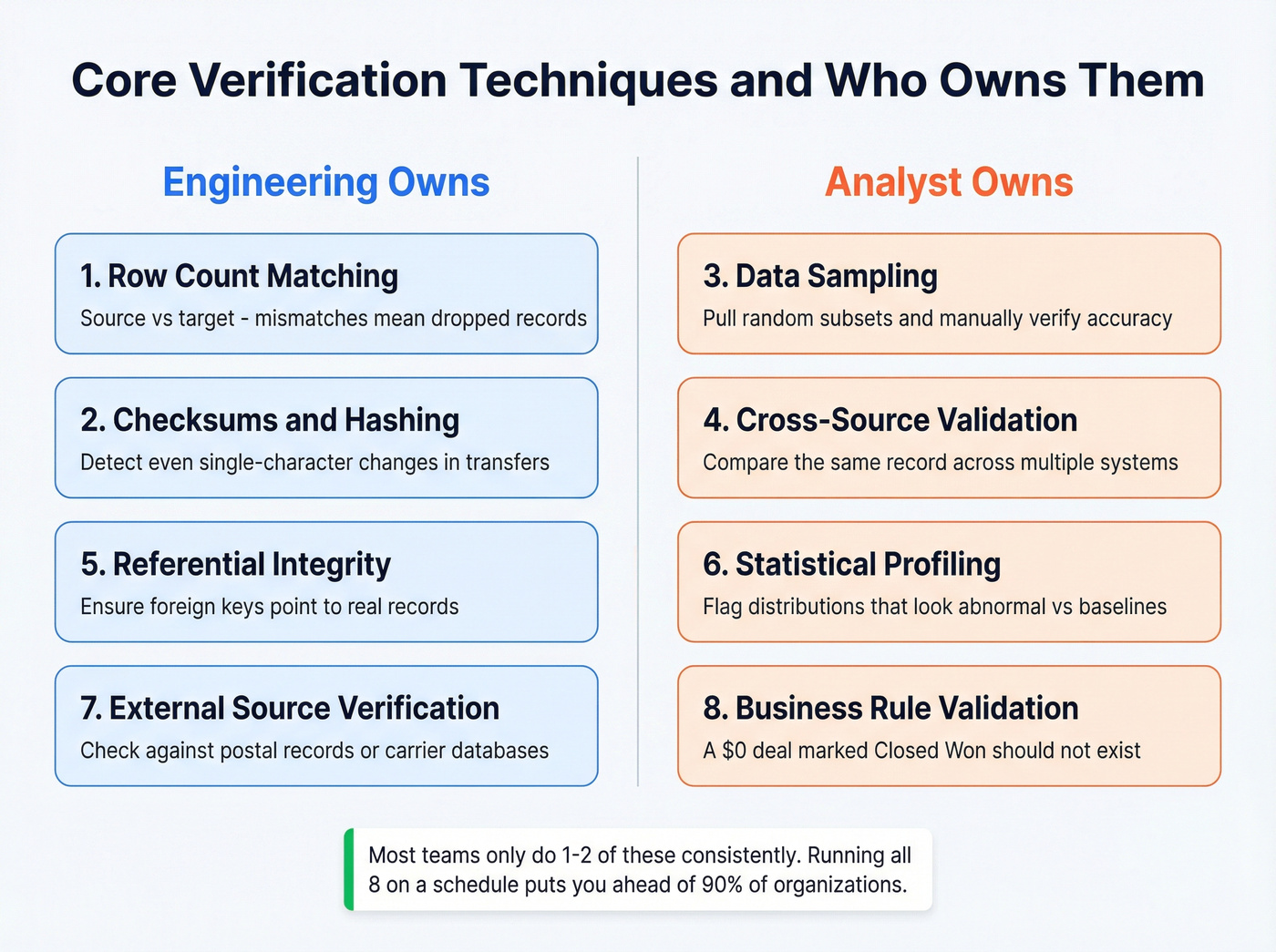
- Row count matching - source vs. target; mismatches mean dropped records.
- Checksums and hashing - detect even single-character changes in transferred data.
- Data sampling - pull random subsets and manually verify accuracy.
- Cross-source validation - compare the same record across multiple systems.
- Referential integrity checks - ensure foreign keys point to real records.
- Statistical profiling - flag distributions that look abnormal vs. baselines.
- External source verification - check against postal records, carrier databases, or other authoritative sources.
- Business rule validation - a $0 deal marked "Closed Won" shouldn't exist.
Let's be honest: most teams only do one or two of these consistently. If you're running all eight on a schedule with clear ownership, you're ahead of 90% of organizations we've worked with.
Common Mistakes That Undermine Quality
I've watched teams make the same errors repeatedly. Here are the ones that hurt most:
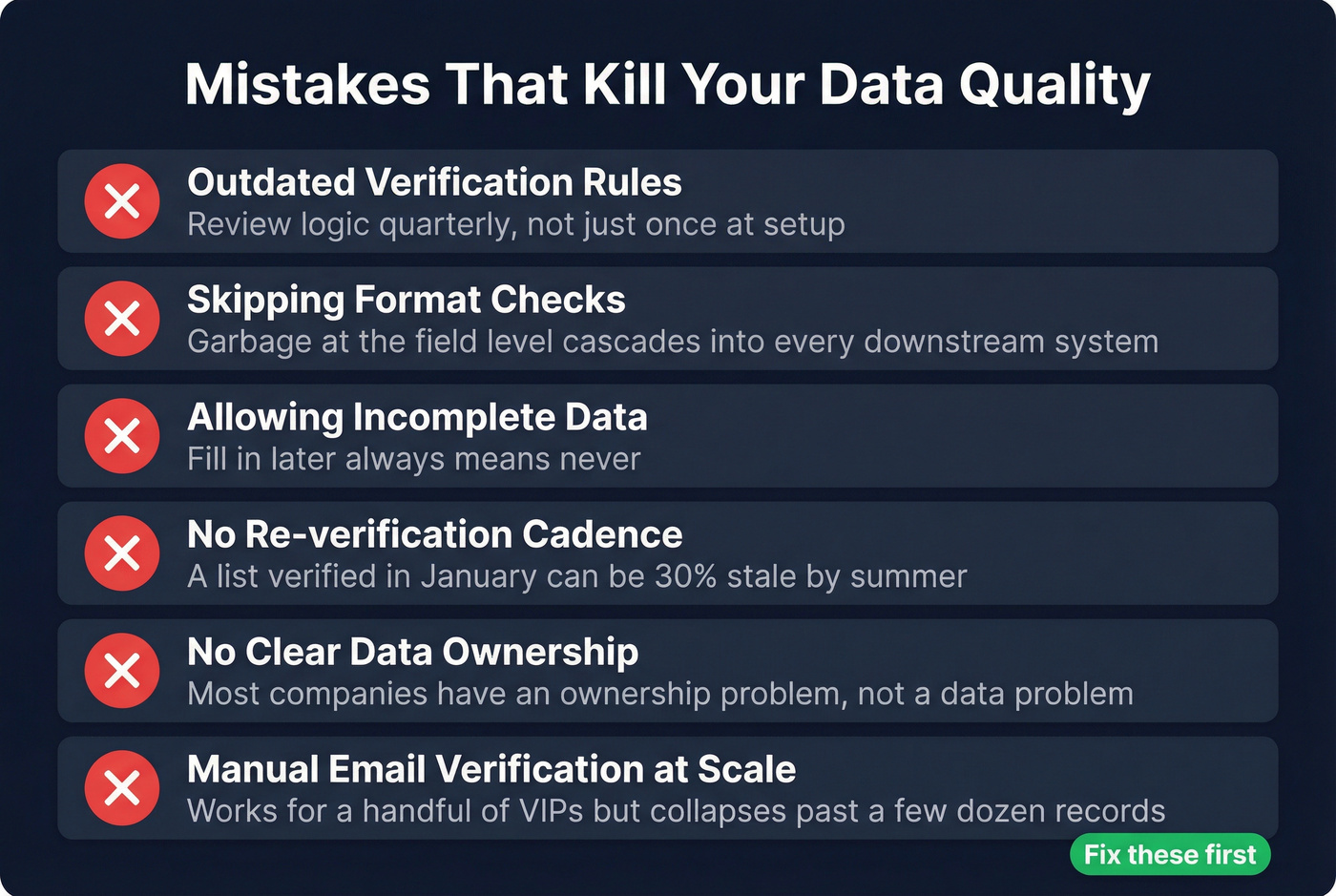
Outdated rules. Review verification logic quarterly, not once at setup. The data changes; your rules should too.
Skipping format checks. Garbage at the field level cascades everywhere. A phone number stored as text with dashes in one system and digits-only in another will break every downstream join.
Allowing incomplete data. If a field is mandatory, enforce it. "Fill in later" means "never."
No re-verification cadence. Set-and-forget means your data is rotting. B2B contact data decays fast enough that a list verified in January can be 30% stale by summer.
No ownership. Here's the thing - most companies don't have a data quality problem. They have a data ownership problem. Assign a human being to every critical dataset or accept that it will decay.
Trying to verify email addresses manually at scale. Some teams still try sending test messages one at a time. It's fine for a handful of VIP contacts, but it collapses past a few dozen records and introduces human error at every step.
Email Verification Challenges
Beyond the general verification workflow, email-specific checks deserve their own section because it's where B2B teams lose the most money.
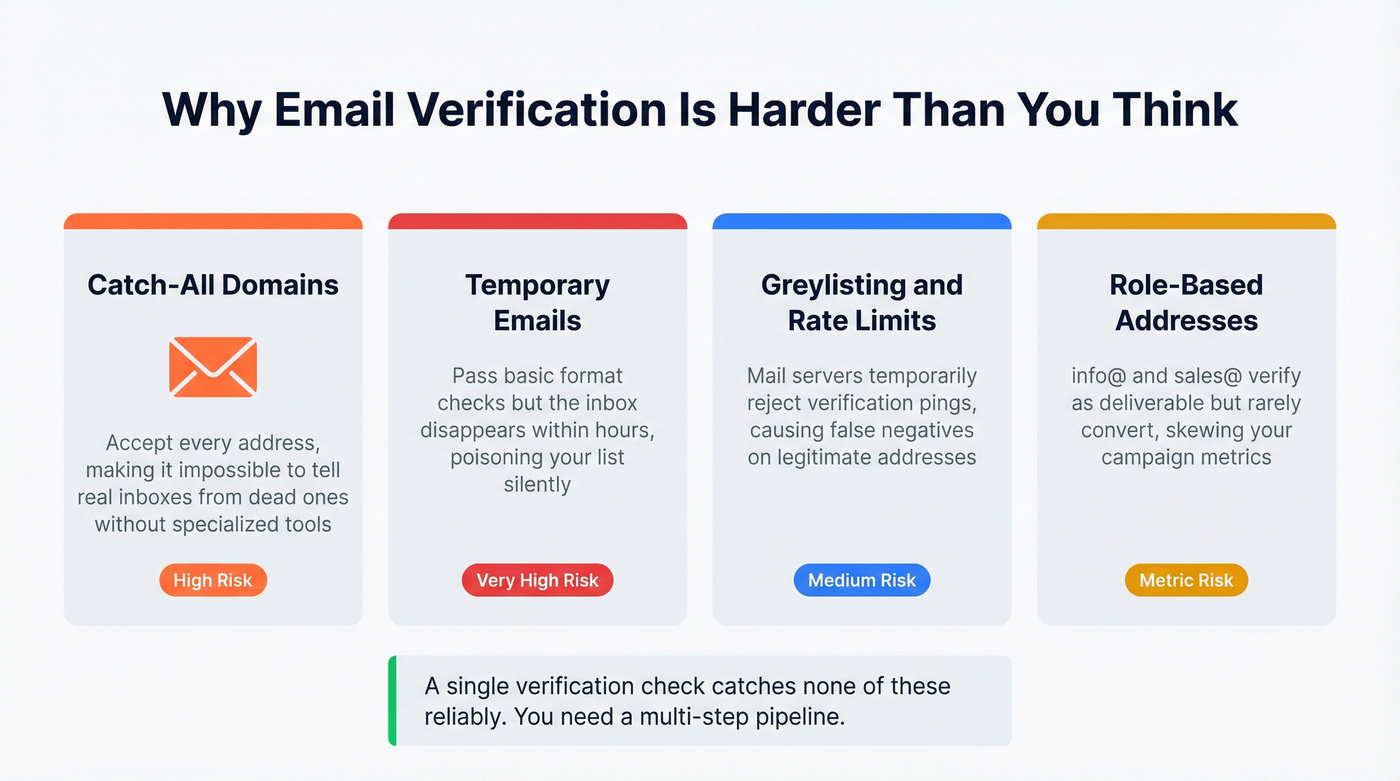
Catch-all domains accept every address, making it impossible to distinguish real inboxes from dead ones without specialized tooling. Temporary email services pass basic format checks but disappear within hours. Greylisting and rate limiting by mail servers can cause false negatives during verification, making legitimate addresses appear invalid. And role-based addresses like info@ or sales@ verify as deliverable but rarely convert, skewing campaign metrics.
These challenges are why relying on a single check - or no check at all - leaves so much risk on the table. The consensus on r/sales and r/coldemail is pretty clear: if you aren't using a dedicated verification tool, you're burning sends.
Tools for Automation
Manual verification doesn't scale. We've tested dozens of tools across categories - here's what actually works.
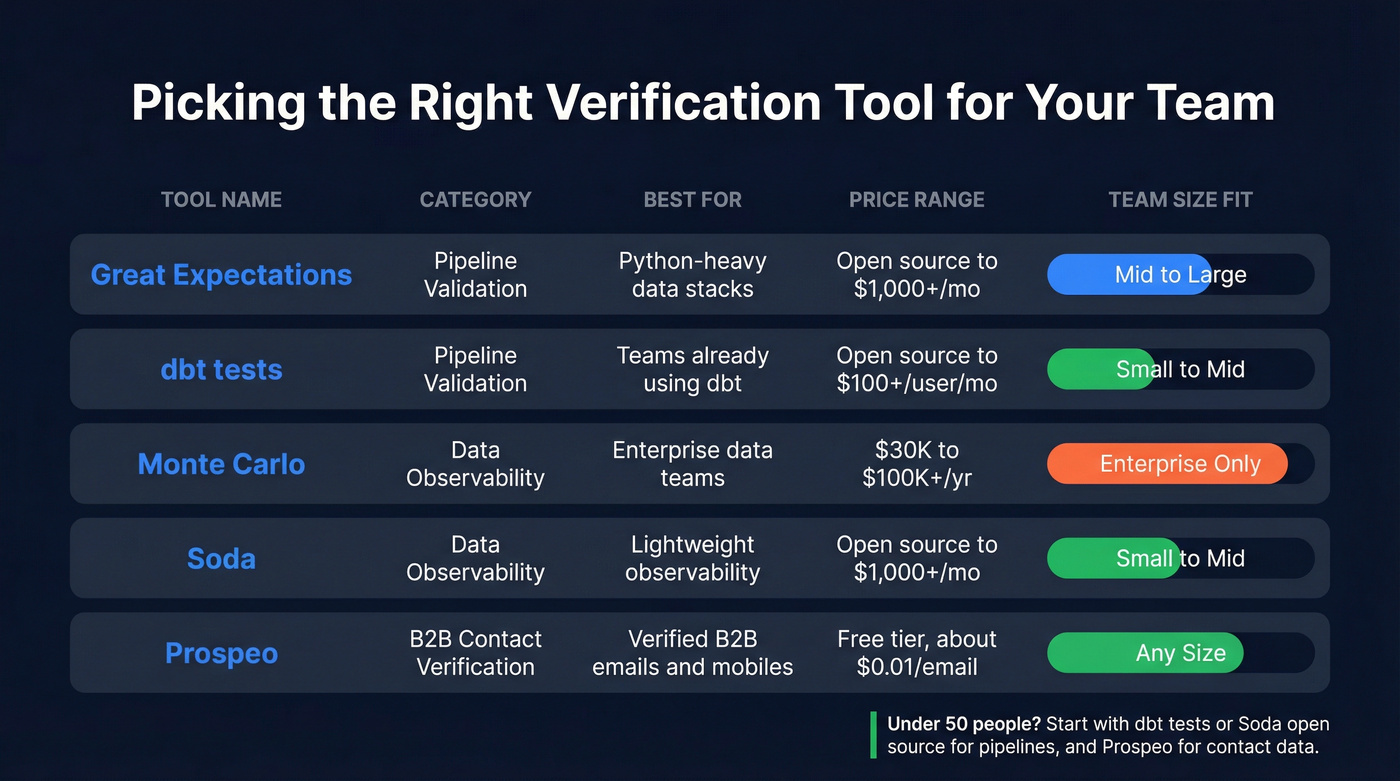
| Category | Tool | Best For | Approx. Pricing |
|---|---|---|---|
| Pipeline validation | Great Expectations | Python-heavy data stacks | Open-source; Cloud ~$300-$1,000+/mo |
| Pipeline validation | dbt tests | Teams already in the dbt ecosystem | Open-source; dbt Cloud ~$100+/user/mo |
| Data observability | Monte Carlo | Enterprise data teams with budget | ~$30K-100K+/yr |
| Data observability | Soda | Lightweight observability | Open-source; Cloud ~$200-$1,000+/mo |
| B2B contact verification | Prospeo | Verified B2B emails and mobiles | Free tier; ~$0.01/email |
For pipeline and warehouse data, Great Expectations and dbt tests are the workhorses - open-source, code-defined expectations, and tight integration with modern ELT stacks. Monte Carlo and Soda sit a layer above, monitoring for anomalies across your entire data estate.
For B2B contact data specifically, Prospeo runs every record through a 5-step verification pipeline with catch-all domain handling, spam-trap removal, and honeypot filtering. The result is 98% email accuracy on a 7-day refresh cycle, so verified data stays verified continuously rather than decaying between quarterly cleanups. The free tier gives you 75 emails plus 100 Chrome extension credits per month, and paid plans run about $0.01 per email.
Skip Monte Carlo if you're a small team without a dedicated data engineering function - it's built for enterprise-scale observability and the price reflects that. For teams under 50 people, Soda's open-source tier or dbt tests will cover most of what you need.
Catch-all domains, temporary emails, greylisting - Prospeo's proprietary email infrastructure handles every challenge on this list. No third-party providers. No guesswork. Meritt cut their bounce rate from 35% to under 4% overnight.
Get emails that actually land in inboxes, not bounce logs.
FAQ
How often should you verify data?
B2B contact data decays up to 70% annually, so monthly is the minimum viable cadence. High-volume outbound teams should verify weekly. Warehouse and pipeline data should run automated checks on every execution - tools like dbt tests and Great Expectations make this trivial.
What's the difference between verification and validation?
Validation checks if data looks right - correct format, expected range. Verification checks if data is actually right by cross-referencing trusted external sources like postal databases or email verification services. You need both; skipping either creates blind spots.
What should a verification checklist include?
Cover these eight techniques: row counts, checksums, sampling, cross-source validation, referential integrity, statistical profiling, external verification, and business rules. Add a re-verification schedule - monthly minimum for contact data - and assign clear ownership per dataset.
Can you verify email addresses manually?
You can for a small handful of contacts - send a test message and see if it bounces. But this breaks down past a few dozen records. It's slow, error-prone, and gives you no insight into catch-all domains or spam traps. For lists over 50 contacts, automated tools catch issues that manual checks simply can't, including honeypots and temporary addresses.