How to Get Emails of Potential Customers: 7 Methods That Actually Work in 2026
$36 back for every $1 you spend. That's email marketing's ROI - and it's held steady for years while every other channel gets more expensive and less predictable. The problem isn't whether email works. It's knowing how to get emails of potential customers who'll actually respond.
Why Email Is Still the #1 Channel for Reaching Customers
There are 4.48 billion email users worldwide, climbing toward 4.89 billion by 2027. Every single day, 361.6 billion emails get sent and received - a 4.3% jump year over year.

Email is 40x more effective than Facebook and Twitter combined for customer acquisition. 81% of B2B marketers say email newsletters are their most-used content marketing channel. 99% of email users check their inbox daily. And email marketing converts at 15.22% on average across industries - no other channel comes close.
The ROI numbers are almost absurd. DemandSage's 2026 data puts it at $36-$40 per $1 spent, with retail and ecommerce peaking at $45:1. Marketing agencies see $42:1. No paid channel touches those numbers.
But all of that depends on having real, verified email addresses for people who might actually buy from you. A list of 10,000 garbage emails is worth less than 200 verified ones.
Choosing Your Path
Your approach depends entirely on what you're trying to do:
Small business and ecommerce: Build an inbound list with lead magnets, popups, and signup forms. Expect 100-500 subscribers in your first three months with consistent effort. Slower, but builds a warmer audience.
Hybrid approach: Combine outbound email finding for immediate pipeline with inbound collection for long-term growth. Most scaling companies end up here.

You just read that most email tools pull from the same recycled databases - and bounce rates prove it. Prospeo runs proprietary email-finding infrastructure with 5-step verification, delivering 98% accuracy across 143M+ verified emails. Stack Optimize built a $1M agency on it with under 3% bounce rates.
Get verified emails of your potential customers for $0.01 each - starting today.
Outbound - How to Find Prospect Email Addresses Using B2B Data Tools
If you're in B2B sales, you don't have time to wait for people to find your website and fill out a form. You need to reach specific decision-makers at specific companies, and you need their verified work emails today.
The tools have gotten dramatically better. But accuracy varies wildly between providers, and most of them pull from the same underlying data sources. A 20,000-contact benchmark test across 15 tools found that 98% of enrichment solutions use databases built from the same providers. That means your choice of tool matters more than most people think.
Prospeo - Best for Verified Email Accuracy
Use this if: You care more about data quality than database size, you've been burned by bounced emails before, or you're running outbound at scale where email deliverability is everything.
Skip this if: You need a full-stack sales engagement platform with built-in sequencing and a dialer. Pair Prospeo with Instantly or Lemlist for that.
Prospeo's database covers 300M+ professional profiles with 143M+ verified emails. The headline number is 98% email accuracy - and it holds up. Stack Optimize built from $0 to $1M ARR using Prospeo data, keeping client deliverability above 94% with bounce rates under 3% and zero domain flags across all clients.

Prospeo runs proprietary email-finding infrastructure. It doesn't rely on third-party email providers, which means you're not getting recycled data that five other tools already sold to your competitors. The 5-step verification process handles catch-all domains, removes spam traps, and filters honeypots - all before the email hits your list.
The Chrome extension has 40K+ users and works on any website or professional profile. Pricing starts free (75 emails/month), and paid plans run about $0.01 per email. No contracts, no annual commitments.
If you're comparing options, start with these email lookup tools and the best B2B email lookup tool picks for 2026.
Apollo.io - Best Free Tier for Getting Started
Apollo is the gateway drug of B2B data tools. The free tier gives you 10,000 email credits per month - generous enough to run real campaigns before spending a dollar. The database covers 275M+ contacts across 73M+ companies, and the platform doubles as a sequencing tool.
Here's the thing: G2 reviewers consistently report 15-20% bounce rates on some segments, and real-world accuracy runs 70-80% versus Apollo's claimed 91%. I've watched teams burn through freshly warmed domains in a week because they trusted Apollo data without verifying it first. At scale, those bounces will torch your sender reputation.
Paid plans start at $49/user/month (annual), with Professional at $79/user/month.
If you're using Apollo specifically, see the deeper breakdown on Apollo.io accuracy.
Hunter.io - Domain Search Done Right
Hunter does one thing exceptionally well: you give it a company domain, and it maps the email patterns and contacts at that organization. Clean interface, fast results, reliable for what it is.
A Dropcontact benchmark showed a 16.4% error rate and 11.2% hard bounce rate in real-world testing - so treat Hunter as a supplementary tool, not a primary prospecting database. Practitioners consistently describe it as better for verification than discovery. Starts at $34/month (annual) with 2,000 credits. Free tier gives you 50 credits/month.
Why Waterfall Enrichment Beats Any Single Tool
No single email finder catches everything.

A PhantomBuster test on 1,000 profiles showed Hunter alone hit 68% success rate, Dropcontact hit 72%, but combining them pushed it to 73% with 97-100% verification. That incremental gain matters at scale.
The concept is simple: run your list through Tool A, take the misses, run them through Tool B, then verify everything. Other tools worth testing in your waterfall stack include Snov.io (90-95% verified accuracy, ~$30/mo) and LeadIQ (82-90%, ~$36/mo).
If you want a more structured approach, use a waterfall enrichment workflow.
Inbound - Collect Emails From Website Visitors
Outbound gets you emails today. Inbound builds a list that compounds over time. If you have any web traffic at all, you're leaving emails on the table without these tactics.
Popups and Slide-Ins That Convert
Popups have a bad reputation, and most of it is deserved - because most popups are terrible. But the data doesn't lie: Omnisend tracked 1.24 billion popup displays and found an average conversion rate of 2.1%, collecting 26.4 million emails. Ecommerce popups perform even better, averaging 8.11% conversion.

The difference between a popup that converts and one that annoys comes down to timing and targeting. Showing a popup in the first five seconds increases bounce rate by up to 5x. The sweet spot is a 6-10 second delay. Even better: trigger on the second page view. Wisepops data showed a one-page delay generated a 28.98% conversion rate - the highest in their sample - and increased attributed revenue by 39%.
Different popup offers for first-time visitors versus returning visitors convert 20-40% better. A first-time visitor gets a welcome discount; a returning visitor gets early access to new products. Soi Paris collected 1,000+ emails in 10 days using targeted onsite notification feeds - an emerging tactic worth testing alongside traditional popups.
Gamified popups (spin-the-wheel, scratch cards) hit 3.5%+ conversion rates. Mobile-optimized popups convert at 2.2% versus 1.4% for desktop-only designs. Exit-intent popups average around 3%, with top campaigns pushing nearly 20%.
If you're not running at least one well-timed popup or slide-in, you're probably converting under 1% of your traffic to email subscribers. That's the lowest-hanging fruit in your entire marketing stack.
If you want benchmarks + tooling, this ties into website lead generation and B2B lead capture.
Lead Magnets That Still Work Post-ChatGPT
Generic PDFs are dead. When anyone can generate a "complete guide" in 30 seconds with ChatGPT, your 12-page PDF on "Top 10 Marketing Tips" has zero perceived value.

What still works: interactive tools where people enter their own data. A Reddit practitioner nailed it - an SEO agency built an ROI calculator where leads plug in their website visitors, conversion rate, and customer LTV, then see projected growth. "People LOVE clicking on stuff and entering in their own numbers, especially B2B business owners."
The key is enabling leads to prove to themselves that your service offers ROI. Good lead magnet conversion rates run 5-15%. The top-performing formats in 2026 are interactive assessments, ROI calculators, personalized recommendation quizzes, and mini-courses delivered via email. Static content still works if it's genuinely unique - original research, proprietary data, industry benchmarks that can't be Googled.
And remember: 79% of marketing leads fail to convert without proper follow-up. The lead magnet is step one. The nurture sequence is where the money is.
To tighten follow-up, build a proper lead nurturing emails sequence.
Signup Forms, Gated Content, and the "Big Ask" Method
Sometimes the simplest approach works best. AWeber's framework is almost embarrassingly straightforward: ask five people per day for their email during normal business interactions. That's 25 per week, 100 per month, 1,200 per year. For a small business, that's a real list.
The checklist:
- Keep forms to name + email only. Every additional field drops conversion by 10-25%.
- Skip CAPTCHA on signup forms - 29% of users don't even attempt to solve one and bounce immediately.
- Place signup forms on every page of your site, not just the homepage. Use heatmaps to find the highest-attention zones.
- Use exit-intent popups as a last-chance capture - they convert up to 3% on average.
- Gate your best content behind an email form, but make the preview compelling enough that people want the rest.
- Drive social followers to email: TikTok Lead Gen forms, Instagram bio links, and YouTube description CTAs all convert surprisingly well.
- Ask during phone calls, at events, after demos. Offline still works.
How to Find Prospect Emails via Professional Profiles
Sales Navigator (~$80-100/month) is the starting point for most B2B prospecting workflows, but it doesn't give you business emails directly. The typical workflow is: search, scrape, enrich, verify. Knowing how to find a prospect's email address from a professional profile is one of the highest-value skills in modern sales.

Sales Navigator search results have roughly 30-35% accuracy on average. You can scrape up to 2,500 leads per search (25 results per page across 100 pages). Boolean search operators are your friend - use quotes for exact phrases, AND/OR/NOT for filtering, and parentheses for complex queries.
Beyond basic search, look at groups, company followers, job postings, and event attendees. These are warmer leads - they've self-selected into a topic or community that signals relevance. Someone who joined a "SaaS Growth Strategies" group is a better prospect than a random VP of Marketing from a keyword search.
The enrichment step is where your tool choice matters most. Typical email find rates from professional profiles run 50-70% depending on the tool and industry.
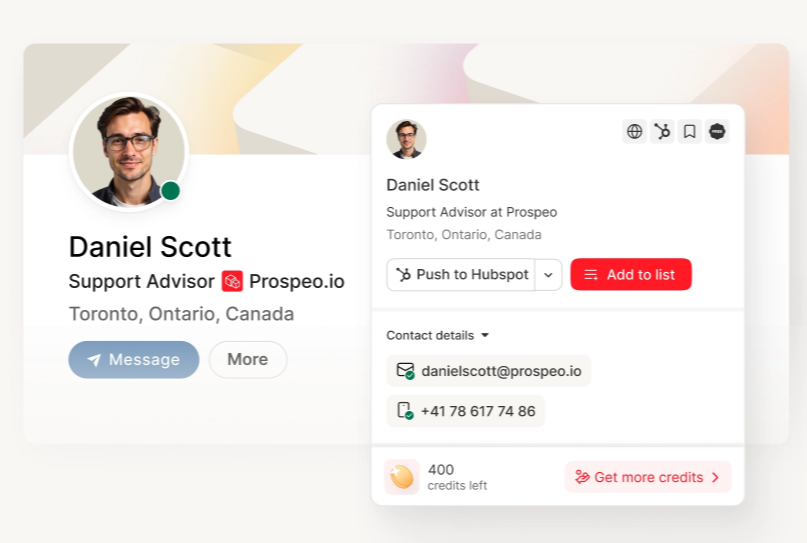
Prospeo's Chrome extension makes this dead simple. One click returns 40+ data points per contact, including verified email and mobile. Instead of exporting a CSV, running it through an enrichment tool, then verifying separately, you get the verified email right there on the profile. For teams doing manual prospecting, it cuts the workflow from four steps to one.
Email Verification - Protect Your Domain Before You Hit Send
I've seen teams spend months warming up a domain, build beautiful sequences, nail their ICP targeting - then destroy everything with one bad list.
It takes three months to warm up a domain and three seconds to burn it with unverified data.
The industry benchmark: keep total bounces below 2%, hard bounces under 1%. Anything above that and you're risking your sender reputation with every campaign.
Here's why verification is non-negotiable: 15-28% of B2B domains are catch-all. A catch-all domain accepts every email address, whether it exists or not. Your email "delivers" but nobody's home. Standard verification tools mark these as "valid" when they're actually a coin flip.
If you're building a verification SOP, follow an email verification list process and use a dedicated email verifier website.
| Tool | Accuracy | Price per 1K | Free Tier |
|---|---|---|---|
| Bouncer | 99.5% | $7 | 1,000 free |
| ZeroBounce | 99% | $10 | 100/month |
| NeverBounce | 97-99% | $8 | 10 free credits |
| MillionVerifier | 99%+ | ~$3.70 | - |
These are all solid standalone verifiers. Practitioners recommend running lists through at least two of them for maximum coverage.

Here's the hot take most data vendors won't tell you: if your email accuracy is below 95% before you hit send, you shouldn't be sending at all. The cost of rebuilding a burned domain - new domain, new warmup, 3+ months of lost pipeline - dwarfs whatever you'd spend on better data upfront. Meritt learned this the hard way: their bounce rate dropped from 35% to under 4% after switching to pre-verified data. When your emails come verified at 98% accuracy with catch-all handling built in, you skip the separate verification subscription entirely.
If you need the full workflow, see how to verify an email address.
Every bounced email damages your sender reputation and kills your $36:1 ROI. Prospeo's catch-all handling, spam-trap removal, and honeypot filtering mean the emails you send actually land. 300M+ profiles, 7-day data refresh, zero recycled third-party data.
Protect your domain and reach real buyers - not dead inboxes.
Staying Legal - GDPR, CAN-SPAM, and CCPA Compliance
Nobody wants to talk about compliance, but GDPR violations in 2024 alone exceeded EUR 1.6 billion in fines. That's not theoretical risk.
The rules differ depending on where your prospects are:
| GDPR (EU) | CAN-SPAM (US) | CCPA (California) | |
|---|---|---|---|
| Consent model | Opt-in / Legitimate interest | Opt-out | Opt-out |
| Unsubscribe deadline | 72 hours | 10 business days | - |
| Max penalty | EUR 20M / 4% revenue | $43,792/email | $7,500/violation |
For US-based outreach: CAN-SPAM is an opt-out model. You don't need prior consent to send a cold email. You do need a valid physical address, honest subject lines, clear identification that it's a commercial message, and a working unsubscribe link. Honor opt-outs within 10 business days.
For EU prospects: GDPR requires either explicit consent or "legitimate interest." For B2B cold email, legitimate interest means you can demonstrate the prospect matches your ICP and would plausibly benefit from your offer. You must document where every email address was obtained. You must honor deletion requests within 72 hours.
For California: CCPA follows an opt-out model. Consumers can request access to their data, deletion, or opt-out of data sales. Penalties run up to $7,500 per violation.
68% of consumers avoid brands that send non-compliant emails. Beyond the legal risk, bad compliance practices destroy trust.
For a practical outbound checklist, use GDPR for Sales and Marketing.
Putting It All Together - Your Email Collection Playbook
Cold email and email marketing are different strategies for different goals. Cold email targets people who've never heard of you - expect reply rates of 1-5% (though personalized campaigns can push into double digits). Email marketing targets opt-in subscribers with established trust and higher engagement.
Personalized emails achieve 29% open rates and 41% click-through rates. McKinsey's research found that companies excelling at personalization generate 40% more revenue from those activities. That's not a marginal improvement - it's a different business.
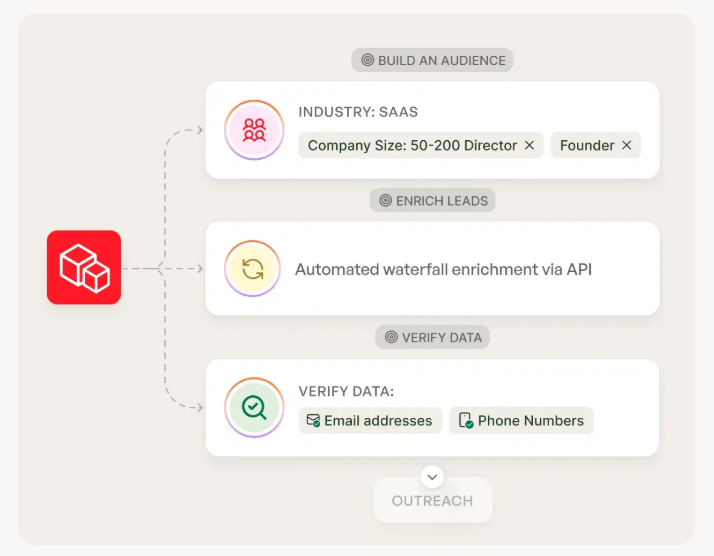
Here's what your stack should look like at different budgets:
Free ($0/month): Apollo free tier for email finding (10K credits) + MillionVerifier for verification + manual signup forms on your website. You'll deal with higher bounce rates and slower workflows, but you can start today.
Growth (~$50-90/month): Prospeo as your data backbone (verified emails at ~$0.01 each, no contracts) + Instantly (~$30/month) or Lemlist (~$59/month) for sending + one popup tool for inbound capture. This is the sweet spot for founders and small teams. We've seen this stack outperform teams spending $500+ on enterprise data seats.
Scale (~$200+/month): A dedicated data platform for accuracy + a sending platform + Sales Navigator (~$80-100/month) for targeting + a CRM with enrichment workflows. Add intent data when you're ready to prioritize accounts showing buying signals.
Multi-channel is where outreach is heading. Email plus social touchpoints consistently outperform email alone. But email remains the backbone - and the entire strategy starts with knowing how to get emails of potential customers who match your ICP. A $50/month investment in verified data can generate $5,000+ in pipeline within 30 days if you're sending to the right addresses.
To pressure-test targeting, define your ideal customer before you scale volume.
FAQ
Is it legal to cold email potential customers?
Yes, in the US. CAN-SPAM operates on an opt-out model - you don't need prior consent, but you must include a valid physical address, honest subject lines, and a working unsubscribe link. In the EU, GDPR requires "legitimate interest" for B2B cold email, meaning you must document that the prospect matches your ICP. Always honor opt-outs promptly.
What's a good email bounce rate for cold outreach?
Keep total bounces below 2% and hard bounces under 1%. Anything higher signals bad data and damages your sender reputation. Tools that verify at 98% accuracy before delivery keep most teams well under that threshold without a separate verification step.
How many emails can I collect per month with inbound methods?
Expect 100-500 subscribers in your first three months with consistent effort. Popup conversion averages 2.1% of visitors (8.11% for ecommerce). Lead magnets convert 5-15% of people who see them. The "ask five people per day" method alone yields about 100 emails per month.
What's the most accurate email finder tool in 2026?
Prospeo leads with 98% verified email accuracy and a proprietary 5-step verification process that handles catch-all domains, spam traps, and honeypots. The 7-day data refresh cycle keeps records current, and proprietary infrastructure means you're not getting recycled data from shared providers.
Should I buy email lists?
No. Purchased lists damage sender reputation, violate GDPR, and typically carry 30%+ bounce rates. They're also full of spam traps that'll get your domain blacklisted. Build your list through verified B2B data tools or inbound methods - the upfront effort pays for itself in deliverability and conversion rates.