

The Best Sales Pitch Decks - What Actually Works in 2026
You've seen the same Zuora teardown from 2016 recycled across every blog post about sales pitch decks. The examples haven't changed, but the way buyers consume them has.
The short version:
- Keep your deck under 9 minutes / 12-18 slides
- Lead with the prospect's problem, not your product
- A perfect deck sent to the wrong person is worthless - verify your list before you hit send (and protect prospect data accuracy)
The 9-Minute Rule
Analysis of [121,828 web-based sales meetings](https://www.gong.io/blog/sales-stats) found a clean split: closed-won deals averaged 9.1 minutes of deck time, while lost deals averaged 11.4 minutes. That's roughly a 25% gap in airtime that correlates directly with outcomes.
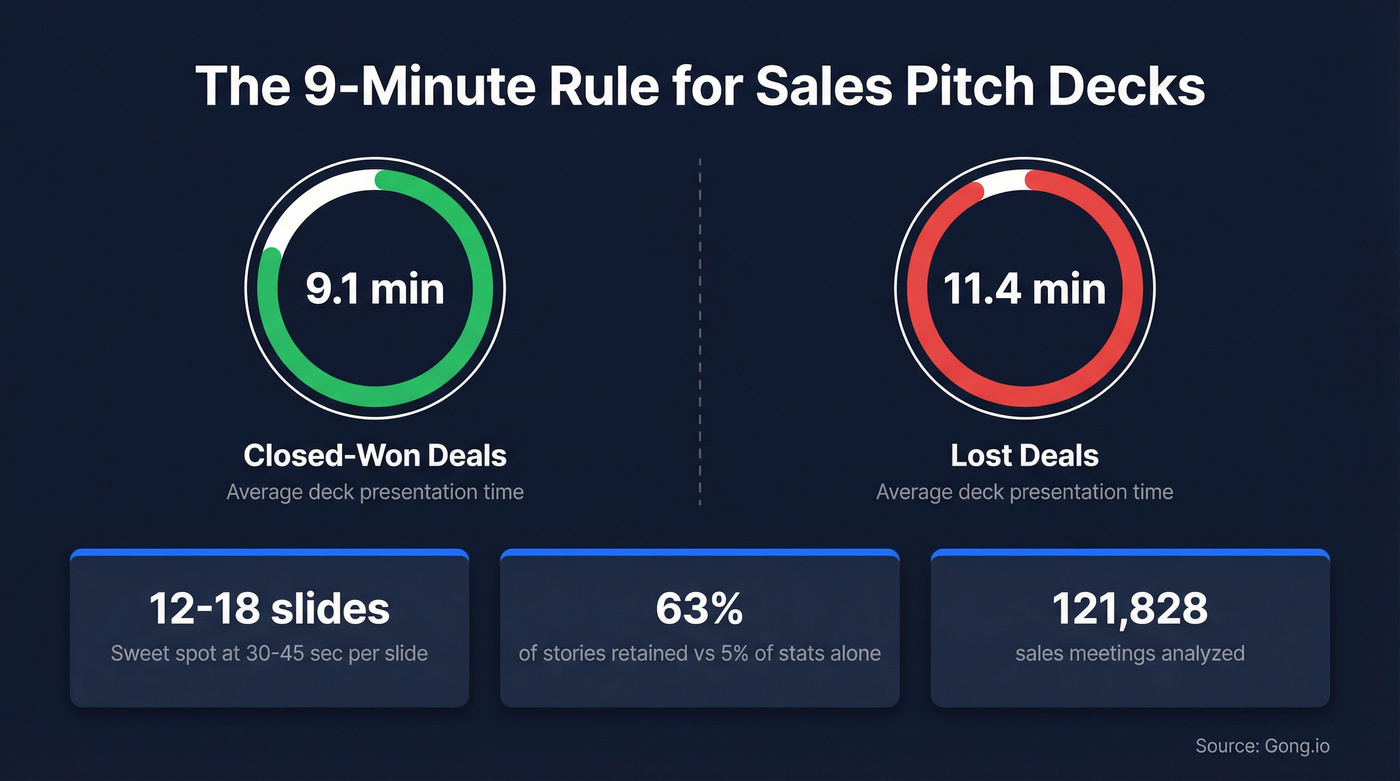
At 30-45 seconds per slide, 9 minutes gives you 12-18 sales pitch slides. The classic 10-20-30 rule still works as a floor, but you can push to 18 slides if each one earns its spot. The key isn't fewer slides - it's fewer minutes. Break your call into ~9-minute chapters with a change of pace between them: a demo, a new speaker, a customer story (see post-demo best practices).
Here's what the data doesn't capture but every experienced rep knows: buyers retain 63% of stories versus 5% of statistics alone. Wrap your numbers in narrative. Use the prospect's name to pull them back in, and when energy drops, skip ahead to next steps instead of powering through a slide that's already lost the room.
5 Slides to Cut Today
Ask any sales rep what kills a deal and you'll hear the same things. Too much text. Product tour too early. No proof. No ROI.
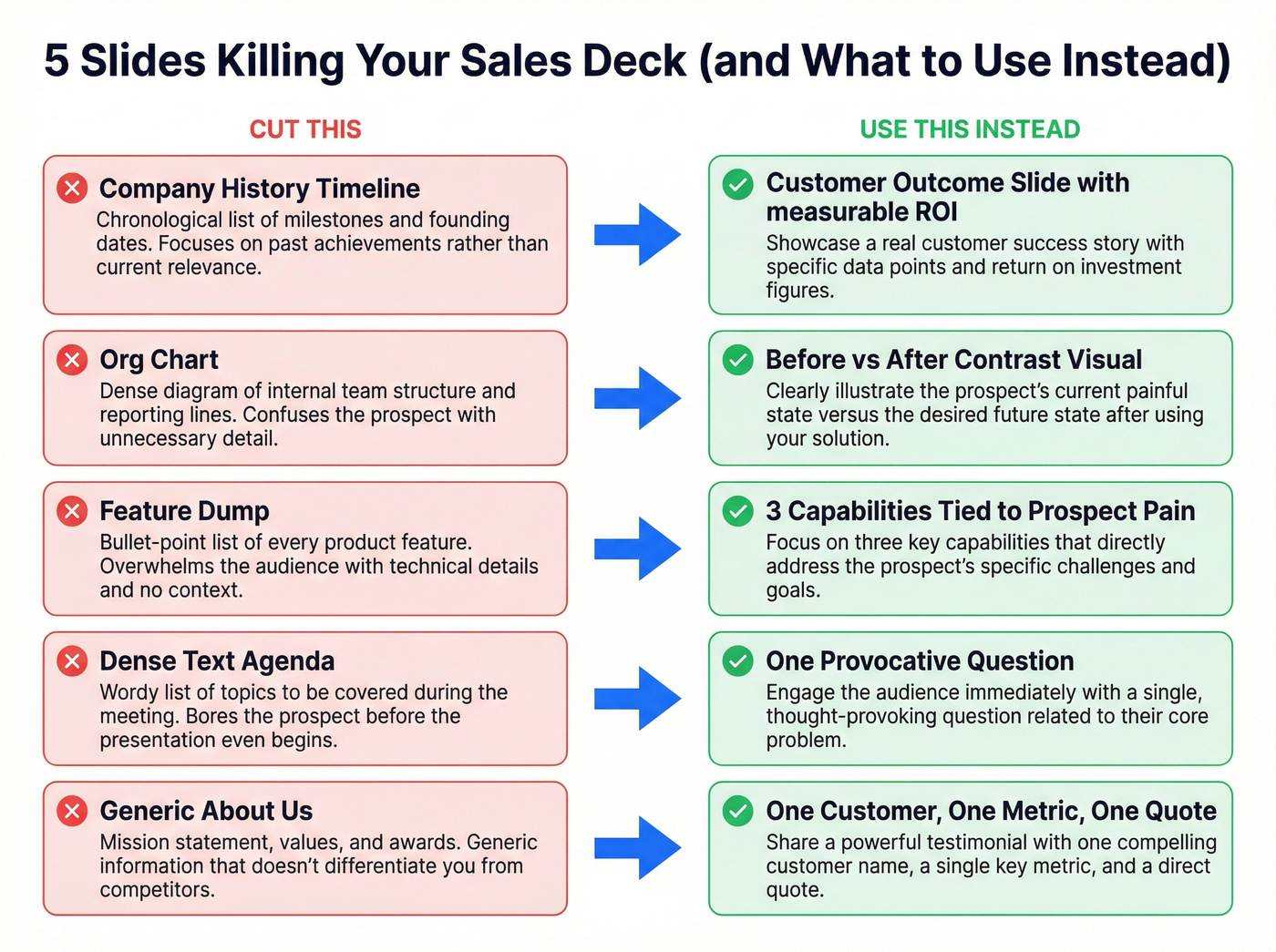
Gong's research flags five "low point" slides as consistent underperformers. In practice, they're usually:
- Company history timeline - Replace with a customer outcome slide showing measurable ROI.
- Org chart - Replace with a "before vs. after" contrast visual.
- Feature dump - Replace with three capabilities tied to the prospect's specific pain (use a tighter lead qualification framework to define that pain).
- Dense text agenda - Replace with a single provocative question that frames the conversation.
- Generic "About Us" - Replace with one customer, one metric, one quote.
Sales Deck Examples Worth Stealing
Zuora - The Narrative Arc
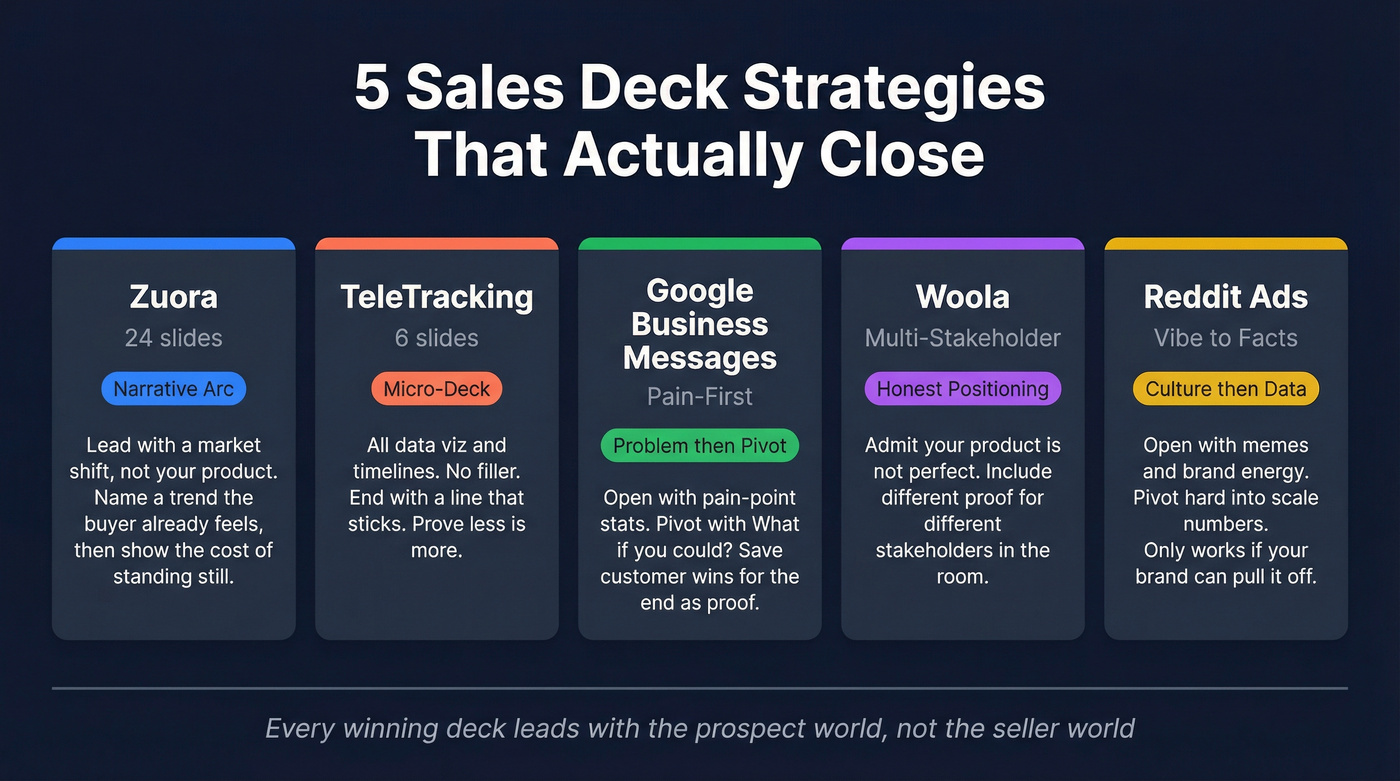
Andy Raskin's famous teardown still holds up. Zuora's 24-slide deck follows a tight narrative: trend, evidence, winners, gap, then solution. The opening line - "We now live in a subscription economy" - doesn't mention Zuora at all. It names a shift the prospect already feels. By the time the product appears, the buyer's already nodding. This is loss aversion in action: show the world changing, then show the cost of standing still.
TeleTracking - The 6-Slide Micro-Deck
We've reviewed hundreds of sales decks, and the ones that close always lead with the prospect's world, not the seller's. TeleTracking is the purest example. Every inch is dedicated to data viz and simple timelines. No filler, no feature lists. It ends with a line that sticks: "It shouldn't cost a billion dollars." Six slides. That's it.
Google Business Messages - Pain-First Structure
Google Business Messages opens with concrete pain-point stats, then pivots with "What if you could...?" before showing how the product fits into existing customer journey moments. Customer wins are saved for the end - proof punctuates the story rather than derailing it. The value proposition lands because the problem was felt first.
Woola - Skip This If You Sell Certainty
"Perfect packaging doesn't exist, but better packaging does." That kind of honesty builds trust with skeptical buyers. Woola includes credibility slides for multiple stakeholders - certifications, sourcing transparency, social proof - because different people in the room need different proof. If your product is genuinely the best option but not a silver bullet, steal this approach. If you sell something with hard guarantees and clear specs, this tone won't fit.
Reddit Ads - The Vibe-to-Facts Pivot
Reddit's sales deck opens with memes and pop culture references. It feels like a brand deck, not a media kit. Then it pivots hard into scale numbers: ~70M monthly users, 5B pageviews, 20 minutes average time-on-site. The vibe earns attention; the data earns the budget.
Let's be honest - this only works if your brand can pull it off. Most B2B companies can't, and shouldn't try.

A perfect pitch deck sent to the wrong person is a wasted pitch deck. Prospeo gives you 300M+ verified contacts with 98% email accuracy so your deck lands in front of actual decision-makers - not dead inboxes with 20% bounce rates.
Stop perfecting slides and start fixing who sees them.
How to Create a Deck That Converts
The single most effective visual pattern in B2B decks right now is the "old way vs. new way" contrast slide. In our experience, it gets more Slack screenshots than any other format.
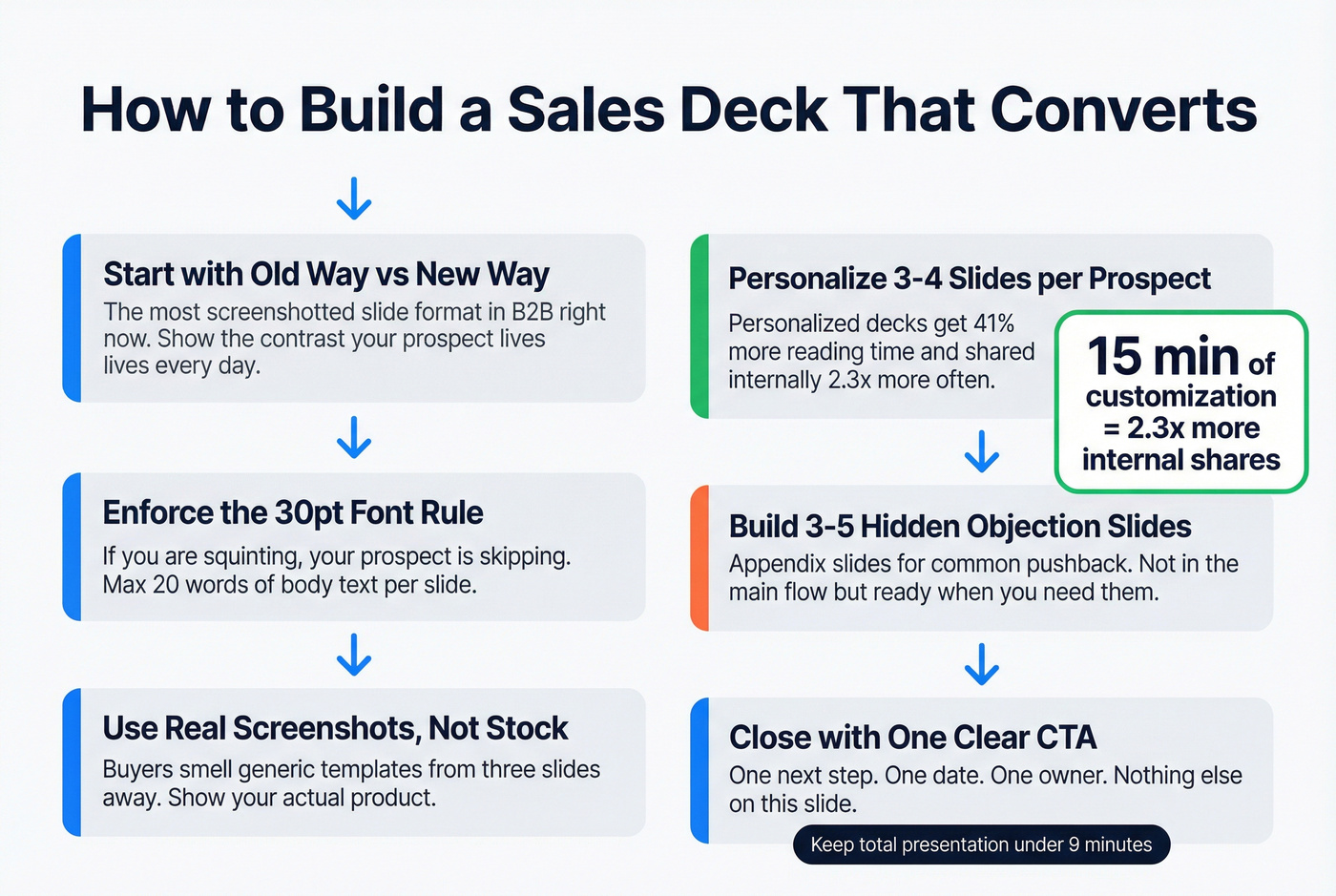
Stick to 30pt font minimum. If you're squinting, your prospect is skipping. Use real product screenshots over stock mockups - buyers can smell a generic template from three slides away. If a slide has 20+ words of body text, cut it. The slide is a visual aid, not a document.
Personalize when you can. Dock's data shows personalized content boosts average reading time by 41% and gets shared internally 2.3x more often. That stat alone should justify the extra 15 minutes of customization per deck. Build 3-5 appendix slides for common objections - they won't appear in your main flow, but they're ready when a prospect pushes back (use a clean taxonomy of types of objections). Think of your deck as a conversation aid, not a script. Include a clear call-to-action slide as your closer: one next step, one date, one owner (borrow a few sales pitch opening patterns to keep the momentum).
AI Tools to Build Your Deck
Gamma is the fastest path from blank page to finished deck. Beautiful.ai wins on polish. Canva's the safe pick if your team already lives there (and if you're automating outreach around it, see AI sales content generation).
| Tool | From | Best For |
|---|---|---|
| Prezi | $7/mo | Non-linear, zoomable |
| Gamma | Free tier / $8/mo | Fast AI-generated decks |
| SlidesAI | $8.33/mo | Google Slides + AI |
| Canva | Free tier / $12/mo | Design-first teams |
| Beautiful.ai | $12/mo | Auto-formatting, polish |
| Chronicle | $12/mo | Interactive, web-native |
| Pitch | $22/mo (2 seats) | Team collaboration |
| STORYD | $24/mo | Data storytelling |
Zapier's latest roundup dropped Microsoft Copilot and Google Gemini from their AI presentation maker list - the dedicated tools are just better at this.
Who Sees Your Deck Matters More
Look, most teams don't have a deck problem. They have a list problem.
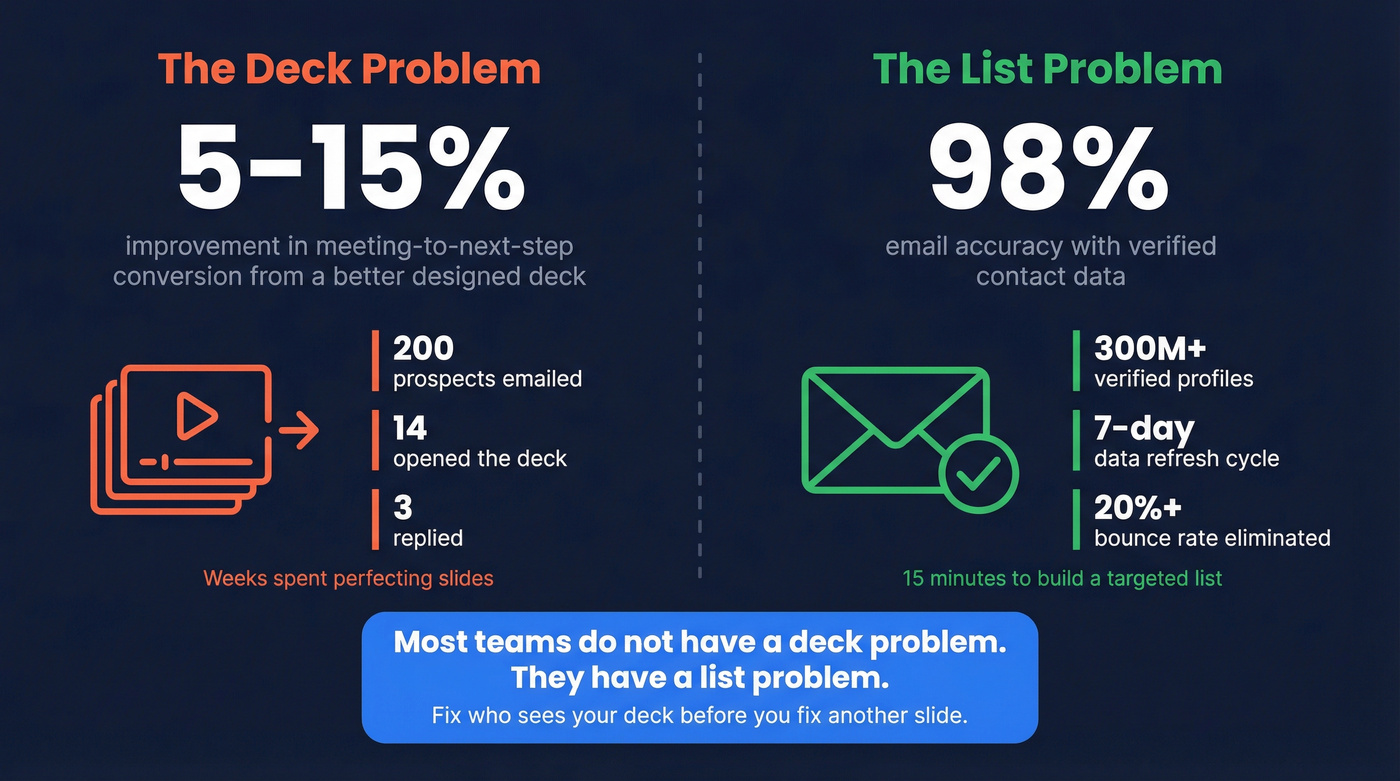
You sent the deck to 200 prospects last quarter. Fourteen opened it. Three replied. The deck wasn't the issue - the list was. A tighter, better-designed winning sales presentation improves meeting-to-next-step conversion by roughly 5-15%. But that only matters if you're reaching verified decision-makers (use account qualification to tighten targeting).
We've seen teams obsess over slide design for weeks while blasting lists with 20%+ bounce rates. That's wasted motion. The consensus on r/sales backs this up - threads about "my deck isn't working" almost always turn into conversations about targeting and list quality, not design (especially when B2B contact data decay is doing damage behind the scenes).
Prospeo gives you 300M+ profiles with 98% email accuracy and a 7-day data refresh cycle, so your deck lands in the right inbox instead of a bounce folder. The free tier includes 75 verified emails per month plus 100 Chrome extension credits - enough to test whether better data changes your reply rates before you spend another hour on slide transitions (pair it with an email checker tool workflow if you're validating lists elsewhere too).

You just spent weeks designing a winning deck. Now send it to people who'll actually open it. Prospeo's 30+ filters - buyer intent, job changes, headcount growth - let you target prospects already in-market, at $0.01 per verified email.
Your deck converts. Make sure your list does too.
FAQ
How many slides should a sales deck have?
Between 10 and 18. Analysis of 121,828 meetings shows closed-won presentations average 9.1 minutes - at 30-45 seconds per slide, that's 12-18 slides. Cut anything that doesn't directly advance the buyer toward a decision.
What's the difference between a sales deck and a pitch deck?
A pitch deck targets investors with market size, team bios, and fundraising asks. A sales deck targets prospects with their problem, your solution, and measurable ROI. Using one for the other almost always underperforms.
What's the best free tool to build a sales deck?
Gamma's free tier includes 400 AI credits - enough to build and iterate on a full deck without paying. Canva's free plan works if you prefer manual design control.
How do I personalize a sales deck at scale?
Use modular slides - keep 70% of the deck fixed and swap 3-4 slides per vertical or persona. Personalized decks get shared internally 2.3x more often, so even light customization compounds when it reaches the buying committee.