

The Post-Demo Playbook: Everything That Happens After "Looks Great!"
A RevOps lead we know ran a post-mortem on a big batch of lost deals. The #1 killer wasn't pricing, product fit, or competition. It was what happened - or didn't happen - in the 14 days after the demo. The prospect said "looks great," the rep felt good, and then... silence. Deals don't die during the demo. They die in the post-demo follow-up.
Ask any experienced rep what kills deals after a great presentation, and the answers are always the same: slow follow-up, single-threaded deals, and bad contact data. Demo-to-meeting conversion sits at 50-60% for most teams, and the average B2B deal involves 6-8 decision-makers. If you demoed to one person and sent one follow-up email, you've barely started the sale.
What You Need (Quick Version)
If you only do three things after every demo, make it these:
- Send your follow-up within 15 minutes - not 24 hours - with a 3-bullet recap, one resource, and a confirmed next step.
- Map every stakeholder on the buying committee before Day 3 and build a multi-channel cadence for each.
- Verify every contact's email and phone number before launching your sequence - a bounced follow-up kills more deals than a bad demo.
That's the skeleton. Let's put muscle on it.
The Last 5 Minutes of the Demo
Most reps end demos with "Any questions?" followed by an awkward pause and a vague promise to "send over some materials." This is where deals start leaking.
Reserve the last 3-5 minutes for a structured wrap-up. Don't wing it. The average CEO has 37+ meetings weekly - your demo is already fading from memory by the time they open their next Zoom link. Lock in your sales demo next steps before the call ends, not after.
Recap the 2-3 key takeaways that mapped to their stated pain. Not your feature list - their problems and how you solve them. Then confirm the mutual action plan: what happens next, who owns each step, and when it happens. "So you'll loop in your VP of Engineering for a technical review by Thursday, and I'll send the security questionnaire by end of day. Sound right?"
Finally, name the next meeting. Don't say "I'll send a calendar invite." Say "Let's book 30 minutes next Tuesday at 2pm to walk through the technical review with your team." Get it on the calendar before the call ends.
The mutual action plan is the single most underused tool in post-demo selling. It turns a vague "we'll be in touch" into a documented commitment with owners and dates. Digital sales rooms like [Flowla] or [Trumpet] make this easy to formalize, but even a shared Google Doc works. The format matters less than the commitment.
Day 0 - The Immediate Follow-Up
Send your follow-up email within minutes of hanging up. Not hours. Not "by end of day." Minutes.
Memory decays fast. The prospect's next meeting often starts before yours has fully left their brain, and by tomorrow morning your demo is competing with dozens of other priorities. A fast follow-up signals professionalism and keeps momentum alive.
Do this:
- Lead with 3-5 bullet-point takeaways framed around their pain points
- Attach one relevant resource: a case study, ROI calculator, or the recording. One. Not four.
- Confirm the next step with a specific date and owner
- Keep it under 200 words
Don't do this:
- Dump every piece of collateral into one email. Decision paralysis is real, and an info dump is the fastest way to trigger it.
- Write "just wanted to follow up" as your subject line. You're not following up - you're advancing the deal. (If you need better options, see subject line alternatives.)
- Bury the next step at the bottom. Lead with it or put it in the P.S.
Here's a template that consistently works for our team:
Subject: Next steps from today's [Product] demo
Hi [Name],
Great conversation today. Here's what stood out:
- [Pain point #1] - we walked through how [feature] solves this by [specific outcome]
- [Pain point #2] - the [integration/workflow] you asked about handles this natively
- [Timeline] - you mentioned wanting to go live by Q3; here's how that maps to our onboarding
I've attached [one resource - case study, security doc, or recording link].
Next step: [Specific action] by [date]. I've sent a calendar invite for [date/time] to [do what].
Talk soon, [Your name]
Clean, specific, actionable.
Days 1-14: The Multi-Channel Cadence
The Day-by-Day Sequence
Email-only follow-up is how most reps run their cadence. It's also why most deals stall. A multi-channel approach dramatically increases your odds of keeping prospects engaged, especially across a buying committee juggling 15 other priorities. (If you want a deeper blueprint, use a proven sales cadence example.)
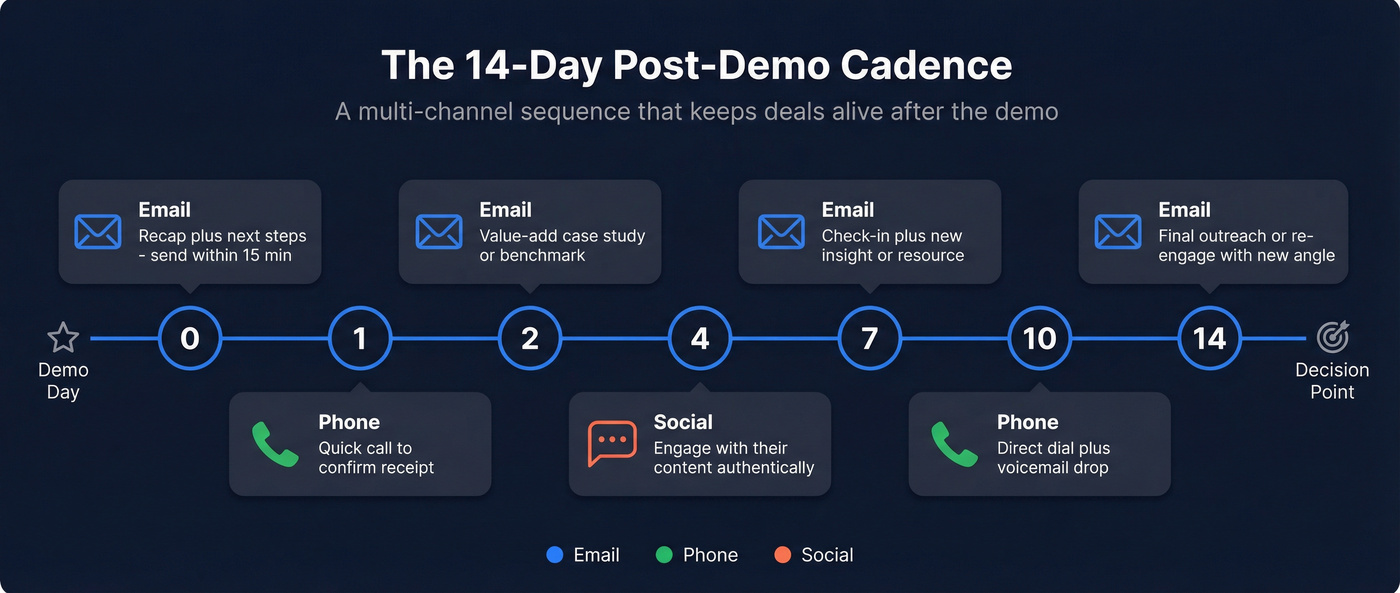
| Day | Channel | Action |
|---|---|---|
| 0 | Recap + next steps (sent within 15 min) | |
| 1 | Phone | Quick call to confirm they received everything |
| 2 | Value-add content: case study or benchmark | |
| 4 | Social | Comment on or share their content |
| 7 | Check-in + new insight or resource | |
| 10 | Phone | Direct dial + voicemail if no answer |
| 14 | Final outreach or re-engage with a new angle |
Each touch should add value, not just ask "did you get my last email?" The Day 2 email should be a genuinely useful resource - a benchmark report, a relevant case study, a competitive comparison they can share internally. The Day 4 social touch should be authentic engagement, not a "great post!" comment. (For a systemized approach, borrow from social selling strategy.)
When the Prospect Goes Silent
Every prospect who goes dark isn't the same. Segment them and respond accordingly.
The Silent Type engaged during the demo, then vanished. They're stuck internally. Switch channels - if email isn't working, pick up the phone. A 90-second voicemail with one new data point beats a fifth email every time. (If you need angles, use these re-engagement email subject lines.)
The Price-Focused Buyer asked about pricing three times during the demo. They're building an internal business case. Send an ROI calculator or a cost-comparison one-pager proactively. (Here’s a framework for a sales ROI calculator.)
The Skeptic pushed back on claims during the demo. They need proof, not persistence. Send a customer reference or offer a technical deep-dive with their team.
Stakeholder Mapping & Champion Enablement
The 5-Question Stakeholder Script
The average B2B buying decision involves 6-8 decision-makers. If you demoed to one person, you've convinced about 1/6 to 1/8 of the buying committee. The rest haven't seen your product, don't know your name, and are about to have opinions anyway. (If you want a clearer model of roles, use buying group personas.)
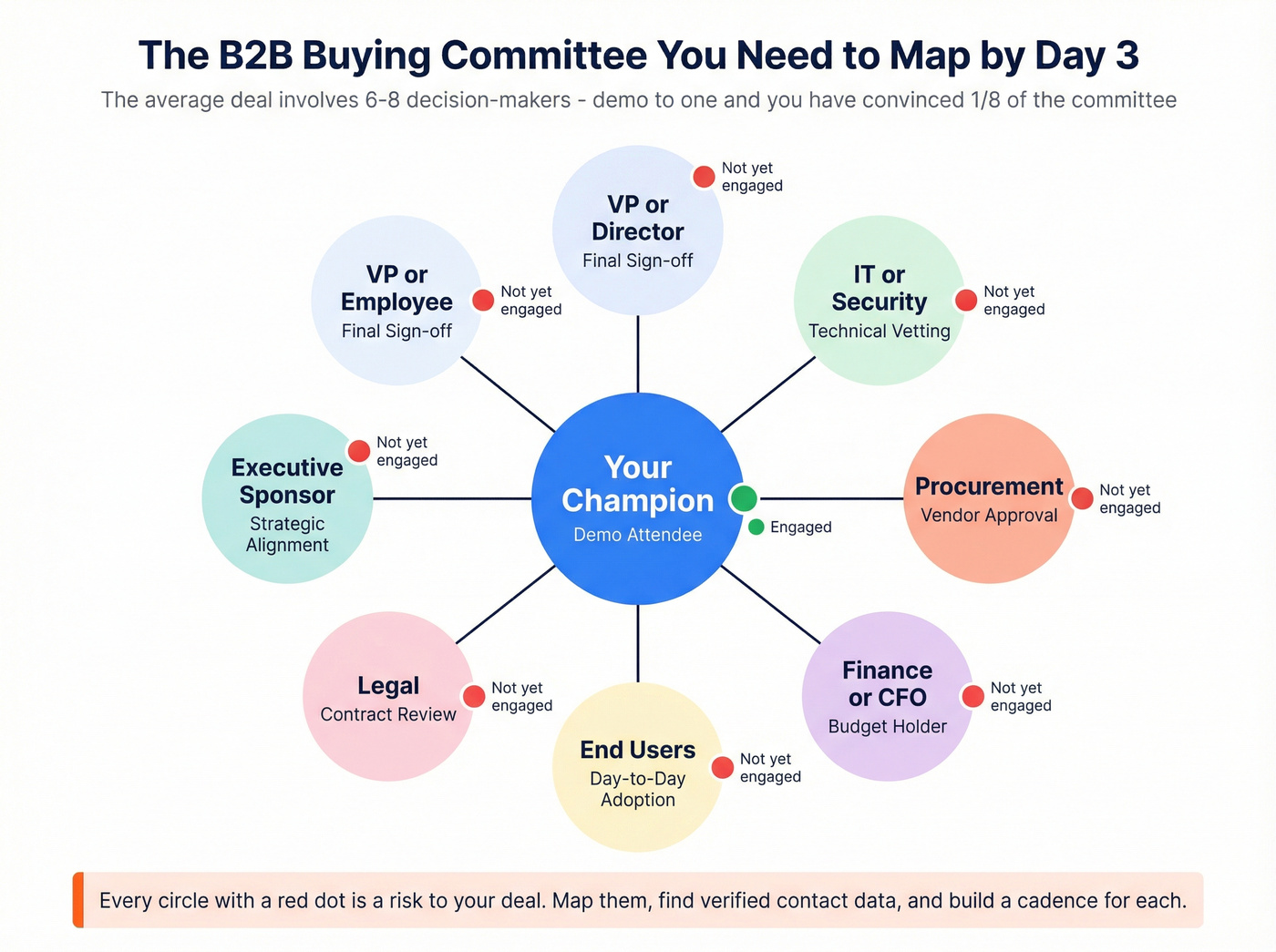
Map the full committee by Day 3. Five questions to ask your primary contact - ideally on the demo itself, but no later than your Day 1 follow-up call:
- "Who else will be involved in making the final decision?"
- "Is anyone from procurement, finance, or IT going to weigh in?"
- "Are there team leads or managers who'll need to sign off?"
- "What does your internal approval process typically look like?"
- "Have you bought something similar before? How was that decision made?"
These aren't aggressive. They're professional. And they surface the people who'll kill your deal in week 6 if you don't engage them in week 1.
Arming Your Champion
Here's a scenario that plays out constantly: your champion loves the product and wants to push it through. Their VP asks "how does this compare to [competitor]?" Your champion fumbles, makes something up, and the deal stalls for two weeks while they "do more research."
Don't let that happen. Give your champion everything they need to sell without you in the room. Share the demo recording immediately - most champions won't schedule a second demo for their boss, they'll forward a link. Build an internal-selling kit with a one-page summary, a relevant case study from a similar company, and an ROI calculator pre-filled with their numbers. Always provide a competitive comparison table. If you don't arm them with a side-by-side, they'll build one themselves - and they'll get it wrong. (This is also where sales collaboration processes help.)

You just mapped 6-8 stakeholders on the buying committee. Now you need verified emails and direct dials for every single one. Prospeo gives you 98% accurate emails and 125M+ verified mobile numbers - so your post-demo cadence actually reaches the people who decide.
A bounced follow-up kills more deals than a bad demo.
No-Show Recovery
A Reply.io analysis of 2,900 meetings found the average demo no-show rate is 13.3%. The variance based on scheduling delay is dramatic:
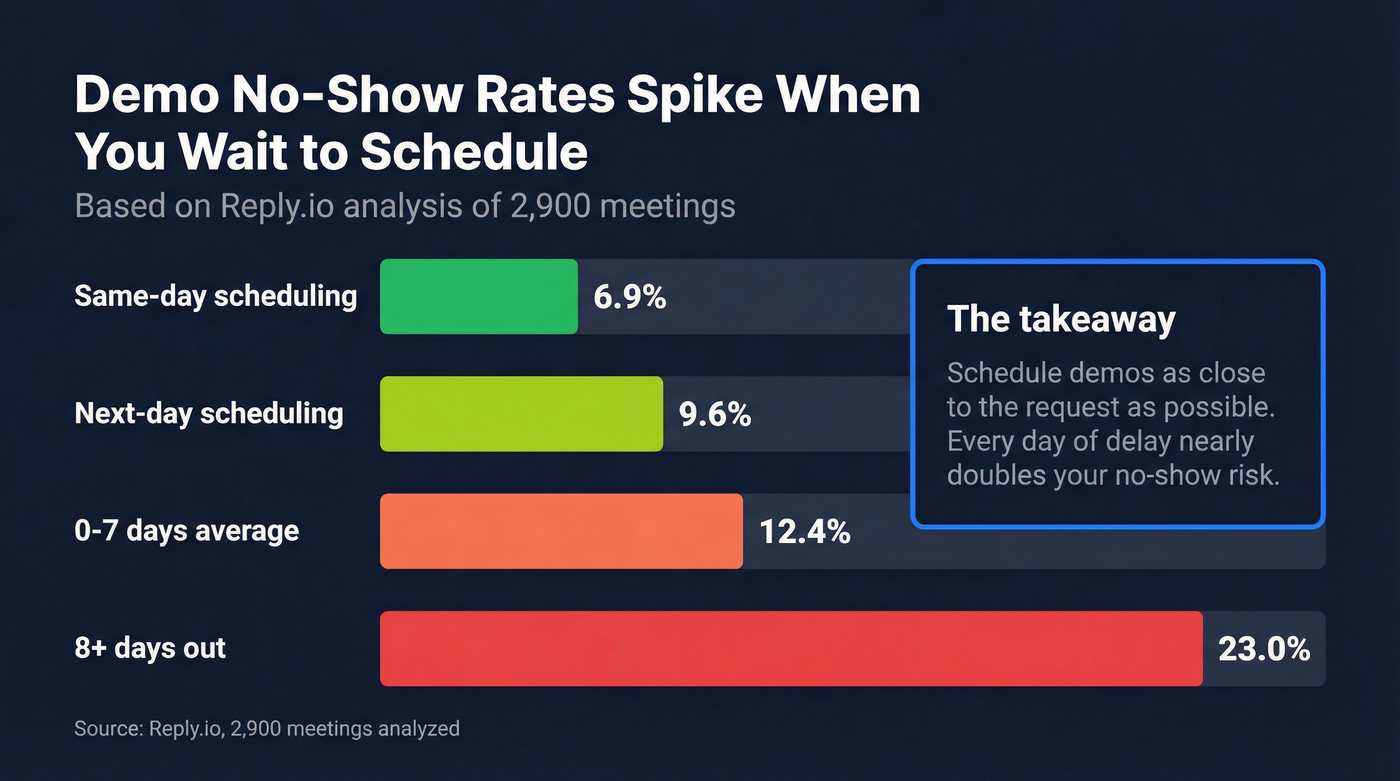
| Scheduling Delay | No-Show Rate |
|---|---|
| Same-day | 6.9% |
| Next-day | 9.6% |
| 0-7 days avg | 12.4% |
| 8+ days out | 23.0% |
Prevention is straightforward: schedule demos as close to the request as possible, and send at least three reminders - immediately after booking, one day before, and 30 minutes before. (If you need better booking language, use these schedule meeting email examples.)
When someone doesn't show, don't take it personally and don't wait. Send a brief, no-guilt email within 30 minutes: "Hey [Name], looks like something came up. No worries - here's a link to rebook at a time that works better." Include two or three specific time slots. If they don't rebook within 48 hours, call. Most no-shows aren't rejection. They're scheduling chaos.
Post-Demo Data Hygiene
This is the section nobody writes about, and it's where we've seen more deals die than anywhere else.
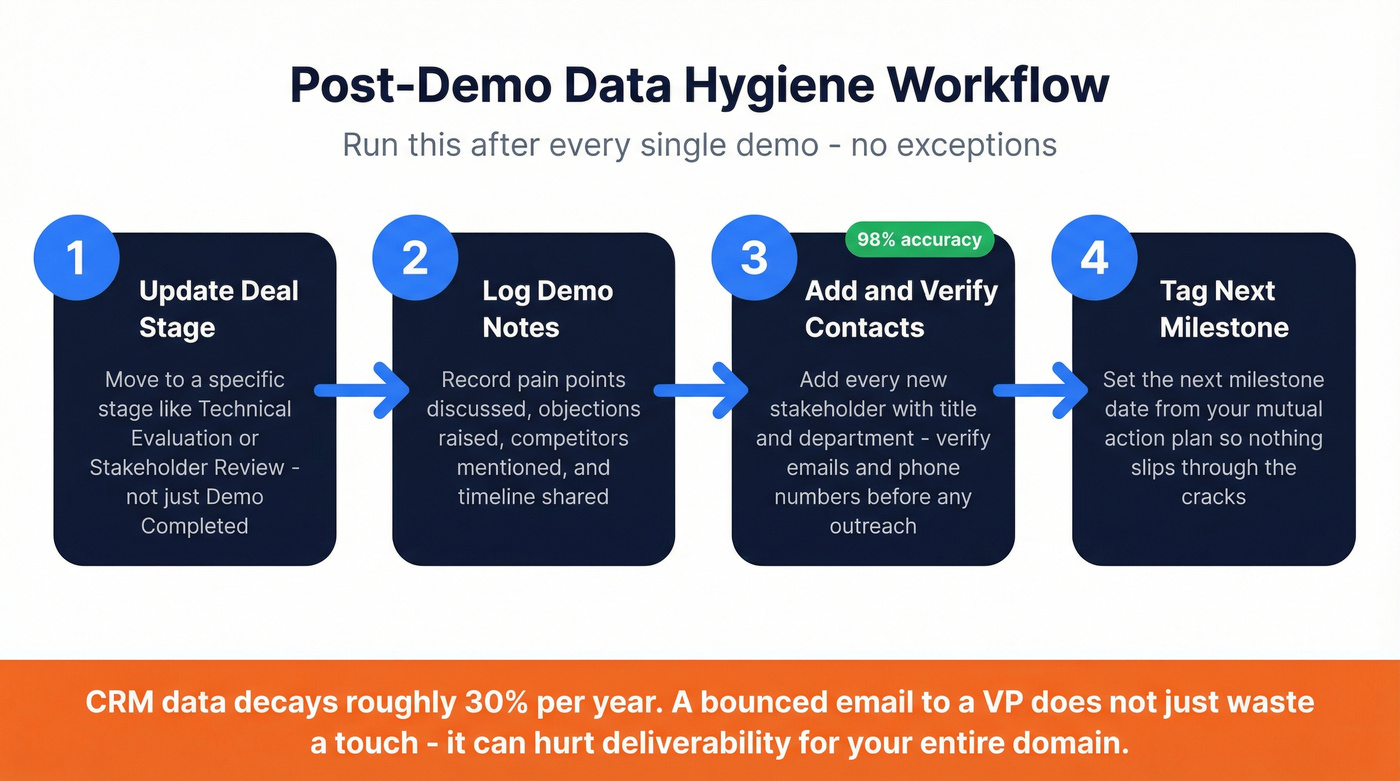
CRM data decays roughly 30% per year. People change jobs, get promoted, switch email addresses. The stakeholder your champion just introduced you to? There's a real chance the email in your CRM is outdated, the phone number routes to a general line, or the contact record is a duplicate from a stale import. (More on this in B2B contact data decay.)
Before you launch a sequence to 6 stakeholders, verify every email and phone number. A bounced email to the VP of Engineering doesn't just waste a touch - it signals to their mail server that you're untrustworthy, which can hurt deliverability for your entire domain. We run every new stakeholder contact through Prospeo's real-time verification before adding them to any sequence. At 98% email accuracy with a 7-day data refresh cycle, it catches dead addresses before they damage your sender reputation.
Beyond verification, here's the data hygiene workflow you should run every time:
- Update the deal stage in your CRM immediately after the demo. "Demo completed" isn't a stage - use something specific like "Technical Evaluation" or "Stakeholder Review."
- Log demo notes with the specific pain points discussed, objections raised, and competitive mentions.
- Add every new stakeholder as a contact, enriched with title, department, and verified contact info.
- Tag the opportunity with the next milestone date from your mutual action plan. (If you need a broader system, follow a CRM hygiene checklist.)
Multi-threading a deal means nothing if half your emails bounce. Prospeo's 7-day data refresh cycle ensures the contact data you pull on Day 1 is still accurate on Day 14 - across every stakeholder, every channel, every touchpoint in your post-demo sequence.
Stop losing deals to stale data. Start at $0.01 per verified email.
Internal Review & Debrief
The MEDDIC Post-Demo Checklist
MEDDIC isn't just a qualification framework - it's the best debrief structure we've found for post-demo analysis. After every demo, run through these before you do anything else:
- Metrics: Can you quantify the prospect's pain in their language? "$200K/quarter lost to manual data entry" is MEDDIC-ready. "They seemed interested" is not.
- Economic Buyer: Do you know who signs the check? If you demoed to a director, the VP or C-suite is the economic buyer. Have you confirmed this?
- Decision Criteria: What are they evaluating on - price, integration, time-to-value? If you don't know, you can't win.
- Decision Process: What happens between "we like it" and "we're buying it"?
- Identify Pain: Can you articulate their pain clearly enough to repeat it to a stranger?
- Champion: Who inside the account is actively selling for you? If the answer is "nobody yet," that's your #1 priority.
Most reps treat MEDDIC as a top-of-funnel exercise and abandon it after qualification. The best reps re-qualify after every single interaction. SPIN Selling was built on 35,000+ sales calls, and the Challenger Sale studied 6,000 reps across 90 companies. The common thread? Top performers qualify rigorously throughout the deal, not just at the beginning.
The 10-Minute Team Debrief
Four questions, 10 minutes - do this after every demo, solo or with your SE:
- What went well? Specific moments, not "it went fine."
- What was unclear to the prospect? Where did they hesitate or go quiet?
- What objections surfaced, and did we handle them or defer them?
- What's the biggest risk to this deal right now?
Use conversation intelligence tools like Gong or Fireflies to review the recording. You'll catch things you missed live - a hesitation before the pricing question, a competitor name dropped casually that you didn't write down.
Post-Demo Surveys
Most teams skip surveys entirely after a demo. That's a mistake.
The right framework is transactional NPS: a quick pulse after a specific interaction, not a quarterly relationship survey. Send it within 30 minutes of the demo while memory is fresh, keep it to 1-2 questions max, and use skip logic so promoters get a different follow-up than detractors. Good questions to test:
- "On a scale of 0-10, how likely are you to recommend [Product] to a colleague?"
- "What feature or capability stood out most?"
- "Was there anything we didn't cover that you expected to see?"
Run these consistently. Expect around a 15-25% response rate on a single-question survey - low volume, but the signal-to-noise ratio is excellent.
Tools for Post-Demo Execution
You don't need a 12-tool stack. You need the right tool in each category, configured to talk to each other.
| Category | Tool | Approx. Price |
|---|---|---|
| Digital Sales Rooms | Flowla, Trumpet, Dock | Free tiers; paid ~$25-50/user/mo |
| Conversation Intel | Gong | ~$100-150/user/mo |
| Conversation Intel | Fireflies, Otter.ai | From ~$19/mo |
| Scheduling | Chili Piper, Calendly | Calendly free; Chili Piper ~$30-60/user/mo |
| Contact Verification | Prospeo | Free 75 emails/mo; ~$0.01/email |
| CRM | Salesforce, HubSpot | HubSpot free; Salesforce from ~$25/user/mo |
The one category most teams underinvest in is contact verification. Skip it if you're only emailing one person at a known-good address. For everyone else - especially when you're building sequences across a 6-person buying committee - verified data is the difference between a cadence that runs and one that bounces.
Benchmarks Cheat Sheet
Keep these numbers handy. They're your baseline for diagnosing where deals are leaking.
| Metric | Benchmark |
|---|---|
| Lead qualification rate | 60-70% healthy; 80%+ great |
| Demo-to-meeting conversion | 50-60% typical; 70%+ exceptional |
| Form fill to booked meeting | ~30% avg; 66.7% with instant scheduling |
| Demo no-show rate | 13.3% average |
| No-show (same-day booking) | 6.9% |
| No-show (8+ day delay) | 23.0% |
| Decision-makers per deal | 6-8 |
| Demo-to-close rate | 15-30% mid-market SaaS |
FAQ
How quickly should I follow up after a demo?
Within 15 minutes. Memory fades fast, and speed signals urgency. The best reps have a template ready before the demo starts - they fill in specifics and hit send immediately. Fast follow-up is the single biggest lever for improving your close rate.
What should a follow-up email include?
Three bullet-point takeaways tied to the prospect's pain, one relevant resource, a confirmed next step with a specific date, and a clear call to action. Keep it under 200 words.
What's a good demo-to-close conversion rate?
15-30% for mid-market SaaS is typical. Demo-to-meeting conversion of 60-70% is strong. If your close rate is below 15%, the issue is usually follow-up execution and stakeholder coverage, not the demo itself.
How do I re-engage a prospect who went silent?
Switch channels - call if email isn't working, try social if calling fails. Lead with new value like a case study, benchmark, or competitive insight, not "just checking in." Give them a reason to respond, not just a reminder you exist.
How do I make sure my follow-up emails actually reach stakeholders?
Verify every email address with a real-time verification tool before sending. One bounced email to a key decision-maker can stall an entire deal for weeks, and repeated bounces damage your domain reputation across the board.