

50+ Re-Engagement Email Subject Lines (Plus the Strategy Most Guides Skip)
You just exported your "inactive 90+ days" segment. That's where re-engagement email subject lines get real - around 25-30% of an email list goes inactive every year, and the number compounds fast if you haven't cleaned house in a while.
Here's the uncomfortable truth most guides skip: blasting that segment with clever subject lines and no sending strategy is how you tank your sender reputation in a single afternoon. 69% of recipients decide whether to mark an email as spam based on the subject line alone, and ISPs are watching what happens next.
You've probably read five articles listing the same 12 subject lines from the same brands. Those work because they're Robinhood or Spotify. You need win-back subject lines that work without brand equity doing the heavy lifting, plus a deliverability playbook that keeps you out of spam while you run them.
The Short Version
- Permission-based subject lines pull 30% higher opens than traditional re-engagement approaches. Lead with those, not "we miss you."
- Verify your list and throttle volume before you hit send. Old segments are loaded with dead addresses, spam traps, and honeypots. One bad blast can damage your domain for weeks.
- Jump straight to the 50+ subject line swipe file or the 4-email sequence blueprint if you already know the basics.
What Makes a Win-Back Subject Line Work
Three things separate subject lines that get opened from ones that get flagged.
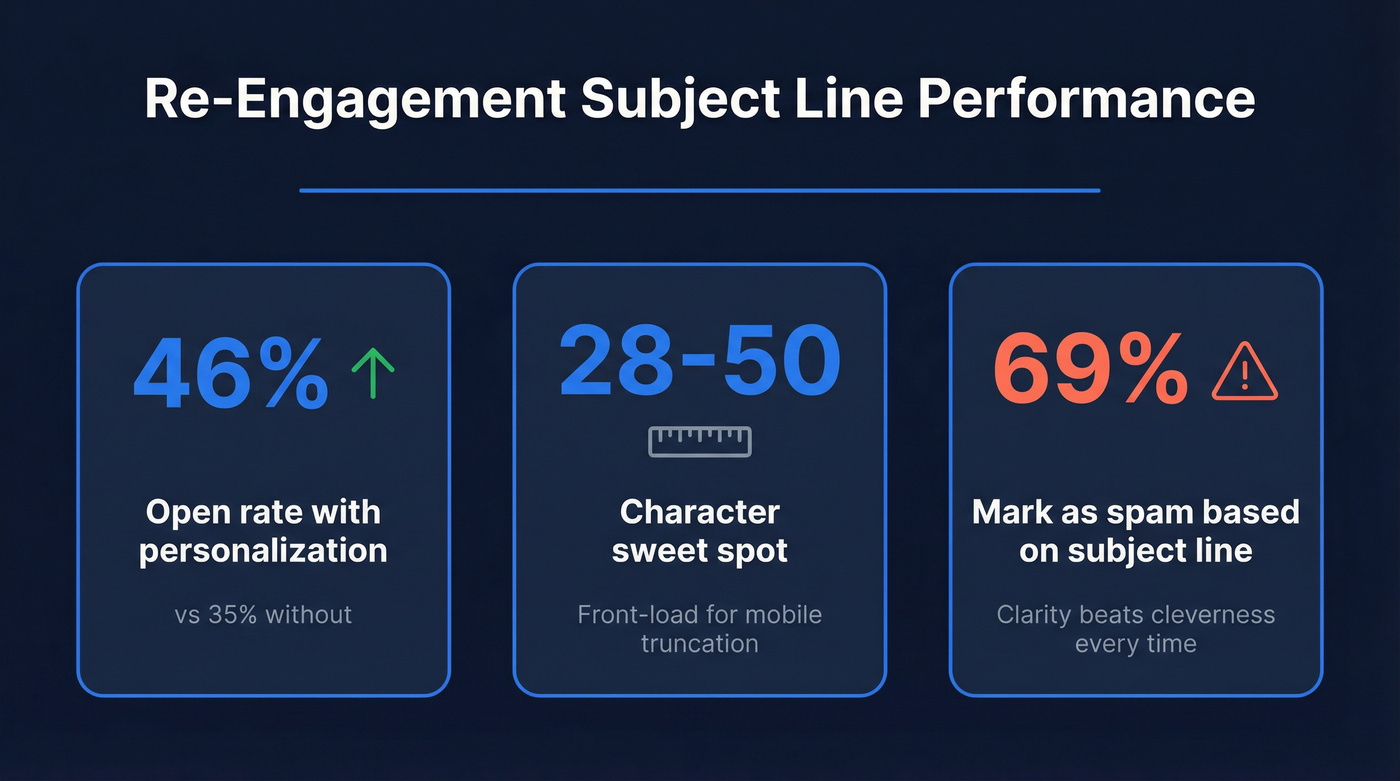
Personalization matters more than cleverness. Personalized subject lines hit a 46% open rate versus 35% without. Even a first name token or a reference to their last purchase changes the math. We've seen teams spend weeks workshopping "creative" copy when simply adding {{first_name}} would've moved the needle more. (If you want more examples, borrow a few patterns from these outreach email templates.)
Length has a sweet spot. The data points to 28-50 characters - aim for 3-5 words for the core hook, plus a personalization token if you're using one. Mobile email clients often show around 40 characters before truncating, so front-load the important stuff.
Clarity beats cleverness every time. That 69% spam-marking stat isn't just about "bad" subject lines - it's about confusing ones. If your subscriber can't tell within two seconds why you're emailing them, you've lost. "Are you still interested?" beats "Something special inside!" for an audience that's already tuned you out.
50+ Re-Engagement Subject Lines by Category
Permission Pass / Confirmation
This is the highest-performing category. Permission-pass subject lines pull 30% higher opens than traditional approaches because they flip the power dynamic - you're asking the subscriber to decide, not begging them to come back.
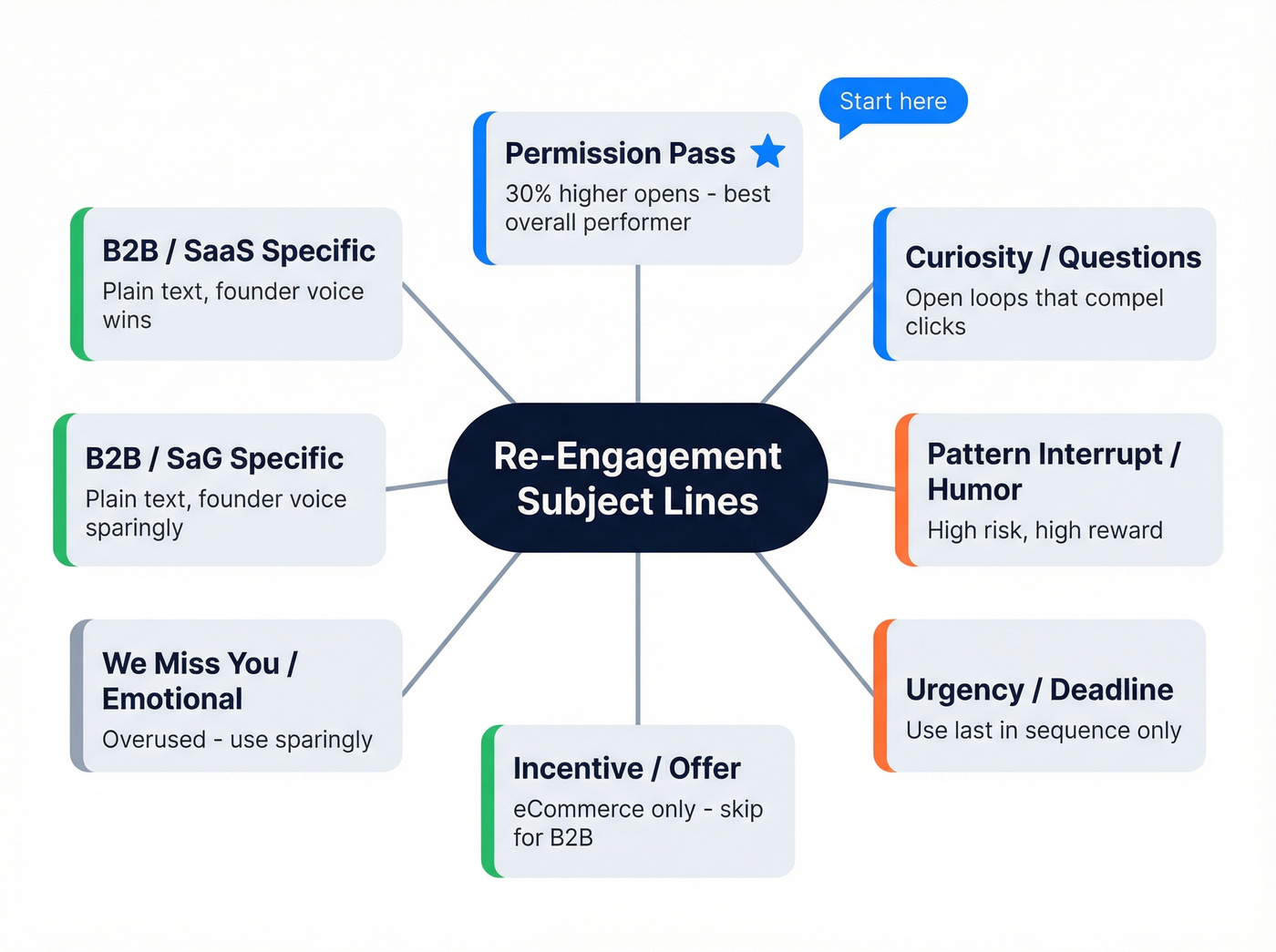
Best for: Every industry, every list size. If you only send one re-engagement email, make it a permission pass.
- "Still want emails from us?" - Direct, zero ambiguity. Works for every industry.
- "Should we keep sending?" - Slightly softer. Good for B2B where the relationship matters.
- "Your call, {{first_name}} - stay or go?" - Personalization plus autonomy.
- "Quick opt-in check" - Short, functional, curiosity-inducing.
- "We need a yes or no" - Blunt. Works for brands with a direct voice.
- "Confirm you still want these" - Frames it as housekeeping, not a guilt trip.
- "One click to stay on the list" - Clear CTA embedded in the subject line itself.
Curiosity / Question-Based
Curiosity works because it creates an open loop the subscriber wants to close. The key is making the question feel relevant, not clickbaity. Skip this category if your brand voice is formal or corporate - questions like "Did we do something wrong?" can land wrong in that context.
- "What changed?" - Two words. Implies you noticed their absence without being needy.
- "Quick question about your account" - Triggers the "did something happen?" instinct.
- "Did we do something wrong?" - Self-deprecating, disarming.
- "{{first_name}}, noticed anything different?" - Vague enough to compel a click.
- "Can we ask you something?" - Conversational. Works well in plain-text format.
- "What would bring you back?" - Honest, and the replies give you actual intel.
- "Are we sending too much?" - Addresses the most common reason people disengage.
Pattern Interrupt / Humor
Humor is high-risk, high-reward. It works when your brand voice supports it. It falls flat when a B2B SaaS company suddenly tries to be funny for the first time in 200 emails.
| Subject Line | Tone | Works For | Avoid If |
|---|---|---|---|
| "This is awkward" | Self-aware | Any brand with a human voice | Highly regulated industries |
| "We'll stop being weird now" | Meta-humor | DTC, consumer apps | First-time humor attempts |
| "Remember us?" | Light, emoji-driven | DTC, younger audiences | B2B enterprise |
| "Plot twist: we still exist" | Deadpan | Brands with long send gaps | Weekly senders |
| "Is it us? It's probably us." | Self-deprecating | Playful brands | Formal B2B |
| "Breaking up is hard" | Classic breakup framing | Broad appeal | Overused - test carefully |
If you want one pattern interrupt to test, "This is awkward" is the strongest: two words, zero fluff, and it sounds like something a person would actually say. (If you want more options in the same vibe, pull a few from these funny email openers.)
Urgency / Deadline-Driven
Urgency works when it's real. "Last chance!" with no actual consequence is spam. "We're removing you in 48 hours" with an actual sunset policy is honest and effective.
When NOT to use this: as your first email in a sequence. Urgency belongs at the end, after you've given the subscriber a reason to care.
- "Last email unless you say otherwise" - Clear consequence. Respects their time.
- "Removing you in 48 hours" - Specific deadline creates genuine urgency.
- "Your subscription expires Friday" - Date-specific. Feels administrative, not salesy.
- "Final check-in before we part ways" - Warm but firm. Good for the last email in a sequence.
- "We're cleaning our list - are you in?" - Honest framing. Subscribers respect transparency.
- "Last call, {{first_name}}" - Personalized urgency. Short and effective.
Incentive / Offer-Based
Incentives work for eCommerce - they're table stakes for DTC re-engagement. For B2B, skip this category entirely.
- "Come back for 20% off" - Direct. No games. The discount does the work.
- "A little something to welcome you back" - Softer framing for premium brands.
- "Free shipping on your next order" - Free shipping often outperforms percentage discounts in eCommerce.
- "{{first_name}}, this code expires Sunday" - Combines personalization, incentive, and urgency.
- "Exclusive: early access just for you" - FOMO without a discount. Good for product launches.
- "We saved something for you" - Curiosity plus implied exclusivity.
"We Miss You" / Emotional Appeal
Let's be honest: this is the most overused category. Every re-engagement guide leads with "we miss you" subject lines. They're table stakes, not a strategy. Use one as a single email in a sequence, not your entire approach.
- "We miss you, {{first_name}}" - It works. It's just not original.
- "It's been a while" - Low-effort but functional.
- "Things aren't the same without you" - More emotional. Works for community-driven brands.
- "Your favorites are waiting" - eCommerce-specific. Pairs well with dynamic product blocks.
B2B and SaaS Re-Engagement
Discount codes don't work when your buyer is a VP of Engineering. B2B re-engagement needs a completely different playbook - SaaS email is about educating and nurturing over time, not selling fast with promos. The consensus on r/sales and r/emailmarketing is that plain-text founder emails consistently outperform designed HTML re-engagement campaigns in B2B. Your subject lines should reflect that. (For a deeper pipeline-first approach, see B2B lead re-engagement.)
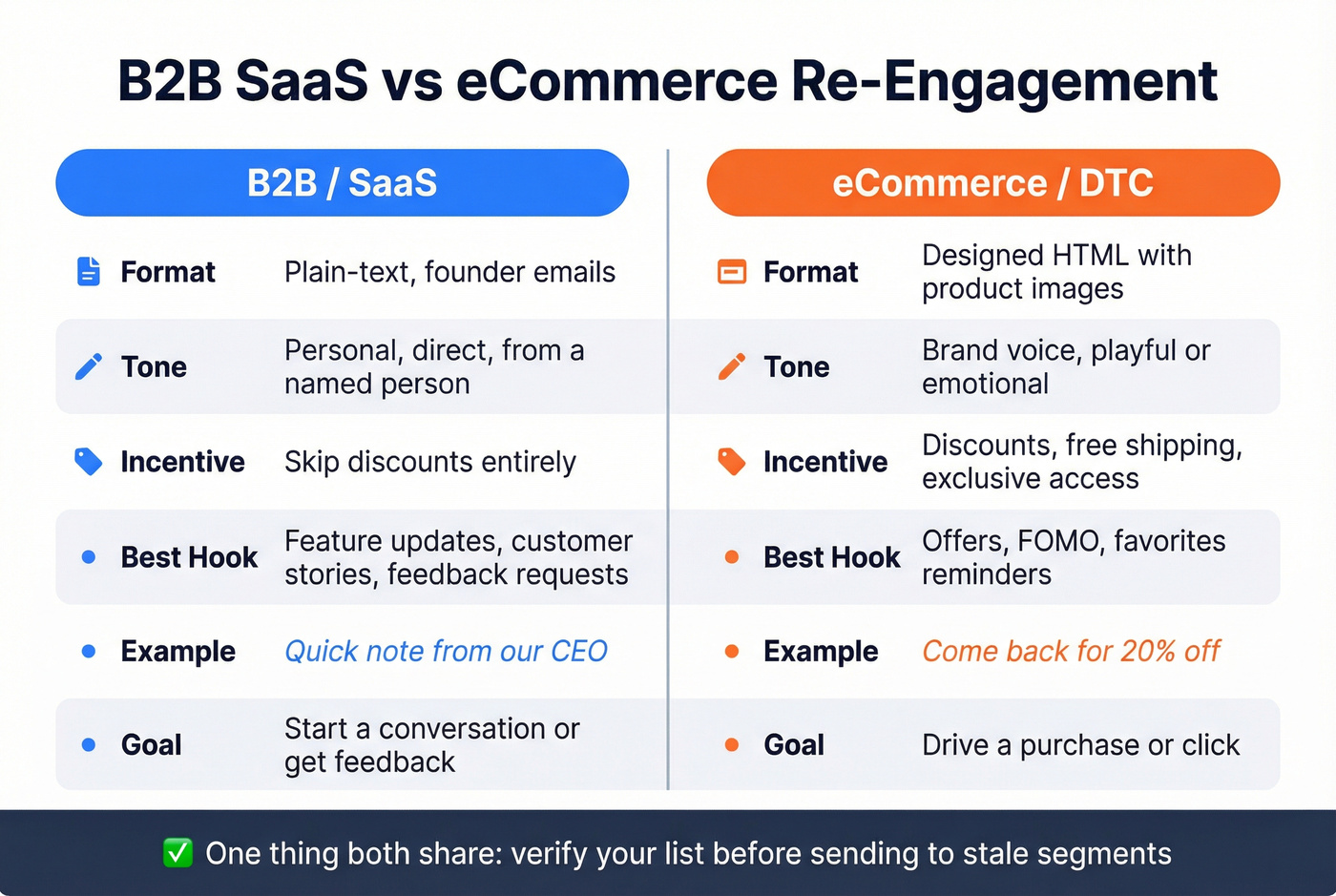
Founder plain-text angle:
- "Quick note from our CEO" - Plain-text, personal, no design. Feels like a real email.
- "{{first_name}}, can I get your honest feedback?" - Invites a reply. The replies are gold for product teams.
- "I noticed you haven't logged in" - Direct, from a named person, not a brand.
Feature update angle:
- "We shipped 3 things you asked for" - Implies you listened. Powerful for churned users.
- "{{Company}} just got a major upgrade" - Product news as re-engagement.
- "New in {{Product}}: [specific feature]" - Specificity signals substance, not fluff.
Customer story angle:
- "How {{customer}} cut their [metric] by 40%" - ICP-aligned testimonial in subject line form.
- "{{Similar company}} just switched back" - Social proof plus implied FOMO.
Usage reminder angle:
- "Your {{Product}} account is still active" - Gentle nudge. No pressure.
- "You're missing [specific feature] in your plan" - FOMO for paid features, great for freemium re-engagement.

You're about to blast an inactive segment - but how many of those emails are still valid? Old lists are loaded with dead addresses and spam traps. Prospeo's 5-step verification catches them before they wreck your sender reputation, delivering 98% email accuracy with catch-all handling and honeypot removal built in.
Clean your re-engagement list before you hit send, not after the damage is done.
The 4-Email Re-Engagement Sequence
Individual subject lines don't work in isolation. You need a sequence, and the spacing matters as much as the copy. (If you want a broader framework, map this to your lead nurturing strategy.)
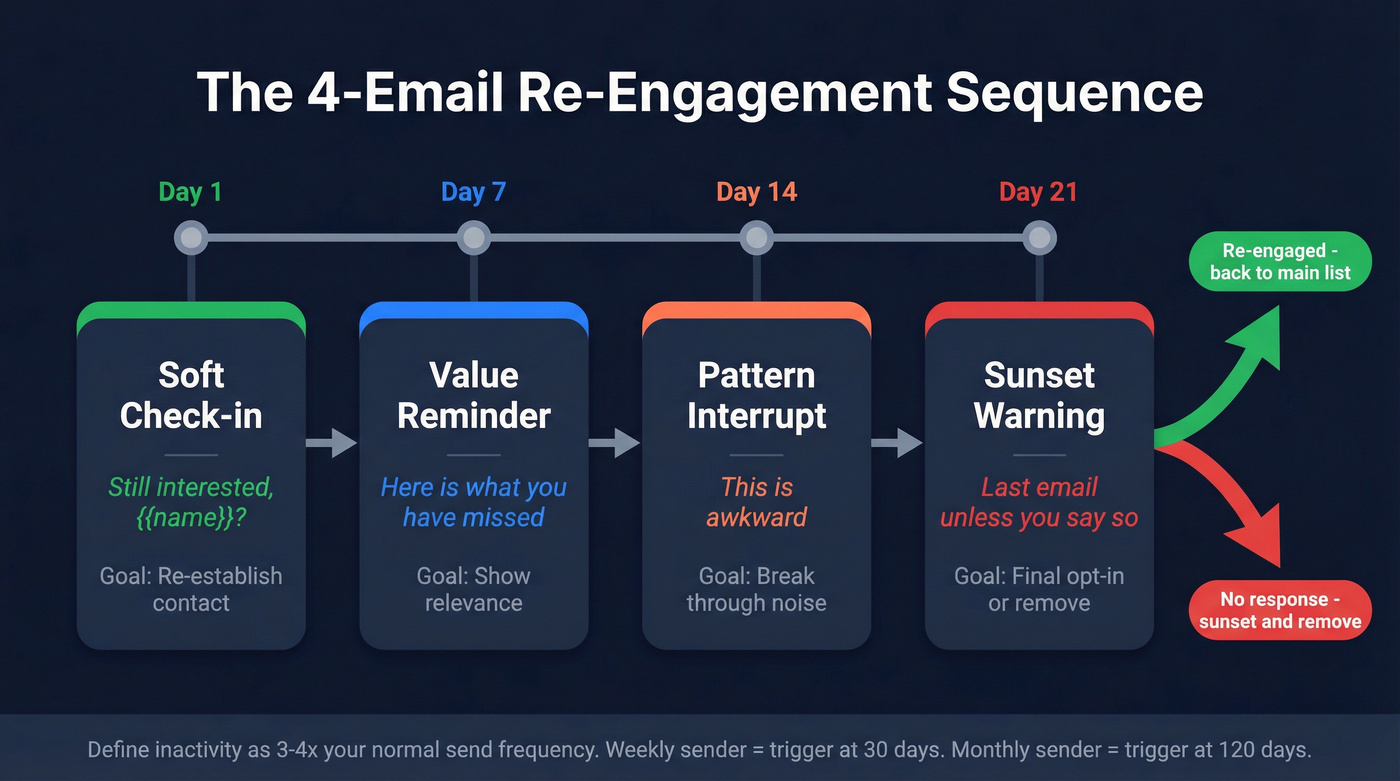
| Day | Purpose | Subject Line Example | Goal |
|---|---|---|---|
| 1 | Soft check-in | "Still interested, {{name}}?" | Re-establish contact |
| 7 | Value reminder | "Here's what you've missed" | Show relevance |
| 14 | Pattern interrupt | "This is awkward" | Break through noise |
| 21 | Sunset warning | "Last email unless you say so" | Final opt-in or removal |
The critical piece most guides skip is defining your inactivity threshold correctly. The formula: define inactivity as 3-4x your normal send frequency. Weekly sender? Trigger your re-engagement sequence at around 30 days of no opens or clicks. Monthly sender? Wait around 120 days. Triggering too early annoys active-but-busy subscribers; triggering too late means you're emailing addresses that have already gone cold.
Keep the sequence to 3-4 emails max. After that, non-responders move to a sunset segment. Continuing to email people who've ignored four attempts hurts your sender reputation more than losing the subscriber ever will.
Our team has watched companies agonize over subject line copy when the real problem is sequence timing. One team A/B tested 15 subject line variants while sending all four emails in a single week - then wondered why their domain reputation cratered. Get the cadence right first. The subject lines are the easy part.
Sending Without Killing Deliverability
Most re-engagement guides don't mention deliverability, which is borderline irresponsible. A re-engagement campaign sent to an unverified, stale segment is one of the fastest ways to destroy a sender reputation. Here's the playbook. (If you need the full framework, start with an email deliverability checklist.)
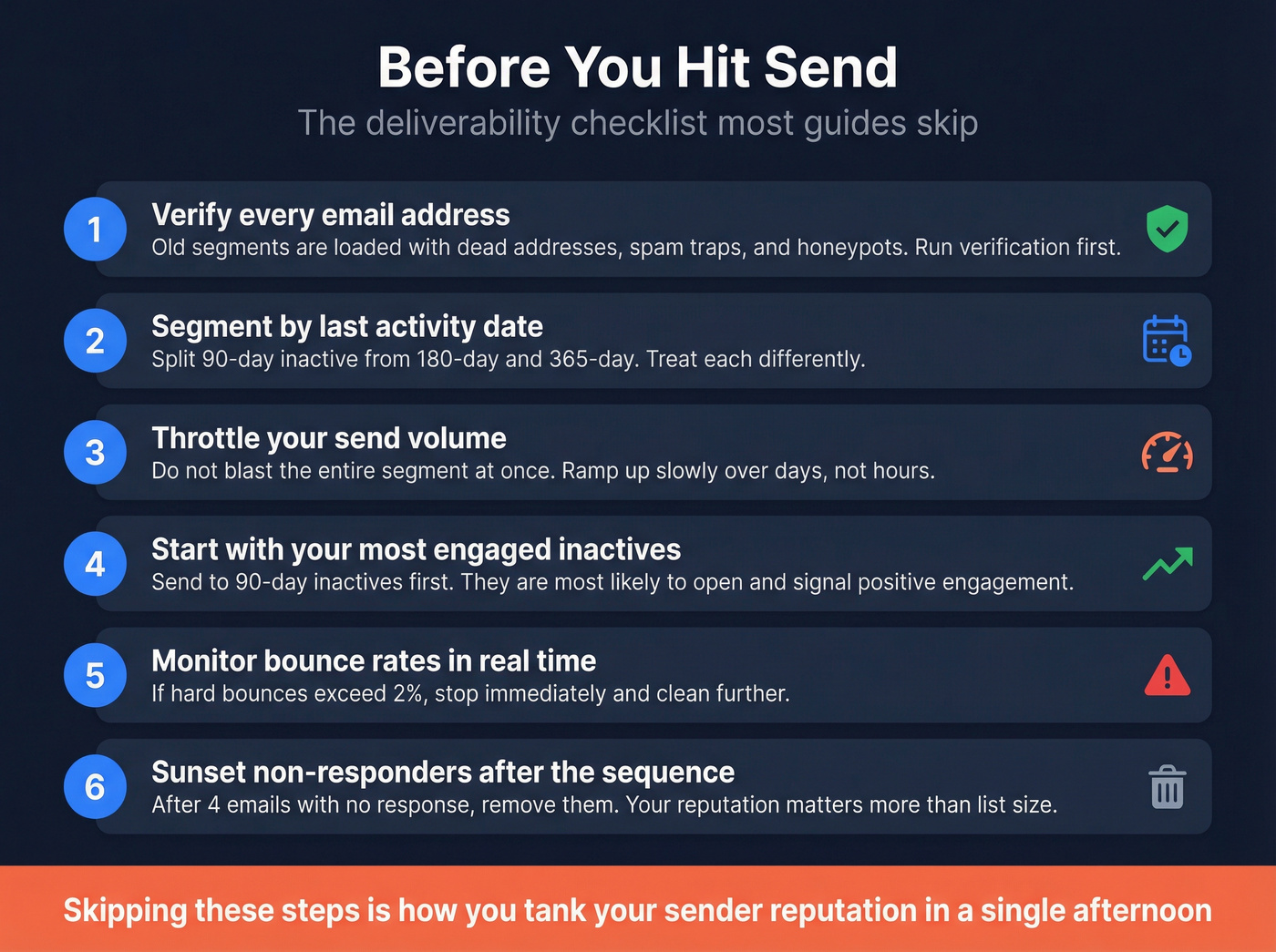
Verify your list first. Non-negotiable. Old segments are riddled with dead addresses, recycled spam traps, and honeypots that ISPs use to catch sloppy senders. Prospeo's 5-step verification process catches invalid addresses, spam traps, and honeypots with 98% accuracy on a 7-day refresh cycle. The free tier gives you 75 verifications to start, no sales call required. (If you're comparing tools, see our roundup of the best email checker tools.)
Follow the 90/10 rule. Your re-engagement volume should be 10% or less of your daily engaged volume. If you normally send to 50,000 engaged subscribers per day, cap your re-engagement sends at 5,000.
Blend your audiences. Don't send re-engagement emails in isolation. Pair them with sends to your engaged segment using a 70/30 ratio - 70% engaged, 30% unengaged. This signals positive engagement to inbox providers and cushions the impact of lower open rates from your inactive segment.
Exclude hard bounces and spam complainers immediately. If someone previously hard bounced or marked you as spam, they don't belong in a re-engagement campaign. They belong on a suppression list. No exceptions.
Don't touch 2+ year inactive contacts. If someone hasn't opened an email from you in two years, that address is either dead, a spam trap, or belongs to someone who genuinely doesn't want to hear from you. Customer.io prohibits re-engaging these addresses in their anti-spam policy, and most ESPs have similar guardrails.
How to A/B Test Subject Lines
Testing re-engagement subject lines is tricky because your sample sizes are smaller and your audience is inherently less responsive.
Test personalization versus no personalization first. It's the single biggest lever. Personalized CTAs outperform generic ones by 22%, and adding industry-based personalization can lift CTR by 19%. Before you test humor versus urgency, lock in whether personalization moves the needle for your specific audience. (If you want a system for scaling this, use a personalization in outbound sales framework.)
Aim for 1,000+ recipients per variant to get statistically meaningful results. If your inactive segment is 3,000 people, you can test two variants. If it's 800, skip the A/B test and go with your best judgment - the sample is too small for the data to mean anything.
Permission-pass subject lines consistently boost opens by 30% over traditional approaches. If you're only running one test, pit a permission pass subject line against your current best performer. That's where the biggest lift usually hides.
Lead with a permission pass, not a discount. Incentive-first re-engagement attracts opens from deal-seekers who go inactive again immediately. Permission-first re-engagement retains subscribers who actually want your content.
One more thing: if your inactive segment is old and hasn't been verified recently, run it through verification before launching your test. Bad addresses skew your open rate data and make your test results meaningless. (Related: email validity check workflows.)
When to Stop - The Sunset Decision
Remove immediately: Hard bounces, spam complaints, and any address that fails verification. These aren't re-engagement candidates - they're liabilities.
Remove after your sequence: Contacts who've been inactive 12+ months and didn't respond to your 3-4 email sequence. They're gone. Accept it.
Sunset at 6 months: If a subscriber hasn't engaged within 6 months of your re-engagement attempt, stop marketing to them until they explicitly re-opt in. Keep them in your database if you want, but remove them from active sends.
Look, I get it - you paid to acquire those contacts. That sunk cost feels real. But dead weight on your list hurts more than the loss. Every unengaged subscriber drags down your open rates, damages your sender reputation, and makes your engaged subscribers less likely to see your emails in their inbox. A smaller, cleaner list outperforms a bloated one every single time.
Some contacts won't re-engage because they've changed jobs - not because they lost interest. Prospeo's database refreshes every 7 days and tracks job changes across 300M+ profiles, so you can find their new work email and restart the conversation where it matters.
Stop emailing dead inboxes. Find where your contacts actually work now.
FAQ
How many re-engagement emails should I send before giving up?
Send 3-4 emails spaced over 3-4 weeks, then stop. Move non-responders to a sunset segment and remove them from active sends. Continuing past four attempts hurts your sender reputation more than losing the subscriber.
What's a good open rate for a re-engagement campaign?
Expect single digits to low teens on the first email, declining with each subsequent send. If your first email lands below 3%, your list likely has a deliverability problem - verify addresses before sending the next one.
Should I offer a discount in my re-engagement email?
For eCommerce, yes - incentives often outperform emotional appeals. For B2B and SaaS, skip discounts entirely. Lead with a product update, customer story, or plain-text founder email instead. Discounts in B2B signal desperation and attract the wrong kind of re-engagement.
What's the best subject line for a reconnecting email?
Permission-pass subject lines like "Still want emails from us?" consistently outperform every other category by 30% in open rates. For one-to-one outreach, something conversational like "{{first_name}}, it's been a while - quick catch-up?" works better. Match the tone to the relationship.