

7 Sales Pitch Script Examples Built on Data, Not Guesswork
Close's founder set out to land one paying customer in four weeks using a structured sales pitch script. His team closed seven in fourteen days. That's not luck - that's what happens when you stop winging it and start working from a framework that's been pressure-tested against real conversations.
The average cold call converts at 2.3%. Top teams running structured scripts hit 5-8%. That gap is what a good sales pitch script example can close for you.
What Separates Good Scripts from Forgettable Ones
Three moves:
- Use a reason-based opener. "The reason for my call is..." delivers a 2.1x higher success rate than jumping straight into a pitch. It grounds the conversation and earns you the next ten seconds.
- Lead with outcomes, not features. Nobody cares about your platform's architecture. They care about cutting their pipeline build time in half.
- Verify your contact data before you dial. Scripts are worthless if you're calling dead numbers. Run your list through a verification tool before any campaign goes live.
Anatomy of a Script That Converts
Most high-performing sales scripts follow the same six-part skeleton. The words change, but the structure stays consistent across industries, deal sizes, and channels.
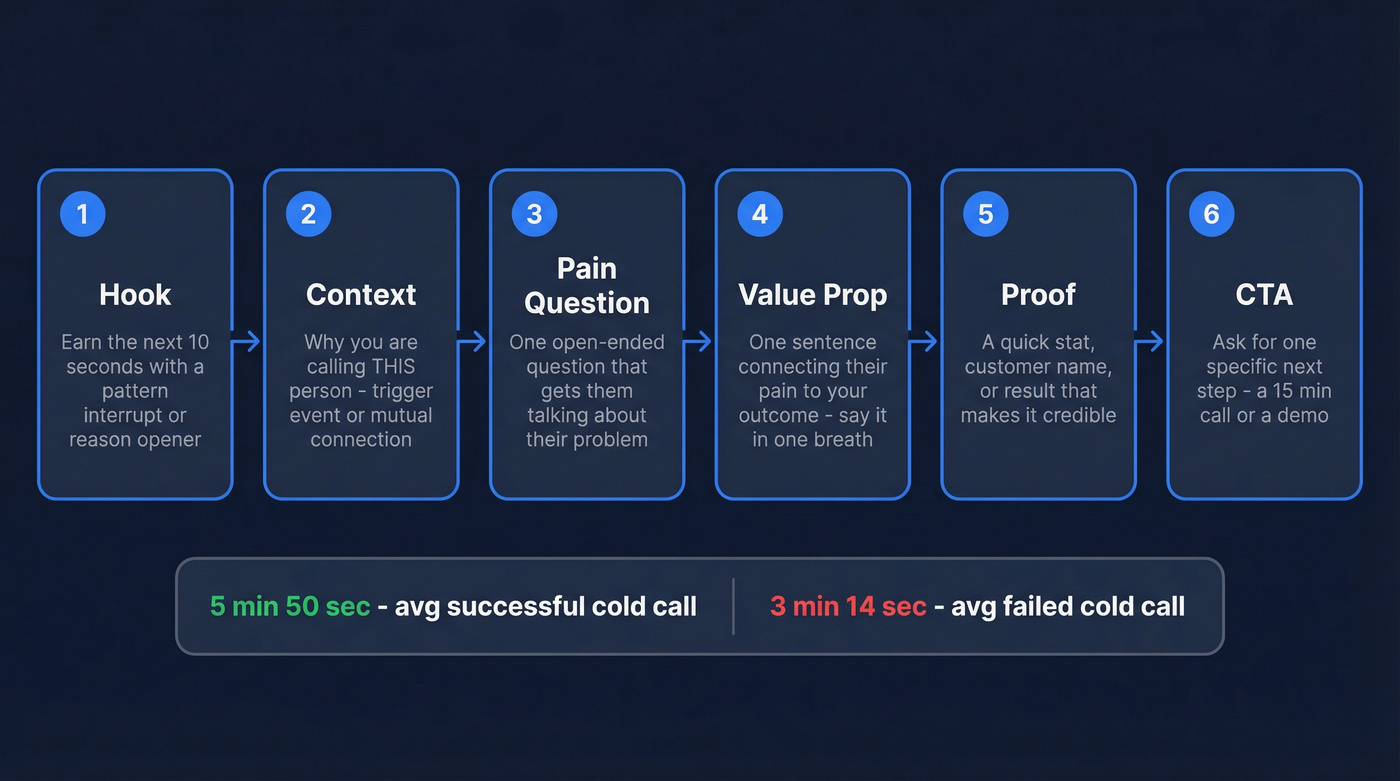
Hook - Your first sentence earns the next ten seconds. Pattern interrupts and reason-based openers work best here. (If you want more data-backed openers, see opening lines.)
Context - Why you're calling this person. A trigger event, a mutual connection, something that proves you didn't pull their name from a random list.
Pain question - One open-ended question that gets the prospect talking about their problem. This is where the call shifts from monologue to conversation. (More examples: open-ended sales questions.)
Value prop - A single sentence connecting their pain to your outcome. Keep it short enough to say in one breath. If you can't say it cleanly, it's too long.
Proof - A quick stat, customer name, or result that makes the value prop credible. "We helped [similar company] cut [metric] by [X%]" is the template.
CTA - Ask for one specific next step. A 15-minute call. A demo. Never leave the close ambiguous.
Successful cold calls average 5 minutes 50 seconds. Failed ones die at 3:14. The six-part framework keeps the prospect engaged long enough to actually have a conversation - and that extra two and a half minutes is where deals get made.
Openers That Actually Work
The first ten seconds determine whether you get a conversation or a dial tone.
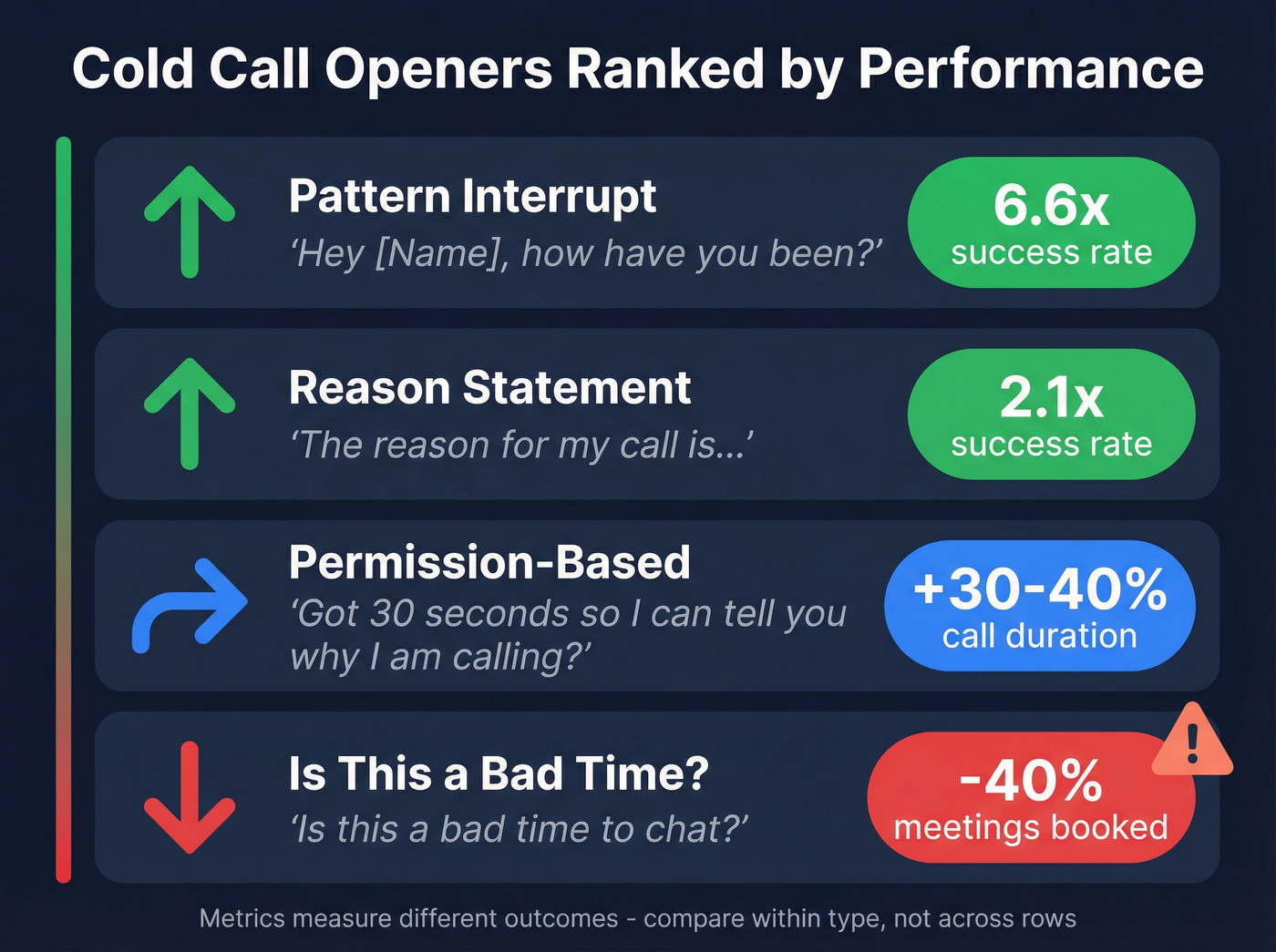
| Opener Type | Example Line | Performance |
|---|---|---|
| Pattern interrupt | "Hey [Name], how've you been?" | 6.6x success rate |
| Reason statement | "The reason for my call is..." | 2.1x success rate |
| Permission-based | "Got 30 seconds so I can tell you why I'm calling?" | +30-40% call duration |
| "Is this a bad time?" | "Is this a bad time to chat?" | -40% meetings booked |
These metrics measure different outcomes - success rate, call duration, and meeting conversion - so compare within type, not across rows.
Let's address the elephant in the room. "Is this a bad time?" shows up in a lot of script templates, including some from reputable companies. But Gong's data is unambiguous: it drops your meeting rate by 40%. It gives the prospect an easy exit before you've said anything of value. Delete it from every script you own.
The permission-based opener is the one we recommend for SaaS environments. It respects the prospect's time while keeping control of the conversation. "Got 30 seconds?" is disarming because it's honest - and most people will give you thirty seconds.
7 Script-by-Script Examples
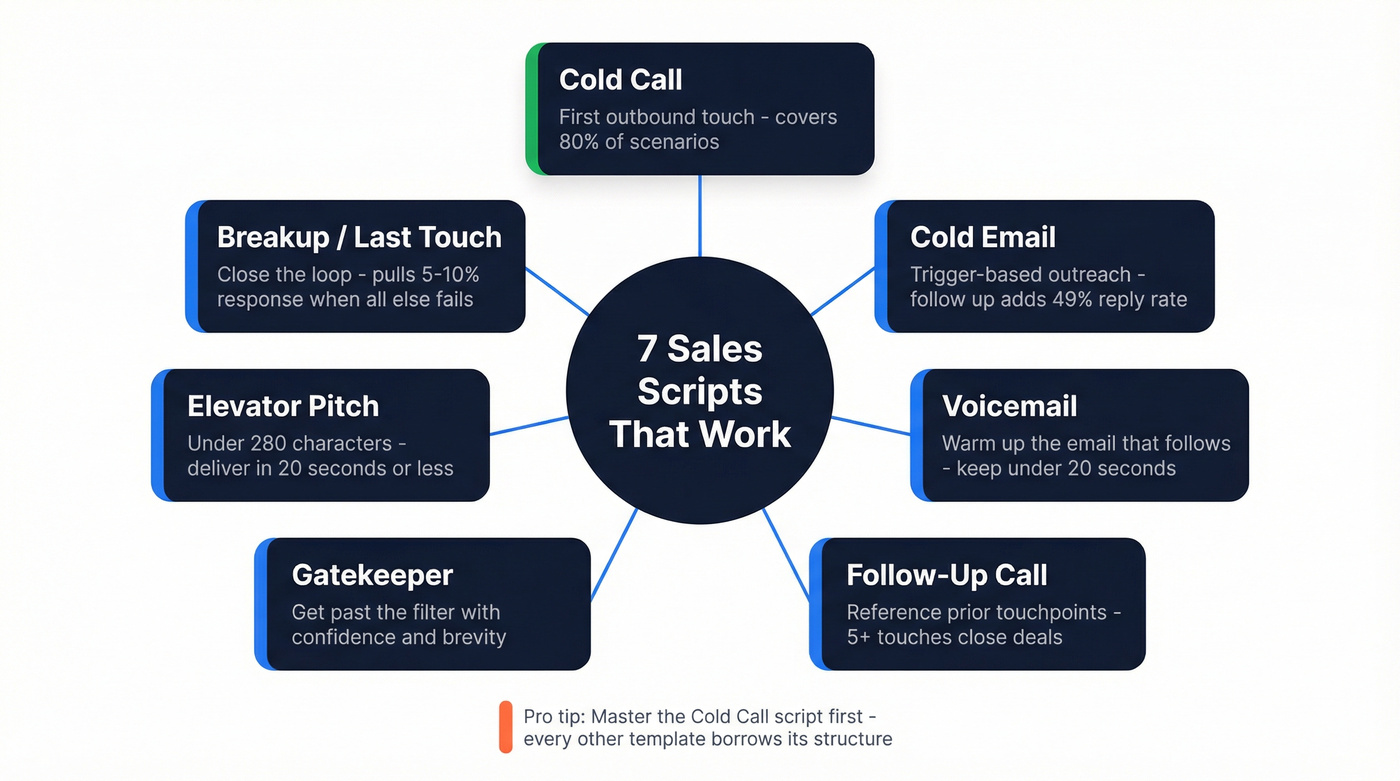
Here's the thing: if you only memorize one script from this list, make it the cold call script. It covers 80% of outbound scenarios and teaches you the structure that every other template borrows from. (For a deeper playbook, use this B2B cold calling guide.)
Cold Call Script
You: "Hey [Name], it's [Your Name] from [Company]. The reason for my call - we help [role/industry] teams [specific outcome], and I noticed [trigger: recent funding, job posting, tech stack change]. Quick question: how are you currently handling [pain point]?"
Prospect: [responds]
You: "That's exactly what we hear from [similar company type]. We helped [Customer] [specific result - e.g., cut ramp time by 40%]. Would it make sense to block 15 minutes this week so I can show you how that'd work for your team?"
The qualifying question in the middle turns a pitch into a dialogue. If the prospect doesn't engage, you know this isn't the right call - and you've saved both of you time. We've tested dozens of variations of this structure across our own outbound campaigns, and the trigger-based opener consistently outperforms generic intros by a wide margin.
Cold Email Script
Subject: [Trigger] + quick question
Hi [Name],
Saw [Company] just [trigger event]. When teams hit that stage, [pain point] usually becomes a bottleneck.
We helped [Customer] [outcome + metric]. Worth a 15-min call this week?
[Your Name]
Your first follow-up alone adds 49% to your reply rate. Don't send one email and call it a day.
Voicemail Script
"Hey [Name], [Your Name] from [Company]. I'm calling because we help [industry] teams [outcome]. I'll shoot you an email with a quick case study - look for it from [your email]. Talk soon."
80% of cold calls go to voicemail. The voicemail isn't meant to close - it's meant to warm up the email that follows. Keep it under 20 seconds.
Follow-Up Call Script
"Hey [Name], following up on [the email I sent / our conversation on Tuesday]. You mentioned [specific detail from prior touchpoint]. I wanted to share one thing that might change how you're thinking about [problem] - got two minutes?"
80% of successful sales require five or more follow-ups. Meanwhile, 48% of reps never follow up once. This is the easiest competitive advantage in sales - just be persistent. The consensus on r/sales is that most reps give up after two touches, which means the third, fourth, and fifth attempts face almost zero competition.
Gatekeeper Script
Two approaches, depending on what you know:
When you have a name: "Hi, it's [Your Name] for [Prospect Name], please." No explanation. No pitch. Confidence and brevity get you through. (More: get past the gatekeeper.)
When you don't: "I'm trying to reach the person who handles [function]. Could you point me in the right direction?"
Skip the elaborate backstory. Gatekeepers hear pitches all day - they're filtering for people who sound like they belong on the other end of the line.
Elevator Pitch Script
"We help [target audience] [achieve outcome] without [common pain]. Our customers typically see [metric] within [timeframe]."
Keep it under 280 characters. If you can't deliver it in 20 seconds, you'll lose people before you finish.
Breakup / Last-Touch Script
"Hey [Name], I've reached out a few times and haven't heard back - totally understand you're busy. I'm going to close out your file on my end. If [pain point] becomes a priority down the road, my door's open. Either way, no hard feelings."
This isn't a guilt trip. It's permission to close the loop. In our experience, breakup emails pull a 5-10% response rate when the rest of the sequence got nothing. The reduced pressure re-engages prospects who were interested but overwhelmed.

You read it above: scripts are worthless if you're calling dead numbers. Prospeo verifies emails at 98% accuracy and delivers 125M+ mobile numbers with a 30% pickup rate - so every script you craft actually reaches a real person.
Stop perfecting scripts for numbers that never connect.
Scripts by Sales Framework
| Framework | Best For | Script Style |
|---|---|---|
| BANT | High-value, long-cycle deals | Qualification-heavy |
| SPIN | Consultative / complex sales | Discovery-driven |
| Challenger | Prospects who don't know they have a problem | Insight-led |
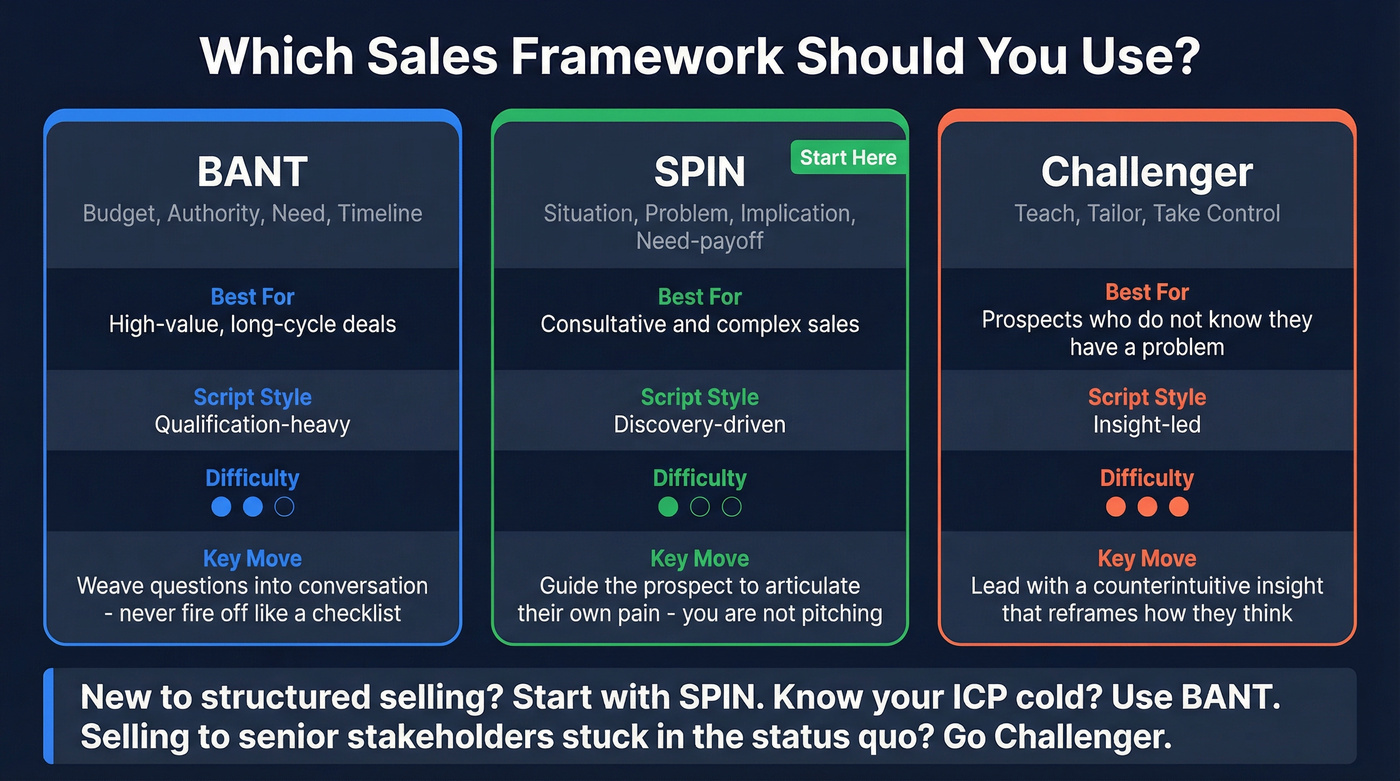
Start with SPIN if you're new to structured selling. BANT is for reps who already know their ICP cold. Challenger is advanced - save it for senior stakeholders who need to be shaken out of the status quo. (If you're building your process end-to-end, use these B2B sales best practices.)
BANT Script
"To make sure this is worth your time - is [solution area] something you've budgeted for this year? And are you the right person to evaluate this, or should I loop someone else in?"
Don't fire off Budget, Authority, Need, Timeline like a checklist. Weave the questions into conversation and let BANT emerge naturally. The moment it feels like an interrogation, you've lost.
SPIN Script
"What does your current [process] look like? (Situation) What's the biggest friction point? (Problem) If that doesn't get fixed this quarter, what happens to [downstream metric]? (Implication) If you could [ideal outcome], what would that mean for your team? (Need-payoff)"
You're not pitching - you're guiding the prospect to articulate their own pain. Neil Rackham's original SPIN research showed this approach dramatically outperforms feature-based selling in complex deals.
Challenger Script
"Most [industry] teams assume [common belief]. But the data shows [counterintuitive insight]. Here's what the top performers are doing differently - and it's probably not what you'd expect."
Teach, tailor, take control. Best for complex sales where the prospect doesn't realize they have a problem yet.
Handling Common Objections
Ask any r/sales regular and they'll tell you: 60% of cold calls hit "I'm not interested" within the first fifteen seconds. The reps who handle it well aren't smoother talkers - they've just practiced more. The framework is simple: Listen, Clarify, Respond. (For a deeper system, see SDR rejection handling.)
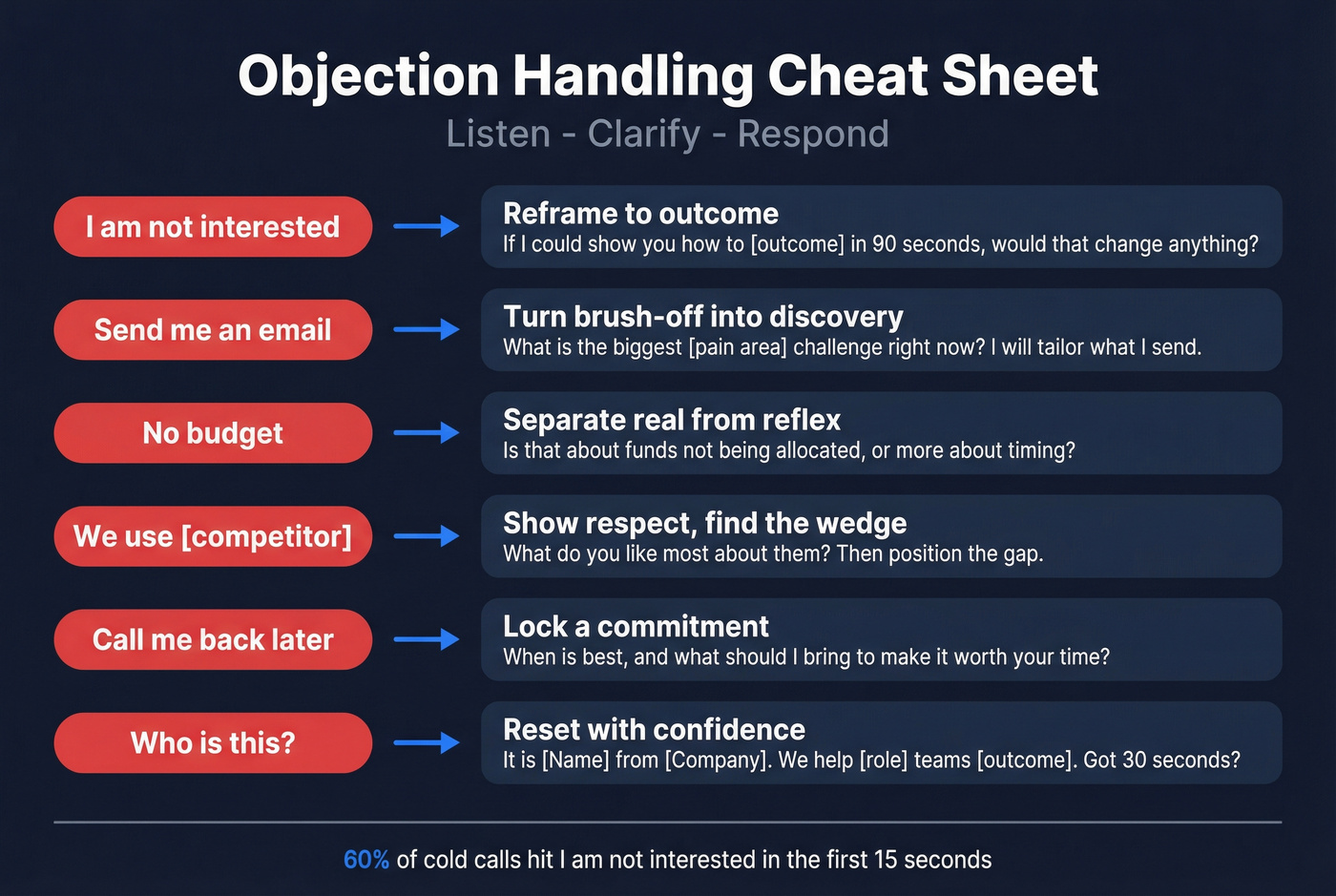
"I'm not interested." "Totally fair. If I could show you how to [outcome] in 90 seconds, would that change anything?" Reframes from product to outcome.
"Send me an email." "Happy to. Quick question first - what's the biggest [pain area] challenge right now? I'll tailor what I send." Turns a brush-off into discovery.
"No budget." "Is that about funds not being allocated, or more about timing?" Separates real objection from reflex.
"We use [competitor]." "Good - what do you like most about them?" Then position the gap. Shows respect, finds the wedge.
"Call me back later." "Absolutely. When's best - and what should I bring to make it worth your time?" Locks a commitment.
"Who is this?" "It's [Name] from [Company]. We help [role] teams [outcome]. Got 30 seconds?" Resets with confidence.
Don't argue. The prospect isn't wrong - they're just not convinced yet. The reps who consistently hit quota aren't the ones with the best scripts. They're the ones who practice until the words disappear and only the conversation remains. Gong's analysis of millions of sales calls confirms that top performers spend more time listening and less time pitching than their peers.
Before You Dial: Data Quality
Look, the best sales pitch script example in the world can't save a call to a disconnected number. B2B contact data decays at roughly 2.1% per month - that's 22% of your list going stale every year. We've watched reps burn through 50 calls in a morning with a 0% connect rate, not because their pitch was bad, but because half their numbers were dead. Sales reps lose 27.3% of their selling time to bad data, and 72% of cold calls never reach a human in the first place. (More on the numbers: B2B contact data decay.)
Prospeo fixes this at the source. The database covers 300M+ professional profiles with 143M+ verified emails at 98% accuracy and 125M+ verified mobiles, all refreshed every 7 days instead of the 6-week industry average. You can search by 30+ filters including intent signals, technographics, job changes, and funding events, then export a verified list before your first dial. Meritt tripled their connect rate to 20-25% after switching, with bounce rates dropping from 35% to under 4%.
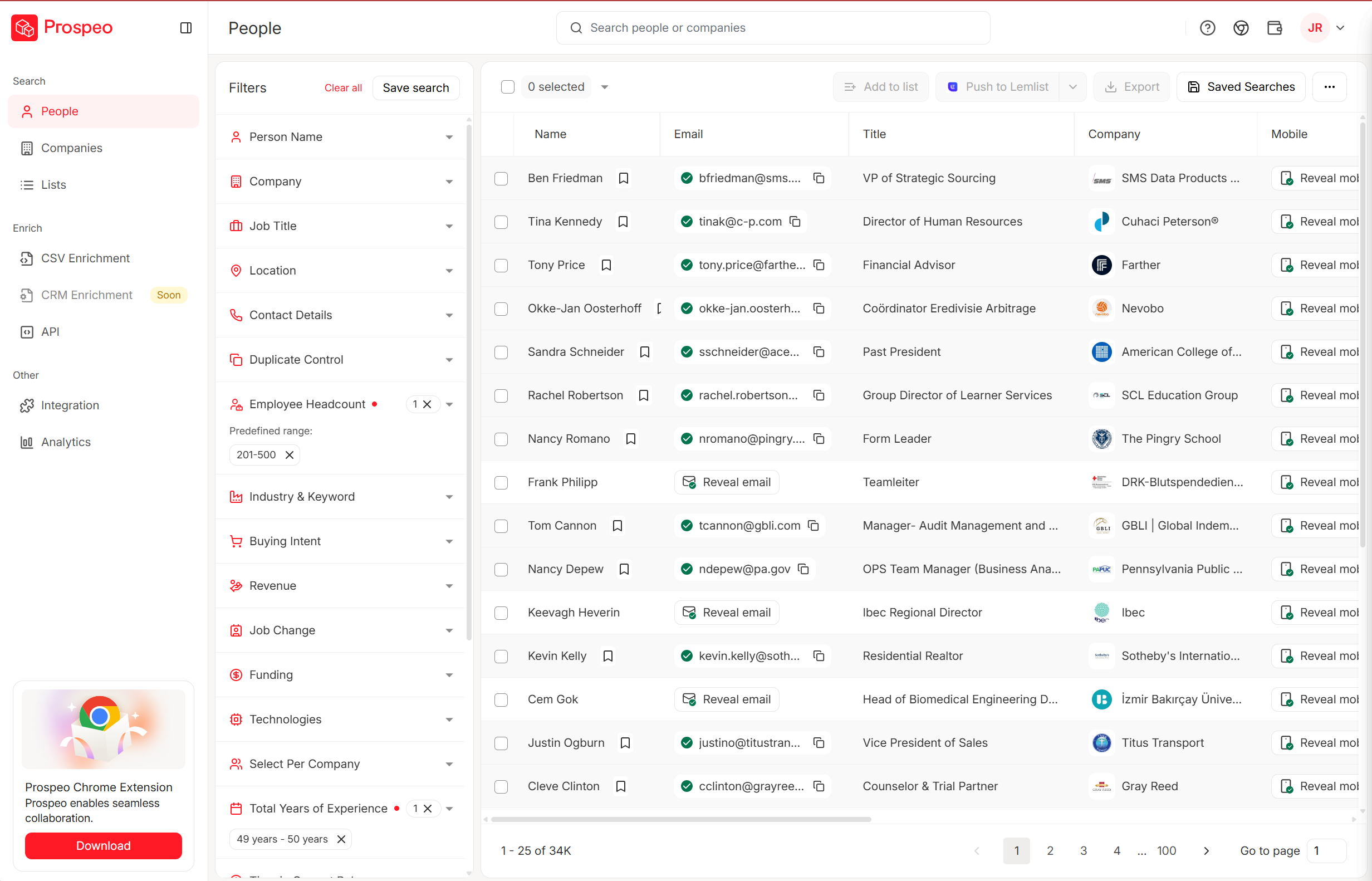
Trigger-based openers outperform generic intros every time. Prospeo tracks 15,000 intent topics, job changes, funding rounds, and tech stack shifts - giving you the exact trigger event to drop into your opening line.
Find the trigger. Write the hook. Book the meeting.
Mistakes That Kill Your Pitch
Talking more than you listen. Use a 60/40 listen-to-talk ratio on discovery calls. If you're doing most of the talking, you're pitching - not selling. (Use these discovery call tips to tighten the flow.)
Leading with features. Bad: "Our platform uses AI-powered predictive analytics." Better: "We help SDR teams cut list-building from 4 hours to 20 minutes." Nobody buys architecture. They buy outcomes.
Skipping qualification. If you don't know whether the prospect has budget, authority, or a real problem, you're performing - not selling. This is the single most common mistake we see from reps who are new to structured outbound.
Using jargon. "Synergistic omnichannel enablement" makes people hang up. Speak like a human.
Not preparing for objections. If "I'm not interested" catches you off guard, you haven't practiced enough. Run a mock pitch with a colleague using the objection responses above until they're automatic.
FAQ
How long should a cold call pitch be?
Successful cold calls average 5 minutes 50 seconds, while failed calls die at 3:14. Aim for the 5-7 minute range - if you're consistently under three minutes, prospects are rejecting you before the value prop lands.
Should I read my script word for word?
No. Treat it as a framework with key phrases and transitions you've internalized. The best reps know the structure cold and improvise the delivery. Scripts prevent freezing; they shouldn't replace genuine conversation.
What's the best day and time to cold call?
Tuesday and Wednesday drive 44% of total demos booked. Best windows are 9-11am and 3:30-5pm in the prospect's local time zone, with 10:00-11:30am as the strongest pocket. Monday mornings and Friday afternoons are dead zones - skip them unless you're desperate for activity metrics.
How do I make sure I'm calling verified numbers?
B2B data decays about 22% per year, so any list older than six months is unreliable. Use a verification tool with a fast refresh cycle before dialing. Prospeo's 7-day refresh keeps numbers current, and the free tier gives you 75 verified lookups to test.