

Lead Conversion Meaning: The Definition Most Teams Get Wrong
Your VP of Sales says conversion dropped 40%. Marketing says it went up. They're measuring different things - one tracks MQLs to demos, the other tracks leads to closed-won. This disconnect costs teams months of misaligned effort and wasted budget.
Lead conversion is the process of turning a potential customer into a paying customer - or, depending on your funnel, moving them from lead status into an active opportunity. Simple definition, but the execution is where everything breaks.
Definition: Lead conversion = turning a lead into a customer (or qualified opportunity).
Formula: (Converted Leads / Total Leads) x 100
Benchmark (website conversion to qualified lead): 2.9% average across 14 industries (Ruler Analytics, 100M+ data points)
That number is probably meaningless for your team - here's why.
What It Actually Means
Salesforce defines lead conversion as turning a potential customer into a paying customer - or, in CRM terms, moving a lead record into an opportunity stage. Both definitions are correct. The problem is that most organizations use them interchangeably when they shouldn't.
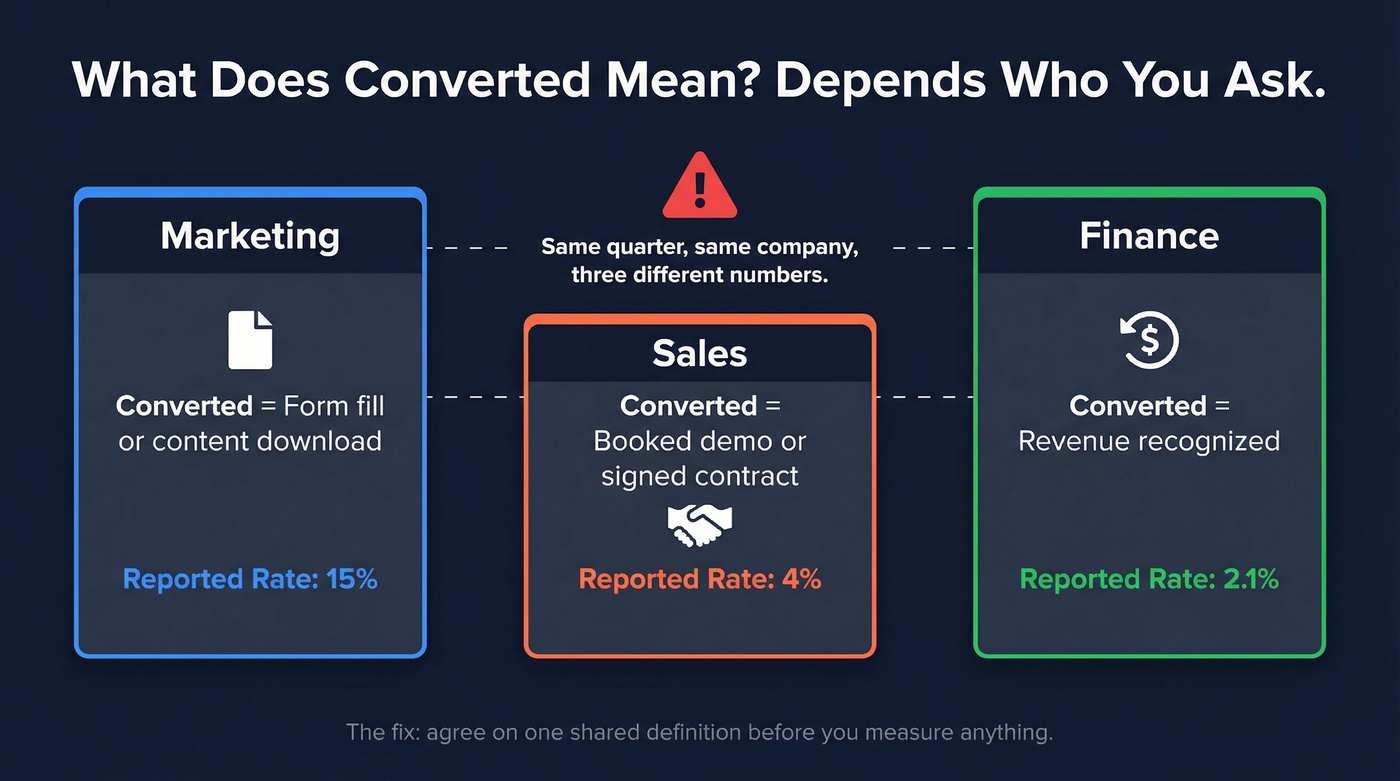
"Converted" means wildly different things depending on who you ask. Marketing might count a form fill. Sales might count a booked demo. Finance counts revenue. When your quarterly review shows a "12% conversion rate," the first question should always be: converted from what to what?
We've seen teams spend entire quarters optimizing the wrong stage because marketing's "conversion" was a whitepaper download and sales' "conversion" was a signed contract. The consensus on r/sales echoes this constantly - teams measuring different things and wondering why the numbers never align. That definition gap is the single biggest reason conversion reports never match across departments.
Lead Conversion vs Lead Gen vs Demand Gen
These three terms get conflated constantly, and the confusion costs real money.
| Demand Generation | Lead Generation | Lead Conversion | |
|---|---|---|---|
| What it does | Builds awareness and trust | Captures contact info | Turns leads into customers |
| Funnel position | Top | Mid | Mid-to-bottom |
| Example metric | Brand search volume | MQLs generated | Lead-to-customer rate |
HubSpot frames it well: demand gen is ungated awareness, lead gen is gated capture, and lead conversion is the downstream work of turning those contacts into revenue. They're sequential, not interchangeable.
The priority data backs this up - 55% of B2B marketers say increasing MQL-to-opportunity conversion rate is a top demand gen priority. Even demand gen teams know the real value is in conversion, not just volume.
How to Calculate Your Rate
The formula is straightforward:
Lead Conversion Rate (%) = (Converted Leads / Total Leads) x 100
Worked example: you generate 500 leads in a quarter and 50 become paying customers. That's a 10% lead-to-customer rate. But what's the percentage really telling you? Only as much as the definitions behind it. If "converted" means different things to different teams, the number is noise.
One critical distinction before we hit benchmarks: lead conversion rate (lead to customer) isn't the same as website conversion rate (visitor to lead). The benchmarks in the next section measure different things depending on the source, and mixing them up will lead you to the wrong conclusions.

You just read that 42% of sales pros say low-quality leads are killing their numbers. Every bounced email and dead phone number is a conversion that never had a chance. Prospeo's 98% email accuracy and 7-day data refresh cycle mean your reps actually reach the people they're targeting - at $0.01 per email.
Stop losing conversions to bad data. Start with 75 free verified emails.
2026 Benchmarks by Industry
Two major datasets give us useful reference points, but they measure different things.
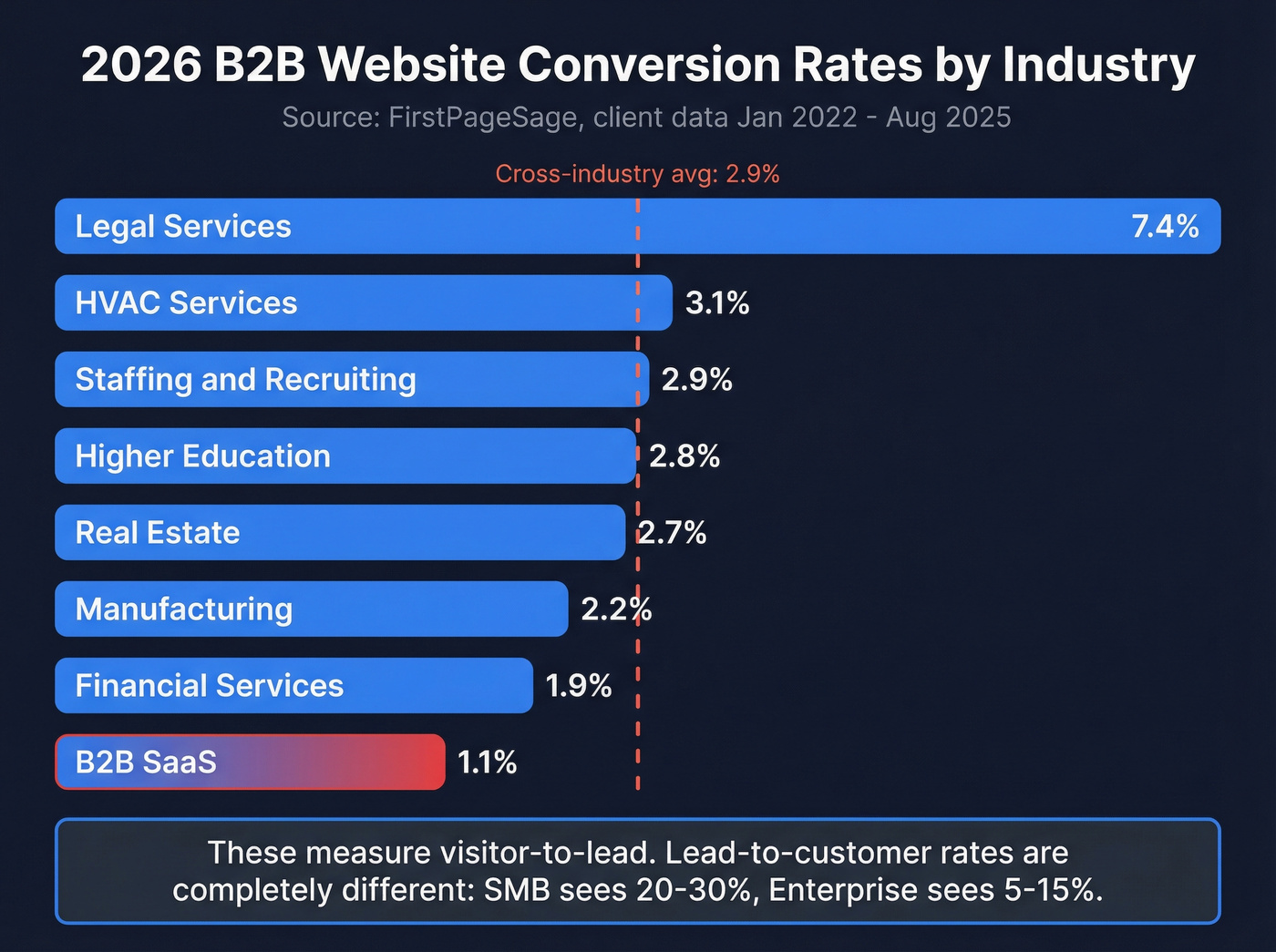
Website visitor to conversion action (FirstPageSage, client data Jan 2022-Aug 2025; 8 of 25 industries shown):
| Industry | Conversion Rate |
|---|---|
| Legal Services | 7.4% |
| HVAC Services | 3.1% |
| Staffing & Recruiting | 2.9% |
| Higher Education | 2.8% |
| Real Estate | 2.7% |
| Manufacturing | 2.2% |
| Financial Services | 1.9% |
| B2B SaaS | 1.1% |
Cross-industry average for qualified lead conversion (Ruler Analytics, 100M+ data points): 2.9% overall, split into a 1.7% form rate and 1.2% call rate.
Lead to customer benchmark ranges: SMB and fast sales cycles see 20-30%, while enterprise and complex deals land at 5-15%.
The gap between 1.1% (B2B SaaS website conversion) and 20-30% (SMB lead-to-customer) isn't a contradiction - they're measuring completely different stages. Know which one you're tracking before you benchmark.
Why Your Rate Is Probably Misleading
Here's the thing. Your blended conversion rate is almost certainly fiction.
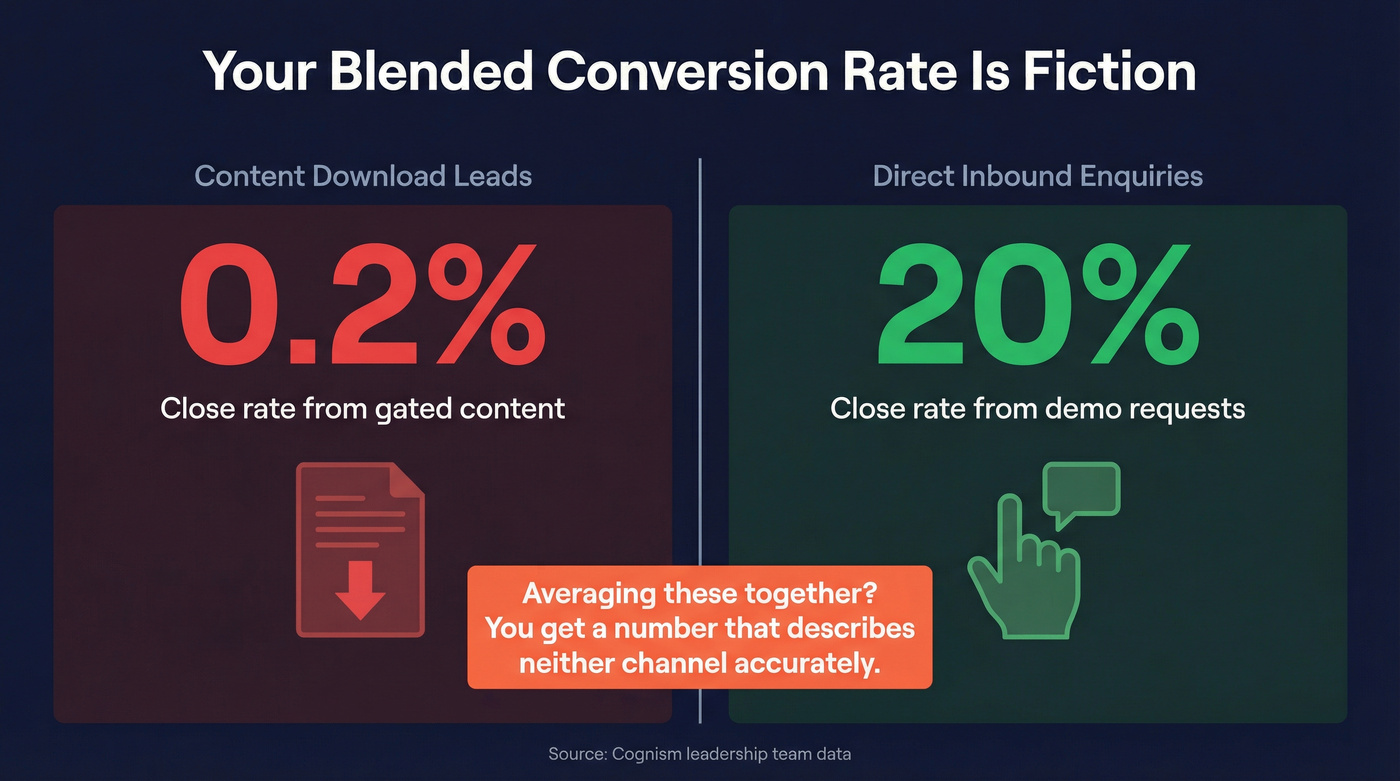
Cognism's leadership team shared a stat that should make every marketer uncomfortable: content leads close at roughly 0.2%, compared to nearly 20% from direct inbound enquiries. If you're averaging those two sources together, you're looking at a number that describes neither channel accurately.
Let's make this concrete. A B2B SaaS company generating 2,000 MQLs per month from content downloads sees a 0.3% close rate. Switch to measuring only demo-request leads and the rate jumps to 18%. Same company, same quarter - completely different story depending on what you count. Cognism themselves saw a 4x increase in inbound pipeline after shifting focus from gated content leads to demand generation, which further proves that lead source matters more than aggregate volume.
The definition inconsistency compounds this. Marketing counts MQLs generated. Sales counts deals closed. Finance counts revenue recognized. Three teams, three "conversion rates," zero alignment. We've watched this play out at companies where the marketing deck shows 15% conversion and the sales deck shows 4% - both technically correct, both completely useless for planning.
Stop obsessing over your overall rate. Break it down by source and stage, or the number tells you nothing actionable.
Five Ways to Improve Lead Conversion
1. Fix Your Data Quality First
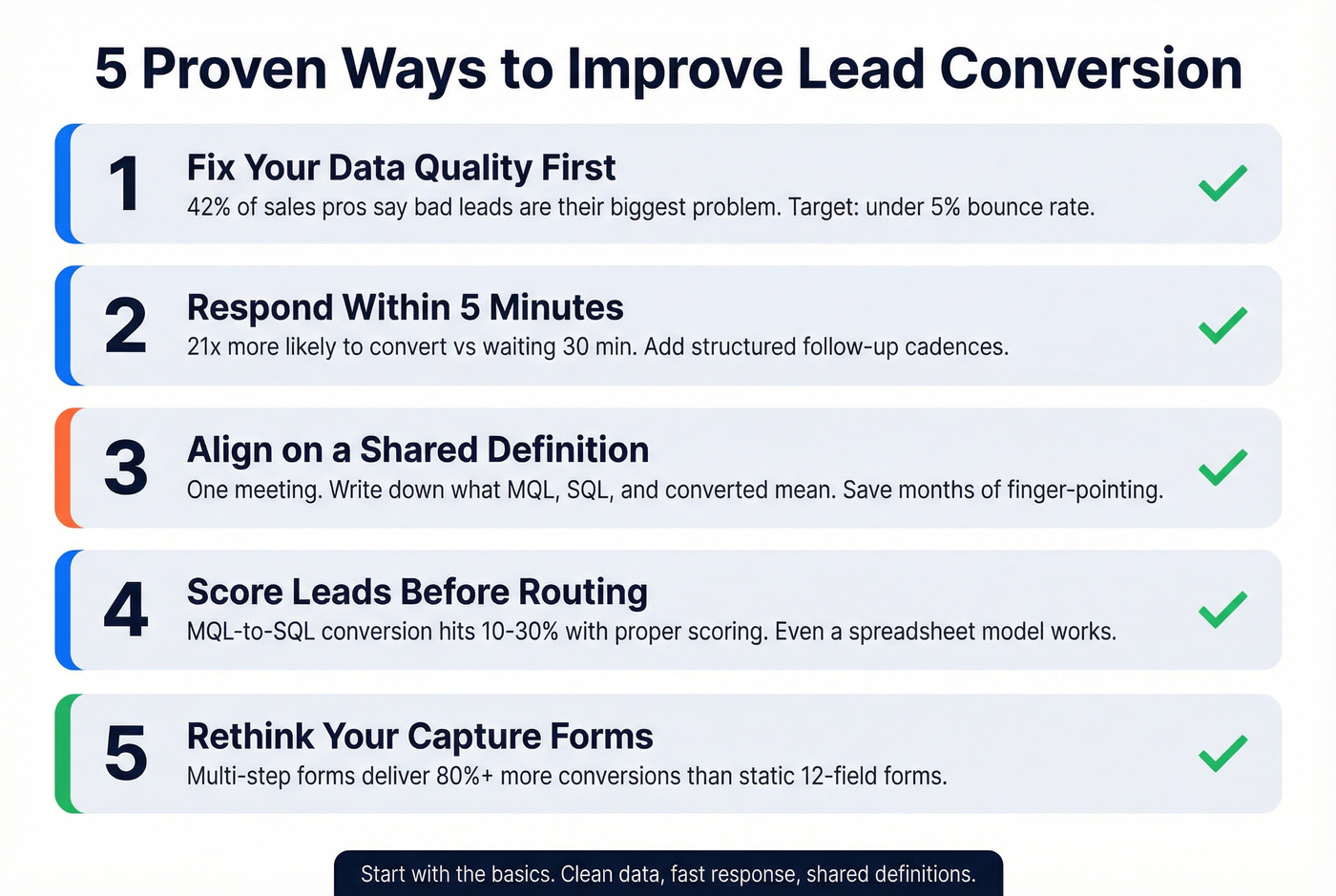
Ask any SDR what kills their conversion rate and you'll hear the same answer: bad phone numbers and bounced emails. The data confirms it - 42% of sales professionals say low-quality leads make selling harder than it was a year ago. If your emails bounce at 15%+ and phone numbers are dead, conversion is capped before the process even starts.
Prospeo verifies emails in real time with 98% accuracy and runs on a 7-day data refresh cycle - compared to the 6-week industry average. When Meritt switched to Prospeo, their bounce rate dropped from 35% to under 4% and pipeline tripled from $100K to $300K per week. That's not a marginal improvement; it's a fundamentally different pipeline.
2. Respond Within 5 Minutes
The data on speed-to-lead is unambiguous. A lead is 21x more likely to convert if called within 5 minutes vs after 30 minutes. But speed alone isn't enough - implementing a structured follow-up cadence with deliberate multi-step sequences has been shown to increase demo bookings by up to 37%. Speed gets you in the door. Cadence keeps you there.
3. Align on a Shared Definition
Here's a test. Walk over to your marketing lead and ask them what "converted" means. Then ask your sales manager. If you get two different answers - and you will - you've found the root cause of every misaligned dashboard in your org.
Write down the definitions of MQL, SQL, and "converted" together. Put them in your CRM as a shared document. This takes one meeting and saves months of finger-pointing.
If you want a cleaner system for cross-functional alignment, build it into Revenue Operations alignment instead of ad-hoc meetings.
4. Score Leads Before Routing
What happens when you stop routing every lead to a rep? Your conversion rate goes up - sometimes dramatically.
MQL-to-SQL conversion typically lands in the 10-30% band depending on ICP fit and scoring rigor. A basic scoring model that filters by firmographic fit and engagement signals removes noise before it hits your reps' queue, and the reps who used to waste time on unqualified leads now spend that time closing real opportunities. You don't need a complex AI scoring engine for this - even a simple spreadsheet model that weights company size, title seniority, and engagement recency will outperform routing everything blindly.
If you need a starting point, use an AI lead qualification workflow or a simple lead scoring system you can govern.
5. Rethink Your Capture Forms
If your lead capture is a 12-field static form with a "someone will call you" CTA, you're leaving conversions on the table. Interactive multi-step forms deliver a minimum 80% increase in lead generation conversion rates and can double overall conversion compared to static forms. And 67% of customers prefer self-service over speaking to a company representative. Shorter forms, progressive profiling, and self-serve booking links all move the number.
If you're rebuilding this from scratch, start with a modern B2B lead capture setup.
Common Conversion Mistakes
Relying on stale data. Contact data decays fast - job changes, email switches, company moves. A provider with weekly refresh cycles and real-time verification makes a measurable difference at scale.
Fix: Audit your bounce rate monthly. If it's above 5%, your data provider is the bottleneck. (If you want the numbers behind this, see B2B contact data decay and the basics of CRM hygiene.)
No shared conversion definition. If marketing and sales can't agree on what "converted" means, every report is noise.
Fix: Hold one cross-functional meeting. Define MQL, SQL, and "converted" in writing. Revisit quarterly.
Over-indexing on MQLs that never convert. Remember that 0.2% close rate on content leads? Volume without qualification is a vanity metric.
Fix: Report source-level conversion rates alongside aggregate numbers. Kill campaigns that generate volume but zero pipeline.
Slow follow-up. Every hour you wait after a lead comes in, your odds of converting drop.
Fix: Automate routing, set SLAs, and measure time-to-first-touch religiously. (If you need a playbook, use an SDR follow-up strategy.)
Look - if your average deal size is under $15K, you probably don't need a complex lead scoring model or a six-figure data platform. A clean email list, a fast response time, and a clear definition of "converted" will get you further than any enterprise tool stack. Skip the sophistication when the basics are broken.
Blended conversion rates hide the truth. But even when you segment by source and stage, none of it matters if your contact data is stale. Prospeo refreshes 300M+ profiles every 7 days - not every 6 weeks like competitors. Meritt saw their pipeline triple from $100K to $300K/week after switching.
Your conversion rate has a ceiling. Verified data removes it.
FAQ
What is a good lead conversion rate?
B2B SaaS averages 1.1% for website-to-lead conversion, while SMB sales cycles with shorter deal timelines see 20-30% lead-to-customer rates. Always compare within your vertical and funnel stage - a blended number across sources is misleading. Enterprise deals with 6+ month cycles typically land between 5-15%.
What's the difference between lead conversion rate and close rate?
Lead conversion rate measures leads becoming customers or qualified opportunities across the full funnel. Close rate specifically measures deals won from proposals or demos - it starts further down the funnel where a sales conversation is already happening. A 25% close rate with a 5% lead-to-opportunity rate means roughly 1.25% end-to-end conversion.
How does data quality affect lead conversion?
If 15%+ of your emails bounce, your effective lead pool shrinks before outreach even begins. Real-time email verification and weekly data refreshes prevent this silent pipeline leak - you can't convert contacts you can't reach.
How do you align sales and marketing on conversion definitions?
Hold a single cross-functional meeting where both teams agree on exact criteria for MQL, SQL, and "converted" - then document those definitions in your CRM. Revisit quarterly. Companies that skip this step end up with marketing reporting 15% conversion while sales reports 4%, making both numbers useless for planning.