Sales Collaboration: The Operational Playbook Most Teams Are Missing
An SDR finds the perfect account, builds a contact list, and passes it to the AE. The AE opens the first record - email bounces. Second record - wrong company. Third - the person left six months ago. Thirty minutes gone, momentum killed, and the SDR's credibility takes a hit.
We've watched this exact scenario play out across dozens of sales teams. It's never framed as a sales collaboration problem, but that's exactly what it is. 86% of employees and executives say poor collaboration is the root cause of workplace failures, and 57% of sales professionals say the sales cycle is getting longer. Reps spend 60% of their time on non-selling tasks - chasing information, fixing handoff errors, sitting in alignment meetings that align nothing.
This isn't about a Slack channel. It's the operating system that determines whether your pipeline moves or stalls.
What You Need (Quick Version)
Effective cross-functional selling comes down to three pillars - People, Process, Tools - and most teams overcomplicate all three.
- People: Fix incentives so reps actually want to collaborate. Shared commission structures and cross-functional ride-alongs beat motivational posters every time.
- Process: Establish DACI ownership for every cross-functional decision. Weekly pipeline review, bi-weekly cross-functional sync, monthly strategy session. That's it.
- Tools: One CRM, one communication tool, one data verification layer. Everything else is optional until you've outgrown the basics.
What Sales Collaboration Actually Delivers
Organizations with strong sales enablement strategies achieve 49% higher win rates on forecasted deals. Alignment between sales and marketing makes companies 67% better at closing. On the flip side, misalignment costs businesses an estimated $1 trillion per year in wasted effort and decreased productivity.
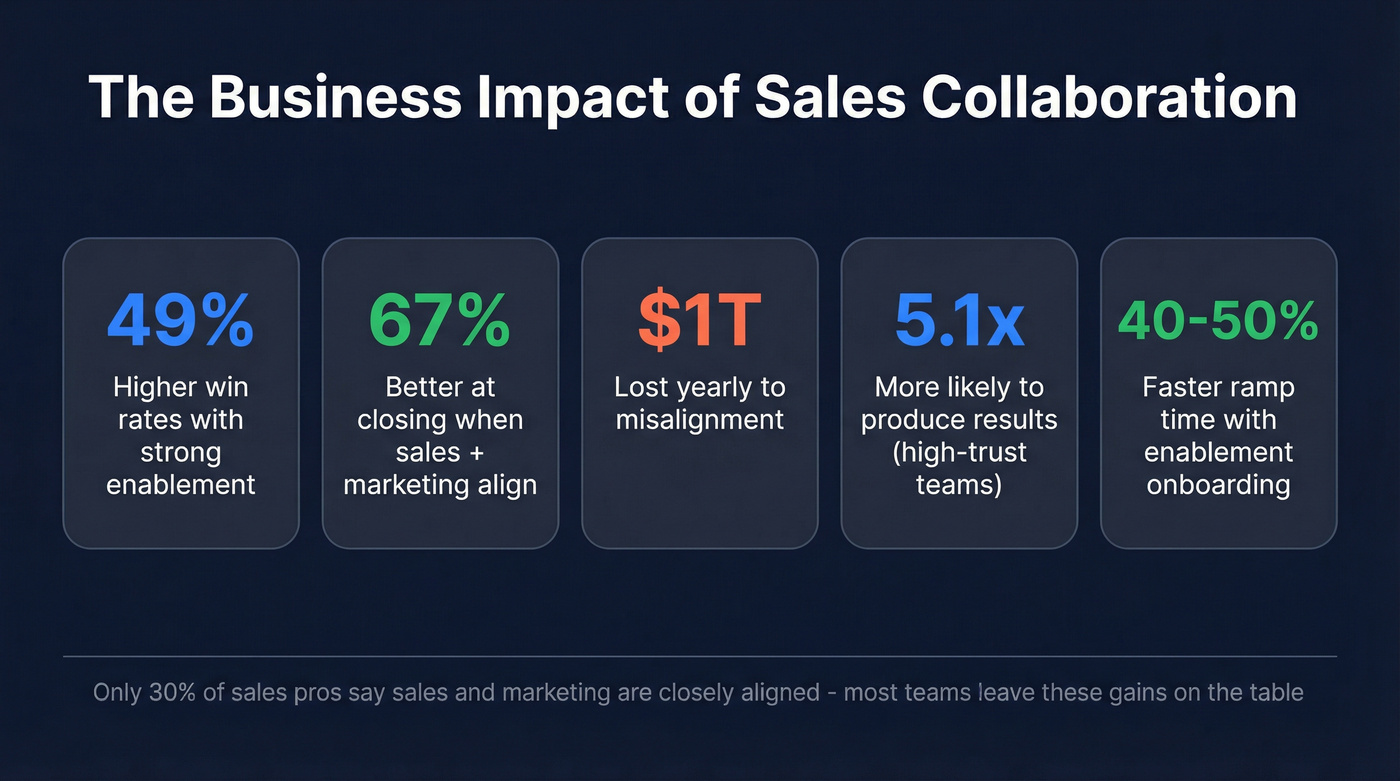
Only 30% of sales professionals believe sales and marketing are closely aligned. That means most organizations are leaving that 67% improvement on the table.

Teams high on trust are 5.1x more likely to produce results, and teams with strong communication are 2.8x more efficient than peers. Enablement-driven onboarding cuts ramp time by 40-50%, meaning new reps contribute to pipeline weeks earlier than they otherwise would, which compounds across every quarter of the year.
These aren't marginal gains. A team that nails collaborative selling doesn't just feel better - it closes more, forecasts more accurately, and retains reps longer.
The Three Collaboration Killers
Misaligned Incentives
Do this: Give each member of a collaborative closing team 75% of the solo commission. Yes, the company pays more per deal. But win rates climb because reps stop hoarding opportunities. Add spot bonuses for cross-functional assists - an SDR who sources intel that helps an AE close a six-figure deal should see something for it.
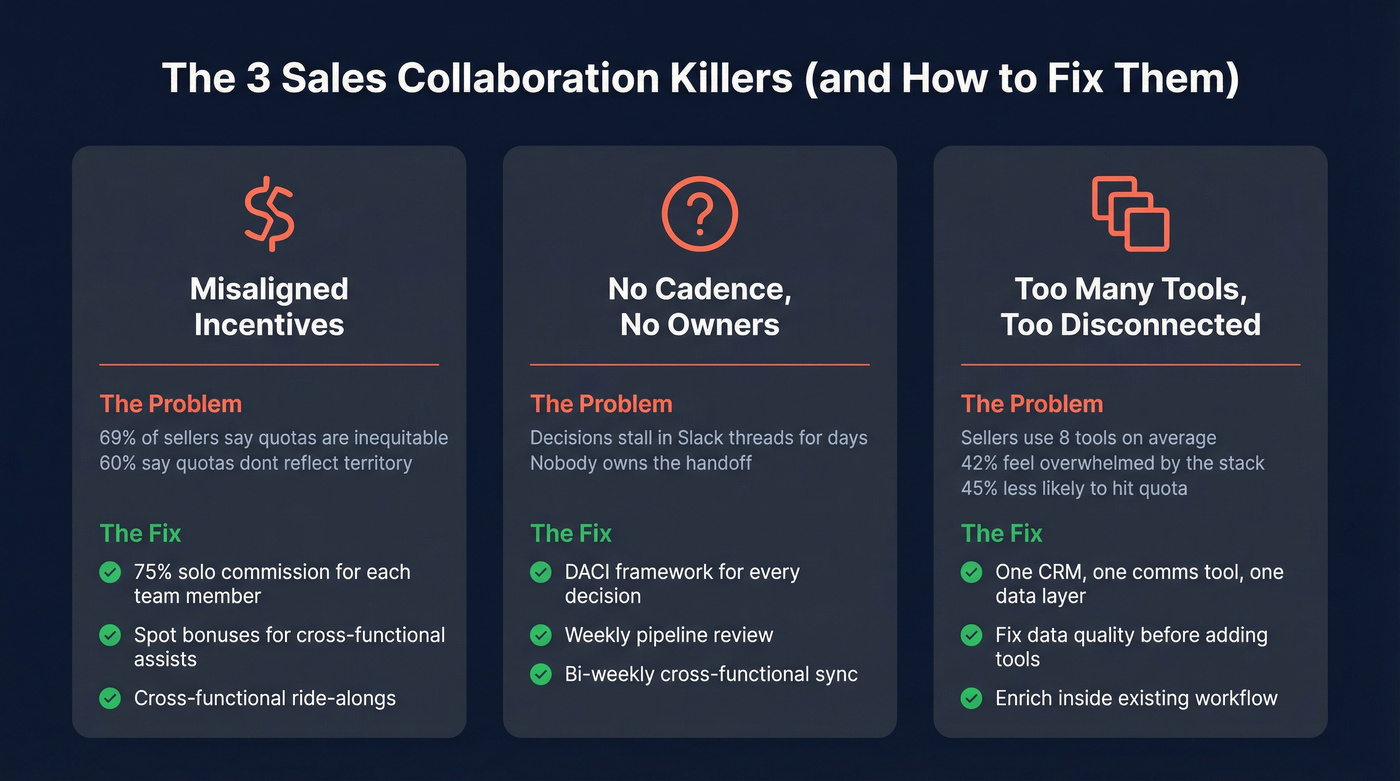
Stop doing this: Setting quotas that don't reflect territory potential. 69% of sellers say their targets are inequitable, and 60% say quotas don't reflect their territory. When reps feel the game is rigged, teamwork is the first thing to die.
Cross-functional ride-alongs - engineers sitting in on sales calls, reps joining sprint reviews - build the empathy that comp plans alone can't create.
No Cadence, No Owners
Most collaboration breakdowns aren't about attitude. They're about ambiguity. Nobody knows who makes the call on a pricing exception. Nobody owns the handoff from sales to CS. Decisions stall in Slack threads for days.
The DACI framework fixes this by assigning clear roles for every cross-functional decision:
| Role | Definition | Sales Example |
|---|---|---|
| Driver | Owns the process | Deal desk lead |
| Approver | Final decision maker | VP Sales or CRO |
| Contributor | Provides input | AE, SE, Legal |
| Informed | Kept in the loop | CSM, Marketing |
Apply DACI to your most common friction points - pricing exceptions, custom implementations, contract redlines. Give marketing early beta access to new features so they can build campaigns before launch, not after. Write specs that explain the why, not just the what. These small process changes eliminate more friction than any tool purchase.
Too Many Tools, Too Disconnected
Sellers use an average of 8 tools to close deals. 42% feel overwhelmed by the stack, and overwhelmed sellers are 45% less likely to hit quota.
Here's the thing: adding another "collaboration platform" makes this worse. The real fix starts with data quality. Bad contact data is the silent killer of SDR-to-AE handoffs, forecast accuracy, and outbound sequences. If the emails in your CRM bounce and the phone numbers are stale, no amount of process will save you.
Prospeo handles this layer with 143M+ verified emails and 125M+ verified mobiles, refreshed every 7 days - so the contacts your SDR passes to the AE are still valid when the AE picks up the phone. Native Salesforce and HubSpot integrations mean enrichment happens inside your existing workflow rather than requiring yet another tab.

Every broken SDR-to-AE handoff starts with bad data. Prospeo's 143M+ verified emails and 125M+ verified mobiles refresh every 7 days - not every 6 weeks - so the contacts your SDR passes are still valid when the AE acts on them. Native Salesforce and HubSpot integrations mean zero extra tabs, zero extra tools in an already bloated stack.
Stop letting stale data sabotage your team's best work.
Collaboration by Pipeline Stage
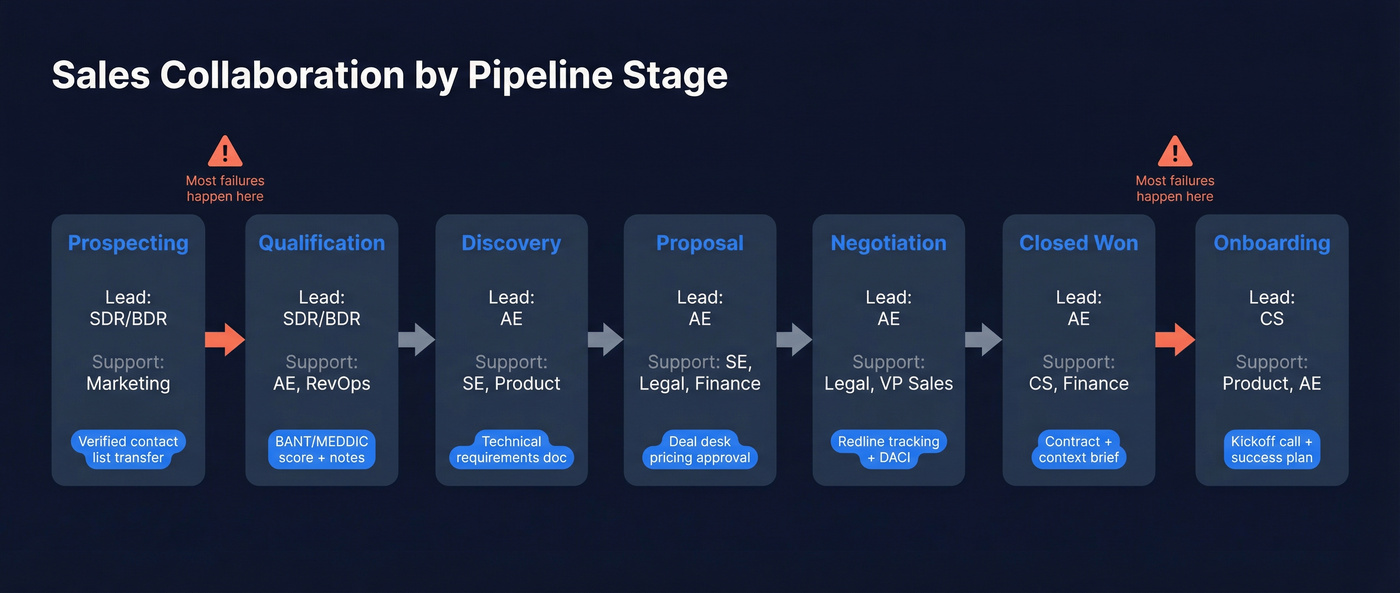
Different stages need different departments leading, with different handoff actions. Here's how it maps:
| Stage | Lead Dept | Supporting Depts | Key Handoff Action |
|---|---|---|---|
| Prospecting | SDR/BDR | Marketing | Verified contact list transfer |
| Qualification | SDR/BDR | AE, RevOps | BANT/MEDDIC score + notes |
| Discovery | AE | SE, Product | Technical requirements doc |
| Proposal | AE | SE, Legal, Finance | Deal desk pricing approval |
| Negotiation | AE | Legal, VP Sales | Redline tracking + DACI |
| Closed Won | AE | CS, Finance | Contract + context brief |
| Onboarding | CS | Product, AE | Kickoff call + success plan |
In our experience, the Prospecting-to-Qualification and Closed Won-to-Onboarding handoffs are where most failures happen. Bad data kills the first; lost context kills the second. If you only fix two handoffs, fix those.
How to Measure Team Alignment
Most guides stop at "communicate better." Let's talk about how to actually measure whether your sales collaboration is working.
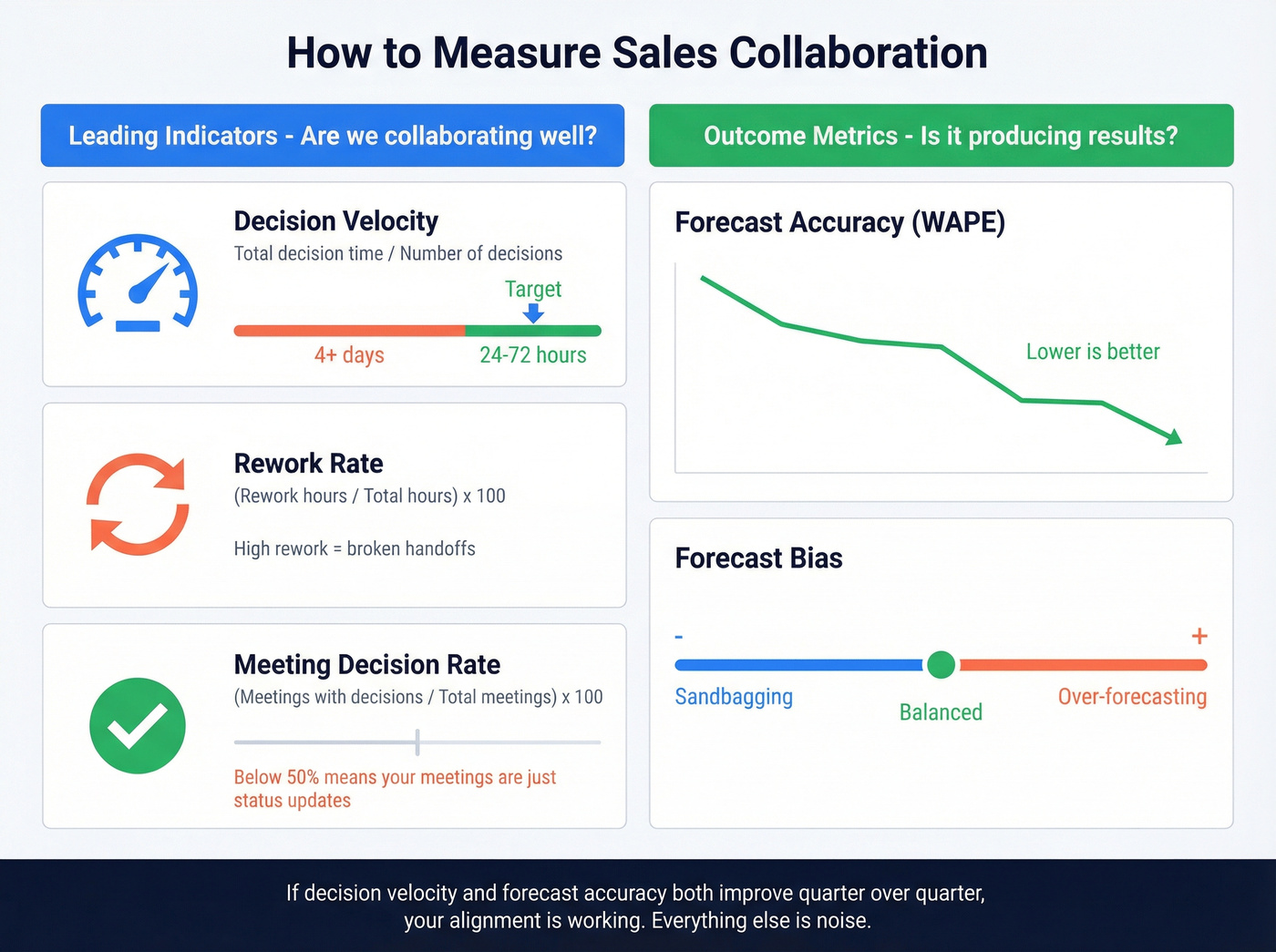
Leading indicators - are we collaborating well?
- Decision velocity: Total time for decisions divided by number of decisions. If your average pricing exception takes 4 days to approve, that's your baseline. Target 24-72 hours for standard approvals.
- Rework rate: Hours spent on rework divided by total project hours, times 100. High rework means handoffs are broken.
- Meeting decision rate: Meetings with a documented decision divided by total meetings, times 100. Below 50%? Your meetings are status updates, not collaboration.
Outcome metrics - is collaboration producing results?
- Forecast accuracy using WAPE (Weighted Absolute Percentage Error). Lower is better.
- Forecast bias: Positive means over-forecasting; negative means sandbagging.
If decision velocity and forecast accuracy are both improving quarter over quarter, your cross-functional alignment is working. Everything else is noise.
The Recommended Tool Stack
You don't need a dedicated "collaboration platform." The average seller already uses 8 tools. Adding a 9th makes things worse.
Start with three: one CRM, one communication tool, one data verification layer. We've tested most of these tools internally - add from there only when you've outgrown the basics.
| Category | Tool | Starting Price |
|---|---|---|
| CRM | Salesforce | From ~$25/user/mo |
| CRM | HubSpot | Free; paid from ~$20/user/mo |
| Communication | Slack | Free; paid from ~$8/user/mo |
| Communication | Microsoft Teams | Included with many Microsoft 365 plans |
| Data & Verification | Prospeo | Free tier; ~$0.01/email |
| Enablement | Highspot | ~$30-60/user/mo |
| Enablement | Seismic | ~$30-80/user/mo |
| Revenue Intel | Gong | ~$100-150/user/mo |
| Revenue Intel | Clari | ~$50-100/user/mo |
| Work Management | ClickUp | From $7/user/mo |
| Work Management | Wrike | From $10/user/mo |
Hot take: If your average deal size is under $10k, you probably don't need Gong or Clari yet. Skip them. Fix your data layer and your handoff process first. A team with clean contacts and clear DACI ownership will outperform a team with $200k in revenue intelligence tools and a CRM full of ghosts. I've seen it happen more than once.
AI and Sales-Marketing Alignment
94% of sales leaders say AI agents are essential for meeting business demands. But 51% report that tech silos delay or limit AI initiatives. AI works as a collaboration multiplier - for coaching, forecasting, deal prioritization - but only when the underlying data and processes are clean.
74% of sales teams with AI are prioritizing data hygiene to support it. That's the right instinct. We've seen teams deploy AI lead scoring on databases where 30% of contacts had changed jobs - the model learned to prioritize ghosts. Real talk: don't buy AI tools before fixing your data foundation. The consensus on r/sales echoes this constantly - fancy tools on dirty data just automate bad decisions faster.
If you're building this into your GTM motion, it helps to map the handoffs to a real RevOps tech stack so AI isn't pulling from five conflicting sources.
Your reps already use 8 tools to close deals. Don't add another - fix the data layer underneath them all. Prospeo enriches your CRM with 50+ data points per contact at a 92% match rate, cutting the rework hours that drag down every collaboration metric on your dashboard.
One enrichment layer. Every handoff fixed. Starting at $0.01 per email.
FAQ
What's the difference between sales collaboration and team selling?
Sales collaboration is the broader operating model - cross-functional alignment across the entire pipeline. Team selling is one tactic within it, where multiple reps work a single deal. You need the operating model for team selling to work, not the other way around.
How do you fix commission structures that discourage teamwork?
Give each member of a collaborative closing team 75% of the solo commission. Win rates climb because reps stop hoarding. Add spot bonuses for cross-functional assists - they're cheaper than lost deals.
What tools do you actually need for cross-functional selling?
Start with three: a CRM like Salesforce or HubSpot, a communication tool like Slack or Teams, and a data verification layer to keep pipeline contacts accurate. Add enablement and intelligence tools only after the basics are solid.
How do you improve collaboration without overhauling everything?
Start with the two handoffs that break most often - Prospecting to Qualification and Closed Won to Onboarding. Apply DACI ownership to each, clean up the contact data flowing between stages, and measure decision velocity weekly. These targeted fixes deliver outsized results before you touch anything else.