

RevOps in 2026: The Practitioner's Guide to Revenue Operations
73% of companies now have a C-suite role dedicated to RevOps. And yet, 89% of those same companies say the function lacks clearly defined strategic goals. That's the central paradox of revenue operations in 2026: it's everywhere and nowhere at the same time.
Most guides are vendor pitches disguised as education. This one isn't. We've spent years inside these orgs building the processes, cleaning the data, and fighting the political battles over reporting lines. This is the operating manual those articles skip.
What You Need (Quick Version)
- Definition: Unified ownership of process, data, enablement, and systems across marketing, sales, and customer success.
- Reporting line: CRO. No CRO? COO or CFO. Never VP of Sales.
- First move: Data governance, not tools.
- Three metrics: Pipeline velocity, LTV:CAC (target 3:1), net revenue retention.
- Staffing ratio: 12 sales reps to 1 ops hire.
- Burnout warning: If you're a team of one covering all three functions, flag it to leadership immediately. That's not sustainable and everyone in the industry knows it.
The rest of this guide is the operating manual.
What Is RevOps?
Natalie Furness, via the RevOps Co-op, puts it cleanly: RevOps is "aligning people, processes, and data systems across go-to-market teams to maximize revenue generation while minimizing costs effectively." That's the practitioner definition, and it's the one that matters.
Jeff Ignacio breaks the function into four pillars: Process, Enablement, Advisory, and Systems. Revenue operations brings GTM strategy and execution to life through those pillars. It's the execution layer between what leadership wants to happen and what actually happens in the CRM, the sequences, and the handoffs between teams.
Let's be clear about what this is not.
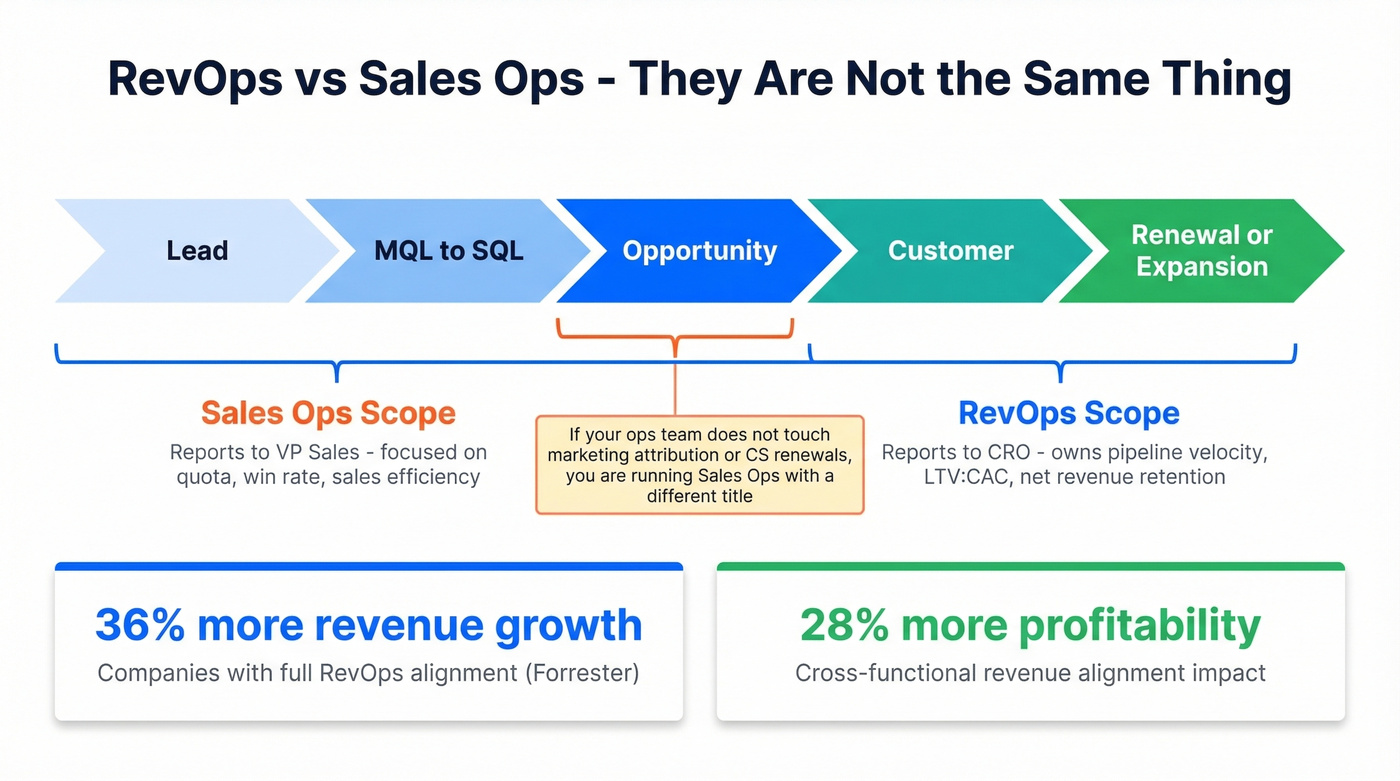
It's not a rebrand of Sales Ops. Sales Ops is a subset focused on sales execution, tools, and process within the sales function. RevOps spans the entire revenue lifecycle: marketing, sales, and customer success. Calling your Sales Ops team "RevOps" without changing the scope is like renaming your garage a "mobility hub." The sign changed. Nothing else did.
It's not a tool. No software makes you a unified ops org. Buying Clari or HubSpot doesn't mean you've "implemented" anything. The function is about people, process, and data alignment. Tools are just the infrastructure layer.
And it's not a job title you slap on someone and walk away. Without executive sponsorship, cross-functional authority, and clear strategic goals, it's just an admin with a fancy LinkedIn headline. That's exactly what 89% of companies are running right now.
Why RevOps Exists
The short answer: siloed teams leak revenue. Marketing generates leads that sales doesn't follow up on. Sales closes deals that CS can't retain. CS identifies expansion opportunities that nobody routes back to the AE. Every handoff is a potential leak, and without a unified function owning the plumbing, those leaks compound quarter after quarter until someone finally asks why pipeline-to-close conversion dropped 15 points.
A Gartner analysis found that sales and revenue ops teams now dedicate 68% of their time to non-client functions. That's a massive shift toward internal coordination, and it happened because the GTM motion got more complex, not less.
BCG research shows aligned organizations see a 10-20% increase in sales productivity. Forrester's data is even more compelling: companies with strong alignment across revenue functions report 36% more revenue growth and 28% more profitability. For a $50M ARR company, a 10-20% productivity lift translates to $5-10M in additional pipeline capacity without adding headcount.
That's why the CFO cares.
RevOps vs Sales Ops
This distinction trips up more people than it should, and it's the core reason the meaning gets muddled in so many organizations.
| Dimension | Revenue Operations | Sales Ops |
|---|---|---|
| Scope | Full revenue lifecycle | Sales function only |
| Reports to | CRO / COO | VP Sales |
| Metrics owned | Pipeline velocity, NRR, LTV:CAC | Quota attainment, win rate |
| Lifecycle coverage | Lead → Customer → Renewal | Opportunity → Close |
| Team structure | Cross-functional | Sales-embedded |
| Goal | Revenue optimization | Sales efficiency |
Sales Ops is a subset of revenue operations. Full stop. Gartner defines revenue operations as "an end-to-end model unifying customer engagement across functions by integrating people, processes, and technology." Sales Ops lives inside that model, handling sales-specific execution and configuration within the governance framework the broader team sets.
The confusion happens because many companies promoted their Sales Ops lead to "Head of RevOps" without actually expanding the scope. If your team doesn't touch marketing attribution or CS renewal workflows, you're running Sales Ops with a different title. That's fine - just be honest about it so you can plan the actual transformation.
The RevOps Operating Model
Four Pillars
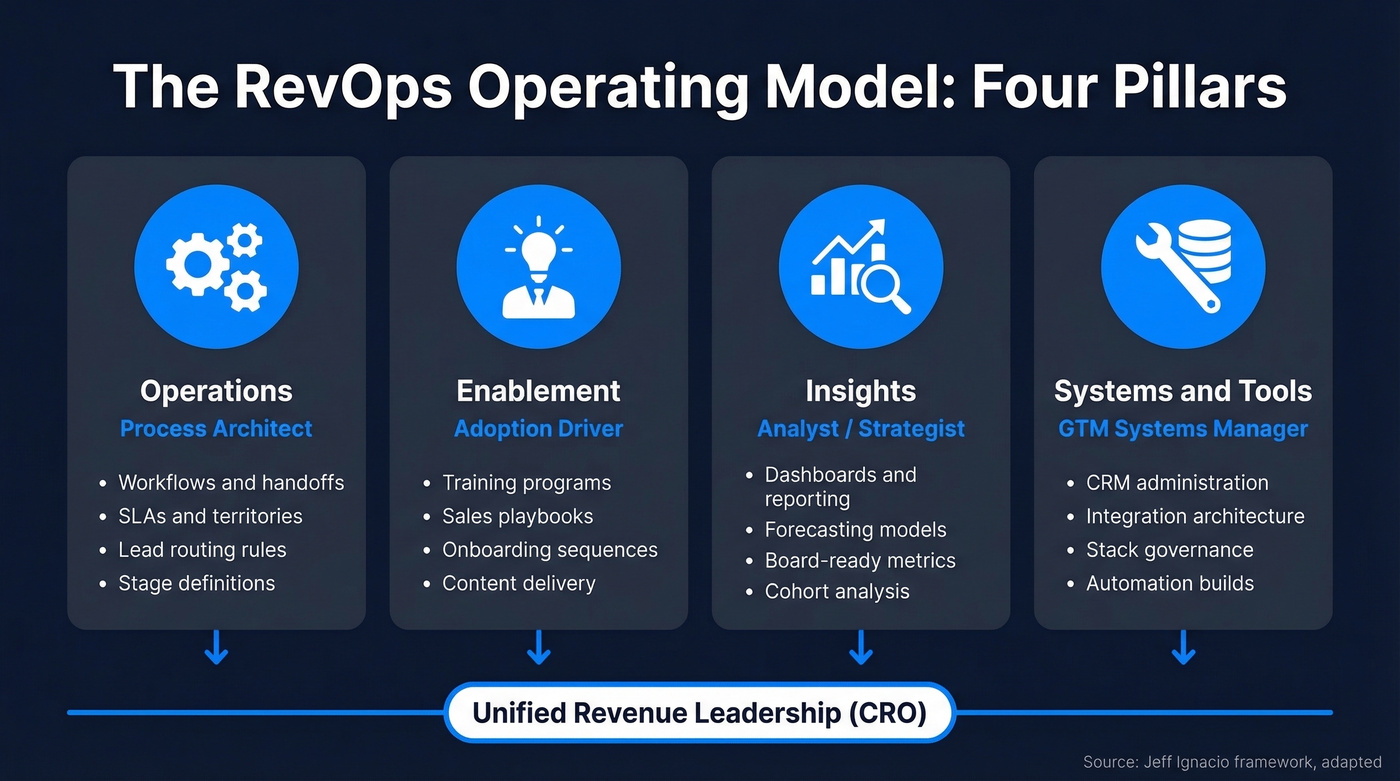
Revenue operations organizes around four pillars. Each one needs clear ownership, even if one person covers multiple pillars in a smaller org.
| Pillar | Ownership | What It Covers |
|---|---|---|
| Operations | Process architect | Workflows, handoffs, SLAs, territories |
| Enablement | Adoption driver | Training, playbooks, onboarding |
| Insights | Analyst / strategist | Dashboards, forecasting, board reporting |
| Systems & Tools | GTM Systems Manager | Integrations, licenses, stack governance |
The Systems & Tools pillar is where the GTM Systems Manager role lives, and increasingly, the GTM Engineer. These aren't "just admins." They're the people who keep your CRM from becoming a graveyard of abandoned custom fields and broken automations.
The GTM Engineer specifically bridges strategy and systems execution: building workflows in tools like Clay, standing up enrichment waterfalls across multiple data providers, stitching together custom API integrations, and automating processes that used to require three tools and a prayer. Think of them as the person who turns a leader's strategy into working infrastructure. It's one of the most underappreciated positions in the GTM org.
Team Structure and Sizing
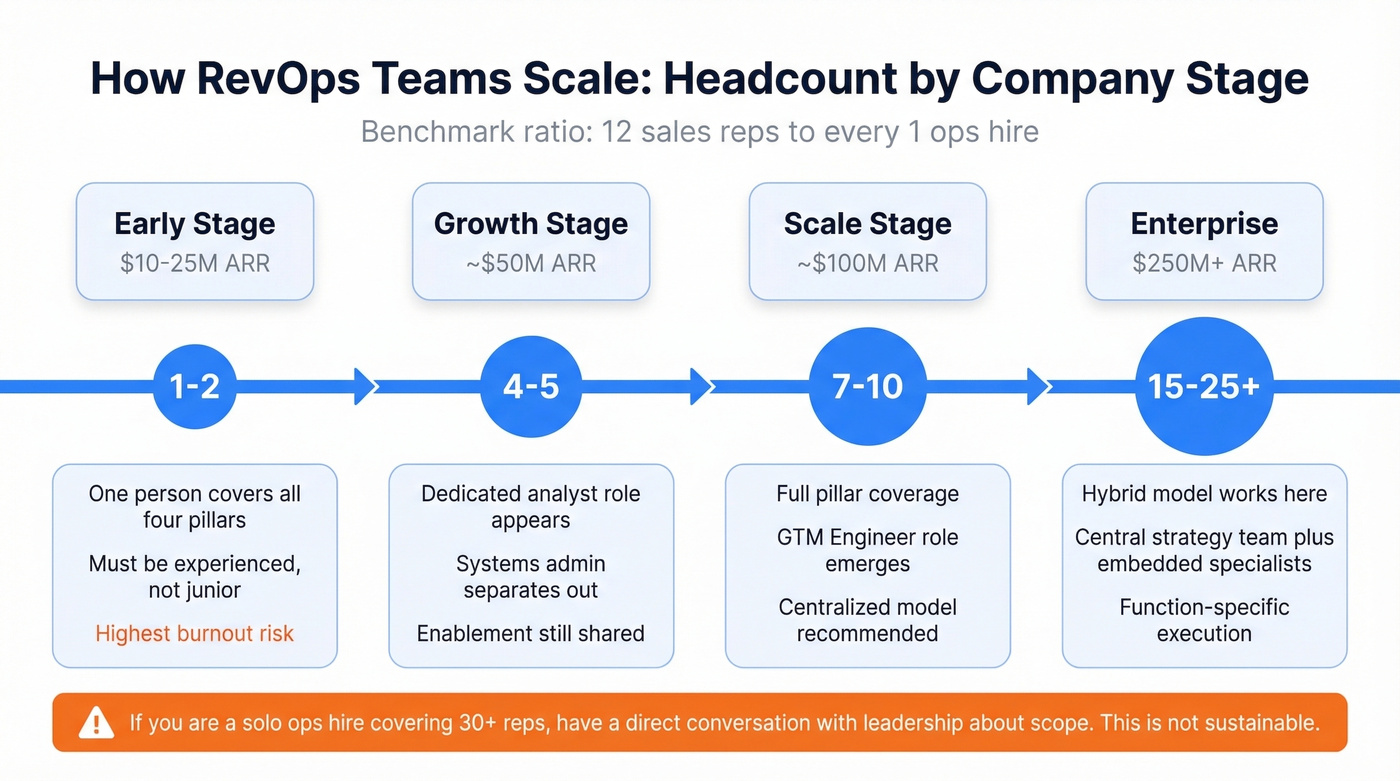
The benchmark ratio is 12 sales reps to every 1 ops hire. Here's how scaling typically looks:
| Company Stage | ARR Range | Ops Headcount |
|---|---|---|
| Early | $10-25M | 1-2 |
| Growth | ~$50M | 4-5 |
| Scale | ~$100M | 7-10 |
| Enterprise | $250M+ | 15-25+ |
At the early stage, you're hiring one person who covers all four pillars. That person needs to be experienced - not a junior admin. We've seen companies try to save money by hiring a recent grad into an "Analyst" role and expecting them to architect the entire GTM data model. It doesn't work, and the cleanup costs more than hiring right the first time.
If you're a solo hire at a company with 30+ reps, you need to have a direct conversation with leadership about scope. Burnout in single-person ops teams is nearly universal.
Centralized vs. Decentralized
Most high-performing teams run a centralized model where one team serves marketing, sales, and CS under a single leader. We recommend this for companies under $100M ARR. Decentralized models - where each function has its own embedded ops person - create faster response times for individual teams but sacrifice cross-functional alignment, which is the entire point. Hybrid models work at enterprise scale: a central strategy team sets standards and governance while embedded specialists handle function-specific execution.
Where Should RevOps Report?
It reports to the CRO. Period.
If you don't have a CRO, the COO or CFO are acceptable alternatives - they have the cross-functional authority and financial perspective to make it effective. Reporting to the VP of Sales or CMO is a bad move. It forces the function to "pick sides," and the other functions immediately distrust the data and recommendations.
The anti-pattern to watch for: a company that creates the function but doesn't give it executive sponsorship. That's not a strategic org. It's a cost center with no authority.

RevOps teams spend 68% of their time on non-client functions. Most of that is fighting bad data. Prospeo's CRM enrichment returns 50+ data points per contact at a 92% match rate - on a 7-day refresh cycle, not the 6-week industry average.
Stop cleaning data. Start operating on it.
Metrics That Matter
Most dashboards track too many metrics and act on too few. These are the ones that actually drive decisions.
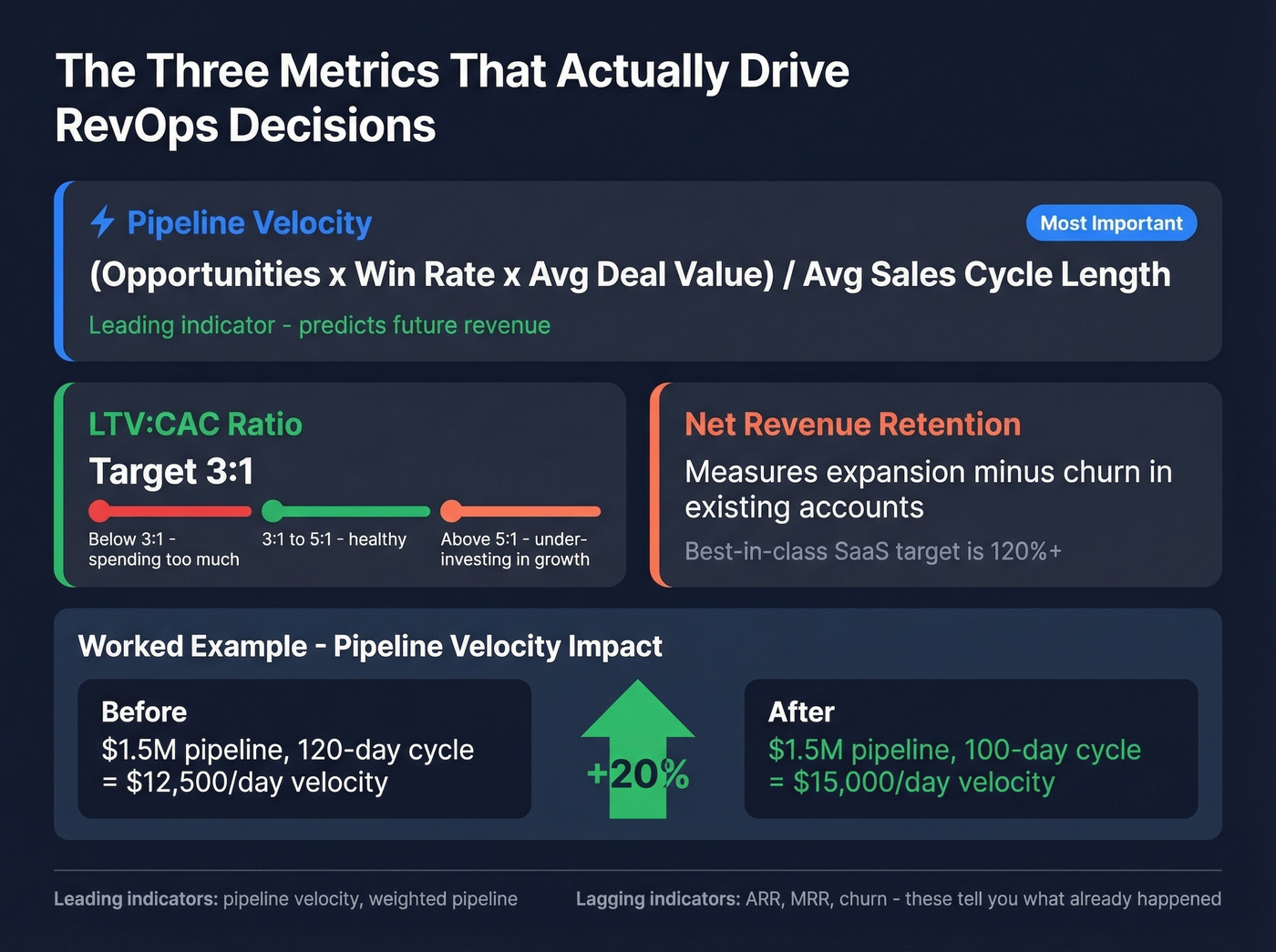
Pipeline velocity is the single most important metric:
(Opportunities x Win Rate x Avg Deal Value) / Avg Sales Cycle Length
This tells you how fast revenue moves through your pipeline. Every lever in that formula is something the ops team can influence - more qualified opportunities through marketing alignment, higher win rates through enablement, larger deals through pricing and packaging, shorter cycles through process optimization.
Weighted pipeline gives you a reality-adjusted view of what's actually likely to close:
(Number of Deals) x (ACV) x (Stage-Specific Win Rate)
A worked example: say you've got $1.5M in qualified pipeline with a 120-day average sales cycle. That's $12,500/day in pipeline velocity. Shorten the cycle to 100 days through better handoffs and faster legal review, and velocity jumps to $15,000/day - a 20% improvement without adding a single new opportunity.
LTV:CAC should target 3:1. Below that, you're spending too much to acquire customers relative to their lifetime value. Above 5:1, you're probably under-investing in growth. The ops org owns the data infrastructure that makes this calculation accurate: attribution models, cost allocation, and cohort retention analysis.
Here's the thing: pipeline velocity and weighted pipeline are leading indicators. ARR, MRR, and churn are lagging indicators. Teams that only report lagging metrics are telling leadership what already happened. The job is to predict what's about to happen and intervene before it goes sideways.
Lifecycle stages need standardized definitions across the entire org: Lead → MQL → SQL → Opportunity → Customer → Renewed/Churned. If marketing and sales define "SQL" differently, every metric downstream is garbage. This is one of the first things you align during implementation.
The RevOps Tech Stack
The Stack Bloat Problem
The average enterprise team manages 12-18 tools. That's not a tech stack - it's a tool graveyard with a few living residents.
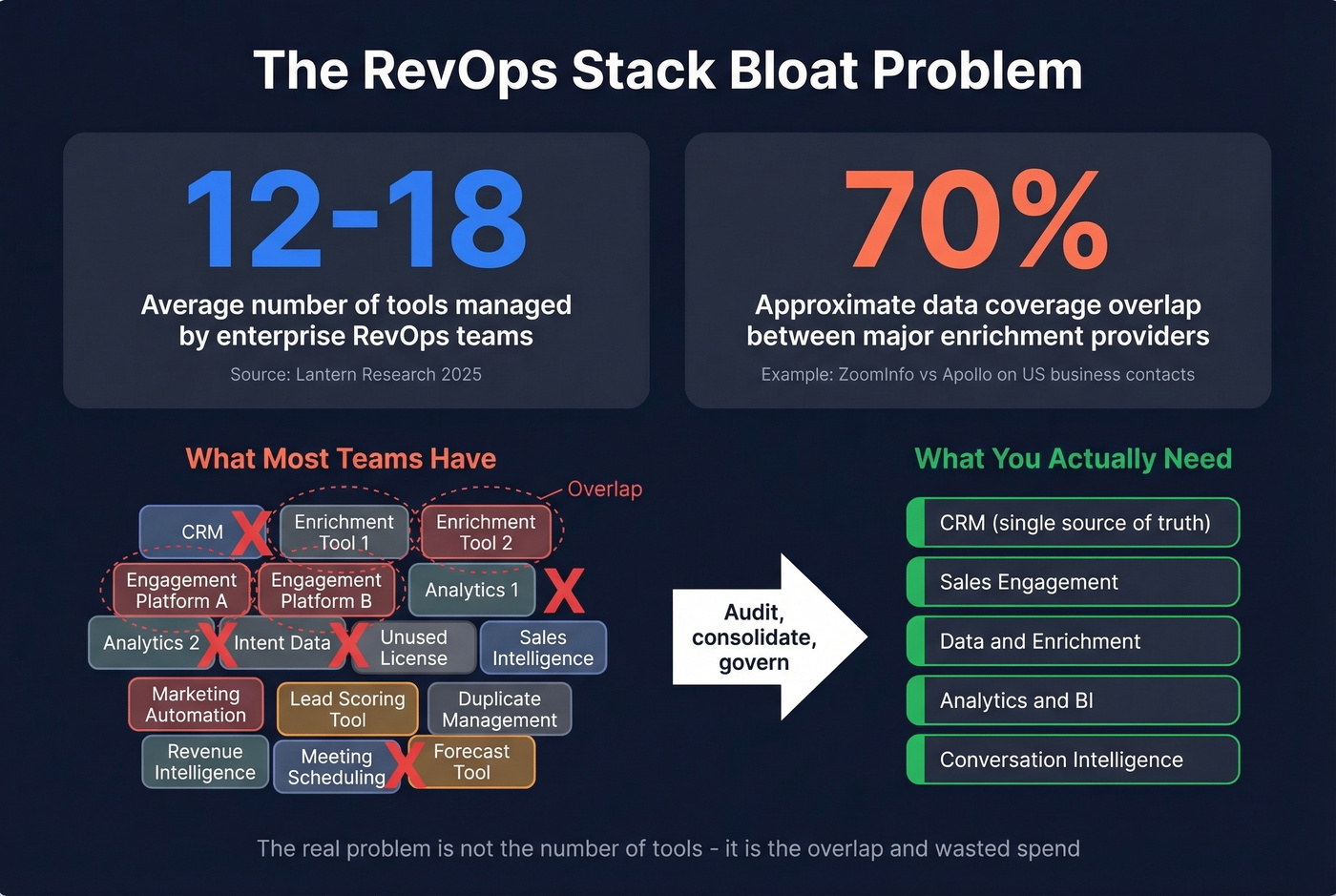
The real problem isn't the number of tools. It's the overlap. There's roughly 70% coverage overlap between ZoomInfo and Apollo on US business contacts. If you're paying for both, you're paying twice for the same data. Multiply that redundancy across your enrichment, engagement, and analytics layers, and you're looking at tens of thousands in wasted spend annually.
Your stack should fit into five categories: CRM, sales engagement, data/enrichment, analytics/attribution, and activation/orchestration. Most companies have the first three covered (often with redundancy) and the last two barely addressed. That's backwards - orchestration and attribution are where the ops org actually moves the needle.
Architecture That Works
The modern stack runs on a data warehouse as the single source of truth. Your CRM is an execution layer, not a reporting layer. The warehouse (Snowflake, BigQuery, Redshift) holds the canonical data, and reverse ETL tools like Census or Hightouch push insights back into the CRM and engagement tools where reps actually work.
This architecture requires a dedicated integration owner - someone who governs what connects to what, enforces data standards, and prevents the "just add another Zapier" sprawl that turns stacks into spaghetti. Warehouse + reverse ETL implementations commonly drive roughly 18-day shorter sales cycles and 60% less manual data entry within the first few months.
Tools by Category
A well-architected stack in 2026, with realistic pricing:
| Category | Tools | Approx. Pricing |
|---|---|---|
| CRM | Salesforce, HubSpot | Free-$300/user/mo |
| Sales Engagement | Outreach, Salesloft | ~$100-150/user/mo |
| Revenue Intelligence | Gong, Clari | ~$25-50K+/yr |
| Reverse ETL | Census, Hightouch | From ~$300/mo |
| Orchestration | Clay | From $149/mo |
HubSpot's free CRM tier is genuinely usable for early-stage teams. Apollo offers a free tier plus paid plans from $49-99/mo. ZoomInfo runs $15-40K/year depending on seat count and data modules. Clari and Gong both price on an annual contract basis, typically $25-50K+ for mid-market teams.
The biggest consolidation ROI sits in the data/enrichment layer - and that's where we'd start. Most teams are overpaying for stale data from providers that refresh on a 4-6 week cycle. Prospeo attacks that problem at a fraction of the cost: roughly $0.01 per email with 98% accuracy and a 7-day refresh cycle, plus a 92% API match rate that means your CRM enrichment workflows return usable contacts at scale.
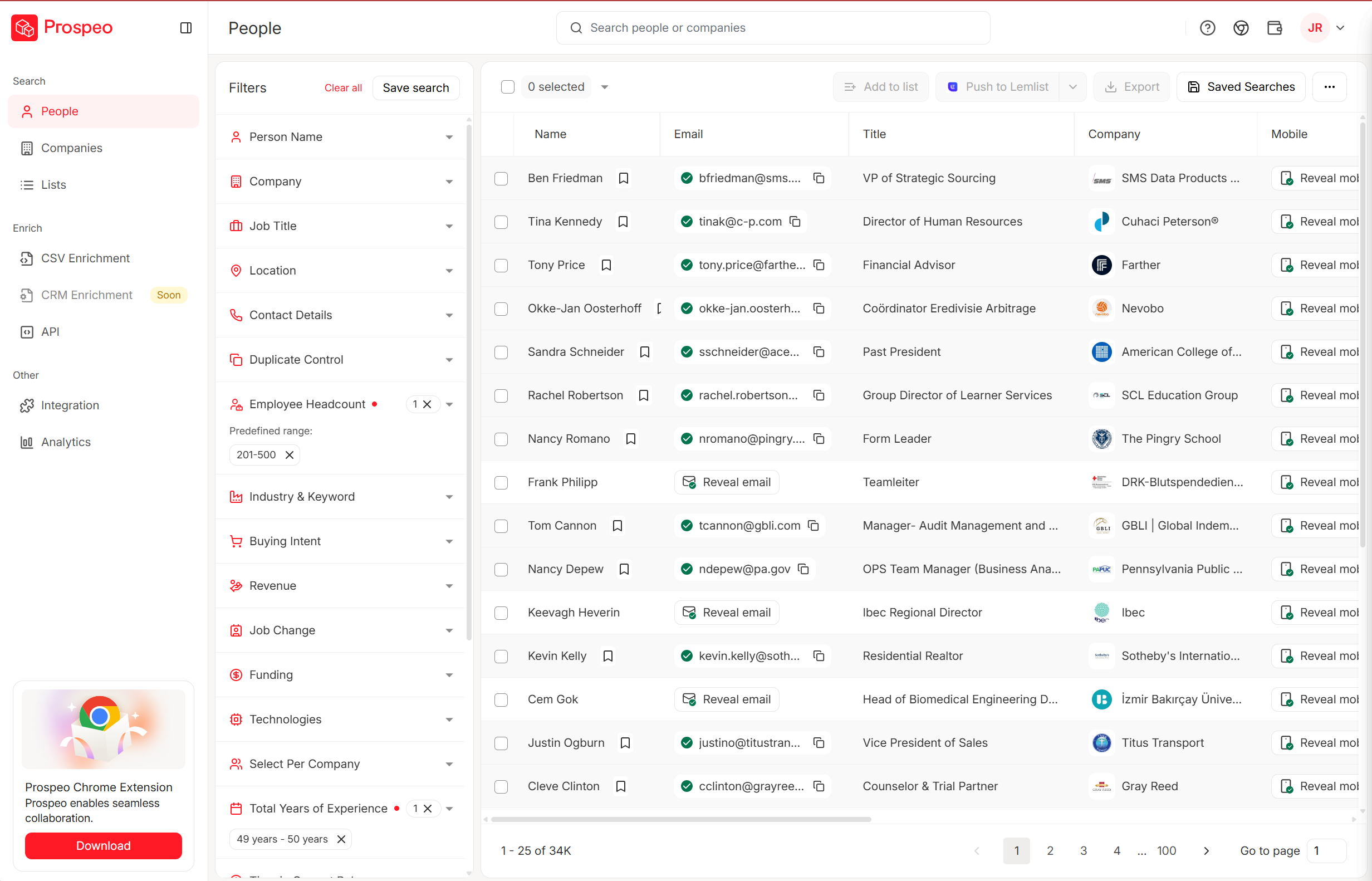
Hot take: if your average contract value is below the mid-market range, you probably don't need ZoomInfo-level spend on data. A tool with higher accuracy at a tenth of the price will outperform an enterprise platform your team barely uses. The best ops teams optimize for data quality per dollar, not brand name per vendor slide.
Organizations with unified tools grow up to 19% faster due to alignment. The tool itself matters less than the architecture - but paying enterprise prices for commodity data when better alternatives exist is exactly the kind of waste this function should eliminate.
How to Implement RevOps
Implementation isn't a project - it's a transformation. Plan for 6-12 months before you're operating at full capacity.
Phase 1 - Audit. Map every tool, process, and data flow across marketing, sales, and CS. Identify overlaps, gaps, and broken handoffs. Document who owns what, where data lives, and which metrics each team trusts (and which they don't). This phase usually surfaces uncomfortable truths - like the fact that marketing and sales are using different definitions for "qualified lead" and have been for two years.
Phase 2 - Define & Align. Standardize lifecycle definitions across all three functions. Set KPI targets for pipeline velocity, LTV:CAC, and NRR. Establish reporting lines and get the CRO or equivalent to formally sponsor the function. Without exec sponsorship, skip to Phase 0: get executive buy-in first. Nothing else works without it.
Phase 3 - Build. Clean your CRM data. This is the unsexy work that makes everything else possible. Run existing contacts through an enrichment API that returns 50+ data points per contact at a 92% match rate, refreshed every 7 days, so your CRM stays clean without manual intervention. Configure your warehouse and reverse ETL. Pilot in one business unit before rolling out company-wide.
Phase 4 - Activate & Optimize. Train role-by-role, not function-by-function. A marketing ops person and a sales ops person need different training even if they're using the same dashboard. Measure against KPIs and iterate quarterly. Don't try to boil the ocean - get one unit running cleanly, then expand.
Common Mistakes
Hiring junior admins instead of experienced operators. This is the most expensive mistake. A quality ops program costs $300-500K for larger teams, and that's money well spent. Hiring a $65K admin to architect your GTM data model creates technical debt that costs 3x to fix later. We've watched this play out repeatedly.
Buying tools before defining process. The CRM "idea graveyard" - dozens of custom fields, abandoned automations, and workflows nobody understands - is the direct result of a tools-first approach. Define the process, then find the tool that supports it.
No executive sponsorship. Without a C-suite champion, the function dies. It becomes a service desk that takes tickets from sales leadership instead of a strategic function that drives revenue architecture. If your ops lead doesn't have a direct line to the CRO or CEO, the function is already compromised.
Keeping sales ops and marketing ops separate. This defeats the entire purpose. If your org still has a marketing ops team reporting to the CMO and a sales ops team reporting to the VP of Sales, you don't have a unified model. You have two ops teams with a shared Slack channel.
Scaling before stabilizing. Pilot first. Get one business unit running cleanly before rolling out to the full org. The companies that try to transform everything at once end up transforming nothing.
Expecting short-term wins. This is a 6-12 month transformation. If leadership expects ROI in 90 days, reset that expectation immediately or the function will be defunded before it has a chance to work.
Ignoring change management. Alex Cosmas calls it the "assumption police" - the function that challenges leadership narratives with real data. That's politically dangerous work. Training, communication, and stakeholder management aren't optional. They're survival skills.
What's Changing in 2026
The Wakefield survey commissioned by Salesloft paints a clear picture: 98% of respondents say scope grew over the past year. 87% plan increased investment. 94% say the function is receiving more executive attention than ever before.
But the clarity gap persists. 64% say they need more clarity on strategy. 62% need better tools. 62% need more access to decision-makers. The function has budget and attention - what it lacks is definition.
Scope is expanding into finance. One of the biggest shifts is revenue operations absorbing billing operations, revenue recognition workflows, and forecasting alignment with the finance team. This makes sense - if the ops org owns the data model that predicts revenue, it should also own the systems that recognize and report it. Expect "Revenue Operations" to increasingly mean "everything between the first marketing touch and the cash hitting the bank account."
AI is the biggest variable. 97% of Wakefield respondents report measurable ROI from AI, with the strongest impact in forecasting and analytics. But AI is also compressing roles. The GTM Engineer position - which commanded $100-130K at Series A-C companies - is already under pressure. Practitioners on r/SalesOperations predict that AI-native platforms will reduce the need for specialized workflow builders, collapsing the role back into broader systems ownership. The GTM Engineers who survive will be the ones who shift from "I build the workflow" to "I design the system architecture that AI executes."
AI compresses junior, execution-focused roles and expands strategic ones. If your career is built on "I know how to configure Outreach sequences," you're vulnerable. If it's built on "I architect the data model that makes the entire GTM motion work," you're more valuable than ever. The RevOps Co-op's reports track this shift closely and are worth following if you're planning your career trajectory.
Career Path and Salaries
Compensation has matured significantly:
| Role | Experience | Base Salary | OTE Range |
|---|---|---|---|
| Analyst | 0-3 years | $55K-$90K | $70K-$125K |
| Manager | 3-7 years | $100K-$235K | $120K-$280K |
| Director | 7-12 years | $140K-$215K | $170K-$275K |
| VP / CRO | 12+ years | $180K-$400K+ | $250K-$500K+ |
Median OTE across all roles sits around $129K. Company size matters enormously: startups with 50 or fewer employees pay a median OTE of roughly $100K, while enterprises with 1,000+ employees push that to $162K. Geography adds another layer - SF, NYC, and Boston pay 20-30% above national averages. For context, director-level ops leaders in major metros were already commanding ~$200K back in 2019, so the salary trajectory has been steep. Manager-level bonuses typically run 10-20% of base.
The sales-to-ops transition is viable and increasingly common. AMA threads on r/SalesOperations make it clear that plenty of former AEs make the switch successfully. If you've spent years in a quota-carrying role, you understand pipeline mechanics, forecasting pressure, and CRM workflows better than most ops hires. That domain expertise is valuable. The gap you'll need to close is on the systems and analytics side - SQL, dashboard building, and integration architecture.
Skip this path if you hate ambiguity. Ops work is 40% firefighting, 30% politics, and 30% actual systems work. If you want clean projects with defined scope, this isn't it.
Looking ahead, AI compresses analyst-level roles (data pulls, report generation, basic forecasting) and expands strategic roles (revenue modeling, GTM architecture, AI workflow design). If you're entering the field today, invest in the strategic skills. The tactical work is being automated faster than most people realize.
Your GTM stack is only as good as the data flowing through it. Prospeo gives RevOps teams 300M+ verified profiles, native integrations with Salesforce, HubSpot, Clay, and Zapier, plus API access for custom enrichment workflows - all at $0.01 per email.
Build the data layer your revenue engine actually deserves.
FAQ
What does a RevOps manager do day-to-day?
A manager typically spends 40-60% of the week on process and data governance (handoffs, lifecycle definitions, dashboards) and the rest on systems work (CRM hygiene, integrations, tool renewals). In early-stage orgs it skews toward firefighting; in mature orgs it shifts toward forecasting, segmentation, and quarterly planning.
What does RevOps mean?
RevOps means one team owns the operating system for revenue: shared processes, shared data definitions, and shared tooling across marketing, sales, and customer success. The practical outcome is fewer handoff leaks and better leading indicators like pipeline velocity, so leadership can intervene weeks earlier than lagging metrics allow.
Is RevOps the same as Sales Ops?
No. Sales Ops is a subset focused on sales execution, tools, and process, while RevOps covers the full lifecycle from lead to renewal. A quick test: if your ops team doesn't own marketing attribution and renewal workflows, you're running Sales Ops with a broader label.
What tools do RevOps teams use?
Most teams use a CRM (Salesforce or HubSpot), sales engagement (Outreach or Salesloft), enrichment/data, revenue intelligence (Gong or Clari), and a warehouse + reverse ETL layer (BigQuery/Snowflake + Hightouch/Census). Enterprises average 12-18 tools, but consolidation usually pays back fastest in the data/enrichment layer.
What's a good data tool for RevOps enrichment?
For enrichment at scale, look for high accuracy, fast refresh cycles, and an API that plays well with your CRM. Prospeo hits 98% email accuracy with a 92% API match rate and a 7-day refresh cycle, which makes it a strong fit for ops teams running automated enrichment workflows. It also includes 125M+ verified mobile numbers and native integrations with Salesforce, HubSpot, and Clay.
Summary
RevOps works when it has executive sponsorship, standardized lifecycle definitions, and ruthless data governance before shiny tools. If you treat it like a title change or a software purchase, you'll recreate the same silos with a new org chart. Build the operating model, measure pipeline velocity and LTV:CAC, keep the stack clean - that's how revenue operations actually drives growth in 2026.