

Best Email Verifier Tools in 2026: Pricing, Accuracy, and Honest Picks
Your email list is rotting right now. Not metaphorically - 25-28% of email databases decay every year as people change jobs, companies fold, and inboxes get abandoned. A list you built six months ago already has dead weight dragging down your sender reputation.
Bounce rates under 2% are healthy. Above 5%, ISPs start flagging your domain. A reliable email verifier is the difference between those two outcomes.
We cross-referenced two major benchmarks, tested free tiers ourselves, and talked to teams running 50K+ outbound emails a month. Here's what actually holds up.
Our Top Picks
| Tool | Best For | Price/10K | Accuracy | Free Tier |
|---|---|---|---|---|
| Prospeo | Find + verify in one step | ~$0.01/email (find + verify) | 98% | 75 emails/mo |
| Bouncer | Pure bulk verification | $45-$49 | 97.8% | 1,000 credits (trial) |
| ZeroBounce | Integration ecosystem | $64-$80 | 96.5% | 100/mo |
| NeverBounce | Catch-all detection | $50-$80 | 99.1% | 1,000 credits (trial) |
| Clearout | Yahoo/AOL validation | $40-$58 | 98.4% | 100 credits |
| Kickbox | Compliance-first teams | $80 | 97.0% | 100 free verifications |
| Hunter | Email finding suite | $149 | 70% (Hunter benchmark) | 100/mo |
| Emailable | Speed | $50-$69 | 97.2% | Free trial |
| EmailListVerify | Budget bulk cleaning | $24 | 97% | 100 free verifications |
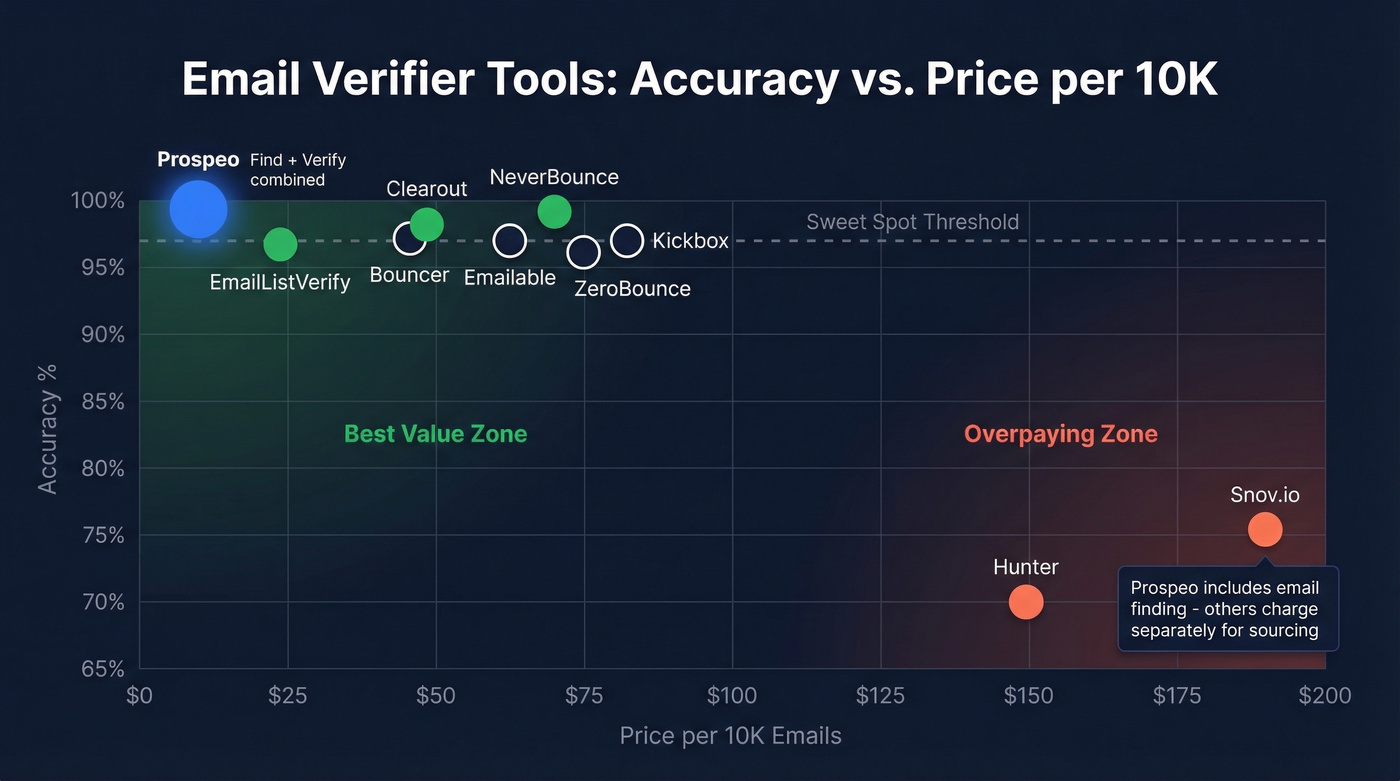
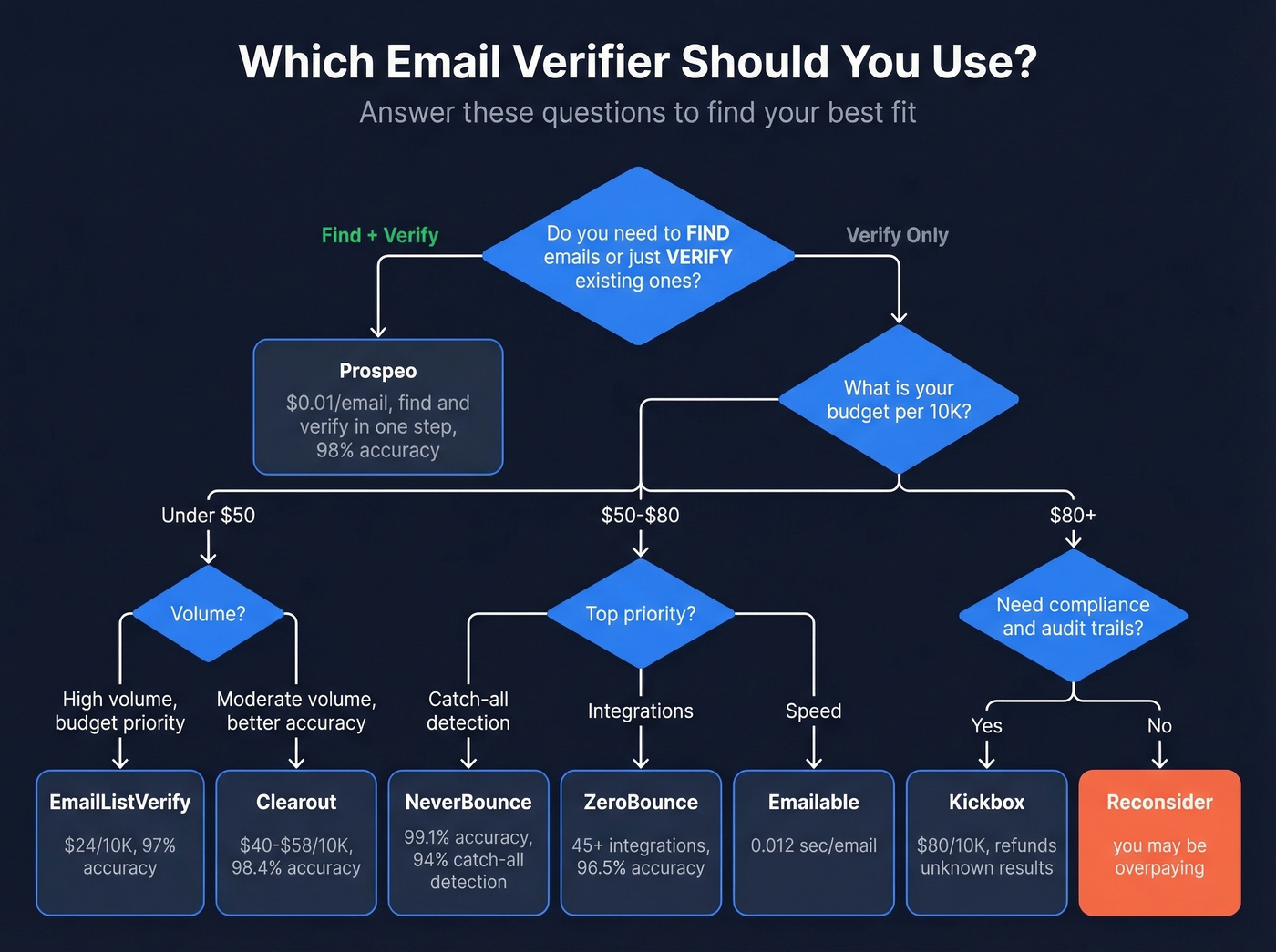
Prospeo sits at the top because it's the strongest pick for finding and verifying emails in a single workflow. You're not paying for verification as a separate step - it's baked into the finding process. For teams running outbound, that distinction matters more than shaving $10 off a 10K batch.
Best Email Verifier Tools Reviewed
Prospeo
Prospeo doesn't fit neatly into the verification-only category because it does more than check addresses - it finds the email first, then runs a 5-step verification process including catch-all handling, spam-trap removal, and honeypot filtering before the address ever hits your list. The database covers 143M+ verified emails across 300M+ professional profiles, all refreshed on a 7-day cycle.
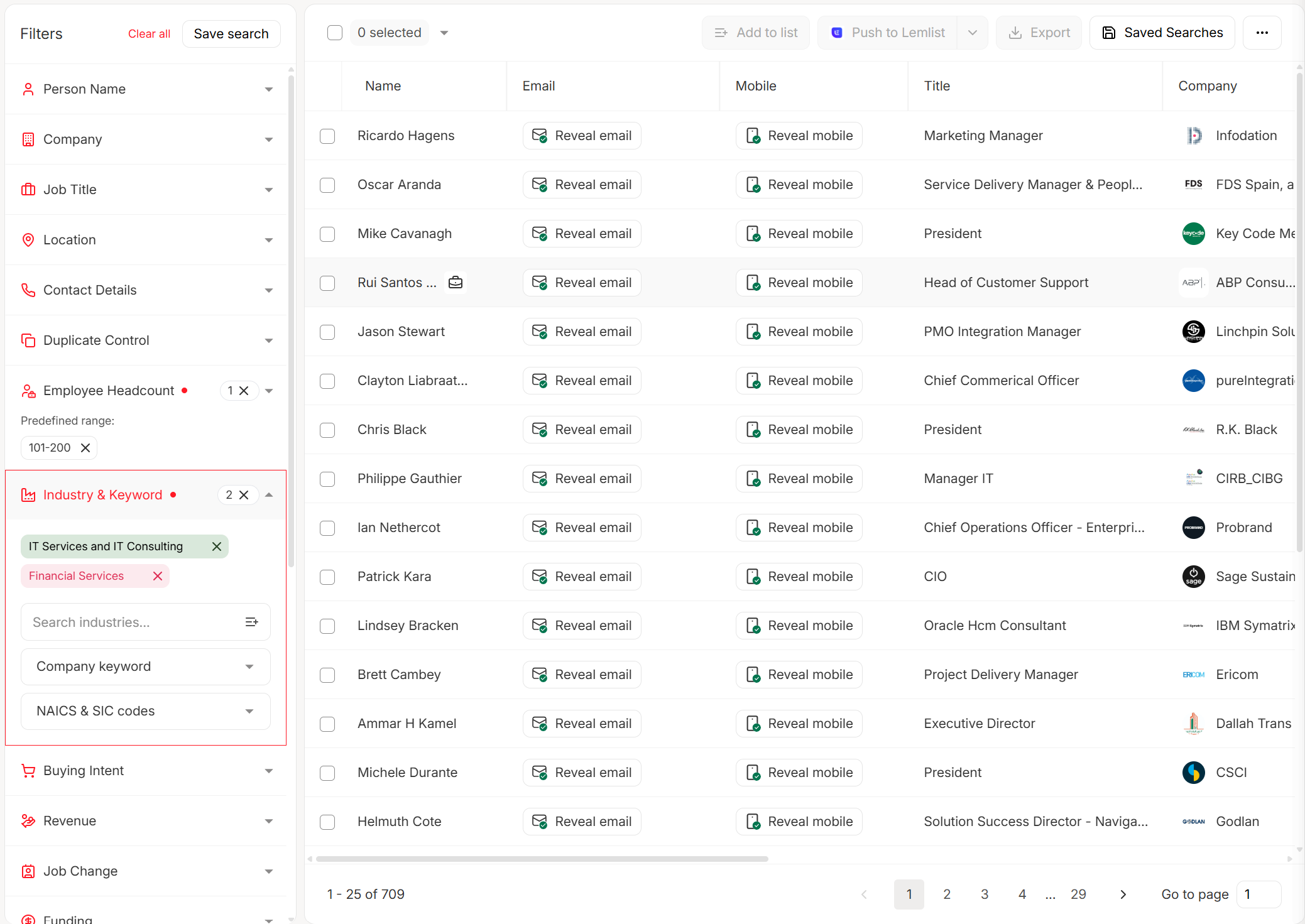
Use this if: You're building prospect lists from scratch and want clean data from the start. At ~$0.01/email, you're paying for finding and verification combined - not stacking two tools. Meritt cut their bounce rate from 35% to under 4% after switching.
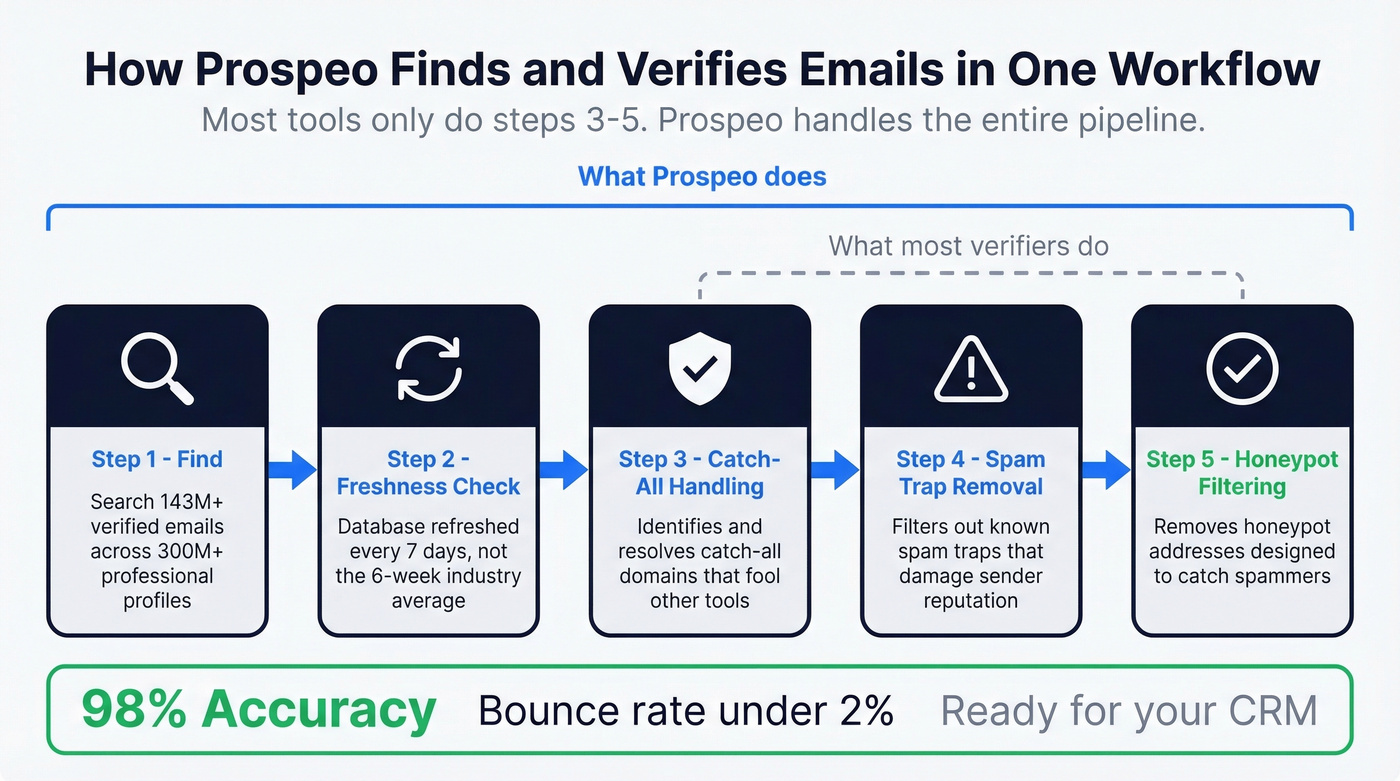
Skip this if: You already have a massive list and just need a bulk cleaning pass. Prospeo's strength is the combined workflow, so pair it with a dedicated list scrubber if you're sitting on years of CRM decay.
Bouncer
Bouncer processes up to 250K emails per upload, costs $45-$49 per 10K, and doesn't make you think about compliance. SOC 2 and GDPR certified, 4.9/5 on Capterra across 233 reviews. In a 90-day benchmark testing 47,000 emails, Bouncer hit 97.8% accuracy - not the highest, but consistent and predictable. Free trial gives you 1,000 credits to test.
Use this if: You want a no-nonsense bulk verification tool that does one thing well and doesn't pretend otherwise.
Skip this if: You need deep integrations or an email-finding suite alongside verification. For teams that want a Swiss Army knife, look elsewhere.
ZeroBounce
ZeroBounce offers 45+ direct integrations - more than any other verifier on this list. Accuracy tested at 96.5% in the 90-day benchmark, and Clay's data quality tests gave it a 99.25% quality score. The ZeroBounce ONE bundle starts at $99/month and packages validation with scoring and deliverability tools. Free tier gives you 100 verifications per month.
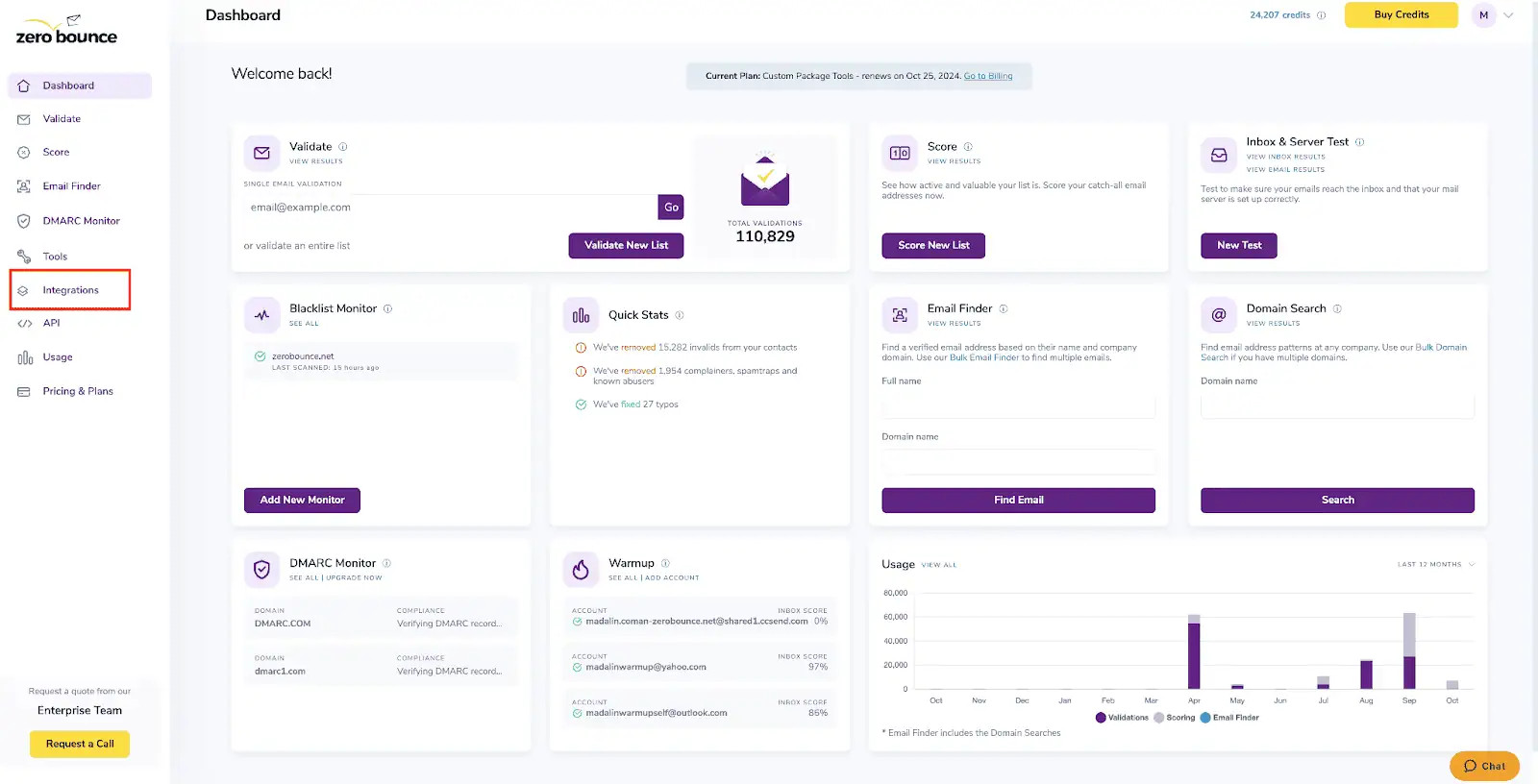
Use this if: Your stack is complex and you need native connections everywhere.
Skip this if: You're price-sensitive on a per-email basis. At $64-$80 per 10K, ZeroBounce isn't the cheapest option - you're paying a premium for the ecosystem.
NeverBounce
NeverBounce posted the highest accuracy in the 90-day benchmark at 99.1%, and it publicly states 94% catch-all detection accuracy - a notoriously hard problem that most validators punt on. Pricing runs $0.008/email on pay-as-you-go, roughly $50-$80 per 10K depending on volume. The integration library runs deep at 80+ connections, and you get 1,000 free credits to start.
Use this if: Catch-all domains are your biggest headache. Enterprise prospects often sit behind catch-all servers, and NeverBounce handles those better than anything else we've tested.
Skip this if: You need the absolute cheapest per-email rate. NeverBounce's PAYG pricing is fair but not budget-tier.
Clearout
Clearout delivers some of the best accuracy numbers in the space - 98.4% in the 90-day benchmark - at one of the lowest price points: $40-$58 per 10K. The tool runs 20+ layered validation checks and offers a 3% bounce rate guarantee, which is a nice safety net. Real-time form verification (Form Guard) catches bad emails at the point of entry, and Clearout advertises 96%+ accuracy for Yahoo and AOL validation.
Use this if: You're running high-volume list cleaning on a budget and want strong accuracy without paying ZeroBounce or NeverBounce prices. The real-time form widget is a bonus for marketing teams.
Skip this if: You need a massive integration ecosystem. Clearout's connections are more limited than ZeroBounce or NeverBounce.
Kickbox
Kickbox's pricing is straightforward: $80 per 10K, $4,000 per million, with a policy that refunds credits for "unknown" results. That last part matters - most verifiers charge you even when they can't give a definitive answer. GDPR compliant and SOC II certified, Kickbox processes about 100K emails in roughly an hour.
Here's where it gets interesting: in the Hunter benchmark, Kickbox scored 67.53% accuracy, while the 90-day benchmark put it at 97%. That gap reflects different test methodologies and list compositions - the Hunter test penalizes "unknown" results, which drags scores down on messy enterprise lists. Solid for compliance-first teams that need audit trails and predictable billing.
Hunter
Here's the thing about Hunter: at $149 per 10K for verification, it's the most expensive standalone option on this list. And in Hunter's own benchmark, their accuracy came in at 70% - respectable, but not category-leading. Where Hunter makes sense is as a full email-finding suite starting at $40/month, where verification is bundled into the workflow. If you're already paying for Hunter's finder, the verification is a nice add-on. Buying it just for verification alone? Overpriced.
If you're comparing options, see our breakdown of Hunter alternatives.
EmailListVerify
The budget pick. At $24 per 10K, EmailListVerify is the cheapest option in this roundup by a wide margin. No monthly commitment - just pay for what you use. Accuracy is reported at 97%, which is reasonable for the price. If you're cleaning a massive inherited list and don't want to spend hundreds of dollars on a first pass, start here. Don't expect the deepest integrations or fastest processing, but for raw cost-per-verification, nothing beats it.
Emailable
Emailable's standout stat is speed: 0.012 seconds per email in the 90-day benchmark, making it the fastest tool tested. Accuracy came in at 97.2%, which is competitive. Pricing starts at EUR25.50/month, with per-10K costs in the $50-$69 range. It's a clean, developer-friendly tool that doesn't try to be a platform. Good for teams that need API-first verification at scale without the overhead of a full suite.
If you're evaluating it head-to-head, check Emailable vs Generect.
Honorable Mentions
Snov.io charges $189 per 10K for verification - expensive, and better suited as an email-finding tool than a standalone checker. Truelist offers something different: unlimited verifications on a flat monthly subscription, combining standard checks with automated browser behavior to improve catch-all resolution. Interesting for teams with unpredictable volumes. Verifalia runs 30+ step verification checks with a free tier and paid plans, appealing to technically demanding teams that want granular control. Email Hippo has been operating since 2009 and offers multiple product tiers - the quiet veteran of the space. None of these are bad; they're just more niche than the tools above.

Most email verifiers charge you to clean a list you already paid to build. Prospeo finds the email and runs 5-step verification - catch-all handling, spam-trap removal, honeypot filtering - before the address ever touches your CRM. 98% accuracy at ~$0.01/email.
Stop stacking two tools. Find and verify in one step.
Pricing Compared
Three pricing models dominate this market, and understanding them saves you from overpaying.
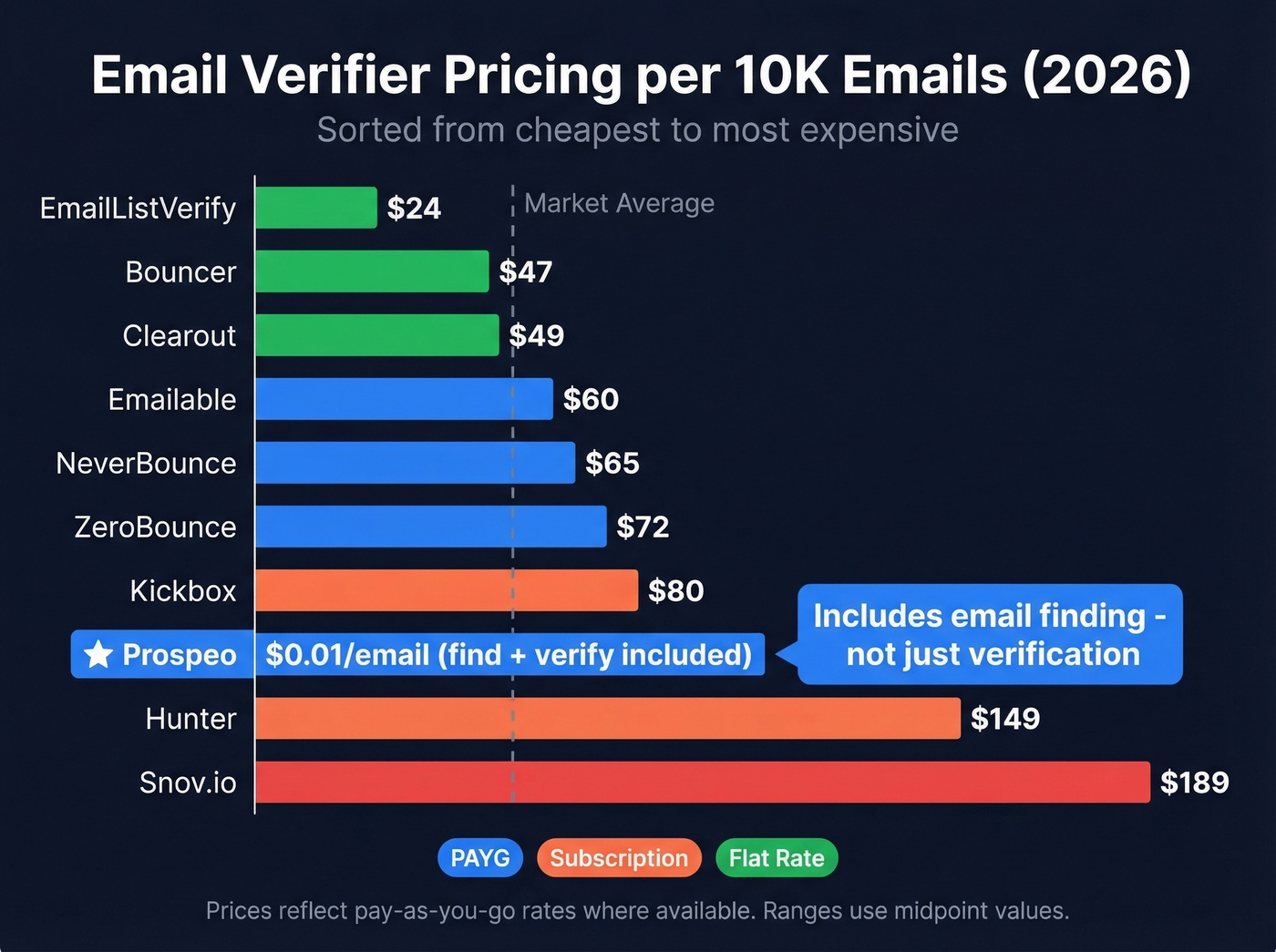
Credit-based (pay-as-you-go) works best for teams with periodic list-cleaning needs. You buy a block of credits and burn them as needed. Bouncer, NeverBounce, Kickbox, and Clearout all offer this.
Subscription plans include a set number of verifications per month. ZeroBounce, Hunter, and Emailable take this approach - better if you're verifying consistently and want predictable billing.
Unlimited/flat-rate is Truelist's model. One monthly fee, verify as much as you want. Rare, but compelling if your volumes spike unpredictably.
| Tool | Price/10K | Free Tier | Model |
|---|---|---|---|
| EmailListVerify | $24 | 100 free verifications | PAYG |
| Clearout | $40-$58 | 100 credits | PAYG/Sub |
| Bouncer | $45-$49 | 1,000 credits (trial) | PAYG |
| NeverBounce | $50-$80 | 1,000 credits (trial) | PAYG |
| Emailable | $50-$69 | Free trial | Subscription |
| ZeroBounce | $64-$80 | 100/mo | PAYG/Sub |
| Kickbox | $80 | 100 free verifications | PAYG |
| Prospeo | ~$0.01/email (find + verify) | 75/mo | Credit-based |
| Hunter | $149 | 100/mo | Subscription |
| Snov.io | $189 | Free trial | Subscription |
One number worth calling out: Prospeo's ~$0.01/email includes the email-finding step. Most tools here price verification separately from sourcing contacts. When you factor in the total cost of finding and verifying a contact, the effective rate is competitive with tools charging half the per-verification price.
If you're building lists upstream, it helps to compare email list providers and data enrichment services too.
Our take: If your average deal size is under $5K, you probably don't need the most expensive tool on this list. EmailListVerify at $24/10K or Clearout at $40/10K will get you 97%+ accuracy. Save the premium tools for enterprise lists full of catch-all domains where the extra accuracy actually moves the needle.
Meritt cut their bounce rate from 35% to under 4%. Stack Optimize keeps client deliverability above 94% with zero domain flags. The difference? Emails verified through Prospeo's proprietary 5-step process, refreshed every 7 days - not the 6-week industry average.
Your list is decaying right now. Verify 75 emails free this month.
How Email Verification Works
Every verification tool runs the same fundamental three-layer process, regardless of what they charge.
Layer 1 - Syntax check. The tool confirms the email follows valid formatting rules. No missing @ symbol, no illegal characters, no double dots. This catches the obvious garbage and takes milliseconds.
Layer 2 - Domain and MX validation. The checker confirms whether the domain exists and has active mail exchange (MX) records. If there's no mail server configured for that domain, the email is dead regardless of what comes after the @.
Layer 3 - SMTP mailbox verification. This is where it gets interesting. The tool initiates an SMTP connection to the mail server and asks whether the specific mailbox exists - without actually sending an email. Real-time latency for this step typically runs 100-500ms.
Beyond these three layers, good tools add secondary checks: disposable email detection (catching those guerrillamail.com addresses), spam trap identification, role account flagging for addresses like info@ or support@, and risk scoring. The more layers, the fewer surprises in your outbound sequences.
Then there's the catch-all problem. Catch-all domains accept mail sent to any address at that domain, so the SMTP check returns "valid" even for mailboxes that don't exist. This is the hardest problem in email verification, and it's where tools diverge sharply. NeverBounce states 94% catch-all detection accuracy. Most others flag catch-alls as "unknown" or "accept-all" and leave the decision to you.
"Unknown" results mean the tool couldn't get a definitive answer - usually because the mail server timed out, greylisted the connection, or runs aggressive firewall rules. Enterprise domains produce more unknowns than SMB domains, which is why accuracy benchmarks vary so much depending on the test dataset.
Accuracy: Claims vs. Reality
Every tool markets 96-99.9% accuracy on their homepage. Let's be honest about what actually happens when you test them.
The LaGrowthMachine benchmark tested 12 services over 90 days across 47,000 emails and measured accuracy against actual bounce data. Results ranged from 96.5% (ZeroBounce) to 99.1% (NeverBounce). Those are strong numbers.
Then there's the Hunter benchmark, which tested 15 verifiers using 3,000 real business emails segmented by company size, run through Clay under identical conditions. Top scores: Hunter at 70%, Clearout at 68.37%, Kickbox at 67.53%. Clay's own data quality tests scored ZeroBounce at 99.25%, Findymail at 98.92%, and Hunter at 98.52% - using a different methodology focused on non-catch-all domains.
| Benchmark | Top Score | Methodology |
|---|---|---|
| LaGrowthMachine (90-day) | 99.1% (NeverBounce) | 47K emails, bounce data |
| Hunter | 70% (Hunter) | 3K emails via Clay |
That's a massive gap, and it's not because these tools are lying. Real-world lists include catch-all domains, greylisted servers, and enterprise firewalls that make definitive verification impossible. The Hunter benchmark penalizes "unknown" results as incorrect, which drags scores down but reflects what actually happens when you upload a messy CRM export.
All major tools perform similarly on easy domains - Gmail, Outlook, standard business email. The difference shows on hard domains: enterprise catch-alls, custom mail servers, and domains with aggressive anti-spam configurations. That's where the consensus on r/SaaS lines up with our own testing - users report roughly 40% discrepancy when running the same list through multiple tools. One user tried Hunter, Clearout, and NeverBounce with "very similar results" and still saw 1-2% bounce rates. That's normal. No tool gets you to zero.
Do You Need a Standalone Verifier?
Look, standalone email verification is often a band-aid for bad upstream data. If your email source delivers unverified or stale contacts, you're paying twice - once to find the email, then again to check whether it's any good.
The smarter approach is fixing the source. When your data provider verifies emails during the finding step and refreshes records frequently, a standalone tool becomes a safety net rather than a crutch. A 7-day data refresh cycle means contacts don't sit in a database aging for weeks before you touch them. Compare that to the 6-week industry average, and you start to see why some teams skip standalone validation entirely.
That said, there are legitimate cases where you still need a dedicated checker. Inherited lists from acquisitions or marketing databases that haven't been touched in months need a cleaning pass - no way around it. CRM decay is real even with good upstream data, and if you're running high-volume marketing campaigns through tools like Mailchimp or Klaviyo, a pre-send verification step is cheap insurance against reputation damage.
If you're troubleshooting deliverability end-to-end, pair verification with an email deliverability guide and email reputation tools.
The question isn't "do I need an email verifier?" It's "do I need a standalone one, or should I invest in a source that verifies from the start?"
Email Verifier FAQ
Is free email verification accurate enough?
Free tiers use the same verification engine as paid plans - accuracy is identical whether you verify 100 emails or 100,000. But 100 free checks won't clean a real list. Free is for testing the tool's interface and results quality. Budget $40-80/month for production use.
What's a good bounce rate after verification?
Under 2% is healthy and keeps your sender reputation clean. Expect 1-2% even after running a quality verification pass - no tool eliminates bounces entirely because emails go stale between verification and send. Above 5% means your tool isn't working properly or your list is too old to salvage without full re-verification.
Why do different verifiers give different results?
Tools use different SMTP connection methods, timeout thresholds, and catch-all handling logic. Users report roughly 40% discrepancy across tools on the same list. The disagreement is worst on enterprise domains with strict firewall rules. Run the same test batch of 500-1,000 emails through 2-3 tools before committing to one for production use.
How often should I re-verify my list?
Every 3 months minimum. Email lists decay 25-28% annually - roughly 7% per quarter. If you're running weekly outbound campaigns, monthly verification is safer. Teams using data sources with short refresh cycles can stretch intervals longer since the underlying data stays fresher.
Can any tool verify catch-all emails?
Not definitively. Catch-all domains accept all incoming mail at the server level, so standard SMTP checks can't confirm whether a specific mailbox exists. NeverBounce states 94% catch-all detection accuracy - the highest published number in our source set. Most other tools return catch-all results as "unknown" or "accept-all," and you'll need to decide your own risk tolerance for sending to them.