

The Account Based Marketing Playbook: A Step-by-Step Operating Manual for 2026
Your CMO just told you to build an account based marketing playbook. You've got a slide deck from last quarter's offsite, a CRM full of accounts nobody's tiered, and a sales team that thinks "alignment" means a shared Slack channel. Here's the thing: nearly 80% of organizations say they have an ABM program, but only 29% measure it with ABM-aligned metrics. That's not ABM. That's demand gen with a new label.
What follows is the operating manual most playbooks skip - scoring models, SLA components, governance cadence, and the failure modes that actually kill programs.
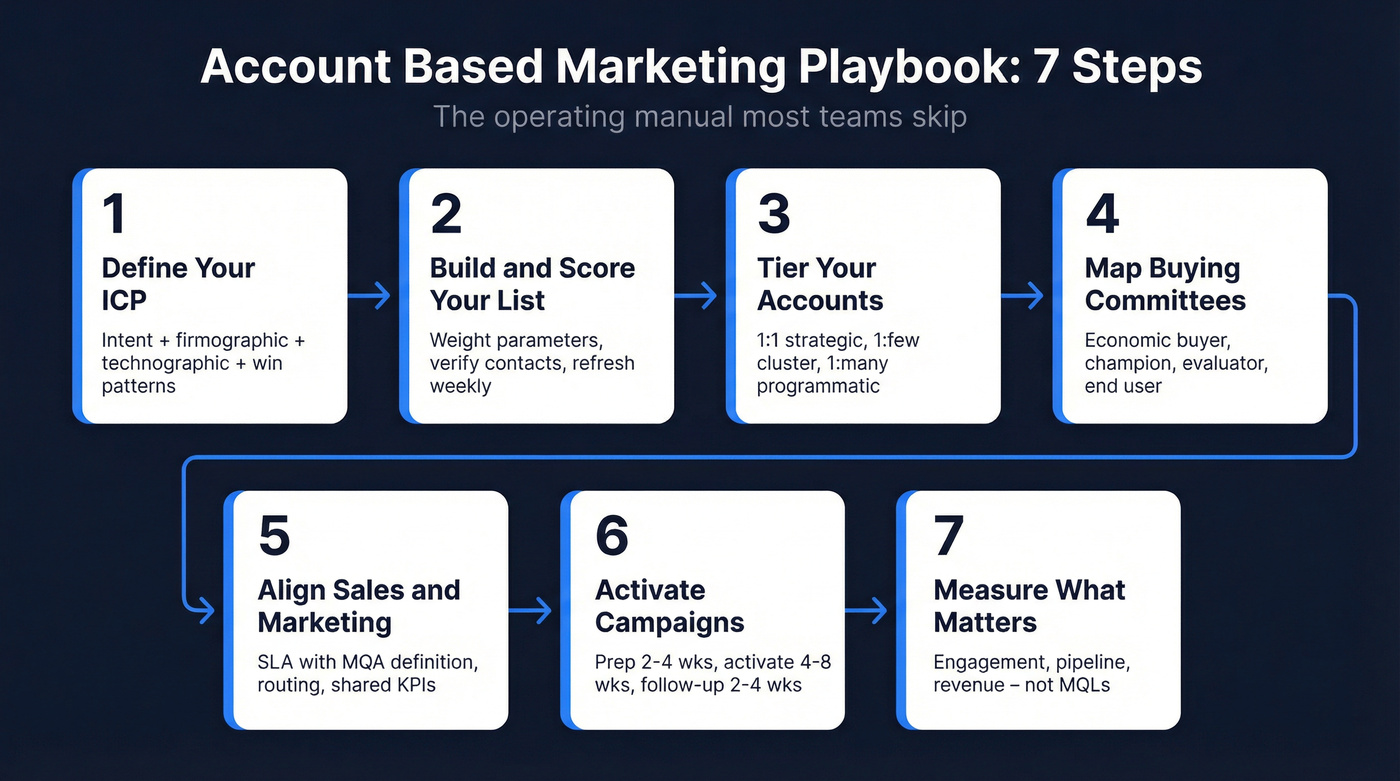
7 Steps to Build Your ABM Playbook
Step 1 - Define Your ICP
Most teams define their ICP with firmographics alone - industry, headcount, revenue range. That's a starting point, not a profile. Use four lenses:
- Intent signals - demo requests, pricing page visits, content engagement (see intent signals)
- Firmographic fit - size, industry, geography, revenue
- Technographic fit - stack compatibility, tools already in use (use firmographic and technographic data)
- Past success patterns - what your best closed-won deals share
Then prioritize accounts across five parameters: ICP fit, current need, opportunity revenue, decision-maker inclination, and buying history. A quick SWOT analysis for each high-value account - assessing your strengths, weaknesses, opportunities, and threats relative to that deal - can sharpen prioritization beyond what a scoring model alone reveals. Revisit quarterly as your win data evolves.
Step 2 - Build and Score Your List
Scoring follows three steps: select your parameters, create a scheme with min/max points per criterion, and assign weights based on your business context. For expansion scoring, five parameters work well - buying signals, access to decision-makers, opportunity revenue, strategic importance, and customer satisfaction. Weights aren't static; adjust them as results come in. (If you want a deeper scoring system, use this ABM lead scoring guide.)
The foundation underneath all of this is contact data quality. A perfectly scored account list with stale emails and wrong phone numbers is worthless. We've seen teams spend weeks building beautiful scoring models only to watch campaigns crater because 30% of their emails bounced on day one. Prospeo's 7-day refresh cycle and 98% email accuracy mean your list starts verified, not stale - and that matters more than any scoring formula. If you're auditing list health, start with B2B contact data decay benchmarks.

Step 3 - Tier Your Accounts
Not every account deserves the same investment. Tier based on deal size and complexity:
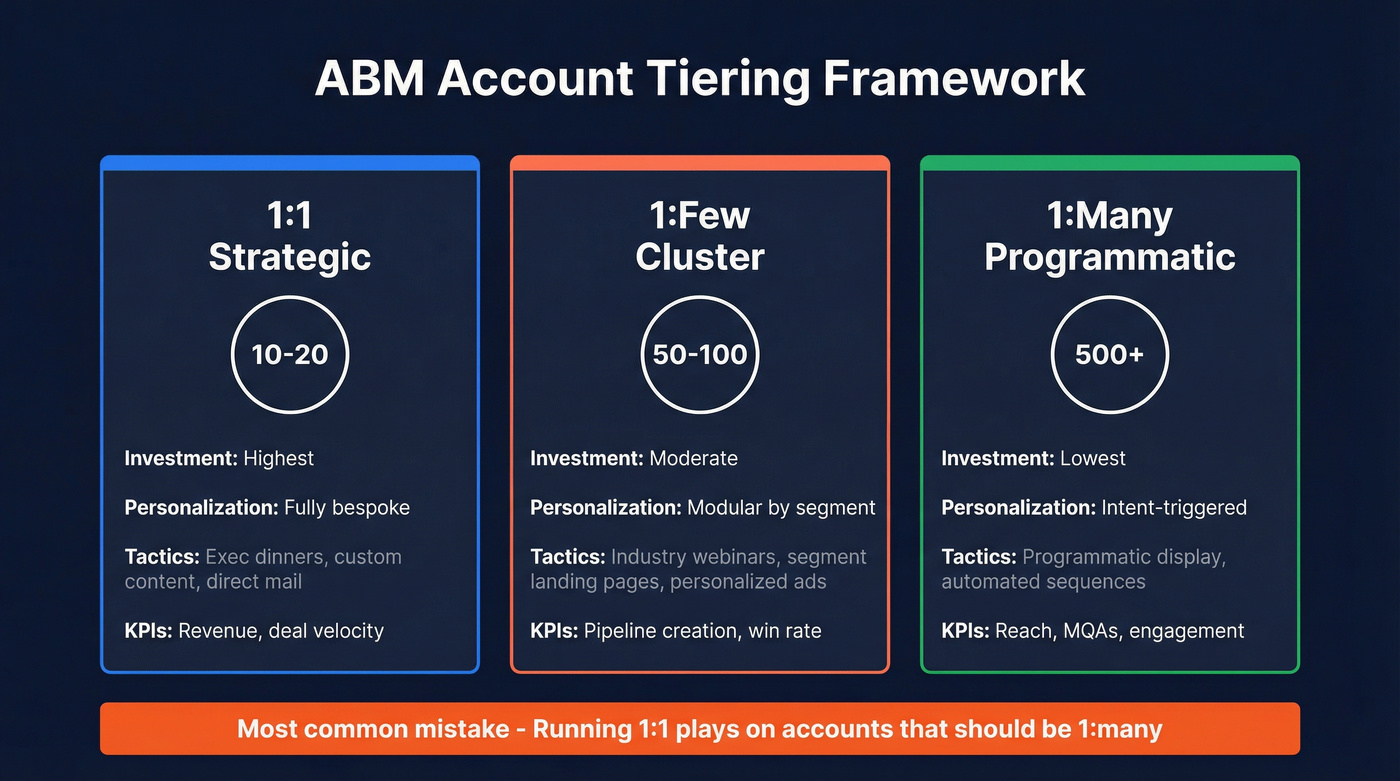
| Tier | Approach | Investment | Personalization | Key KPIs |
|---|---|---|---|---|
| 1:1 | Strategic | Highest | Fully bespoke | Revenue, deal velocity |
| 1:Few | Cluster | Moderate | Modular by segment | Pipeline creation, win rate |
| 1:Many | Programmatic | Lowest | Intent-triggered | Reach, MQAs, engagement |
The most common mistake? Running 1:1 plays on accounts that should be 1:many. That's how you burn your team out on 200 accounts when they should be going deep on 20. (For a scoring-first approach to tiering, see ABM account prioritization.)
Step 4 - Map Buying Committees
Enterprise buying committees run upwards of 12 people. For 1:1 accounts, your minimum coverage threshold is a primary contact plus three influencers. Map four roles: the economic buyer who signs the check, the champion who sells internally, the technical evaluator who validates the solution, and the end user who lives with it daily.
Look - if you can't name the economic buyer and champion for a 1:1 account, you don't have enough coverage to run a 1:1 play yet. Drop it to 1:few until you do. This is where guided selling becomes critical: equip reps with decision trees and next-best-action prompts so they know exactly which stakeholder to engage and when. (If you need a clean way to operationalize this, use buying group personas.)
Step 5 - Align Sales and Marketing
Every ABM guide says "align sales and marketing." None give you the SLA. A strong allbound approach treats inbound and outbound as a single coordinated motion - not two teams running parallel campaigns. Your SLA needs five components:
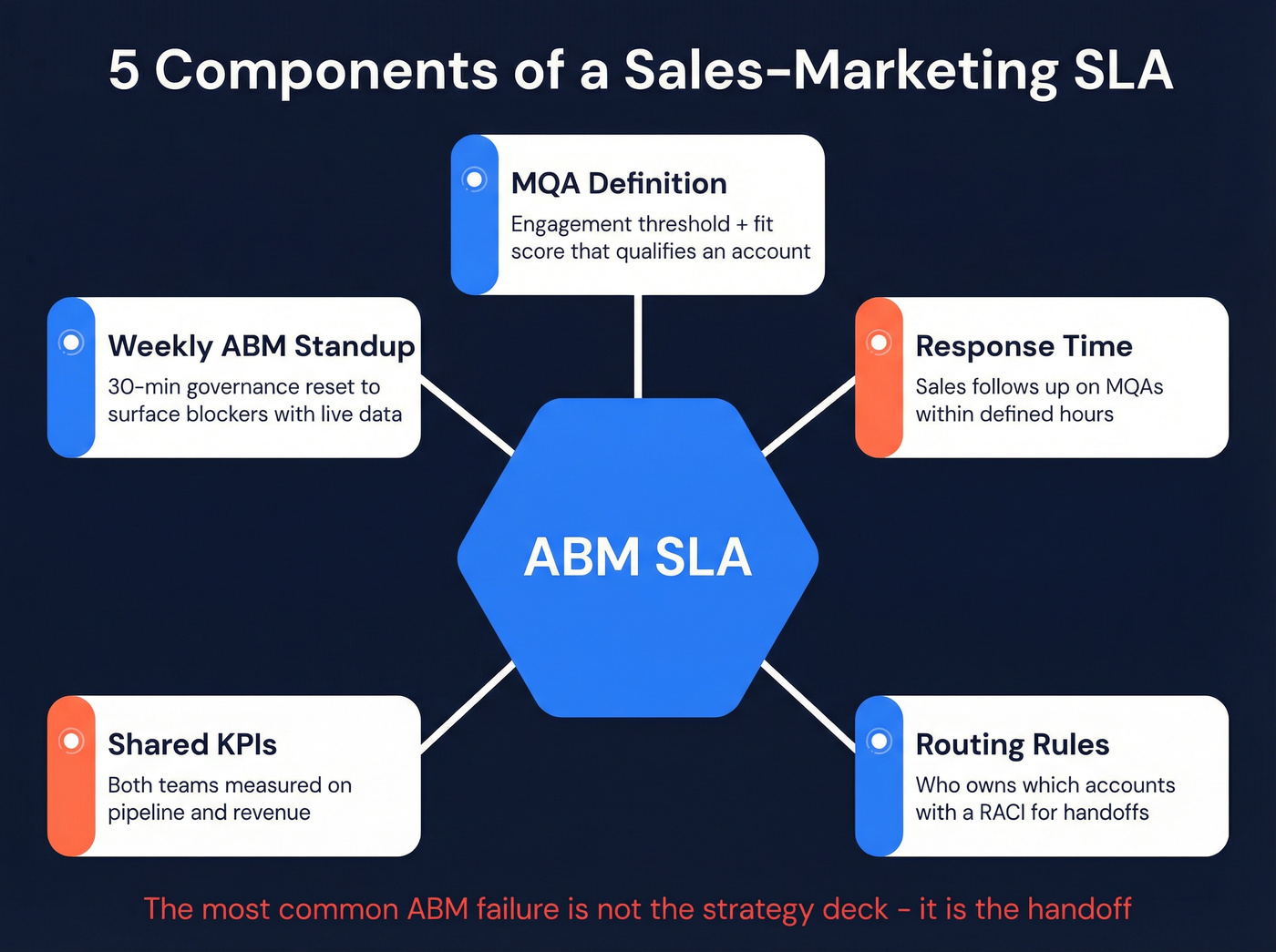
- MQA definition - engagement threshold + fit score that qualifies an account (tie it to account qualification)
- Response-time commitments - sales follows up on MQAs within X hours
- Routing rules - who owns which accounts, with a RACI for handoffs
- Shared KPIs - both teams measured on pipeline and revenue
- Weekly ABM standup - your governance reset point to surface blockers using live data
The most common ABM failure isn't the strategy deck - it's the handoff. Marketing warms up accounts, and nothing happens next. That's an SLA problem. Write it down or watch your program die quietly.
Step 6 - Activate Campaigns
Structure campaigns in three phases: Preparation at 2-4 weeks, Activation at 4-8 weeks, and Follow-Up at 2-4 weeks. Split responsibilities clearly - SDRs handle firmographic groundwork, AEs bring objectives and pain points, marketing optimizes timing and channel mix.
Only 43% of marketers feel confident delivering personalized experiences at scale - which is exactly why tiering matters. Don't try to personalize everything.
1:1 gets exec dinners, bespoke content, and direct mail. 1:few gets industry webinars, segment-specific landing pages, and personalized ads. 1:many runs programmatic display and intent-triggered sequences.
Personalize based on real account signals - hiring spikes, funding rounds, tech stack changes, leadership moves. A play built around job changes at target accounts is one of the highest-converting triggers we've seen: when a champion moves to a new company, that's an immediate warm intro to a fresh buying committee. Generic "Hi {FirstName}" doesn't count. (To systematize this trigger, see automated champion tracking.)
Guided selling in practice looks like this: a rep receives an alert that a 1:1 account just visited the pricing page three times this week, and the playbook prescribes a specific sequence - a personalized video from the AE, followed by a case study matched to the account's industry, followed by a direct-dial call to the champion. That's guided selling, not guesswork. If your motion is multi-threaded, make sure you understand what is multithreading in sales.
Step 7 - Measure What Matters
If you're measuring ABM by MQLs, you don't have an ABM program. You have demand gen with account filters.
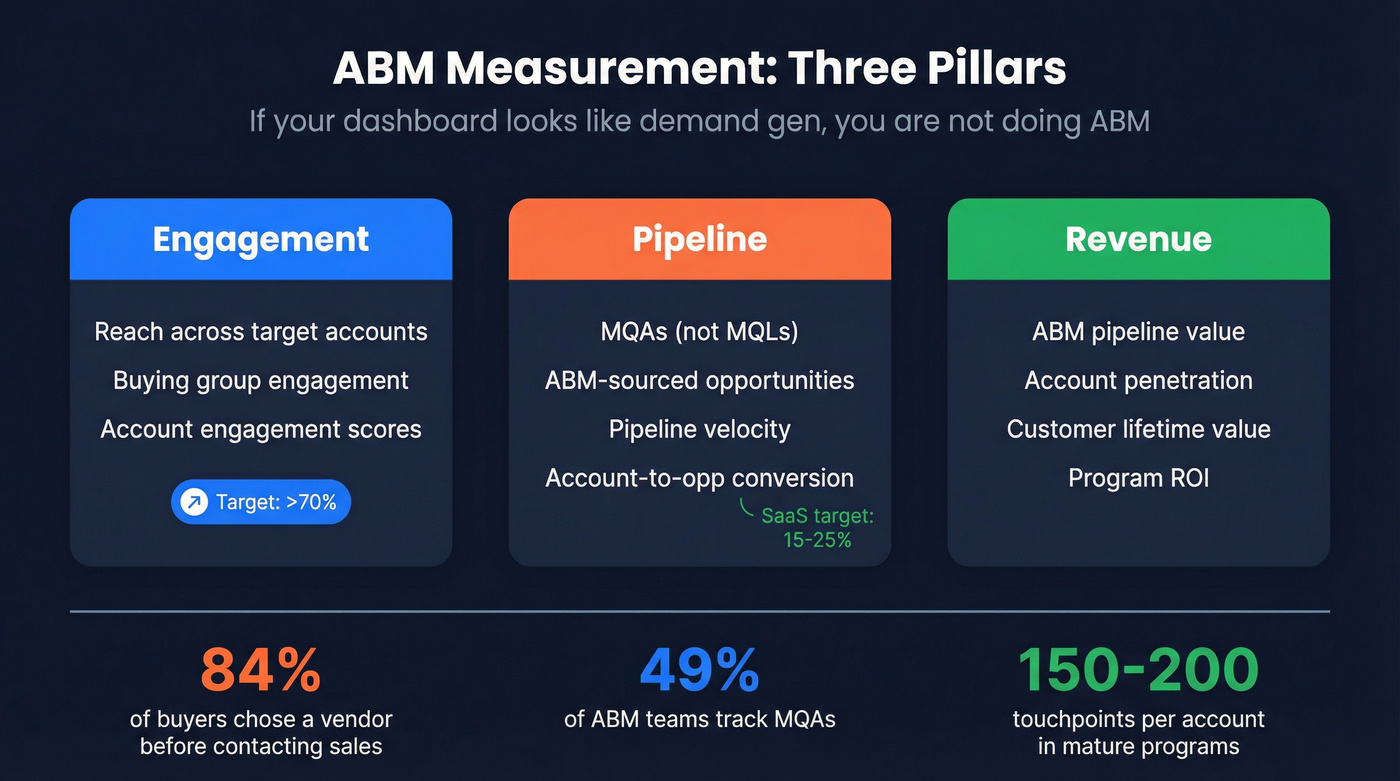
The numbers prove it: 49% of ABM teams track MQAs from target accounts, while 44% still track MQLs from non-target accounts - the gap is almost nonexistent, which tells you how broken most measurement is. Use a three-pillar framework:
Engagement tracks reach, buying group engagement, and account engagement scores. Pipeline tracks MQAs, ABM-sourced opportunities, and pipeline velocity. Revenue tracks ABM pipeline value, account penetration, CLV, and program ROI. (For dashboards and formulas, use ABM reporting.)
SaaS teams should target 15-25% account-to-opportunity conversion; manufacturing runs 8-12%. Mature programs track influence across 150-200 touchpoints per account - first-touch attribution misses most of the picture. And remember: 84% of buyers have already selected their preferred vendor before contacting sellers. Your measurement needs to capture influence across that entire journey, not just the last click.
ABM Results That Actually Happened
| Company | Tactic | Results |
|---|---|---|
| DocuSign | Tailored content across 6 industries | 60% engagement lift, 300% page views, 22% pipeline growth |
| LiveRamp | 15 high-value accounts, display + email + direct mail | 33% cold-to-meeting in 4 weeks, 25x CLV over 2 years |
| Caroo | Personalized microsites + CRM dashboards | 85% engagement lift, 32 new opps, 78 decision-makers added |
| Cloud services co. | Personalized content hubs for 50 accounts | [$1.3M pipeline](https://www.inverta.com/resources/the-power-of-precision - building-effective-abm-campaigns-a-case-study), 70% engagement, 190% contact increase |
The pattern across all four is the same: deep personalization on a focused account set, measured by pipeline and revenue - not vanity metrics.

Your scoring model is useless if 30% of emails bounce on launch day. Prospeo's 5-step verification delivers 98% email accuracy with a 7-day refresh cycle - so your tiered account lists stay current, not stale. Map entire buying committees with 300M+ profiles and 30+ filters including intent, technographics, and headcount growth.
Stop building ABM playbooks on top of dead data.
What Kills ABM Programs
Four failure modes we see repeatedly:
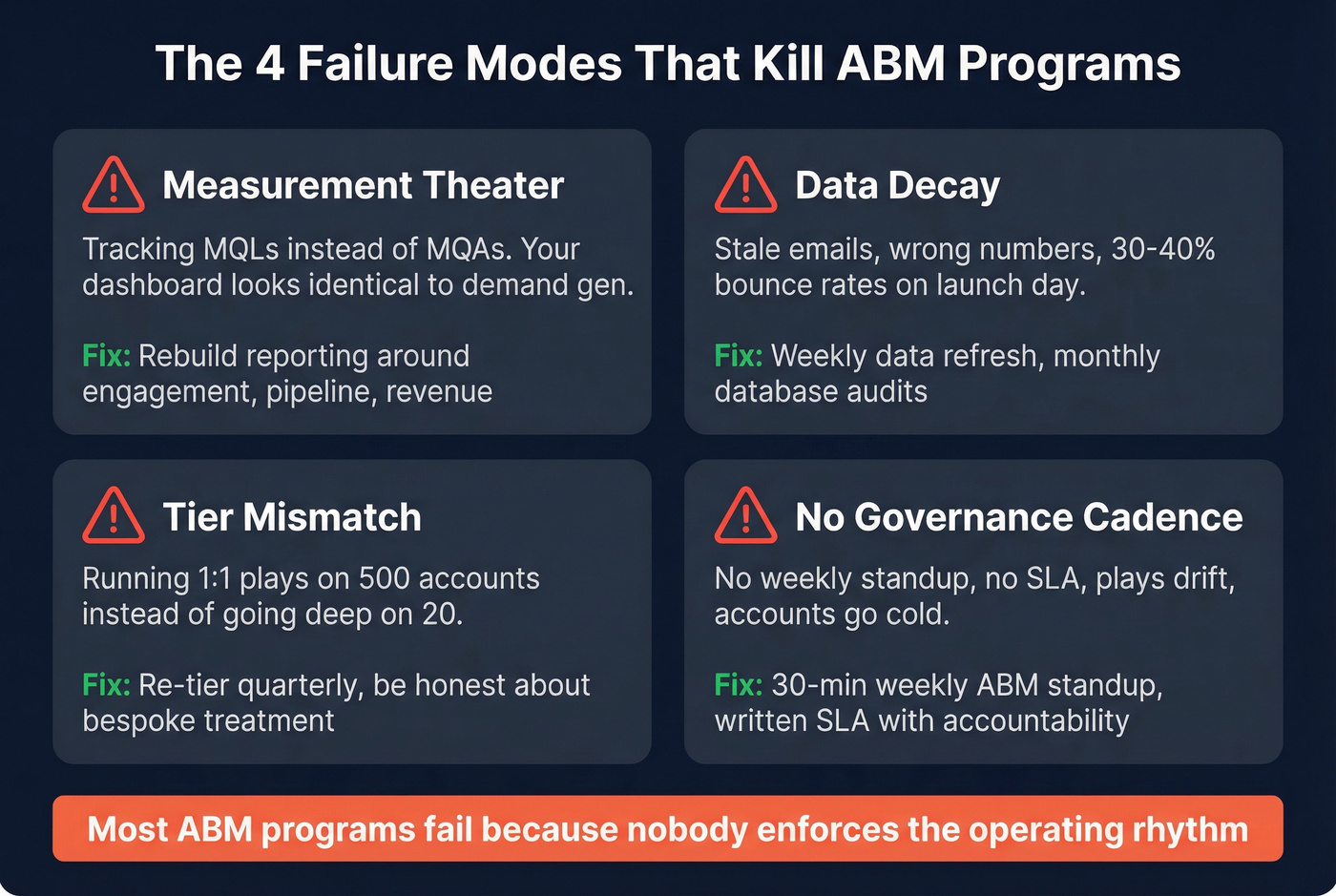
Measurement theater. Tracking MQLs instead of MQAs. If your dashboard looks the same as your demand gen dashboard, you aren't doing ABM. Rebuild reporting around the three-pillar framework. Kill the MQL column.
Data decay. Contact info goes stale, emails bounce, campaigns collapse before they start. Teams like Snyk saw bounce rates drop from 35-40% to under 5% after switching to a weekly data refresh cycle. Audit your contact database monthly - stale data is the silent killer of ABM programs. (Use a CRM hygiene checklist to keep it clean.)

Tier mismatch. Running 1:1 plays on 1:many accounts burns budget and exhausts your team without generating proportional pipeline. Re-tier quarterly. Be honest about which accounts deserve bespoke treatment.
No governance cadence. No weekly standup, no SLA, no accountability. Plays drift, accounts go cold, and nobody notices until the quarterly review. The weekly ABM standup takes 30 minutes and saves months of wasted effort.
Let's be honest: most ABM programs don't fail because of bad strategy. They fail because nobody enforces the operating rhythm. If your team can't commit to a 30-minute weekly standup, skip ABM entirely - run targeted demand gen instead and own it.
Covering a 12-person buying committee means nothing if you can't reach them. Prospeo gives you 143M+ verified emails and 125M+ verified mobile numbers with a 30% pickup rate - so your 1:1 plays actually connect with economic buyers and champions. At $0.01 per email, you get enterprise-grade coverage without enterprise pricing.
Reach every stakeholder on the buying committee - not just their gatekeepers.
Recommended ABM Tech Stack
You don't need a $50K ABM platform to start. You need a clean account list, verified contacts, and a weekly standup.
| Category | Tool | Starting Price | Best For |
|---|---|---|---|
| Data & Enrichment | Prospeo | Free (75 emails/mo); ~$0.01/email paid | Verified emails + mobiles, weekly refresh |
| Data & Enrichment | ZoomInfo | ~$15K-$40K/yr | Enterprise firmographic data |
| Data & Enrichment | Apollo.io | Free; from $49/mo | Budget outbound + sequences |
| Intent Data | Bombora | ~$20K-$60K/yr | Standalone intent signal feed |
| ABM Platform | Demandbase | ~$30K-$100K/yr | Enterprise ABM orchestration |
| ABM Platform | 6sense | ~$30K-$120K/yr | AI intent + predictive |
| ABM Platform | RollWorks | ~$12K-$40K/yr | Mid-market ABM + ads |
| CRM | HubSpot Pro | From $800/mo | SMB/mid-market ABM dashboards |
| CRM | Salesforce | ~$25-$330/user/mo | Enterprise ABM integrations |
Start with the top three rows. Add an ABM platform when you've validated your ICP, scoring model, and SLA - not before. The consensus on r/sales and r/marketing is that teams buying 6sense or Demandbase before nailing their ICP end up paying enterprise prices for demand gen workflows they could've run in HubSpot.
Playbook vs. Framework
A common question: is this a playbook or a framework? The distinction matters.
A framework gives you principles and mental models - "focus on high-value accounts, align sales and marketing, personalize outreach." A playbook gives you the specific plays, SLAs, scoring models, and cadences to execute those principles. You need both, but this guide is deliberately prescriptive and operational, built to be followed step by step. Use a framework to decide your ABM philosophy; use this account based marketing playbook to run it.
FAQ
How long does it take to launch an ABM program?
Plan 8-16 weeks from ICP definition to first campaign activation. The preparation phase - scoring, tiering, SLA creation - takes the longest. Rushing it is the most common reason programs stall before producing pipeline.
What's the minimum budget for ABM?
You can start with a free CRM tier, a data provider with a free plan, and manual account research. Enterprise ABM platforms at $25K-$120K/year are optimization layers, not prerequisites.
How many accounts should a first ABM program target?
Start with 25-50 accounts for 1:1 or 1:few programs. Going broader before validating your ICP and sales-marketing SLA dilutes effort and makes measurement nearly impossible. Scale after your first quarter of results.
How does SWOT analysis help with ABM?
Running a SWOT against your top-tier accounts reveals competitive advantages and vulnerabilities before you activate campaigns. Strong product integrations might be a strength against one account's tech stack, while a missing enterprise SLA could be a weakness - shaping which plays you run and which objections you preempt.
Should ABM campaigns change seasonally?
Yes - a December activation looks different from a Q2 push. Budget cycles tighten, decision-makers are harder to reach, and holiday timelines compress approval windows. Adjust activation phases and channel mix to match the buying rhythm of your target accounts, not just your internal calendar.