How to Improve Lead Quality: The Operational Playbook
Your pipeline has never been fuller. Your revenue has never been flatter. The VP of Sales drops a Slack message at 4pm: "Marketing sent us 600 leads last month and we closed three." That disconnect isn't a volume problem - it's a quality problem. 61% of B2B marketers send every lead directly to sales, but only 27% of those leads are actually qualified. The rest just burn rep hours and erode trust between departments.
TL;DR
- Benchmark your funnel - know what "good" looks like before you optimize
- Build a lead scoring model with negative scoring and decay
- Pick the right qualification framework for your deal size
- Clean your contact data - verification before outreach, always
- Create a marketing-sales SLA with shared definitions
What Lead Quality Actually Means
Let's get the definitions straight, because sloppy terminology is where most alignment problems start.
An MQL has engaged with your content but isn't ready for a sales conversation. An SQL has shown buying intent - requesting a demo, asking about pricing, hitting bottom-funnel pages repeatedly. A PQL has used your product through a trial or freemium tier and crossed usage thresholds that signal readiness. These aren't interchangeable, and treating them as if they are is how you end up with a "600 leads, 3 deals" situation.
3% of your market is actively buying at any given time. Another 7% are open to it. Everyone else is browsing. Poor-quality leads are the #1 complaint from sales teams - and sales rejects leads for the same predictable reasons: missing context, wrong persona, or personal email addresses. The goal isn't more leads. It's finding more of the 3%.
Benchmark Your Funnel First
Before you fix anything, measure where you stand. The average lead-to-MQL conversion rate across industries is 31%, but the range is enormous.
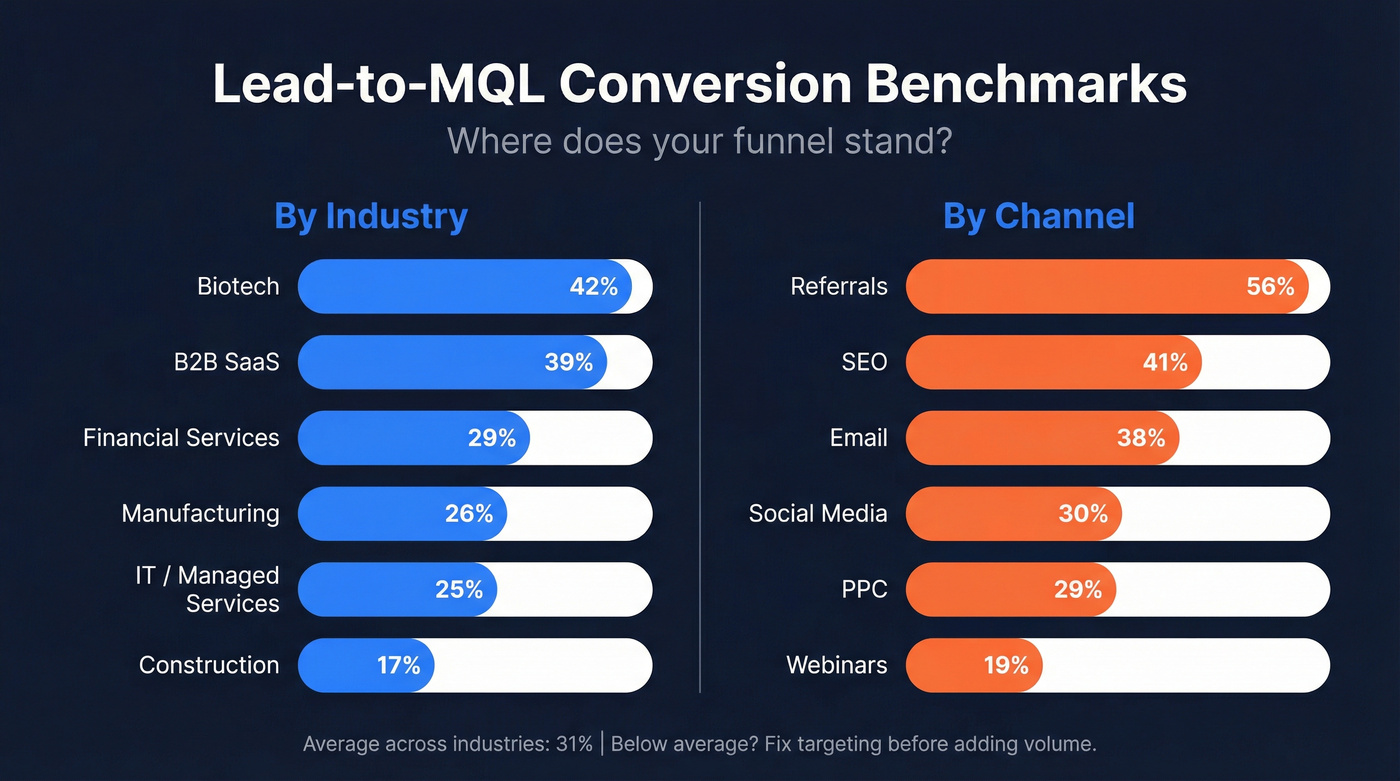
Lead-to-MQL by Industry
| Industry | Lead-to-MQL |
|---|---|
| Biotech | 42% |
| B2B SaaS | 39% |
| Financial Services | 29% |
| Manufacturing | 26% |
| IT / Managed Services | 25% |
| Construction | 17% |
If your number falls below your industry average, the problem is targeting - not volume. Tighten your ICP before you spend another dollar on acquisition.
Lead-to-MQL by Channel
| Channel | Lead-to-MQL |
|---|---|
| Referrals | 56% |
| SEO | 41% |
| 38% | |
| Social Media | 30% |
| PPC | 29% |
| Webinars | 19% |
Once leads become MQLs, the MQL-to-SQL conversion rate typically falls between 10% and 20%. B2B SaaS averages 13%, fintech sits around 11%, pharma hits 21%. Below 10% means you have a lead quality problem. Above 20%, your criteria might be too loose - you're letting unqualified leads through and calling it success.
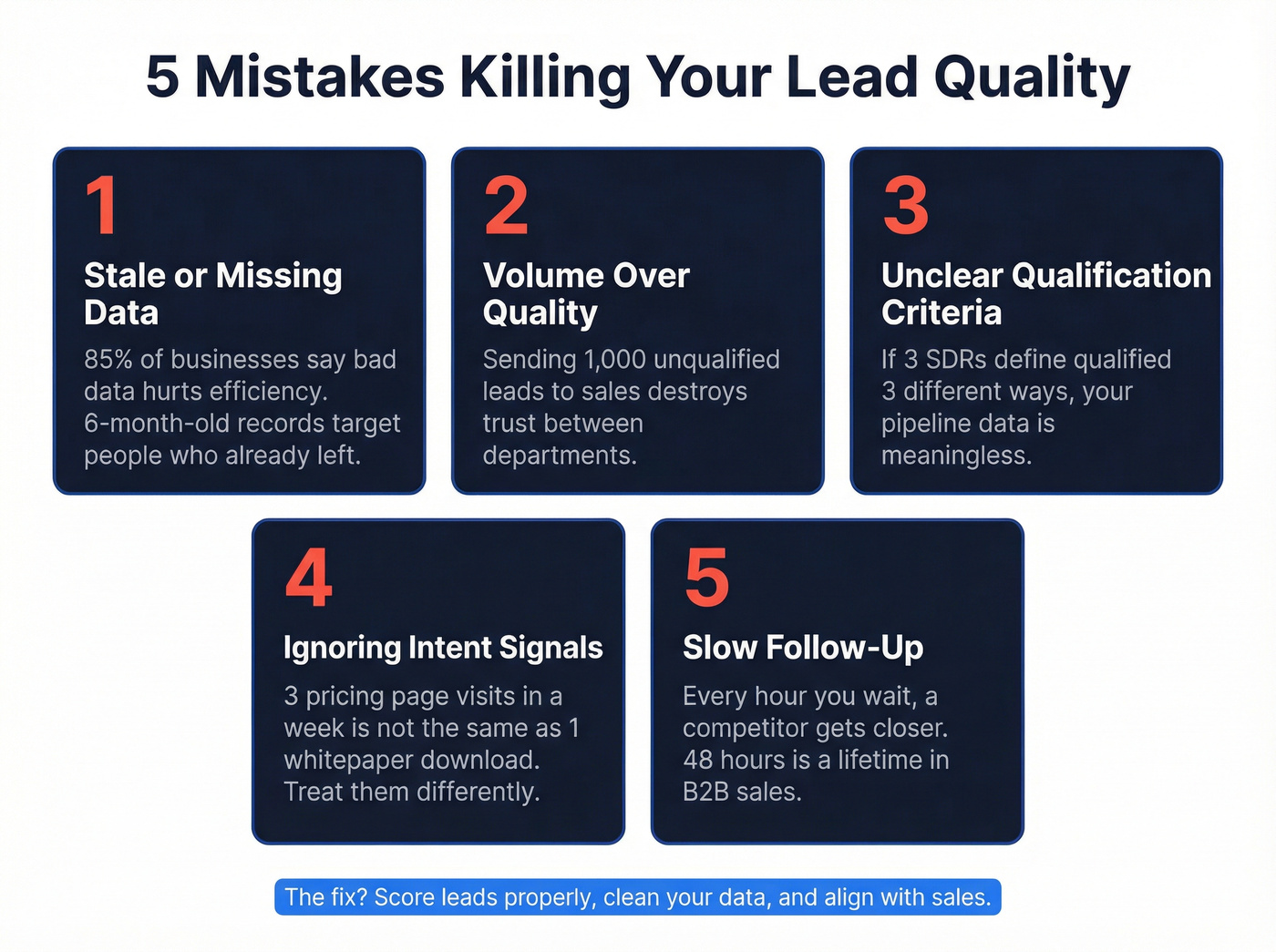
Five Mistakes Killing Your Lead Quality
- Stale or missing data. 85% of businesses say poor-quality data harms operational efficiency. If your CRM records are six months old, you're targeting people who've already changed jobs.
- Prioritizing volume over quality. Sending 1,000 unqualified leads to sales isn't a win. It's a way to destroy trust between departments.
- Unclear qualification criteria across reps. If three SDRs define "qualified" three different ways, your pipeline data is meaningless.
- Ignoring buyer intent signals. Someone visiting your pricing page three times in a week is a fundamentally different lead than someone who downloaded a whitepaper once. The behavioral gap between those two people is massive, yet most scoring models treat them the same.
- Slow follow-up on high-value leads. We've seen teams lose deals simply because they waited 48 hours to respond. Every hour you wait, a competitor gets closer.

Stale data is the #1 lead quality killer. Prospeo refreshes every record every 7 days - not the 6-week industry average - so your reps never waste time on contacts who've already moved on. 98% email accuracy, 92% enrichment match rate, 50+ data points per contact.
Fix your data and your lead quality fixes itself.
Build a Scoring Model That Works
Lead quality improvement starts with a scoring model that separates signal from noise. Here's a B2B SaaS model we've seen drive results:
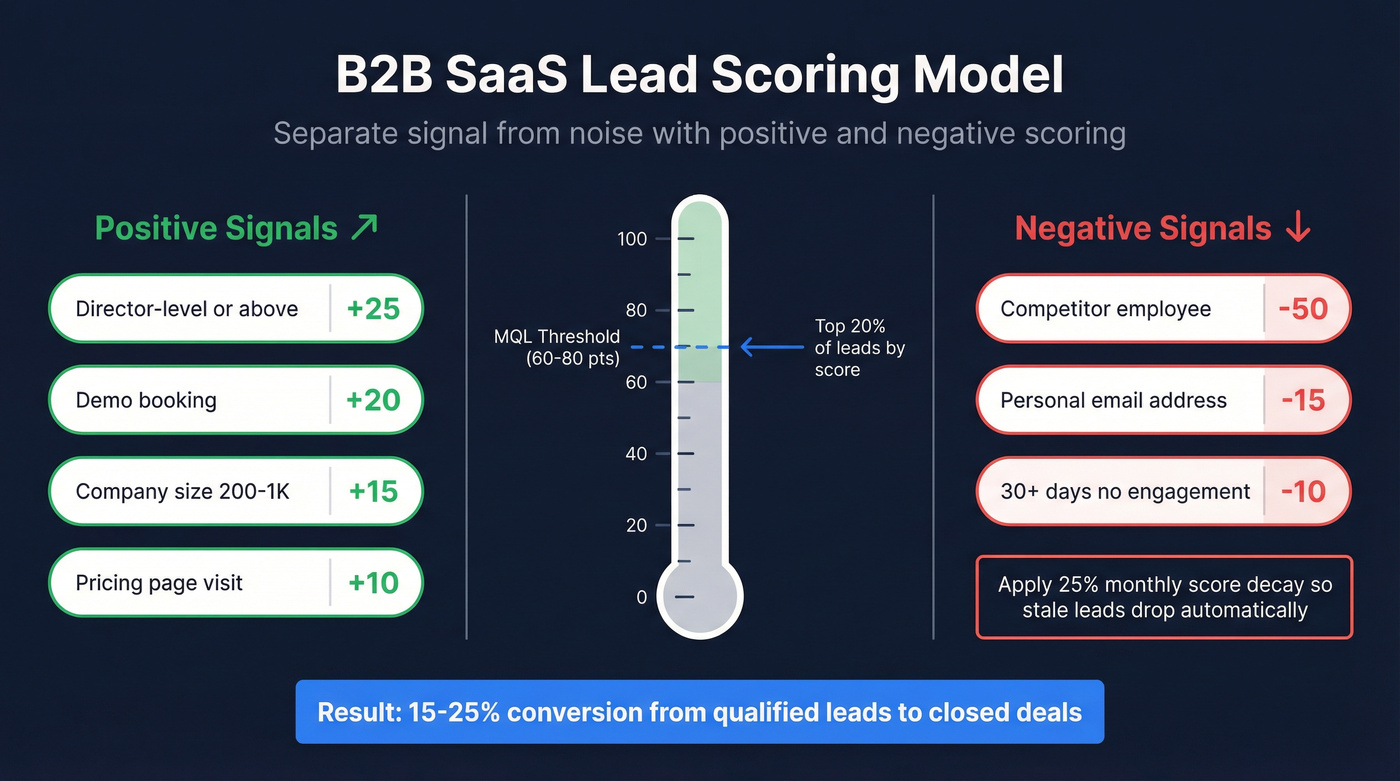
| Signal | Points |
|---|---|
| Director-level or above | +25 |
| Company size 200-1K | +15 |
| Pricing page visit | +10 |
| Demo booking | +20 |
| Personal email address | -15 |
| Competitor employee | -50 |
| 30+ days no engagement | -10 |
Set your MQL threshold at 60-80 points. Teams that pair scoring with automated routing see conversion rates jump up to 40% with 97% assignment accuracy.
The negative signals matter just as much as the positive ones. Apply a 25% monthly score decay so stale leads don't sit at the top of the queue forever. Set your threshold to capture the top 20% of leads by score. Done right, this yields 15-25% conversion from qualified leads to closed deals.
Here's the thing: most teams should nail manual scoring before touching predictive AI. We've watched companies waste months on ML models built on top of dirty data. Get the fundamentals right first - the lift from basic scoring alone is massive.
Pick the Right Qualification Framework
| Framework | Best For | Conversion Impact |
|---|---|---|
| BANT | Deals under $25K | 59% conversion increase |
| CHAMP | Fluid budget / new category | 15% higher win rate |
| MEDDIC | Deals >$50K, cycles >3mo | 25% win-rate improvement |
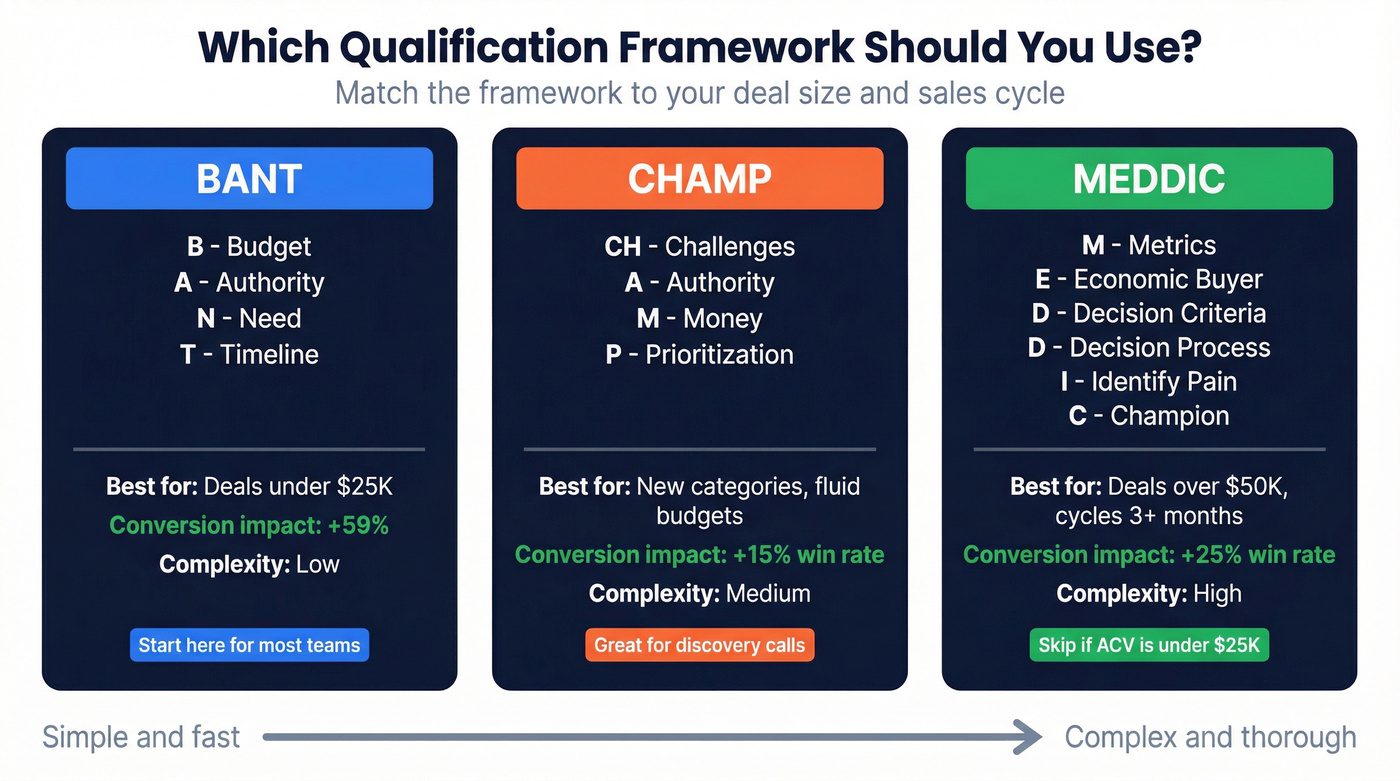
The smartest teams layer these. BANT for initial screening, CHAMP during discovery when budget is still forming, MEDDIC for late-stage enterprise deals. None of these frameworks handle timing well on their own, so layer intent signals on top - competitor page visits, multiple stakeholders engaging, pricing page frequency - to separate "good fit" from "good fit who's buying now."
Skip MEDDIC if your average deal size is under $25K. The overhead isn't worth it. BANT will get you 80% of the way there, and your reps won't dread filling out qualification notes.
Clean Your Data First
None of the scoring models or frameworks above matter if your contact data is wrong. About 30% of CRM records go stale every year. Unverified lists bounce at 5-15%, torching your sender reputation and wasting rep time. Verification typically brings that under 2%.
Prospeo handles enrichment and verification in one platform - 98% email accuracy, a 7-day data refresh cycle versus the six-week industry average, and an enrichment API returning 50+ data points per contact at a 92% match rate. Snyk's team of 50 AEs cut their bounce rate from 35-40% to under 5% after switching, and AE-sourced pipeline jumped 180%.
For bigger budgets, ZoomInfo ($15K-$40K/year) offers the deepest US database plus intent data, and Apollo's free tier plus $49-99/mo paid plans combine a database with a sequencer. But if data accuracy is the priority - and for maximizing lead quality, it should be - you'll get better verification at a fraction of the cost with a purpose-built tool.
Snyk's 50 AEs dropped their bounce rate from 35-40% to under 5% and grew AE-sourced pipeline 180% - because clean data made every scoring model and qualification framework actually work. Prospeo gives you the same accuracy at $0.01 per email, no contract required.
Better data in, better leads out. It's that simple.
Create a Marketing-Sales SLA
Only 22% of companies feel marketing and sales are tightly aligned. The ones that do grow roughly 20% per year. The ones that don't watch revenue stagnate while both teams blame each other in quarterly reviews.
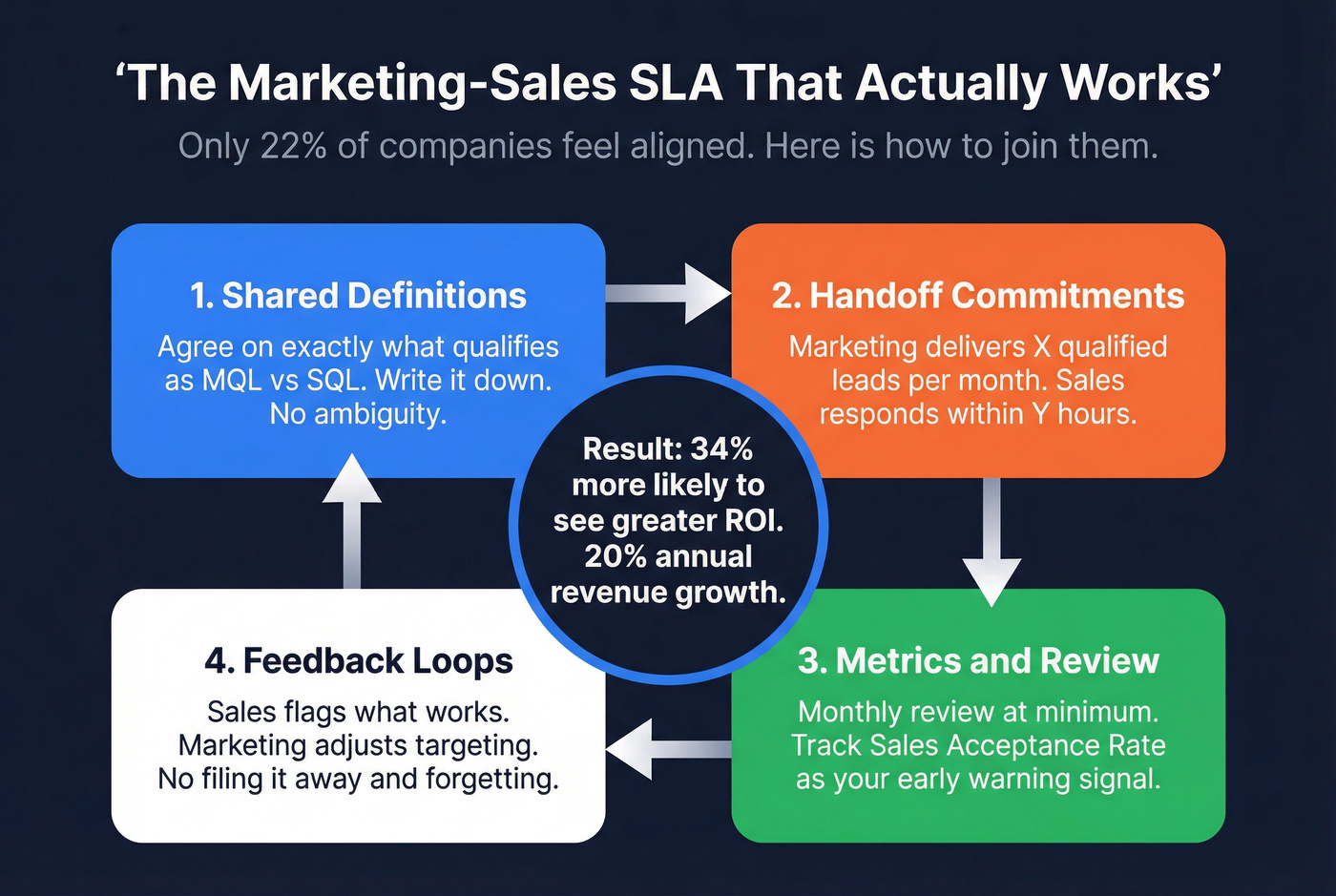
Your SLA needs four components:
- Shared definitions - what exactly qualifies as an MQL vs. SQL
- Handoff commitments - marketing delivers X qualified leads; sales responds within Y hours
- Metrics and review cadence - monthly at minimum
- Feedback loops - sales flags what's working and what isn't, and marketing actually adjusts targeting based on that feedback instead of filing it away
Teams with SLAs are 34% more likely to see greater ROI year over year. The single most diagnostic metric is Sales Acceptance Rate - the percentage of MQLs that sales actually accepts. If SAR drops, your lead quality definitions are drifting. In our experience, a monthly SLA review catches this drift before it becomes a quarter-long problem.
FAQ
What's a good MQL-to-SQL conversion rate?
10-20% is the standard range for B2B. SaaS averages 13%, pharma hits 21%. Below 10% signals a lead quality problem - tighten your scoring criteria and ICP definitions before adding more volume.
How often should I update lead scoring criteria?
Review quarterly and apply 25% monthly score decay. Recalibrate thresholds whenever MQL-to-SQL drifts outside the 10-20% band for two consecutive months - that's your early warning signal.
What's the fastest way to improve lead quality?
Verify your contact data before any outreach. Unverified lists bounce at 5-15%, destroying sender reputation and wasting rep time. Pair verification with a shared marketing-sales SLA so both teams agree on what "qualified" means.
Does lead scoring actually increase conversion rates?
Yes. Teams using lead scoring with automated routing see conversion rates jump up to 40%. The key is including negative signals like personal emails, competitor employees, and engagement decay - not just positive ones.
How do I align marketing and sales on lead definitions?
Build a formal SLA with shared MQL/SQL definitions, handoff commitments, and a monthly review cadence. Companies with SLAs are 34% more likely to see greater ROI. Track Sales Acceptance Rate monthly - if it drops, your definitions are drifting.