9 B2B Marketing Challenges That Actually Matter in 2026 (and How to Fix Them)
Marketing generated 500 MQLs last month. Sales accepted 73. The finger-pointing starts in the Monday pipeline review - marketing says the leads are qualified, sales says they're garbage, and the CFO wants to know why pipeline is flat despite a 12% budget increase. A 2021 MarketingProfs study found 55% of B2B leaders already struggled with digital-era relationship building. Since then, privacy regulation, AI-driven buyer behavior, and tighter budgets have turned manageable friction into structural dysfunction.
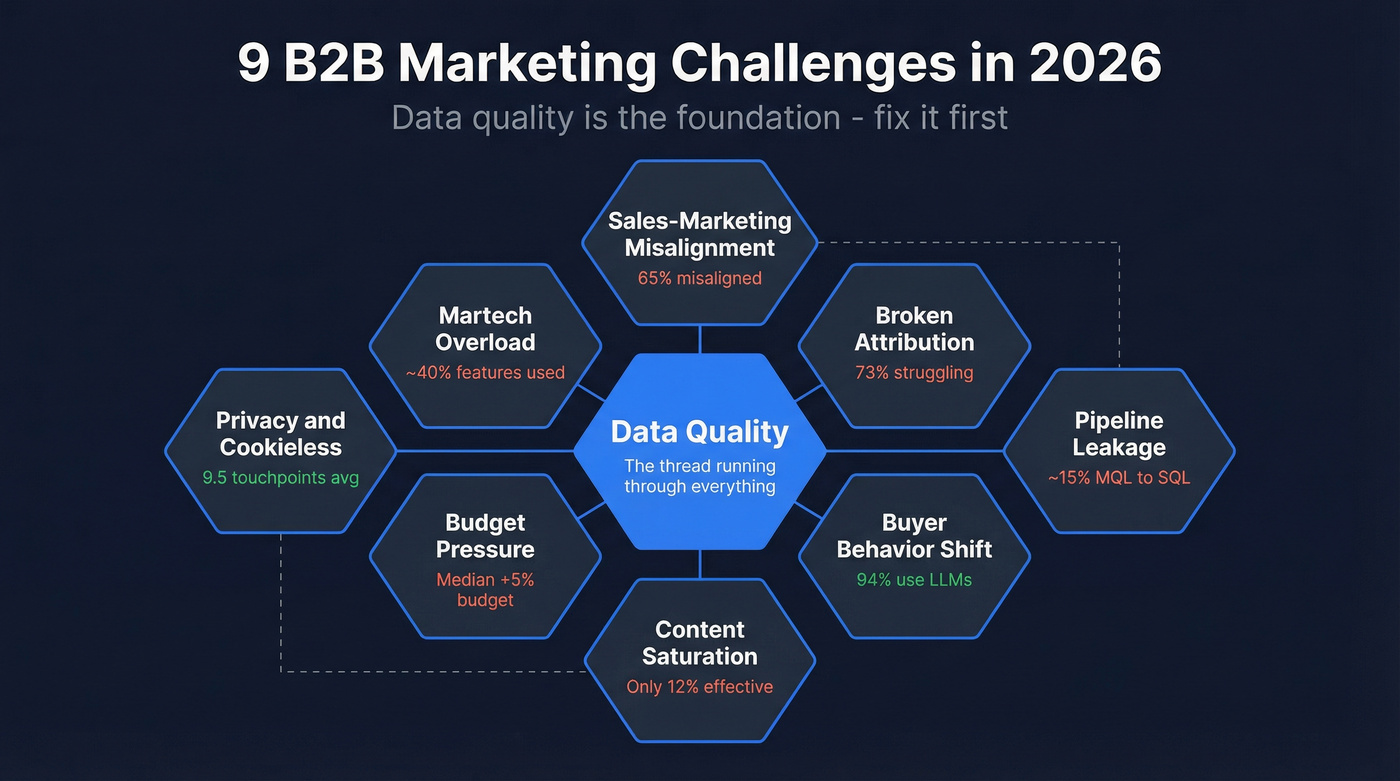
These are the B2B marketing challenges that define 2026 - and most teams are still treating symptoms instead of causes. The problems aren't separate line items. They're interconnected, and data quality is the thread running through all of them. Fix the foundation, and half the list gets easier.
Fix Three Things This Quarter
- Align with sales on shared ICP definitions and lead stage criteria. The 65% misalignment stat isn't abstract - it's a common reason your MQL-to-SQL rate falls below 15%. (If you need a framework, start with an Ideal Customer Profile.)
- Switch from last-click to multi-touch attribution. Even a simple time-decay model will reveal you're over-crediting retargeting and under-crediting the content that actually starts deals. Use a pipeline attribution model your CFO can audit.
- Audit your contact data quality. If your bounce rate is above 5%, everything downstream is leaking. (Here’s a practical guide to verifying email addresses.)
The median B2B conversion rate is 2.9%. That's your benchmark. Let's figure out where your funnel is leaking and why.
The 9 Challenges at a Glance
| Challenge | One-Line Description | Key Stat |
|---|---|---|
| Sales-Marketing Misalignment | Teams can't agree on what a "good lead" is | 65% report misalignment |
| Attribution Is Broken | Privacy killed tracking; last-click lies | 73% face attribution challenges |
| Pipeline Leakage | Leads enter, revenue doesn't come out | MQL-to-SQL survives at ~15% |
| Buyers Changed | AI research, earlier contact, smaller shortlists | 94% use LLMs during the buying journey |
| Content Saturation | More content, less impact | Only 12% rate content highly effective |
| Budget Pressure | More pipeline expected, same budget | Median increase just 5% |
| Privacy + Cookieless | Measurement infrastructure is crumbling | 9.5 touchpoints before conversion |
| Data Quality | Bad data poisons everything downstream | 30-40% bounce rates with unverified lists |
| Martech Overload | Too many tools, too little integration | Teams use ~40% of features |

If your bounce rate is above 5%, every challenge on this list gets worse - misalignment, broken attribution, pipeline leakage. Prospeo's 5-step verification delivers 98% email accuracy on 300M+ profiles, refreshed every 7 days. Teams using Prospeo cut bounce rates from 35%+ to under 4%.
Stop debugging your funnel. Start with data that actually connects.
The 9 Problems Worth Fixing
Sales-Marketing Misalignment
65% of sales and marketing professionals report a lack of alignment. That's not a survey curiosity - it's the root cause of the Monday pipeline fight. Forrester's data shows companies with strong cross-functional alignment see 2.4x higher revenue growth, while 69% of B2B buyers report inconsistent information between vendor websites and the sellers who contact them. For any B2B CMO, this misalignment is the single most urgent problem to solve before investing in new channels or tools.
The fix isn't a quarterly "smarketing" meeting. It's structural:
- Joint ICP definition. Marketing and sales build the ideal customer profile together, not in separate rooms. (If you want options beyond firmographics, use these types of customer profiling.)
- Shared KPIs. Pipeline velocity, win rate on marketing-sourced leads, and qualified pipeline generated - not MQL volume. Use a tight set of sales and marketing KPIs.
- Explicit handoff definitions. Write down what makes an MQL vs. an SQL, who owns the next action, and what the SLA is for follow-up.
- Closed-loop reporting. Connect your CRM to marketing automation so both teams see what happens after the handoff. This is easier when you run a real B2B RevOps layer.
Here's the thing: if your sales team can't articulate the MQL criteria marketing uses, you don't have alignment. You have two teams running parallel processes.
Attribution Is Broken
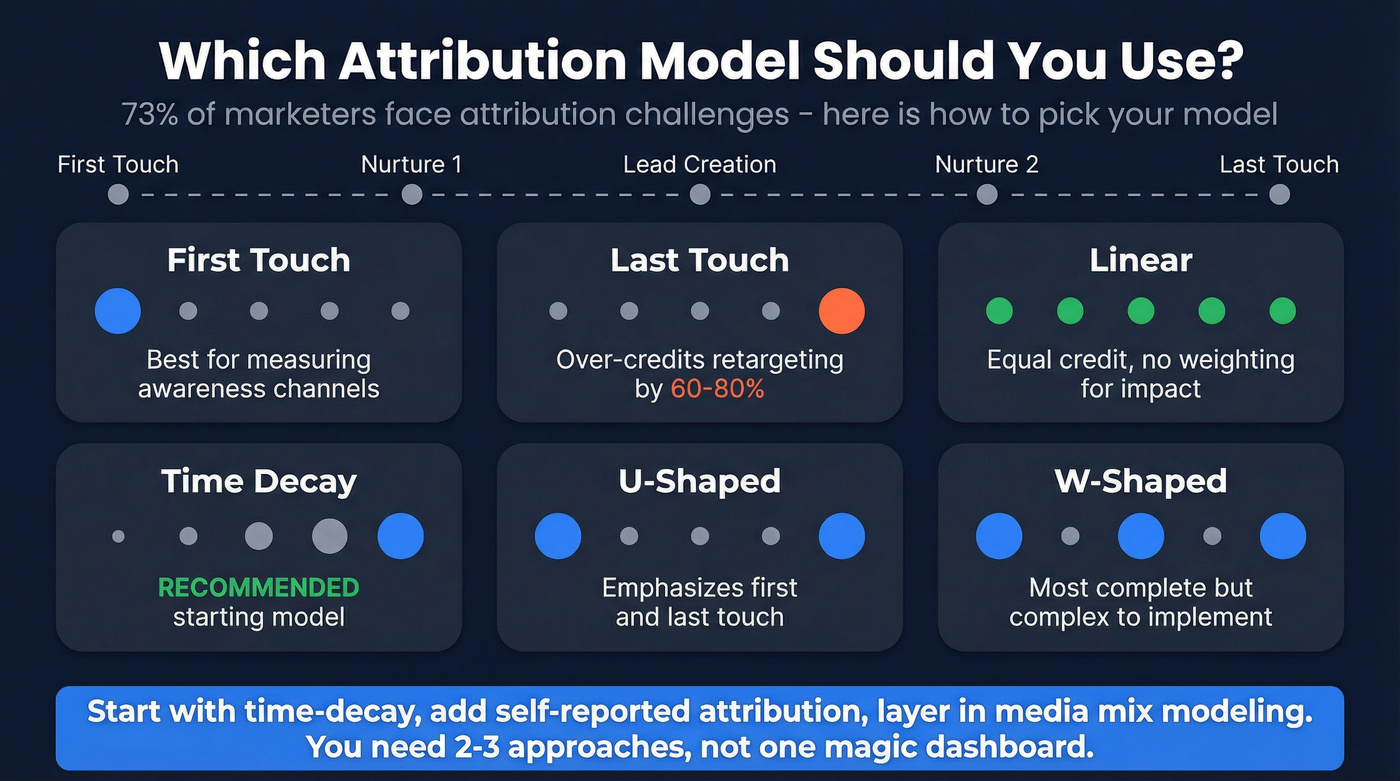
73% of marketers report significant attribution challenges since iOS 14.5. Facebook attribution visibility dropped up to 50% for some advertisers. And last-click attribution - still the default for most teams - makes retargeting appear to drive 60-80% of conversions, because it's always the final touch.
We've seen this play out firsthand. A B2B SaaS company at $18M ARR switched from last-click to time-decay multi-touch attribution. The result: CAC dropped 22%, conversion rate improved 18%, pipeline velocity jumped 34%, and they redistributed $400K in annual spend to channels that actually started deals. This is one of the most common B2B SaaS marketing challenges - measurement complexity scales with longer sales cycles and multi-stakeholder buying committees. (If you want a deeper setup, see marketing revenue attribution.)
| Model | Type | Best For | Limitation |
|---|---|---|---|
| First-touch | Single-touch | Awareness channel credit | Ignores nurture + closing |
| Last-touch | Single-touch | Conversion channel credit | Over-credits retargeting |
| Linear | Multi-touch | Equal credit across journey | No weighting for impact |
| Time-decay | Multi-touch | Recency-weighted credit | Under-credits awareness |
| U-shaped | Multi-touch | First + last touch emphasis | Ignores middle touches |
| W-shaped | Multi-touch | First + lead + opp creation | Complex to implement |
Our recommendation: run time-decay as your starting model, layer in self-reported attribution ("how did you hear about us?"), and use media mix modeling for budget allocation. You need 2-3 measurement approaches running in parallel, not one magic dashboard.
Pipeline Leakage and Low Conversion
The median B2B conversion rate is 2.9%, with a typical range of 2.0-5.0%. But the aggregate number hides where the real damage happens:
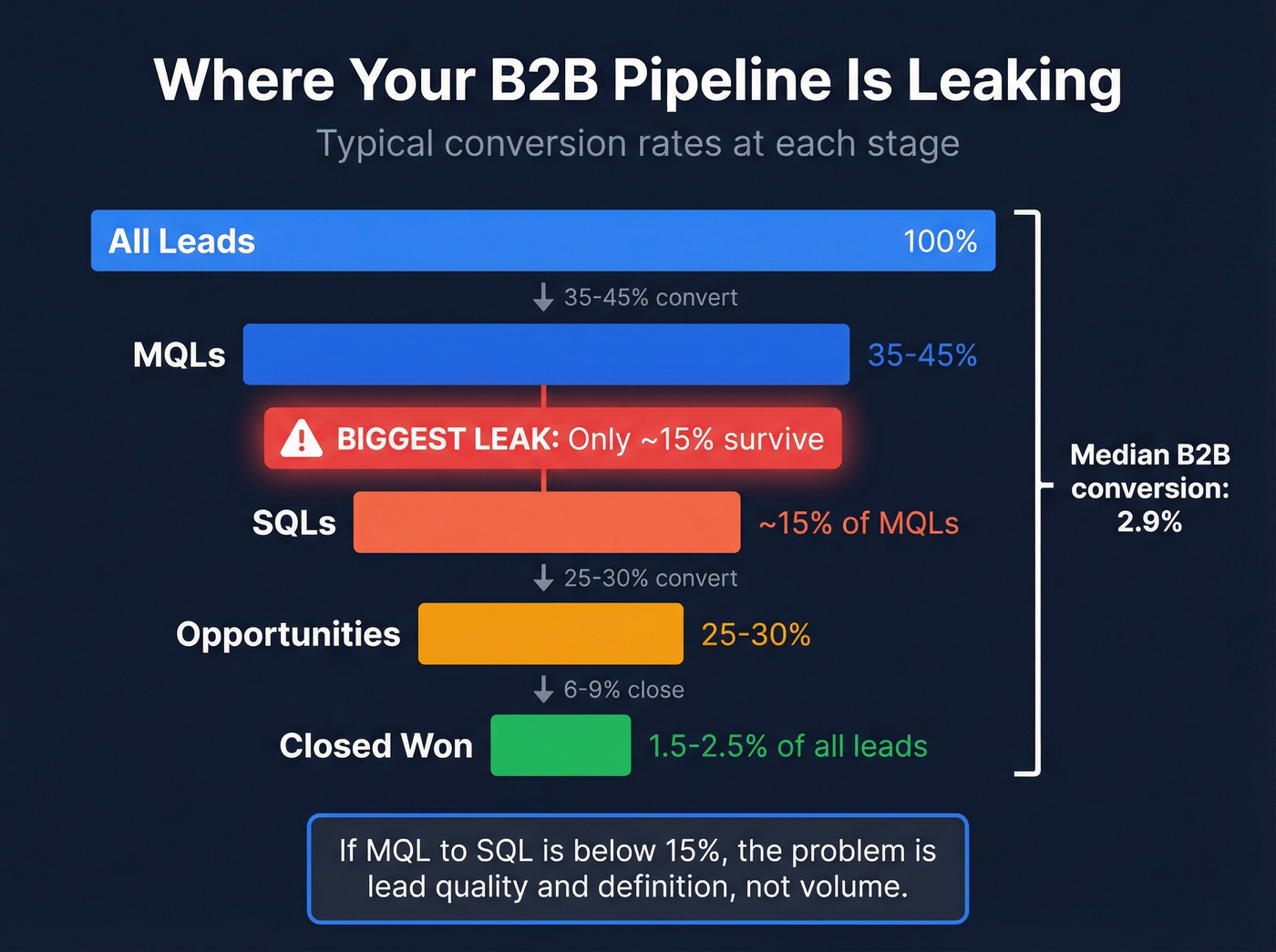
- Lead to MQL: 35-45%
- MQL to SQL: ~15% - this is the biggest leak
- SQL to Opportunity: 25-30%
- Opportunity to Closed-Won: 6-9%
- Overall Lead-to-Customer: 1.5-2.5%
If your MQL-to-SQL rate is below 15%, the problem is lead quality and definition, not volume. Pouring more leads into a broken handoff just accelerates waste. In most cases, the quality problem traces back to misalignment on what "qualified" means, or bad contact data that inflates lead counts with undeliverable emails and wrong numbers. If you want a clean way to quantify the impact, use a sales velocity calculator.
Buyers Changed - You Didn't
94% of B2B buyers now use LLMs during their buying journey. They're using ChatGPT, Perplexity, and Copilot to build shortlists, compare vendors, and validate claims before they ever talk to a human. Yet vendor interactions stayed flat at 16 per person with the winning vendor - buyers aren't engaging more, they're engaging differently.
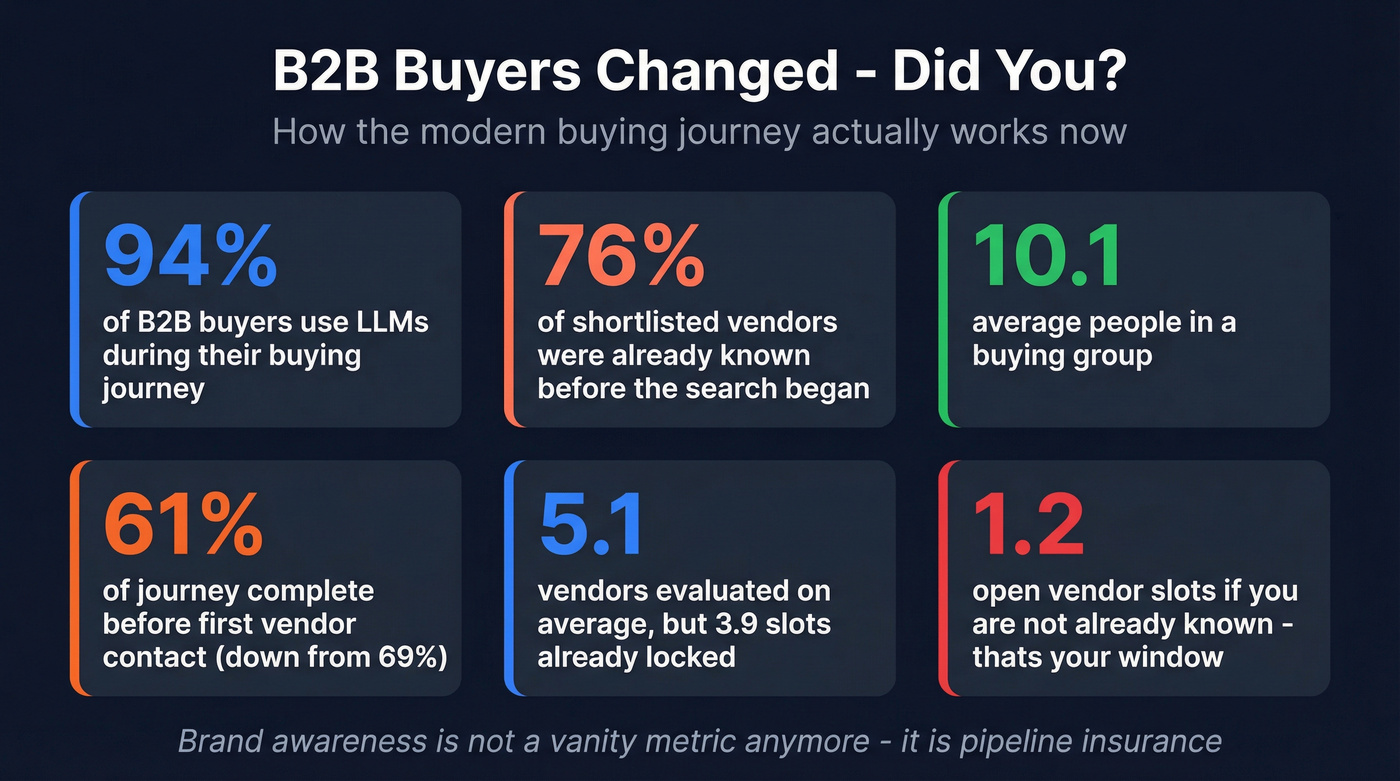
The timing shift matters most. First vendor contact moved from 69% to 61% of journey completion - buyers are reaching out roughly 3.5 weeks sooner than in prior years. Why? 58% said they engaged vendors earlier to validate AI capabilities and implementation. Buying groups average 10.1 people, evaluate 5.1 vendors on average, and 76% of shortlisted vendors were already known before the search began.
Do the math: that's roughly 3.9 of 5.1 slots locked before anyone opens a browser. Only 45% of buyers research 2-3 vendors. If you're not in the consideration set before the journey starts, you're fighting for 1.2 open slots. Brand awareness isn't a vanity metric anymore - it's pipeline insurance. (If you’re mapping this shift, start with buyer journey stages and touchpoints.)
Content Saturation
Only 12% of B2B marketers rate their content marketing as highly effective, according to CMI's survey of 1,015 B2B marketers. The top challenges: creating content that prompts action (40%), resource constraints (39%), and measuring effectiveness (33%).
What separates effective teams from those treading water isn't tools or volume. When effective teams were asked what moved the needle, content relevance and quality topped the list at 65%, followed by team skills (53%) and alignment with sales (45%). Technology came in fourth at 43%.
The answer to content saturation isn't more content. It's fewer, better pieces aimed at the right accounts. We've watched teams cut their publishing cadence in half and see engagement go up - because they stopped writing for keywords and started writing for buying committees. If your content team can't name the top 5 objections your sales team hears, the content won't convert regardless of volume. If you need a starting backlog, use these B2B content ideas. Skip the "publish 3x/week" playbook if you don't have the resources to make each piece genuinely useful.
Budget Pressure and CMO Priorities
Ask any B2B marketer in a Slack community or on r/sales what keeps them up at night, and it's rarely a channel problem - it's proving marketing's value to the CFO.
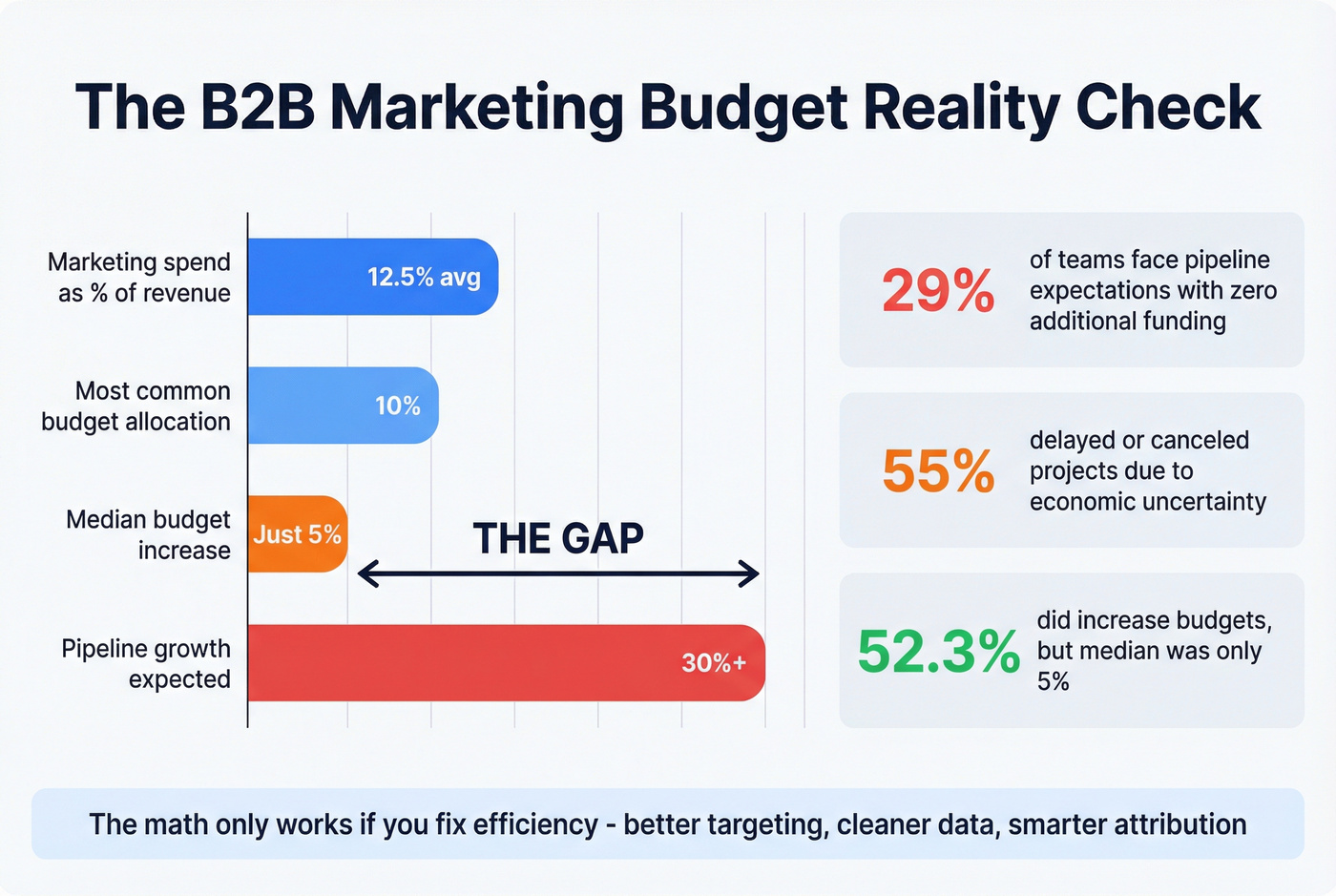
Marketing spend averages 12.5% of revenue across B2B companies, with the most common answer being 10%. While 52.3% of teams increased budgets heading into recent fiscal years, the median increase was just 5%. The average was 22%, but that's skewed by a handful of outliers throwing money at AI initiatives. The real pressure comes from 29% of teams facing pipeline expectations without additional funding, and 55% delayed or canceled projects due to economic uncertainty.
You're being asked to generate 30% more pipeline with a 5% budget increase. The math only works if you fix efficiency - better targeting, cleaner data, smarter attribution. Throwing budget at channels you can't measure is how marketing departments lose credibility with the CFO. (If you need to pressure-test spend, start with B2B customer acquisition cost.)
Let's be honest: if your average deal size is under $15k, you probably don't need a $50k/year data platform or a six-figure ABM tool. A verified contact database, a solid CRM, and multi-touch attribution will outperform a bloated stack every time. Simplification - cutting tools and focusing on fewer, higher-impact workflows - consistently beats stack expansion at this price point.
Privacy and Cookieless Measurement
The privacy cascade that started with App Tracking Transparency hasn't stopped. Third-party cookies are on a deprecation trajectory that's been slow but irreversible, and buyers average 9.5 touchpoints before converting - spread across months, devices, and channels that don't talk to each other.
The practical measurement stack for 2026 combines GA4's data-driven attribution for channel-level insights, server-side tracking for first-party data collection, media mix modeling for budget allocation, and incrementality testing via geo holdouts for validation. Channel CAC commonly varies 20-50% depending on which attribution system you trust - exactly why you need multiple approaches cross-checking each other.
Data Quality and Contact Accuracy
This is where everything connects. Bad contact data doesn't just cause bounced emails - it cascades. Bounced emails waste budget. Wasted budget breaks attribution. Broken attribution causes misalignment on which channels work. Misalignment leads to the Monday pipeline fight we started with.
Teams running outbound with unverified data see bounce rates of 30-40%. That destroys sender reputation and makes every downstream metric unreliable. I can't overstate how often we see teams blame their messaging or their channel mix when the real culprit is a list full of dead emails. (If you’re diagnosing deliverability, start with email IP reputation.)
Prospeo addresses this at the foundation - 98% email accuracy, a 7-day data refresh cycle versus the 6-week industry average, and a 5-step verification process that catches spam traps and honeypots. Snyk's 50-person AE team saw bounce rates drop from 35-40% to under 5% while AE-sourced pipeline jumped 180%. Pricing starts at roughly $0.01 per email with a free tier, compared to legacy providers charging ~$1 per lead.

Martech Stack Overload
The average B2B marketing stack has 12+ tools, and teams use only a fraction of the features they're paying for. That's not a technology problem - it's a procurement problem. Teams buy tools for specific use cases, never integrate them properly, and end up with overlapping functionality and siloed data.
The audit is simple: list every tool, map each one to a funnel stage, and if two tools serve the same stage, cut one. Prioritize tools that integrate natively with your CRM. Salesforce or HubSpot should be the backbone, and everything else should feed into or pull from that system. For teams evaluating consolidation, a modern GTM stack view helps you cut without breaking workflows. For teams with more than 15 tools, we've found that consolidation alone - before any new purchases - typically saves 20-30% of martech spend while actually improving data flow between systems.
Why These Challenges Are Connected
The biggest obstacle isn't any single item on this list - it's that teams treat them as separate problems. Bad data causes misattribution, which causes misalignment, which causes budget waste, which causes the CFO to question marketing's value. It's one system, not nine independent fires.
Fix the foundation and half these B2B marketing challenges shrink on their own. Start with your contact data, then build your attribution and alignment frameworks on clean inputs. The teams that win in 2026 won't be the ones with the biggest budgets or the most tools. They'll be the ones where every system trusts the data feeding it.
MQL-to-SQL conversion collapses when leads are padded with bad contacts. Prospeo gives marketing and sales the same verified foundation - 143M+ emails, 125M+ direct dials, and 30+ filters including buyer intent and job changes so every lead matches your shared ICP.
Align your teams on leads worth calling - at $0.01 per email.
FAQ
What's the biggest B2B marketing challenge in 2026?
Sales-marketing misalignment, because it compounds every other problem. When teams can't agree on ICP definitions or lead stage criteria, pipeline leaks at every handoff. Aligned companies see 2.4x higher revenue growth according to Forrester.
Why is B2B attribution so difficult?
Privacy changes - iOS 14.5, cookie deprecation, cross-device fragmentation - broke traditional tracking. Buyers average 9.5 touchpoints across months-long cycles, making single-touch models unreliable. Layer multi-touch attribution, self-reported data, and media mix modeling together for a clearer picture.
What's a good B2B conversion rate?
The median is 2.9%. The biggest leak is MQL-to-SQL, where only about 15% survive the handoff to sales. If you're below these benchmarks, focus on lead quality and handoff definitions rather than top-of-funnel volume.
How do you improve B2B contact data quality?
Use a verification tool with real-time checks, frequent refresh cycles, and 98%+ accuracy. Aim for bounce rates under 5%; anything above damages sender reputation and skews every downstream metric.
How much should B2B companies spend on marketing?
The average is 12.5% of revenue, with 10% being the most common answer. Over half of teams increased budgets recently, but the median increase was only 5% - meaning most teams need to generate significantly more pipeline with marginally more resources.