

Marketing Revenue Attribution: What Actually Works (And What Doesn't)
It's the night before the board meeting. The CFO wants to know what marketing contributed to last quarter's revenue. You pull up three dashboards - GA4, HubSpot, and your attribution platform - and they each tell a different story. One says LinkedIn drove $800K in pipeline. Another says $200K. The third credits organic search for everything.
91% of marketers say attribution is important, but only 31% are confident in their numbers. That gap is the whole problem. Marketing revenue attribution is supposed to close it. Instead, most teams just have three dashboards that disagree.
So what is revenue attribution at its core? It connects marketing and sales actions - ads, webinars, content, sales conversations - to actual closed-won dollars. Not clicks. Not MQLs. Revenue. Getting it right changes how you allocate budget, defend headcount, and forecast pipeline. Getting it wrong means you're making million-dollar decisions on fiction.
The Short Version
Start with time-decay multi-touch + CRM integration. Don't buy a $3K/month platform until you've maxed out what HubSpot or Salesforce can do natively. Time-decay gives recent touchpoints more credit, which maps to how B2B buying actually works.
Fix your data quality first. Attribution reports built on bounced emails and stale job titles credit revenue to phantom touchpoints. Clean your CRM before configuring any model.
Don't rely on one measurement method. As you scale past $10M ARR, triangulate attribution with incrementality testing and marketing mix modeling. No single method captures the full picture.
Why Most Teams Get Attribution Wrong
A study of 127 B2B SaaS companies found that 83% couldn't answer basic attribution questions accurately - yet 57% were running some form of attribution model. Most teams have attribution. They just have bad attribution.
The core issue isn't the model. It's the data underneath it.
The average B2B buyer journey spans 14 touchpoints across 6-9 months. Multiple contacts within a single account interact with different channels at different times. Offline events, dark social, and word-of-mouth create attribution black holes no model can see. And if 15-35% of your contact records have bounced emails, outdated titles, or wrong company associations, your attribution engine is confidently assigning revenue to people who don't exist in the roles you think they hold.
Here's the thing: most attribution problems are actually data quality problems wearing an attribution costume. We've watched teams spend months evaluating Dreamdata vs. HockeyStack vs. Attribution App when the real issue was that their CRM hadn't been cleaned since 2023. Without reliable data flowing through your systems, even the most sophisticated model produces junk.

Revenue Attribution Models Explained
Single-Touch Models
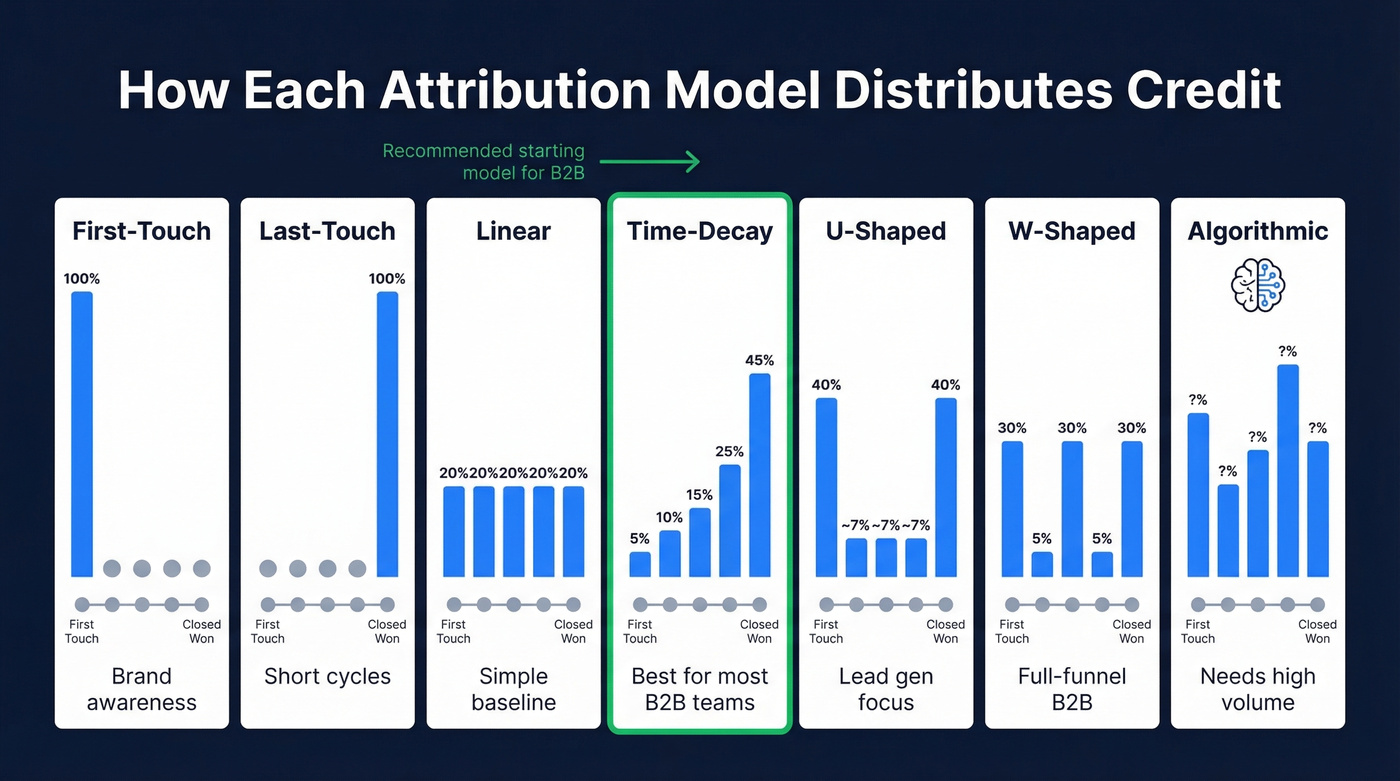
First-touch and last-touch are the simplest models - and still the most common. First-touch credits the initial interaction that brought someone in. Last-touch credits the final touchpoint before conversion. Both are easy to implement and easy to understand, which is exactly why they're dangerous. In a 14-touchpoint journey, giving 100% credit to one moment is like crediting the last mile of a marathon for the whole race.
If you're still using first-touch as your primary view, it helps to understand the mechanics and failure modes of first-touch attribution before you defend it in a board deck.
Multi-Touch Models
This is where most B2B teams should live. Linear distributes credit equally across all touchpoints. Time-decay weights recent interactions more heavily. U-shaped splits credit between first-touch and last-touch, with the rest spread across the middle. W-shaped adds a third anchor at deal/opportunity creation. Full-path spreads credit across the full lifecycle from first touch through key stage milestones and the final touchpoint.
| Model | How It Works | Best For | Limitation |
|---|---|---|---|
| First-touch | 100% to first interaction | Brand awareness measurement | Ignores nurture entirely |
| Last-touch | 100% to final touchpoint | Quick conversion cycles | Ignores top-of-funnel |
| Linear | Equal credit, all touches | Simple multi-touch baseline | Overvalues low-impact touches |
| Time-decay | More credit to recent touches | Longer B2B cycles (6-9 months) | Undervalues brand/awareness |
| U-shaped | 40/40/20 split, first + last | Lead gen-focused teams | Misses mid-funnel nuance |
| W-shaped | 30/30/30/10 across 3 anchors | Full-funnel B2B marketing | Complex to configure |
| Full-path | Anchors across key lifecycle stages | Enterprise with long cycles | Requires clean stage data |
What time-decay looks like in practice: A prospect reads a blog post in January (5% credit), clicks a LinkedIn ad in March (10%), attends a webinar in May (20%), downloads a case study in June (30%), and requests a demo in July (35%). On a $50K deal, that's $2,500 attributed to the blog, $5,000 to the ad, $10,000 to the webinar, $15,000 to the case study, and $17,500 to the demo. The model respects recency without erasing the top of funnel.
Time-decay with CRM integration is the right starting model for most B2B teams. It doesn't require the data infrastructure that W-shaped or full-path demand, and it maps to how buying committees actually accelerate toward a decision.
Data-Driven / Algorithmic
Algorithmic models use machine learning to assign credit based on actual conversion patterns in your data. GA4 offers a version of this, and platforms like HockeyStack and Dreamdata build their own. The catch: you need volume. If you're closing 20 deals a month, there isn't enough signal for the algorithm to learn from. These models shine at scale but mislead at low volumes.
Why Attribution Reports Disagree
Every tool tracks differently. GA4 uses session-based, cookie-dependent tracking. HubSpot tracks known contacts through form submissions and email engagement. Meta reports conversions using its own 1-day view / 28-day click window - claiming full credit even when other channels influenced the journey. LinkedIn does the same. So does Google Ads.
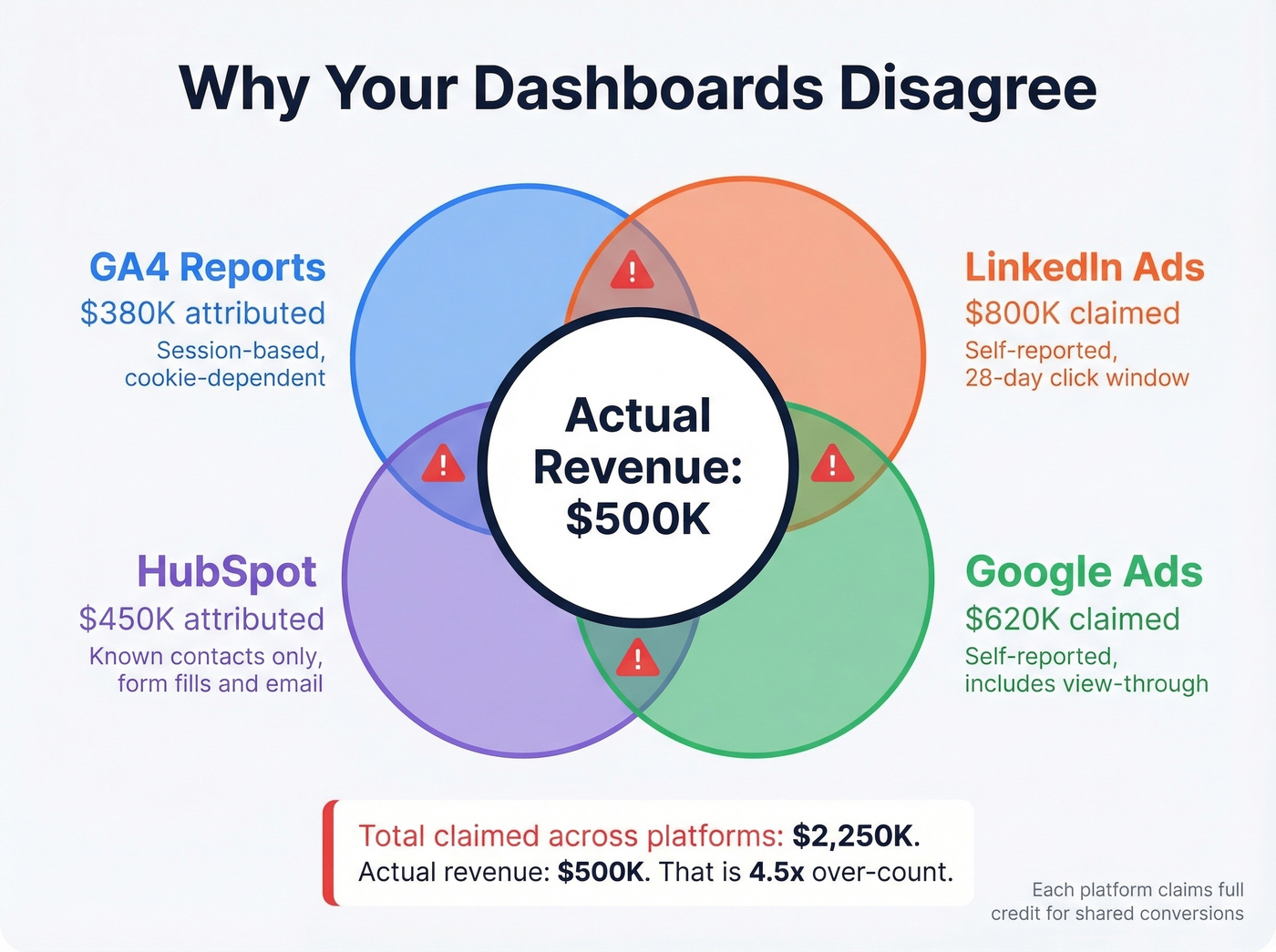
The result: overlapping credit across channels that adds up to more than 100% of your actual revenue. We've seen scenarios where LinkedIn's self-reported pipeline was 4x what CRM data showed when properly attributed. That's not a rounding error - it's a fundamentally different measurement system.
Then there's the political layer. The consensus on r/analytics is that teams run multiple models simultaneously and stakeholders pick whichever version supports their argument. The CMO uses first-touch to justify brand spend. Demand gen uses last-touch to defend paid budgets. Everyone's right in their own dashboard and wrong in aggregate.

You just read it: most attribution problems are data quality problems in disguise. If 15-35% of your CRM contacts have bounced emails or stale titles, your model is crediting revenue to ghosts. Prospeo's 7-day data refresh and 98% email accuracy mean every touchpoint in your attribution chain maps to a real person in a real role.
Fix your CRM data and your attribution fixes itself.
Attribution Alone Isn't Enough
Attribution tells you what happened. It doesn't tell you what would've happened without the spend. For that, you need a measurement stack, not a single tool.
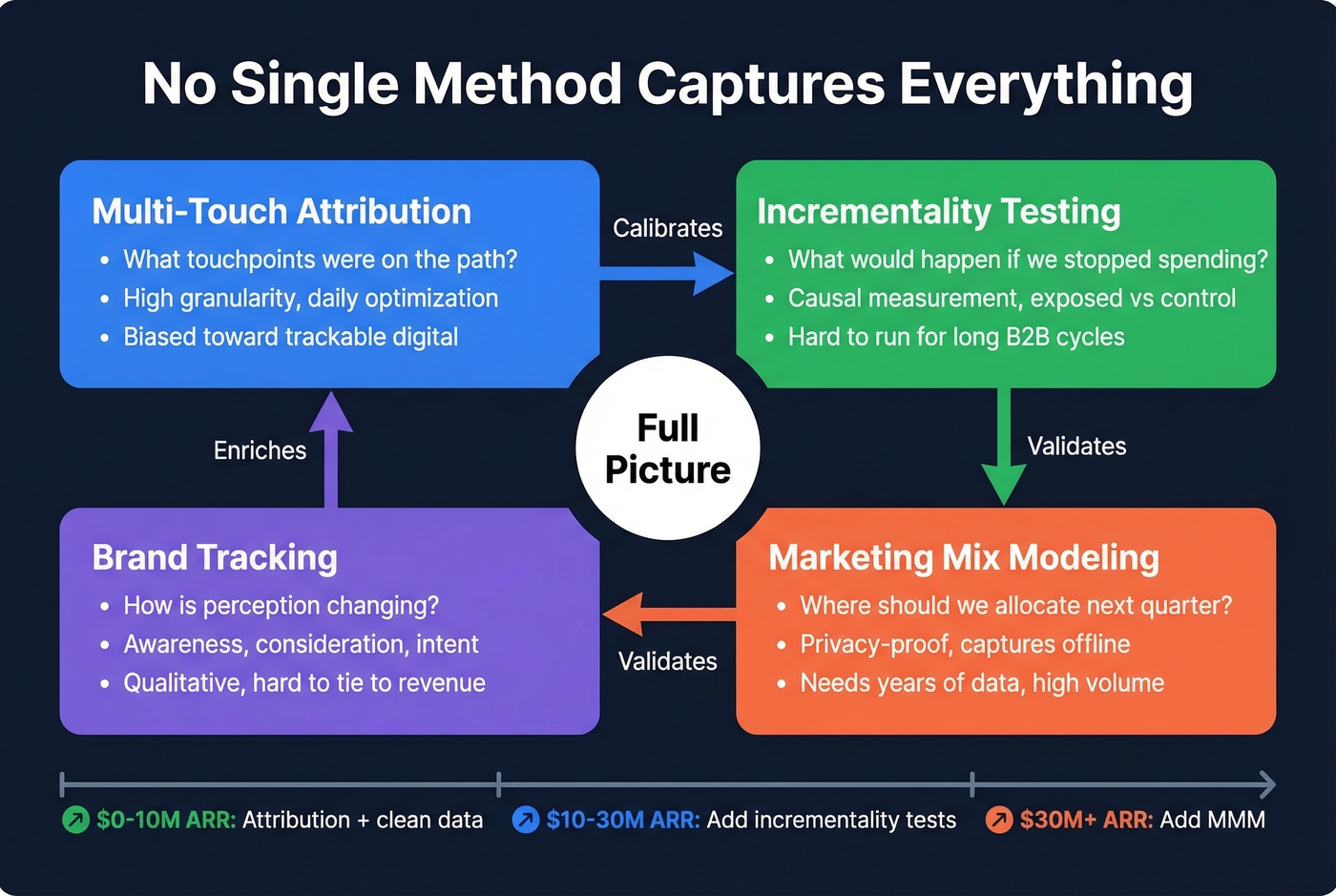
Attribution answers which touchpoints were on the path to revenue - high granularity, daily optimization, but biased toward trackable digital interactions. Incrementality testing answers a different question entirely: if we turned off Meta ads, how much revenue would we actually lose? This is causal measurement using exposed vs. control groups, but pausing spend long enough to cover a 6-9 month B2B deal cycle is often impractical.
Marketing mix modeling answers where to allocate next quarter's budget. It's privacy-proof - no cookies or user-level tracking - and it captures everything including offline. But it requires years of clean historical data, and for B2B companies under $50M ARR, conversion volumes are usually too low for solid statistical modeling. Brand tracking adds the perception layer that none of the above capture directly: awareness, consideration, intent.
The triangulation framework from Ekimetrics gets this right: MMM adds depth to attribution, incrementality tests calibrate MMM, brand tracking enriches the brand impact that attribution misses. For most teams, start with attribution, add incrementality experiments as you scale, and consider MMM only when you have the data volume and budget to support it.
Let's be honest: if your average deal size is under $15K and your sales cycle is under 90 days, you probably don't need a dedicated attribution platform at all. HubSpot or Salesforce native reporting plus clean data will get you 80% of the way there. The remaining 20% isn't worth $2K/month until you're past $10M ARR.
The Privacy Problem
Measurement is getting harder, not easier. Safari and Firefox already block third-party cookies by default. Chrome shifted in mid-2024 to a user-choice model rather than full deprecation - but the direction is clear. Fewer than 46% of businesses feel "very prepared" for cookieless marketing.
Consent banners strip signals from every touchpoint. Regulatory bodies are cracking down on fingerprinting and probabilistic identifiers. Global Privacy Control is becoming enforceable across expanding U.S. state privacy laws. First-party data and server-side tracking aren't optional anymore - they're the foundation.
Implementation Roadmap
Weeks 1-2: Data Audit & Governance
Start with your CRM, not your attribution platform. Audit contact records for bounced emails, outdated job titles, missing company associations, and duplicate entries. Establish UTM governance - standardized naming conventions across every ad platform, email tool, and landing page. Tools like Prospeo's CRM enrichment can verify and fill gaps across your database, returning 50+ data points per contact with a 98% email accuracy rate and records refreshed every 7 days.
Define ownership: Marketing Ops owns connector configuration, UTM standards, and campaign structure. RevOps owns opportunity IDs, contact roles, and stage mappings. If you don't have dedicated Marketing Ops, the CRM owner handles all of the above.
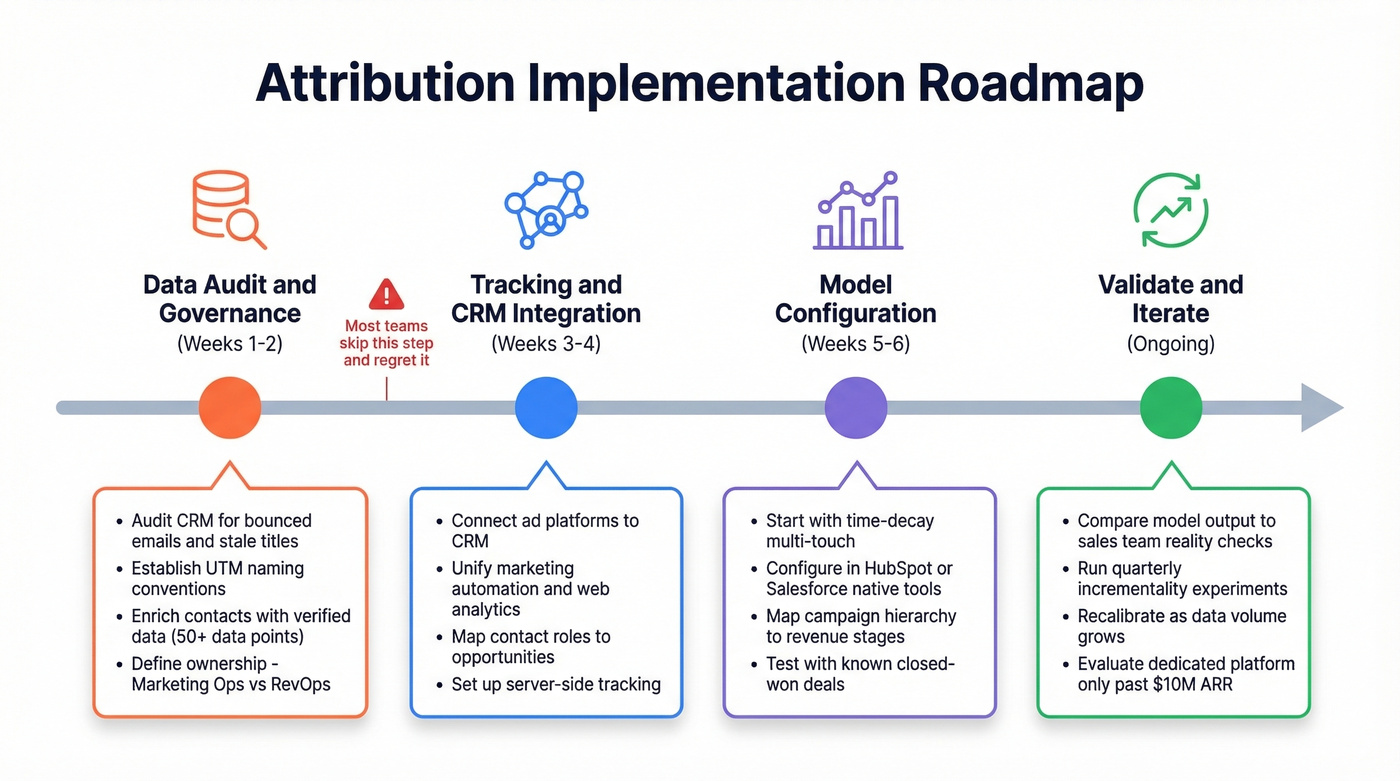
Weeks 3-4: Tracking & CRM Integration
Connect your ad platforms, marketing automation, web analytics, and CRM into a unified data layer. Capture both online and offline touchpoints - event attendance, sales conversations, direct mail. Ensure every touchpoint links back to a contact record and every contact links to an opportunity. For teams with data engineering resources, exporting GA4 to BigQuery gives you cleaner raw data for attribution analysis than relying on GA4's native reports.
Weeks 5-6: Model Selection & Baselines
Start with time-decay multi-touch. Run it against your last two quarters of closed-won deals and compare to last-touch as a sanity check. Establish your baseline: attributed pipeline divided by total pipeline, reviewed monthly. A low rate usually signals UTM, naming, or CRM linkage issues - not channel performance problems.
Weeks 7-8: Validation & Budget Review
Present your first attribution-informed budget review. Compare multi-touch findings to channel-native reporting. Flag the biggest discrepancies - these are your highest-leverage optimization opportunities. Commit to quarterly model refinement based on closed-won cohort analysis.
What Happens When You Get It Right
The 127-company analysis included a detailed before/after case. One mid-market B2B SaaS company implemented time-decay multi-touch with CRM integration and the budget shifts were dramatic: LinkedIn spend increased 40%, content production doubled, retargeting dropped 30%, and $400K in annual spend was redistributed. Six-month results: CAC down 22%, conversion rate up 18%, pipeline velocity up 34%.
The model didn't generate those results - the budget decisions it informed did. When you can accurately tie marketing touchpoints to revenue, every dollar moves with conviction instead of guesswork.
If you want to operationalize this beyond dashboards, build the habit of tracking marketing-generated pipeline alongside attribution so finance and sales can reconcile the same story.
Attribution Tools Worth Evaluating
The market runs roughly $600-$4,800/month depending on features and scale.
HubSpot Marketing Hub (Enterprise)
If you're already in the HubSpot ecosystem, Enterprise's attribution reporting is good enough for 80% of teams under $20M ARR. Multi-touch models, revenue attribution, and content attribution - all native. The catch: you need Enterprise tier at around $3,600/month. That's steep if you're buying it just for attribution, but reasonable if you're already on the platform.
Dreamdata
Purpose-built for B2B revenue attribution with strong Salesforce and HubSpot integration. Dreamdata maps the full account journey - not just individual contacts - which matters when buying committees have 5-10 people. Free tier for basic attribution, paid plans from ~$999/month. For B2B teams that need account-level visibility without building a custom data warehouse, it's the strongest dedicated option we've evaluated.
If you're running account-level motions, pair attribution with a clear ABM dashboard so your team can see account engagement and revenue in one place.
HockeyStack
Account-level B2B attribution with self-serve analytics. Best for mid-market and above with complex buying committees. Custom pricing, typically $1,500-$5,000/month.
Wicked Reports
Strong for companies straddling B2B and DTC/ecommerce. Plans from ~$250-$2,000/month. Skip this if you're pure B2B SaaS - the tracking model is built around shorter purchase cycles and doesn't handle 6-month deal timelines well.
| Tool | Best For | Pricing | Key Limitation |
|---|---|---|---|
| HubSpot Enterprise | HubSpot-native teams | ~$3,600/mo | Requires Enterprise tier |
| Dreamdata | B2B account journeys | Free-$999+/mo | Less useful for DTC |
| HockeyStack | Complex buying committees | ~$1,500-$5,000/mo | Custom pricing only |
| Wicked Reports | B2B/DTC hybrid | ~$250-$2,000/mo | Weaker for pure B2B SaaS |
If you're evaluating tools mainly to justify spend, it also helps to standardize the B2B marketing KPIs you report to leadership so attribution doesn't become the only “source of truth.”
Your attribution engine needs clean contact-to-account mapping to work. Prospeo enriches every record with 50+ data points - verified email, current title, company, department - at a 92% match rate. That's the foundation time-decay and W-shaped models actually require to produce numbers your CFO will trust.
Stop attributing revenue to contacts who left the company two years ago.
FAQ
Which attribution model works best for B2B?
Time-decay multi-touch with CRM integration is the best starting model for most B2B teams. It weights recent touchpoints more heavily - matching how buying committees accelerate toward a decision - while still crediting earlier interactions. No complex data infrastructure required.
How does CRM data quality affect attribution?
If 15-35% of contact records have bounced emails or stale job titles, your attribution reports credit revenue to phantom touchpoints. Enriching and verifying CRM records before configuring any model is the single highest-leverage fix most teams skip.
Can I do revenue attribution without a dedicated platform?
Yes. HubSpot and Salesforce native reporting covers most needs for teams under $20M ARR. Nail your data quality and UTM governance first - the platform isn't the bottleneck, the data is. Disciplined CRM hygiene beats expensive tooling every time.
Why do my attribution dashboards show different numbers?
Each platform uses different tracking methods and credit windows. GA4 relies on cookies, HubSpot tracks known contacts via forms, and ad platforms claim full credit within their own attribution windows. The overlap produces totals exceeding 100% of actual revenue. Use CRM-sourced multi-touch as your single source of truth.
How much do attribution tools cost?
Mid-market platforms run $600-$4,800/month. HubSpot Enterprise starts around $3,600/month. Dreamdata offers a free tier with paid plans from ~$999/month. HockeyStack typically costs $1,500-$5,000/month with custom pricing.