

The Dark Funnel Is Where Your Pipeline Actually Starts
Your CMO is staring at a dashboard showing branded search up 40% this quarter. No campaign is running. No press hit. No product launch. Pipeline is growing, but attribution says it came from "direct traffic."
That gap between what's happening and what your tools can see? That's the dark funnel - and a huge chunk of your buyer journey lives there.
The Short Version
- Most of your buyer journey is invisible to attribution software. UK and Ireland buyers control 57% of the journey before vendor contact; in APAC, roughly 73% happens anonymously before anyone picks up the phone.
- AI is making it worse. ChatGPT, Claude, Gemini, and Copilot now shape B2B shortlists with zero attribution trail.
- The highest-ROI fix costs $0. A mandatory free-text "How did you hear about us?" field plus Google Search Console branded search tracking will reveal more than most attribution setups ever will.
- When you're ready to act on hidden pipeline signals, you need verified contact data to reach in-market accounts - not more dashboards.
What Is the Dark Funnel?
Think of it as the iceberg below the waterline. Above the surface, you've got trackable clicks, form fills, and ad impressions. Below it - invisible and massive - sits everything else.
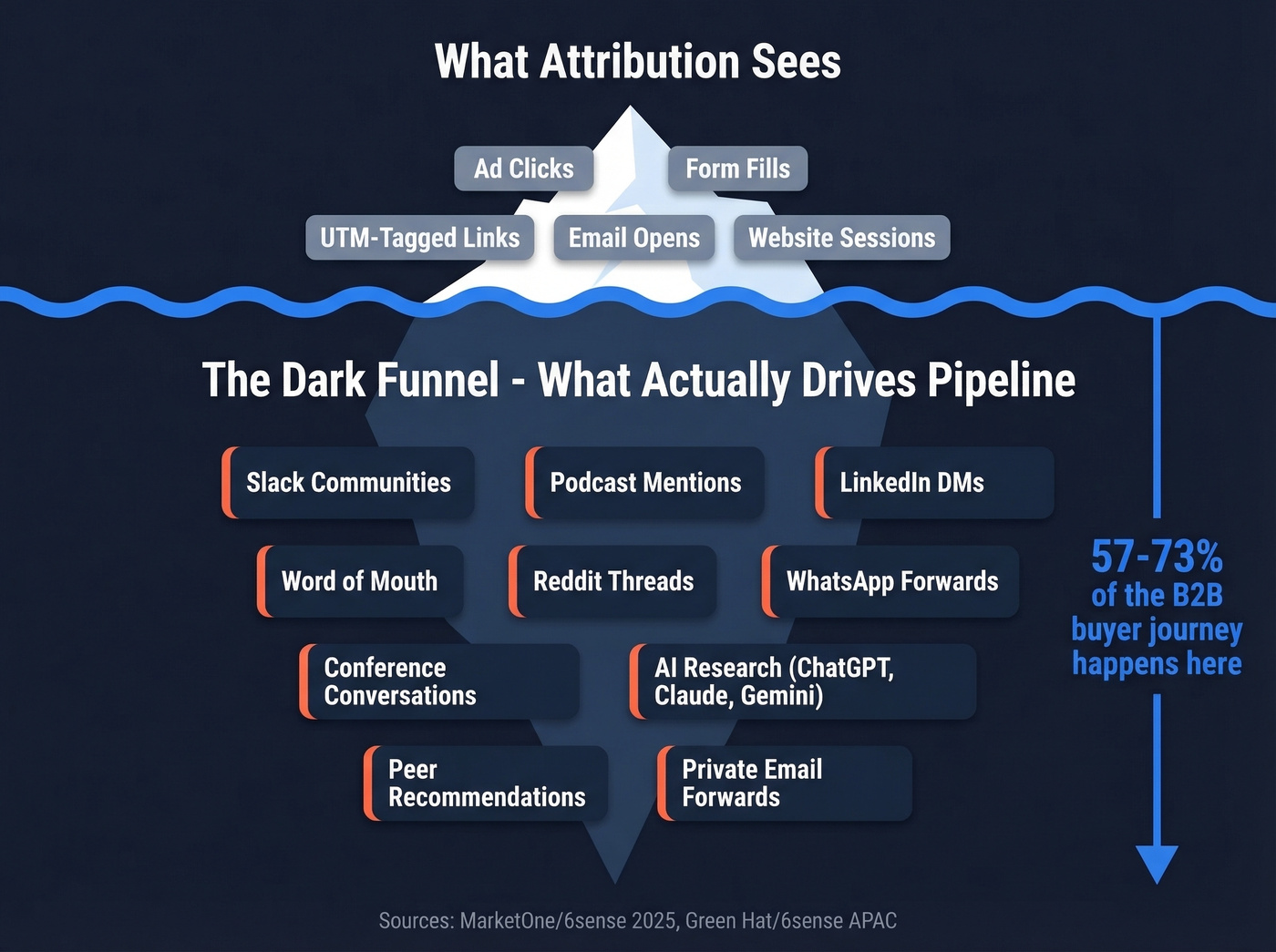
That "everything else" includes Slack communities, podcast mentions, LinkedIn DMs, word-of-mouth recommendations at conferences, Reddit threads, WhatsApp forwards, and increasingly, AI-generated research summaries. None of these produce a UTM parameter. None show up in your HubSpot attribution report.
This concept isn't new. Buyers have always asked peers for recommendations before Googling a vendor. What's changed is the proportion - and the speed at which private channels are multiplying. The attribution crisis isn't a technology failure; it's a behavioral shift. Buyers moved into private environments, and no amount of tracking pixels will follow them there.
Dark Funnel vs Dark Social
These terms get used interchangeably, but they're not the same. Dark social is a subset - specifically, private sharing like DMs, texts, email forwards, and WhatsApp messages that strip tracking parameters. When someone texts a colleague a link to your pricing page, that visit shows up as "direct traffic." That's dark social.
The broader dark funnel includes dark social, but also covers podcast influence, event conversations, community discussions, AI research, and plain old word of mouth. Alexis C. Madrigal's Atlantic analysis is often cited as showing 56.5% of social traffic can be dark social alone. Layer on every other untrackable channel, and you see the scale of the problem.
Hidden Buyer Journey by the Numbers
A 2025 study by MarketOne and 6sense surveyed 754 UK and Ireland buyers across deals averaging £320,000. Buyers controlled 57% of their journey before ever contacting a vendor. Globally, that number was 61% - down from 69% in 2024.
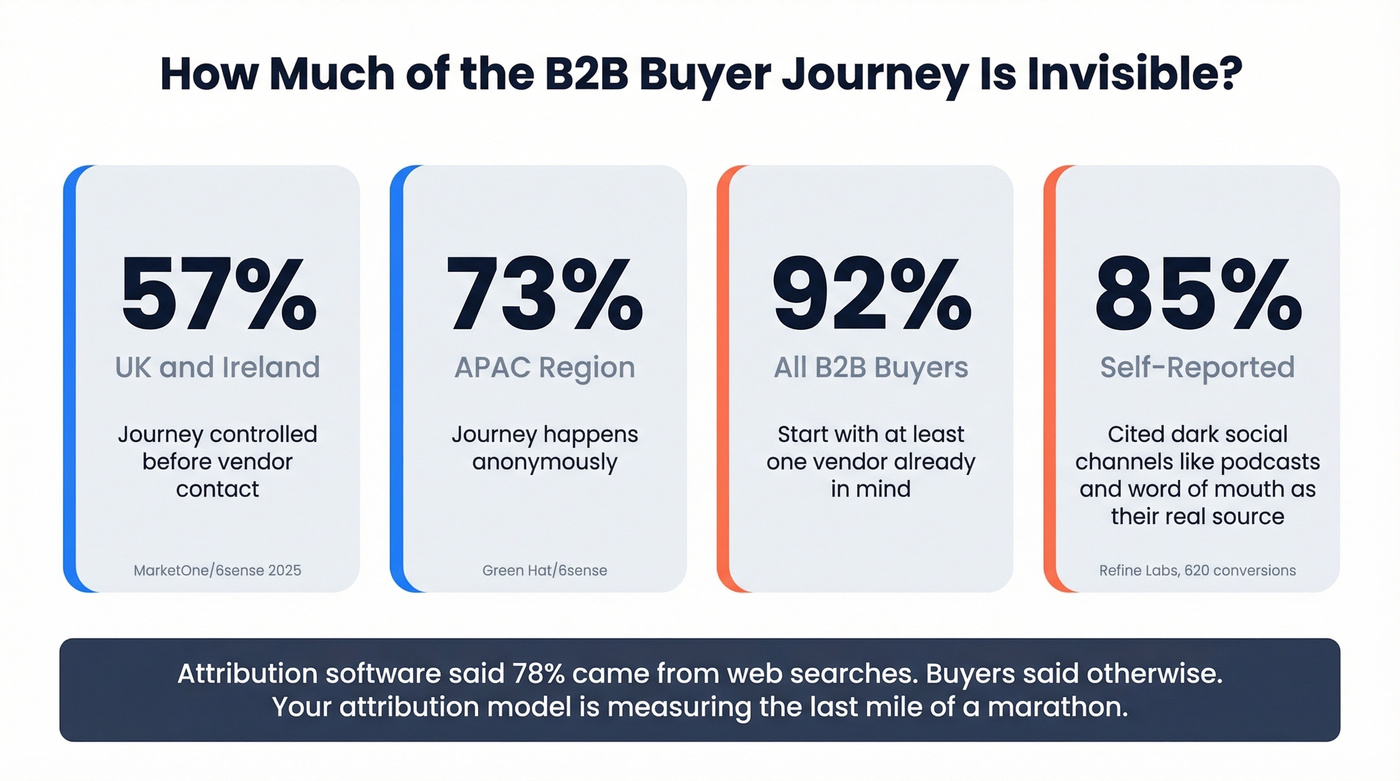
The APAC numbers are more dramatic. Green Hat and 6sense research found roughly 73% of the buying journey happens anonymously. Buying groups average 12.8 people generating 1,280 interactions over a 13-month cycle. First vendor contact doesn't happen until around month 9.5.
Here's the stat that should really make you rethink attribution: a widely cited benchmark says 92% of B2B buyers start with at least one vendor in mind, and 41% have already selected a preferred vendor before formal evaluation begins. Combine that with Refine Labs' 12-month test across 620 conversions - where software attribution said 78% came from web searches, but self-reported data showed 85% cited dark social channels like podcasts, word of mouth, and community - and the picture is clear.
Your attribution model is measuring the last mile of a marathon and calling it the whole race.
AI Is the Newest Dark Layer
Here's the channel nobody's attribution model accounts for: large language models.
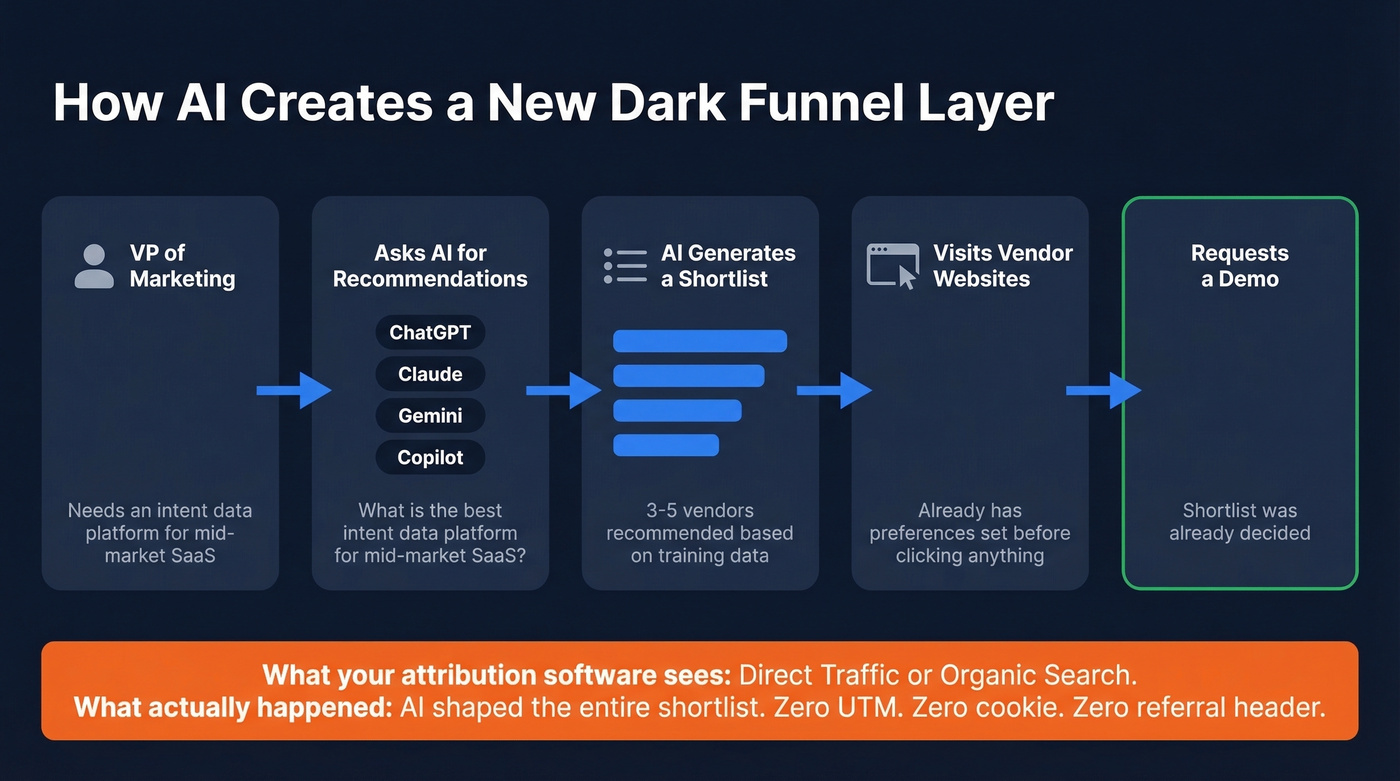
A VP of Marketing evaluating intent data platforms doesn't just Google anymore. They open ChatGPT or Claude and ask, "What's the best intent data platform for mid-market SaaS?" The LLM generates a shortlist. That shortlist shapes which vendors get a demo request. No UTM. No cookie. No referral header.
Buyers use Gemini, Copilot, and ChatGPT as research assistants - summarizing reviews, comparing pricing, even drafting vendor evaluation criteria. By the time they hit your website, their shortlist is already set. Your attribution software credits the visit to "direct traffic" or "organic search," completely missing the AI-assisted research that actually drove the decision.
If your average deal size is above $20K, AI-assisted research is already shaping your pipeline and you have zero visibility into it. This isn't a 2028 problem. It's happening right now, and it gets worse every quarter.

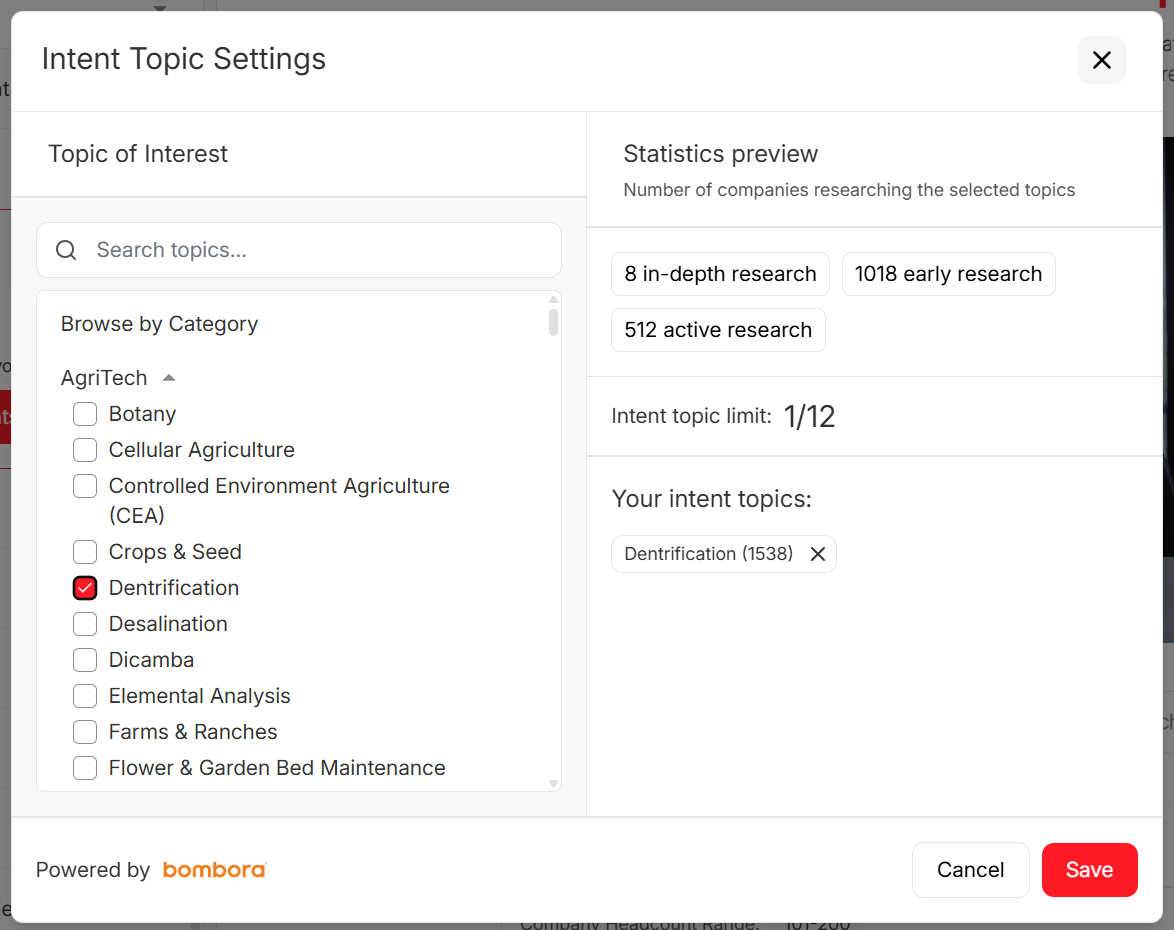
Intent data flags accounts researching your category - but without verified contact data, those signals die in a dashboard. Prospeo tracks 15,000 intent topics via Bombora, then gives you 98% accurate emails and 125M+ verified mobiles to reach the buying committee directly.
Turn dark funnel signals into booked meetings for $0.01 per email.
Five Signs Invisible Activity Is Eating Your Pipeline
Not sure whether this matters for your business? Run through this diagnostic:
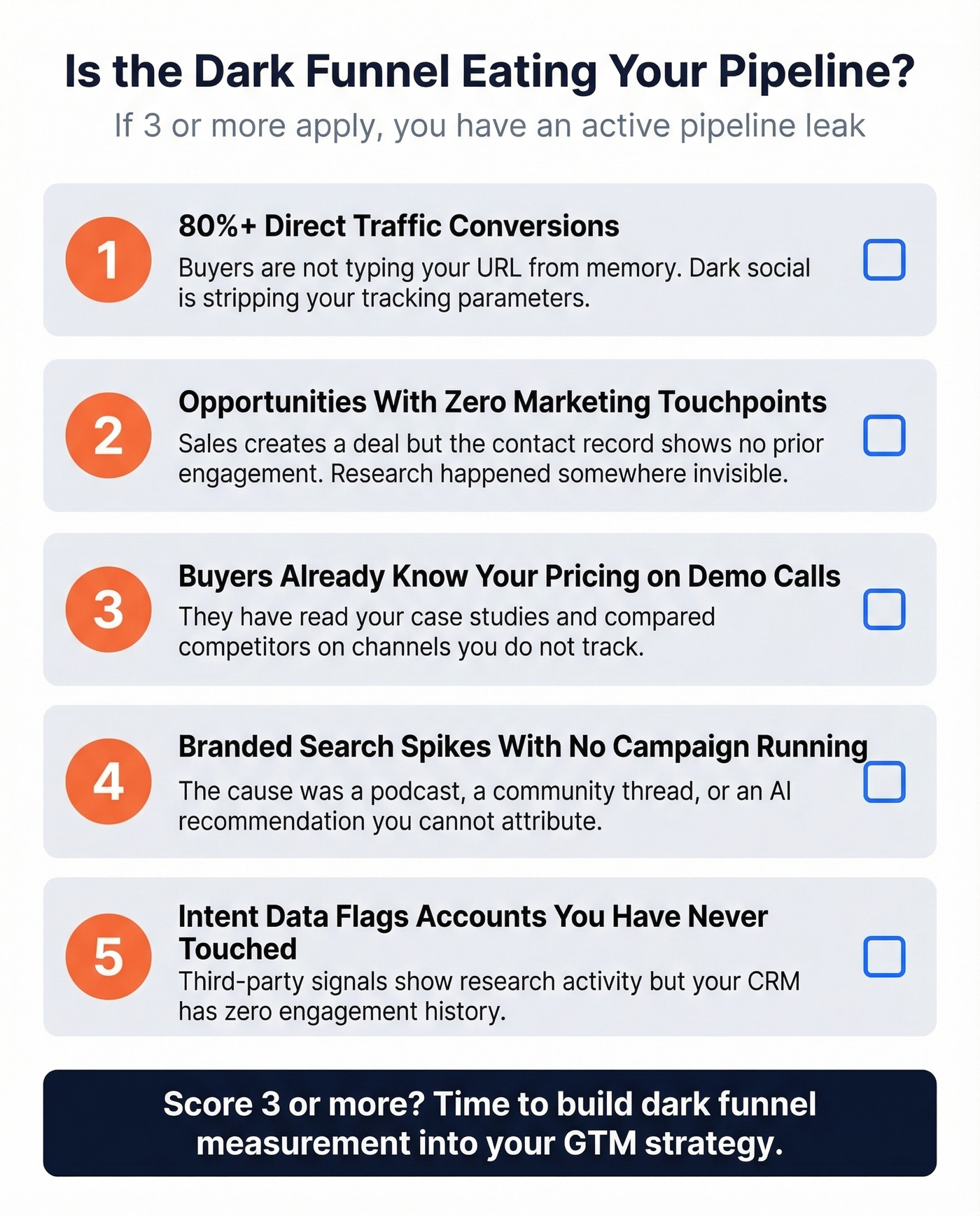
- Attribution shows ~80% "direct traffic" conversions. Buyers aren't typing your URL from memory. It's dark social stripping your tracking parameters.
- Opportunities appear without marketing touchpoints. Sales creates an opportunity, and the contact record shows zero prior engagement. The buyer did their research somewhere you can't see.
- Buyers arrive to demos already knowing your pricing. They've read your case studies and compared you to competitors - all on channels you don't track.
- Branded search spikes with no campaign running. Nobody has an answer because the cause was a podcast appearance, a viral community thread, or an AI recommendation.
- Intent data flags accounts your team has never touched. Third-party intent signals show a company researching your category, but there's zero engagement in your CRM.
If three or more sound familiar, this isn't theoretical for your team. It's an active pipeline leak.
The Business Case: Selling This to Your CEO
This isn't vibes. It's pipeline math.
Common Room analyzed data from four B2B SaaS customers - one sales-led, three product-led. About 28% of open pipeline (roughly $103.5M across the sample) was first seen in untracked channels. Around 26% of closed deals (~$5M) originated there.
The velocity numbers are even more compelling. Deals first seen through invisible touchpoints closed in 60.6 days versus 131 days for other deals - 54% faster. That makes intuitive sense: a buyer who's already done extensive anonymous research arrives warmer and moves through your sales process with less friction. And 82% of buying teams reach out to their preferred vendor first. If you're not the vendor they discovered during their hidden research phase, you're starting every deal from behind.
When half your pipeline touches untracked channels before or during the deal lifecycle, ignoring those signals isn't just a measurement gap. It's a revenue gap.
How to Measure the Dark Funnel
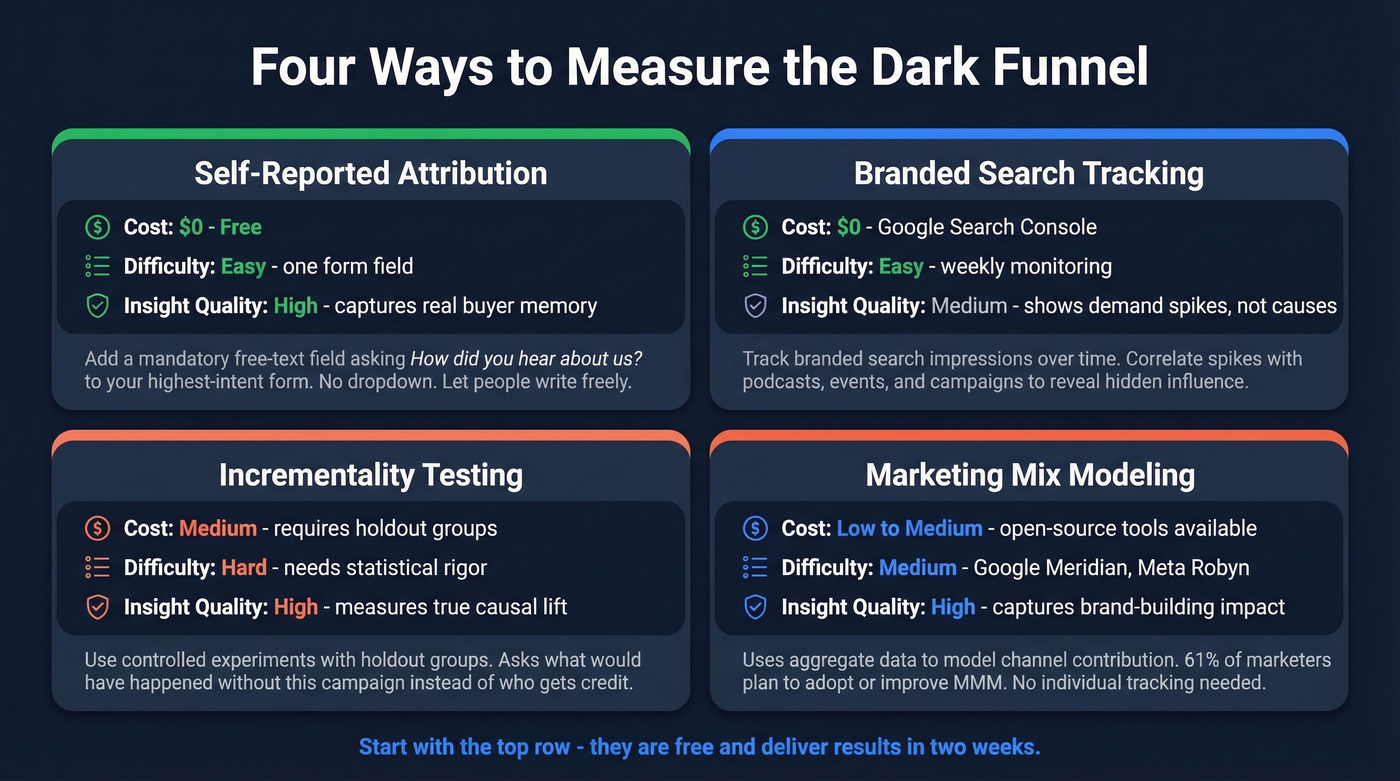
You can't instrument invisible buyer activity the way you instrument a landing page. But you can build proxies that give you directional intelligence. We've seen four approaches actually work.
Self-Reported Attribution
This is the single highest-ROI tactic, and it's free. Add a mandatory free-text field - not a dropdown - to your highest-intent conversion form. "How did you hear about us?" Let people write whatever they want.
Dropdowns don't work because they anchor respondents to the channels you think matter. Free text captures what actually happened. In our experience, the answers will surprise you within the first two weeks.
Branded Search Tracking
Google Search Console is your free proxy for hidden demand. Track branded search impressions and clicks over time, then correlate spikes with your activity calendar. Did branded search jump the week after your CEO appeared on a podcast? After a conference? Those correlations reveal influence that no attribution tool captures.
Incrementality Testing
Instead of asking "which channel gets credit?", ask "what would have happened if we hadn't run this campaign?" Incrementality testing uses holdout groups and controlled experiments to measure true lift. It's harder to implement than attribution software, but it answers a fundamentally better question. If you need a clean way to define stages and touchpoints first, start with a sales funnel framework you can actually measure.
Marketing Mix Modeling
MMM is having a renaissance. Per EMARKETER's 2024 survey, 61% of marketers plan to adopt or improve MMM, and open-source tools like Google Meridian and Meta Robyn are making it accessible to teams without PhD statisticians. MMM uses aggregate data to model channel contribution without relying on individual-level tracking - particularly good at capturing the impact of brand-building activities that feed invisible demand.
Building a Dark Funnel Strategy
Understanding untracked demand is one thing. Operationalizing it is another. Here's how the measurement approaches above connect to tools that let you actually act on what you find.
Intent Data Platforms
Intent data is the most common tool for visibility into hidden buyer activity, but most platforms tell you which company is researching, not which person. That distinction matters when you're trying to book meetings.
| Tool | Annual Cost | Best For |
|---|---|---|
| Bombora | $25K-$80K | Standalone intent |
| 6sense | $35K-$150K+ | Full-stack enterprise |
| Demandbase | $40K-$120K | ABM-focused enterprise |
| G2 Buyer Intent | $10K-$87K+ | Entry-level (if on G2) |
| ZoomInfo Intent | ~$7.2K-$36K | Cheapest major vendor |
Let's be honest: these are expensive tools that solve half the problem. They tell you an account is in-market. They don't give you a verified email for the right person at that account. If you're evaluating providers, compare options in our guide to B2B company data.
Attribution and Social Listening
HockeyStack offers multi-touch attribution with signal integration from untracked channels. Dreamdata provides attribution tooling with a freemium entry point. For social listening, Brand24 catches brand mentions across communities and forums - useful for spotting the conversations your attribution model misses entirely. If you want a dedicated stack for community/forum monitoring, see B2B listening options.
Turning Signals Into Meetings
You've got intent data showing 50 accounts researching your category. Now what?
You need verified contact data for the actual decision-makers - not a company-level signal you can't act on. Prospeo combines Bombora-powered intent data across 15,000 topics with 300M+ professional profiles, 98% email accuracy, and a 7-day data refresh cycle. Instead of paying $25K-$150K for an intent platform and then another tool for contact data, you get both in one place at roughly $0.01 per email with a free tier to start. If you're cleaning and enriching records before outreach, use a proper data enrichment workflow.
Skip this approach if your funnel fundamentals are broken, though. Before you scale dark funnel measurement, make sure you're capturing existing demand first. Fix your conversion forms, tighten your demo booking flow, and nail your follow-up speed. Better measurement amplifies a working funnel - it doesn't fix a broken one. If your team is leaking deals after the first touch, start with sales pipeline challenges and a tighter sales process optimization plan.
The Monday Morning Playbook
Stop reading and start measuring. Here's a four-week action plan:
Week 1: Add a mandatory free-text "How did you hear about us?" field to your highest-intent conversion form. No dropdown. No suggested answers. Just an open text box. This takes 15 minutes and will change how you think about attribution within 30 days.
Week 2: Set up Google Search Console branded search tracking. Document your baseline for branded impressions and clicks. Map your content calendar, podcast appearances, events, and community activity against branded search trends.
Week 3: Build an outreach list for in-market accounts. Pull verified emails for accounts showing intent signals. Before you scale, check your bounce rate - if it's above 5%, fix your data source first. Bad data will tank your deliverability faster than any dark funnel insight can help. Use email bounce rate benchmarks to diagnose the root cause, and lock in an email deliverability checklist before you ramp volume.
Week 4: Run your first correlation analysis. Compare branded search volume against your podcast, event, and content calendar. You won't have statistical significance yet, but you'll start seeing which invisible activities drive visible demand. This is the beginning of a repeatable strategy you can refine quarter over quarter. To operationalize those signals, build a simple system for identifying buying signals.
Dark funnel deals close 54% faster because buyers arrive warm - but only if you reach them first. Prospeo's 7-day data refresh means you're contacting in-market accounts with fresh, verified data while competitors work from 6-week-old records.
Stop measuring invisible pipeline. Start converting it.
FAQ
What's the difference between dark funnel and dark social?
Dark social is a subset - specifically private sharing like DMs, texts, and email forwards that strip tracking parameters. The broader dark funnel encompasses all untrackable buyer activity: word of mouth, events, podcasts, AI research, community conversations, and dark social itself.
Can you track hidden buyer activity without expensive tools?
Yes. The two highest-ROI tactics are free: a mandatory free-text "How did you hear about us?" field on conversion forms, and branded search tracking in Google Search Console. These give you directional data within 30 days. For contact-level action, Prospeo's free tier (75 emails/month) layers intent signals with verified emails so you can actually reach the accounts showing up in your data.
How does AI change untracked buyer research?
Buyers now use ChatGPT, Claude, and Gemini to build vendor shortlists, summarize reviews, and compare pricing - all with zero attribution trail. By the time they visit your site, their decision is largely made. No attribution tool on the market can track LLM-assisted research yet.
Why does this matter more for B2B than B2C?
B2B buying cycles are longer, committees are larger, and peer recommendations outweigh ads. A B2C impulse purchase involves one search. A B2B deal averaging £320K involves 12+ stakeholders researching across private channels for months - most of it completely invisible to your CRM. That's why a dark funnel strategy isn't optional for B2B revenue teams in 2026.