

The AIDA Sales Funnel: Build, Measure, and Fix Every Stage
Your SDR team sent 5,000 cold emails last quarter. Pipeline stayed flat. Bounce rate hit 35%. The VP of Marketing blamed messaging. The VP of Sales blamed targeting. Nobody thought to ask which stage of the funnel actually broke.
That's the real problem - and it's exactly what the AIDA sales funnel was built to diagnose, if you use it right. Most teams treat AIDA as a copywriting formula they learned in college. It's not. It's a diagnostic tool that tells you where your funnel leaks and what to fix first.
The Short Version
- AIDA is a diagnostic tool, not a textbook concept. Map each stage to KPIs, find the leak, fix it. The stage-by-stage KPI table below is the single most useful thing in this article.
- The benchmarks matter. B2B SaaS averages 2.3% visitor-to-lead conversion. If you're below that, your Attention stage is broken. If MQL-to-SQL is below 13%, your middle-of-funnel is the problem.
- AIDA is too slow for paid social unless you compress it. Scroll-based platforms demand compressed messaging - one sentence, not four stages. Adapt or waste budget.
- AIDA stops at Action. Returning customers spend 67% more than new ones. If you don't bolt on retention, you're leaving real revenue on the table.
What Is the AIDA Model?
The AIDA model breaks) the buyer's journey into four cognitive stages: Attention, where they notice you; Interest, where they engage; Desire, where they want what you offer; and Action, where they buy, book, or sign up. The concept traces back to the 1890s, with St. Elmo Lewis among the first to formalize it - making it one of the oldest frameworks in marketing.
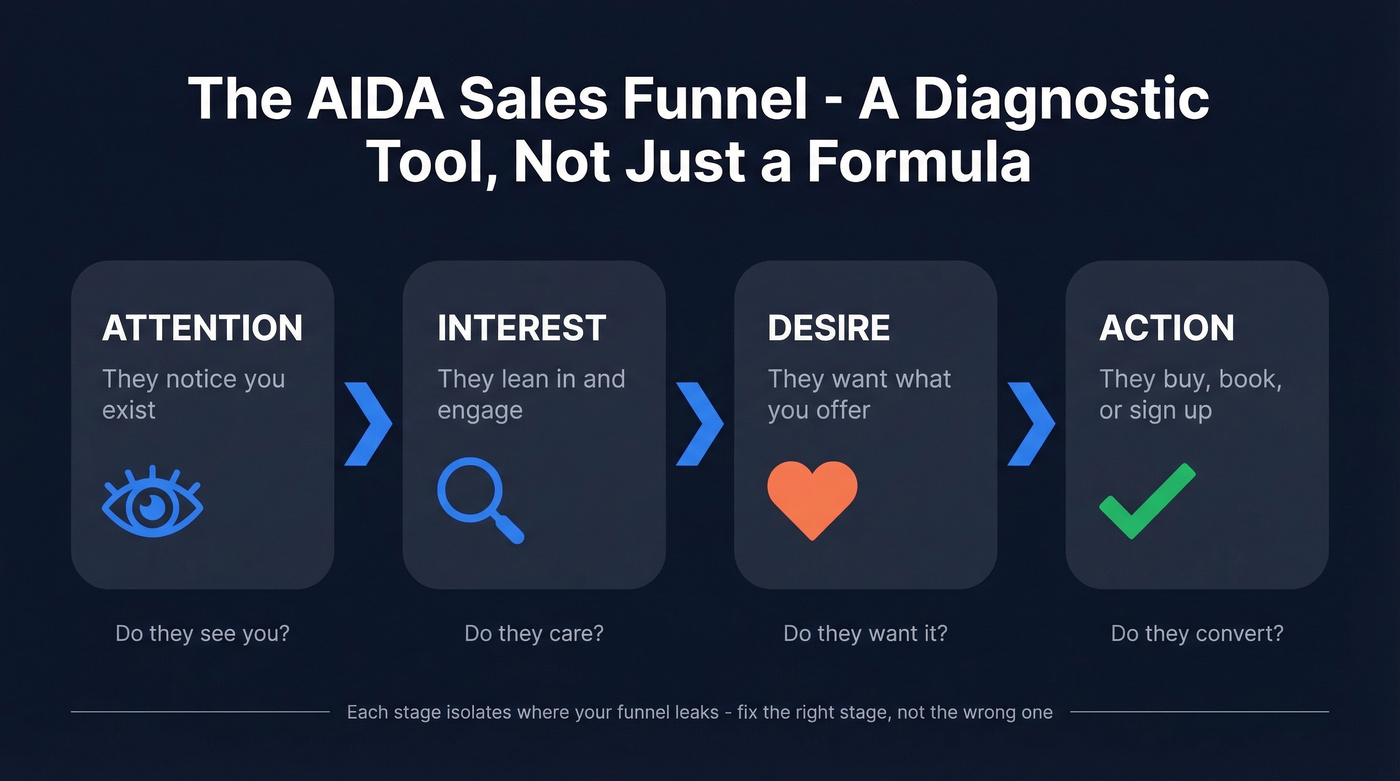
Here's the thing: AIDA only works in 2026 if you modernize it. The original model assumed a linear path - see an ad, get curious, want the product, buy it. Real buyer journeys are messier. Multiple channels, multiple touchpoints, multiple stakeholders in B2B. The framework's power isn't in its linearity. It's in its ability to isolate which stage is underperforming. When your pipeline stalls, AIDA gives you four places to look instead of a hundred. That's why it survives - not because it's perfect, but because it's the fastest diagnostic tool most teams have access to.
The Four Stages (With KPIs and Examples)
Attention
Attention is the top of everything. The prospect becomes aware you exist. Your KPIs here are impressions, reach, email open rate, organic search impressions, and social followers. If these numbers are low, nothing downstream matters.
The tactical move most teams get wrong: leading with features instead of problems. Duolingo doesn't send push notifications saying "Learn Spanish with our spaced-repetition algorithm." They send "Your streak is about to die." That's a problem/symptom hook, and it works because it triggers an emotional response before the reader has time to scroll past. TOF hooks should name the pain, not the product.
Interest
Once you've got attention, Interest is where the prospect leans in. They're clicking, reading, watching. Track CTR, watch time, bounce rate, and return visitors. If your Attention metrics are strong but Interest metrics tank, your hook promises something your content doesn't deliver.
The shift from Attention to Interest requires a change in messaging - you stop hooking and start proving. Comparisons, data, case studies, anything that answers "why should I care?" Repeating your TOF hooks at this stage actually increases CPM and reduces CTR. The consensus on r/FacebookAds is clear: stage-mismatched messaging is the #1 performance killer, not targeting or bids.
Desire
Desire is where the prospect moves from "interesting" to "I want this." Your KPIs shift to CTA clicks, demo requests, case study downloads, MQL count, and lead score. Social proof carries this stage - testimonials, logos, specific results.
Calendly nails this. Their landing pages don't get creative at the bottom of the funnel. They show logos, quote a time-saved stat, and put the CTA right there. Clarity beats creativity at BOF, every time. If your MQLs are healthy but demo requests are flat, your Desire stage messaging is probably too clever by half.
Action
Action is the conversion event: meeting booked, free trial started, pipeline created. Track meeting bookings, trial sign-ups, opportunities created, and conversion rate.
For SaaS, Action is where the real funnel begins. The sale isn't closed when someone signs up for a trial. It's closed when they activate, adopt, and renew . If you're measuring Action as the end of your funnel, you're measuring the wrong thing.
How to Measure Each Stage
Most teams only track Action-stage metrics - conversion rate, pipeline created, revenue. That's like diagnosing a car problem by only checking the speedometer. You need upstream metrics to find the actual leak.
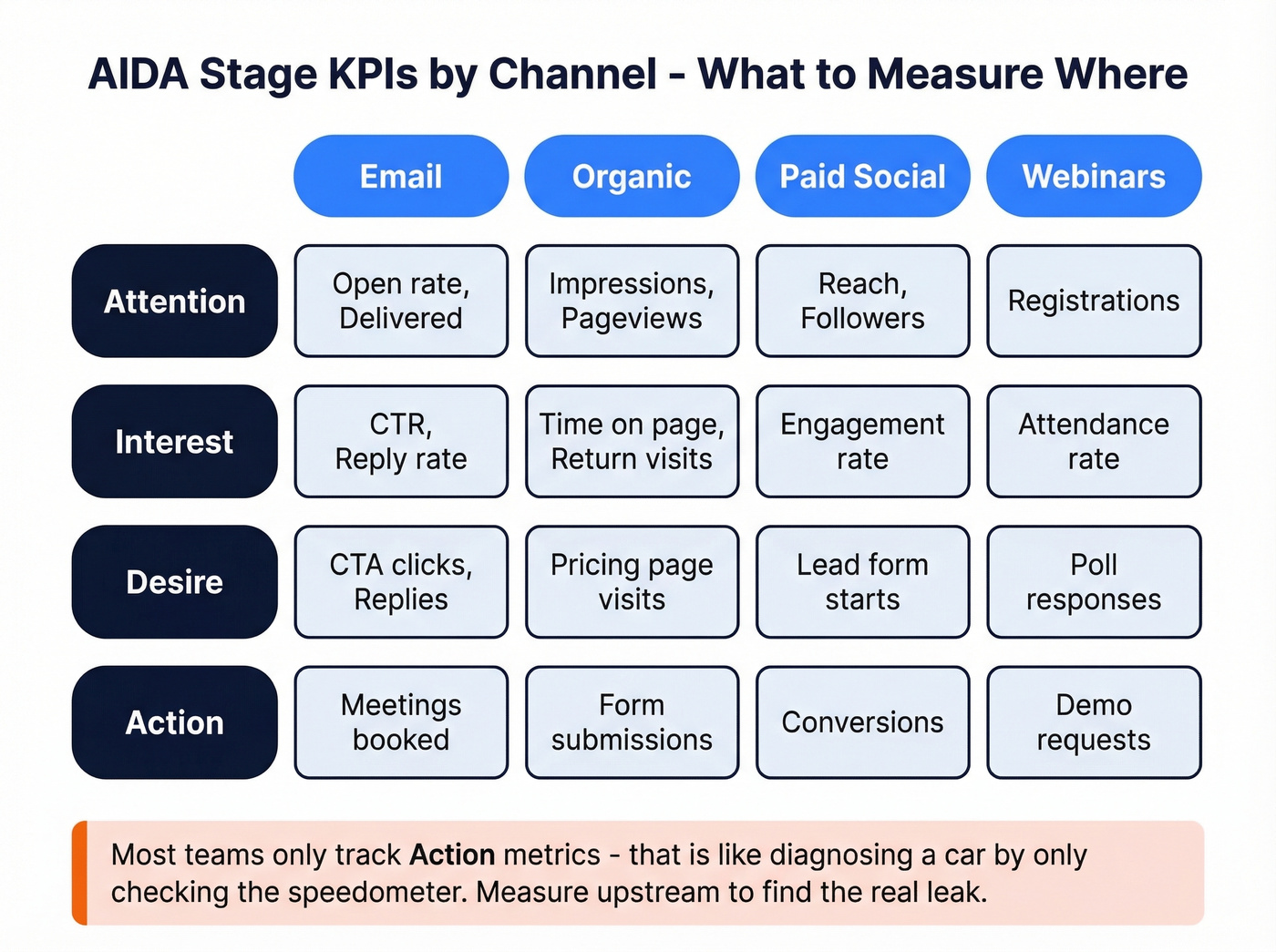
| AIDA Stage | Organic | Paid Social | Webinars | |
|---|---|---|---|---|
| Attention | Open rate, delivered | Impressions, pageviews | Reach, followers | Registrations |
| Interest | CTR, reply rate | Time on page, returns | Engagement rate | Attendance rate |
| Desire | CTA clicks, replies | Pricing page visits | Lead form starts | Poll responses |
| Action | Meetings booked | Form submissions | Conversions | Demo requests |
The pattern we see repeatedly: teams pour budget into Attention (more ads, more emails, more content) when the real bottleneck is Interest-to-Desire. If people see you but don't engage, spending more on reach is burning money. Diagnose first, then spend.
AIDA Diagnosis in Practice
Let's walk through a real scenario. A mid-market SaaS company runs a cold email campaign to 3,000 prospects. Open rate is 48% - strong. But CTR is 1.2%, and only four meetings get booked. The instinct is to send more emails. AIDA says otherwise.
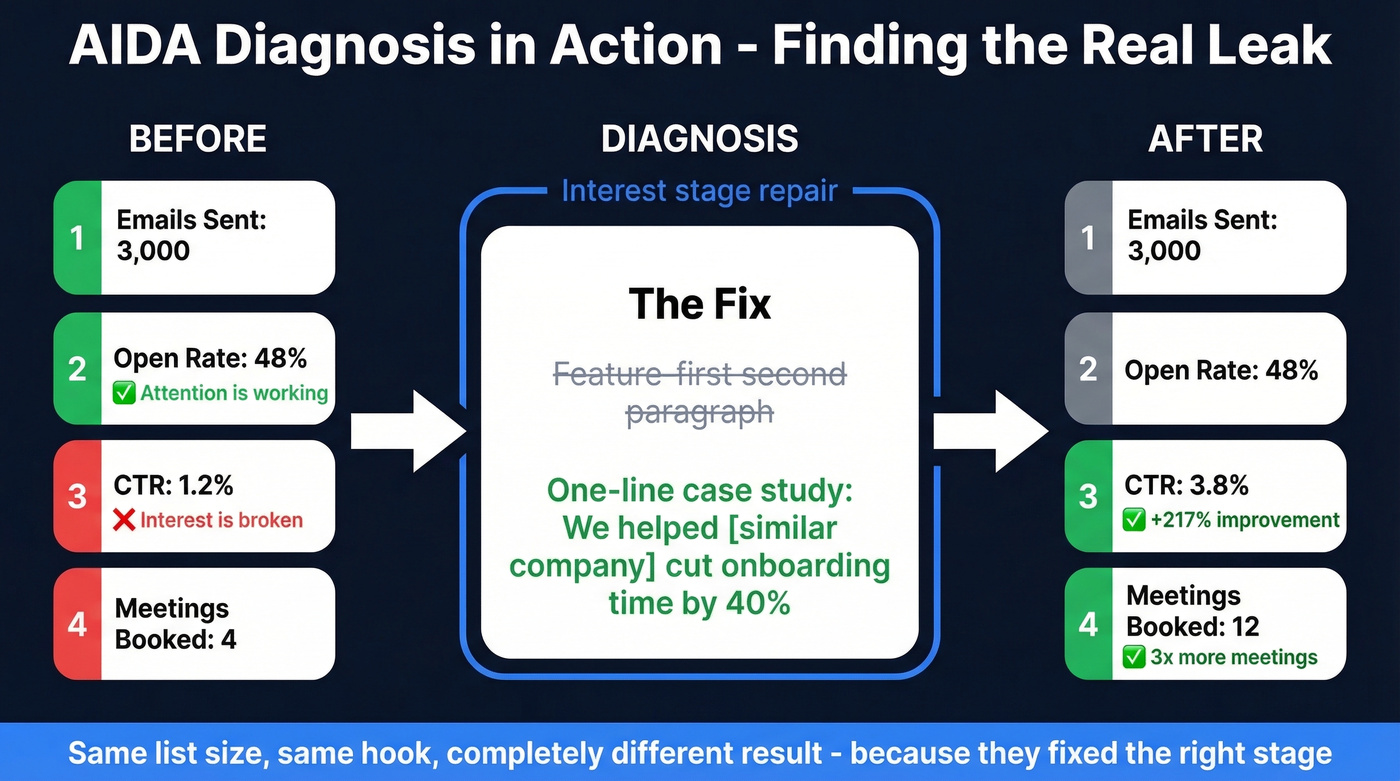
Attention is working - nearly half the list opened. Interest is broken - a 1.2% CTR means the body copy fails to prove value after the hook lands. The fix: replace the feature-first second paragraph with a one-line case study ("We helped [similar company] cut onboarding time by 40%"). After the swap, CTR jumps to 3.8% and meetings triple in the next send. Same list size, same Attention hook, completely different result - because the team fixed the right stage instead of throwing volume at the wrong one.

That 35% bounce rate in the example above? It kills your Attention stage before Interest even has a chance. Prospeo's 98% email accuracy and 7-day data refresh mean your opens reflect real messaging performance - not stale data dragging down every stage of your AIDA funnel.
Stop diagnosing copy when the real leak is bad data.
Funnel Benchmarks by Stage
Numbers make the framework useful. FirstPageSage's benchmark report provides stage-by-stage conversion rates across industries:
| Industry | Lead-to-MQL | MQL-to-SQL | SQL-to-Opp | SQL-to-Closed |
|---|---|---|---|---|
| B2B SaaS | 39% | 38% | 42% | 37% |
| Cybersecurity | 24% | 40% | 43% | 46% |
| eCommerce | 23% | 58% | 66% | 60% |
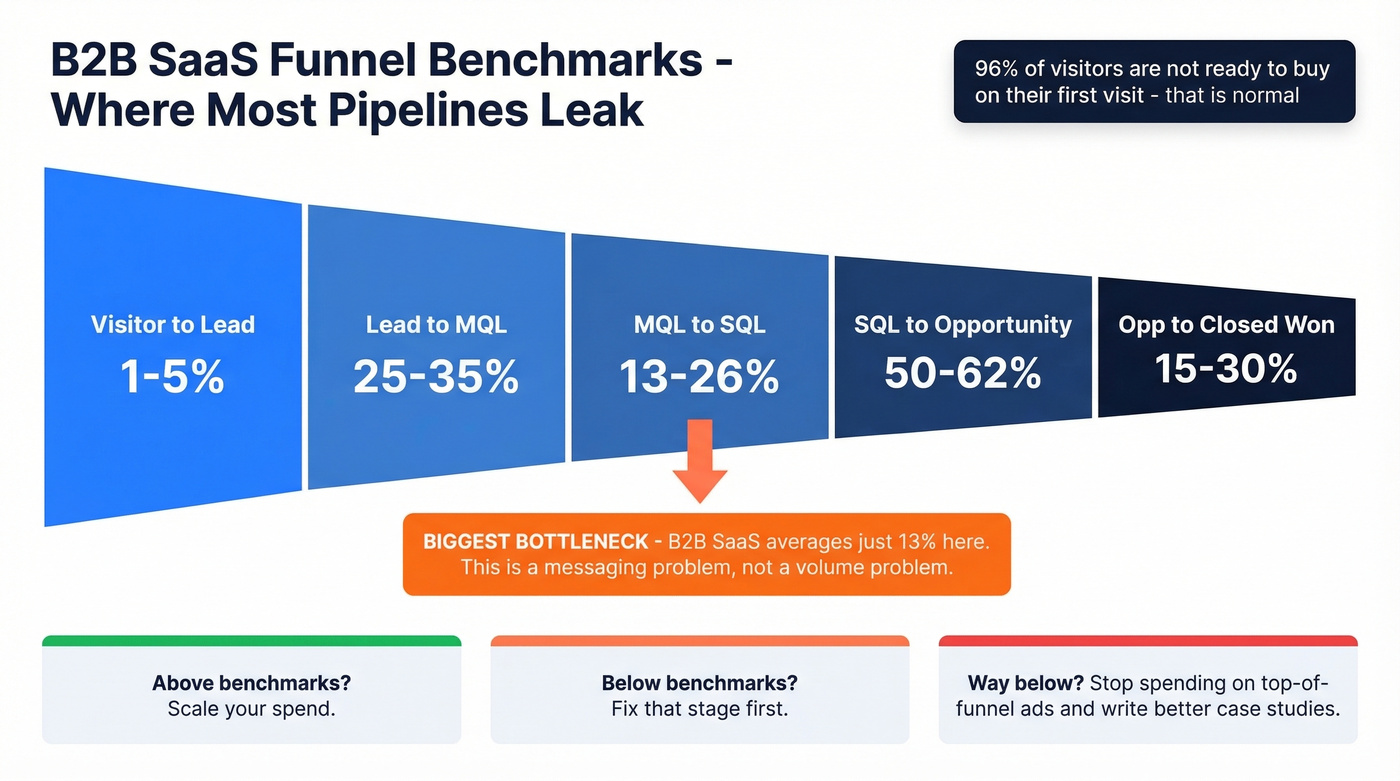
VWO's analysis gives broader ranges that work as quick sanity checks:
| Stage | Typical Range |
|---|---|
| Visitor-to-Lead | 1-5% |
| Lead-to-MQL | 25-35% |
| MQL-to-SQL | 13-26% |
| SQL-to-Opportunity | 50-62% |
| Opp-to-Closed Won | 15-30% |
96% of visitors aren't ready to buy on their first visit. That's not a failure - it's normal. The diagnostic question is whether your funnel moves them through stages efficiently. For B2B SaaS specifically, the MQL-to-SQL conversion averages just 13%, making it the biggest bottleneck in most pipelines. Prospects qualify as marketing-ready but aren't actually sales-ready. That's a messaging problem, not a volume problem.
Look - if your average deal size is under $15k and your MQL-to-SQL rate is below 13%, you don't have a lead gen problem. You have a middle-of-funnel content problem. Stop buying more top-of-funnel ads and go write three better case studies.
How to Apply AIDA by Channel
Cold Email and Outbound
AIDA maps beautifully to cold email - you can execute the entire framework in four sentences. Attention: identify the prospect's specific problem. Interest: present a clear solution. Desire: drop relevant social proof. Action: one easy next step with urgency.
None of this matters if your emails bounce. A 35% bounce rate doesn't just kill that campaign - it tanks your domain reputation for every future send. Before you write a single AIDA-structured outreach email, verify your list. We've seen teams go from 35% bounce rates to under 4% just by running contacts through Prospeo's real-time verification before hitting send. If you're building a repeatable outbound motion, start with cold email marketing benchmarks and a clean deliverability baseline.
Paid Social (Meta, Instagram)
AIDA is too slow for scroll-based platforms. Users decide in seconds whether to stop or keep scrolling. A veteran Facebook ads manager with 11 years of experience put it bluntly - the gradual buildup doesn't work when the algorithm rewards immediate engagement. Short copy wins 99% of the time. Short videos win 99% of the time.
The fix: compress your value prop into one sentence that hits Attention and Desire simultaneously. Skip the Interest buildup. Name your price in the ad itself - lead volume drops, but conversion quality jumps because you've filtered out unqualified clicks. Track everything with server-side Conversion APIs, because browser-based pixels are increasingly unreliable.
Landing Pages and Organic
AIDA maps naturally to landing page structure. Headline equals Attention. Body copy covers Interest and Desire. CTA delivers Action. No modification needed.
The numbers back this up: SEO-sourced leads convert MQL-to-SQL at 51% versus 26% for PPC. Organic visitors arrive with higher intent because they searched for the problem themselves. One SaaS company saw +32% organic traffic and +8% bottom-of-funnel form fills in three months by aligning content to funnel stages. AIDA gives you the structure; organic gives you the intent. AI tools can accelerate this - use them to generate headline variants for A/B testing at the Attention stage, personalize Interest-stage content based on visitor segments, and optimize CTA copy at Action. The framework stays the same; AI just lets you iterate faster. If you want a more operational view, use a B2B sales funnel template to map assets to stages.
Where AIDA Breaks Down
Too Slow for Paid Social
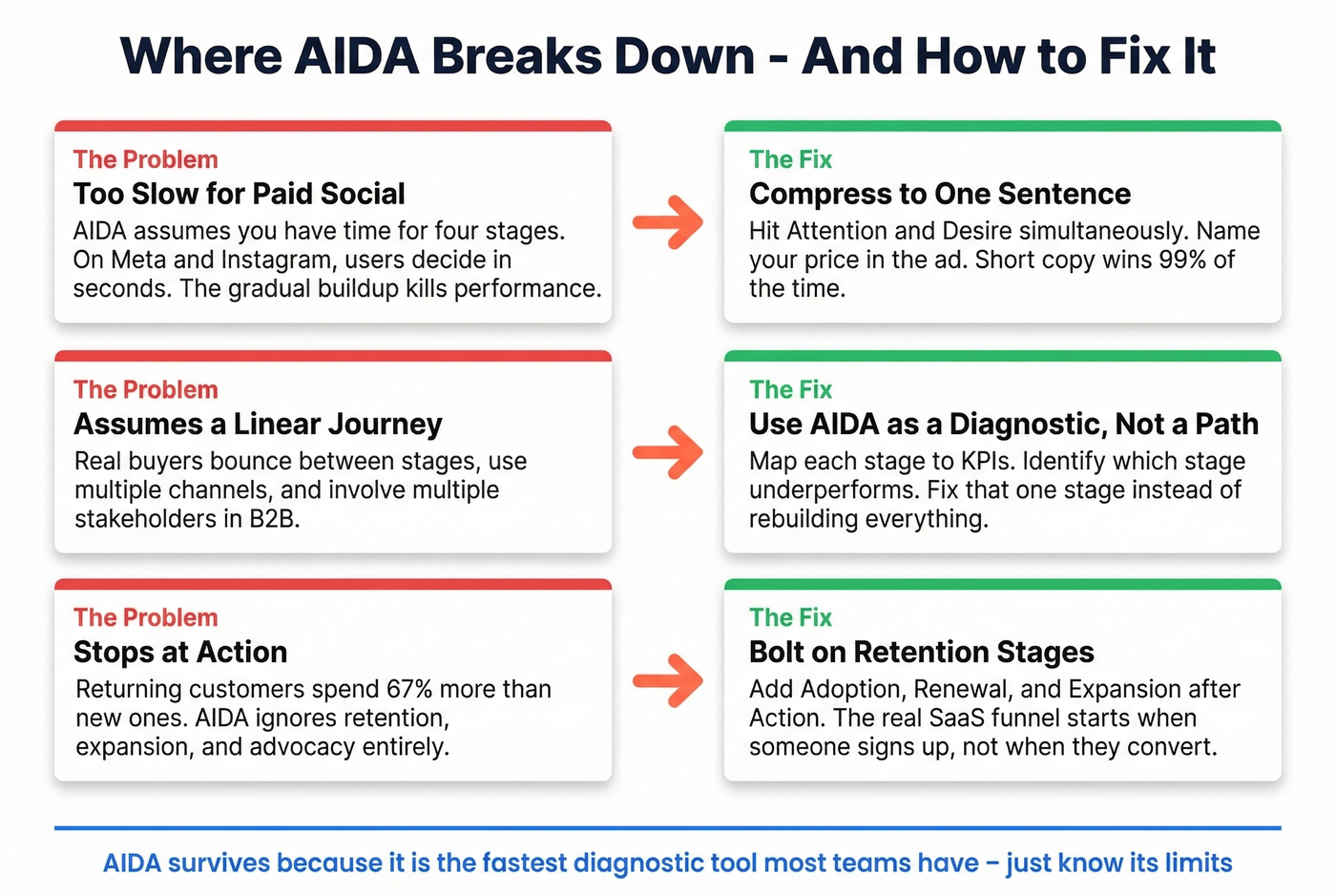
We covered this above, but it bears repeating. AIDA assumes you have time to walk the buyer through four stages. On Meta and Instagram, you don't. The framework works for email, landing pages, and long-form content. For paid social, treat it as a diagnostic lens, not a copywriting template.
Stage-Mismatched Messaging
80% of performance issues come from copy that doesn't match the buyer's stage. Using top-of-funnel hooks in bottom-of-funnel content raises your CPM and tanks your CTR. Using bottom-of-funnel urgency at the top scares people off.
The fix requires discipline: write distinct copy for each stage. Audit your existing content and tag every piece as Attention, Interest, Desire, or Action. You'll almost certainly find that most of your content clusters in one or two stages, leaving the others starved. If you need a practical way to structure stage-specific value, borrow the stage-by-stage approach from how to add value in sales.
Optimizing in Silos
This is the failure mode nobody talks about. Your paid team optimizes Attention metrics. Your content team optimizes Interest metrics. Your sales team optimizes Action metrics. Nobody owns the full funnel, so nobody notices that the Interest-to-Desire handoff is where 60% of prospects disappear.
60% of consumers take six or more actions before buying from a new brand - across multiple channels, multiple sessions, multiple devices. If each team optimizes their slice without seeing the full picture, you get a funnel that looks healthy stage-by-stage but leaks at every transition. Cross-channel attribution is the technical challenge, but the real problem is organizational: someone needs to own the entire AIDA framework end-to-end. This is where RevOps ownership and shared definitions matter.
Stops at Action
AIDA's biggest structural flaw: it treats the purchase as the finish line. For SaaS, Action is where the real funnel begins - onboarding, activation, expansion, renewal. Returning customers spend 67% more than new ones. 79% of leads fail to convert due to inadequate nurturing. If your funnel ends at Action, you're optimizing for acquisition while ignoring the revenue engine. If you're serious about post-purchase performance, track renewal rate and retention drivers alongside acquisition KPIs.
Bad data is the other silent funnel killer. You can nail every stage and still fail if you're targeting the wrong people or bouncing off stale emails. Skip this section if your bounce rate is already under 5% - but if it's not, fixing data quality will do more for your pipeline than rewriting a single email. Start by monitoring email bounce rate and tightening your list hygiene.
B2B vs B2C Differences
The AIDA framework applies to both B2B and B2C, but the stages behave differently.
| Dimension | B2B | B2C |
|---|---|---|
| Cycle length | Weeks to months | Minutes to days |
| Decision-makers | 3-10 stakeholders | Usually 1-2 |
| Desire drivers | ROI, case studies | Price, convenience |
| Retention lever | Account management | Loyalty programs |
| Content at Interest | Whitepapers, webinars | Reviews, comparisons |
95% of buyers consult online reviews before purchasing. Nearly 60% of B2B buyers make purchasing decisions before engaging a salesperson. That second stat is critical - it means your Interest and Desire stages have to do the selling before sales ever gets involved. If your case studies and comparison pages are weak, no amount of SDR outreach will compensate. This is also why a tight ideal customer profile and consistent lead scoring matter more in B2B than in B2C.
In B2C, the Attention-to-Action path can happen in a single session. In B2B, each stage takes weeks and involves different stakeholders. Your content needs to serve the researcher, the champion, and the economic buyer - often with different assets for each.
Beyond AIDA: Modern Frameworks
AIDA isn't the only option. Here's how the alternatives stack up:
| Framework | Core Idea | Best For | Limitation |
|---|---|---|---|
| Flywheel (HubSpot) | Customers as momentum | Retention-heavy SaaS | Weak on acquisition |
| McKinsey CDJ | Non-linear loop | Complex B2B, 5+ buyers | Hard to operationalize |
| Bow Tie Funnel | Mirrored post-purchase | SaaS expansion revenue | Requires mature ops |
| AARRR (Pirate Metrics) | Acquisition-to-Revenue loop | Product-led growth SaaS | Ignores pre-acquisition |
| AIDALA | AIDA + Loyalty + Advocacy | Full lifecycle marketing | Adds complexity |
| Forrester RaDaR | Reach/Depth/Relationship | Multi-channel strategy | Abstract for small teams |
Google's own framework - sometimes called ACID (Awareness, Consideration, Intent, Decision) - was built from analyzing 130 million transactions. Worth studying if you're running large-scale paid campaigns.
In our experience, the practical recommendation breaks down like this: use AIDA for single-channel campaigns and copywriting. Use the Flywheel for retention-heavy businesses where referrals drive growth. Use AARRR for product-led growth where activation and retention metrics matter more than marketing stages. Use the McKinsey CDJ for complex B2B deals with five or more stakeholders. Regardless of which framework you pick, measure every stage - because the framework is only as good as the data feeding it. To keep measurement consistent, standardize your funnel metrics across teams.
Your AIDA diagnosis is only as good as the contacts feeding it. When 300M+ verified profiles, 30+ filters for buyer intent, and $0.01/email fuel your pipeline, you can finally isolate which stage actually broke - instead of blaming targeting for a data quality problem.
Diagnose your funnel with data you can actually trust.
FAQ
Is the AIDA model still relevant in 2026?
Yes - as a diagnostic framework, not a rigid sequence. AIDA helps you identify which funnel stage leaks and where to focus resources. Compress it for paid social, extend it with retention stages for SaaS, and always pair it with stage-specific KPIs.
What's a good overall funnel conversion rate?
Most sales funnels convert between 3% and 10% end-to-end, with B2B SaaS averaging 2.3% visitor-to-lead. The biggest bottleneck is typically MQL-to-SQL at 13%, which maps to the Interest-to-Desire transition in AIDA terms.
How is AIDA different from TOFU/MOFU/BOFU?
They map directly: Attention equals TOFU, Interest and Desire equal MOFU, Action equals BOFU. TOFU/MOFU/BOFU is more common in content marketing; AIDA is more common in copywriting and advertising. Same concept, different labels.
What's the biggest AIDA funnel mistake?
Stage-mismatched messaging - using top-of-funnel hooks in bottom-of-funnel content, or vice versa. This raises costs and tanks conversion rates. Write distinct copy for each stage and audit existing content for alignment.
How do I keep outbound emails from bouncing?
Verify your contact data before every send. Stale emails bounce, killing deliverability and domain reputation. Tools like Prospeo verify emails in real time with 98% accuracy and refresh records every 7 days, keeping your list clean as people change roles.