

How to Add Value in Sales (Not Just Talk About It)
"Add value to your prospects." Every sales manager, every enablement deck drops this phrase like it's actionable advice. It's not. As one frustrated rep put it on r/sales, nobody makes it clear how to actually add value in sales - especially when you're trying to book a meeting without sounding like a pest.
The numbers explain the gap. Only 34% of salespeople demonstrate proficiency in selling value beyond price. Just 19% of companies have formally adopted value selling. Meanwhile, 61% of sellers missed quota last year. What follows is a stage-by-stage playbook for closing that gap - with talk tracks you can steal today.
What "Value Creation" Actually Means
TheSalesBlog's framework breaks value into a hierarchy worth internalizing.
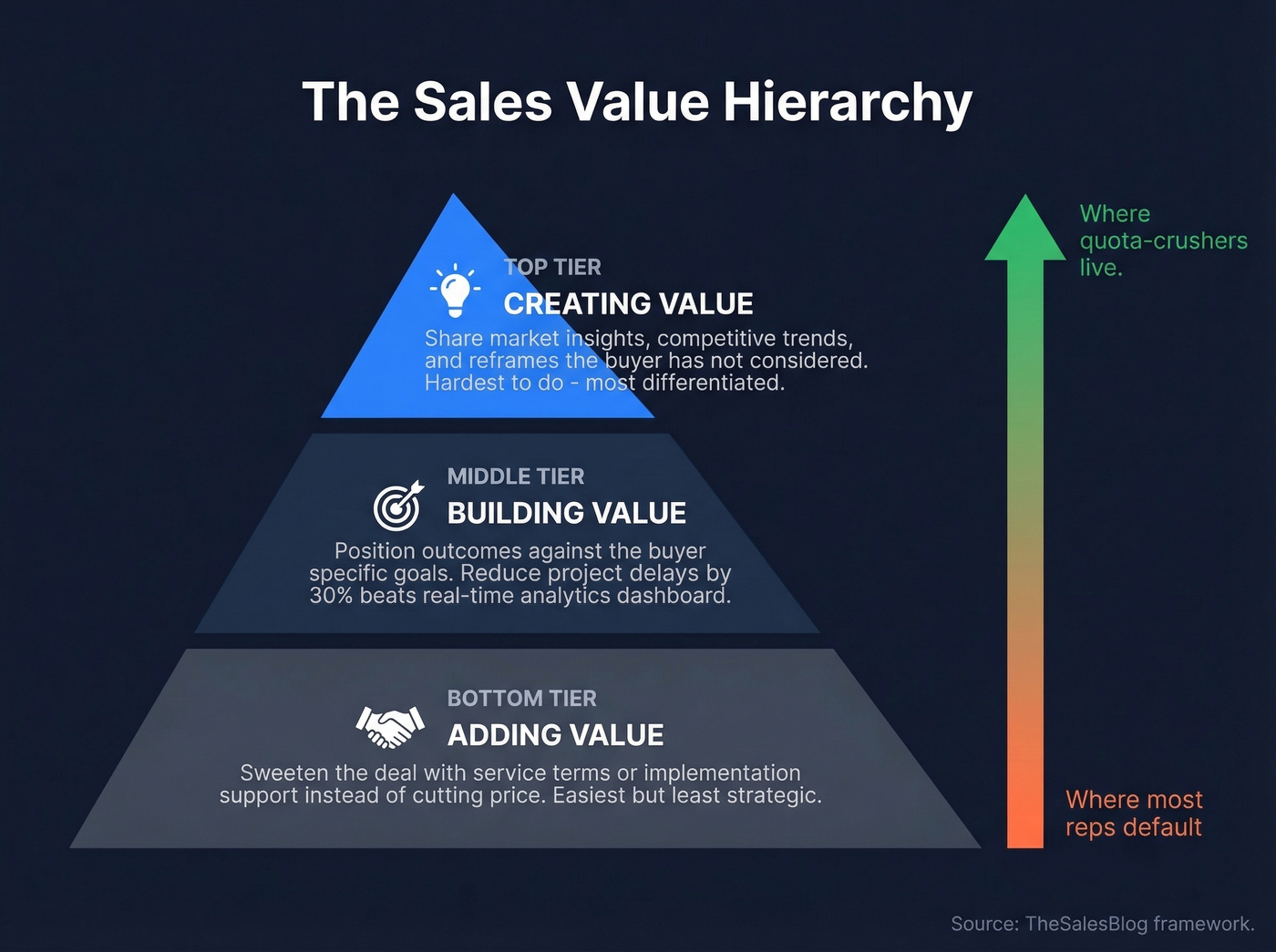
Creating value happens inside the sales conversation itself. You share a market insight, a competitive trend, or a reframe the buyer hadn't considered. This is the hardest type and the most differentiated.
Building value is positioning outcomes against the buyer's specific goals. "Reduce project delays by 30%" beats "real-time analytics dashboard" almost every time.
Adding value is the negotiation layer - sweetening the deal with service terms or implementation support instead of cutting price. Important, but the least strategic of the three.
Most reps default to the negotiation layer because it's the easiest. The real competitive advantage lives in creating and building value - generating insight, not just concessions. That's what separates quota-crushers from everyone else.
How to Deliver Value at Every Deal Stage
Providing Value in Outreach
75% of B2B buyers told Gartner they'd prefer a seller-free buying experience. Your outreach has to earn attention with insight, not just ask for time.
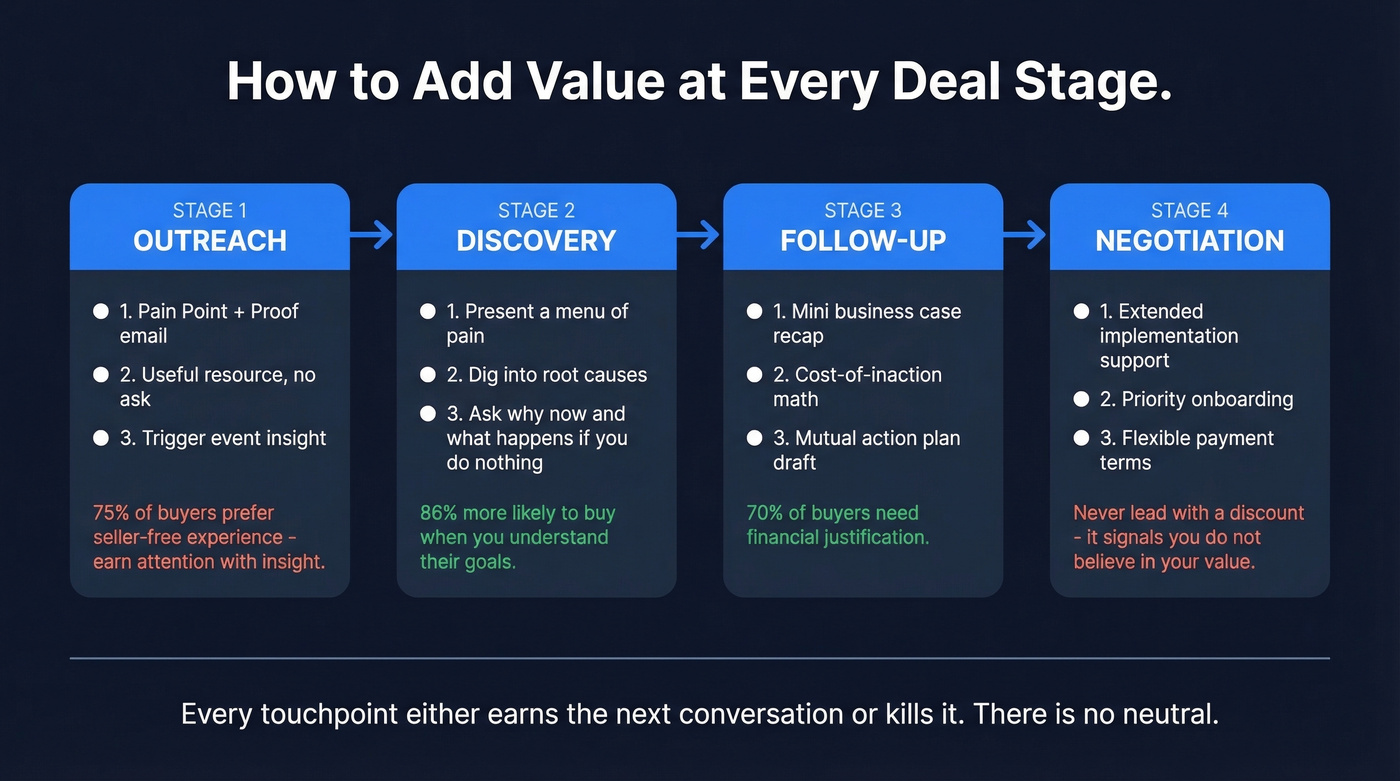
Three cold email structures that work:
Pain Point + Proof: Lead with a specific pain your ICP faces, then link to a case study. "Teams running [process] typically lose X hours/week to [pain]. Here's how [company] cut that by 40%."
Useful Resource: Give something genuinely helpful - a benchmark report, a teardown of their current approach. No ask in the first email. Just value. (If you need a tighter system, borrow from proven sales prospecting techniques.)
Trigger Event: Reference a funding round or leadership change. Flag a likely pitfall. "Congrats on the Series B - teams scaling from 20 to 50 reps usually hit [specific problem] around month 3." (This gets easier when you're identifying buying signals consistently.)
Of course, a value-packed cold email is worthless if it bounces. Prospeo verifies emails in real time with 98% accuracy across 143M+ verified addresses, so your carefully crafted outreach actually lands in the inbox. If deliverability is a recurring issue, start with an email deliverability guide and track your email bounce rate.
During Discovery
Discovery is where you can create the most value, and most reps blow it by jumping to their pitch too early. The UserGems framework offers a clean structure: present a "menu of pain" with three common challenges peers face, dig into root causes with open-ended questions, then close with transparency-encouraging prompts to clarify intent. Tailor your questions by seniority - executives care about strategic outcomes while managers care about operational friction. (For a deeper bank, use these discovery questions.)
We've watched reps lose six-figure deals by skipping this step. Your question bank should include these, pulled from a thread on r/sales:
- "Why now? What changed?"
- "Walk me through how you're doing this today."
- "Who feels the pain most acutely?"
- "What happens if you don't solve it - could you live with it?"
That last question is gold. 86% of buyers are more likely to purchase when sellers understand their goals. These questions prove you do. Providing value isn't just about sharing information - it's proof that you've done the work to understand their world, and that builds trust faster than any feature demo ever will.
Value-Driven Follow-Up
Here's the thing: everyone hates the "just checking in" email. Reddit threads are full of reps asking how to follow up without sounding pointless. The answer is simple - never follow up empty-handed. Every touch should deliver one of these:
- Mini business case recap - quantify the cost of their current problem using numbers from discovery
- Relevant benchmark - a data point from their industry that reframes urgency
- Cost-of-inaction math - "Based on what you shared, staying on the current path costs roughly $X/quarter"
- Mutual action plan draft - a timeline showing implementation, sent unprompted
- Competitive intel - something they'd forward to their boss (this is where a solid competitive intelligence strategy pays off)
70% of B2B buyers need financial justification for confident purchase decisions. Your follow-ups should build that justification for them. In our experience, the reps who pair strong follow-up content with accurate contact data - knowing they're reaching the right person at the right time - consistently outperform those who spray generic check-ins across a stale list. If you want plug-and-play copy, keep sales follow-up templates handy.
During Negotiation
When the buyer pushes on price, resist the discount reflex. Discounting signals you don't believe in your own value.
Sweeten with non-price concessions instead: extended implementation support, priority onboarding, additional training seats, flexible payment terms, or early access to a roadmap feature. These usually cost you less than a discount and often matter more to the buyer. The goal is to deliver outcomes, not price cuts. (If you need a framework, use an anchor in negotiation to protect value.)

You just learned how to craft outreach that earns attention with insight instead of begging for time. But even the best value-driven cold email is worthless if it hits an invalid address. Prospeo delivers 98% email accuracy across 143M+ verified addresses - refreshed every 7 days - so your carefully researched, insight-loaded messages actually reach the decision-maker.
Stop losing value-packed outreach to bad data. Verify before you send.
Mistakes That Kill Deal Value
These patterns tank deals. Let's be honest - we've seen every one of them in the wild.
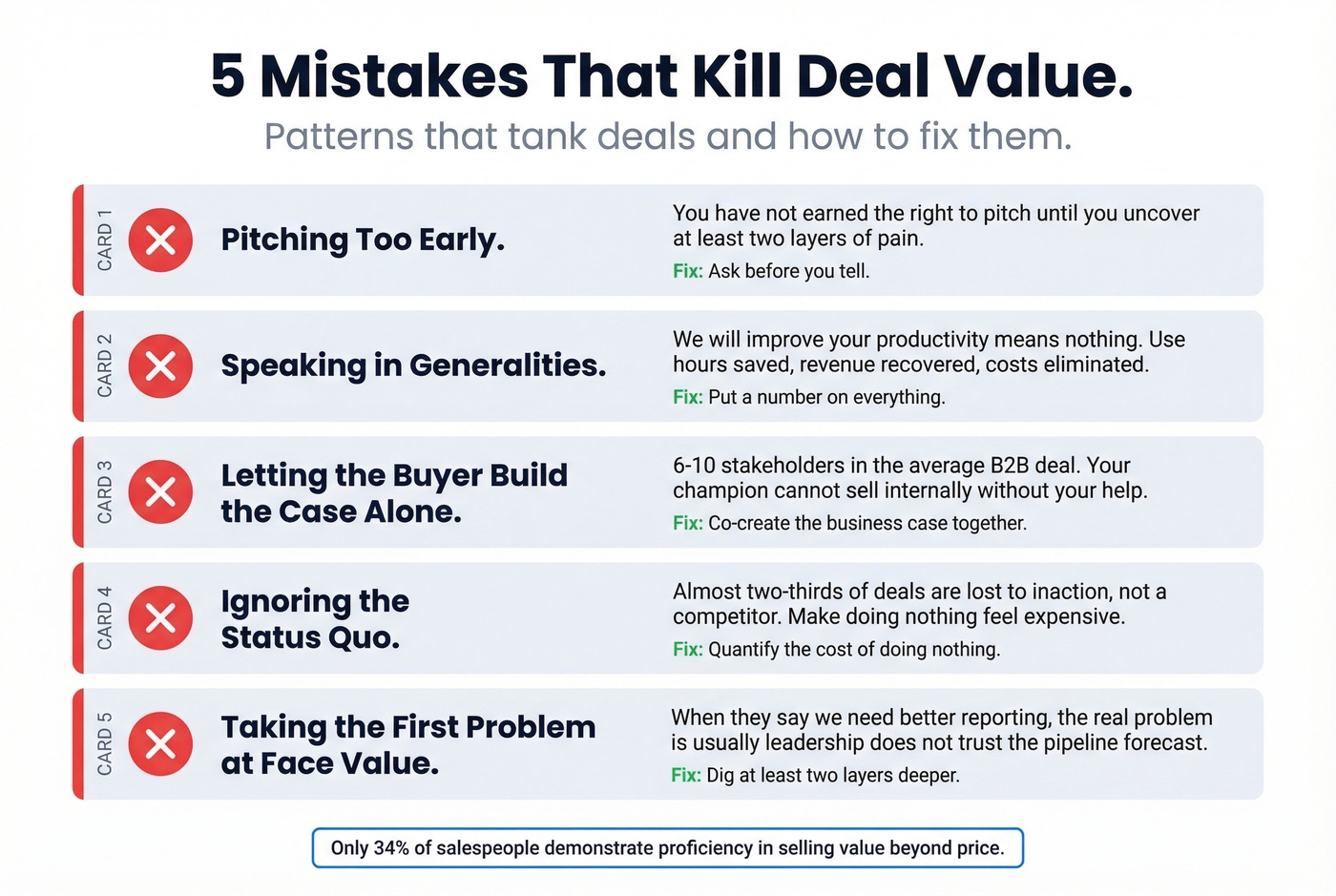
1. Pitching too early. You haven't earned the right to talk about your solution until you've uncovered at least two layers of pain. Redirect: "Before I walk through how we'd help, I want to make sure I understand what's actually driving this."
2. Speaking in generalities. "We'll improve your productivity" means nothing. Translate everything into hours saved, revenue recovered, costs eliminated. If you can't put a number on it, you haven't done enough discovery. (This is also where data-driven selling separates top reps.)
3. Letting the buyer build the business case alone. With 6-10 stakeholders involved in the average B2B purchase, your champion can't sell internally without help. Co-create the business case with them - give them the slides, the ROI calculator, the one-pager they can forward to finance.
4. Ignoring the status quo. Almost two-thirds of deals aren't lost to a competitor. They're lost to inaction. Quantify the cost of doing nothing. Make the status quo feel expensive.
5. Taking the first problem at face value. The first pain a buyer mentions is rarely the real one. When they say "we need better reporting," the actual problem is usually that leadership doesn't trust the pipeline forecast. Dig deeper.
When price comes up too early, try this redirect from Neil Thubron: "Happy to discuss price - but it'll only make sense in the context of the outcomes we're trying to drive. Let's nail those down first."
The Insight Selling Edge
The Challenger methodology, born from a study of 6,000 sales professionals, boils down to three moves: Teach, Tailor, Take Control. The core idea is the reframe - you make the customer see a problem they didn't know they had, tailor that insight to their situation, and lead them toward a decision.
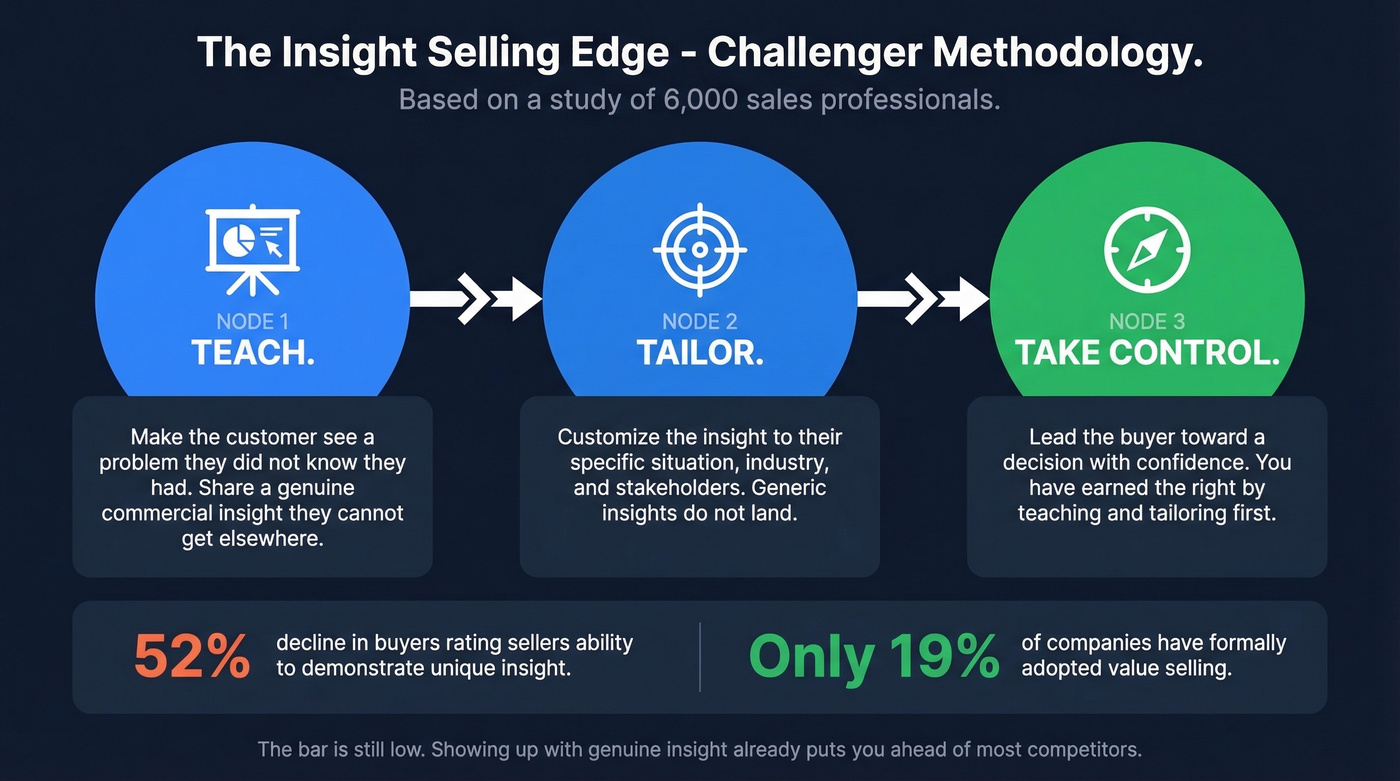
Even back in 2020, buyers rated sellers' ability to demonstrate unique insight down 52%. The bar is still low. Showing up with a genuine commercial insight already puts you ahead of most competitors. This is how to add value in B2B sales at the highest level - by teaching buyers something they couldn't learn on their own.
Skip this approach if your product is truly commoditized and price is the only differentiator. But if you're selling anything with implementation complexity, a multi-stakeholder buying committee, or a long sales cycle, insight selling isn't optional. It's the whole game.
Stop Being Generic
Look, most reps don't need better closing skills - they need better opening skills. The reps hitting quota in 2026 aren't the ones with the best pitch decks. They're the ones delivering insights their buyer can't get elsewhere, quantifying impact through business cases the CFO can actually approve, and making sure every message reaches the right person in the first place. Every touchpoint either earns the next conversation or kills it. There's no neutral. (If you want more scripts, keep a swipe file of talk track examples.)
With 6-10 stakeholders in every B2B deal, you need direct access to every buyer - not just your champion. Prospeo gives you 125M+ verified mobile numbers with a 30% pickup rate and 30+ filters including buyer intent, job changes, and department headcount so you can reach the right people with the right value message at the right time.
Reach every stakeholder in the deal - not just the one who replied.