

7 Talk Track Examples That Actually Sound Like Conversations
The best rep on your team says the same thing on every call. The opener, the pivot, the objection response - nearly identical each time. Yet it sounds completely natural. That's not talent. That's a talk track done right, and below are seven you can steal today.
What You Actually Need
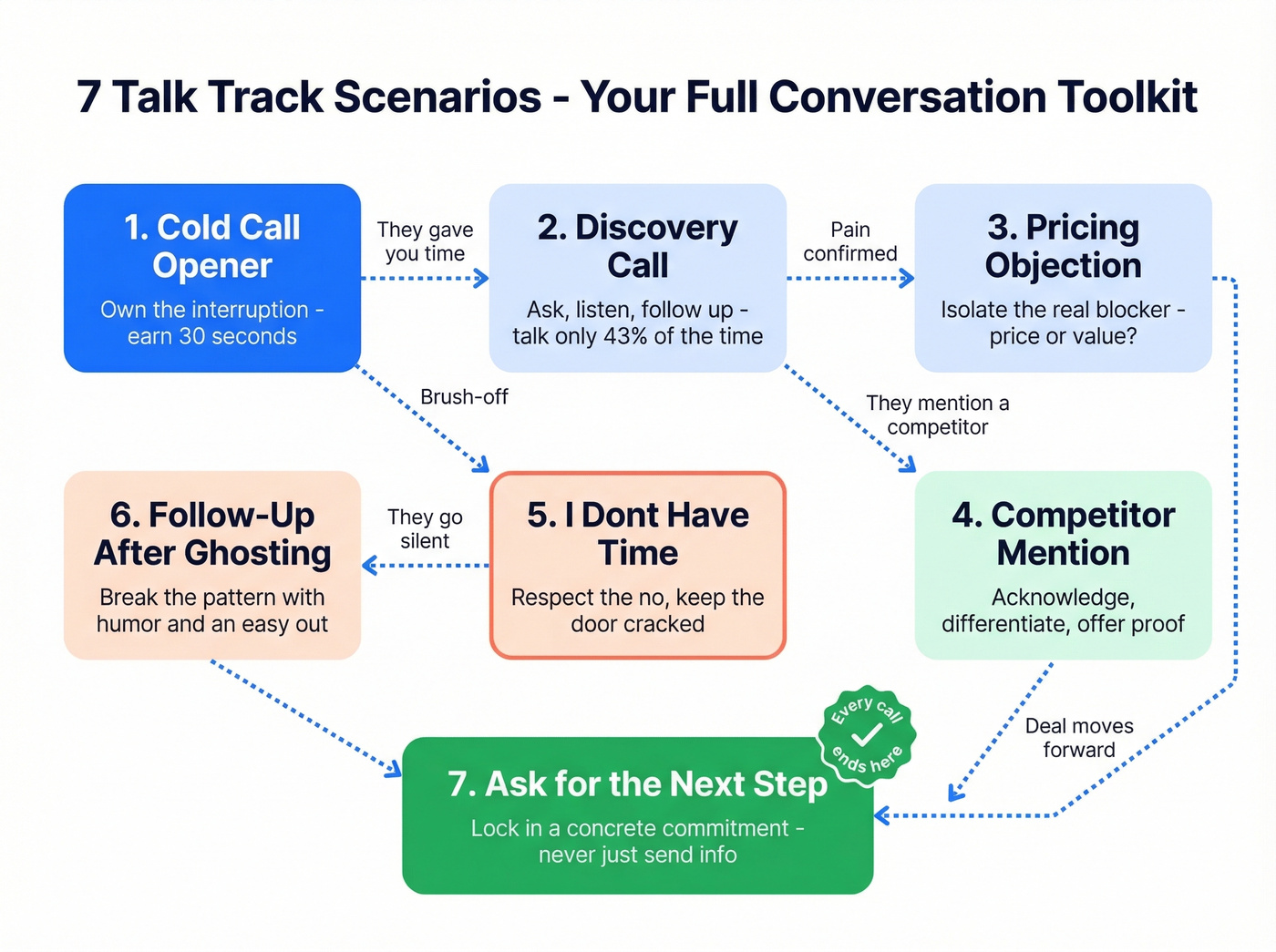
Seven modular blocks that cover 90% of sales conversations: cold call opener, discovery, pricing objection, competitor mention, brush-off, follow-up after ghosting, and next-step commitment. Copy the examples below, swap in your product details, and practice until they sound like you.
A talk track is a flexible conversational framework - not a script you read verbatim, not a battlecard you pull up mid-call. It's the skeleton of what to say, with enough room to sound human.
Talk Track vs Script vs Battlecard
| Talk Track | Script | Battlecard | |
|---|---|---|---|
| What it is | Modular key points + questions | Word-for-word language | Competitive intel sheet |
| When to use | Any live conversation | New rep onboarding | Competitor comes up |
| Format | Flexible framework | Verbatim text | Quick-reference card |
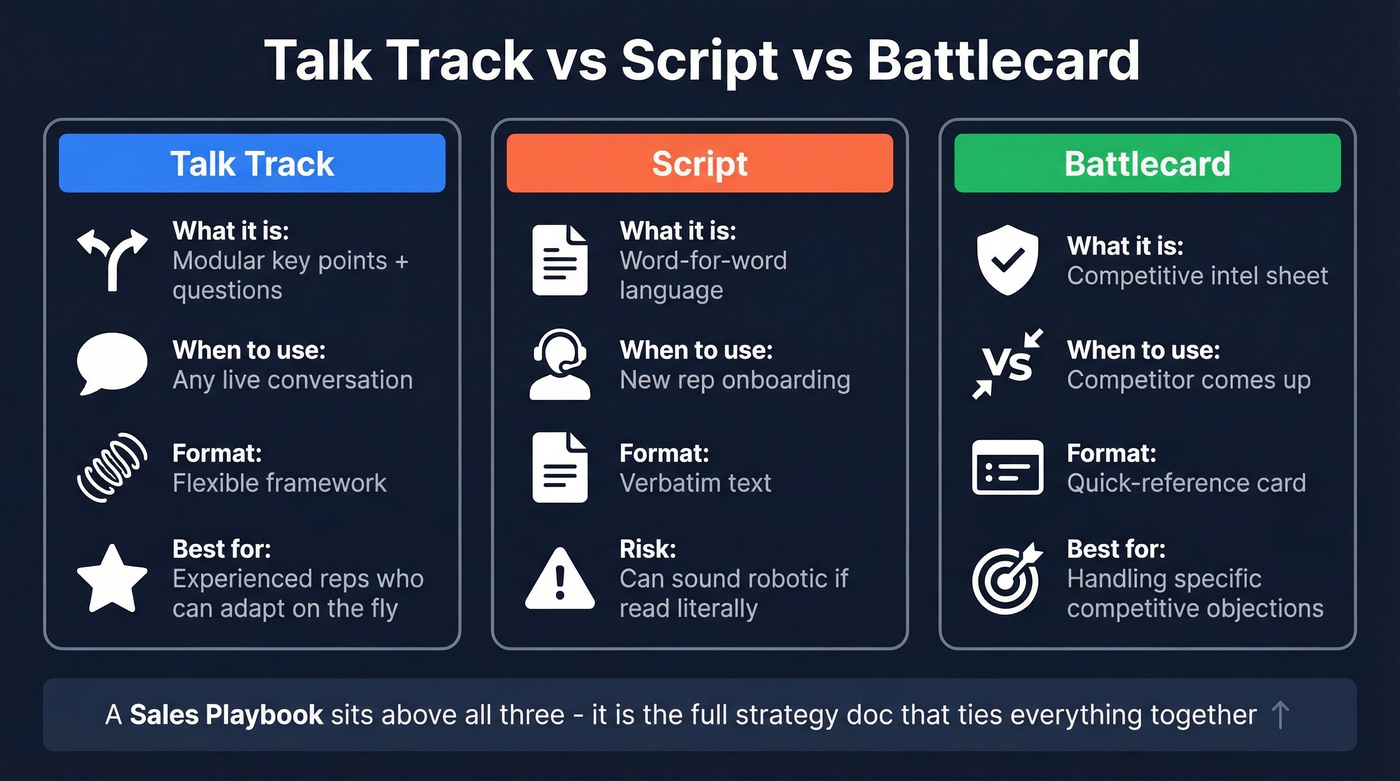
A sales playbook sits above all three - it's the full strategy doc that includes your conversational frameworks, scripts, battlecards, and process.
7 Sales Talk Track Examples by Scenario
Each example is copy-ready. Steal the language, swap in your details, and practice out loud three times before your next call.
1. Cold Call Opener
"I know you weren't expecting my call, and I promise to be brief. Can I get 30 seconds to see if this is worth your time?"
Keep this under 30 seconds. Owning the interruption earns permission to continue instead of triggering the defensive "who is this?" reflex. The 30-second framing feels low-risk - it's a micro-commitment, not a meeting request. This is one of the most reliable outbound openers we've seen because it disarms resistance before it builds.
2. Discovery Call
"What's your team doing today to [solve X]? ... What happens when that breaks?"
Spend 3-5 minutes here. This is where deals are won or lost. Top-closing B2B reps talk just 43% of the time compared to 65% for average performers. That gap is almost entirely discovery. Follow up with "walk me through the last time that happened" to get specific pain, not hypothetical pain.
3. Pricing Objection
"Help me understand - at what price would you purchase this? ... If I could get you to $XYZ, would we have a deal today?"
This virtual close technique isolates whether price is the real blocker or a smokescreen. If they give you a number, you're negotiating. If they can't, the objection is about value, timing, or authority - and discounting won't fix any of those.
4. Competitor Mention
Don't do this: "Oh, [Competitor]? They're terrible at X, Y, and Z."
Do this: "Good - [Competitor] is solid for [X]. Where we're different is [Y]. Want me to show you a side-by-side?"
Acknowledging competitors builds credibility. 57% of the buying journey is complete before a prospect talks to you. They already did their research. Meet them where they are.
5. "I Don't Have Time"
"Totally fair - can I get 30 seconds to see if this is worth a 10-minute call next week?"
This is the most common brush-off in cold calling. Most reps either push harder or give up entirely. This response respects the "no" while keeping the door cracked. You're asking for permission to earn time later, not demanding it now.
6. Follow-Up After Ghosting
"I sent a couple of notes - no response tells me one of three things: timing's off, it's not a priority, or you're being chased by a bear. If it's 1 or 2, mind telling me which?"
"Just checking in" signals you have nothing new to say. This version uses light humor to break the pattern and gives the prospect an easy out. They can literally just type "1." If you need more reply-getting language, borrow a few sales follow-up templates and adapt them to your voice.
7. Asking for the Next Step
"Based on what you've shared, [specific next step] makes sense. Can we lock in [day/time]?"
"I'll send some info" is where deals go to die. Every call should end with a concrete commitment - a calendar invite, a demo date, an intro to another stakeholder. Name the specific next step based on what they told you, not a generic "let's circle back." (If you want a tighter close, map it to the steps to close a sale.)
Before & After: Fixing a Pitchy Framework
A real SDR posted their HubSpot CRM talk track on r/sales and diagnosed their own problem: "always too pitchy/salesy" and "too product heavy."
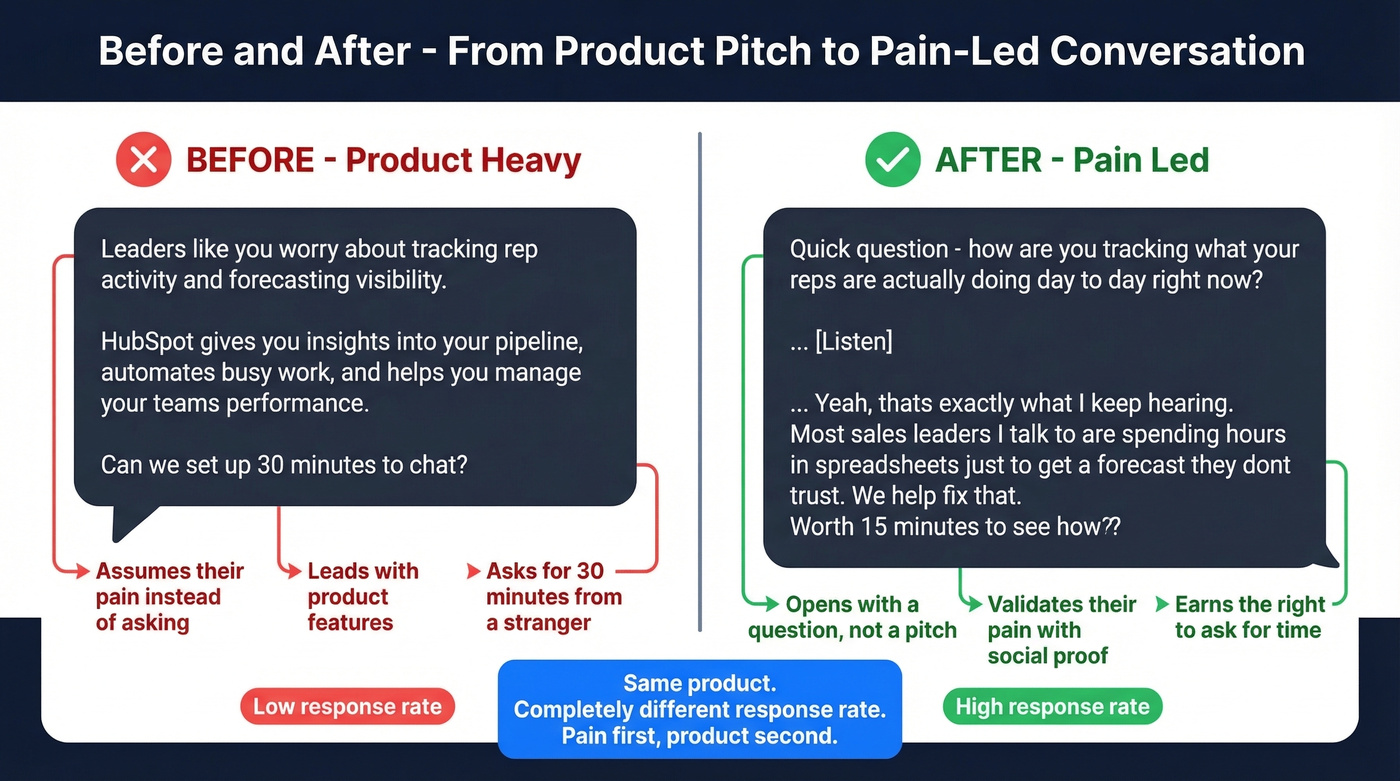
Before (product-heavy):
"Leaders like you worry about tracking rep activity and forecasting visibility. HubSpot gives you insights into your pipeline, automates busy work, and helps you manage your team's performance. Can we set up 30 minutes to chat?"
After (pain-led):
"Quick question - how are you tracking what your reps are actually doing day-to-day right now? ... [Listen] ... Yeah, that's exactly what I keep hearing. Most sales leaders I talk to are spending hours in spreadsheets just to get a forecast they don't trust. We help fix that. Worth 15 minutes to see how?"
Same product, completely different response rate. The "before" leads with the product. The "after" leads with the prospect's pain and earns the right to pitch. Pain first, product second - that principle applies to every scenario above.

A perfect talk track means nothing if you're calling the wrong number. Prospeo gives you 125M+ verified mobile numbers with a 30% pickup rate - so your cold call opener actually reaches a decision-maker, not a dead line.
Stop rehearsing scripts for voicemails nobody checks.
Why Structured Conversations Close More
Here's the thing: most sales teams don't have a closing problem. They have a structure problem. Structured sales calls that hit specific talking points convert 27% better than unstructured calls, and new reps ramp to productivity 39% faster when equipped with proven frameworks. In our experience, the teams that document their top performer's approach and make it the default starting point see the biggest jumps in consistency across the board.
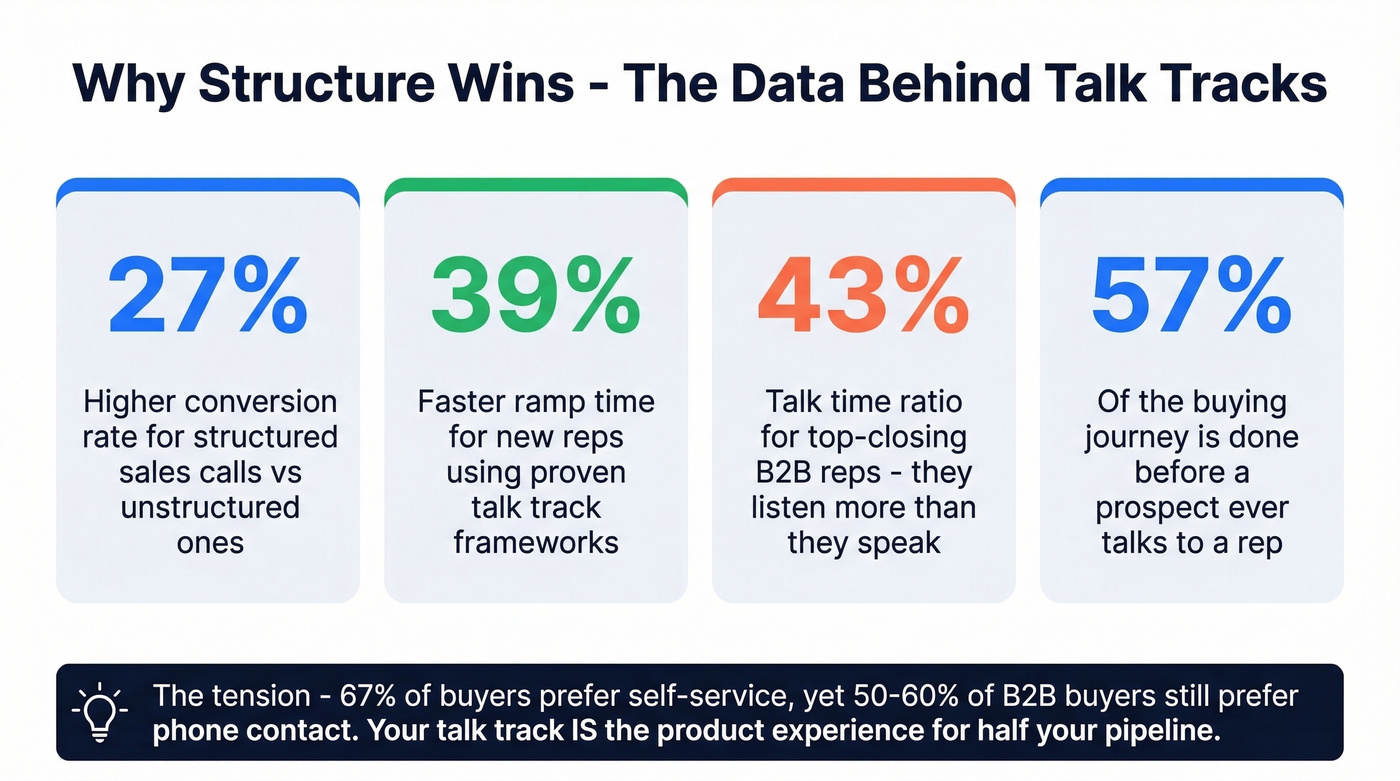
The data creates an interesting tension, though. 67% of customers now prefer self-service over talking to a rep, yet 50-60% of B2B buyers still prefer phone contact during the sales process. Your talk track is the product experience for half your pipeline - it needs to add value fast, not recap what they already know from your website.
How Top Producers Differ
Study the top producers on any sales floor and you'll notice a pattern: they spend less time pitching and more time asking layered follow-up questions. They treat each of the seven blocks above as a conversation starter, not a monologue. They also adapt their pacing - slowing down during discovery and speeding up during the close - which is something no written framework can fully capture.
Record your best reps. Transcribe the calls. You'll find the real-world examples worth cloning.
Tools for Building and Measuring
Fathom is free and records calls with AI summaries - great for spotting which conversational blocks land. Grain offers free team plans for collaborative call review. For enterprise conversation intelligence, Gong runs roughly $1,600/user/year plus a $50K platform fee - serious money, but it shows exactly where reps deviate and how that affects outcomes.
Let's be honest, though: your talk track is only as good as your prospect list. If a third of your dials go to disconnected numbers, your opener never gets heard. We've found that verifying contact data before outreach - using a tool like Prospeo, which refreshes its 125M+ verified mobile numbers every 7 days - makes the difference between a productive calling block and an afternoon of voicemails. If you're rebuilding your outbound motion, start with a simple cold calling system and layer talk tracks on top.
You just built a killer talk track. Now you need a list worth calling. Prospeo's 300M+ profiles with 30+ filters - buyer intent, job changes, tech stack - let you target prospects who already have the pain your framework addresses. At $0.01 per email, bad data is no longer an excuse.
Pair your new talk track with contacts that actually pick up.
Talk Track Examples FAQ
What's the difference between a talk track and a sales script?
A talk track is a flexible framework of key points you adapt in real time; a script is verbatim language read word-for-word. Reps using talk tracks sound natural and can pivot mid-conversation, while scripted reps often sound robotic and lose prospects at the first unexpected question.
How many talk tracks does a rep need?
Seven modular blocks cover 90%+ of outbound scenarios - cold open, discovery, pricing objection, competitor mention, brush-off, ghosting follow-up, and next-step close. Remix them by swapping variables for industry, buyer role, and pain point to create vertical-specific variations.
Does contact quality affect talk track performance?
Absolutely. The best opener in the world fails on a wrong number. Verifying contact data before outreach - checking that emails are valid and mobile numbers are live - ensures your carefully practiced framework reaches the right person on a live line.
Where can I find more real-world examples?
Record your top performers, transcribe the calls, and extract the patterns. Those real-world conversations are the best source of proven talk track examples you can adapt. Supplement with the seven scenarios in this article, then build variations for each vertical you sell into.