

7 Steps to Close a Sale (Backed by 1M+ Analyzed Calls)
An analysis of [1,000,000+ sales call recordings](https://openviewpartners.com/blog/closing-techniques-in-sales-are-dead/) found something uncomfortable: across 42,945 closing calls, rep behavior on winning calls looked nearly identical to rep behavior on losing calls. Same talk-to-listen ratio. Same number of questions. Same interactivity. Closing techniques didn't separate winners from losers - what happened before the close did.
Most closing guides list 12 techniques and zero data. Here are the seven steps to close a sale that actually move deals to closed-won:
- Qualify ruthlessly
- Run deep discovery
- Demonstrate value to their pain
- Validate with proof
- Align every stakeholder
- Handle objections by category
- Ask for the business
The single highest-leverage move? Build a Mutual Action Plan for every complex deal, especially those with six-figure contract values. It forces accountability on both sides and kills the "we'll get back to you" death spiral.
Why Most Deals Stall
Deals don't die from rejection. They die from indecision.
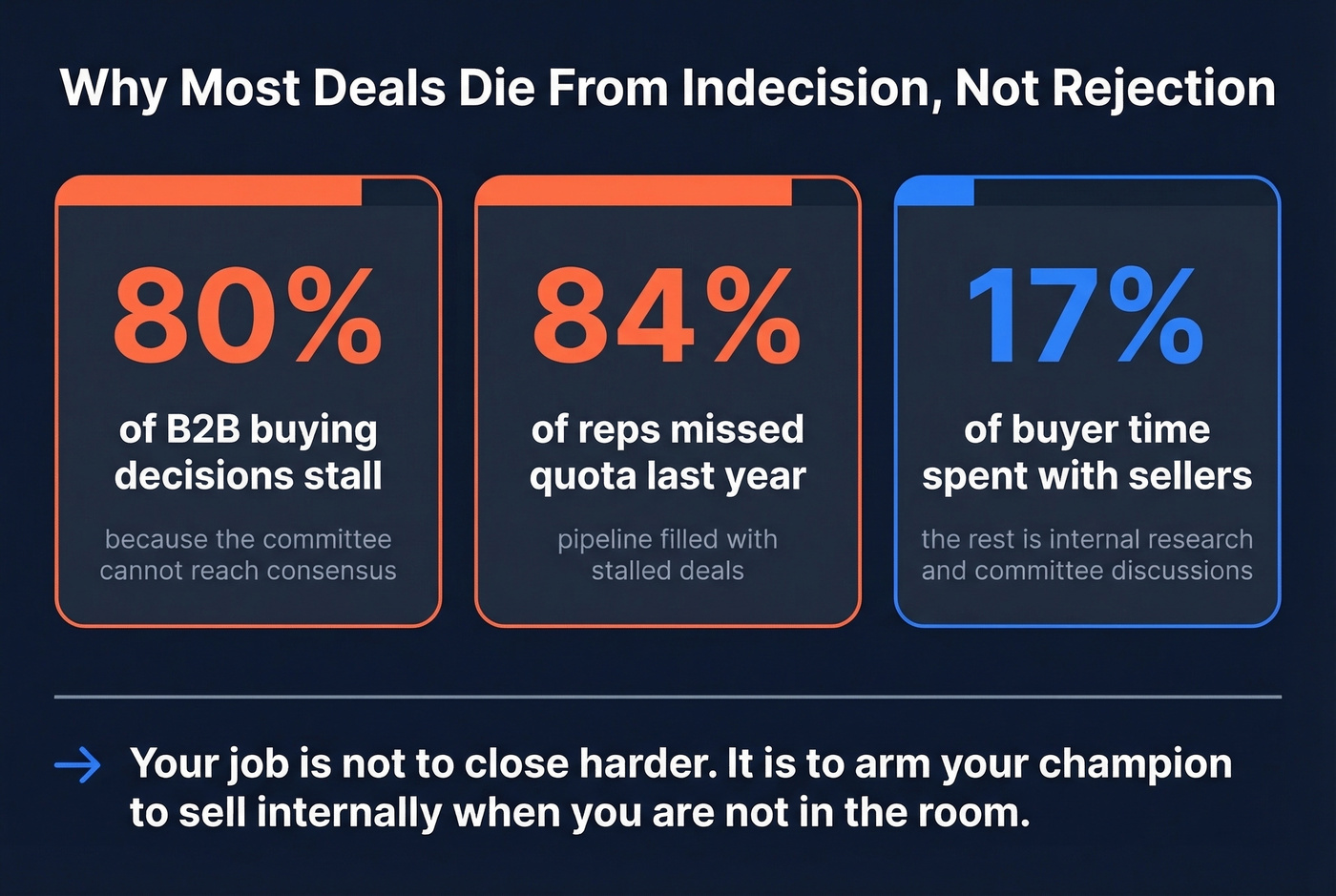
Nearly 80% of B2B buying decisions stall because the buying committee can't reach consensus - not because someone said no. The average buying committee now runs 6-11 stakeholders, and 84% of reps missed quota last year. Buyers spend only 17% of their buying time meeting with suppliers. Two-thirds of the process is digital now - internal research, committee discussions, vendor comparisons you'll never see.
Your job isn't to "close harder." It's to arm your champion with everything they need to sell internally when you're not in the room.
How to Close a Sale in 7 Steps
Step 1: Qualify Ruthlessly
Use this step when the prospect has a defined problem, budget authority, a real timeline, and a buying process they can articulate. If you're keeping a deal alive because the prospect was friendly on the first call, stop. Friendliness isn't intent.
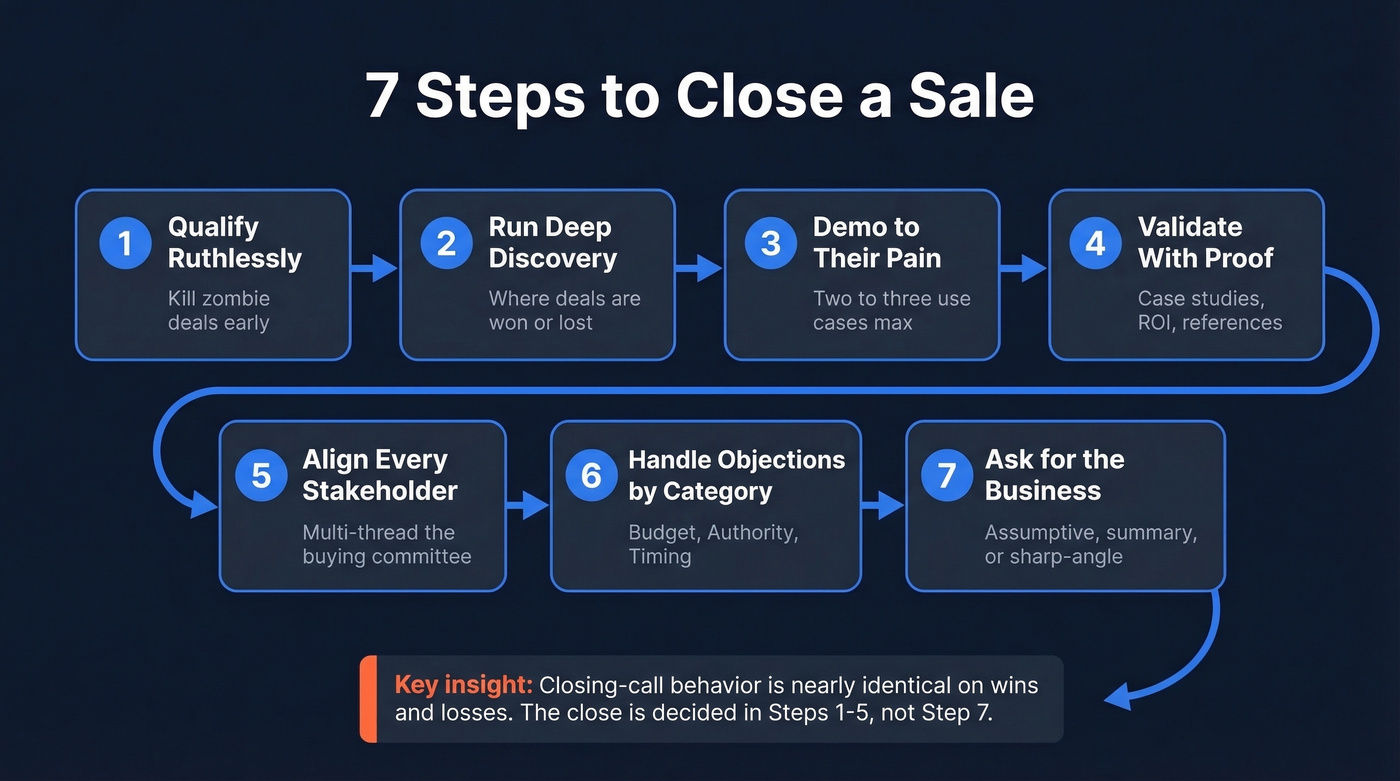
Failing to qualify leads is one of the most common sales mistakes - it wastes pipeline and distorts forecasting. Run BANT on every opportunity. Disqualify fast. We've seen teams cut their average cycle length by weeks just by killing zombie deals earlier.
Step 2: Run Deep Discovery
This is where deals are won or lost. Every sales leader we've talked to says the same thing - the close is decided in discovery, not in the final pitch. Your discovery call should cover:
- What's the business problem costing them today?
- How do they make purchasing decisions?
- What does their evaluation timeline look like?
- What have they already tried?
The "how do they decide?" question is the one most reps skip, and it's the one that matters most. The same 1M-call analysis found that discussing competitors early improves win likelihood - waiting until the close to address competition correlates with losses. Surface competitive concerns here, not later.
Step 3: Demonstrate Value to Their Pain
Buyers don't care about your feature list. They care about two or three use cases tied directly to the pain they described in discovery. Focus your demo on those and nothing else.
Here's the thing: feature dumps are how you lose a room. We've watched reps burn 40 minutes walking through capabilities nobody asked about, only to run out of time before covering the one thing the prospect actually needed to see. Match your demo to their words from discovery - literally use their language back to them.
Step 4: Validate With Proof
On winning closing calls in the 1M-call study, buyers raised "pre-purchase jitters" - implementation plans, SLAs, customer success support. That's a buying signal. It means they're mentally past "should we buy?" and into "how do we make this work?"
Have your proof ready before they ask: a relevant case study, a concrete ROI number, a reference customer. Your champion needs these for the internal meetings you're not invited to. If you don't hand them ammunition, they'll walk into that room empty-handed, and your deal will stall.
Step 5: Align Every Stakeholder
We've all had the deal that's been "almost closed" for six weeks. That's a multi-threading failure. Engaging multiple stakeholders in the same account lifts win rates by up to 130%. Single-threading is the silent killer of enterprise deals.
Build a stakeholder map early: economic buyer, technical buyer, influencers, blockers. Multi-threading requires verified contact data for the full buying committee - you can't engage people you can't reach. Prospeo finds verified emails and mobile numbers across entire accounts with 98% email accuracy and 125M+ verified mobiles, so you're not guessing at email formats or dialing switchboards.
Step 6: Handle Objections by Category
Organize rebuttals by BANT category so reps aren't improvising under pressure:
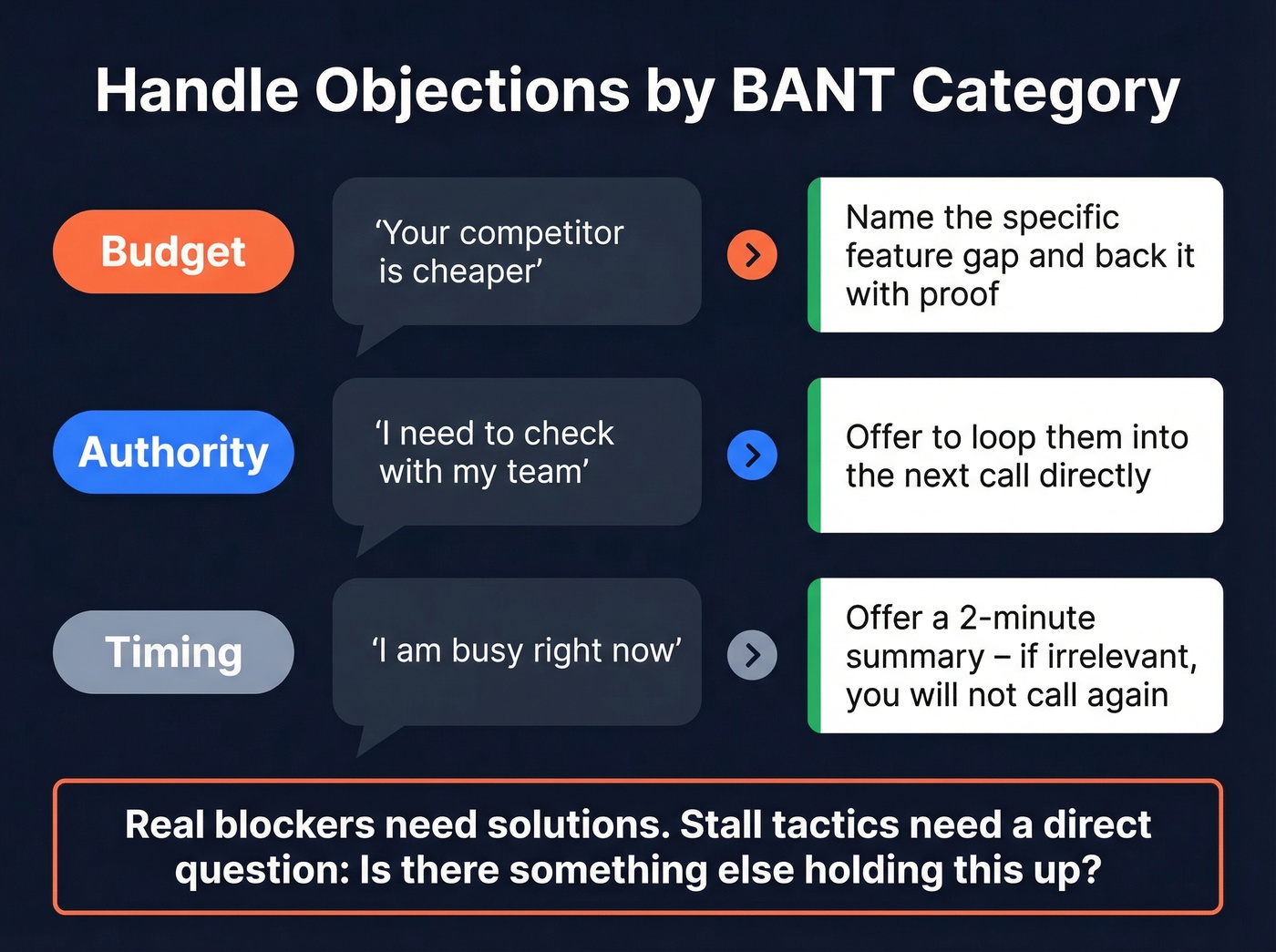
- Budget - "Your competitor is cheaper." Name the specific feature gap and back it with proof.
- Authority - "I need to check with my team." Offer to loop them into the next call directly.
- Timing - "I'm busy right now." Offer a 2-minute summary; if it's irrelevant, you won't call again.
The goal isn't to "overcome" objections. It's to categorize them so you know whether you're facing a real blocker or a stall tactic. Real blockers need solutions. Stall tactics need a direct question: "Is there something else holding this up?"
Step 7: Ask for the Business
Assumptive close for warm deals: "I'll send the agreement this afternoon." Summary close for complex deals: recap every agreed-upon pain point, solution, and ROI figure, then ask for commitment. Sharp-angle close for negotiation-heavy deals: "If I get you that concession, can we sign this week?"
In our experience, the summary close wins most often for multi-stakeholder deals because it reminds everyone in the room why they started this process in the first place. Whatever technique you use, schedule the next step while you're still on the call. Don't end with "I'll follow up next week." End with a calendar invite.

Step 5 fails without verified contact data. Multi-threading lifts win rates 130%, but only if you can actually reach every stakeholder. Prospeo gives you 98% accurate emails and 125M+ verified mobile numbers across entire accounts - so you engage the full buying committee, not just your one champion.
Stop single-threading deals because you can't find the other buyers.
Buying Signals Checklist
- Active: Asking about pricing, requesting a demo, comparing you to competitors, asking about implementation timelines
- Passive: Visiting your pricing page repeatedly, downloading case studies, requesting proposals
- Emotional: Expressing enthusiasm about a feature, using urgency language, raising concerns about switching costs
Close Rate Benchmarks in 2026
The average B2B win rate sits around 21%. That number varies wildly by industry:
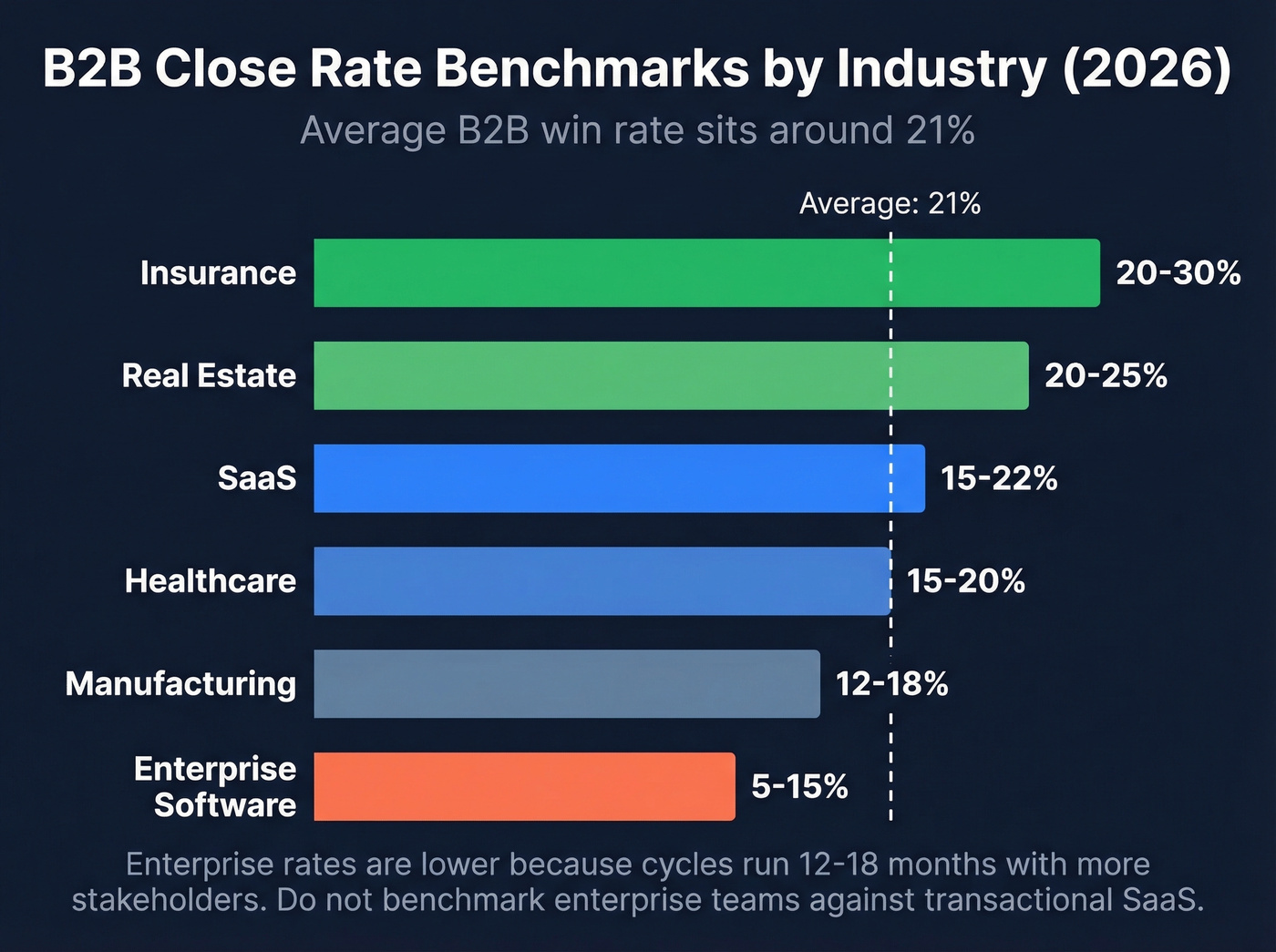
| Industry | Close Rate |
|---|---|
| Insurance | 20-30% |
| Real estate | 20-25% |
| SaaS | 15-22% |
| Healthcare | 15-20% |
| Manufacturing | 12-18% |
| Enterprise software | 5-15% |
Enterprise rates are lower because cycles run 12-18 months and involve more stakeholders. Don't benchmark your enterprise team against a transactional SaaS motion - they're different sports entirely.
Mistakes That Kill Deals
Talking more than listening. If you're talking more than you're listening on discovery, you're pitching - not learning. This one mistake cascades through every step that follows.
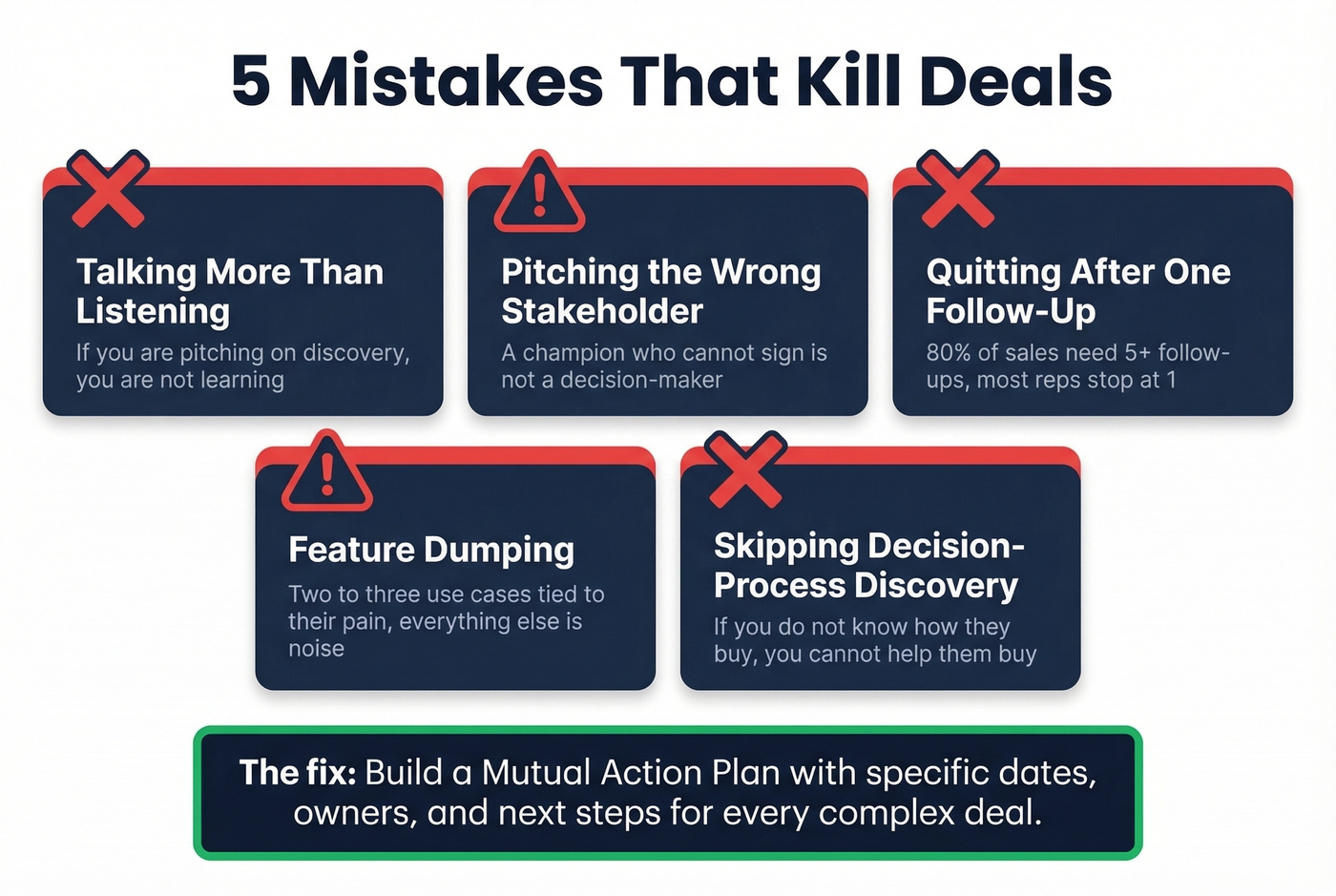
Pitching the wrong stakeholder. A champion who can't sign is useful. A champion you mistake for the decision-maker is dangerous. Always ask: "Who else needs to weigh in on this?"
Quitting after one follow-up. 80% of sales require five or more follow-ups. Many reps stop after one. Build a cadence with specific dates and owners, and make each touchpoint add value instead of just "checking in."
Feature-dumping. Two or three use cases tied to their stated problems. Everything else is noise that dilutes your message and eats clock.
Skipping decision-process discovery. If you don't know how they buy, you can't help them buy. It's that simple.
Let's be honest: if your average deal size is under $10k, you probably don't need a seven-step process at all. Qualify, demo, close - three steps. The full framework here is built for deals where indecision kills more pipeline than rejection does. Know which game you're playing.
84% of reps missed quota last year. The difference isn't closing technique - it's reaching decision-makers with verified data before competitors do. Prospeo's 300M+ profiles with 30+ filters let you qualify faster, multi-thread deeper, and arm your champion with proof that lands.
Close more deals by reaching the right people first - at $0.01 per email.
FAQ
What's the most important step in closing a sale?
Discovery. Data from 1M+ sales calls shows closing-call behavior is nearly identical between wins and losses - the difference is built in earlier steps. Nail discovery and stakeholder alignment, and the close follows naturally.
How many follow-ups does it take to close a deal?
80% of sales require five or more follow-ups, yet many reps stop after one. Build a follow-up cadence into your Mutual Action Plan with specific dates and owners. Each touchpoint should add value, not just "check in."
How do I reach multiple stakeholders in the same account?
Map the buying committee first: economic buyer, technical buyer, influencers, blockers. Then use a verified contact data tool to find emails and direct dials for each person. Multi-threading lifts win rates by up to 130%, and it's nearly impossible without accurate contact data across the full account.