

The Only Discovery Call Script PDF Backed by 519,000 Calls
Most discovery call script PDFs are glorified checklists - a dozen generic questions, zero data behind them, and no guidance on what actually moves a deal forward. Meanwhile, 96% of buyers have already researched you before they pick up the phone. They don't need a feature walkthrough. They need a rep who asks sharp questions and listens.
Three numbers matter:
- Talk 43%, listen 57%. That's the golden ratio from Gong's analysis of 519K discovery calls. Above 65% talk time, outcomes tank.
- Ask 11-14 questions uncovering 3-4 problems. Not 20+. More than that feels like an interrogation.
- Open every call with a 1-2 minute "up-front contract." Set the agenda, relieve pressure, define next steps. This is the move that kills ghosting.
The full script, cheat sheet, and downloadable PDF are below.
Why Most Discovery Scripts Fail
Every discovery call template circulating online is the same bare skeleton: opening, small talk, questions, close. No data. No pacing guidance. No distinction between a $5K deal and a $200K enterprise cycle. Reps download the file, read it once, and wing it anyway - because the script didn't give them enough to actually change behavior.
Here's the thing: when you know that speaker switches per minute correlate with closed deals, you stop monologuing. When you know 11-14 questions is the sweet spot, you stop cramming 25 into a 20-minute call. The script below gives you the why behind each phase, not just the words.
Quick-Reference Numbers
| Metric | Target |
|---|---|
| Talk-to-listen ratio | 43% / 57% |
| Questions per call | 11-14 |
| Problems uncovered | 3-4 |
| Max talk time | <65% |
| Call pacing | Frequent speaker switches |
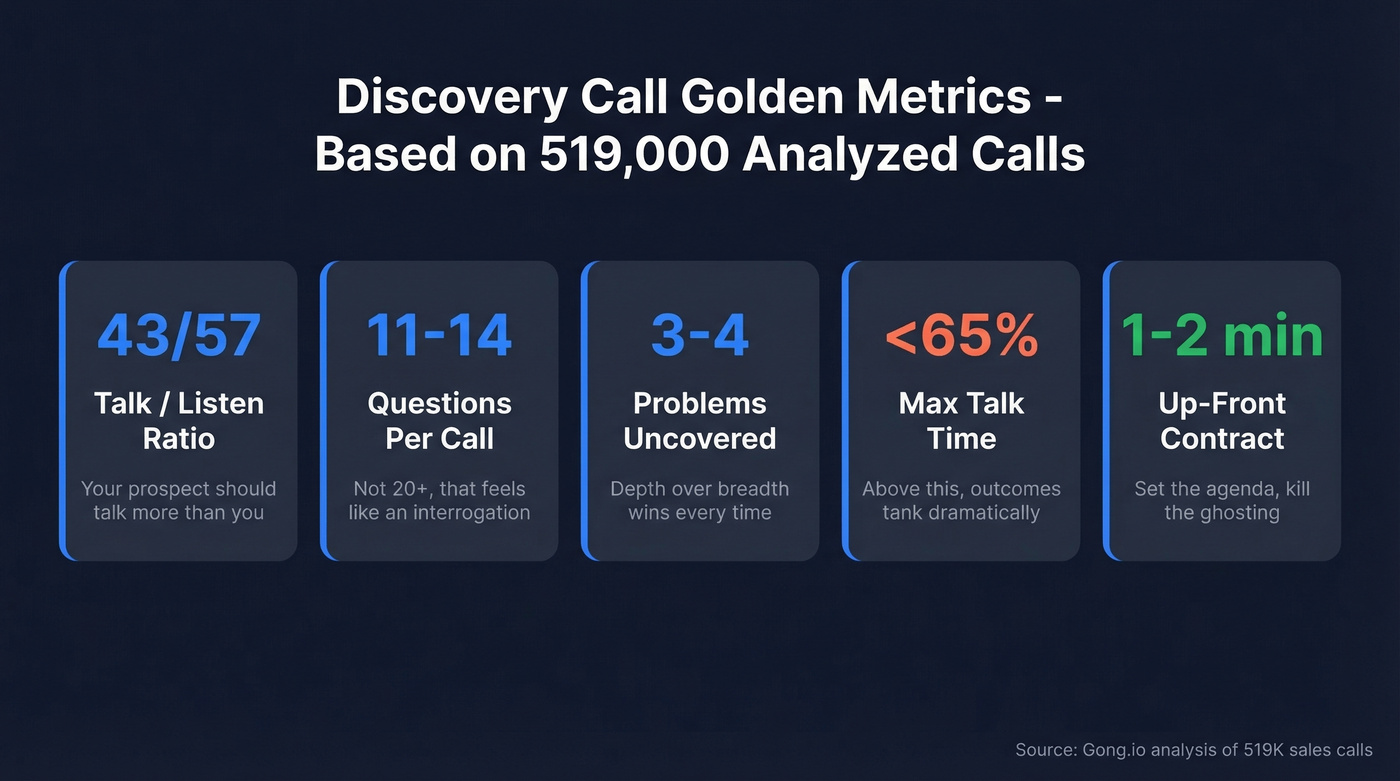
Great discovery calls feel like conversations, not depositions. Spread your questions across the call and don't frontload them.
Pre-Call Research Checklist
Buyers complete roughly 80% of their buying journey before they ever engage sales. If you show up asking "So what does your company do?" you've already lost credibility. Compile a one-page prospect profile before dialing:
- Company basics - headcount, revenue range, recent funding, industry vertical
- Technographics - what tools they run today, especially competitors or adjacent solutions
- Stakeholders - who else is involved (enterprise deals average 8-12 stakeholders)
- Recent triggers - job changes, headcount growth, new hires in relevant departments
We pull most of this from Prospeo's database in a single search - verified emails, verified mobile numbers, technographics, and company firmographics, all refreshed on a 7-day cycle. That's the difference between generic questions and ones that make the buyer think "this person did their homework."
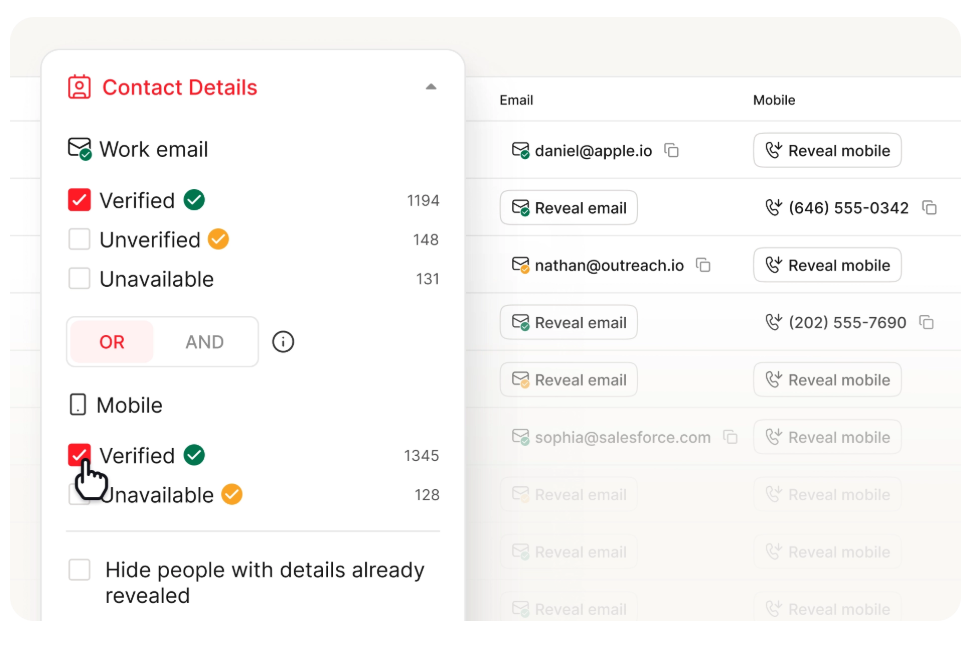

The pre-call checklist above only works if you have the data. Prospeo gives you verified emails, direct dials, technographics, and company firmographics - all refreshed every 7 days - so you walk into every discovery call with context that makes buyers lean in.
Stop asking 'So what does your company do?' - show up prepared.
The Full Script, Phase by Phase
Phase 1 - The Up-Front Contract
This is the most important move in the entire call. A practitioner on r/salestechniques broke down why most discovery calls fail: they start without clear ground rules, so the prospect never commits to a next step.
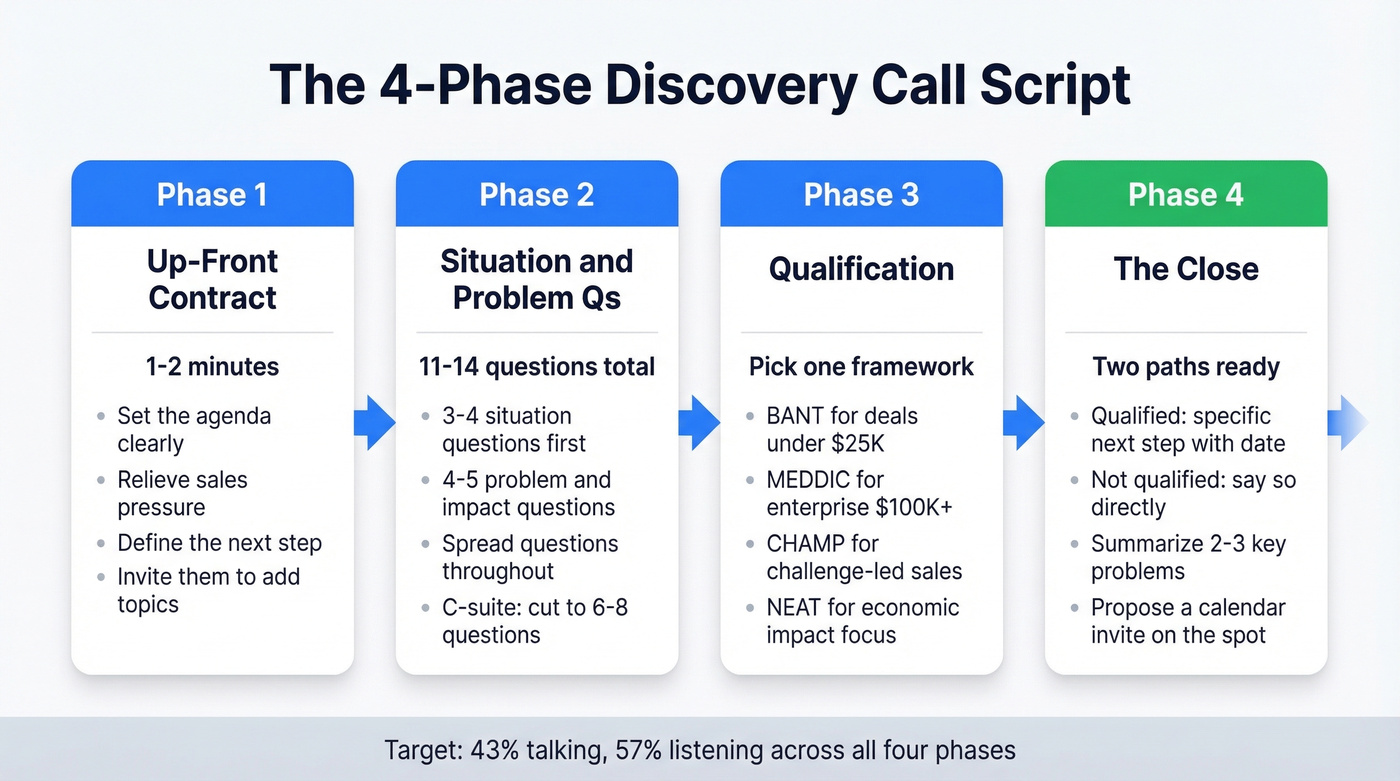
"Hey [Name], thanks for making time. Before we jump in - this isn't a pitch. I'm going to ask some questions about [specific area]. If it turns out we're not a fit, I'll tell you. If there is something here, the next step would be a follow-up with [stakeholders] to cover pricing and technical details. Sound fair? Anything you'd add to the agenda?"
One to two minutes. You've relieved pressure, set the agenda, defined the exit, and invited collaboration. In our experience, reps who add this single step cut ghosting rates dramatically - because the prospect agreed to a next step before the first discovery question even landed.
Phase 2 - Situation and Problem Questions
This is where the 11-14 question range lives. Start with three or four situation questions to map the current state: how they handle the process today, what tools they're using, how the team is structured. These aren't exciting, but they give you the context to ask sharp follow-ups.
Then shift to problem and impact questions - four or five that dig into where things break down. "What happens when [problem] occurs - what's the downstream impact?" is worth more than three surface-level questions combined. "Why is this a priority now versus six months ago?" reveals urgency better than any BANT checkbox .
The research shows that spreading questions throughout the call - rather than frontloading them - correlates directly with higher close rates. Think tennis match, not interrogation.
One exception worth knowing: when selling to C-suite, fewer questions perform better. Too many discovery questions actively harm deals at the executive level. With a VP or above, cut your question count to 6-8 and make every single one count.
Phase 3 - Qualification
Now you're checking whether this deal is real.
| Framework | Lead Question | Follow-Up |
|---|---|---|
| BANT | "Is there budget allocated?" | "Or would we need to build a case?" |
| MEDDIC | "What metrics define success?" | "Who owns those metrics?" |
| CHAMP | "What's your biggest challenge?" | "How does it rank against other priorities?" |
| NEAT | "What's the economic impact?" | "What happens if you don't solve this?" |
Pick one framework and stick with it. Spend enough time to qualify, not enough to feel like a compliance form.
If you want a deeper bank of prompts, start with these discovery questions and adapt them to your ICP.
Phase 4 - The Close
Two paths, and you need both ready.
Qualified: Summarize the two or three key problems they shared, connect them to your solution, and propose a specific next step with a specific date. "Does Thursday at 2pm work for a technical review with [stakeholder]?" beats "Let's find some time" every single time.
Not qualified: Say so directly. "Based on what you've described, I don't think we're the right fit for [specific reason]. I'd recommend looking at [alternative]." Most reps skip the graceful exit. Don't. It builds trust, earns referrals, and keeps the door open for later.
Pick Your Framework
Let's be honest: if your average contract value is under $25K, you don't need MEDDIC. BANT will sort your leads faster with less overhead. Save MEDDIC for enterprise deals where you're navigating 8-12 stakeholders across a 6-9 month cycle - 73% of SaaS companies selling >$100K ARR use some version of it for good reason. Teams that adopted MEDDIC saw 18% higher win rates, and teams that improved authority mapping saw 35% fewer late-stage collapses.
If you're selling complex deals, this MEDDIC sales qualification breakdown will help you apply it without overengineering.
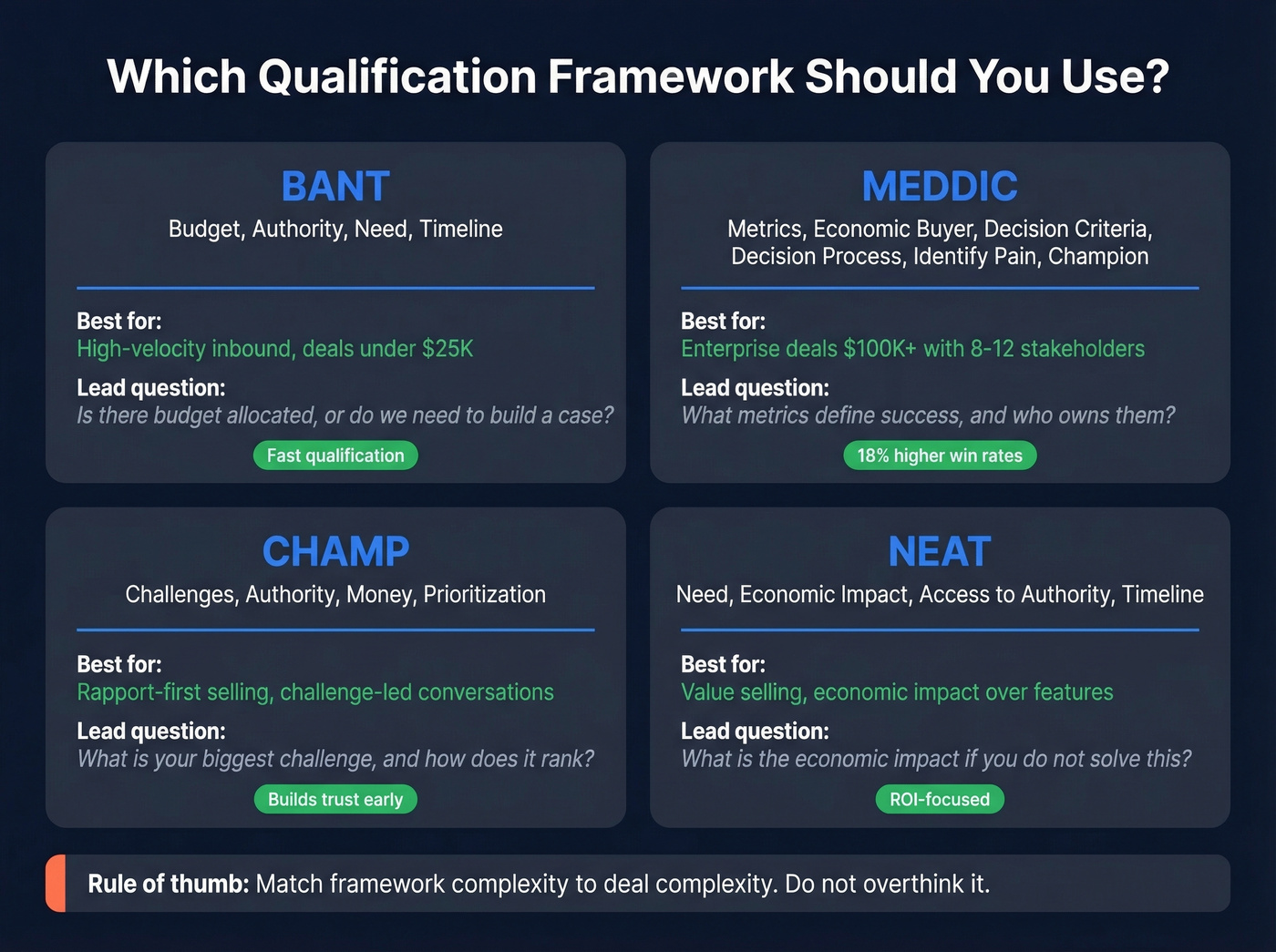
CHAMP works when you want to lead with challenges and build rapport before talking money. NEAT fits teams that sell on economic impact rather than feature comparisons. Match the framework to your deal complexity and move on - don't overthink it.
Three Mistakes That Kill Calls
1. Talking more than 45% of the time. The data is unambiguous. Lost deals average around 62% rep talk time, while closed-won deals sit closer to 57%. If you catch yourself monologuing, stop and ask a follow-up question.
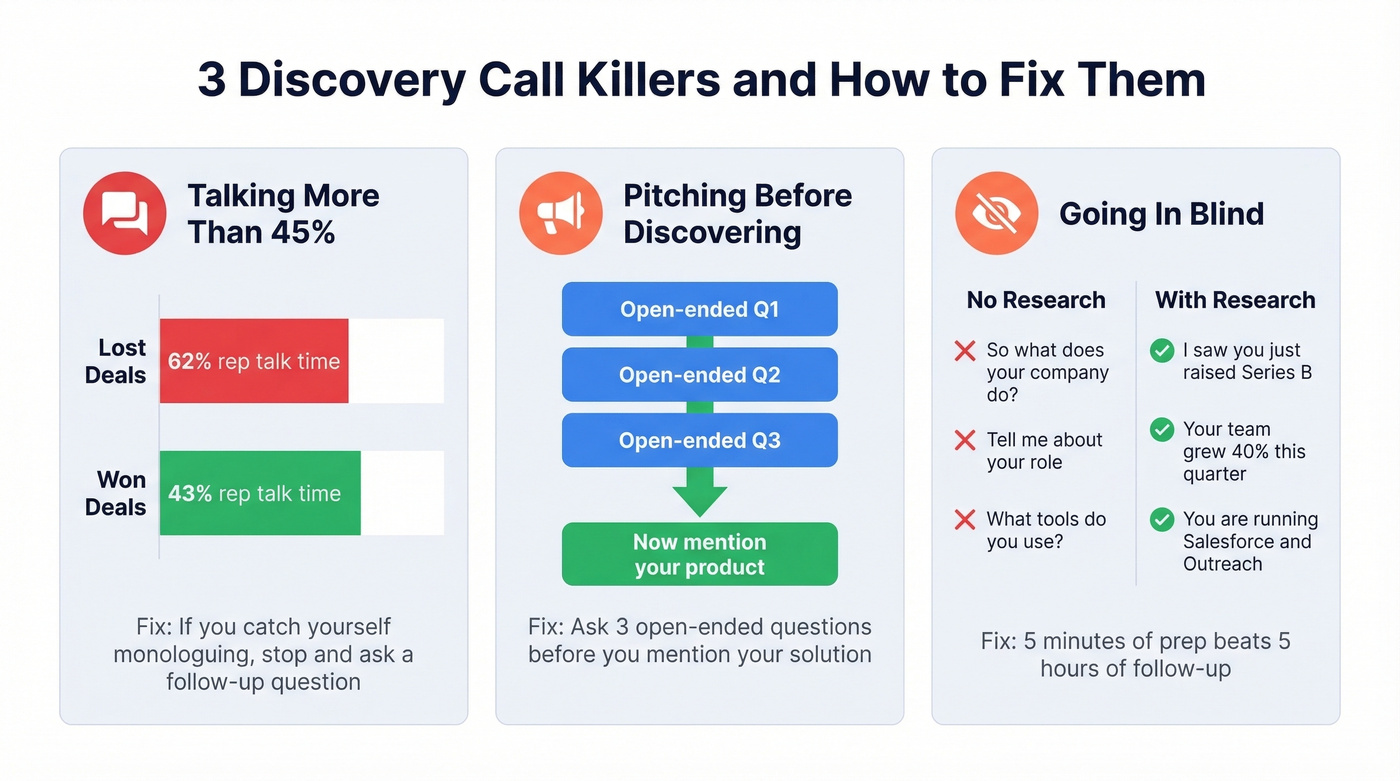
2. Pitching before discovering. HubSpot's guidance is simple: ask three open-ended questions before you mention your product. If you're solving a problem you haven't confirmed exists, you're guessing.
3. Going in blind. No research on the prospect's technographics, org structure, or buying signals means your questions will be generic - and generic questions get generic answers. The best discovery reps sound like they already understand the prospect's world. That takes five minutes of prep, not five hours. Prospeo's Chrome extension pulls 40+ data points per contact from any website in one click, so there's no excuse to show up cold.
To tighten the rest of your motion, pair this with a simple sales prospecting techniques system and a consistent cold calling system.
Sharp discovery questions require sharp data. Prospeo's 30+ search filters surface job changes, headcount growth, funding rounds, and tech stack - the exact triggers that turn generic openers into conversations that close. 98% email accuracy means the call actually happens.
Research every prospect in 60 seconds instead of 60 minutes.
Download the Script PDF
The full phase-by-phase discovery call script PDF, framework cheat sheet, and pre-call research checklist are packaged in a single download. Print it, pin it next to your monitor, and customize it for your ICP. No email gate - just the script.
After the call, use these sales follow-up templates to lock in the next step while the pain is fresh.
[Download the Discovery Call Script PDF →]
FAQ
How long should a discovery call last?
Most B2B discovery calls run 15-30 minutes. For complex enterprise deals with multiple stakeholders, stretch to 30-40 minutes. Keep it under 40 regardless - anything longer and you're pitching, not discovering.
How many questions should I ask?
Aim for 11-14 questions that uncover 3-4 distinct business problems. More than 14 starts feeling like an interrogation and actually hurts close rates. For C-suite conversations, drop to 6-8.
What's the best qualification framework?
BANT for high-velocity inbound triage where deals close under $25K. MEDDIC for enterprise deals with multiple decision-makers and six-figure contracts. CHAMP if you lead with challenges over budget. Match the framework to your deal complexity and sales cycle length.
How do I research prospects before a call?
Use a B2B data platform to pull firmographics, technographics, and org-chart details in one search. Combine that with recent trigger events like funding rounds or leadership changes, and your questions will land sharper than 90% of the reps your prospect talks to that week.