

Data-Driven Selling: What It Actually Takes (Not What Vendors Tell You)
Your VP tells the board pipeline is 3x quota. Forecast accuracy? Sixty percent. Half the "qualified" deals haven't had a meeting in three weeks. That's not data-driven selling - it's analytics theater, and it's everywhere.
Making sales decisions led by metrics instead of gut sounds simple. The execution is where teams fall apart, not because they lack data, but because they're drowning in the wrong data and acting on none of it.
The Quick Version
- Fix your data first. A CRM full of bounced emails and wrong titles is worse than a spreadsheet with 200 verified contacts.
- Track 5-7 KPIs that map to revenue, not activity. Calls made isn't a KPI. Pipeline health is.
- Build a lean stack. CRM + enrichment + conversation intelligence. You don't need a $100k platform on day one.
Why a Data-Driven Sales Approach Matters
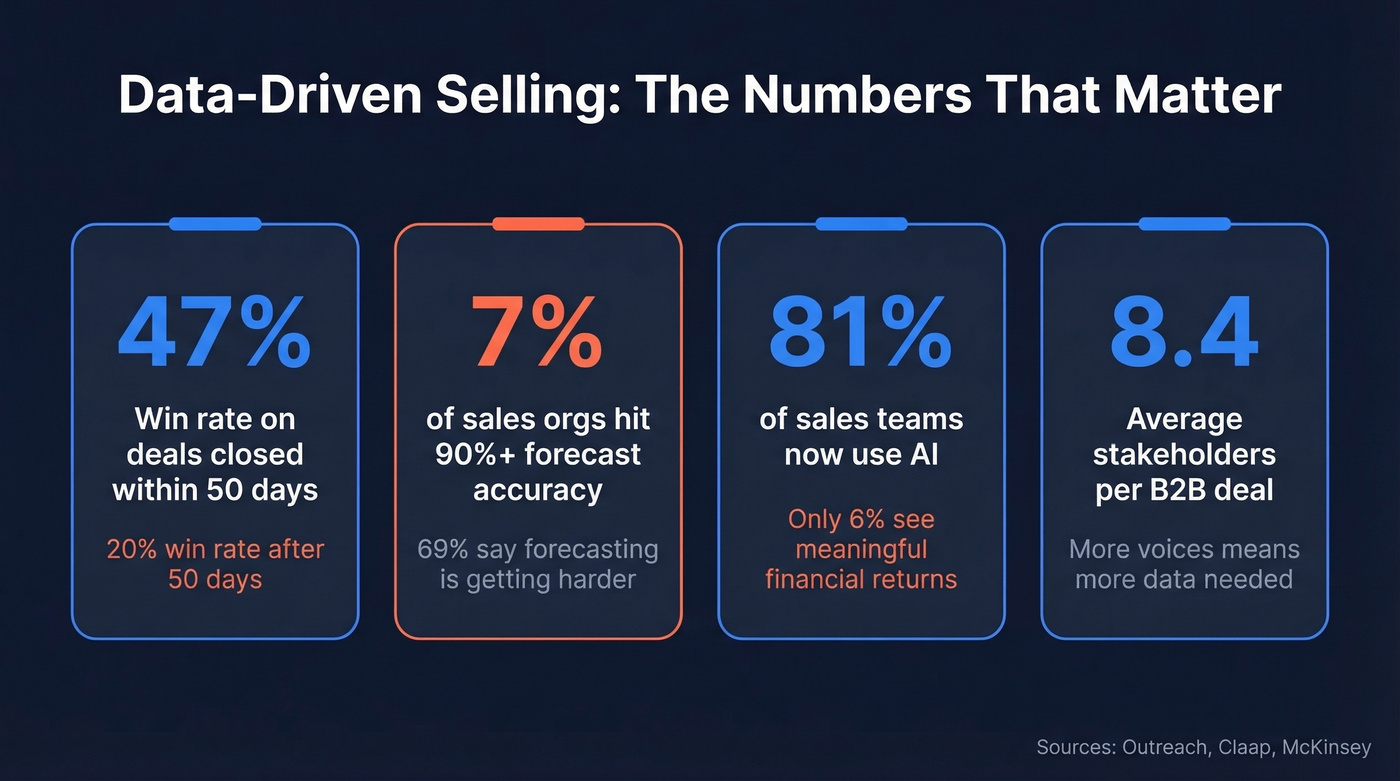
Deals closed within 50 days show a 47% win rate vs. 20% for deals that drag past that mark. Conversation intelligence users close 11 days faster on average, with a 10-point win-rate lift on deals over $50k. Those aren't marginal gains - they're the difference between hitting plan and missing it by a mile.
Only 7% of sales orgs achieve forecast accuracy above 90%, and 69% of leaders say forecasting is getting harder. With the average B2B purchase involving 8.4 stakeholders, the gap between teams that use data well and teams that just collect it widens every quarter.
Here's the thing: the biggest lie in this space is that you need more data. You need cleaner data, fewer metrics, and reps who actually look at them.
Five Data Sources That Power It
Not all data is equal, and the taxonomy matters. Exchange data - emails, calendar events, Slack threads - tells you who's actually talking to whom and how often. Content data reveals what prospects consume from your marketing assets: engagement signals, not just downloads. Your first-party digital data (website visits, app usage, form fills) should flow into your CRM automatically.
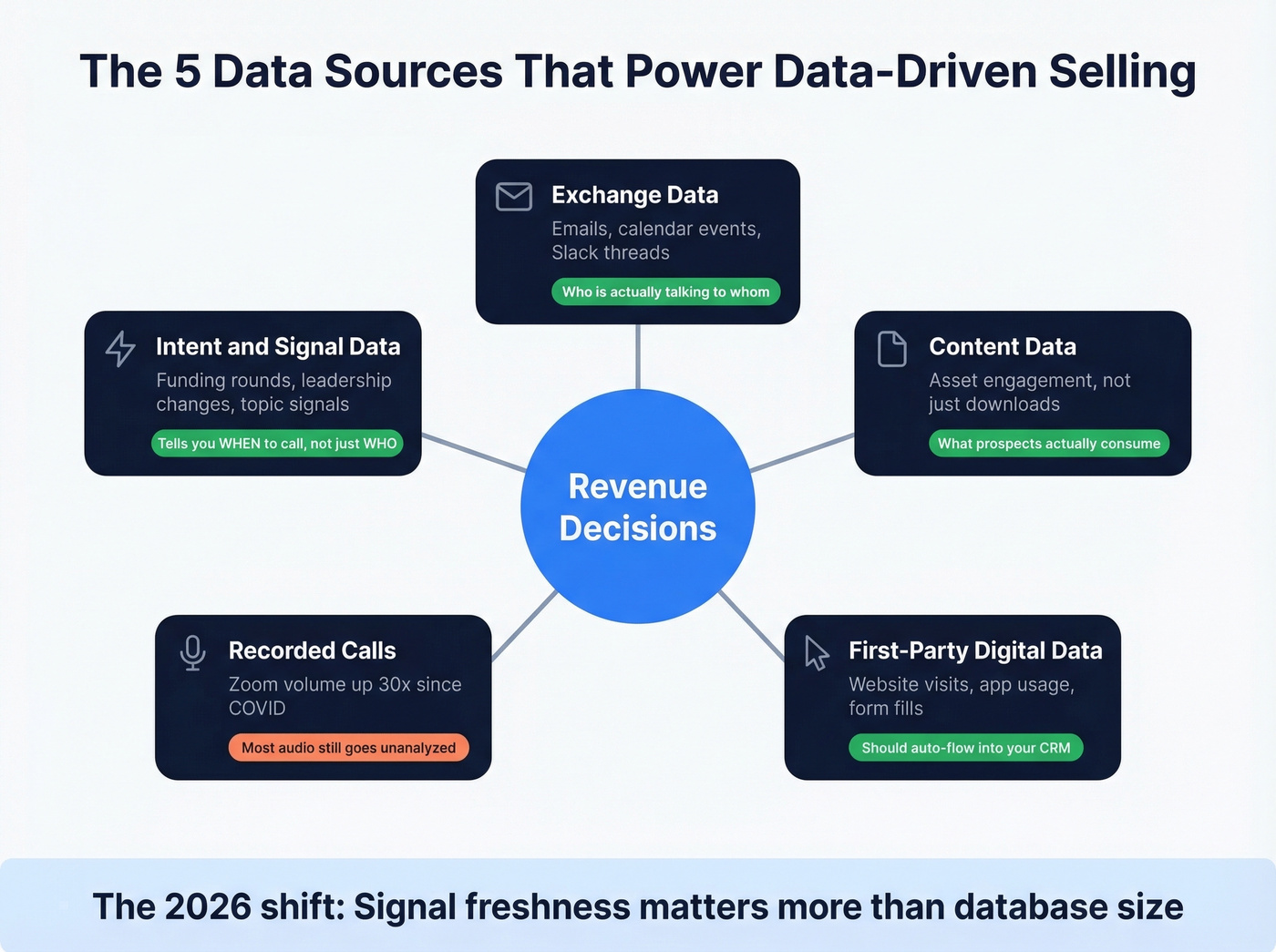
Then there's recorded calls. Zoom call volume is up 30x since COVID, and most of that audio still goes unanalyzed. Finally, intent and signal data - trigger events like leadership changes, funding rounds, and topic-level buying signals - turns static databases into something that tells you when to call, not just who to call.
The shift in 2026 isn't about database size. It's about signal freshness: knowing a VP of Engineering started searching for "SOC 2 compliance" last Tuesday, not that they exist in a database somewhere. Budget timing matters too. Tracking fiscal year cycles and headcount surges gives you a reason to reach out that isn't "just checking in." Leading with a specific signal or relevant metric in sales conversations is what separates personalized outreach from spam.
How to Build a Data-Driven Sales Process
Step 1: Audit your current state - with frontline reps in the room. Your playbook says one thing. Your reps do another. Include the people actually making calls. They'll tell you where the process breaks, and they'll be blunt about it if you let them.
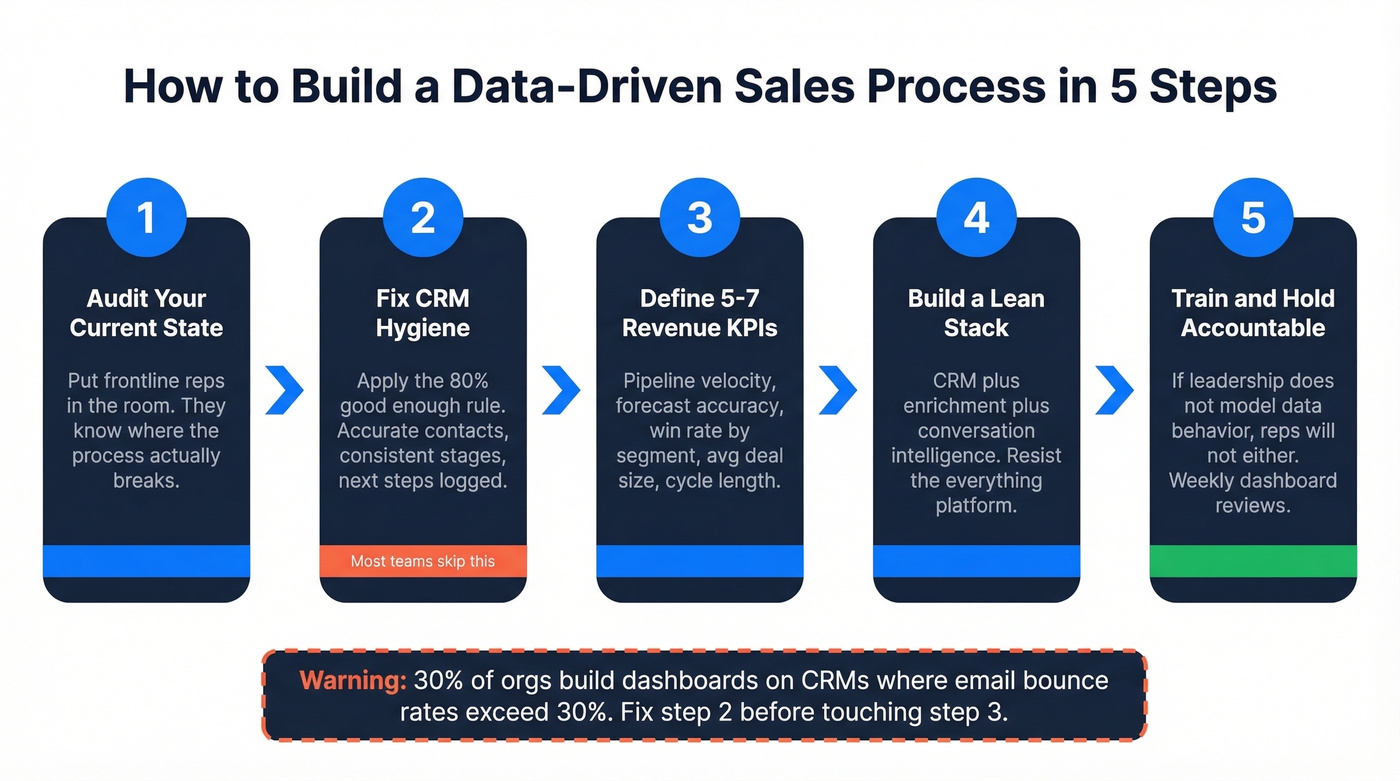
Step 2: Fix CRM hygiene. Apply the "80% good enough" principle. You need accurate contact info, consistent deal stages, and next steps logged. That alone puts you ahead of most teams. We've seen orgs spend six months building dashboards on top of a CRM where 30% of email addresses bounce - that's building a house on sand.
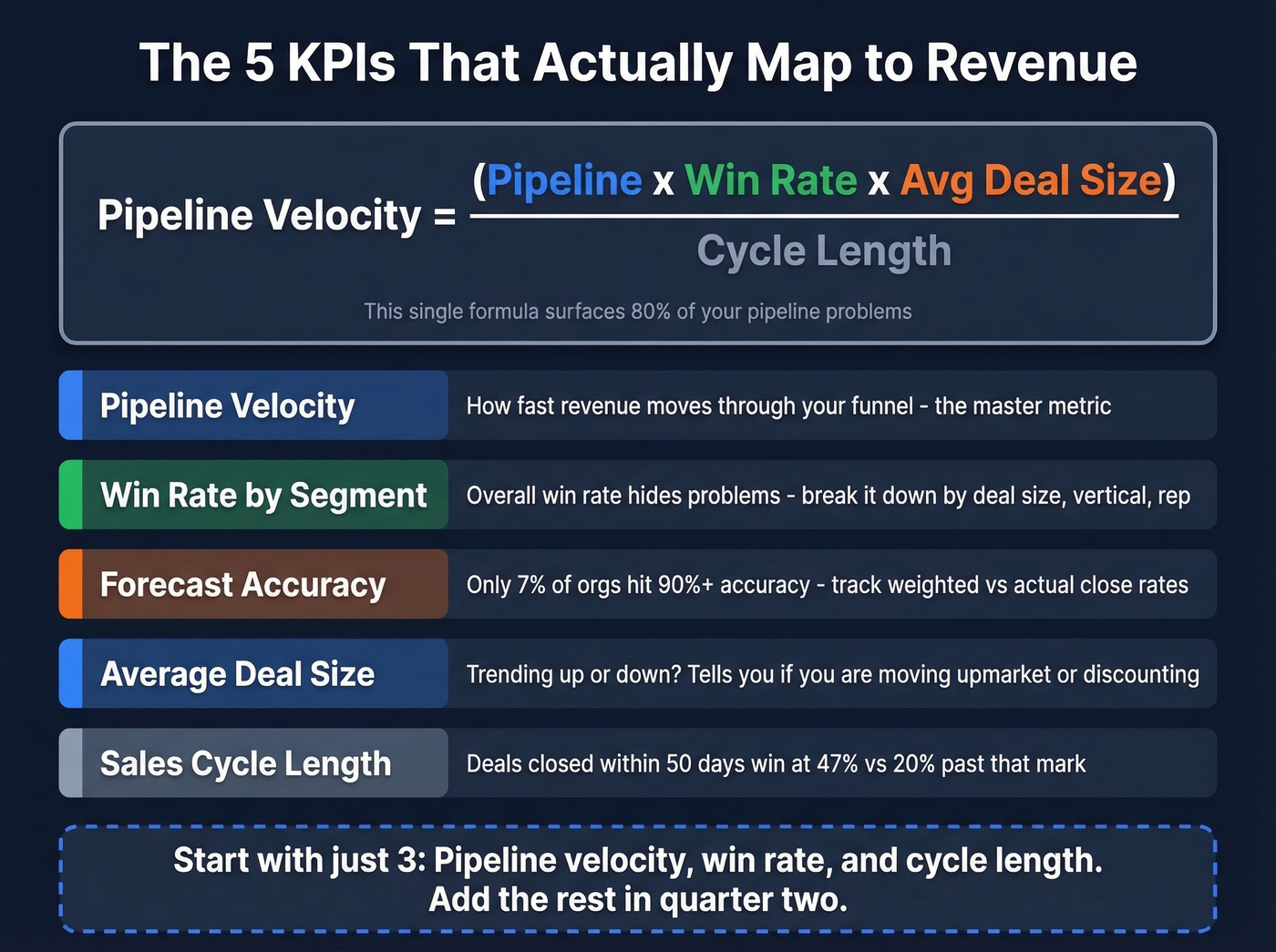
Step 3: Define 5-7 revenue-mapped KPIs. Pipeline velocity (pipeline x win rate x avg deal size / cycle length), forecast accuracy, win rate by segment, average deal size, and cycle length. These connect to revenue. Activity counts don't.
Step 4: Build a lean tech stack. CRM, enrichment tool, and conversation intelligence. Resist the urge to buy a platform that does everything - you'll use 30% of it. We cover specific tools below.
Step 5: Train and hold accountable. Only 52% of CEOs believe in their own growth plans. If leadership doesn't model data-informed behavior, reps won't either. Hire for data comfort, reward metric-backed decisions, and review dashboards weekly. This is change management, not a software rollout.

You just read it: 35% bounce rates kill everything downstream. Prospeo's 5-step verification and 7-day data refresh cycle cut bounce rates below 4% - proven across 15,000+ companies. At $0.01 per email, fixing your CRM hygiene costs less than one bad dashboard.
Stop building dashboards on bounced emails. Verify first.
Five Mistakes That Kill Results
Vanity metrics top the list. Tracking emails sent and calls made without conversion context is noise - tie every metric to a revenue outcome. Close behind is no context: "Win rate dropped 5%" means nothing without a segment and a baseline.
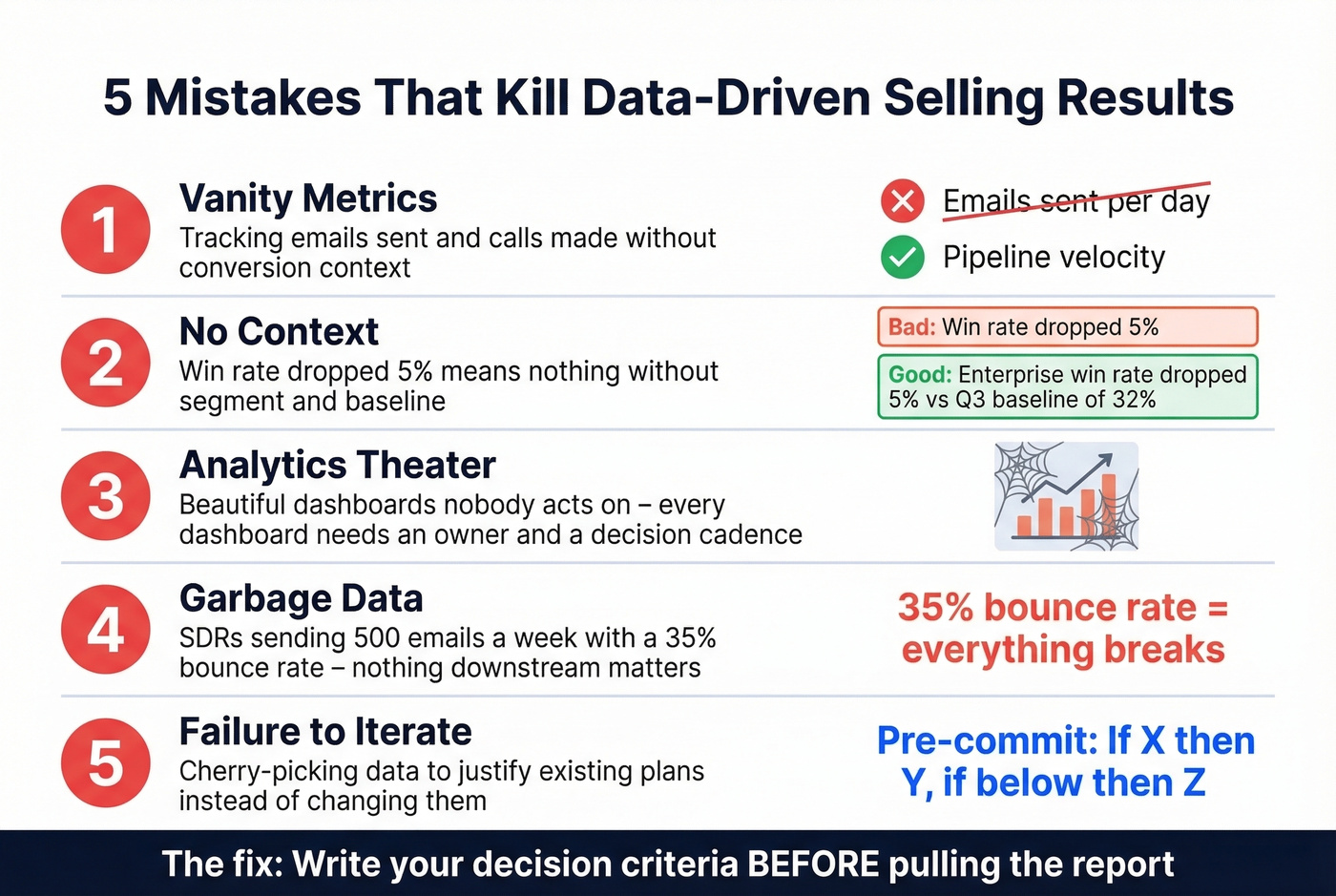
Analytics theater is the third killer - beautiful dashboards nobody acts on. The r/DigitalMarketing crowd calls this "snake oil", and they're right. Every dashboard needs an owner and a decision cadence. Without that cadence, data-driven decision making stays theoretical. Reports pile up. Nothing changes.
Garbage data is the silent one. Your SDRs are sending 500 emails a week with a 35% bounce rate. Nothing downstream matters until you verify before you send (see email bounce rate). And finally, failure to iterate - teams cherry-pick data to justify existing plans instead of changing them. Pre-commit to decision criteria before pulling the report. If you can't write down "we'll do X if the number is above Y and Z if it's below," you're not ready to pull the report.
AI - What Works, What Doesn't
81% of sales teams now use AI. Only about 6% see meaningful financial returns. That's a McKinsey number, and it's the most important stat in this article.
But the wins are real when the foundation is right. Grammarly deployed Salesforce Einstein for predictive lead scoring on free users and saw an 80% increase in account upgrades with sales cycles cut by more than half. LivePerson dropped research time from 20 minutes per prospect to 2 - a 10x efficiency gain. 45% of high-performing teams now run hybrid human-AI SDR models where AI handles research, prioritization, and first-draft personalization while humans handle judgment and the moments that close deals.
The practical applications that work right now: ranking inbound leads by fit score, adjusting MQL thresholds dynamically, and triggering nurture paths when engagement drops. Treat predictive scores as probabilistic guidance, not gospel.
Look - if your average deal size is under $10k and your CRM bounce rate exceeds 10%, skip the AI tools entirely. Fix your data foundation first. A $49/month enrichment tool will outperform a $2,000/month AI platform sitting on garbage inputs every single time.
Your Sales Strategy Stack
You don't need ten tools. You need four categories covered.
| Category | Tool | Starting Price |
|---|---|---|
| CRM | HubSpot | Free; paid from ~$20/user/mo |
| CRM | Salesforce | From $25/user/mo |
| CRM | Pipedrive | From $14/user/mo |
| Enrichment | Apollo | ~$49/user/mo |
| Enrichment | ZoomInfo | ~$15-40k/yr |
| Conversation Intel | Gong | ~$100-150/user/mo |
| BI / Analytics | Tableau | From $15/user/mo |
If your CRM data bounces at 35%, nothing else in this guide matters. In our experience testing enrichment tools across client campaigns, data freshness is the single biggest variable. Prospeo refreshes every 7 days - compared to the 6-week industry average - with 98% email accuracy across 300M+ profiles. The free tier gives you 75 verified emails a month to test before committing a dollar.
For RevOps teams running enrichment workflows, the difference between a 7-day refresh and a 6-week refresh is the difference between reaching a buyer who just changed roles and emailing someone who left the company in March.
If you're comparing vendors, start with data enrichment services and then pressure-test your process with a simple lead scoring model.

The article says a $49/month enrichment tool beats a $2,000/month AI platform on bad data. Prospeo returns 50+ data points per contact at a 92% match rate - plus intent signals across 15,000 topics so you know when to call, not just who.
Signal freshness wins deals. Get data that's 7 days old, not 6 weeks.
Data-Driven Selling FAQ
What's the difference between data-driven and data-informed selling?
Data-driven means metrics lead the decision - you change course when numbers dictate it. Data-informed means data is one input alongside intuition and experience. Most teams are data-informed and don't realize it. To move toward fully data-driven decision making, pre-commit to thresholds that trigger action before you pull the report. Write the "if X, then Y" rule first. Then look at the number.
What KPIs matter most?
Pipeline velocity, win rate, forecast accuracy, average deal size, and sales cycle length. These five map directly to revenue. If you can only track three, start with pipeline velocity, win rate, and cycle length - they'll surface 80% of your problems.
What tools do you need to start?
A CRM (HubSpot or Pipedrive for SMBs), a data enrichment tool for verified contacts, and a BI layer for dashboards. Add conversation intelligence when deal sizes justify the ~$100-150/user/month investment. Skip anything that requires a six-month implementation before you see value.
How do you get reps to actually use data?
Pick one metric - like pipeline velocity - and tie it to a weekly review cadence. When reps see metric-backed decisions leading to better quota attainment rather than more busywork, adoption follows. Mandate CRM hygiene, but reward insight, not just compliance. I've watched teams try to roll out five new dashboards at once and get zero adoption. One metric, one cadence, one quarter. Then expand.