

Personalized Outreach: Why Most Teams Get It Wrong (And How to Fix It)
Your team sends 500 emails a week and gets 8 replies. The copy's decent, the offer's solid, and your SDRs spent hours "personalizing" every message. So what's broken? 57% of decision-makers say the outreach they receive feels impersonal - even when it includes their name and company. The problem with personalized outreach isn't effort. It's method.
What You Need (Quick Version)
Most tailored outreach fails for three reasons. Fix them and you'll outperform 90% of outbound teams:
- Data quality. If your bounce rate is above 3%, your emails aren't reaching anyone. Personalization is irrelevant when messages land in spam or bounce entirely.
- Signal-based context. First name + company name isn't personalization. A funding round, a leadership change, a hiring spike - that's context worth writing about.
- Brevity. The best-performing cold emails in 2026 are 40-60 words. Not 140. Every extra sentence increases deletes.
Teams that nail these three things routinely move from a ~3% reply rate to 5-6%+. The rest of this piece breaks down exactly how, with benchmarks, a framework, and a template you can steal today.
Why Most "Personalized" Emails Fail
Most AI personalization is just mail-merge with extra steps. Plug in a first name, a company name, maybe an industry - and the tool generates a sentence that sounds like every other AI-written opener in the prospect's inbox. One thread on r/SaaS put it bluntly: these tools "sound robotic" because they lack real context. They're automating the wrong layer.
The second failure mode is automation without relevance. Teams crank up send volume because their tools make it easy, then wonder why spam complaints spike. Almost 20% of cold emails get flagged as spam - and a big chunk of that comes from blasting unsegmented lists with the same "personalized" template.
Then there's the AI opener trap. We've seen teams adopt AI SDR tools expecting magic, only to watch their domain reputation crater within weeks. The AI generates more volume, not better messages. Volume without relevance is just noise with a higher hosting bill.
If your "personalization" is something a mail-merge could've done in 2015, you're not personalizing. You're decorating a template.
A Framework That Actually Scales
The teams getting 5-10%+ reply rates aren't writing bespoke novels for every prospect. They're running a tiered system that matches personalization depth to signal strength - what some practitioners call the "Show Me You Know Me" (SMYKM) principle. Sam McKenna's SMYKM framework is associated with 43% open rates and 20% reply rates because every message proves the sender did real homework.
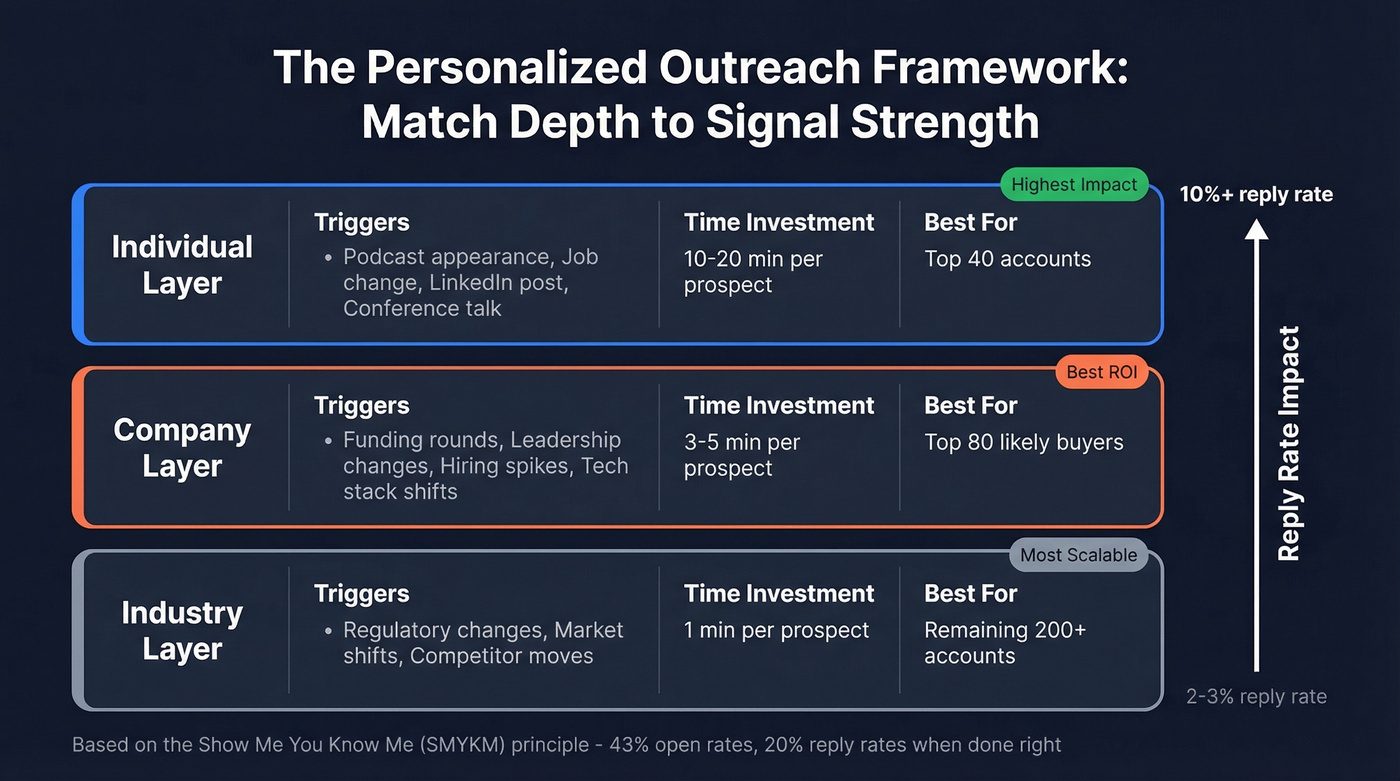
Individual Layer
This is the hardest to scale and the most powerful when it lands. Reserve it for decision-makers at your highest-value accounts. The triggers here are specific to the person: a recent podcast appearance, a job change, a post about a challenge your product solves, a conference talk. Budget 10-20 minutes per prospect and only use this where the deal size justifies the investment.
Company Layer
This is where most teams should spend their energy. Funding rounds, leadership changes, hiring spikes in specific departments, tech stack shifts, new office openings - these signals apply across multiple contacts at the same account. Write one strong company-level insight and use it for every stakeholder you're reaching. It scales well and still feels genuinely researched.
The challenge is finding these signals at scale. Prospeo's 30+ search filters pull buyer intent across 15,000 topics, technographics, job changes, headcount growth, and funding into one view - so reps spend time writing, not researching.
Industry Layer
The most scalable layer, but the weakest on its own. Regulatory changes, market shifts, competitor moves - these apply to entire segments. Stack industry context with a company or individual signal and it works. Use it alone and you're back to template territory.
Triage by Signal Urgency
Not every account deserves the same investment. A practical framework from Kaspr's outreach guide illustrates this well: if you're managing 300 accounts, maybe 80 are likely buyers and 40 are tier-one based on ICP fit and activity signals. Focus your deep personalization on those 40. The other 260 get industry-level templates.
Targeted campaigns with 50 or fewer recipients hit 5.8% reply rates versus 2.1% for large blasted lists. Smaller, more focused sends win every time.
Let's be honest: a lot of content out there paints a beautiful picture of customized decks, tailored demos, and bespoke digital sales rooms for every prospect. That's aspirational. None of it matters if your foundation - data quality and deliverability - is broken. Fix the plumbing first, then worry about the interior design.
Separate Research From Writing
The biggest unlock we've found in outbound isn't better copy - it's separating the research step from the writing step. One team on r/GrowthHacking documented this shift: four people targeting 500 enterprise accounts per month. Good personalized outreach was taking 20-30 minutes per account, which meant they could only cover 150 accounts with the same headcount.
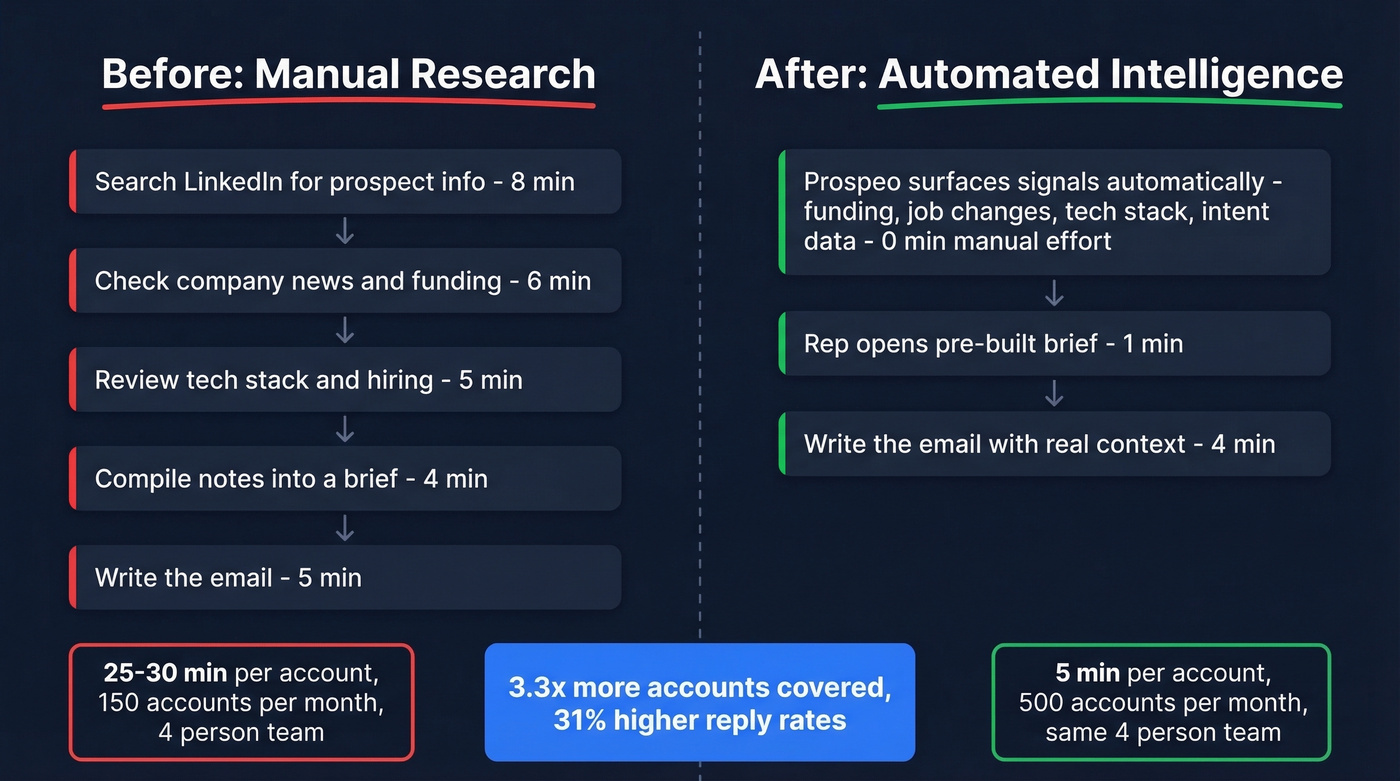
Their fix: automate the intelligence-gathering layer entirely. Company news, digital signals, team changes, tech stack data - all compiled into a brief before a human ever touches the email. Research time dropped from ~25 minutes to ~5 minutes per account. Throughput jumped from 150 to 500 accounts. Reply rates went up 31%.
The principle is simple: automate intelligence gathering, keep human writing. The writing stays human. The research doesn't have to be.

You just read how separating research from writing 3x'd one team's throughput. Prospeo's 30+ filters surface funding rounds, job changes, tech stack shifts, and buyer intent across 15,000 topics - so your reps open a brief, not a browser. 98% email accuracy means those personalized messages actually land.
Stop researching for 25 minutes. Start writing in 5.
The Infrastructure Nobody Talks About
Deliverability is the unsexy prerequisite that determines whether your personalized outreach even matters. One practitioner on r/Entrepreneur documented a full rebuild that's worth studying.
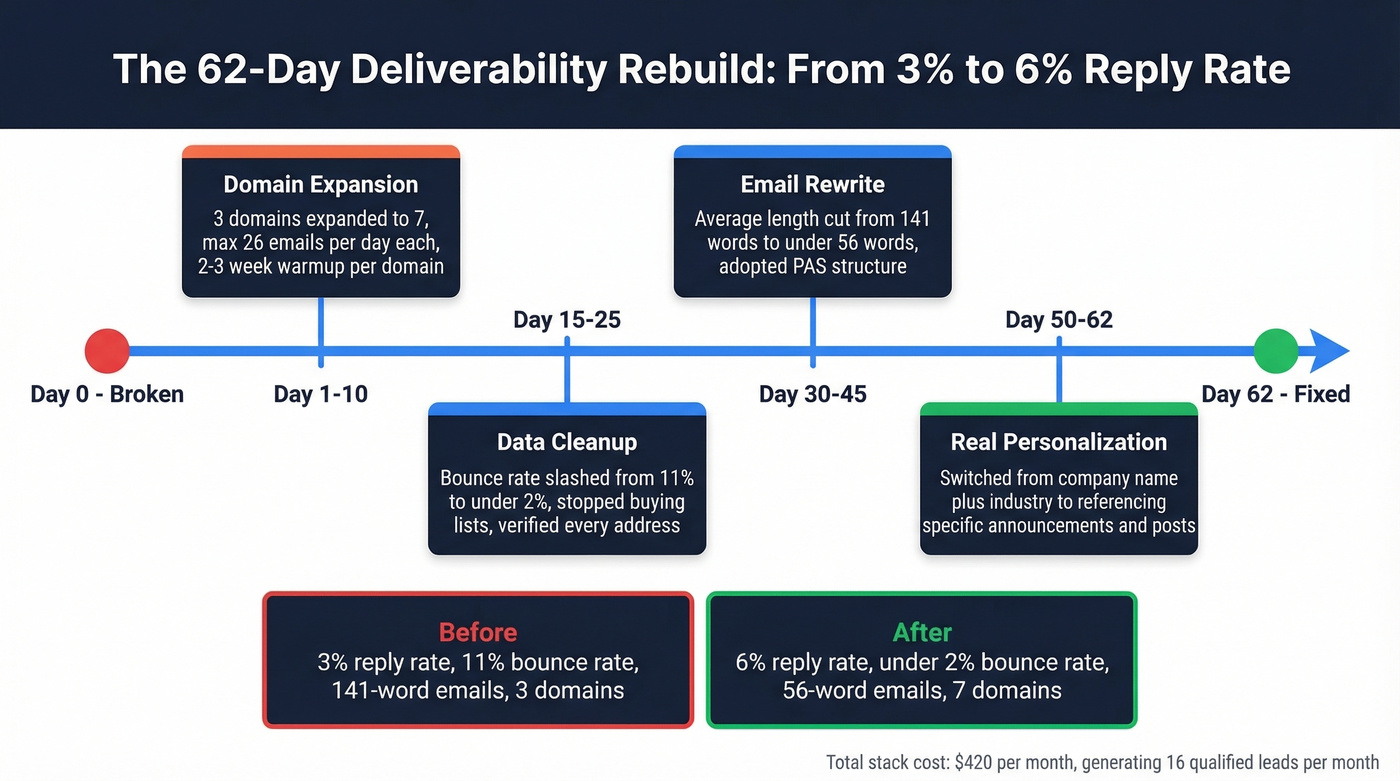
Their reply rate had decayed from 8% to 3% over 18 months. Over 62 days, they rebuilt everything:
- Domains: 3 to 7, each sending max 26 emails/day
- Bounce rate: 11% down to under 2% (stopped buying lists, verified every address)
- Email length: 141 words down to under 56 words
- Personalization: from "company name + industry" to referencing a specific announcement or post
Result: reply rate climbed back to 6%. Total stack cost: $420/month generating 16 qualified leads/month.
Domain and Sending Setup
Multiple domains aren't optional anymore. Warm each one for 2-3 weeks before sending. Cap at 25-30 emails per domain per day. If you're sending 200 emails daily from a single domain, you're burning it. Practitioners on r/salesdevelopment recommend running two verifiers minimum - the cost of a bad address is always higher than the cost of double-checking.
Data Quality Is the Foundation
This is where most outbound programs quietly fail. Bad data doesn't just mean bounces - it means spam traps, honeypots, and a slow death for your sender reputation that you won't notice until it's too late. Prospeo runs a 5-step verification process with catch-all handling and spam-trap removal on proprietary infrastructure that doesn't depend on third-party email providers. Email accuracy sits at 98%, and every record refreshes on a 7-day cycle versus the 6-week industry average.
The proof is in client results: Meritt dropped their bounce rate from 35% to under 4%. Stack Optimize maintains sub-3% bounce rates with zero domain flags across all clients. If your bounce rate is above 3%, your personalization doesn't matter because your emails aren't reaching anyone.
The $420/Month Stack
You need three layers: verified contact data, a sequencer, and a CRM. Everything else is optional. A realistic monthly budget looks like ~$100-200 for a data source, ~$100-150 for a sequencer like Instantly or Smartlead, and your existing CRM. That's it. You don't need a $40k/year platform to run effective outbound.
How to Stand Out in Sales Outreach
The Structure Behind the Template
The best-performing cold emails follow a PAS (Problem-Agitation-Solution) structure, even when they don't look like it. Lead with a trigger that implies a problem, agitate by connecting it to a real pain, and offer your solution as the bridge. AIDA works too, but PAS is better for cold email because it earns relevance faster.
One example showcased by Criminally Prolific hit a 47% reply rate using exactly this structure - short, trigger-based, with a soft CTA. That's not typical, but it shows what's possible when the framework is right.
The Anatomy of a 50-Word Email
Here's the template:
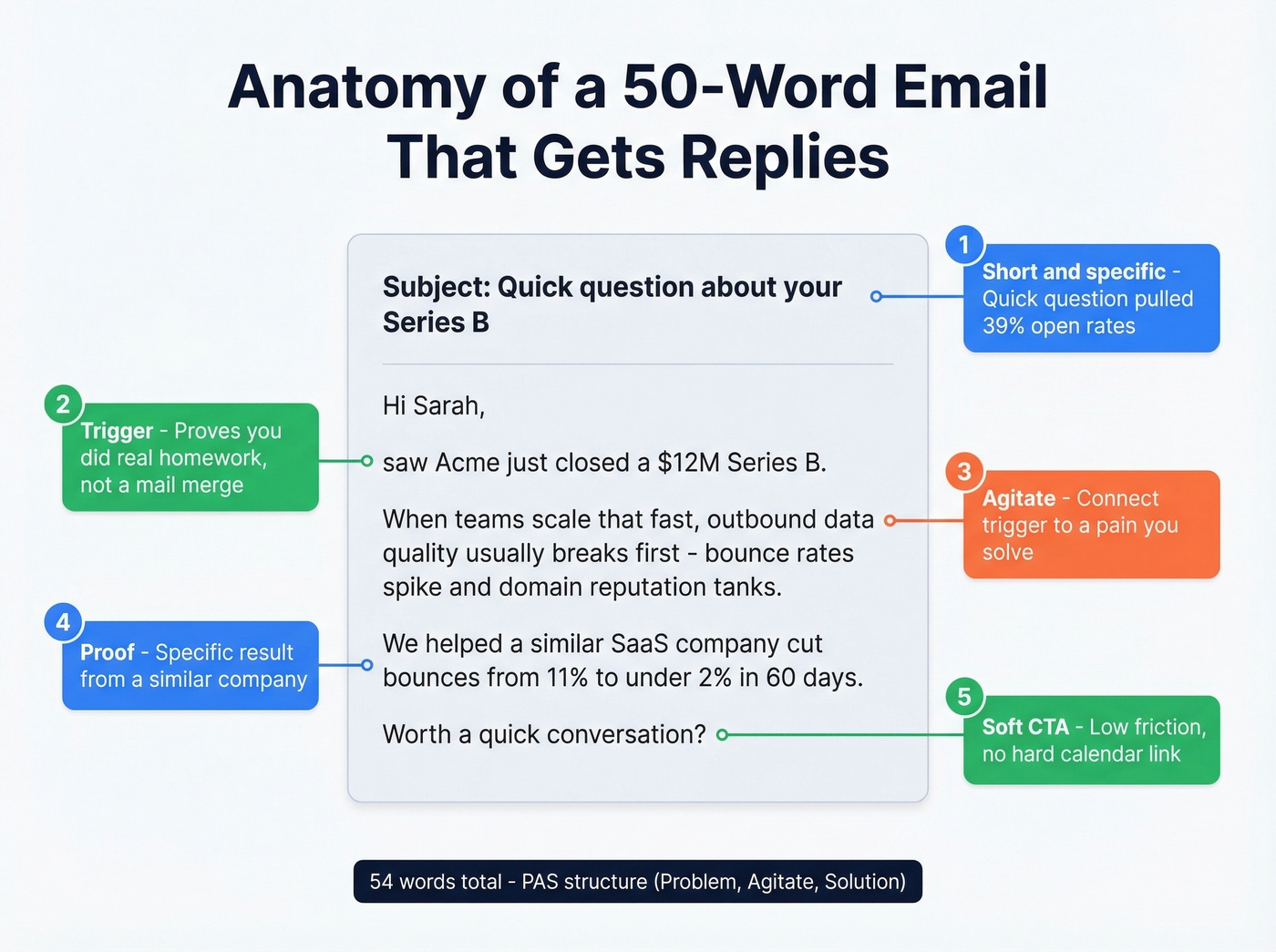
Subject: Quick question about [specific thing]
Body: [Name], saw [specific trigger - funding round / hire / post]. [One sentence connecting trigger to a problem you solve]. We helped [similar company] [specific result].
Worth a quick conversation?
And here's what it looks like filled in:
Hi Sarah, saw Acme just closed a $12M Series B. When teams scale that fast, outbound data quality usually breaks first - bounce rates spike and domain reputation tanks. We helped a similar SaaS company cut bounces from 11% to under 2% in 60 days.
Worth a quick conversation?
That's 54 words. The trigger proves you did your homework. The value prop connects to a real pain. The soft CTA reduces friction versus a hard calendar link.
Don't Stop at Email
Here's a stat most outbound teams ignore: email alone expects ~3% response rates. Add a coordinated social touchpoint and that number jumps to 15%+. Multi-channel isn't a nice-to-have - it's a multiplier.
Subject Lines and Timing
Data from the 3%-to-6% rebuild case study: "Quick question" pulled 39% opens. Including the company name hit 33%. "Partnership opportunity" dropped below 19%. Keep subject lines short, specific, and curiosity-driven.
For timing, send Tuesday through Thursday, 8-11am in the recipient's timezone. Wednesday consistently shows the highest reply rates. Instantly's 2026 benchmark data shows 58% of replies come from step 1 - your first email matters most. The sweet spot for sequence length is 4-7 touchpoints.
Benchmarks: What Good Looks Like
Let's calibrate expectations with real numbers from 2026:
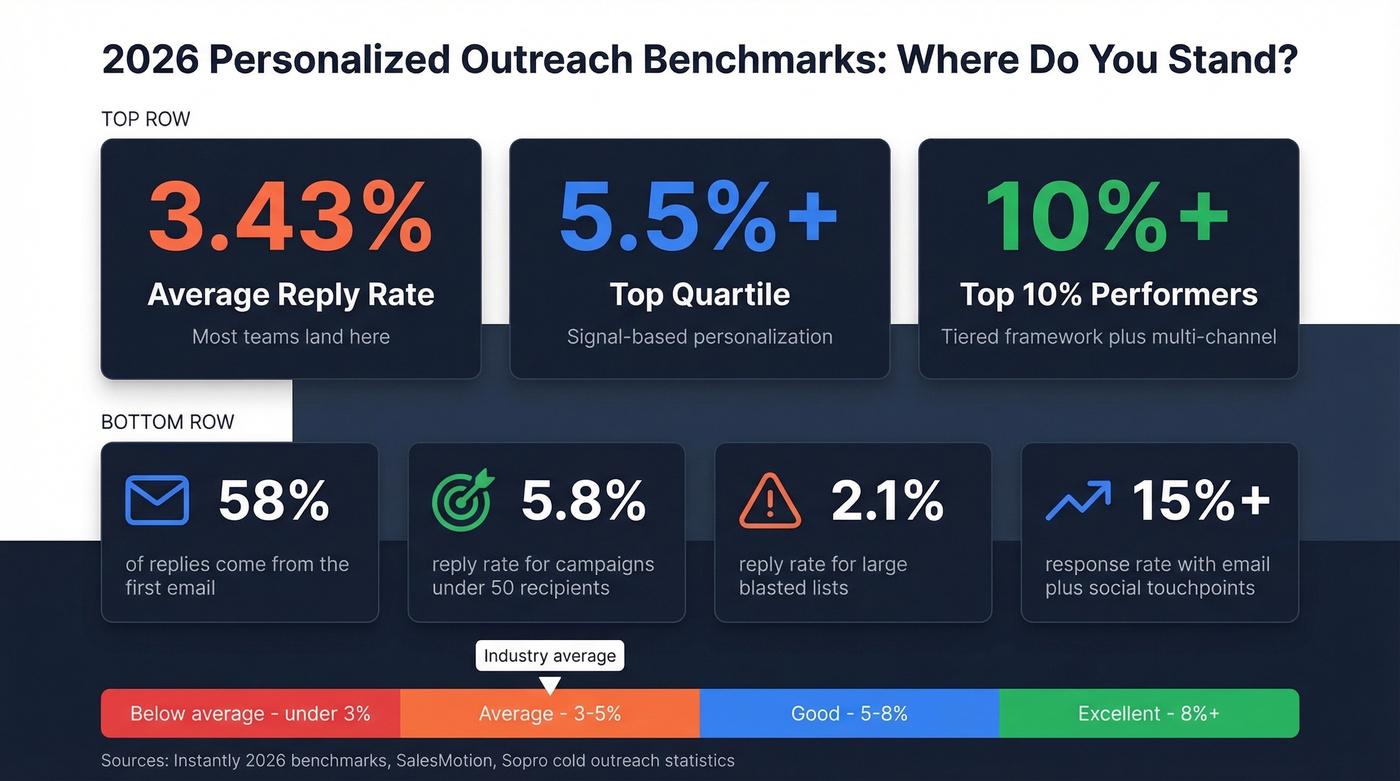
| Metric | Benchmark | Top Performers |
|---|---|---|
| Reply rate | 3.43% average | 5.5%+ (top quartile), 10%+ (top 10%) |
| Replies from step 1 | 58% | - |
| Optimal sequence length | 4-7 touches | 4-5 touches |
| Best email length | Under 80 words | 40-60 words |
| Reply rate (50 or fewer recipients) | 5.8% | vs. 2.1% for large lists |
Source: Instantly 2026 Cold Email Benchmark Report
Sopro's data across 151 million outreach points puts the average cold email response rate at 5.1%. The gap between these numbers tells you something important: "personalization" is a spectrum, and where you land on it determines whether you're at 3% or 6%+.
Here's my hot take: personalization is overrated. Relevance is what matters. A perfectly personalized email about something the prospect doesn't care about still gets deleted. A slightly less personalized email that nails a real pain point gets a reply. If you're closing deals under $10k, you probably don't need deep individual-level personalization at all - company-layer signals with a tight value prop will outperform overwrought "I loved your podcast episode" openers nine times out of ten. Optimize for relevance first, then layer in personalization as proof you've done your homework.
Compliance: Don't Skip This
Cold outreach is legal in most jurisdictions - but the rules have teeth. GDPR penalties reach EUR 20 million. CCPA fines hit $7,988 per intentional violation. 92% of consumers say they care about data privacy, which means sloppy compliance doesn't just risk fines - it damages your brand.
The AI Enrichment Trap
Most teams miss this: when AI enrichment feeds automated lead scoring or routing, GDPR Article 22 kicks in. That means safeguards like human review and the right to contest automated decisions. If you're using AI to score and prioritize leads, build in a human checkpoint. This is the compliance issue that'll bite outbound teams hardest in 2026.
The Basics
- CAN-SPAM (US): Physical address, opt-out mechanism, honor unsubscribes within 10 days.
- GDPR (EU/UK): Lawful basis required - typically legitimate interest for B2B. Clear sender ID, easy opt-out, data minimization.
- CCPA (California): Notice at collection. Right to opt out of data sales. Right to deletion.
- CASL (Canada): Implied consent for B2B with an existing relationship. Express consent otherwise.
Skip this section at your own risk. We've watched agencies lose entire client rosters over a single GDPR complaint.
That 11% bounce rate in the case study above? It's what happens when you skip verification. Prospeo's 5-step email verification - with catch-all handling, spam-trap removal, and a 7-day data refresh - keeps bounce rates under 3% so your carefully personalized outreach actually reaches the inbox.
Personalization is worthless if your emails bounce. Fix the data first.
FAQ
How long should a personalized cold email be?
Aim for 40-60 words. Instantly's 2026 benchmark data shows the best-performing first-touch emails come in under 80 words. Lead with the trigger, state the value, and close with a soft CTA - nothing else.
What's a good reply rate for cold outreach in 2026?
The average across Instantly's dataset is 3.43%. Top quartile campaigns hit 5.5%+, and elite campaigns exceed 10%. Consistently above 5% means you're outperforming most outbound teams. Below 3% signals a structural problem - usually data quality or deliverability.
Does AI personalization actually work?
Only when the AI has real signals - funding rounds, hiring patterns, or tech stack changes - not just a name and company. Signal-based AI outperforms generic mail-merge dramatically. The bottleneck is always context quality, not copy generation speed.
How do I stop cold emails from going to spam?
Keep bounce rates under 2%, use multiple domains capped at 25-30 emails each per day, warm new domains for 2-3 weeks, and verify every address before sending. Spam traps and honeypots are the silent killers of domain reputation - catching them before you hit send is the whole game.