

Targeted Email Campaigns: The Practitioner's Guide to Emails That Actually Convert
Your marketing director just asked why email ROI dropped 15% this quarter - even though open rates look fine. The answer is buried in metrics that are lying to you, segments that are too broad, and a list that's quietly rotting underneath everything.
Only 60% of ecommerce businesses personalize emails based on customer activity. The other 40% are blasting their entire list with the same message and wondering why conversions are flat. Targeted email campaigns fix all three problems, but only if you build them on the right foundation.
The Short Version
Before we go deep, here's what matters most:
Stop trusting open rates. Use click-to-open rate (CTOR) as your primary engagement metric. Apple's Mail Privacy Protection inflates opens by 18 points across 80,000+ accounts. A big chunk of that "42% open rate" is measurement noise.
Build automated behavioral flows, not just broadcast campaigns. Klaviyo's data across 183,000+ brands shows flows convert at 13x the rate of one-off campaign sends. That's not a marginal improvement - it's a different category entirely.
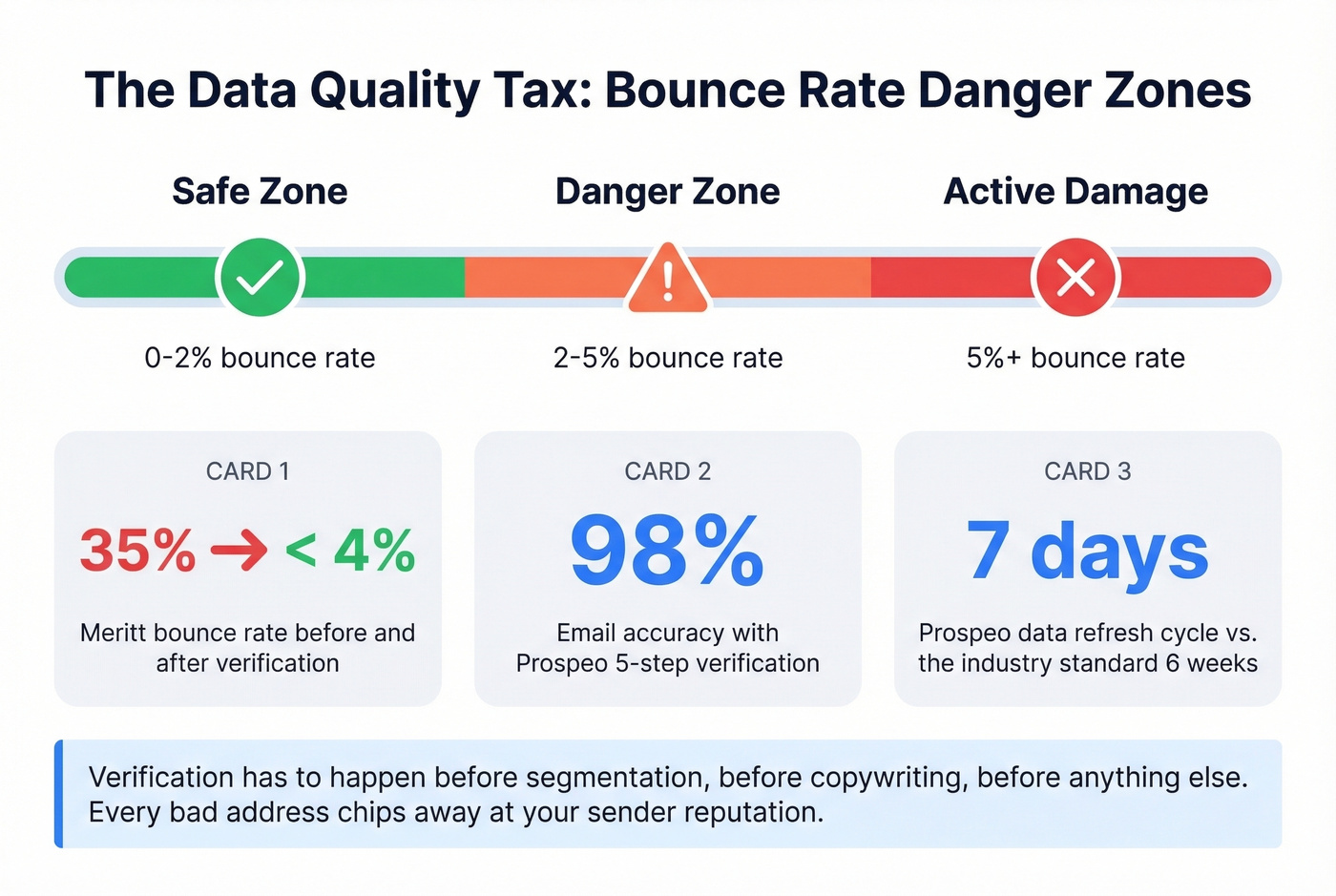
Verify your list before you segment it. Above 2% bounce rate is the danger zone. Above 5%, you're actively damaging deliverability, and no amount of clever copy fixes that.
What Makes Targeted Campaigns Work?
Adding {{first_name}} to a subject line isn't targeting. Neither is blasting your entire list with a "personalized" product recommendation that's identical for everyone.
Real targeting means segmenting your audience by behavior, intent, lifecycle stage, or engagement level, then crafting messages that speak to where each group actually is. Segmented campaigns see 14.31% more opens and 101% more clicks compared to unsegmented sends. That's the gap between email as a cost center and email as a revenue channel.
Why Open Rates Are Lying to You
Open rates have been unreliable since September 2021, and they're getting worse. Apple Mail holds roughly 46% of email client market share, and every email opened on Apple Mail gets pre-fetched by Apple's servers - registering as "opened" whether the recipient actually read it or not.
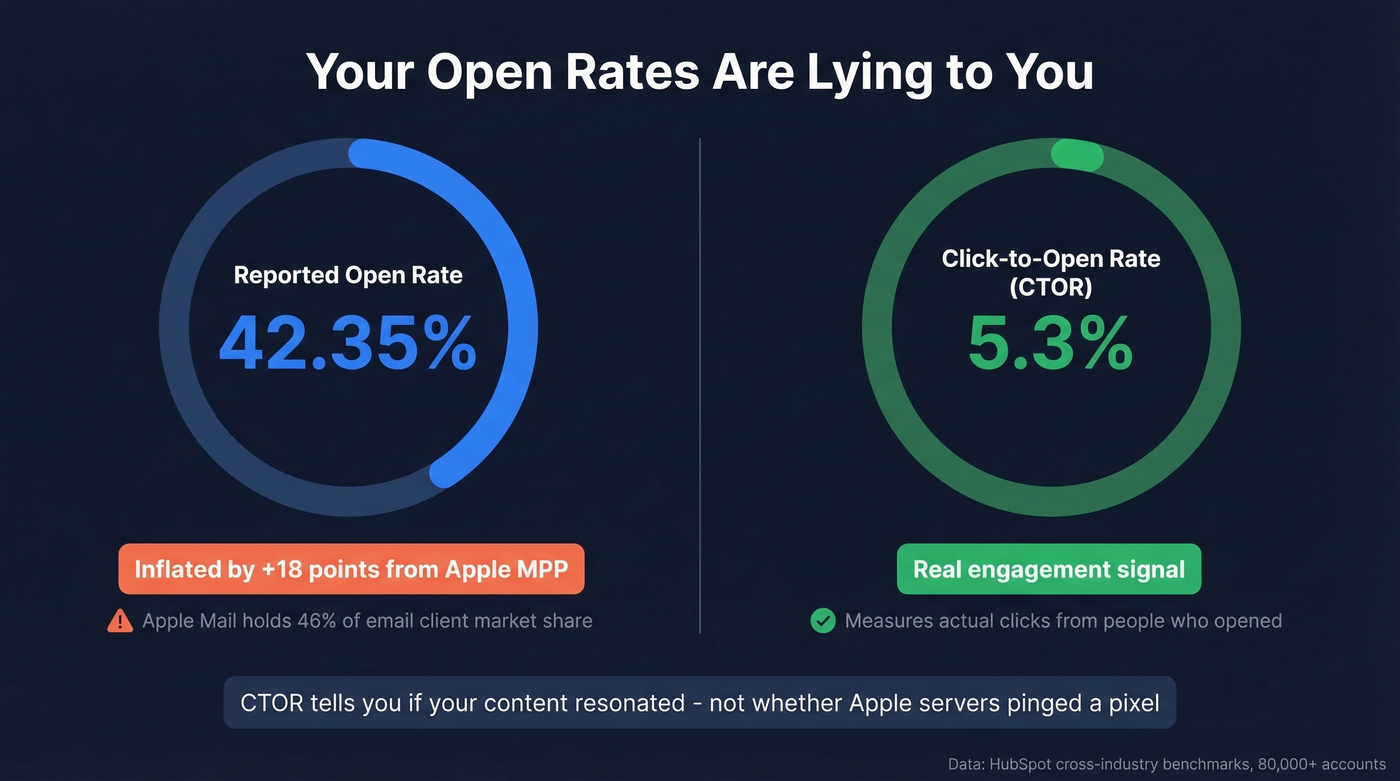
A study of 80,000+ email marketing accounts found open rates jumped 18 points in the six months after Mail Privacy Protection launched. That's not engagement growth. That's noise.
HubSpot's most recent cross-industry average open rate is 42.35%. Looks great on a dashboard. Means almost nothing.
The replacement metric is click-to-open rate (CTOR) - the percentage of people who opened and then actually clicked. HubSpot's cross-industry CTOR sits at 5.3%. That number is real. It tells you whether your content resonated with people who saw it, not whether Apple's servers pinged a tracking pixel.
We've seen teams get clearer signal within two weeks of switching their dashboards from open rate to CTOR. If your reporting still leads with opens, you're optimizing for a vanity metric.
2026 Benchmarks That Actually Matter
Three major platforms publish benchmark data. They don't agree on the numbers - different methodologies, different sample populations - but triangulating across all three gives you a realistic picture.
| Metric | Mailchimp (all) | HubSpot (all) | Klaviyo (campaigns) |
|---|---|---|---|
| Open rate | 35.63% | 42.35% | 31% |
| Click rate | 2.62% | 2.3% | 1.69% |
| CTOR | - | 5.3% | - |
| Unsub rate | 0.22% | 0.22% | - |
| Order rate | - | - | 0.16% |
Mailchimp's data comes from billions of emails sent to lists of 1,000+ subscribers. HubSpot's numbers run higher in part because MPP inflates opens. Klaviyo's dataset covers 183,000+ brands and includes the most useful metric nobody else tracks: placed order rate.
Campaigns vs. Flows
This is where the real insight lives. Klaviyo breaks out one-off campaigns from automated flows - welcome sequences, cart abandonment, win-back - and the gap is staggering:
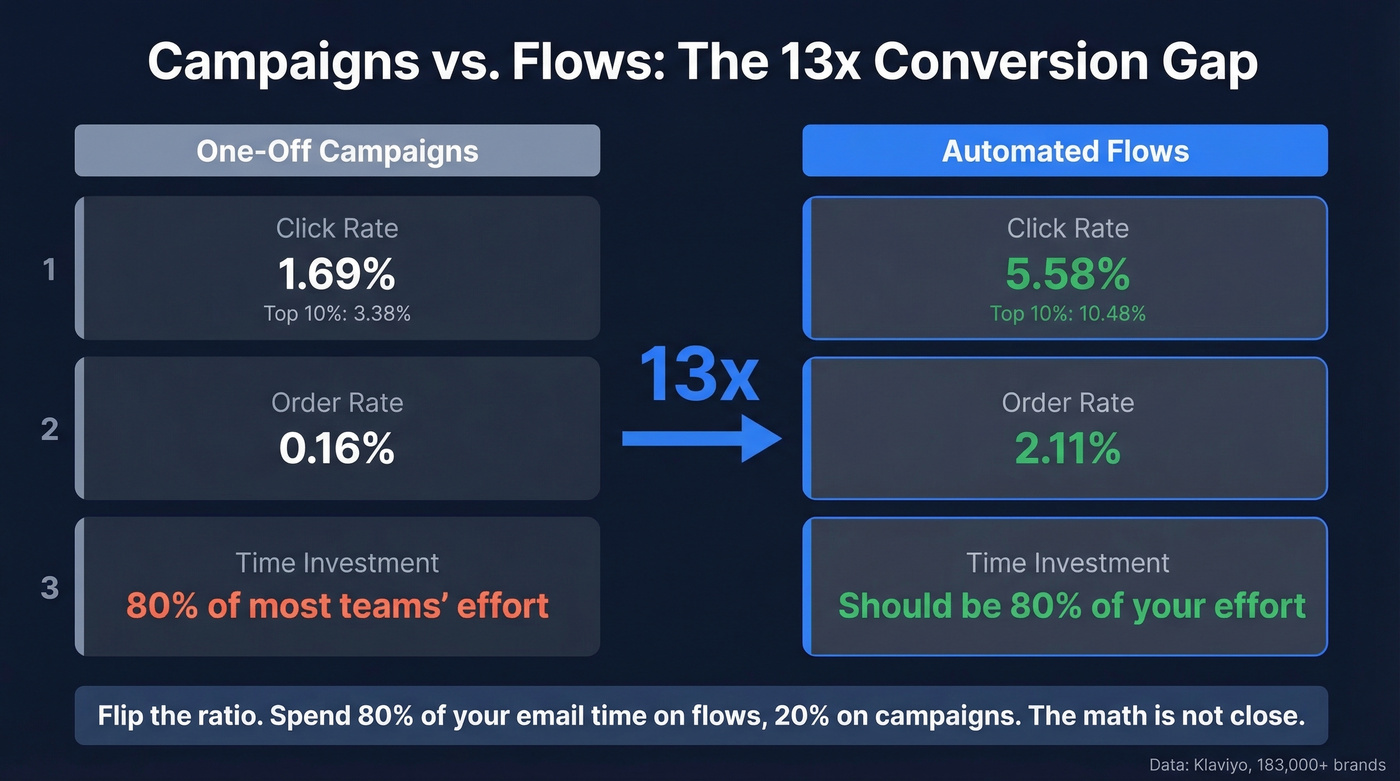
- Campaign click rate: 1.69% average, 3.38% for top 10%
- Flow click rate: 5.58% average, 10.48% for top 10%
- Campaign order rate: 0.16%
- Flow order rate: 2.11%
Flows convert at 13x the rate of campaigns. If you're still running your email program primarily through broadcast sends, you're giving up the majority of your email revenue. The top performers aren't writing better subject lines - they're building better automation.
Most teams spend 80% of their email time on campaigns and 20% on flows. Flip that ratio. The math isn't close.
Building Segments That Move Numbers
Most teams segment by demographics and stop there. Industry, company size, job title - it's a start, but it's table stakes. The teams seeing real lift are layering behavioral and intent signals on top of those basics.
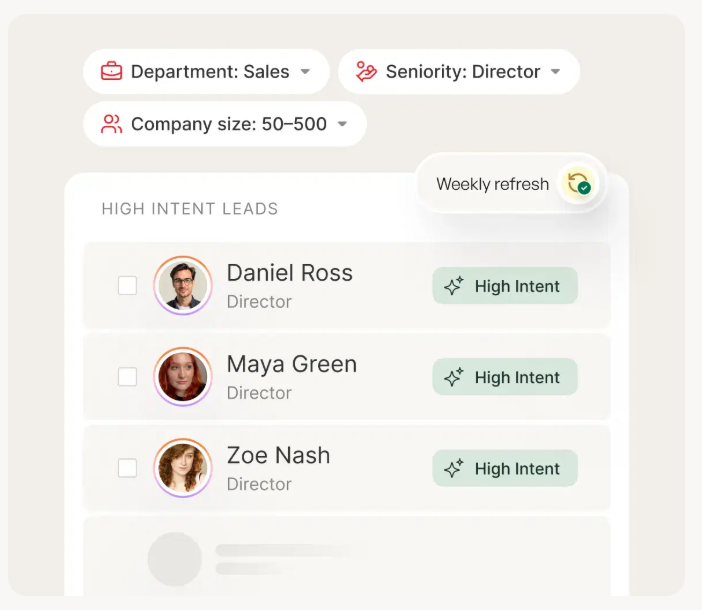
Demographic segmentation narrows the audience but doesn't predict readiness to buy. Industry, geography, company size - these determine which product you pitch, not whether someone's ready to hear the pitch.
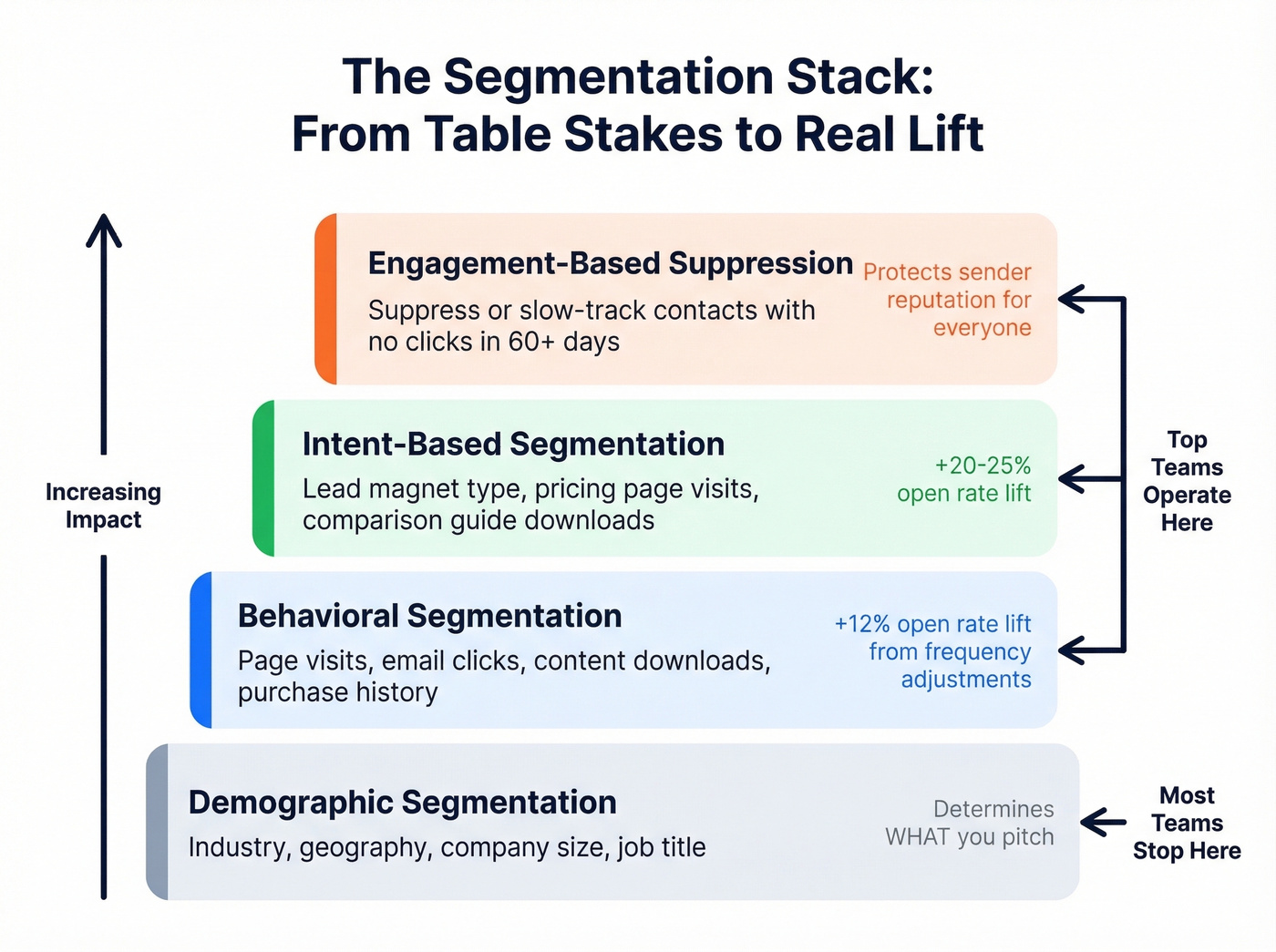
Behavioral segmentation watches what people actually do. Page visits, email clicks, content downloads, purchase history. Briana Torres at Injectco reported a 12% year-over-year open rate boost just by adjusting send frequency based on engagement - heavy clickers get more emails, low-engagement contacts get a slower cadence. This same principle applies to outbound programs, where segmented cold email outreach consistently outperforms generic blasts.
Intent-based segmentation is where the biggest lifts hide. Deepak Shukla saw 20-25% open rate lifts by splitting audiences based on which lead magnet they downloaded. An SEO guide versus a webinar signup signals very different buying intent, and the follow-up should reflect that.
Engagement-based suppression is the move most teams skip. If someone hasn't clicked in 60 days, sending them the same cadence as your most active subscribers hurts deliverability for everyone. Suppress or slow-track disengaged contacts. Your sender reputation depends on it.
A Concrete Segmentation Recipe
Here's an example you can build today in most ESPs: Location = Spain + Date added > 365 days ago + Last opened > 90 days ago. That gives you a lapsed-subscriber segment in a specific market. Instead of blasting them with your standard newsletter, send a re-engagement sequence with a localized offer. This kind of layered filter is what separates "we segment" from "we segment well."
One warning: if your segments are so small that you can't draw meaningful conclusions from performance data, you've gone too far. A segment of 47 people doesn't give you statistical significance on anything. Keep segments large enough to learn from.

You just read that bounce rates above 2% actively damage deliverability. Every segment you build is only as good as the data underneath it. Prospeo's 5-step email verification delivers 98% accuracy - with catch-all handling, spam-trap removal, and a 7-day refresh cycle so your list never rots.
Stop segmenting a list that's quietly destroying your sender reputation.
Campaign Types That Drive Revenue
Not all campaign types are created equal. Here's where to invest your automation time, ranked by typical ROI impact.
Cart abandonment is the single highest-ROI automation you can build. Baymard Institute pegs the average cart abandonment rate at 69.19%. A well-timed 3-touch sequence - reminder at 1 hour, social proof at 24 hours, discount at 72 hours - recovers a meaningful percentage of that revenue with minimal ongoing effort.
Welcome sequences are your first impression, and they're disproportionately important. In our experience, a 3-5 email welcome flow that progressively profiles subscriber interests outperforms a single "thanks for signing up" by 3-5x on downstream engagement. Don't waste that window.
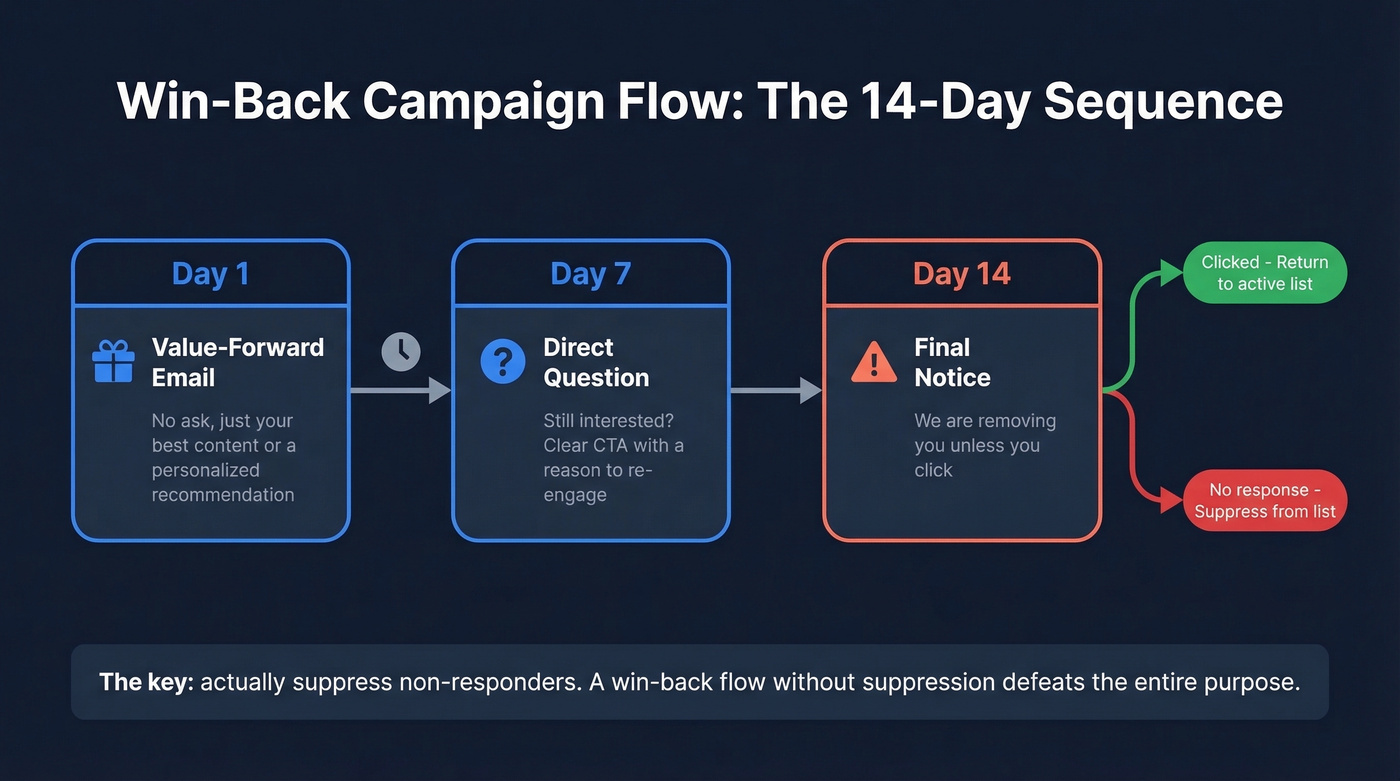
Win-back campaigns deserve a caveat: skip them if you don't have a clear suppression plan. Too many teams build re-engagement flows but never actually remove non-responders, which defeats the purpose entirely. If you do build one, use this cadence:
- Day 1: Value-forward email - no ask, just your best content or a personalized recommendation.
- Day 7: Direct question - "Still interested?" with a clear CTA and a reason to re-engage.
- Day 14: Final notice - "We're removing you from our list unless you click." Then actually suppress non-responders.
Intent-triggered campaigns fire when a prospect signals buying readiness - visiting a pricing page, downloading a comparison guide, or hitting a lead score threshold. These are your highest-intent sends. Niche micro-segment campaigns, like trial users who viewed a specific feature page, often outperform broader sends by 2-3x on conversion rate.
A/B Testing: Keep It Simple
Test one variable at a time: subject line, send time, or CTA placement. The consensus on r/coldemail is consistent - never buy lists, always use a real reply-to address, and keep every email to one clear CTA. Those basics matter more than any multivariate test.
The Foundation Everyone Skips: Data Quality
You've built a beautiful cart abandonment flow. Segmentation is tight, copy is sharp, timing is perfect. Then 12% of your emails bounce.
Your ESP flags the spike. Inbox placement drops across your entire domain. Suddenly your best-performing welcome sequence is landing in spam too.
That's the data quality tax, and it compounds silently. Every bad email address you send to chips away at your sender reputation. Bulk-sender guidelines set the threshold at 2% bounce rate. Above that, you're in the danger zone. Above 5%, you're actively damaging your ability to reach anyone.
Verification has to happen before segmentation, before copywriting, before anything else. Prospeo's 5-step verification process handles syntax checks, domain validation, catch-all handling, spam-trap removal, and honeypot filtering - delivering 98% email accuracy on verified addresses. Meritt saw their bounce rate drop from 35% to under 4% after switching, which unlocked the deliverability headroom they needed for outbound campaigns to actually land. And because Prospeo refreshes data on a 7-day cycle, addresses don't go stale between campaigns the way they do with tools running on the industry-standard 6-week refresh.
Intent-based segmentation drives the biggest lifts - but you need intent signals to build those segments. Prospeo tracks 15,000 buyer intent topics via Bombora, layered with 30+ filters like technographics, job changes, and headcount growth. Build segments that predict readiness to buy, not just fit.
Layer real intent data into every segment for $0.01 per verified contact.
Deliverability Checklist for 2026
Clean data gets you to the starting line. Deliverability infrastructure gets you across it. Litmus found that 70% of emails show at least one spam-related issue, and programs that actively monitor deliverability are 22% more likely to rate themselves successful.
Here's the non-negotiable list:
- SPF, DKIM, and DMARC with proper domain alignment. Google and Yahoo enforce these for bulk senders, with Microsoft joining.
- RFC 8058 one-click unsubscribe via List-Unsubscribe and List-Unsubscribe-Post headers. Required for bulk senders now.
- Spam complaints under 0.3%. Above that threshold, mailbox providers start throttling your sends.
- Bounce rate under 2%. Verification before sending keeps this in check without manual list scrubbing. (If you need a deeper breakdown of bounce types and thresholds, see bounce rate.)
- Inbox placement above 90%. If you drop below this floor, investigate immediately - something in your authentication, content, or list hygiene is off.
- Domain warmup for new sending domains. Start at 5-10 emails per day and ramp over 4-6 weeks. Rushing this is the fastest way to land in spam from day one.
- Mobile-responsive templates. Over 60% of email opens happen on mobile. If your emails break on a phone screen, nothing else matters.
Choosing the Right Platform
The ESP market is crowded, but the decision usually comes down to your use case and budget. Here's a directional comparison for the platforms that come up most in practitioner discussions:
| Platform | Starts at | Best for | Honest tradeoff |
|---|---|---|---|
| MailerLite | $9/mo | Simple, cheap campaigns | Limited advanced automation |
| Brevo | $8/mo | Budget + transactional | Basic templates, features gated |
| Mailchimp | $13/mo | Easy editor, brand recognition | Free automations very limited |
| ActiveCampaign | $15/mo | Deep behavioral automation | Brutal learning curve |
| Omnisend | $16/mo | Ecommerce + SMS | Less useful outside ecommerce |
| HubSpot | $20/mo | CRM-integrated marketing | Gets expensive fast at scale |
| Klaviyo | ~$20-$35/mo | Predictive ecommerce segmentation | Overpriced outside ecommerce |
The r/MarketingAutomation consensus is clear: ecommerce teams should look at Klaviyo or Omnisend for predictive segmentation and native Shopify integrations. B2B teams do better with ActiveCampaign or HubSpot, where CRM integration and lead scoring matter more than product catalog syncs. For teams watching their budget, Brevo or MailerLite both offer solid deliverability at a fraction of the cost.
Here's the thing: Klaviyo pricing climbs fast as your list grows. If you're not running an ecommerce store, that spend doesn't justify itself. And ActiveCampaign's automation builder is powerful but genuinely takes weeks to learn. Pick based on what you'll actually use, not what has the longest feature list.
Compliance in Plain English
GDPR
If any subscriber is in the EU, GDPR applies - regardless of where your company is based. Cumulative GDPR fines have reached roughly EUR5.88B across 2,245 enforcement actions, with penalties up to EUR20M or 4% of global annual turnover.
The rules that matter for email: consent must be explicit with no pre-checked boxes, collecting an email for order confirmations doesn't grant promotional permission, and you can't keep inactive subscribers on your list indefinitely. If someone hasn't engaged in 12+ months and you have no other legal basis, remove them.
CCPA
CCPA applies to for-profit businesses with $25M+ revenue or those handling data on 100,000+ California residents. Penalties range from $2,500 to $7,500 per violation. You have 45 days to respond to Right to Know or Right to Delete requests, and 15 business days for opt-out requests. One detail that catches marketers off guard: email engagement metrics like opens, clicks, and timestamps count as personal information under CCPA's broad definition.
FAQ
What's a good click-to-open rate?
HubSpot reports a 5.3% CTOR across industries, while top performers hit 8-10%. CTOR is the most reliable engagement metric in 2026 because Apple's Mail Privacy Protection inflates open rates by roughly 18 points.
How often should I send emails?
Match frequency to engagement level. Heavy clickers handle 3-4 sends per week without fatigue. Low-engagement contacts should get once a week or less. If your unsubscribe rate spikes above 0.5%, you're over-sending.
What's the difference between campaigns and flows?
Campaigns are one-off broadcasts sent on a specific date. Flows are behavior-triggered sequences that run automatically. Klaviyo's data shows flows convert at 13x the rate of campaigns because each prospect enters based on their own action rather than an arbitrary send date.
How do I clean my list before sending?
Run your list through a verification tool to flag invalid addresses, spam traps, and catch-all domains. Prospeo's free tier includes 75 verifications per month - enough to audit a segment - and delivers 98% accuracy. Remove anyone who hasn't engaged in 90+ days and aim for under 2% bounce rate.
Do I need GDPR compliance if I'm US-based?
Yes, if any subscriber is in the EU. GDPR applies based on the data subject's location, not your company's headquarters. Use double opt-in for EU subscribers and honor unsubscribe requests immediately. Fines reach up to EUR20M or 4% of global revenue.
The core loop for targeted email campaigns is simple: verify your data, segment by behavior and intent (see intent-based segmentation), automate flows instead of broadcasting, and measure CTOR instead of open rates. Get those four things right and you'll outperform most email programs running today.