

Anchor in Negotiation: What 84 Studies Say About the First Number
You're up for a new role. The recruiter asks your salary expectations. You know you're worth $110K, but they've already mentioned the range "starts around $85K." Suddenly, $95K feels like a win - even though it's $15K below your target. That's an anchor in negotiation, and it just cost you money.
Here's the maddening part: half the advice on the internet says "never give a number first," and the other half says the first number wins. Both camps cite research. Both sound confident. Neither tells you what to actually do in the moment. Let's fix that.
The Three Rules That Cover 80% of It
If you're short on time:
- Use precise numbers. $47,500 beats $50,000. Recipients perceive precision as knowledge and concede more.
- Never anchor naked. Pair every number with a reason. A price without context is just a guess - a price with framing is a position.
- If you get anchored, pause. Remind yourself you have a choice before responding. This choice-mindset nudge reduces anchoring bias across seven experimental studies.
Now let's get into the mechanics.
What Is Anchoring in Negotiation?
Anchoring is a cognitive bias where the first number in a conversation disproportionately influences the final outcome. It's not a tactic someone invented. It's how human brains process numerical information under uncertainty.
The classic demonstration comes from Tversky and Kahneman's 1974 research. Participants spun a rigged roulette wheel that landed on either 10 or 65, then estimated the percentage of African nations in the United Nations. The group that saw 10 estimated 25%. The group that saw 65 estimated 45%. A completely random number - one with zero informational value - shifted estimates by 20 percentage points.
Guhan Subramanian at Harvard tells a classroom story that makes this concrete. A student argued that $10.69/hour was unreasonable as a starting wage. After extended negotiation, the final deal landed at... $10.69/hour. The anchor held. Not because it was fair, but because it was first.
Does the Anchoring Effect Actually Work?
Most anchoring articles cite that one 1974 study and stop. The real evidence base is much deeper.
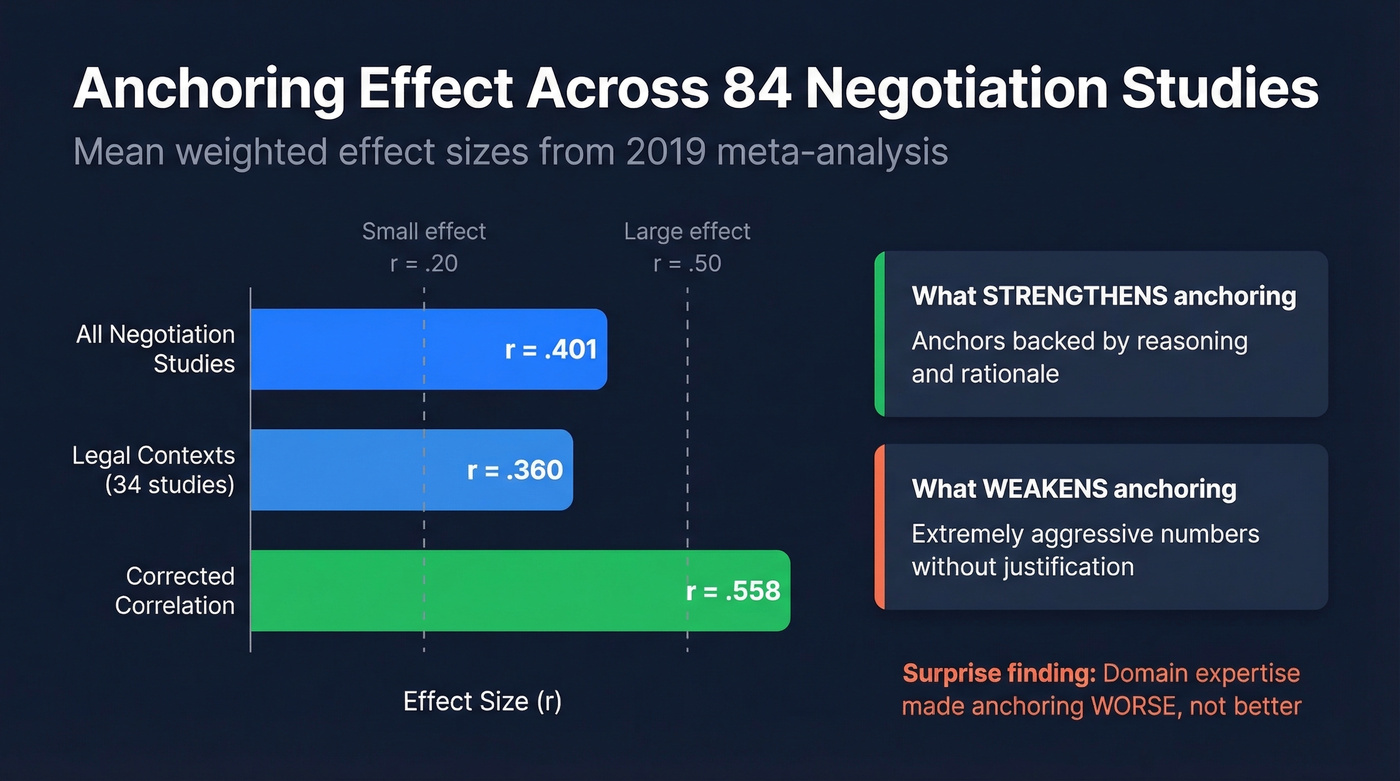
A 2019 meta-analysis synthesized 84 effect sizes across negotiation studies and found a mean weighted effect size of r = .401, with a corrected correlation of .558. That's a large effect in social science. In legal contexts specifically (34 studies), the effect was r = .360 - slightly weaker, but still substantial enough to shift jury awards and settlement figures by tens of thousands of dollars.
Two moderators matter for practitioners: more extreme anchors slightly weakened the effect, while anchors perceived as meaningful - backed by reasoning - significantly strengthened it. An ambitious number with a rationale beats an outrageous number every time.
Experienced negotiators aren't immune. The meta-analysis found that domain expertise actually exacerbated anchoring rather than mitigating it. We've seen this firsthand in B2B deal reviews - senior reps who "know the market" often accept a buyer's first counter more readily because they generate reasons why it might be justified. The smarter you think you are, the more vulnerable you become.
The precision angle is equally powerful. Columbia Business School research involving 1,254 fictitious negotiators found that precise opening offers ($5,015 vs. $5,000) led to better outcomes because recipients perceived the offer-maker as more informed. Yet a review of Zillow listings found only 2% of home sellers used precise dollar amounts. Almost everyone rounds - which means precision is a free edge.
Should You Make the First Offer?
This is the question that generates the most contradictory advice.
A 2026 paper in Humanities and Social Sciences Communications (Nature) interviewed 49 negotiation practitioners and uncovered what the researchers call the "Practitioner-Researcher Paradox." Academic literature overwhelmingly supports moving first. Practitioners often prefer moving second for the information advantage. Both sides have evidence.
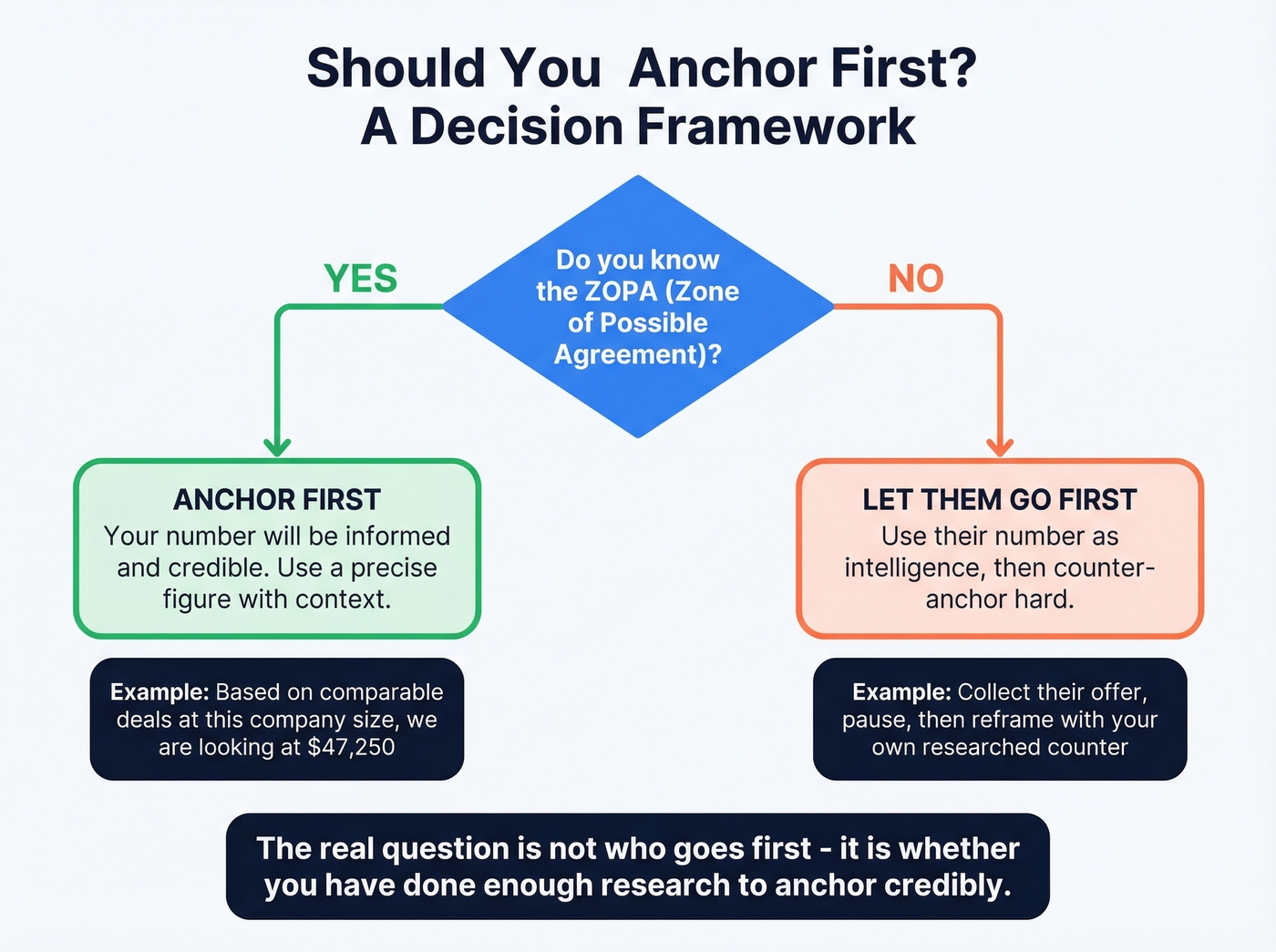
The resolution is a knowledge question. Harvard's Program on Negotiation frames it as a ZOPA assessment:
If you know the ZOPA, anchor first. Your number will be informed and credible.
If you're operating blind, let them go first. Use their number as information, then counter-anchor hard.
Lipp et al. (2023) introduced the "anchor zone" concept - the space between the first and second offer. Even if you move second, your counter-anchor shapes the negotiation through its effect on concession patterns.
Chris Voss takes the contrarian position: "he who names the price first loses." There's wisdom here for complex, relationship-heavy deals where the ZOPA is genuinely unknown. For a salary negotiation or a straightforward procurement deal where you've done your homework? Anchor first.
Here's the thing everyone misses: the debate over who goes first is the wrong debate. The better question is whether you've done enough research to anchor credibly. A prepared second mover beats an uninformed first mover every time - and most first movers are woefully uninformed.

The best anchor in any negotiation is preparation - and preparation starts with reaching the right decision-maker. Prospeo gives you 98% accurate emails and verified direct dials from 300M+ profiles, so you walk into every deal knowing exactly who holds the budget.
Stop negotiating blind. Start every deal with verified buyer data.
How to Set an Effective Anchor
Four steps, in order.
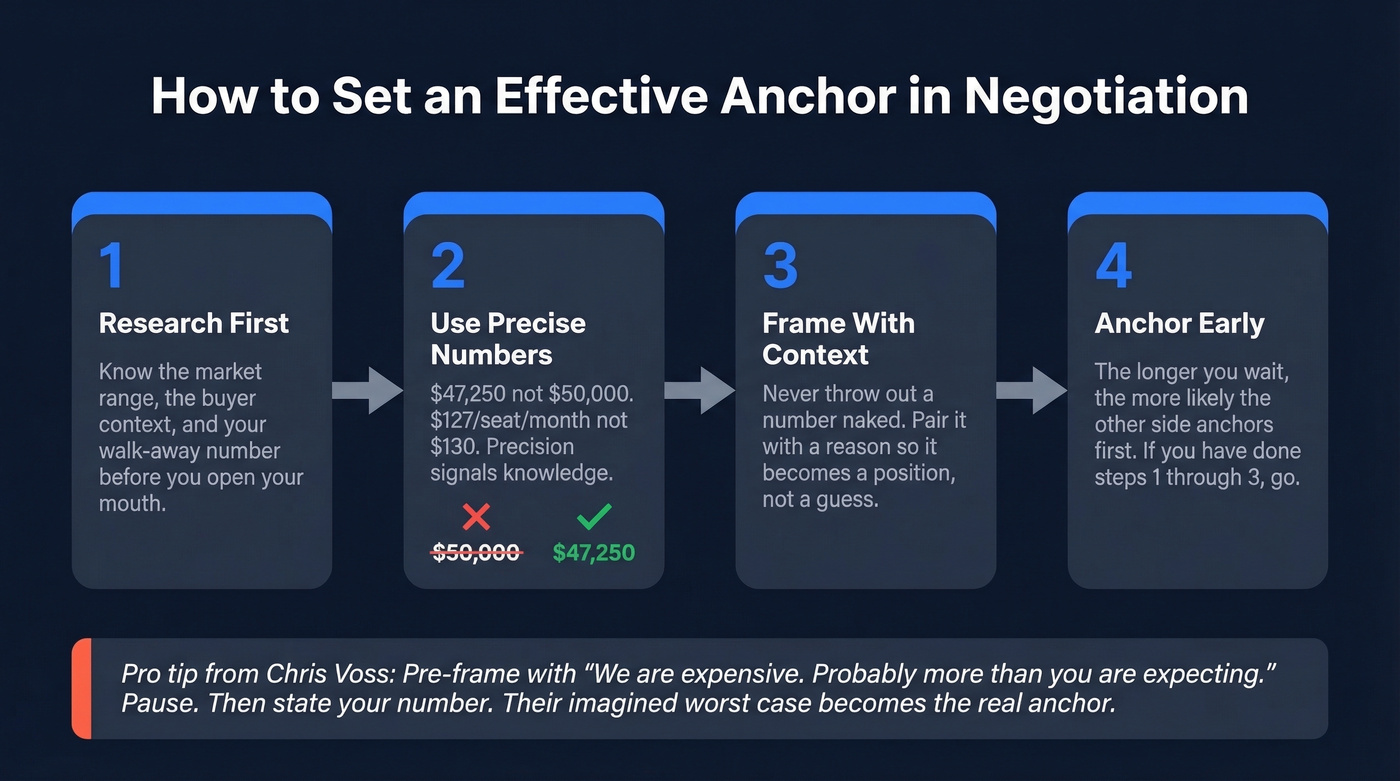
2. Use precise numbers. $47,250, not $50,000. $127/seat/month, not $130. The Columbia research is clear: precision signals knowledge, and knowledge earns concessions. In our experience, precision works best in written proposals where the number sits on the page and invites scrutiny.
3. Frame with context. Never throw out a price naked. Pair your number with a reason: "Based on the scope of this implementation and comparable deals we've closed at this company size, we're looking at $47,250." The number alone is an anchor. The number plus reasoning is a position.
4. Anchor early. The longer you wait, the more likely the other side anchors first. If you've done steps 1-3, you've earned the right to set the frame.
Anchoring isn't just about price, either. Proposing a two-week delivery timeline anchors the conversation around speed, even if four weeks is more realistic. Scope, deadlines, payment terms - every quantifiable element of a deal is an anchoring opportunity.
The Emotional Pre-Frame
Chris Voss uses a technique worth stealing: before stating your number, pre-frame it so the actual figure feels like relief. Say something like, "We're expensive. Probably more than you're expecting." Pause. Let them brace. Then state your number. Because they imagined something worse, your real price lands softer - their imagined worst-case becomes the anchor, and your actual offer feels reasonable by comparison.
How to Counter an Anchor
Getting anchored is inevitable. Here's how to neutralize it.
Name the Gap, Not the Number
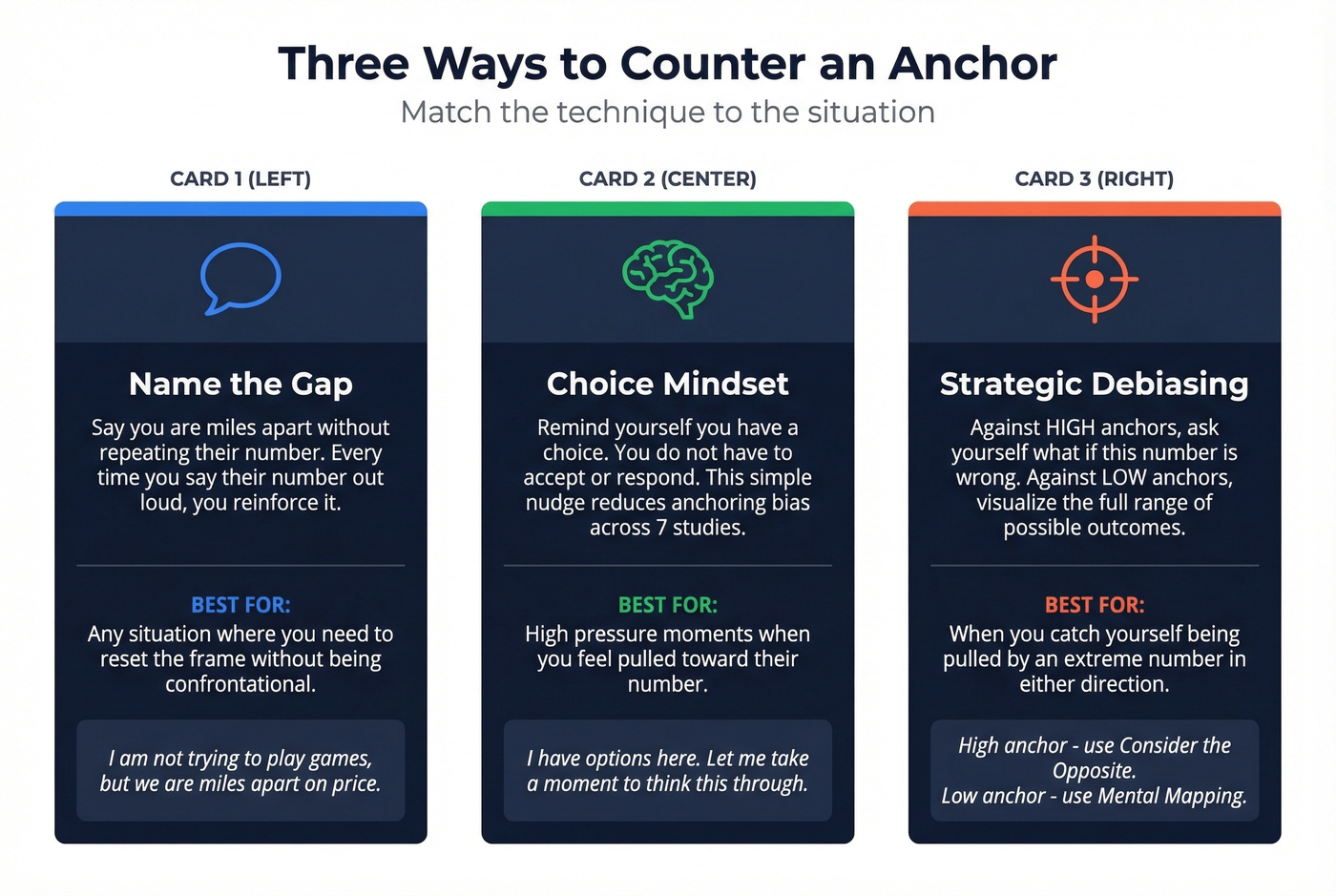
"I'm not trying to play games with you, but we're miles apart on price." Pause. Then present your counter with framing. This Harvard-recommended approach works because it names the gap without repeating their number. Every time you say their number out loud, you reinforce it.
The Choice Mindset
A 2024 study in the Journal of Experimental Social Psychology tested this across seven studies: simply reminding yourself that you have a choice - that you don't have to accept or respond to the anchor - reduces its pull. The reminder prompts you to generate more counteroffers mentally, weakening the anchor's dominance. One caveat: this effect fades under high cognitive load, which is why the best negotiators pause before responding to any first offer.
Pick Your Debiasing Direction
A 2024 PLoS One study found asymmetric effectiveness between two debiasing strategies. "Consider the opposite" - asking yourself what if this number is wrong? - works best against high anchors. "Mental mapping" - visualizing the full range of possible outcomes - works better against low anchors. Match the technique to the direction of the anchor.
When the Anchor Is Absurd
Voss's approach here is blunt: "Ha! That was a good one. Nice." Beat. "I'm sorry, but when you use a number like that, I feel like I'm wasting my time because it's completely unworkable." Then silence. This reframes the extreme anchor as socially inappropriate rather than engaging with it as a starting point. Skip this if you're in a long-term vendor relationship where the other side might just be testing the waters - a lighter touch works better when you'll be renegotiating with the same people next quarter.
When Anchoring Backfires
Anchoring isn't free.
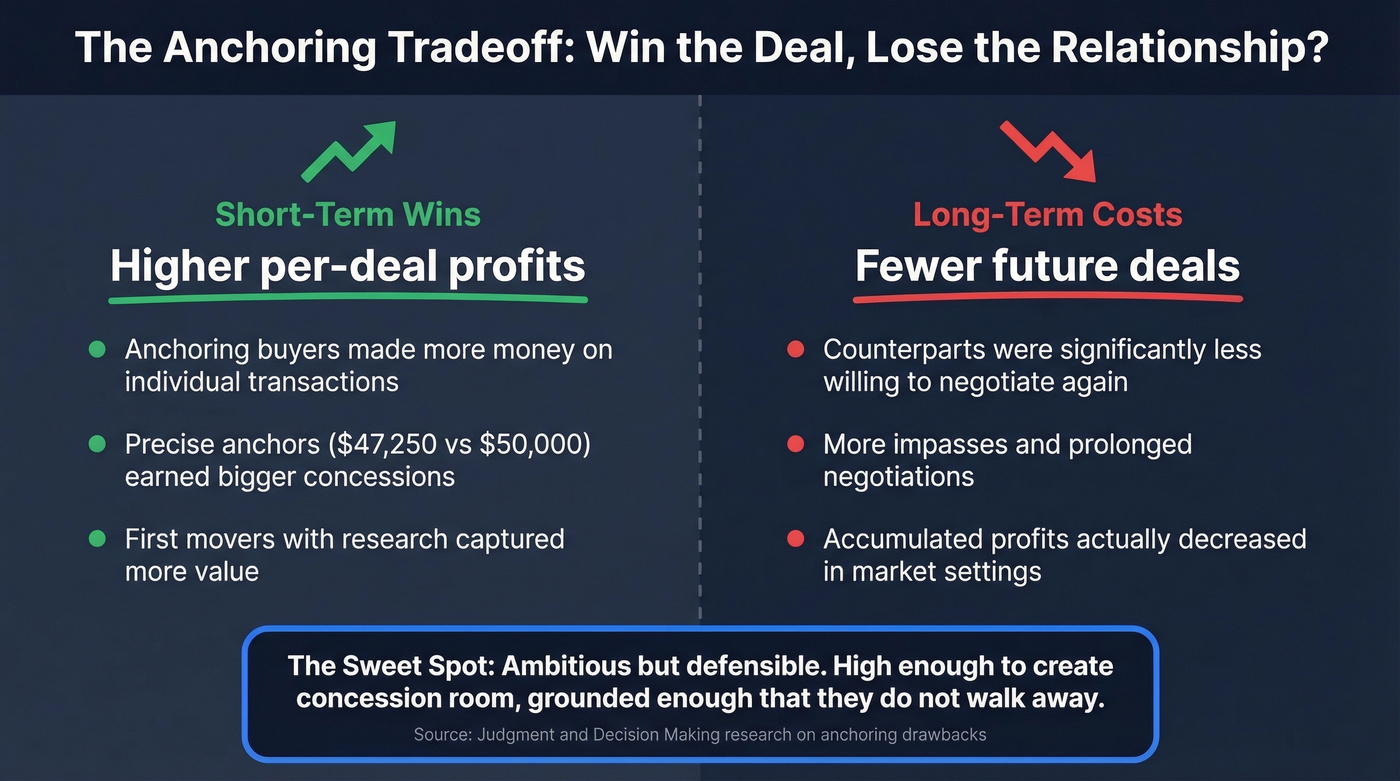
A study in Judgment and Decision Making found that buyers who used anchoring tactics made higher profits on individual deals - but their counterparts were significantly less willing to negotiate with them again. In a market setting, anchoring actually decreased accumulated profits by increasing impasses and prolonging negotiations.
A SaaS seller on r/sales worried about anchoring at 3x the typical final price, fearing it would "ruin credibility" given six-figure swings. That fear is justified - if you can't defend the number. An ambitious anchor backed by data is a negotiation strategy. An ambitious anchor backed by nothing is a bluff, and bluffs get called.
The sweet spot is ambitious but defensible. High enough to create room for concession, grounded enough that the other side doesn't walk away.
Anchoring in B2B Sales
Everything above applies to B2B deals, but the preparation bar is higher. When you're anchoring a $50K proposal, the buyer's procurement team will pressure-test your number against market rates, competitive bids, and internal benchmarks. Your anchor needs to survive scrutiny.
The strongest B2B anchors start with intelligence, not intuition. Before you price a proposal, you need verified data on the prospect's company size, funding stage, tech stack, and growth trajectory. When you know a prospect just raised a Series C and is hiring 40 engineers, you anchor differently than when they're a bootstrapped 20-person team. We've seen B2B teams completely reframe their pricing simply by checking a prospect's latest funding round before the call - a five-minute check that shifts the entire negotiation.
Lead with your premium option. If you have three tiers, open with the highest. The premium price becomes the anchor, and your mid-tier suddenly looks reasonable by comparison. But it only works if the premium tier is a real offering with real value, not a decoy. Understanding the anchoring effect in sales is what separates reps who discount reflexively from those who hold margin while still closing deals.
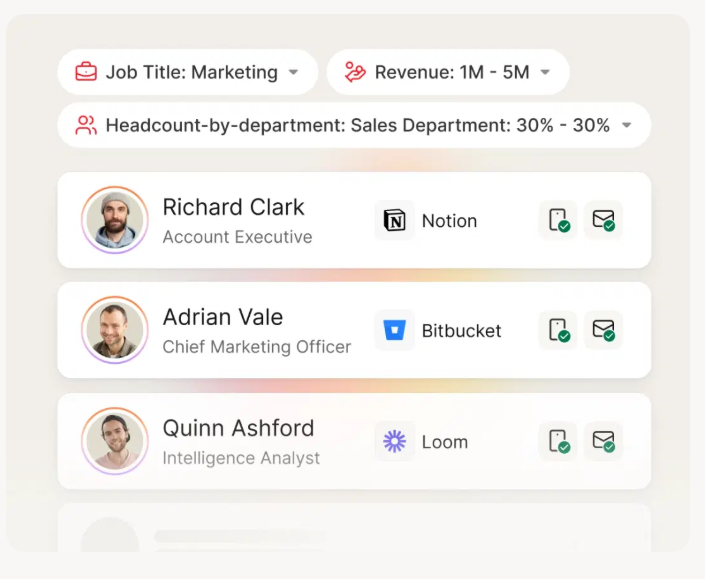
Research beats tactics every time. Before you anchor a price, use Prospeo's 30+ filters - buyer intent, funding signals, headcount growth - to know your prospect's situation cold. When your number comes with context, it's not a guess. It's a position.
Anchor with confidence. Let intent data tell you what buyers care about.
FAQ
Is anchoring manipulative?
Anchoring operates whether you intend it or not - someone always names a number first. Being deliberate about your anchor in negotiation is preparation, not manipulation. The ethical line: use defensible numbers and transparent reasoning, not fabricated figures designed to exploit.
Does anchoring work on experienced negotiators?
Yes - often more effectively. The 84-study meta-analysis found that domain expertise exacerbated anchoring bias rather than mitigating it. Experts generate more reasons why an anchor might be justified, which paradoxically strengthens its hold.
What data do I need before setting a B2B anchor?
Company revenue, headcount, funding stage, tech stack, and decision-maker role. These five data points let you calibrate an anchor that's ambitious but credible. Prospeo's 30+ search filters surface all five in seconds - the difference between a defensible position and a blind guess.
How does anchoring in sales differ from everyday negotiation?
B2B anchoring carries higher stakes because buyers often have procurement teams, competitive bids, and internal benchmarks to cross-reference your number. The core psychology is identical, but your opening figure needs to be backed by verifiable market data rather than gut instinct alone.