

Marketing Generated Pipeline: The Operational Guide to Measuring, Reporting, and Growing It
Finance asked why marketing spent $200K last quarter and pipeline is flat. You pull up the dashboard, and it's a mess of MQLs, campaign touches, and "influenced" numbers that don't tie to a single closed deal. This is the moment where marketing generated pipeline either earns you a seat at the revenue table or gets you relegated to the "cost center" line item.
79% of B2B companies miss their quarterly forecast by more than 10%](https://www.outreach.io/resources/blog/sales-pipeline-generation). A big reason? Nobody agrees on what marketing actually generated. This isn't a vanity metric. It's a system. Let's build one that holds up when the CFO asks questions.
What Marketing Generated Pipeline Actually Means
Two terms get conflated constantly, and the confusion creates quarterly fights between sales and marketing.
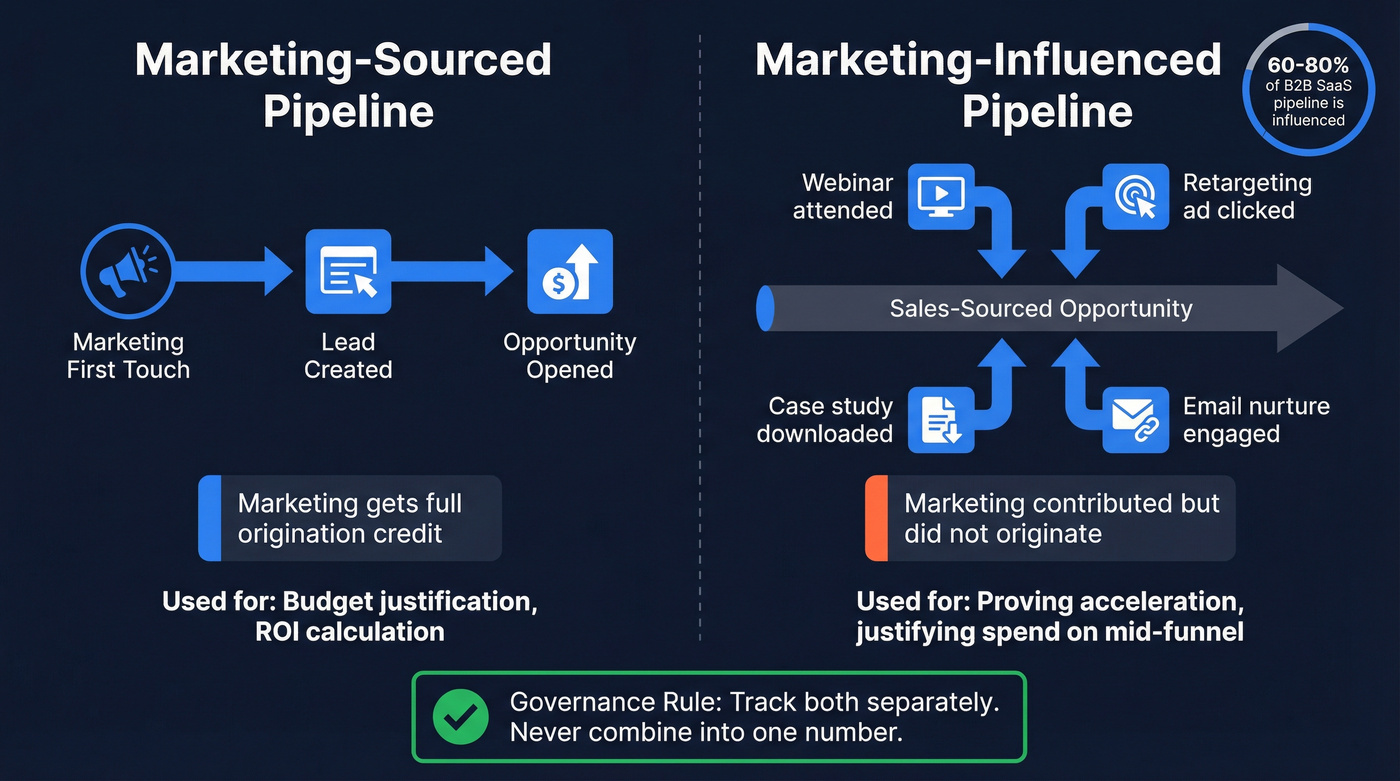
Marketing-sourced pipeline is pipeline where marketing originated the opportunity - the first meaningful touch came from a marketing channel and led directly to opportunity creation. Marketing gets full origination credit.
Marketing-influenced pipeline is broader: the total pipeline value where marketing contributed at least one meaningful touchpoint, regardless of who originated the deal. A sales-sourced opportunity where three buying committee members attended a webinar before close? That's influenced. Tracking influence separately gives leadership a clearer picture of how campaigns accelerate deals already in motion, rather than just start them.
Marketing-influenced pipeline typically represents 60-80% of total pipeline in B2B SaaS. Here's the number that should change how you staff your next QBR: influenced opportunities close 15-30% faster than non-influenced deals. That alone justifies tracking it as a separate, first-class metric.
The governance rule that matters most: track both, but never combine them into a single number. The moment you blend sourced and influenced, you're double-counting, and finance will catch it.
How to Measure Marketing Pipeline Value
Attribution model selection isn't a religion - it's a decision about which question you're answering.
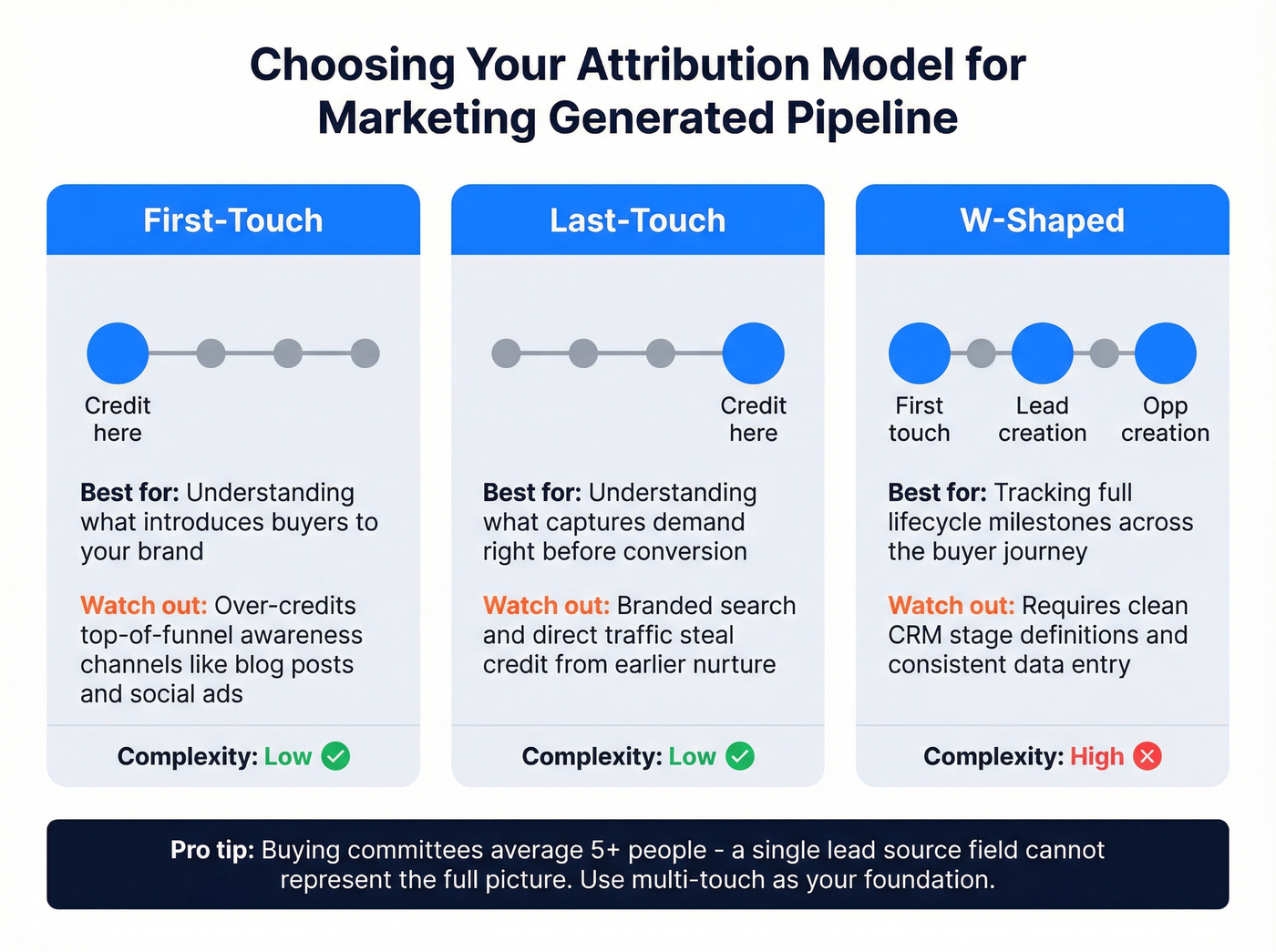
| Model | Best For | Watch Out For |
|---|---|---|
| First-touch | What introduces buyers | Over-credits awareness |
| Last-touch | What captures demand | Branded search steals credit |
| W-shaped | Lifecycle milestones | Requires clean stage definitions |
Most CRMs still rely on single-touch lead source tracking in 2026 - when buying committees average 5+ people. A single "lead source" field can't represent six people who each took different paths to your product. Google retired several rules-based attribution models in 2023. If Google gave up on rules-based attribution, stop relying on platform-reported numbers as your source of truth.
For lookback windows, 180-365 days is the standard range. Start at 180 and extend to 365 for enterprise cycles.
Here's the thing: common governance failures kill measurement before it starts. UTM parameters drop silently, reps skip CRM fields, and nobody audits the data until the quarterly review. Fix the plumbing first. Accurate pipeline value depends entirely on clean, consistent data flowing through your CRM.
The Dark Funnel Problem
Attribution reports show roughly 80% of deals as "direct traffic". That's not because buyers typed your URL from memory.
The real influence happened in Slack DMs, peer conversations, G2 research, podcast mentions, and word-of-mouth - channels your analytics can't see. The dark funnel isn't an excuse to stop measuring, though. Layer an influence overlay alongside multi-touch attribution: account-level intent signals, "how did you hear about us" fields, and closed-won deal reviews where reps ask buyers what actually drove the decision.

Dark funnel or not, pipeline starts with reaching the right buyers. Prospeo's 300M+ profiles with 30+ filters - including buyer intent, technographics, and headcount growth - let you build pipeline around your locked ICP, not loose MQL definitions. 98% email accuracy means your sourced pipeline stays clean.
Generate pipeline that survives the CFO's questions.
Benchmarks That Matter
Pipeline coverage ratios vary by segment because win rates and cycle lengths vary:
| Segment | Coverage Ratio | Typical Cycle |
|---|---|---|
| SMB | 2-3x quota | 30-60 days |
| Mid-market | 2.5-4x quota | 60-120 days |
| Enterprise | 3-5x quota | 90-180+ days |
Pipeline health isn't just coverage. Track quality - likelihood to convert - and convertibility - will it close in the forecast window - alongside volume. Report both unweighted pipeline ("how much is in play?") and weighted pipeline ("how much is realistically likely?") so leadership sees the full picture.
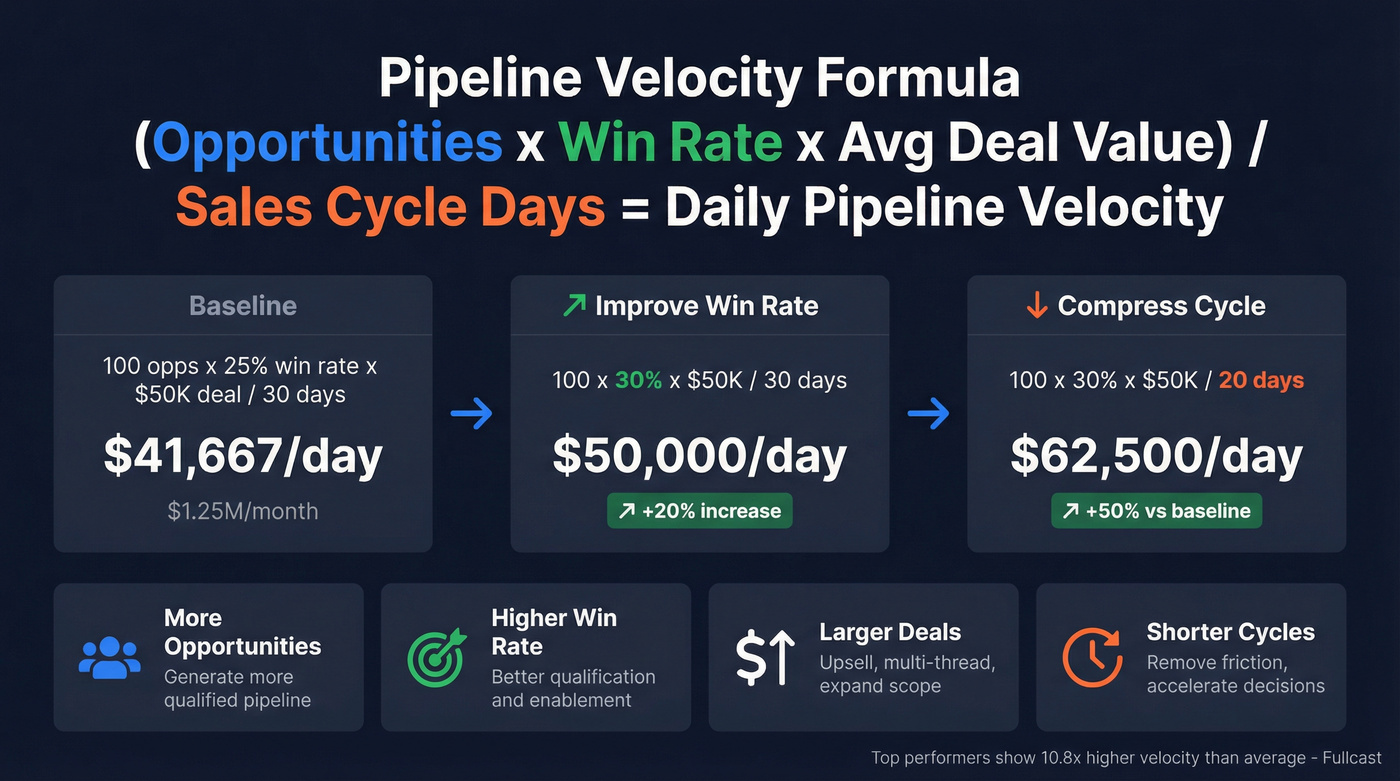
The pipeline velocity formula is where this gets actionable:
(Opportunities x Win Rate x Avg Deal Value) / Sales Cycle Days
Worked example: 100 opportunities x 25% win rate x $50,000 average deal / 30 days = $41,667/day, or roughly $1.25M/month. Bump win rate to 30% and velocity jumps to $50,000/day. Compress the cycle from 30 to 20 days and you hit $62,500/day - a 50% increase from one operational lever. These aren't abstract improvements; they're specific levers marketing and sales can pull together. Fullcast's benchmarks report a 10.8x gap in sales velocity between top and average performers, which tells you execution on these levers compounds fast.
Hot take: If your average deal size is under $15K and your sales cycle is under 30 days, velocity math matters more than attribution precision. Spend your energy compressing cycle time, not debating first-touch vs. multi-touch.
Teams that track pipeline weekly correlate with 87% forecast accuracy. Monthly reviews catch coverage gaps too late.
Reporting Pipeline to Leadership
The exec KPI stack should follow this order - it mirrors how a CFO thinks about investment and return:
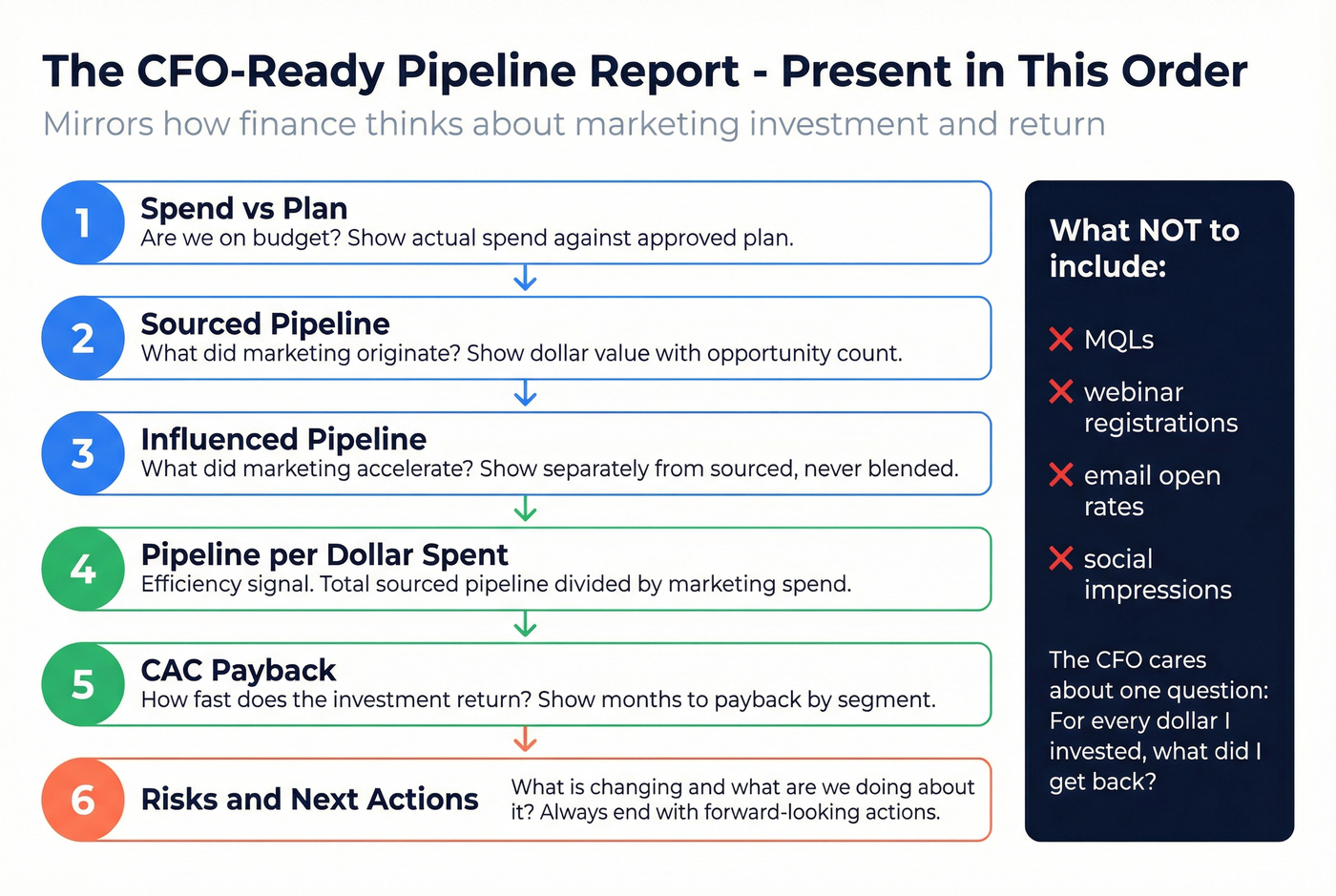
- Spend vs. plan - are we on budget?
- Sourced pipeline - what did marketing originate?
- Influenced pipeline - what did marketing accelerate?
- Pipeline per dollar spent - efficiency signal
- CAC payback - how fast does the investment return?
- Risks + next actions - what's changing and what are we doing about it?
The CFO doesn't care about MQLs or webinar registrations. They care about one question: "For every dollar I invested, what did I get back?" For the dark funnel, pre-load your deck with the influence overlay. Lead with attributable revenue, then add context about intent spikes and review site activity in the last 30-90 days before close.
How to Grow Marketing Generated Pipeline
Stop obsessing over attribution precision. Start obsessing over these levers.
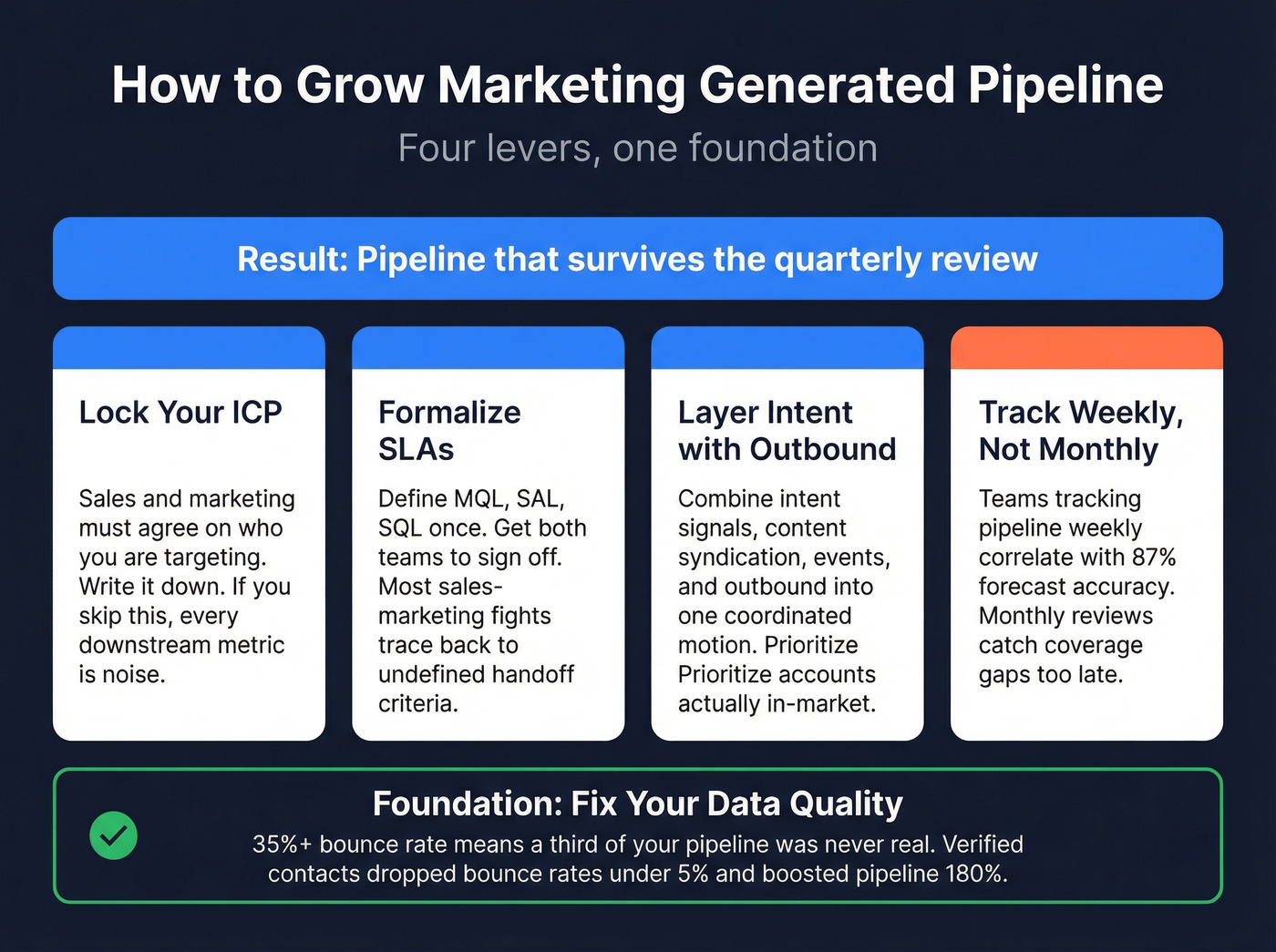
Lock your ICP definition. If sales and marketing can't agree on who you're targeting, every downstream metric is noise. We've seen teams burn entire quarters arguing about lead quality when the real problem was that nobody wrote down what "good" looks like.
Formalize SLAs with locked definitions. MQL, SAL, SQL - define them once, get both teams to sign off. The recurring fights on r/marketing about sales-marketing alignment almost always trace back to undefined handoff criteria.
Layer intent with coordinated outbound. Pipeline doesn't come from one campaign. Combine intent signals, content syndication, events, and outbound into a single motion. This is where tools like Prospeo's intent data - tracking 15,000 Bombora topics layered with job role and company growth signals - help you prioritize accounts that are actually in-market rather than spraying campaigns at a static list.
Fix your data quality. This is the lever most teams ignore, and it's the one that frustrates us the most. Snyk's team was running a 35-40% bounce rate, meaning more than a third of their "pipeline" was phantom. After switching to verified contact data, bounce rates dropped under 5% and AE-sourced pipeline jumped 180%. A 35%+ bounce rate means a third of your pipeline was never real. Marketing reports it, sales can't work it, and the forecast misses. Skip this step at your own risk.

In our experience, the teams that fix data quality first see the fastest pipeline gains - everything else compounds on top of a clean foundation.
Pipeline velocity compounds when your data is fresh. Prospeo refreshes every 7 days - not 6 weeks - so the contacts feeding your pipeline are current. Teams using Prospeo book 26% more meetings than ZoomInfo and 35% more than Apollo, directly compressing the cycle length lever in your velocity formula.
Faster data refresh means faster pipeline velocity. Do the math.
FAQ
What's the difference between sourced and influenced pipeline?
Marketing-sourced pipeline means marketing originated the opportunity through first touch. Marketing-influenced pipeline means marketing touched an existing opportunity at least once during the buyer journey. Track both separately - blending them into one number creates double-counting that finance will flag immediately.
What pipeline coverage goals should marketing set?
SMB teams should target 2-3x quota coverage, mid-market 2.5-4x, and enterprise 3-5x. Set goals by segment and track weekly. Tie goals to both sourced and influenced numbers so marketing is accountable for origination and acceleration.
How do you track pipeline from dark funnel channels?
Layer account-level intent data, "how did you hear about us" form fields, and closed-won buyer interviews as an influence overlay alongside multi-touch attribution. Expect 30-50% of real influence to be invisible to standard analytics - that's normal, not a failure of your measurement system.