

First Touch Attribution: What It Is, When It Works, and How to Set It Up
Your CMO just asked which channel drove last quarter's pipeline. The podcast sponsorship that started 200 conversations? Zero credit. The branded search ad someone clicked right before filling out a demo form? Full credit. That's last-touch attribution doing what it does - rewarding the closer and ignoring the opener. And it's why 44% of marketers say first touch attribution is actually more useful for measuring digital campaigns, even though 41% default to last-touch anyway.
The Short Version
First touch attribution gives 100% credit to the first interaction a prospect has with your brand. GA4 doesn't offer a dedicated first-click model like Universal Analytics did, but workarounds exist using "first user" dimensions in acquisition reports and explorations. For most teams, the move is simple: pair first-touch for discovery with last-touch for conversion - the "80/20" approach that gives you most of the insight with a fraction of the complexity.
Attribution isn't a reporting preference. It's a decision system. Pick the model that helps you allocate budget, not the one that generates the prettiest dashboard.
What Is First Touch Attribution?
First touch attribution assigns 100% of the conversion credit to the very first marketing interaction in a customer's journey. Someone discovers your brand through an organic blog post, then clicks a retargeting ad, then attends a webinar, then requests a demo - the blog post gets all the credit.
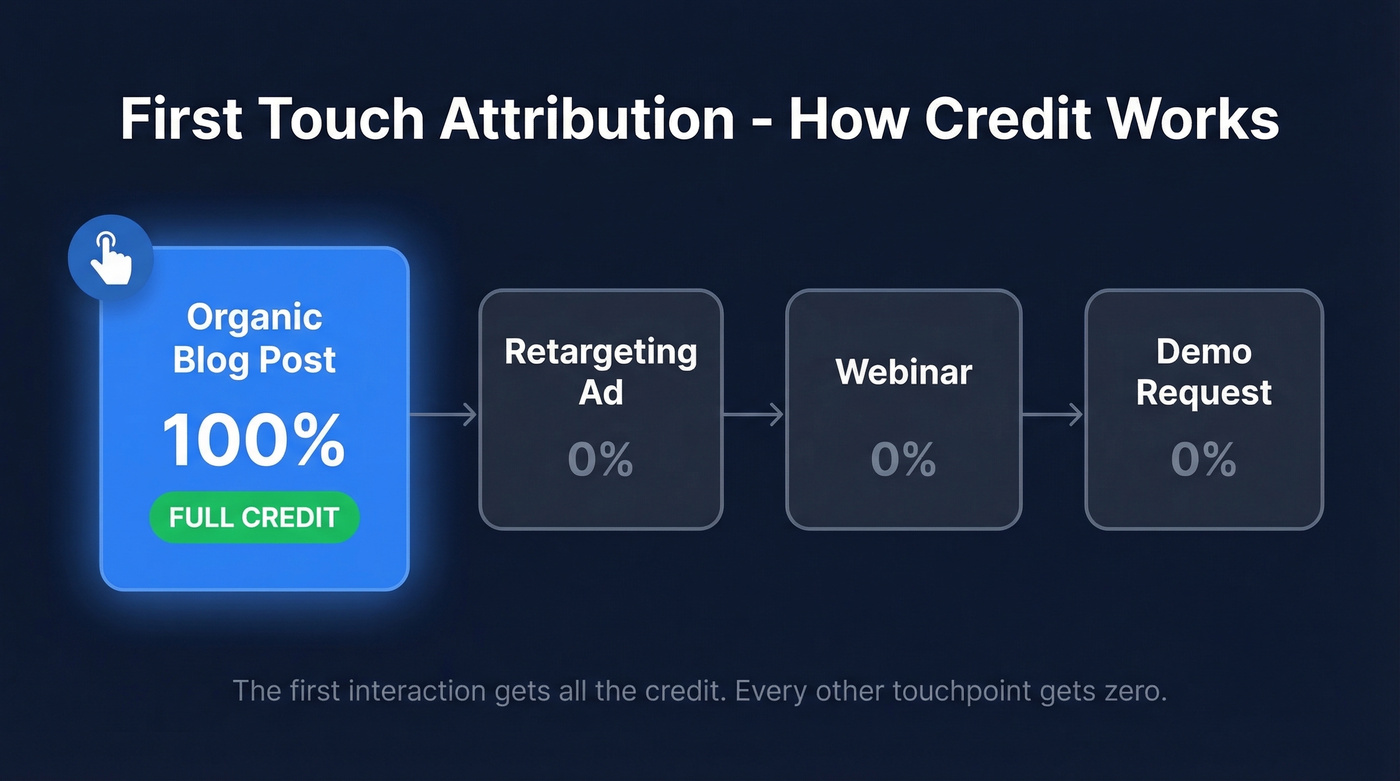
The model is deliberately reductive. That's the point. It answers one question cleanly: what's driving discovery?
Here's how credit flows across a typical four-touchpoint journey:
| Touchpoint | Channel | First Touch Credit | Last Touch Credit |
|---|---|---|---|
| 1st | Organic blog post | 100% | 0% |
| 2nd | Retargeting ad | 0% | 0% |
| 3rd | Webinar | 0% | 0% |
| 4th | Demo request | 0% | 100% |
One critical distinction: "first touch" almost always means "first known touch." The prospect might've heard your name on a podcast or seen a colleague's post before ever hitting your site. You can't track what you can't see, and every attribution model shares this blind spot.
First Touch vs Last Touch vs Multi-Touch
The real question isn't which model is "right." It's which model answers the question you're actually asking.
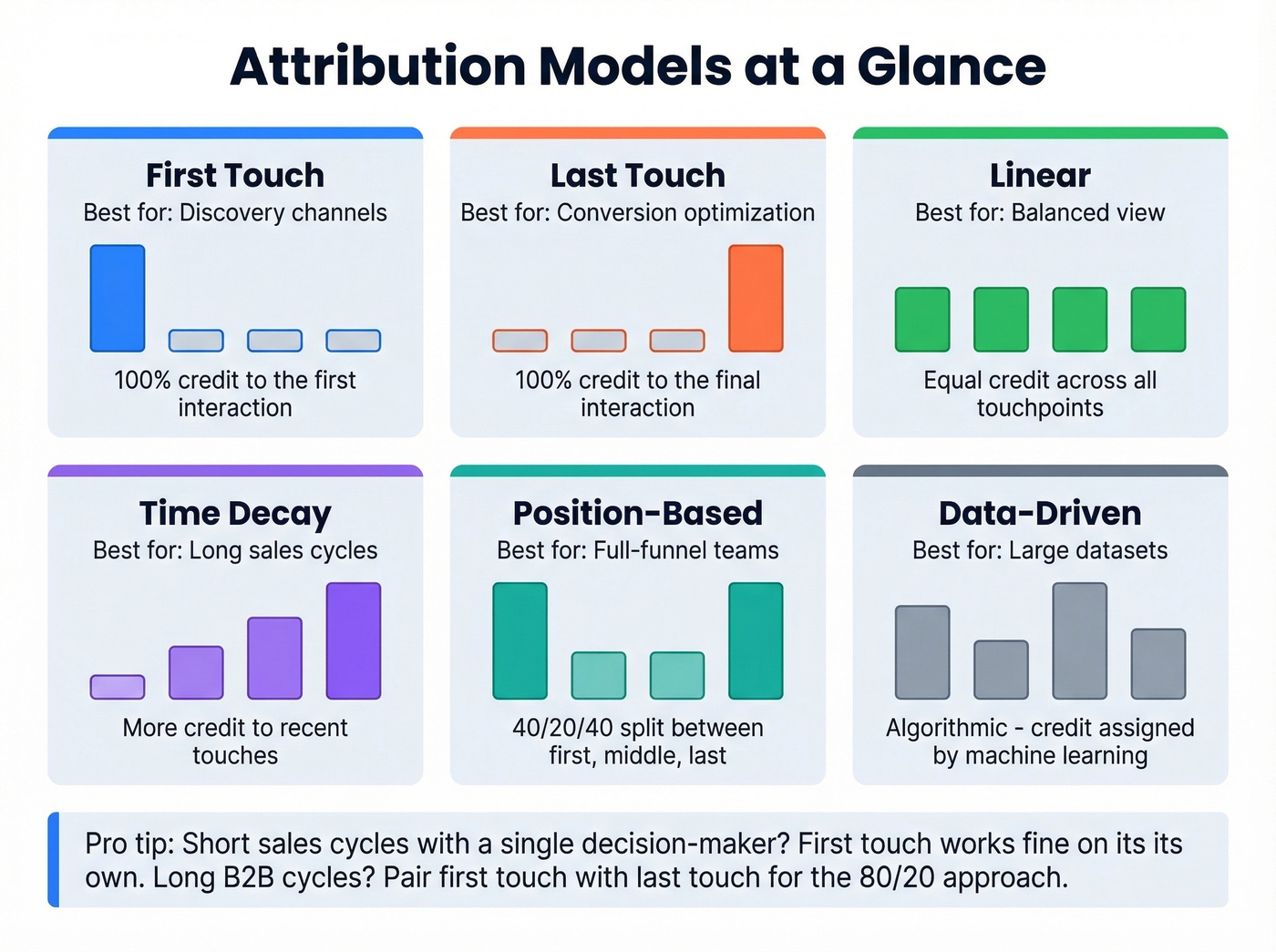
| Model | Credit Logic | Best For | Key Limitation |
|---|---|---|---|
| First touch | 100% to first interaction | Discovery channels | Ignores conversion path |
| Last touch | 100% to final interaction | Conversion optimization | Ignores awareness |
| Linear | Equal across all touches | Balanced view | Dilutes signal |
| Time decay | More to recent touches | Long sales cycles | Undervalues top-of-funnel |
| Position-based | Weighted split (first + last) | Full-funnel teams | Arbitrary weighting |
| Data-driven | Algorithmic | Large datasets | Black box |
Here's the decision heuristic we use: short sales cycles with a single decision-maker? A first-touch model works fine on its own. Long B2B cycles with buying committees? Pair it with multi-touch, but only if you have the data hygiene to support it. Privacy-constrained environments where you're losing 40-60% of tracking data? Single-touch becomes your most reliable directional signal, because it requires the least data to function.
Single-touch models prioritize precision over accuracy - they give you a clean, actionable signal rather than a noisy approximation of the full picture. For most teams, that tradeoff is worth it.
Why It Still Matters in 2026
75% of companies now use multi-touch attribution. That makes first-touch the underdog. But it's more relevant now than it was five years ago, not less.
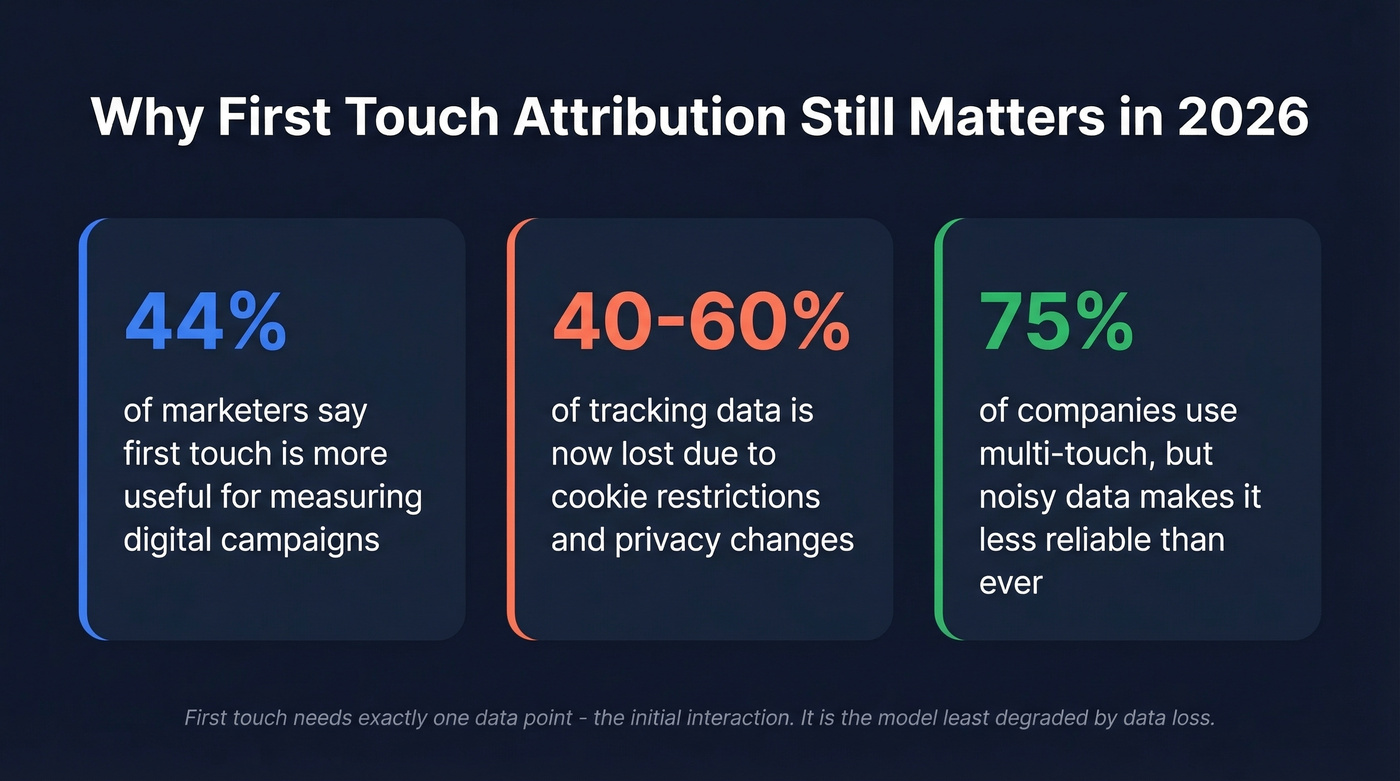
The reason is privacy. Safari's ITP caps cookies at 7 days. Firefox blocks trackers by default. iOS 14.5 gutted mobile tracking. Chrome's third-party cookie restrictions are finally in effect. When your tracking data has 40-60% gaps, sophisticated multi-touch models don't get smarter - they get noisier. You're feeding incomplete data into a complex algorithm and trusting the output. That's not analytics. That's astrology.
A first-touch model needs exactly one data point: the initial interaction. It's the model least degraded by data loss. And when you pair it with last-touch - the 80/20 approach that PPC practitioners on Reddit keep recommending - you get a discovery signal and a conversion signal without the overhead of maintaining a multi-touch model nobody on the team fully understands.
Let's be honest: if your attribution model can't be explained in under a minute, it's too complex for decision-making. Most teams would be better served by a shared spreadsheet with first-touch and last-touch columns than by an expensive attribution platform nobody trusts.

First touch attribution tells you which channels drive discovery. Prospeo tells you exactly who discovered you. Enrich your first-touch leads with 98% accurate emails and verified direct dials - 50+ data points per contact, refreshed every 7 days.
Turn your top-of-funnel signal into pipeline that actually converts.
How to Set Up First Touch Attribution
GA4 (2026 Workarounds)
GA4 doesn't offer a first-click attribution model like UA did. The available models are basically data-driven and last-click variants - rules-based models like first-click aren't selectable.
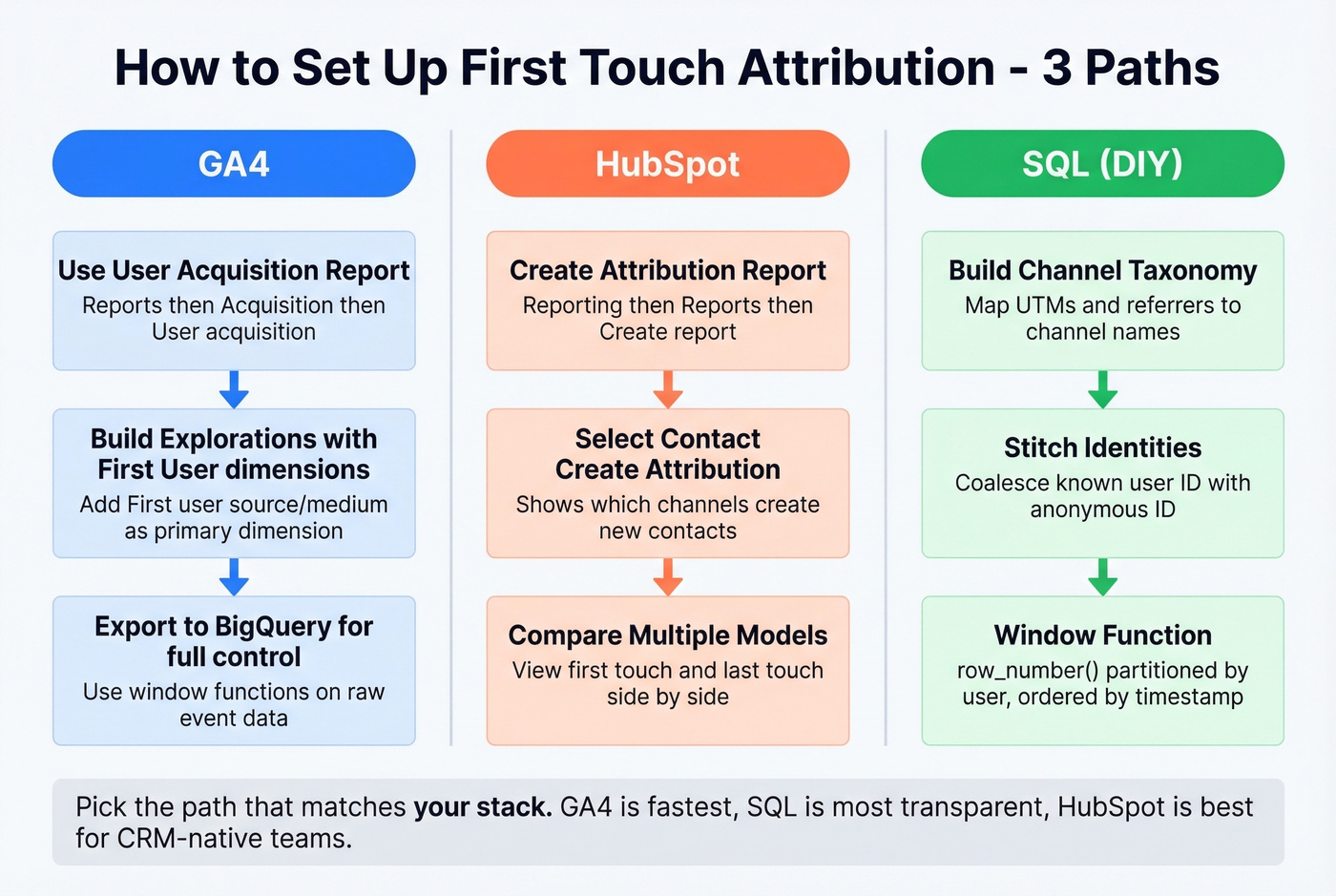
To get first-touch data anyway:
User Acquisition Report. Navigate to Reports > Acquisition > User acquisition. This report uses "first user" dimensions by default, showing the source/medium/campaign that originally acquired each user - the closest thing to a native first-touch report in GA4.
Explorations with "First user" dimensions. Build a custom exploration and add "First user source/medium" as your primary dimension. This bypasses the attribution model setting entirely - whether your settings are on data-driven or last-click, "first user" dimensions reflect the initial interaction.
BigQuery export + custom SQL. For full control, export raw GA4 event data to BigQuery and build first-touch logic with window functions. More on this in the SQL section below.
GA4's attribution settings live at Admin > Data Display > Events > Attribution settings. The model you set there affects dimensions like Source/Medium/Campaign without a prefix. If you're using "first user ..." dimensions in your reports, the attribution model setting isn't what's driving those numbers.
HubSpot
HubSpot's attribution reporting is straightforward:
- Navigate to Reporting > Reports > Create report > Attribution report.
- Select "Contact create attribution" to see which channels create new contacts - your first-touch proxy.
- For deal-level and revenue attribution, you'll need Marketing Hub Enterprise.
- Select multiple attribution models in a single report to compare how credit shifts between first-touch, last-touch, and other models side by side. This defuses the political arguments before they start.
SQL (Build It Yourself)
When you don't trust GA4 or need warehouse-native attribution, build it yourself in three steps:
Channel taxonomy. Classify every traffic source into channels using referrer URLs and UTM parameters. Map
utm_source=google+utm_medium=cpcto "Paid Search," referrer containingtwitter.comto "Organic Social," and so on.Identity stitching. Create a stable identifier using
coalesce(known_user_id, anonymous_id)as yourindividual_identifier, mapping anonymous pre-conversion visits to known post-conversion users.First-event window function. Use
row_number() over(partition by individual_identifier order by page_viewed_at)to identify each person's first interaction. Filter torow_number = 1, join to your conversion table, and you've got first-touch attribution at the warehouse level.
This is the approach Hex documented when they needed attribution faster than they could build a full sessions model. Not elegant, but transparent - and transparent beats black-box every time.
B2B vs B2C: When First Touch Breaks Down
The model works differently depending on how your buyers actually buy.
Use first-touch confidently when:
- Sales cycles are days, not months
- One person makes the buying decision
- Discovery and conversion happen in the same session or close to it
- You're optimizing top-of-funnel spend in B2C or product-led growth
Be cautious when:
- B2B journeys span weeks to months with dozens of touchpoints
- Buying committees mean five people at one account consume different content
- Standard 30-day attribution windows miss early-stage interactions entirely
- Your CRM source field gets overwritten every time a contact re-engages
The B2B problem is structural. "First touch" in B2B really means "first known touch for the first person we tracked at this account." The VP who saw your billboard? Not tracked. The analyst who read your Gartner mention? Not tracked. The SDR who cold-called the director? Tracked, but in Salesforce, not your marketing attribution tool.
Account-level attribution - aggregating touchpoints across all contacts at a company, using platforms like Demandbase or HubSpot ABM - is the real answer for complex B2B. First-touch still has value as a directional signal for which channels open doors, but don't mistake it for the full story.
Privacy and Cookie Erosion
The cookie erosion timeline tells the story:
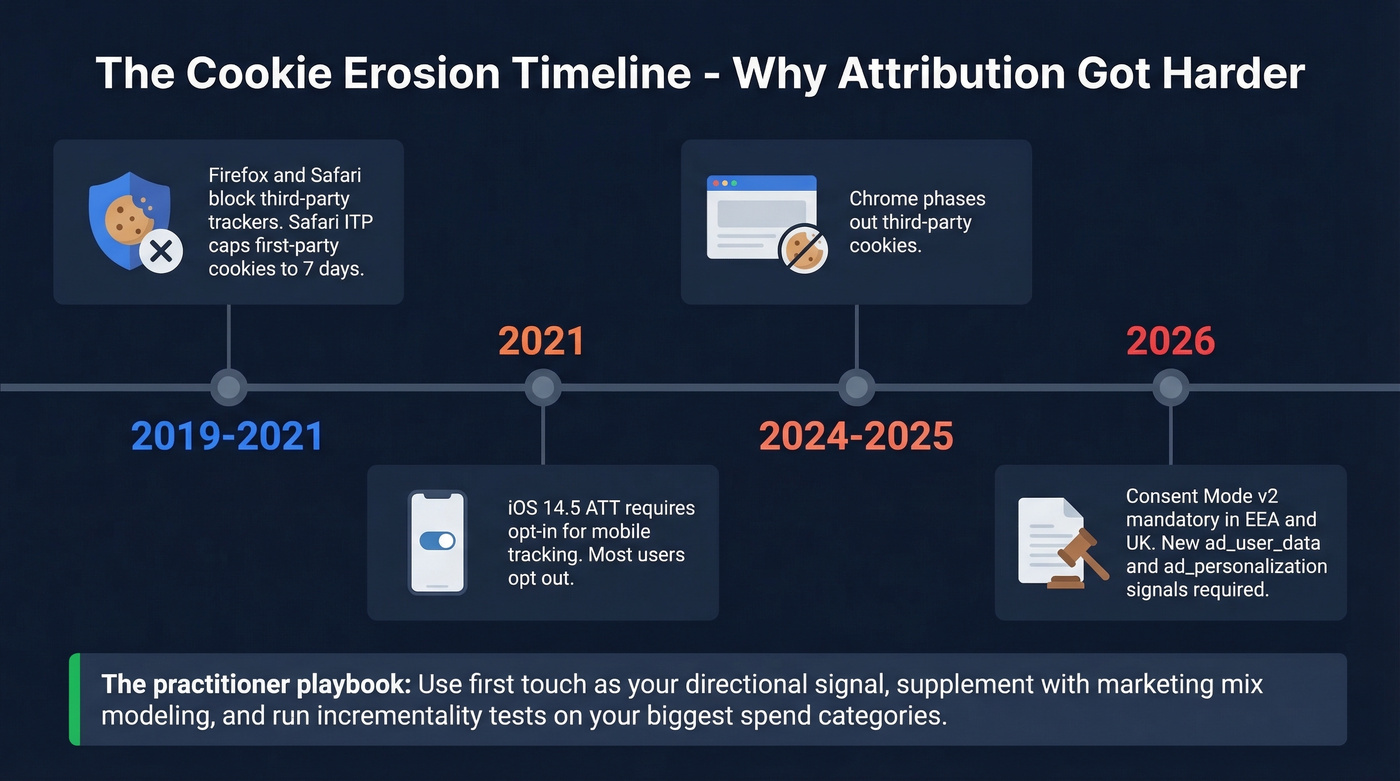
- 2019-2021: Firefox and Safari block third-party trackers; Safari's ITP caps first-party cookie lifespan to 7 days.
- 2021: iOS 14.5 ATT requires opt-in for mobile tracking. Most users opt out.
- 2024-2025: Chrome phases out third-party cookies.
- 2026: Consent Mode v2 is mandatory in the EEA and UK, introducing
ad_user_dataandad_personalizationsignals.
Server-side tracking offers a partial fix - server-managed cookies can extend attribution windows back to one year, bypassing browser-side JavaScript cookie limits. But cross-device tracking for unauthenticated users is effectively dead without deterministic matching via login or User ID.
When data loss hits 40-60%, multi-touch attribution doesn't degrade gracefully. It breaks. The practitioner playbook: use first-touch as your directional signal, supplement with marketing mix modeling for channel-level budget allocation, and run incrementality tests on your biggest spend categories. Post-purchase surveys ("how did you hear about us?") remain embarrassingly effective for validating what the models tell you. If you're not running one, start this week.
Mistakes That Corrupt First-Touch Data
1. Defaulting to a non-first-touch view without realizing it. GA4's default model is data-driven. If you aren't intentionally using "first user" dimensions in User acquisition reports or Explorations, you can easily end up analyzing session-based or last-touch-style views and calling it "attribution." We've seen teams report on "first touch" for months while actually pulling session-scoped data. Check your dimensions.
2. Ignoring cross-device journeys. Someone discovers your brand on mobile via Instagram, then converts on desktop by typing your URL. Your tool sees a "direct" visit and credits nothing useful.
3. Not accounting for dark social. Slack messages, podcast mentions, word-of-mouth - none generate UTM parameters. Your first-touch data has a systematic blind spot for the channels that often matter most. This is the frustrating part: the channels driving the most genuine awareness are the hardest to measure. (If this is a recurring issue, you’ll want a plan for the dark funnel.)
4. CRM source field overwriting. The original lead source gets overwritten every time a contact re-engages through a new campaign. Three months later, your "first touch" says the lead came from a retargeting ad, not the conference booth where you actually met them.
5. Using attribution to settle politics. When teams cherry-pick the model that supports their argument, attribution becomes theater. The CMO credits the blog, the VP of Sales credits cold calls, and the CFO - unconvinced by either - funds neither.
Attribution accuracy starts with data accuracy. If 15% of your emails bounce and contact records are stale, your first-touch insights are built on a cracked foundation. Tools like Prospeo that verify emails at 98% accuracy and refresh records every 7 days provide the kind of hygiene that makes attribution data commercially useful, not just analytically interesting.
You just built a first-touch model that proves organic drives discovery. Now what? Prospeo's CRM enrichment fills in the gaps - 83% of leads come back with verified contact data, at $0.01 per email. No contracts, no sales calls required.
Stop attributing leads you can't actually reach.
FAQ
Is first touch attribution available in GA4?
Not as a selectable model. GA4 removed the first-click option that Universal Analytics offered. Use the "First user source/medium" dimension in User Acquisition reports or Explorations instead. For full flexibility, export GA4 data to BigQuery and build custom first-touch logic with SQL window functions partitioned by user ID.
When should I use first touch vs multi-touch?
Use first-touch when you need a clear answer about which channels drive discovery - especially with short sales cycles or significant tracking gaps. Pair it with last-touch for conversion insight. Add multi-touch only when you have clean data, long sales cycles, and the resources to maintain the model. Most teams overinvest in multi-touch complexity before mastering the basics.
How does bad contact data affect attribution accuracy?
If emails bounce or phone numbers are disconnected, attributed contacts can't be reached - making the insight commercially useless. Keeping your contact database fresh with verified data ensures attributed leads are actually actionable, not just a line in a report nobody trusts.