

What Is B2B? The Complete Guide to Business-to-Business Commerce in 2026
The global B2B ecommerce market is projected to hit $36 trillion by 2026. That's not a typo. While consumer brands fight over Instagram impressions, the companies behind those brands - the ones selling cloud infrastructure, raw materials, compliance software, and logistics - drive enormous volumes of global commerce. And 94% of business-to-business buyers now use LLMs during their purchase process, which means the way this market operates is changing faster than most sellers realize.
Here's the short version: B2B means companies selling to other companies, not consumers. It's a $36T market growing at 14.5% CAGR. Modern buying involves 6-10 stakeholders, roughly 10-month sales cycles, and buyers who've already defined their requirements before they ever talk to a sales rep.
What Does B2B Mean?
B2B (business-to-business): Any commercial transaction where one company sells products or services to another company rather than to an individual consumer.
That definition is technically correct and practically useless. So what does a B2B company actually look like? It's a SaaS company selling CRM software to a 200-person sales team. A semiconductor manufacturer supplying chips to an automotive OEM. A consulting firm advising a private equity portfolio company on post-merger integration. Or a data platform providing verified contact information so an outbound sales agency can actually reach decision-makers.
What makes this model fundamentally different isn't just the buyer - it's the buying process. Purchases involve procurement teams, legal review, security questionnaires, multi-stakeholder consensus, and negotiated pricing. A typical buying group includes six to ten people across an organization, each with different priorities and veto power.
Business-to-business commerce spans every layer of the economy: primary (raw materials and extraction), secondary (manufacturing and assembly), and tertiary (services and software). Consumer-facing brands get the attention, but the companies supplying those brands are where the volume lives.
Then there's the cash flow reality that separates this world from everything else. Transactions run on payment terms that don't exist in consumer commerce - Net-30, Net-60, sometimes Net-90 invoicing means sellers can wait months for payment, creating dynamics that shape everything from pricing to vendor selection. Customer concentration risk, where losing a single account can crater revenue, adds another layer of operational complexity that B2C companies rarely face.
B2B by the Numbers
The scale of business-to-business commerce is staggering.
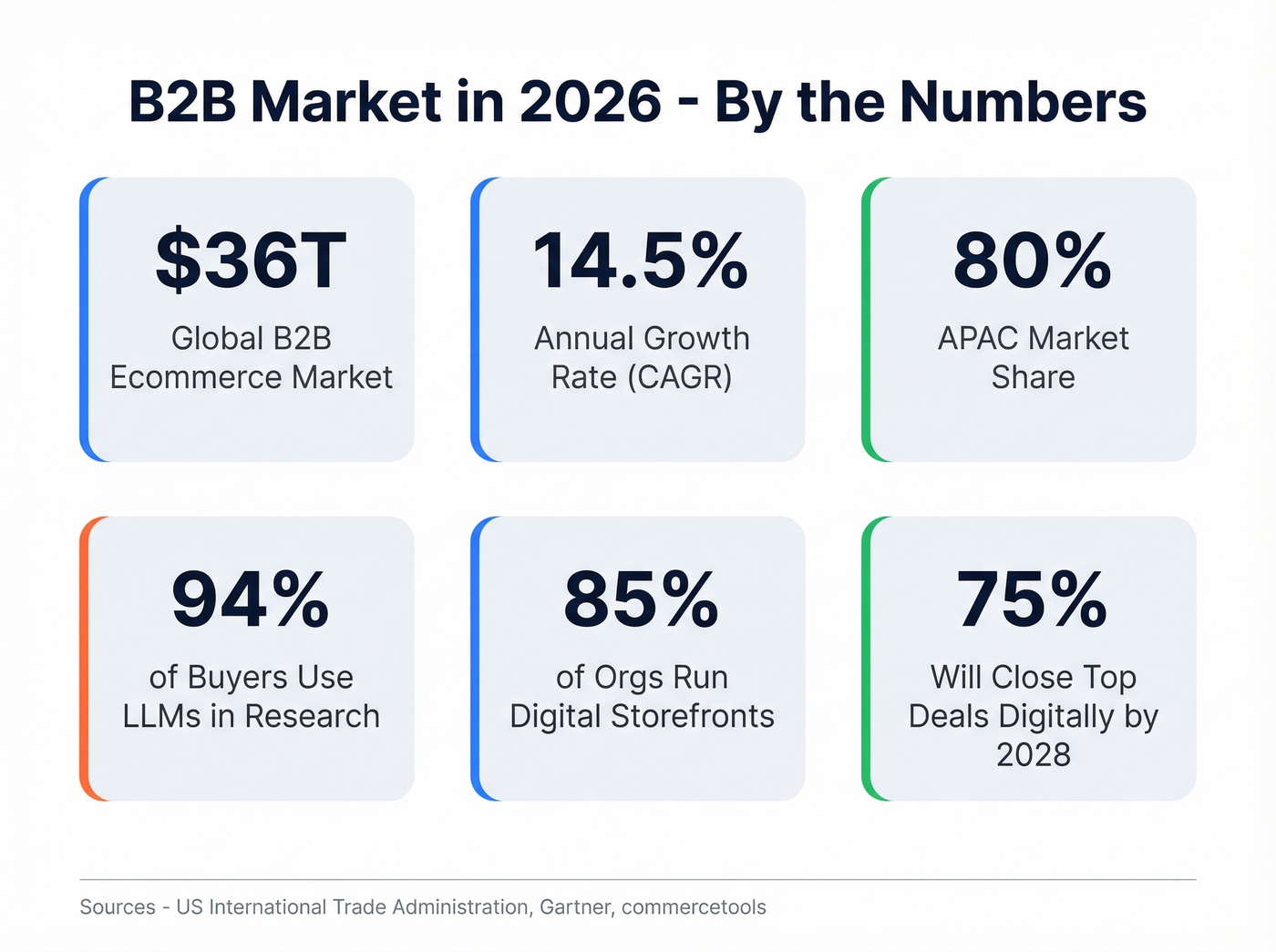
- Global ecommerce market: $36 trillion projected by 2026
- Growth rate: 14.5% CAGR through 2026
- Regional dominance: APAC accounts for roughly 80% of market share by 2026
- Digital adoption: ~85% of organizations now operate an ecommerce storefront or self-service portal
- Future trajectory: 75% of organizations will complete their highest-revenue deals via digital channels by 2028
These aren't projections from a decade ago. This is the market right now - massive, digitizing fast, and increasingly concentrated in Asia-Pacific.
B2B vs B2C - The Real Differences
The standard comparison is "B2B is rational, B2C is emotional." That framing misses the structural differences that actually matter.
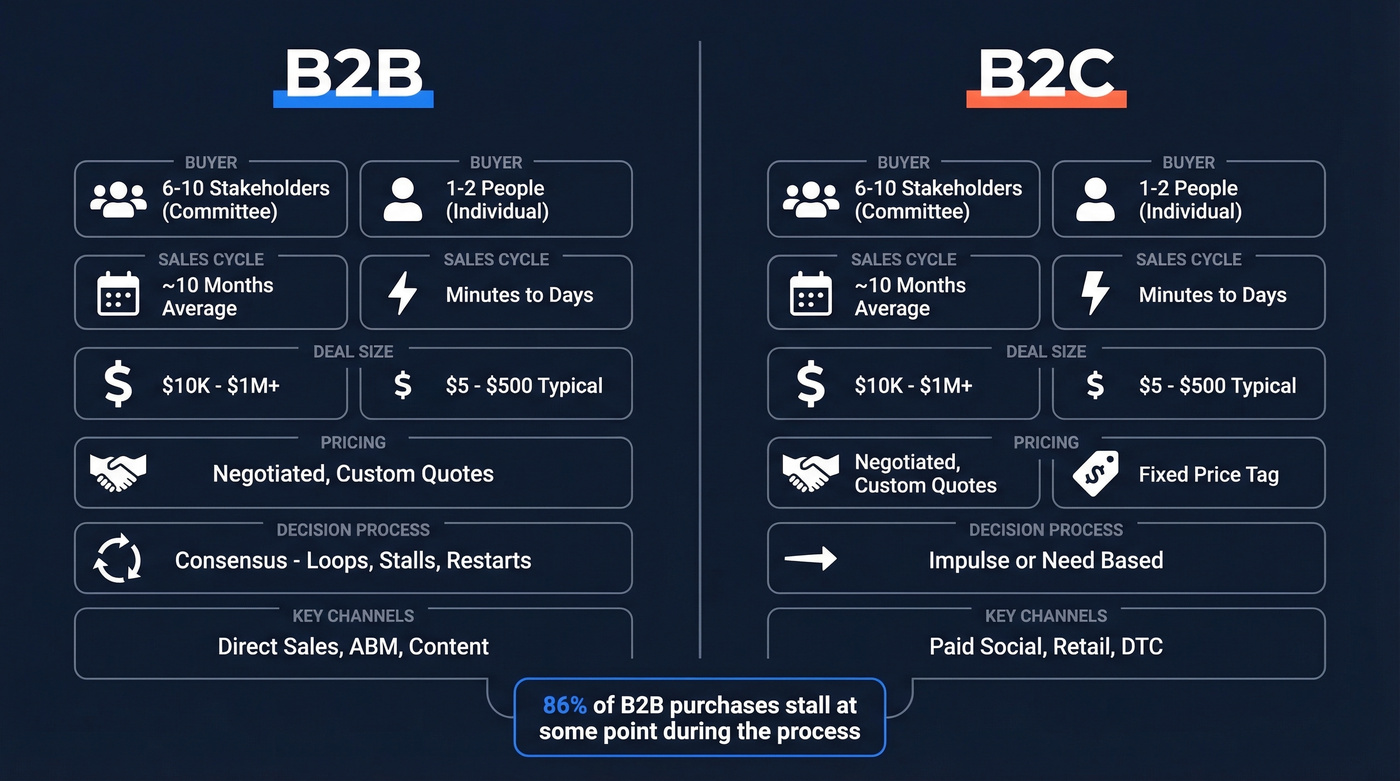
| Dimension | B2B | B2C |
|---|---|---|
| Buyer | Company (committee) | Individual consumer |
| Sales cycle | ~10 months on average | Minutes to days |
| Stakeholders | 6-10 per deal | 1-2 |
| Pricing | Negotiated/custom | Fixed/standardized |
| Deal size | Typically $10K-$1M+ | $5-$500 typical |
| Decision process | Consensus-driven | Impulse or need |
| Key channels | Direct sales, ABM, content | Paid social, retail, DTC |
The stakeholder count is what really separates these worlds. Gartner's research identifies 6-10 decision-makers in a typical buying group, each navigating six distinct buying jobs: problem identification, solution exploration, requirements building, supplier selection, validation, and consensus creation. These jobs don't happen sequentially - they loop, overlap, and restart.
In B2C, you convince one person to click "buy." In B2B, you convince a committee to agree - and that committee includes people who've never spoken to you and don't know your product exists. The VP of Engineering cares about integration. The CFO cares about total cost. Legal cares about compliance. Procurement cares about contract terms. You need to satisfy all of them, often simultaneously, which is why sales cycles commonly stretch to around 10 months and 86% of purchases stall at some point during the process.
Pricing is another structural gap. A B2C product has a price tag. A business-to-business deal has a negotiation. Enterprise software contracts, professional services engagements, and infrastructure deals are all custom-quoted, volume-discounted, and subject to procurement review. There's no "add to cart" for a $500K platform deployment.
How Buying Works in 2026
The buying process in 2026 looks nothing like it did five years ago. The power has shifted decisively to the buyer.
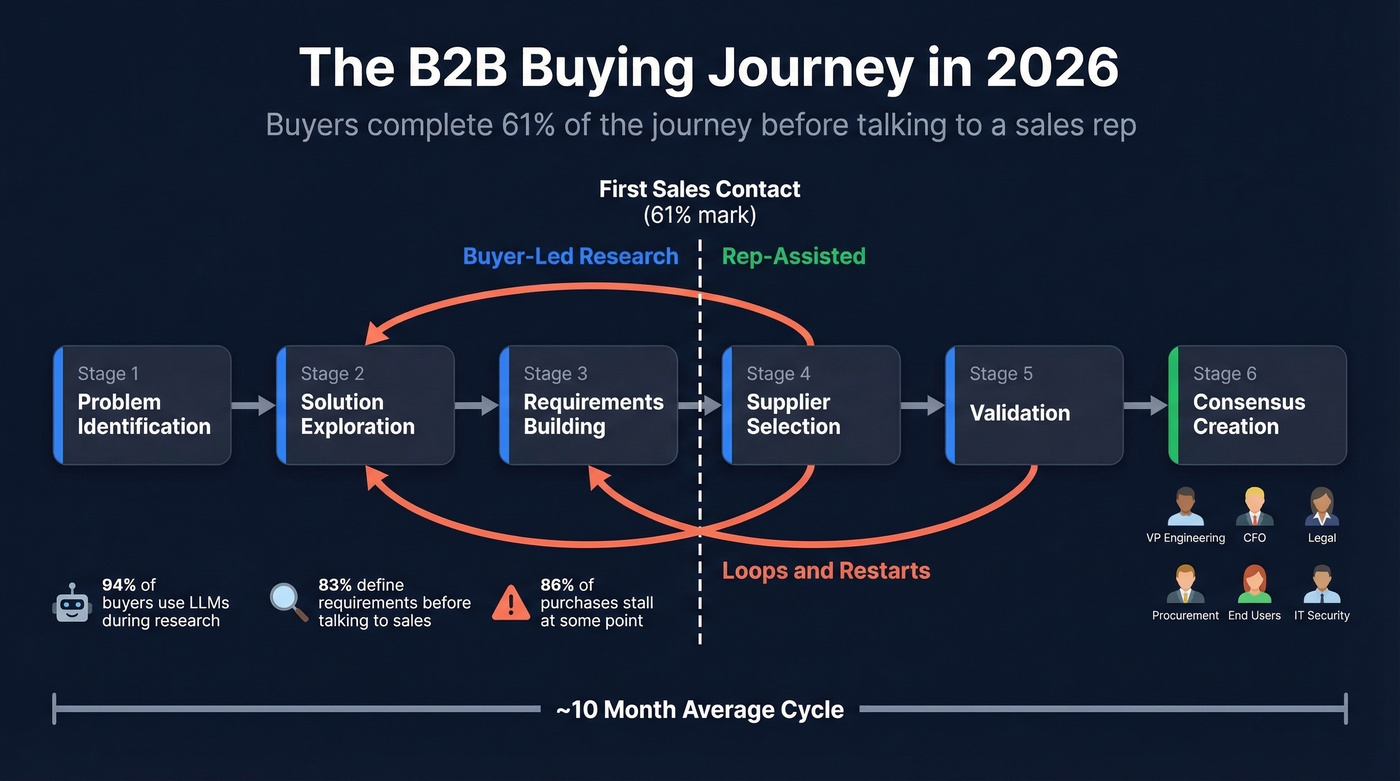
According to 6sense's 2025 research, 83% of buyers mostly or fully define their requirements before they ever speak with a sales rep. They've already researched solutions, compared vendors, and built internal consensus - all before your SDR gets a chance to pitch. The average sales cycle compressed from 11.3 months in 2024 to 10.1 months in 2025, driven by economic pressure that pushed buyers to engage sellers earlier in the process. First contact now happens at 61% of the buying journey, down from 69% the year before.
LLMs have fundamentally changed how buyers research. 94% now use them during their purchasing process, and 89% specifically seek out solutions with AI features. Buyers aren't just searching the web anymore - they're asking ChatGPT to compare vendors, summarize G2 reviews, and draft requirements documents. 72% have encountered Google AI Overviews during research, and 90% clicked through to at least one cited source. If your content isn't structured for AI-mediated discovery, you're invisible during the research phase.
Yet despite all this self-service capability, the buying experience is broken. Forrester found that 86% of purchases stall at some point, and 81% of buyers end up dissatisfied with the provider they ultimately choose. That's a staggering failure rate for a process that takes nearly a year.
Gartner's data adds nuance: while 75% of buyers say they prefer a rep-free experience, the ones who use digital tools in partnership with a sales rep are 1.8x more likely to complete a high-quality deal. The rep's role has shifted from "gatekeeper of information" to "guide through complexity."
The sentiment on r/b2bmarketing mirrors this tension. As one practitioner put it: "People don't want to spend money and have very little trust." Even small fees face scrutiny. The trust deficit is real, and it's reshaping how every company selling to other businesses needs to operate.

In a $36T market where 83% of buyers define requirements before talking to a rep, reaching the right stakeholders early is everything. Prospeo gives you 300M+ verified profiles with 30+ filters - buyer intent, technographics, headcount growth - so you connect with all 6-10 decision-makers before your competitors do.
Stop waiting for buyers to find you. Find them at $0.01 per verified email.
Types of B2B Companies
This isn't a single industry - it's a business model that spans virtually every sector.
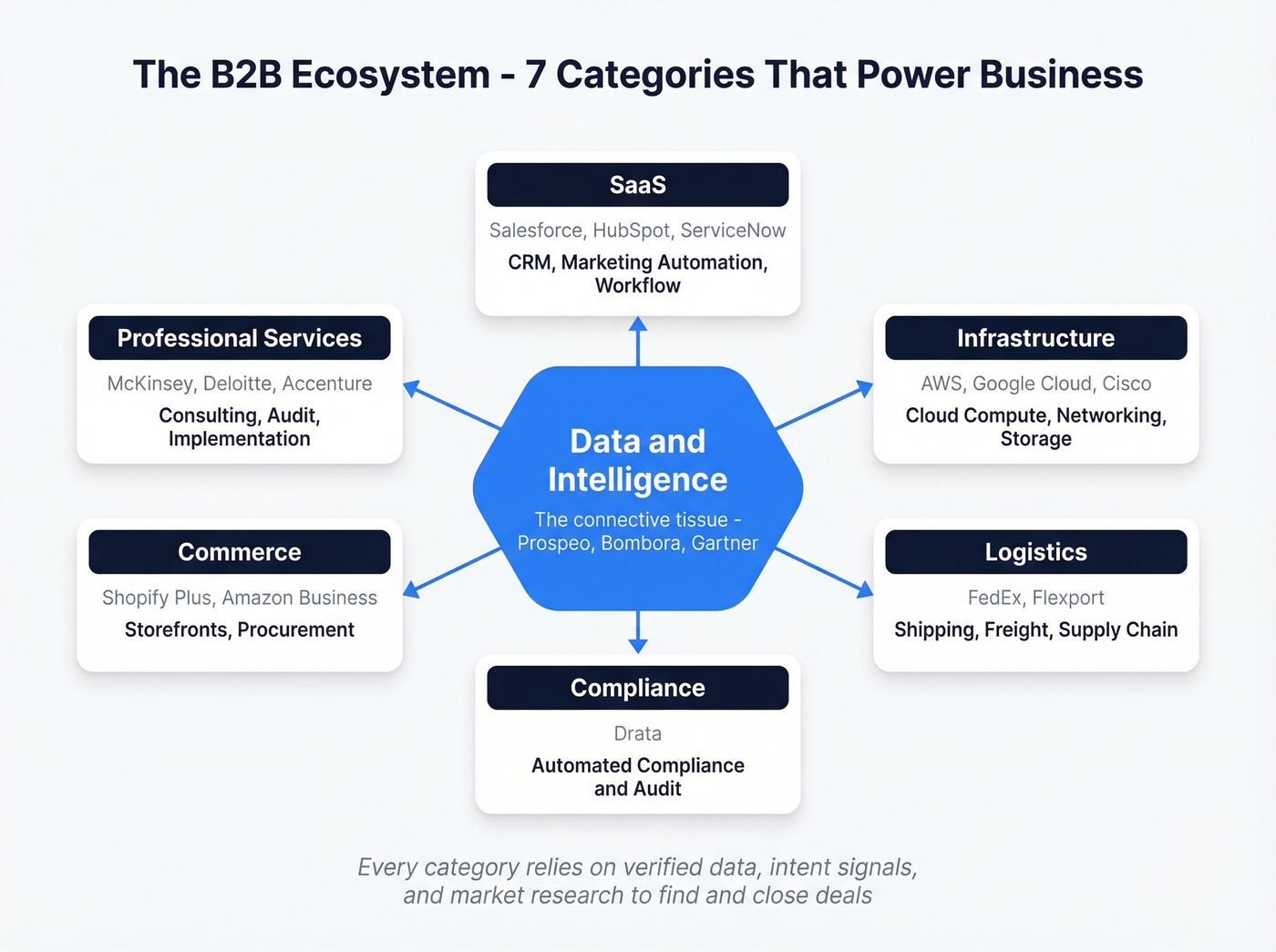
| Category | Examples | What They Sell |
|---|---|---|
| SaaS | Salesforce, HubSpot, ServiceNow | CRM, marketing automation, workflow |
| Infrastructure | AWS, Google Cloud, Cisco | Cloud compute, networking, storage |
| Logistics | FedEx, Flexport | Shipping, freight, supply chain |
| Compliance | Drata | Automated compliance and audit |
| Data & Intelligence | Prospeo, Bombora, Gartner | Contact data, intent signals, research |
| Commerce | Shopify Plus, Amazon Business | Storefronts, procurement |
| Professional Services | McKinsey, Deloitte, Accenture | Consulting, audit, implementation |
The Data & Intelligence category is the connective tissue for every other row in that table. These companies power the intelligence layer that every other category relies on - verified contact data for outbound teams, intent signals for demand gen, and market research for strategic planning.
The common thread across all categories: the buyer is a business, the sales process is complex, and the relationship extends well beyond the initial transaction. A Salesforce deal isn't a one-time purchase - it's a multi-year platform commitment with implementation, training, and ongoing expansion.
What Works in B2B Marketing Now
Mass-blast campaigns underperform targeted programs. Marketing in 2026 rewards focus over volume.
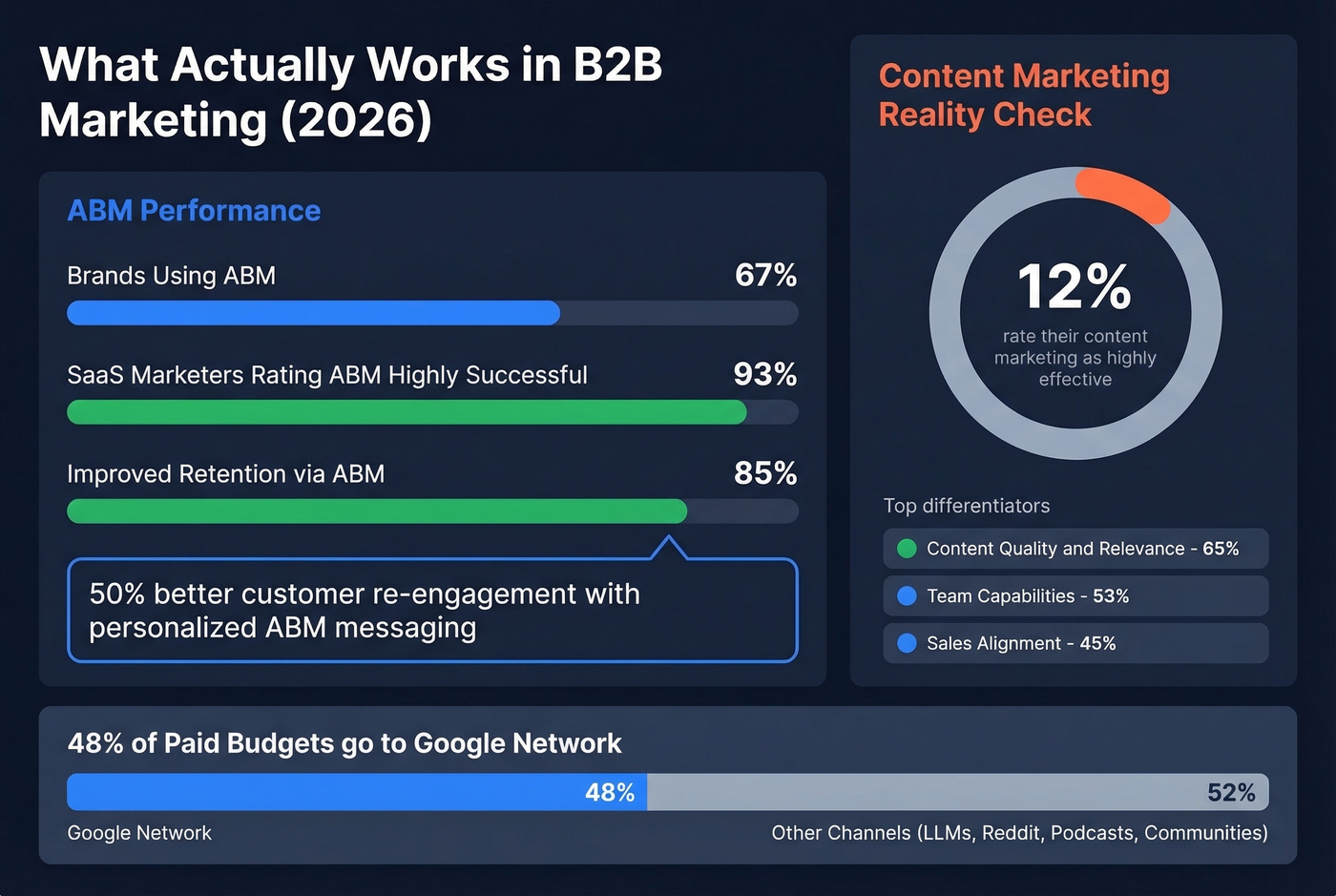
Account-based marketing has become a core strategy for mid-market and enterprise teams. 67% of brands now use ABM, and 93% of SaaS marketers rate it as highly successful. Personalized ABM messaging drives 50% better customer re-engagement rates, and 85% of marketers report improved retention through ABM programs. We've seen teams that pair ABM with intent data consistently outperform those running broad campaigns - it's the difference between fishing with a spear and fishing with a net full of holes.
Content marketing remains foundational, but the bar has risen dramatically. A CMI survey of 1,015 marketers found only 12% rate their content marketing as "highly effective." The biggest differentiator among top performers? Content quality and relevance - 65% cite it as the top driver, followed by team capabilities at 53% and sales alignment at 45%. (If you're rebuilding your strategy, start with B2B content marketing.)
The channel mix is fragmenting. 48% of paid media budgets still flow to the Google Network, but buyer intent now scatters across LLMs, Reddit, podcasts, and peer communities for early-stage discovery. Google captures high-intent searches; everything else captures the research phase.
Two trends worth watching: people-led distribution - putting paid spend behind founders and operators rather than company pages - and the rise of curated events. Large trade shows are losing ground to invite-only dinners and private sessions where companies control the narrative and the guest list. 91% of marketers expect to use intent data for account prioritization in 2026, up from a minority just two years ago.
Sales and Prospecting
Let's be honest: the volume-based outbound playbook is dying. Campaign data from 500+ programs shows cold email response rates cratering from ~5% to roughly 0.5%. Connection acceptance on professional networks has dropped from 34% to under 12%. Decision-makers answer about 2 out of every 100 cold calls. We've watched teams burn through entire TAMs with generic sequences that generate nothing but unsubscribes.
The shift is from volume to signal. Instead of blasting 10,000 contacts and hoping for 50 replies, modern teams identify accounts showing active purchase intent, verify contact data before sending a single email, and personalize sequences based on real triggers - job changes, funding rounds, technology adoption, headcount growth.
This is where data infrastructure becomes the bottleneck. You can have the best messaging in the world, but if a big chunk of your emails bounce, your domain reputation tanks and nothing lands in the inbox. The difference between good and bad data isn't a nice-to-have - it's the difference between a healthy pipeline and a burned domain. One of our customers, Snyk, cut their bounce rate from 35-40% to under 5% and saw AE-sourced pipeline jump 180% just by fixing the data layer.
If your average deal size is under five figures, you probably don't need a $30K/year data platform. But you absolutely need verified emails at roughly $0.01 each, a 7-day data refresh cycle, and enough search filters to target by intent, technographics, and growth signals. That's the minimum viable data stack for outbound in 2026. (For more outbound tactics, see sales prospecting techniques.)

Another thread in r/sales keeps surfacing the same complaint: reps spend hours every week just cleaning bad data from their CRM before they can start prospecting. That's not a workflow problem - it's a data quality problem. Fix the source, and the downstream metrics follow. If you're diagnosing the root cause, start with email bounce rate and then tighten your email deliverability setup.
B2B sales cycles average 10 months and 86% of deals stall. Bad data makes it worse - bounced emails burn your domain and kill momentum. Prospeo's 98% email accuracy and 7-day data refresh mean every touchpoint actually lands, so your pipeline keeps moving.
Your competitors' data is 6 weeks old. Yours refreshes every 7 days.
The Future of B2B (2026-2028)
By 2028, 75% of organizations will close their biggest deals through digital channels. Not small purchases - the highest-revenue transactions. That single projection tells you where the market is heading.
Digital channels are already driving new revenue: 56% of companies report new-product revenue growth through digital channels, and that number is climbing as self-service research, digital configuration, and rep-assisted closing become the standard workflow for enterprise purchases.
AI is becoming embedded in every stage of the buying and selling process. With 94% of buyers already using LLMs, sellers who don't adapt their content strategy for AI-mediated discovery will lose visibility. Your website, your case studies, your pricing transparency - all of it needs to be structured for both human readers and AI summarization.
Stack consolidation is accelerating. Companies that consolidate their martech and sales tech stacks report a 29% reduction in operating costs. The era of buying 15 point solutions and duct-taping them together is ending. Platforms that do fewer things well are beating suites that do everything poorly. Vertical marketplaces - industry-specific platforms for procurement, parts sourcing, and wholesale - are also gaining traction as buyers demand more specialized purchasing experiences.
Business-to-business commerce isn't getting harder. It's getting more honest. Buyers have more information, more leverage, and less patience for mediocre products. That's brutal if you're selling vaporware. It's great if you're selling something that actually works.
FAQ
What does B2B stand for?
B2B stands for business-to-business, describing any transaction where one company sells products or services to another company rather than to individual consumers. It covers everything from SaaS subscriptions to raw material supply chains.
What's the difference between B2B and B2C?
B2B involves longer sales cycles averaging around 10 months, 6-10 stakeholders per deal, negotiated pricing, and consensus-driven decisions. B2C is typically faster, sold at fixed prices to individuals, and driven more by emotion and convenience than committee approval.
How do B2B companies find customers?
Modern teams combine content marketing, ABM, intent data, and outbound prospecting with verified contact data. Tools like Prospeo and Bombora let teams target in-market buyers instead of blasting cold lists - using 30+ search filters, intent signals across 15,000 topics, and real-time email verification.
How big is the B2B market?
Global ecommerce in this space is projected to reach $36 trillion by 2026, growing at 14.5% CAGR. APAC accounts for roughly 80% of that market, with digital channels driving an increasing share of the highest-value transactions.
What are examples of B2B companies?
Salesforce (CRM), AWS (cloud infrastructure), FedEx (logistics), HubSpot (marketing automation), Prospeo (contact data and intent signals), and Drata (compliance) are all companies selling products and services to other businesses across different sectors.