

What Is B2B Content Marketing (And Why Most Teams Get It Wrong)?
Only 12% of B2B marketers rate themselves as highly effective at content marketing. Another 47% say "somewhat effective," which is corporate-speak for "we're publishing stuff but can't prove it works." The gap between those two groups isn't talent or budget - it's distribution, measurement, and the willingness to tie content directly to pipeline.
The Short Version
- B2B content marketing means creating content that moves buyers through a long, multi-stakeholder sales cycle - not just generating traffic.
- Only 12% of B2B teams rate themselves highly effective (CMI 2026 report, 1,015 respondents).
- The gap isn't content creation. It's distribution and measurement.
- This guide covers strategy, formats, attribution models, and the mistakes that separate the 12% from everyone else.
B2B Content Marketing Defined
B2B content marketing is creating and distributing content - blog posts, case studies, webinars, reports, calculators - to attract, educate, and convert business buyers. Unlike a product demo or a cold call, content marketing works across the entire buying journey, from the first Google search to the final vendor comparison spreadsheet.
Here's the thing: most B2B companies treat content marketing as "publish blog posts and hope." That's not a strategy. A strategy means every piece maps to a buyer journey stage, targets a defined persona, and has a distribution plan before it's written.
The CMI 2026 report found the top three factors effective teams credited for improving results were content relevance and quality (65%), team skills and capabilities (53%), and alignment with sales (45%). Notice what's missing? Volume. Publishing more doesn't fix a broken strategy.
B2B vs B2C: What's Actually Different
It's not just "longer sales cycle." It's a fundamentally different buying process, and understanding that structural difference explains why the same playbooks that work for consumer brands fall apart in enterprise sales.
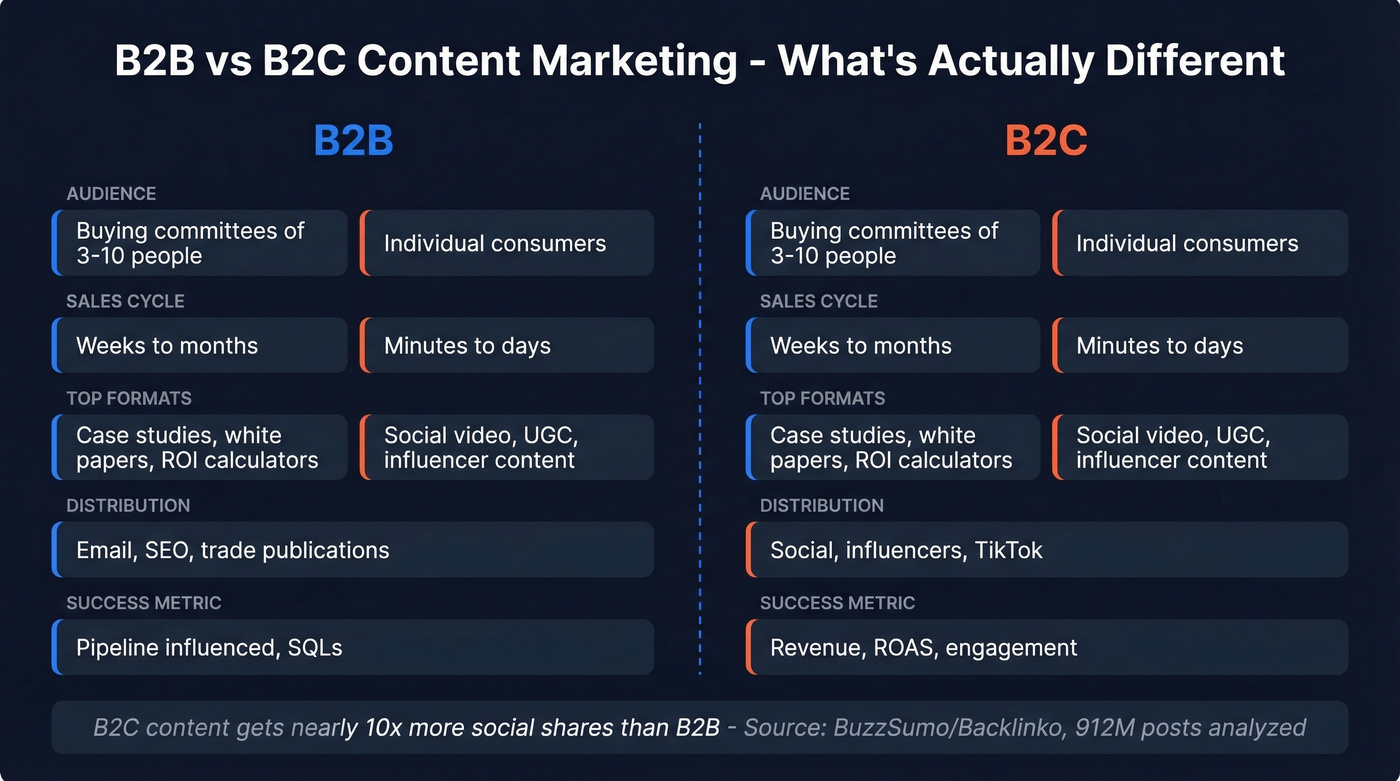
| Dimension | B2B | B2C |
|---|---|---|
| Audience | Buying committees of 3-10 people | Individual consumers |
| Sales cycle | Weeks to months | Minutes to days |
| Key formats | Case studies, white papers, ROI calculators | Social, video, UGC |
| Distribution | Email, SEO, trade pubs | Social, influencers, TikTok |
| Success metric | Pipeline influenced, SQLs | Revenue, ROAS, engagement |
A BuzzSumo/Backlinko analysis of 912 million posts found that B2C content gets nearly 10x more social shares than B2B content. Your whitepaper on compliance automation isn't going viral on Instagram. That's fine - but it means you can't rely on organic social reach. B2B content needs deliberate, channel-specific distribution.
Why It Works (When It Works)
HubSpot's State of Marketing data ranked website/blog/SEO as the #1 ROI channel for B2B marketers. Not paid social. Not events. Content-driven organic search.
The proof gets more concrete at the enterprise level. SAP's "Inspire the Future" campaign generated EUR 924.4M in pipeline with 48% higher engagement than their other social campaigns and 22,000+ podcast listeners. Enterprise teams report higher effectiveness overall - 68% rate themselves as highly or somewhat effective versus 59% in the broader B2B cohort.
But content marketing only works when it's connected to revenue. Measurement and reporting ranked as a top-five needle-mover for effective teams. Teams that can't attribute pipeline to content lose budget. Teams that can attribute it get more. Simple as that.
Best B2B Content Formats by Funnel Stage
The right format depends on where the buyer sits in the funnel.
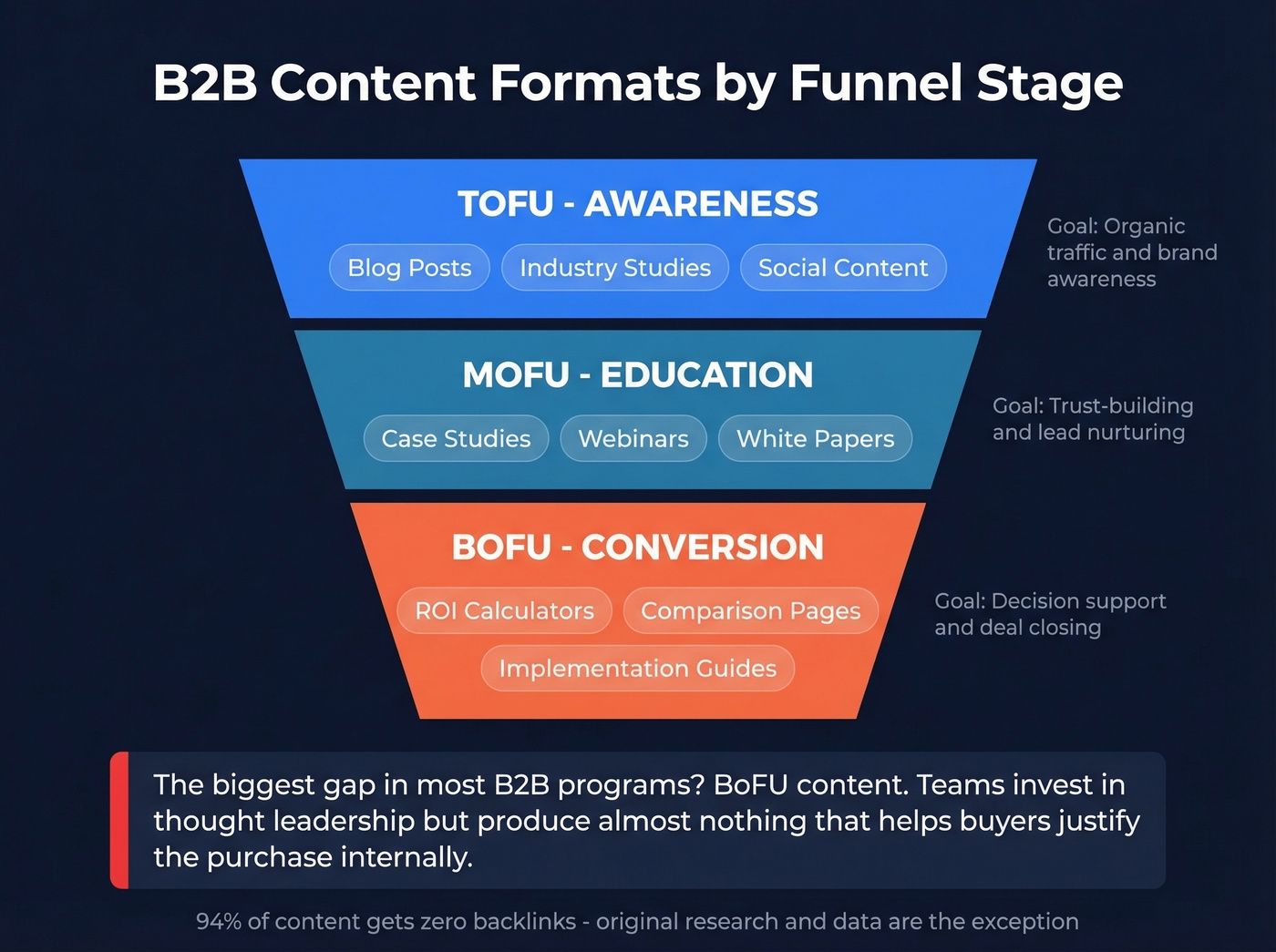
| Funnel Stage | Best Formats | Why |
|---|---|---|
| ToFU | Blog posts, industry studies, social | Awareness, organic traffic |
| MoFU | Case studies, webinars, white papers | Education, trust-building |
| BoFU | ROI calculators, comparisons, implementation guides | Decision support |
Industry studies are the standout link magnets. Backlinko's organic CTR study pulled 6.8K referring websites and 7,283 social shares - that's the kind of compounding asset most blog posts will never become. Meanwhile, 94% of content gets zero backlinks. The content that earns links tends to be original research, proprietary data, or frameworks other writers cite.
The biggest gap we see in B2B content programs? BoFU content. Teams invest heavily in thought leadership but produce almost nothing that helps a buyer justify the purchase internally. Comparisons, ROI calculators, and implementation guides are unsexy but directly influence closed deals.
If your average deal size is under $10K, you probably don't need a 40-page whitepaper. A sharp comparison page and a two-minute ROI calculator will outperform it every time.

BoFU content converts when it reaches the right buyers. Prospeo's B2B database lets you build prospect lists with 30+ filters - buyer intent, technographics, headcount growth - so your case studies and ROI calculators land in front of the decision-makers who actually close deals.
Stop publishing into the void. Distribute to verified buyers at $0.01 per email.
How to Build a Strategy That Drives Pipeline
Five steps. None of them are "hire a writer and start publishing."
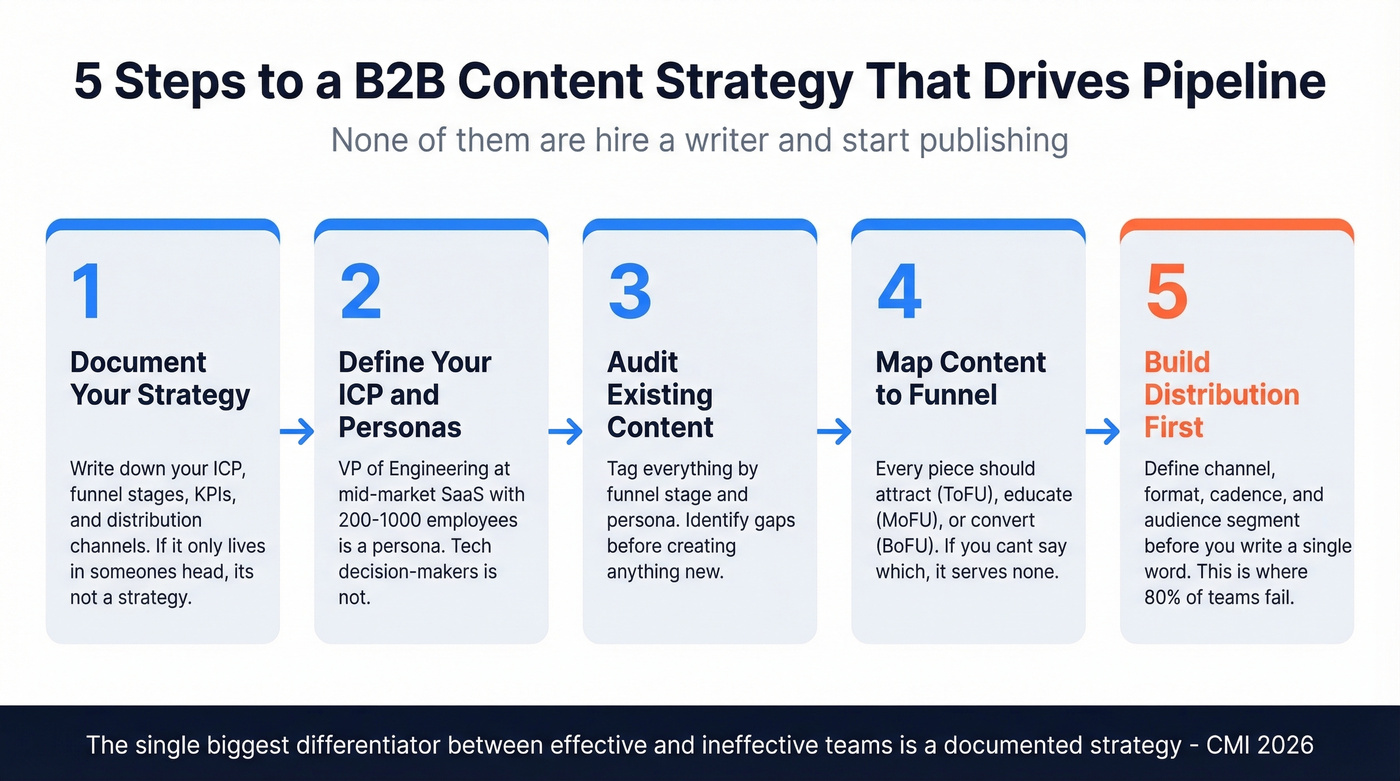
1. Document your strategy and goals. A documented strategy is the single biggest differentiator between effective and ineffective teams. Write down your ICP, funnel stages, KPIs, and distribution channels. If it lives only in someone's head, it's not a strategy - it's a vibe.
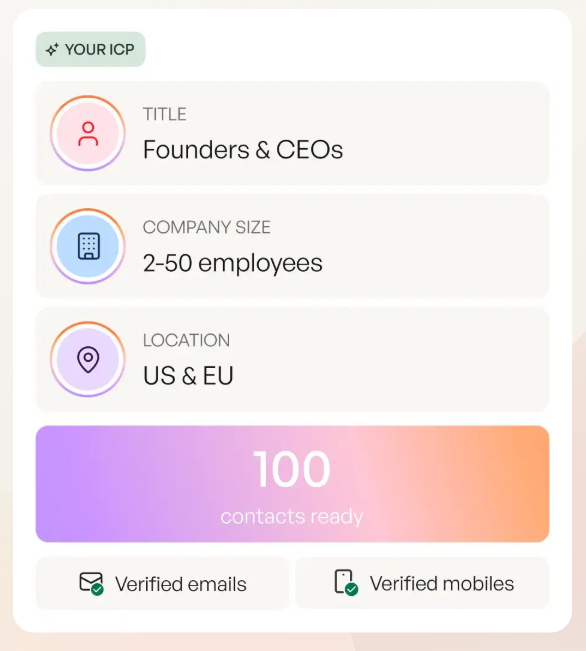
2. Define your ICP and build personas. "VP of Engineering at mid-market SaaS companies with 200-1,000 employees" is a persona. "Tech decision-makers" is not. Once you've defined your ICP, build prospect lists to match - Prospeo's B2B database covers 300M+ professional profiles with 30+ filters including buyer intent and technographics, so you can build lists that actually reflect who you're writing for.
3. Audit existing content. Most companies have more content than they think - and most of it isn't mapped to any funnel stage. Tag what you have by stage and persona, then identify gaps before creating anything new.
4. Map content to funnel stages. Every piece should attract (ToFU), educate (MoFU), or convert (BoFU). If you can't say which stage a piece serves, it probably serves none of them well.
5. Build a distribution plan before you create. This is where 80% of teams fail. 73% of B2B marketers use email newsletters and 81% use LinkedIn - but "post it on LinkedIn" isn't a distribution plan. Define the channel, format adaptation, cadence, and audience segment for each piece before you write a single word.
How to Distribute B2B Content
That 10x social sharing gap between B2C and B2B means organic social alone won't carry your content program.
SEO/organic is the long game - and the highest-ROI channel according to HubSpot's data. It takes 6-12 months to compound in competitive categories. Don't skip it, but don't rely on it alone either.
Email newsletters remain the highest-leverage distribution channel for B2B. You control the audience, timing, and format. But email only works if your list is clean. High bounce rates hurt deliverability and damage your sender reputation, which means every subsequent campaign performs worse - we've seen teams tank their domain reputation in a single quarter by sending to unverified lists. Tools like Prospeo's email finder verify addresses at 98% accuracy before you send, with a free tier of 75 emails plus 100 Chrome extension credits per month. Great content sent to bad addresses is just expensive noise.
Sales enablement is the most underrated distribution channel - and the most wasted. A lot of marketing content never gets used by sales reps. Your sales team talks to prospects every day. Arm them with case studies, comparison guides, and ROI calculators they can drop into conversations. Content that sales actually uses closes deals.
Paid social and LinkedIn work for amplifying your best 10-20% of content, not for distributing everything.
How to Measure Content Marketing ROI
Let's be honest: measurement is where most B2B content programs go to die. 86% of B2B marketers say measurement and attribution are growing priorities. Only 38% are actively improving their approach.
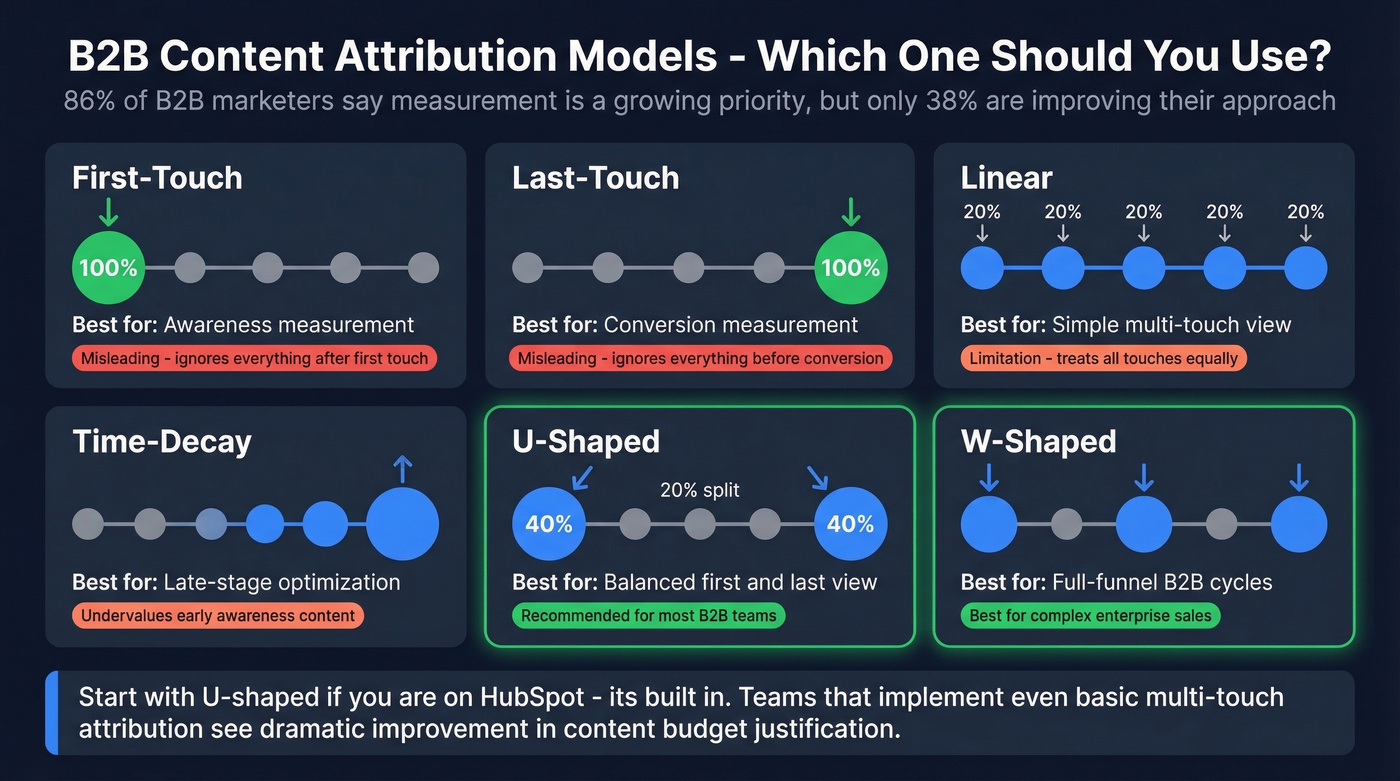
B2B buying cycles involve dozens of touchpoints across months. A buyer reads a blog post in January, attends a webinar in March, downloads a comparison guide in May, and requests a demo in June. Which touchpoint gets credit?
| Model | How It Works | Best For | Limitation |
|---|---|---|---|
| First-touch | All credit to first touch | Awareness measurement | Ignores everything after |
| Last-touch | All credit to final touch | Conversion measurement | Ignores everything before |
| Linear | Equal credit, all touches | Simple multi-touch view | Treats all touches equally |
| Time-decay | More credit to recent touches | Late-stage optimization | Undervalues early content |
| U-shaped | 40% first, 40% last, 20% middle | Balanced first/last view | Arbitrary weight split |
| W-shaped | Weights first, lead, opportunity | Full-funnel B2B cycles | Complex to implement |
For most B2B teams, U-shaped or W-shaped gives the most honest picture. First-touch and last-touch are easy to implement but actively misleading - they'll tell you blog posts don't work because they're rarely the last touch, or that demo pages are your best content because they're always the last touch. In our experience, teams that implement even a basic U-shaped model see a dramatic improvement in content budget justification. If you're running HubSpot, this is built in. Start there.
Build your KPI framework by funnel stage: ToFU measures traffic and impressions, MoFU measures MQLs and engagement depth, BoFU measures pipeline influenced and revenue attributed. If you're only measuring traffic, you'll eventually conclude that content doesn't drive revenue - even when it does.
3 Mistakes That Kill Pipeline
Teams can publish consistently and still see zero measurable leads. The issue is almost always one of these three problems.
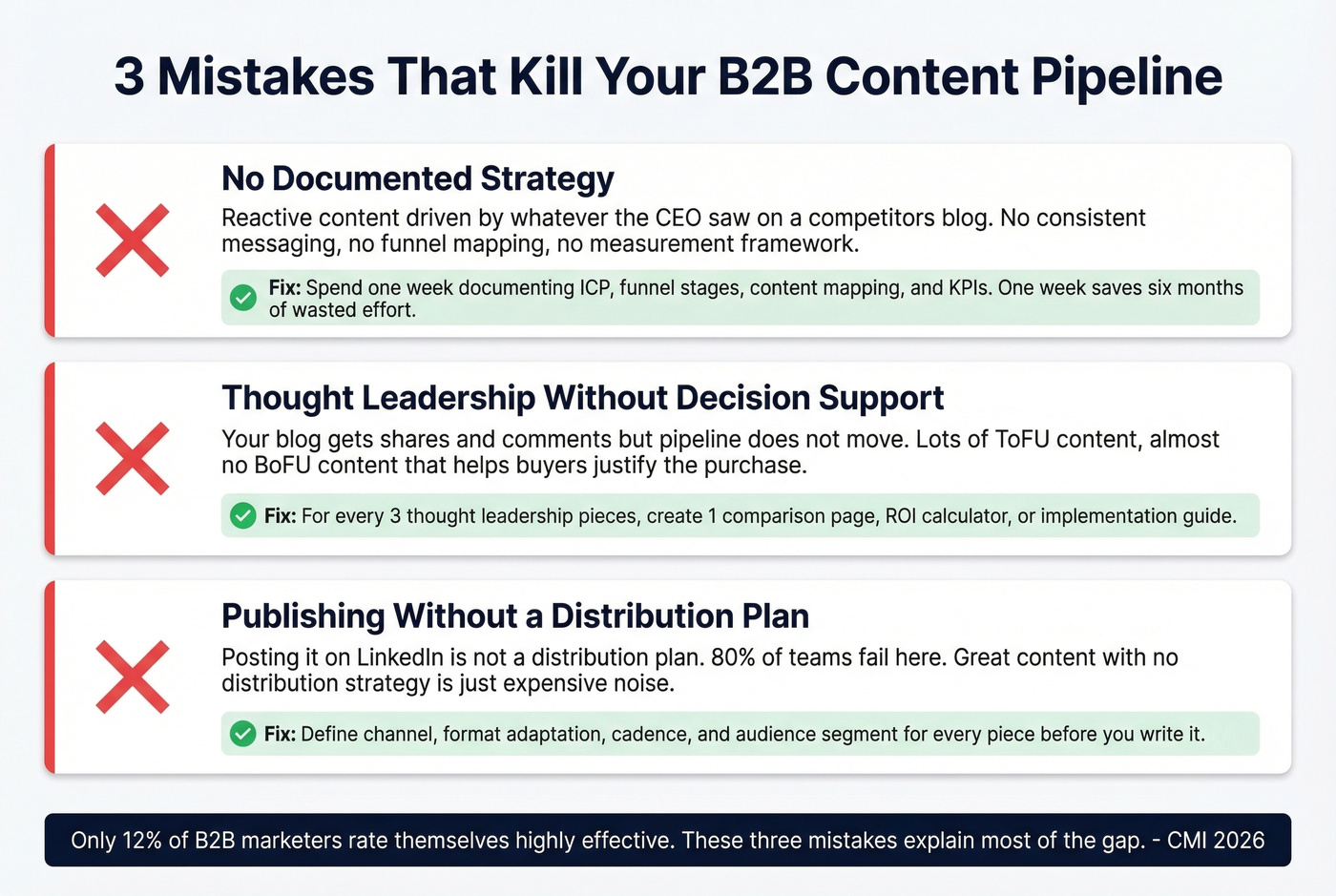
Mistake 1: No documented strategy. Reactive content driven by whatever the CEO saw on a competitor's blog. No consistent messaging, no funnel mapping, no measurement framework. Spend one week documenting your ICP, funnel stages, content-to-stage mapping, and KPIs. One week saves six months of wasted effort.
Mistake 2: Thought leadership without decision support. Your blog gets shares and comments, but pipeline doesn't move. We've seen this pattern repeatedly - teams with 200+ blog posts and zero comparison pages. For every thought leadership piece, create a companion BoFU asset: a comparison page, an ROI calculator, or an implementation guide with a 30-60-90 day rollout plan.
If you need a template for that rollout plan, use a 30-60-90 day plan structure and adapt it to implementation.
Mistake 3: Audience-journey mismatch. A security leader needs risk and compliance data. A RevOps buyer needs integration details. A finance stakeholder needs TCO and payback period. One blog post can't serve all three. Tag every piece by persona AND funnel stage. When a piece tries to serve more than two personas, split it.
Real Examples With Numbers
SAP "Inspire the Future" generated EUR 924.4M in pipeline and EUR 266.15M in projected revenue. It drove 48% higher engagement than SAP's other social campaigns and pulled 10,000+ YouTube views within 30 days for industry-specific videos. The principle applies at any scale: content tied to specific audience segments with clear distribution outperforms generic publishing every time.
SaaS whitepaper campaign: A mid-market SaaS company ran a whitepaper-to-webinar-to-nurture sequence with lead scoring. Results: 40% increase in qualified leads over six months, 80% webinar attendance rate with 50% converting to high-quality leads, and a 25% increase in sales pipeline. Nothing revolutionary about the format - the execution was what mattered.
Huler SEO guide: A single comprehensive guide generated roughly 300,000 impressions over 12 months and ranks page 1. One piece. No paid promotion. That's the compounding power of well-researched, well-optimized content in a specific niche.
FAQ
Is B2B content marketing worth it for small companies?
Yes - effectiveness is driven by content relevance, team skills, and sales alignment, not headcount or budget. Start with one blog post per week, one email newsletter, and LinkedIn repurposing of your best-performing pieces. Consistency beats volume at every company size.
How long until content generates pipeline?
Expect 6-12 months for meaningful SEO-driven pipeline in competitive B2B categories. Paid distribution and direct email outreach with verified contact data can accelerate results - you don't have to wait for Google to index your content before getting it in front of buyers.
What's the single best B2B content format?
Case studies are the most reliable MoFU/BoFU asset for influencing pipeline, while original industry studies generate the most backlinks and long-term organic traffic. The best programs invest in both - case studies for conversion, research for compounding visibility.
How do you measure B2B content marketing ROI?
Use a U-shaped or W-shaped attribution model that credits both first-touch awareness content and last-touch conversion content. Track ToFU by traffic, MoFU by MQLs and engagement depth, and BoFU by pipeline influenced and revenue attributed. HubSpot has this built in natively.
You just read that 45% of effective teams credit sales alignment for their results. That alignment starts with shared data. Prospeo gives your content and sales teams the same 300M+ profile database with 98% email accuracy, so the ICPs you write for are the same prospects your reps are calling.
Align content strategy with real pipeline data - not guesswork.