

Product-Led Growth Examples With Real Numbers (2026)
Your CEO just came back from a SaaS conference buzzing about product-led growth. "Slack did it. Calendly did it. We should do it." Cool. But nobody at that conference mentioned that Slack spent $233M on sales and marketing the year it went public, or that the average free-to-paid conversion rate across PLG companies is a brutal 9%. Every product-led growth examples article lists the same six logos and calls it a strategy. This one shows you the math.
The Short Version
PLG works when time-to-value is under 5 minutes and activation is intentionally designed. Elite companies hit 15-25% free-to-paid conversion by obsessing over activation - yet only 34% of PLG companies actually track activation at all. Study Calendly for viral distribution, Figma for collaboration-driven adoption, and Prospeo for self-serve B2B data done right.
What PLG Actually Is (and Isn't)
Product-led growth means the product itself drives acquisition, conversion, and expansion. Users sign up, experience value, and upgrade - ideally before a salesperson ever gets involved. Blake Bartlett at OpenView coined the term back in 2016, and it's gone from buzzword to default operating model for most of SaaS.
Here's the thing: PLG isn't freemium. Freemium is one pricing model within PLG. You can run a product-led motion with a free trial, a reverse trial, or even a self-serve paid tier with no free option at all. A scan of 474 Series A startups found that 39% enable self-serve, but only 25% offer a free tier. PLG means users can start using the product without talking to sales. It doesn't mean "free."
The adoption numbers tell the story. 58% of B2B SaaS companies now report having a PLG motion, and 91% plan to increase their investment. Nearly half plan to double it.
PLG Benchmarks That Matter
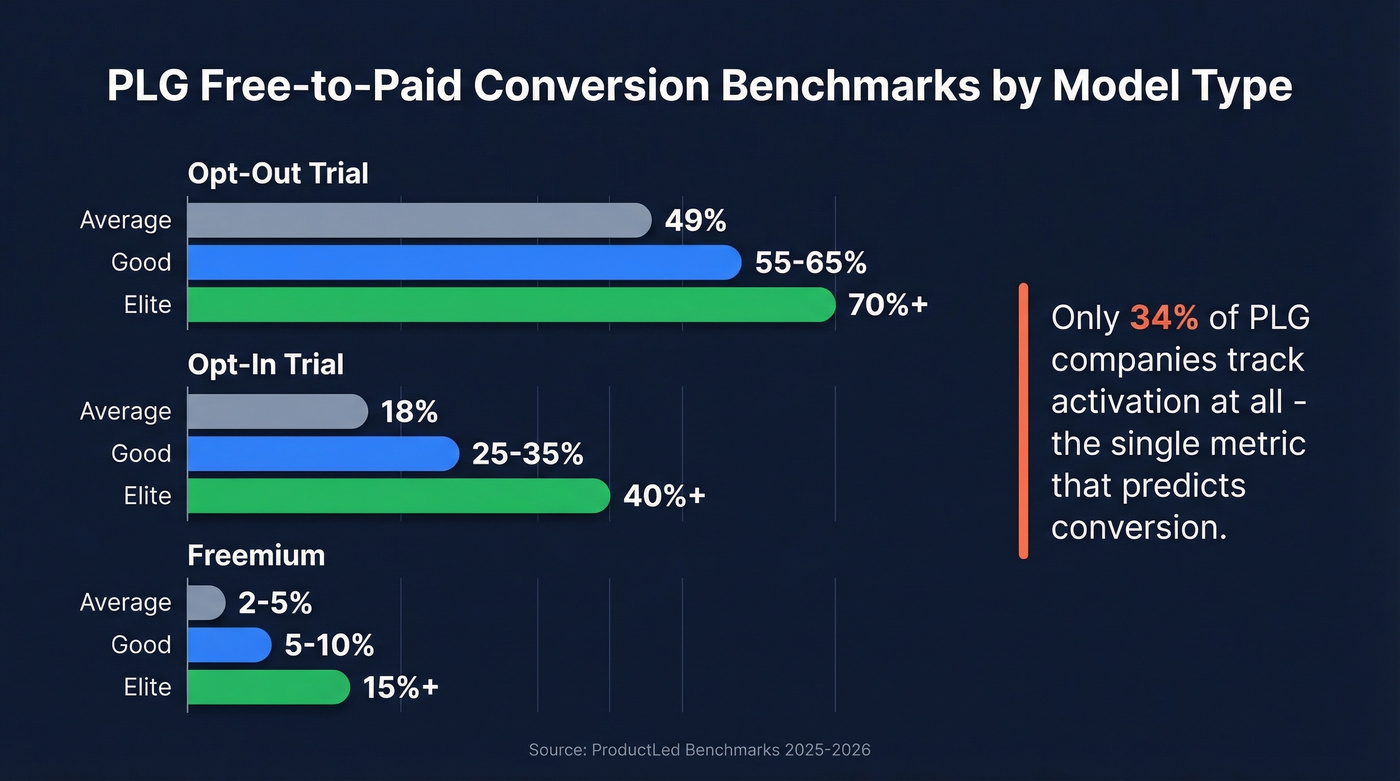
Most PLG articles throw around conversion rates without context. A 5% free-to-paid rate is terrible for an opt-out trial and excellent for freemium. Here's the breakdown that actually helps you set targets.
| Metric | Average | Good | Elite |
|---|---|---|---|
| Activation rate | 20-30% | 40-60% | 70%+ |
| Free-to-paid (opt-in trial) | ~18% | 25-35% | 40%+ |
| Free-to-paid (opt-out trial) | ~49% | 55-65% | 70%+ |
| Free-to-paid (freemium) | 2-5% | 5-10% | 15%+ |
| PQL-to-paid conversion | ~25% | 30% | 39% |
| Expansion as % of new revenue | 15-20% | 30-40% | 40%+ |
PQL benchmarks are segmented by ACV: 30% at $1K-$5K, 39% at $5K-$10K.
The number that should scare you: only 34% of PLG companies track activation at all. They're running a product-led motion without measuring the single metric that predicts conversion. That's like running paid ads without tracking clicks.
Two more benchmarks worth internalizing. Freemium models convert visitors at ~140% higher rates than free trials at the top of funnel, even though freemium free-to-paid conversion is typically lower than trial conversion. PQLs convert roughly 3x better than MQLs, yet only ~24% of companies use them. The gap between knowing about PLG and executing it well is enormous - companies with intentional free models convert 57% better than those who slapped on a free tier because a competitor had one.
12 Real-World Product-Led Growth Examples
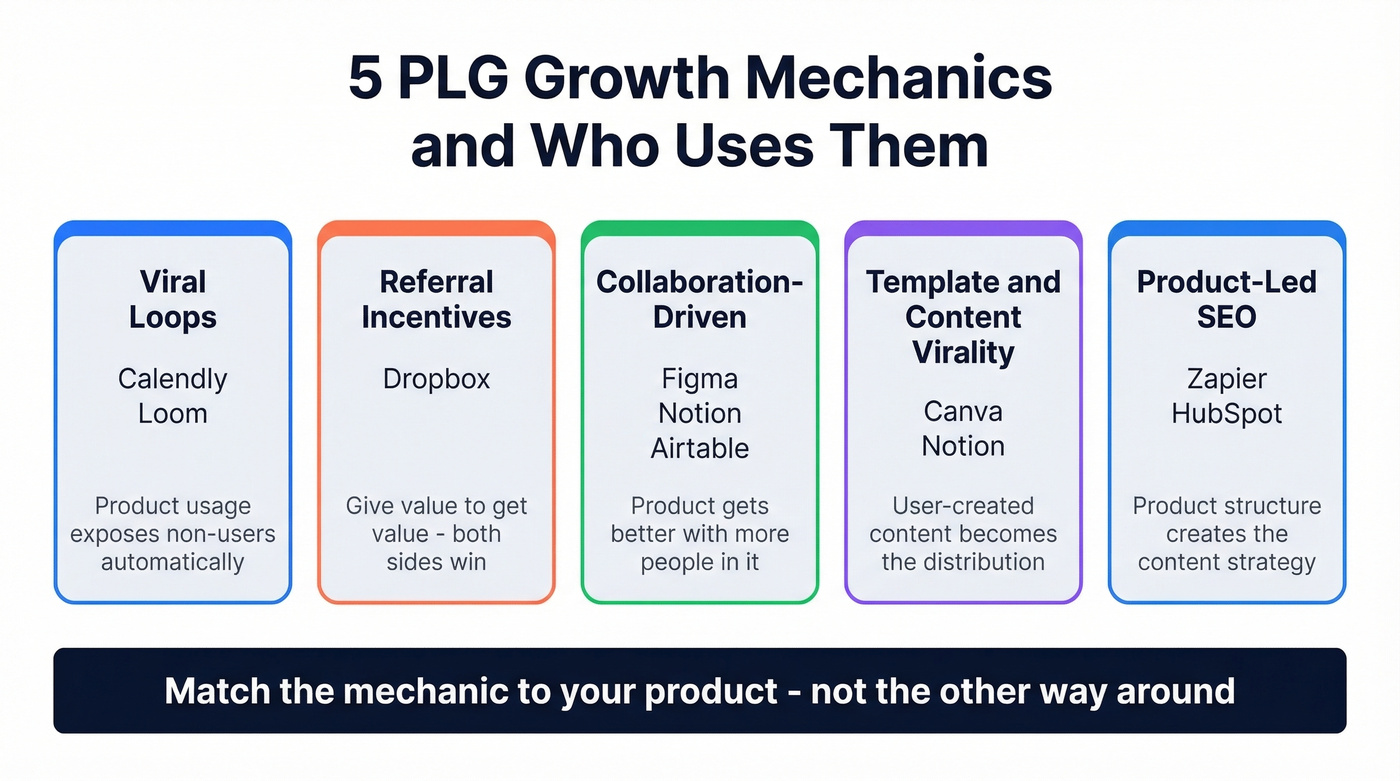
Before we get into each company, notice the patterns. PLG mechanics cluster into five types: viral loops (Calendly, Loom), referral incentives (Dropbox), collaboration-driven adoption (Figma, Notion, Airtable), template/content virality (Canva, Notion), and product-led SEO (Zapier, HubSpot). Recognizing which mechanic fits your product matters more than copying any single company's playbook.
Slack - Bottom-Up Workspace Adoption
Slack is the poster child for PLG, and also the poster child for why "PLG = no sales team" is a myth. The viral mechanic is elegant: one person creates a workspace, invites their team, and adoption spreads bottom-up across departments until IT formalizes the contract.
The numbers tell a more nuanced story. At IPO, Slack had 575 customers paying over $100K annually - and those customers represented 40% of revenue. Only 8% of revenue came from direct free-to-paid conversion. Slack's S&M spend hit $233M, or 58% of revenue, and sales headcount grew 66% year-over-year. What to steal: PLG fills the top of the funnel. Sales closes the big deals. Don't confuse the two.

Calendly - Viral Distribution via Product Usage
Calendly is the purest PLG example in existence. Every time someone sends a scheduling link, a non-user sees the product in action. The product IS the marketing. No content strategy or paid campaign can replicate the efficiency of your users doing your distribution for you, millions of times a day.
The free tier handles basic scheduling. But the genius is structural: Calendly embeds itself in the workflow of people who interact with external contacts - salespeople, recruiters, consultants - which means every meeting booked is a product impression on someone who might need the same tool. What to steal: find the moment where your product touches someone outside your user base, and make that moment effortless.
Figma - Collaboration as the Growth Engine
Make collaboration the default state of your product, not a premium feature. Every collaborator is a potential paid user.
Figma proved this by turning design files into multiplayer documents. When a designer shares a file with a PM, marketer, or engineer, those non-designers enter the product as viewers or commenters - and many eventually become editors with paid seats. The result: 37% of Figma's ARR comes from customers paying over $100K, and their sales efficiency ratio sits at a best-in-class 1.0. Free tier for individuals, paid seats for teams. We've seen this collaboration-driven pattern replicate across dozens of tools - when the product gets better with more people in it, growth compounds on itself.
Dropbox - The Referral Loop That Built a Category
Dropbox went from 100,000 users in 2008 to over 33 million by 2010. The mechanic was simple: give storage, get storage. Refer a friend, both of you get extra space. The incentive was perfectly aligned - users wanted more of the thing they were already using, and the cost to Dropbox was marginal. The referral loop has been copied a thousand times since, but Dropbox proved it at a scale that still impresses.
Zoom - Frictionless Onboarding, Enterprise Reality
Zoom's join experience - click a link, you're in a meeting - is the gold standard for zero-friction onboarding. That frictionless entry is what made it spread.
But don't mistake the entry point for the business model. Enterprise customers represent 59% of revenue. Self-serve revenue declined 7.9% year-over-year. Zoom runs a 500+ person sales organization. The free tier is a lead generation machine for the enterprise motion, not the business model itself. Skip this example if you're looking for a pure self-serve playbook.
Notion - Template-Driven Expansion
Notion's growth engine runs on user-generated content. Shared documents and workspaces expose non-users to the product, but the real flywheel is templates. Community-created templates - project trackers, wikis, CRM setups - serve as both distribution and onboarding. New users start with a template instead of a blank page, which compresses time-to-value dramatically. The template marketplace is essentially free marketing at scale. What to steal: let your users create the onboarding content. A community-built template library scales faster than any product team can.
HubSpot - Free CRM as the Wedge
HubSpot gives away the data layer and monetizes the workflow layer. The free CRM captures contacts and deal data. Once a team relies on that data, the upsell to Marketing Hub, Sales Hub, or Service Hub becomes natural. Identify the layer of your product that creates dependency, then give it away. Charge for the actions people take on top of that dependency.
Prospeo - Self-Serve B2B Data
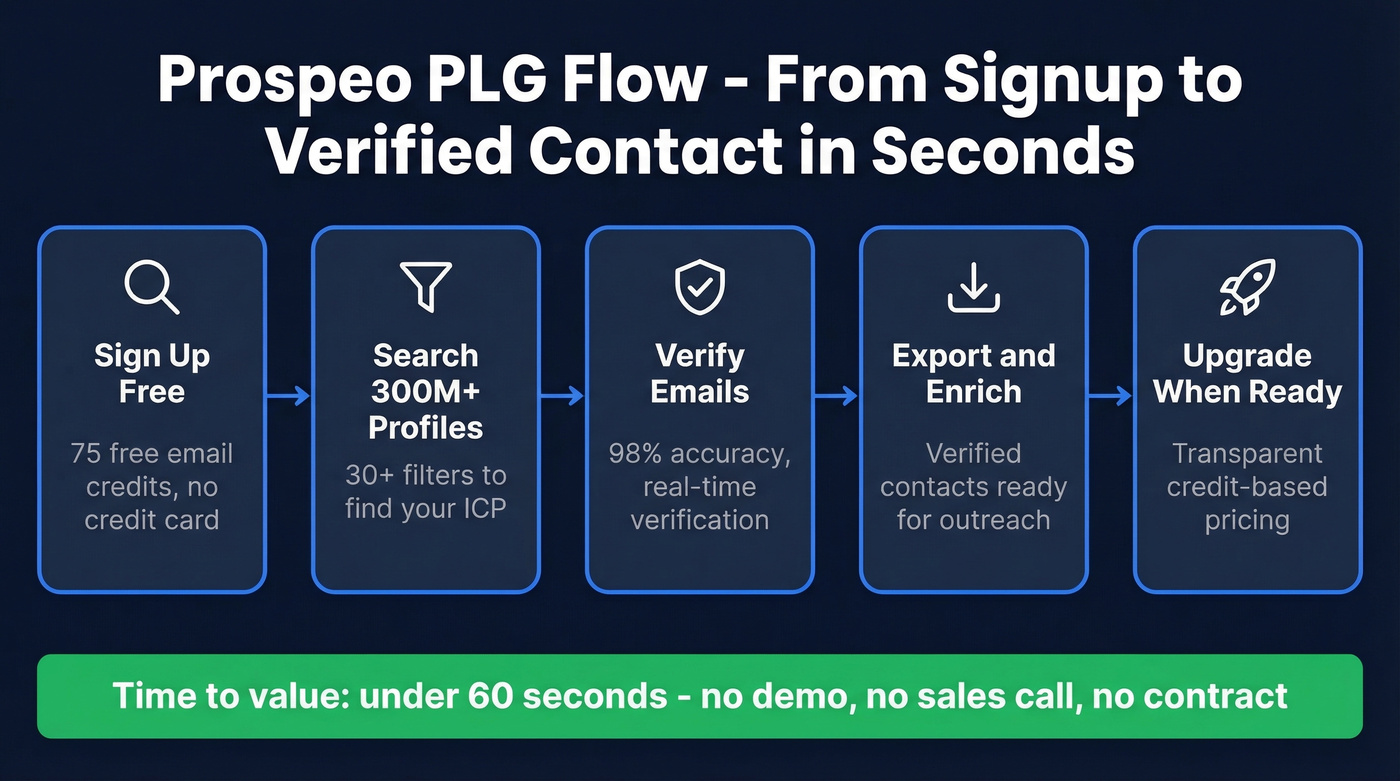
Most B2B data platforms gate everything behind a "request a demo" wall. Prospeo flips that: free tier with 75 email credits, transparent credit-based pricing, no contracts. Users sign up, search 300M+ professional profiles with 30+ filters, and verify emails at 98% accuracy - all before spending a dollar. The self-serve motion works because time-to-value is immediate: paste a URL or run a search, get verified contact data in seconds. That's PLG applied to a category that historically resisted it.
Quick Mentions
Loom - Every async video shared exposes a non-user to the product via the share player. The viewer sees "Record a Loom" and the loop continues.
Canva - Shared designs carry Canva branding on the free tier. Template virality drives signups from people who see a design and want to make their own.
Zapier - Product-led SEO at its finest. Landing pages rank for "[Tool A] + [Tool B] integration," driving organic signups at massive scale. The product's structure creates the content strategy.
Airtable - Shared bases and templates function as distribution. When someone shares an Airtable base, the recipient needs an account to interact with it - instant user acquisition baked into the workflow.

PLG companies live and die by activation speed. Prospeo delivers self-serve B2B data with 98% email accuracy, 125M+ verified mobiles, and zero sales calls required - exactly the frictionless experience PLG demands. Your reps get verified contacts in seconds, not days.
Ship your PLG motion on data that actually connects to real buyers.
What Everyone Gets Wrong About PLG
The biggest misconception in SaaS right now is that PLG means you don't need a sales team. The actual numbers demolish this.
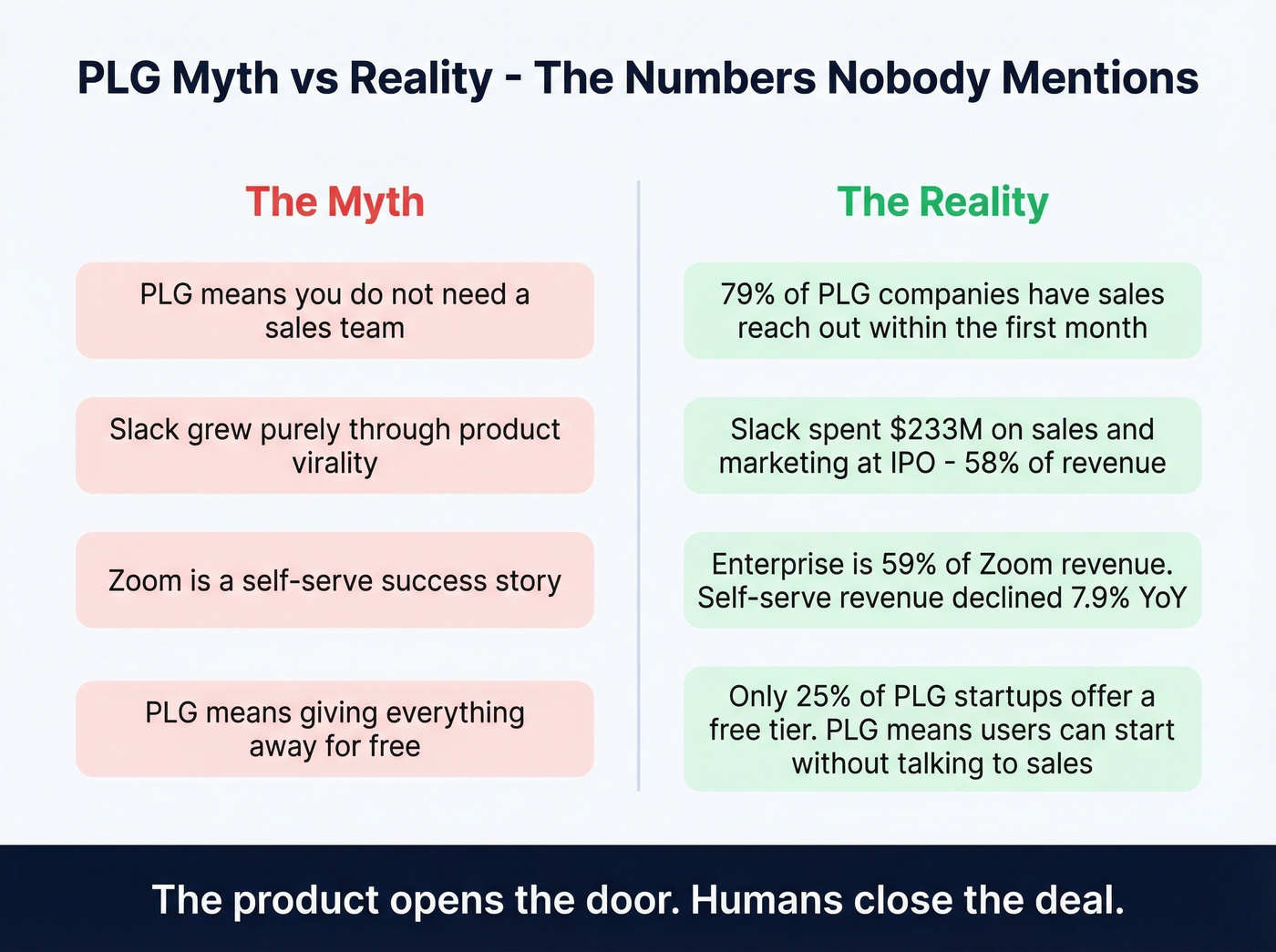
Slack spent $233M on sales and marketing the year it went public. Zoom runs a 500+ person sales organization and derives 59% of revenue from enterprise accounts. Figma generates 37% of ARR from customers paying over $100K. These aren't exceptions. 79% of companies with a free trial or freemium model have sales reach out to users within the first month.
The reality is a hybrid model, and the breakpoint is ACV:
| ACV Range | GTM Motion |
|---|---|
| Below ~$10K | Pure self-serve works |
| $10K-$50K | Inside sales assisting PLG funnel |
| $50K-$100K | Specialized sales takes over |
| Above $100K | Field sales fed by PLG pipeline |
In our experience, this breakpoint holds almost universally. Self-serve works when the product proves its value before money changes hands. But even self-serve platforms layer in sales support for larger accounts. The product opens the door; humans close the deal.
Let's be honest: if your deal sizes stay under five figures, you probably don't need ZoomInfo-level complexity in your tech stack or your go-to-market motion. A simpler product with transparent pricing will outperform a bloated platform that requires a 45-minute demo to understand.
PLG changes how you sell, not whether you sell. If your board thinks PLG means cutting the sales budget, show them Slack's S-1.
Why Most PLG Attempts Fail
Five failure modes kill PLG motions before they generate meaningful revenue.
Confusing PLG with "having a free trial." An unintentional free model - one that exists because a competitor has one, not because it's designed to convert - performs 57% worse on free-to-paid conversion than an intentional one. "We added a free tier" isn't a strategy.
Not tracking activation. Only 34% of PLG companies measure activation rate. If you don't know what percentage of signups reach your product's core value moment, you're optimizing blind. This is the single most important metric in PLG, and two-thirds of teams ignore it.
Slow time-to-value. Top PLG companies deliver value in under 5 minutes. If your onboarding takes 30 minutes of configuration before a user sees anything useful, you've already lost most of them. Every extra step is a drop-off point. We've seen teams triple their activation rate just by cutting onboarding from 8 steps to 3.
Blank states and generic onboarding. New users who land on an empty dashboard don't know what to do next. Templates, demo data, and guided flows fix this. Keep onboarding to 3-5 steps max - role-based onboarding drives 20-30% higher conversion than one-size-fits-all flows. As one practitioner put it on r/SaaS: "PLG is not a buzzword - it's exactly how you measure whether your product can sell itself."
Ignoring the 48-hour window. Users who activate within 48 hours of signup convert 3-5x more often than those who don't. If your onboarding emails fire on day 3, you've missed the window. Front-load your activation nudges.
The Business Case in One Table
If the failure modes don't convince you to get intentional about PLG, the economics will.
| Metric | With Self-Serve Revenue | Without |
|---|---|---|
| Profitability rate | 68% | 36.4% |
| Free-to-paid conversion | +25.9% higher | Baseline |
| Time-to-value | +18.3% faster | Baseline |
| Overall performance lift | +14.5% | Baseline |
| Revenue per employee | $300K+ | Under $100K |
Data from a large-scale PLG benchmark dataset analyzing 446 B2B SaaS companies.
The biggest gains come from moving from $0 to $100K-$500K in self-serve revenue. You don't need to be Slack-scale. Even modest self-serve revenue correlates with nearly double the profitability rate and dramatically higher revenue per employee.
How to Build Your PLG Motion
Five steps, each with a benchmark to hit.
Design an intentional free model. Decide whether you're running freemium, opt-in trial, opt-out trial, or reverse trial - and design it deliberately. 75% of PLG companies start with free trial or freemium. Intentional models convert 57% better than accidental ones.
Optimize time-to-value under 5 minutes. Map your user's first session. What's the fastest path to the core value moment? Cut everything else. If it takes more than 5 minutes, you're losing the majority of signups.
Track activation rate - target 40%+. Define your activation event: the action that correlates with retention. Instrument it. Optimize relentlessly. Average is 20-30%, good is 40-60%. You can't improve what you don't measure.
Implement PQLs. Only ~24% of PLG companies use product-qualified leads, but those that do see ~3x higher conversion rates. A PQL is a user whose product behavior signals buying intent - define yours and route them to sales.
Plan the hybrid motion early. Decide your ACV breakpoint. Below $10K, let self-serve run. Above that, layer in sales. In our experience, waiting until you're losing enterprise deals to figure this out costs you 6-12 months of pipeline.
The best PLG examples above share one trait: they remove friction from the first experience. Prospeo does the same for outbound - 300M+ profiles, 30+ filters, and $0.01 per email with no contracts. Self-serve onboarding in under 5 minutes, the same time-to-value bar elite PLG companies set.
Stop gating your sales data behind enterprise contracts.
FAQ
What's the difference between PLG and freemium?
PLG is a go-to-market strategy where the product drives acquisition, activation, and expansion - freemium is just one pricing model within it. You can run a product-led motion with a free trial, reverse trial, or self-serve paid tier. 39% of PLG startups enable self-serve without offering a free plan at all.
What's a good free-to-paid conversion rate?
The average across all free models is 9%, but the model type matters enormously. Opt-in free trials convert ~18%, opt-out trials ~49%, and freemium models 2-5%. Best-in-class PLG companies with intentional free models hit 15-25%.
Can PLG work for high-ACV products?
Below ~$10K ACV, pure self-serve works well. Between $10K-$50K, most companies add inside sales to assist the funnel. Above $50K, PLG feeds the pipeline but field sales closes. Slack, Zoom, and Figma all run hybrid motions for enterprise - and that's where most of their revenue originates.
What are the most common PLG mechanics?
The five patterns across successful product-led growth examples are viral loops (Calendly, Loom), referral incentives (Dropbox), collaboration-driven adoption (Figma, Airtable), template virality (Notion, Canva), and product-led SEO (Zapier, HubSpot). Most companies combine two or three rather than relying on one.