

How Verifying an Email Address Actually Works - And Why Tools Get It Wrong
You just sent 12,000 cold emails. By morning, your ESP flags an 8% bounce rate and threatens to throttle your domain. The "verified" list you bought last quarter? Not as verified as you thought. (If you're buying lists, read: email list providers and Is It Illegal to Buy Email Lists?.)
Verifying an email address involves more than a green checkmark. Here's what actually happens when a tool checks an address, and where the process breaks down.
The Short Version
Verifying an email address means checking syntax, DNS/MX records, and SMTP responses - but 30-40% of B2B domains are catch-all, so "unknown" results are normal, not a bug. Keep your bounce rate under 2%. Above 5% and your ESP will throttle you. (More on this in our email deliverability guide and email bounce rate breakdown.)
Best tools by use case: ZeroBounce for standalone accuracy, MillionVerifier for budget bulk jobs, Prospeo for verification built into prospecting so you skip the cleanup step entirely.
What Email Verification Actually Checks
Every verification tool runs the same basic pipeline, whether it costs $0.0003 or $0.008 per email. The difference is what happens after the basics.
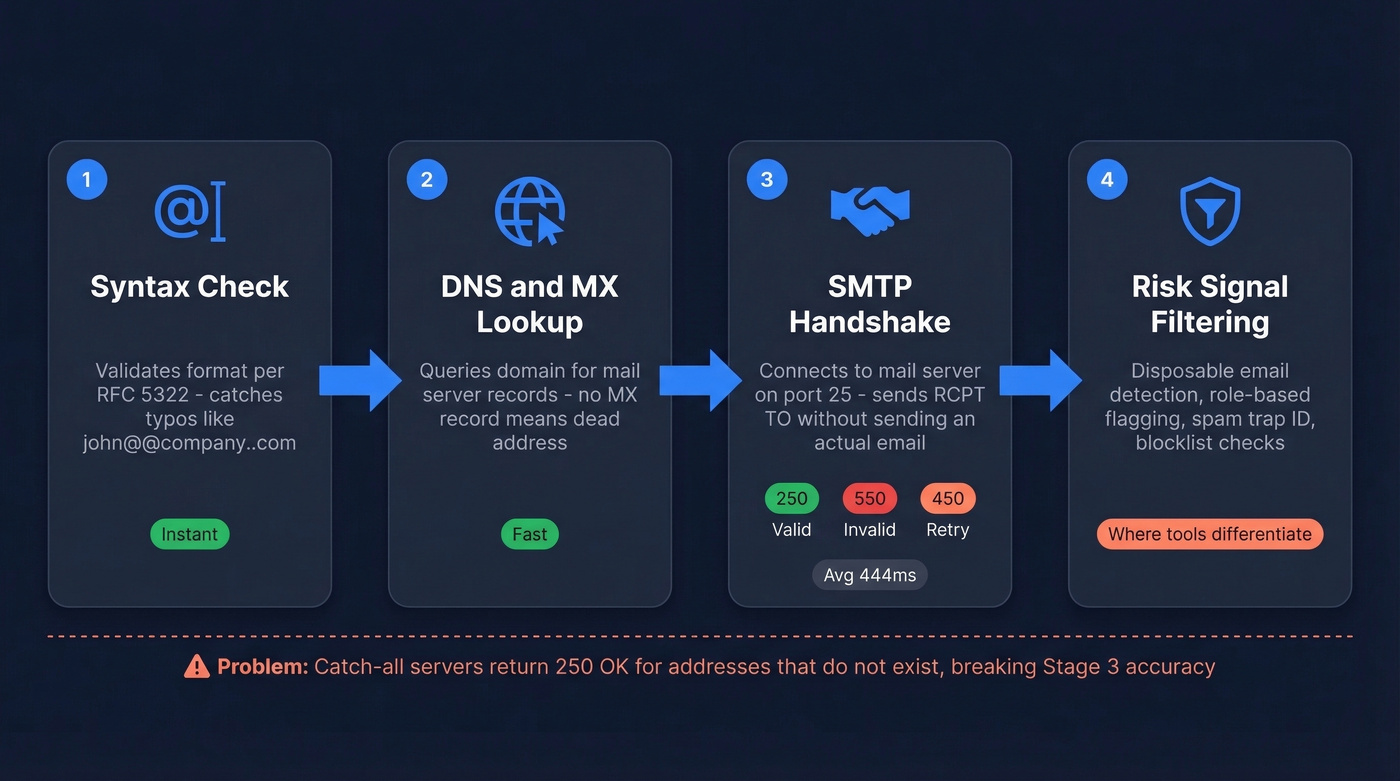
Stage 1: Syntax check. The tool confirms the address follows standard format rules (RFC 5322 / RFC 5321) - valid characters, an @ symbol, a properly structured domain. This catches typos like "john@@company..com" instantly. Trivial, but it filters obvious junk.
Stage 2: DNS and MX lookup. The tool queries DNS for the domain's MX records to confirm it actually receives email. No MX record means no mail server, and the address is dead. This stage also catches typo domains - "gmial.com" instead of "gmail.com."
Stage 3: SMTP handshake. Here's where it gets interesting. People assume the tool sends an actual email. It doesn't. The tool opens a connection to the mail server on port 25, sends a HELO/EHLO command, then a MAIL FROM and RCPT TO with the target address. The server responds with a code: 250 means accepted, 550 5.1.1 means "no such user," and 450 means temporary failure. The whole exchange takes milliseconds - Email Hippo reports a 444ms average API response time, with throughput benchmarks around 10,000 requests per hour per IP.
Stage 4: Risk signal filtering. Good tools layer on disposable email detection, role-based address flagging (info@, support@), spam trap identification, and blocklist cross-referencing. This is where tools differentiate themselves, and where cheap verifiers cut corners. (If you’re cleaning lists after deliverability issues, see spam trap removal and email reputation tools.)
The problem? Some mail servers don't follow protocol. They return 250 OK for addresses that don't exist.
The Catch-All Problem
Here's the thing: 30-40% of B2B email domains are configured as catch-all. The server accepts every email sent to the domain, regardless of whether the mailbox exists. Your verification tool sends RCPT TO for "totallyFakeAddress@bigcorp.com," gets a 250 OK, and marks it as valid.
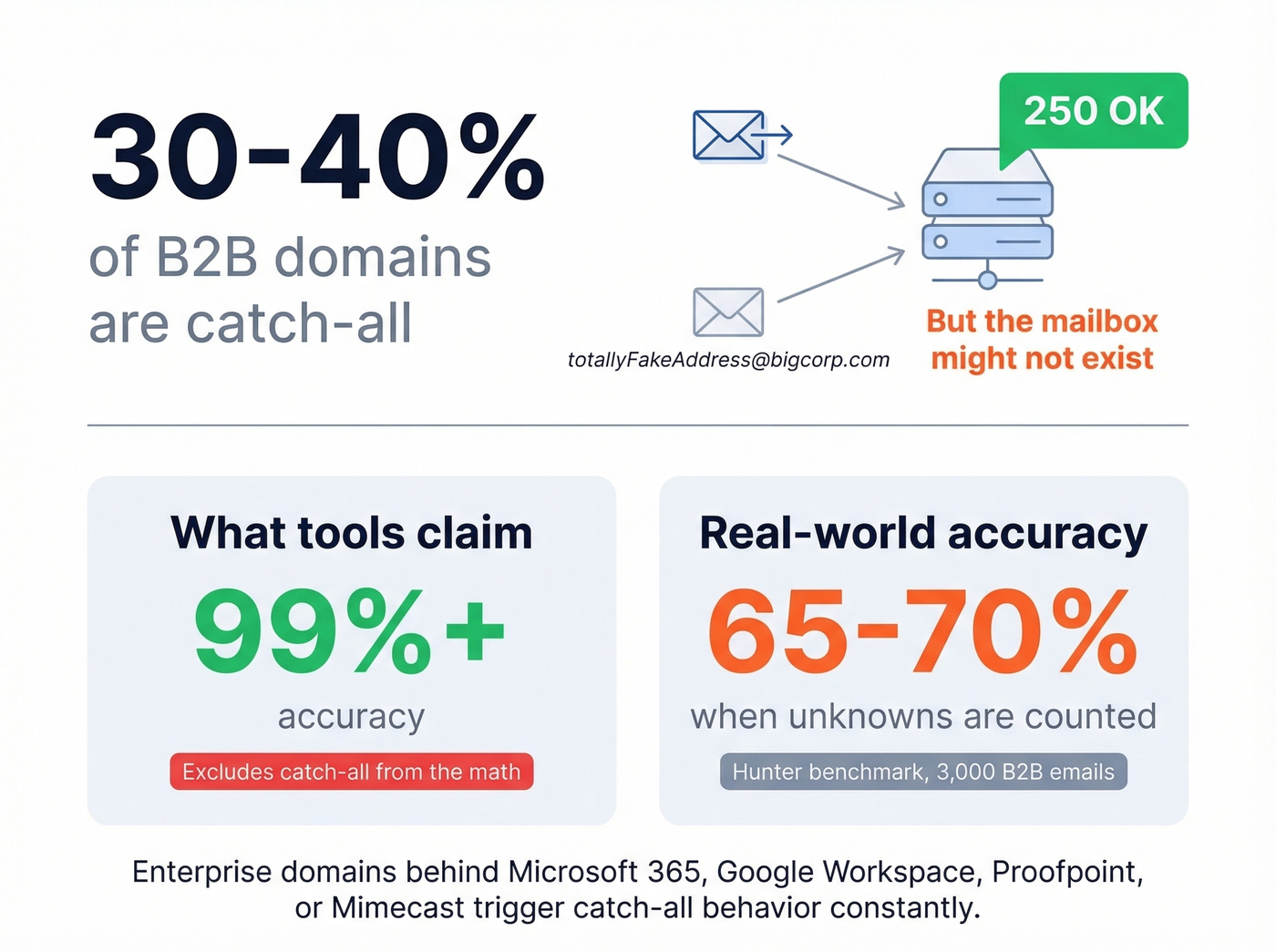
This is the most common complaint we hear from outbound teams: they verified a list, sent the campaign, and still hit 4% bounces because half the list was catch-all. Enterprise environments running Microsoft 365 or Google Workspace behind Proofpoint or Mimecast trigger this behavior constantly. A Hunter benchmark testing 3,000 real business emails showed overall accuracy landing around 65-70% for top tools when unknown/accept-all results were counted against the score.
Any tool claiming 99%+ accuracy on B2B lists is either excluding catch-all domains from their math or lying. The best tools resolve some catch-alls through proprietary heuristics, but nobody's cracked this completely. In our testing, catch-all domains consistently produced the most unreliable results regardless of which verifier we used. (If you want a deeper verifier landscape, see Bouncer alternatives and our AI email checker guide.)

Prospeo's 5-step verification catches what other tools miss - including catch-all domains, spam traps, and honeypots. At 98% email accuracy with a 7-day data refresh, you skip the export-verify-reimport cycle entirely.
Stop cleaning lists. Start with clean data at $0.01 per email.
Why Verified Emails Still Bounce
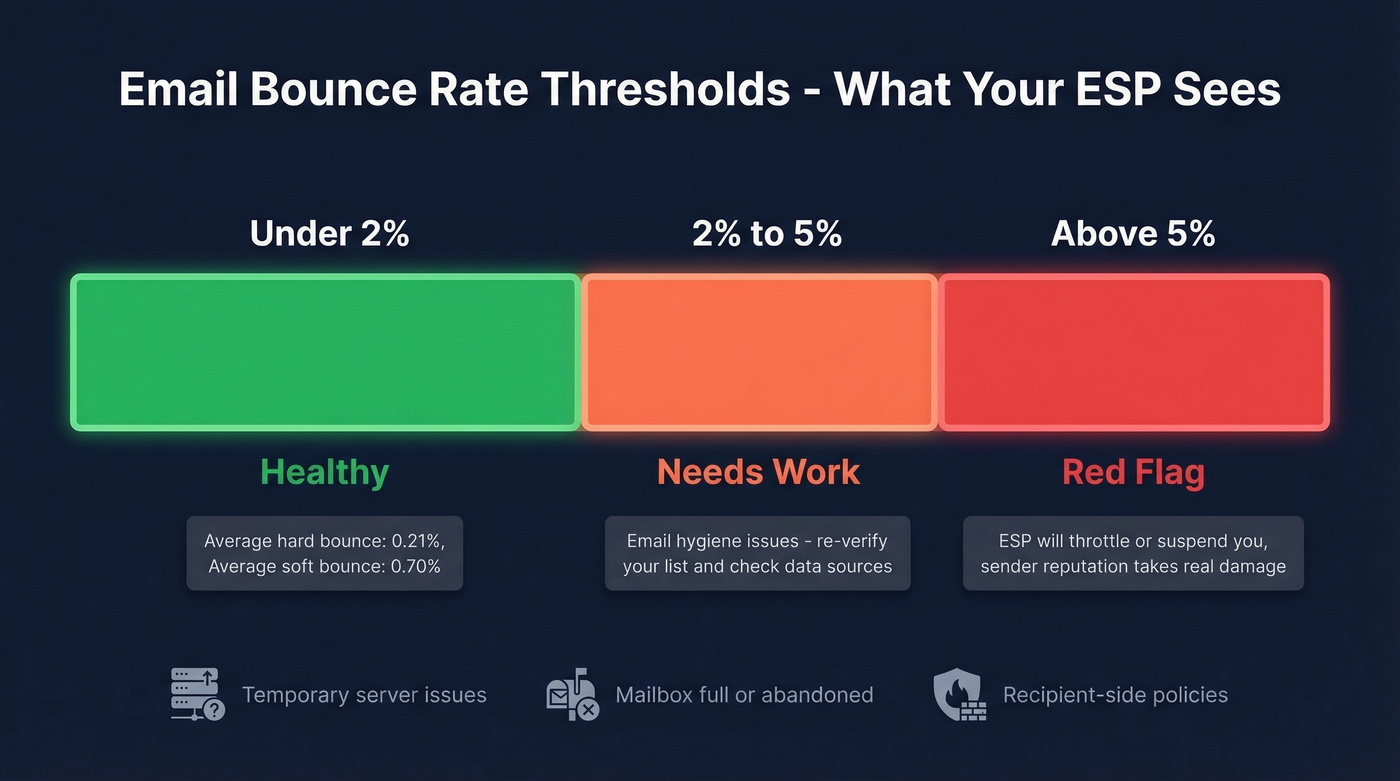
Even a perfectly verified email can bounce. Average hard bounce rates sit around 0.21% and soft bounces around 0.70%. Three common reasons:
- Temporary server issues. The recipient's mail server was up during verification but down when you sent.
- Mailbox full or abandoned. The address exists but nobody's home - common with employees who've left but whose accounts linger for months.
- Recipient-side policies. Corporate firewalls, content filters, or rate limits that block your message regardless of address validity.
The threshold that matters: under 2% bounce rate is healthy. Between 2-5% means your email hygiene needs work. Above 5% is a red flag - your ESP will throttle or suspend you, and your sender reputation takes real damage. (If you’re scaling sends, also track email velocity.)
When to Use Each Verification Method
Single verification works when you're manually adding contacts or checking a handful of addresses before high-stakes outreach. Skip it if you have more than 50 addresses - you'll burn time you don't have.
Bulk verification is what you want before large campaigns, before warming up a new domain, after long sending pauses, and during data migrations. Expect 18-35 minutes for 10,000 emails. Good tools retry greylisted addresses automatically with 15-30 minute exponential backoff delays. Skip it if your data source already runs verification on output.
API verification fits real-time checks in signup forms, CRM workflows, or prospecting tools. Many APIs cache results briefly (Emailable caps cache at 5 minutes, for example) to balance freshness with speed. Skip it for one-off list cleans. (If you’re building outbound systems, see cold email API.)
Let's be honest about the fastest workflow, though: it skips standalone verification entirely. When your prospecting tool verifies emails before they ever reach your list, you eliminate the "export, upload to verifier, download, re-import" dance that eats an hour every campaign. (This is also why teams invest in outbound lead generation tools instead of point solutions.)
Tool Comparison for 2026
Here's how the tools stack up, anchored to a 10,000-email benchmark test run across real B2B outbound data.
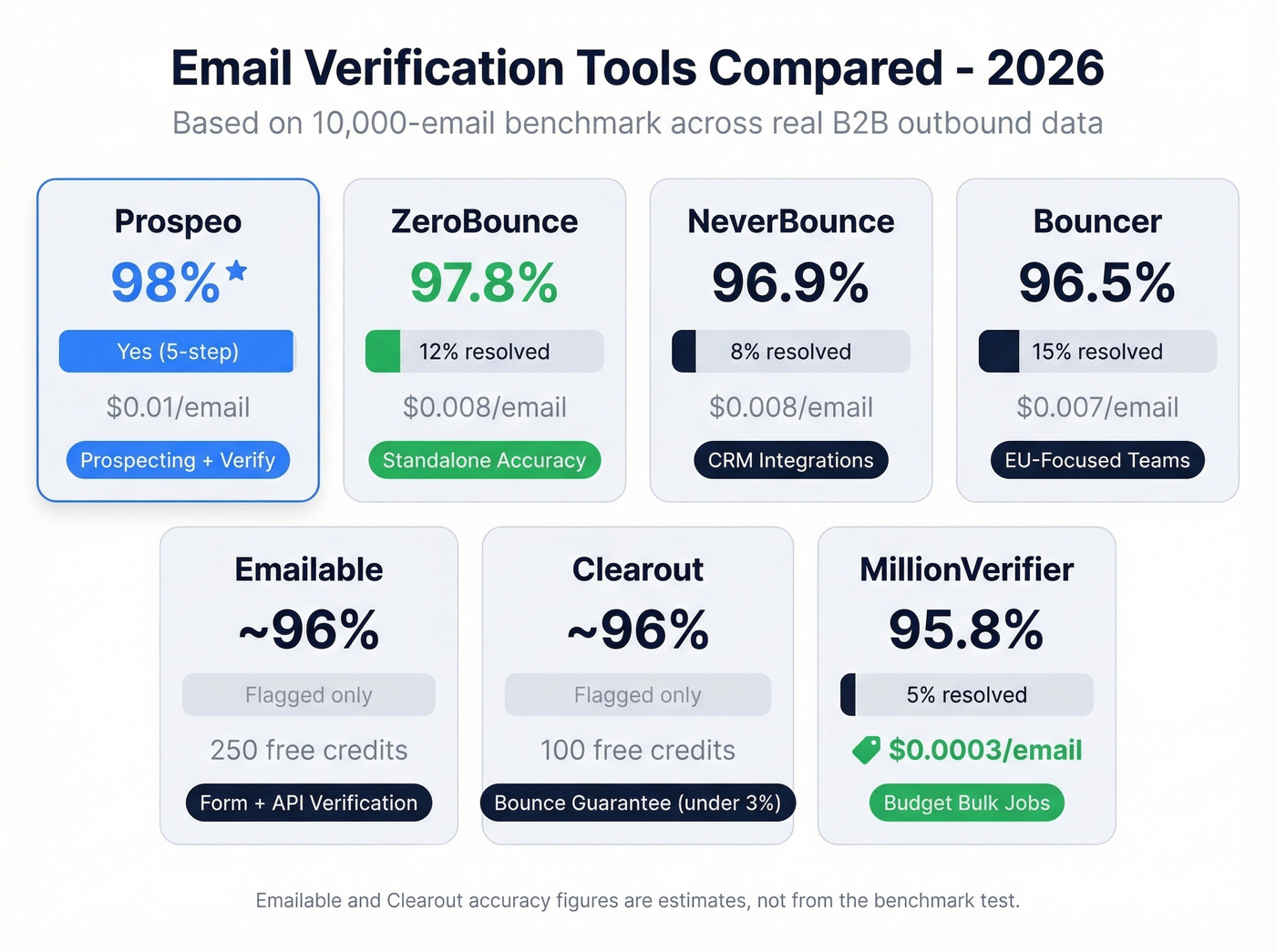
| Tool | Accuracy | Catch-All Handling | Cost/Email | Best For |
|---|---|---|---|---|
| Prospeo | 98% | Yes (5-step) | ~$0.01 (75 free/mo) | Prospecting + verify |
| ZeroBounce | 97.8% | 12% resolved | $0.008 (100 free/mo) | Standalone accuracy |
| NeverBounce | 96.9% | 8% resolved | $0.008 (1K free trial) | CRM integrations |
| MillionVerifier | 95.8% | 5% resolved | $0.0003 | Budget bulk jobs |
| Emailable | ~96% | Flagged only | 250 free credits | Form + API verification |
| Clearout | ~96% | Flagged only | 100 free credits | ≤3% bounce guarantee |
| Bouncer | 96.5% | 15% resolved | ~$0.007 | EU-focused teams |
Emailable and Clearout accuracy figures are estimates - they weren't included in the 10K benchmark.
ZeroBounce is the gold standard for standalone verification. In the benchmark, it hit 97.8% accuracy with the lowest false-positive rate (0.9%) and resolved 12% of catch-all addresses. At $0.008/email, it's not the cheapest, but the result detail and accuracy justify the premium if email address validation is your only need.
MillionVerifier is the opposite bet - $0.0003/email means 10,000 addresses cost about $3-6. Accuracy drops to 95.8% and catch-all resolution is minimal. For massive lists where cost matters more than perfection, nothing else comes close on price. We've seen teams cut their bounce rate in half just by switching from a budget verifier to one with catch-all resolution, so know what you're trading off.
NeverBounce splits the difference at 96.9% accuracy with native CRM and ESP integrations. Bouncer is worth a look for EU-based teams - 96.5% accuracy, 15% catch-all resolution, and strong GDPR compliance. Emailable and Clearout are solid picks for real-time verification workflows, with Clearout leaning hard into its ≤3% bounce-rate positioning.
For teams running outbound prospecting, Prospeo's 5-step verification pipeline - including catch-all handling, spam-trap removal, and honeypot filtering - runs automatically when you find contacts. That means the data is already clean before it hits your CRM. At 98% email accuracy, it matched or beat every standalone verifier in our testing, and the 75 free emails per month let you test without commitment. (If you’re also enriching records, see data enrichment services.)
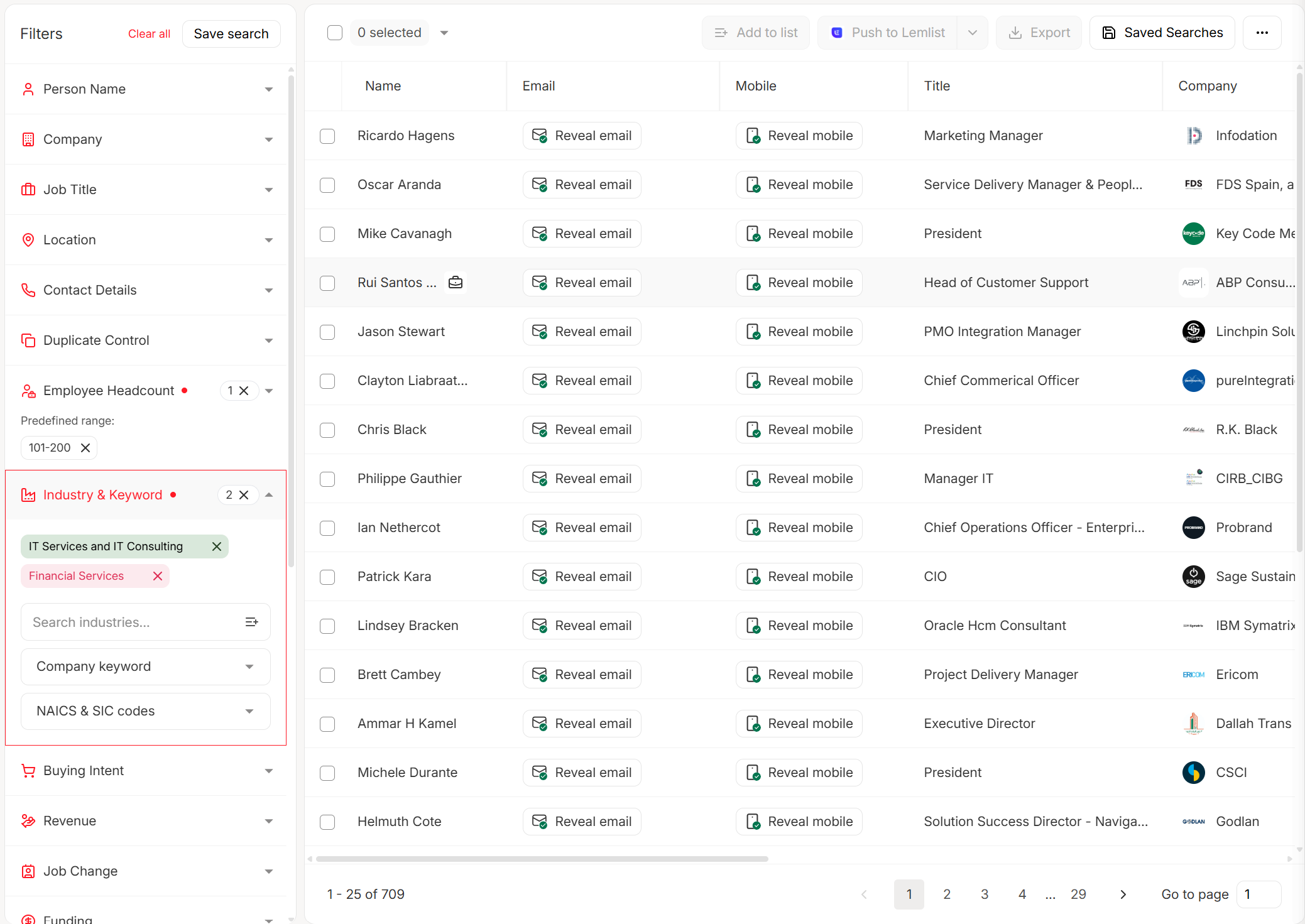
Teams using Prospeo keep bounce rates under 4% - even on catch-all-heavy B2B lists. Verification is built into every email found, so there's no second tool, no extra upload, no wasted hour per campaign.
Verification baked into prospecting. 75 free emails to prove it.
FAQ
Is verifying an email address legal?
Yes. Verification checks whether a mailbox exists - it doesn't access inbox content. The SMTP handshake is a standard protocol interaction, and no personal data is read or stored. Google's bulk sender guidelines recommend list hygiene as a best practice.
How often should I re-verify my list?
Re-verify before every major campaign and at least quarterly. Email addresses decay at roughly 2-3% per month due to job changes and domain shutdowns. A list older than 90 days will contain enough dead addresses to push you past the 2% bounce threshold.
What's the difference between verification and validation?
Nothing meaningful. Both terms refer to the same process of checking syntax, DNS, and SMTP responses. Some vendors draw a distinction for marketing purposes, but the underlying technology is identical.
What's a good free option for verifying email addresses?
Most tools offer limited free tiers: ZeroBounce gives 100 free monthly checks, Emailable offers 250 free credits, and Hunter includes 25 free lookups. Prospeo's free plan includes 75 email credits per month with full 5-step verification and catch-all handling - the strongest value for small teams running real outbound.